
How to Use Meta Ads for Shopify in 2026: The Strategy That Works
How to Use Meta Ads for Shopify in 2026: The Strategy That Works
Meta Ads remain the dominant paid acquisition channel for Shopify stores in 2026 — but the strategy that generated strong ROAS three years ago is not the same strategy that works today. The targeting landscape has shifted fundamentally since iOS 14.5, the algorithm has grown significantly more capable, and the creative formats that drive conversions have evolved in ways that catch most merchants off guard.
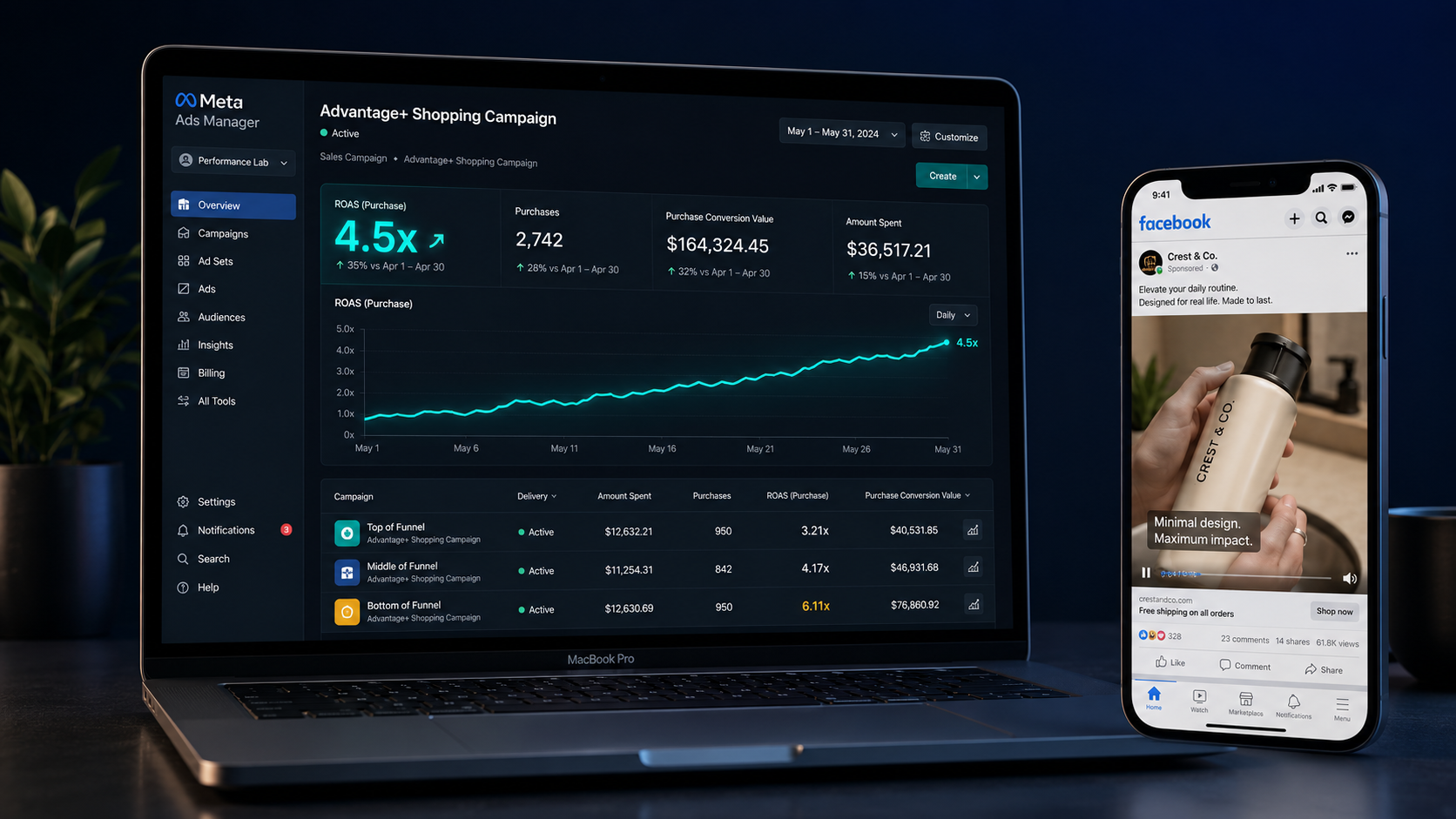
The merchants stuck in 2022-era Meta strategy are seeing rising customer acquisition costs, declining attributed ROAS, and ad creative that used to convert sitting flat. The merchants who have adapted to how Meta's AI actually works in 2026 are running leaner account structures, spending more on creative testing and less on audience micromanagement, and achieving 4.5x ROAS on Advantage+ Shopping campaigns that outperform their previous manually configured setups by 15 to 25%.
Meta Ads deliver an average ROAS of 2.79x to 3.61x across ecommerce in 2026, with Advantage+ campaigns averaging closer to 4.5x when properly structured. Retargeting campaigns specifically deliver 5x to 10x ROAS on warm audiences. The gap between those numbers and what most Shopify merchants are actually seeing is almost entirely explained by strategy, not by platform performance.
This guide covers the full-funnel Meta Ads strategy that works for Shopify stores in 2026 — from account structure and campaign setup through creative, targeting, tracking, and the measurement framework that gives you accurate performance data in a post-iOS world.
Why the Old Meta Ads Playbook No Longer Works
Before building the right strategy, understanding why the old approach stopped working prevents you from recreating the same mistakes with a new campaign structure.
The pre-iOS 14.5 Meta Ads playbook was built on precise interest and behavioral targeting. Advertisers would stack demographic filters, interest categories, and lookalike audiences with surgical specificity — "women aged 25 to 34 in the US who are interested in skincare, follow specific beauty accounts, and have recently made online purchases." The assumption was that more precise targeting equals better results.
That assumption held when Facebook had access to granular cross-app behavioral data. After iOS 14.5's App Tracking Transparency feature required explicit opt-in for cross-app tracking — and approximately 75% of iOS users opted out — that behavioral data pool contracted dramatically. Interest-based targeting lost the granularity it depended on. Lookalike audiences built from incomplete conversion data became less accurate. And platform-reported attribution became significantly less reliable as the signals Meta's algorithm used to optimize vanished behind privacy walls.
The result: 51% of marketing leaders do not trust the performance data they receive from ad platforms. Platform-reported ROAS overstates actual performance by 15 to 40% due to iOS privacy changes, conversion modeling, and cross-device behavior. And the manual targeting strategies that once delivered consistent results became increasingly unreliable as the underlying data quality declined.
The correct response to this environment is not better targeting. It is better creative, broader audience definitions, server-side tracking that bypasses iOS restrictions, and a campaign structure that lets Meta's AI optimization do the work that manual targeting once attempted to do manually.
The Full-Funnel Framework: Three Stages, Three Objectives
The fundamental strategic shift for Meta Ads in 2026 is treating the platform as a full-funnel channel rather than a pure acquisition tool. Brands that run only direct-response conversion campaigns — aiming for immediate purchase from every ad impression — consistently underperform brands that run ads across all three funnel stages with stage-appropriate objectives.
Full-funnel strategies improve ROAS by 2.7x on average compared to direct-response-only setups. The logic is straightforward: a customer who has seen your brand at the awareness stage, been warmed at the consideration stage, and is retargeted at the conversion stage converts at dramatically higher rates and lower cost than a customer seeing your brand for the first time with a hard "buy now" message.
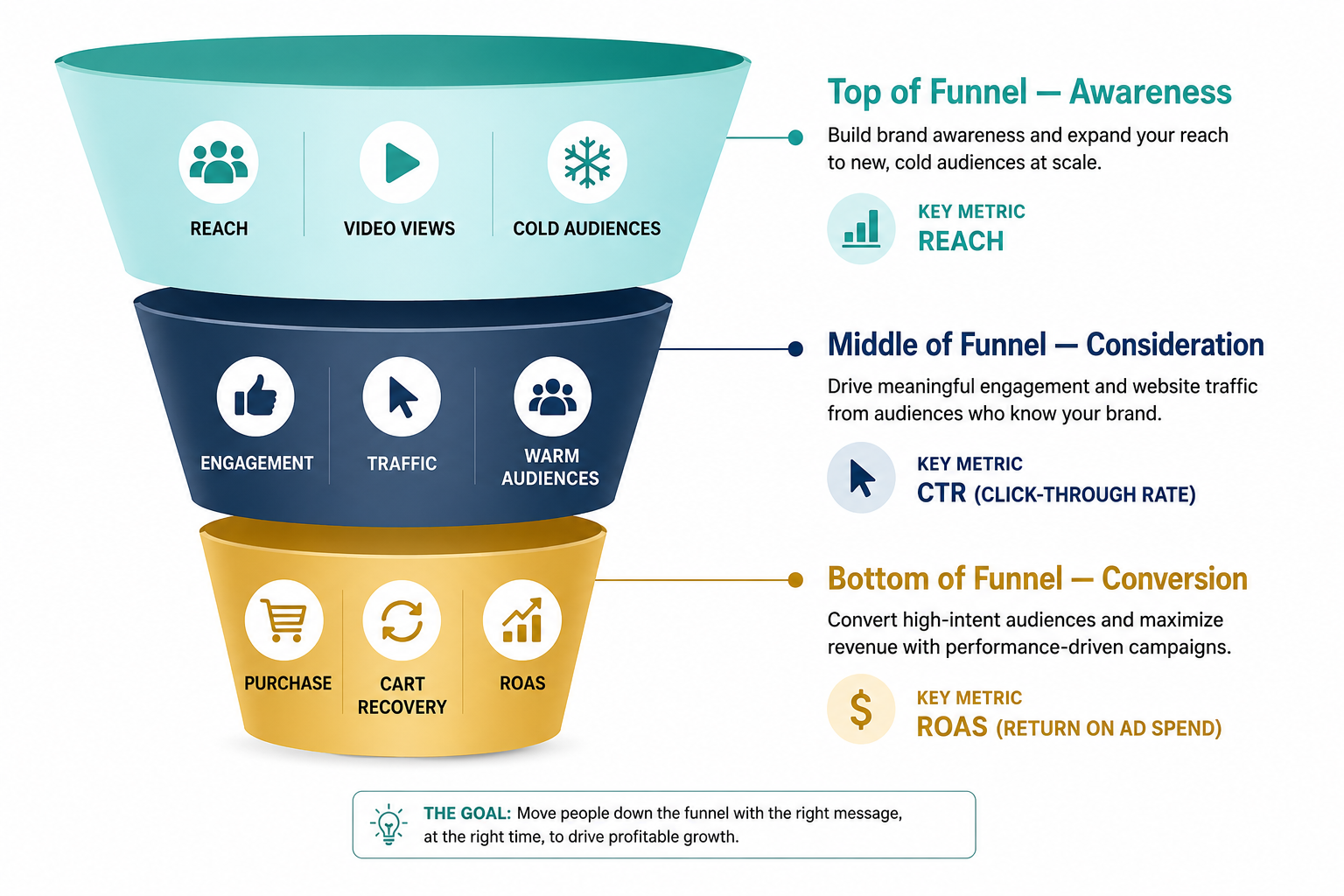
The three funnel stages each require a different campaign objective, different creative approach, and different performance metrics.
Top of funnel — awareness and discovery — uses reach and video view objectives. The goal at this stage is brand exposure to cold audiences who have never encountered your store. Success is measured by CPM, video completion rate, and brand recall lift, not by purchase conversion rate.
Middle of funnel — consideration and engagement — uses traffic and engagement objectives targeting warm audiences. These are people who have seen your top-of-funnel content, visited your website, or engaged with your social profiles. The goal is educating and warming them toward purchase intent. Success is measured by click-through rate, landing page views, and add-to-cart rate.
Bottom of funnel — conversion — uses purchase conversion objectives targeting the warmest audiences: cart abandoners, product page viewers, email subscribers, and past purchasers. This is where your highest ROAS campaigns live. Success is measured by cost per purchase, ROAS, and new customer cost.
Most Shopify stores run only bottom-of-funnel campaigns and wonder why their CPAs keep rising. Without the top and middle funnel feeding warm audiences into the bottom, you are constantly prospecting cold audiences with purchase-intent messaging — the most expensive and least effective way to run Meta Ads.
Advantage+ Shopping Campaigns: The Core of Your 2026 Strategy
Advantage+ Shopping Campaigns (ASC) represent the most significant structural change to Meta Ads strategy in the past three years, and understanding how to use them correctly is the single highest-leverage change most Shopify merchants can make to their account.
ASC is Meta's AI-driven campaign type that automates audience targeting, budget allocation, and creative optimization simultaneously. Rather than defining specific audiences, creative variations, and budget splits manually, you provide a budget, a creative pool, and a conversion objective — and Meta's algorithm finds the right people, at the right time, with the right creative, automatically.
Meta Advantage+ Shopping Campaigns average approximately 4.5x ROAS versus 3.7x for manual campaigns — a 15 to 25% lift with approximately 32% lower cost per acquisition. These are not marginal improvements. For a store spending $10,000 per month on Meta, a 25% ROAS improvement means $2,500 in additional attributed revenue from the same budget.
The recommended budget split for stores spending under $30,000 per month on Meta is 70 to 80% toward ASC with the remaining 20 to 30% reserved for manual campaign testing. This ratio reflects the reality that at this spend level, ASC's AI optimization has enough signal to outperform manual targeting in most cases, while the manual budget maintains the ability to test specific audiences, creative formats, and messaging angles that ASC may not discover organically.
For stores spending between $30,000 and $200,000 monthly, a hybrid structure works best: 55 to 65% in ASC with 35 to 45% in manual campaigns that provide audience intelligence and creative testing at a controlled spend level. Above $200,000 monthly, a 50 to 60% ASC allocation with strategic manual layering allows for incremental scale while preserving ASC's core efficiency advantages.
When setting up ASC for a Shopify store, connect your Shopify product catalog through Commerce Manager and enable catalog sales within the campaign. This allows ASC to serve dynamic product ads — automatically generating personalized creative showing each viewer the specific products they are most likely to purchase based on their browsing behavior and Meta's audience data.
One critical configuration: add a custom audience exclusion for recent purchasers — typically the past 30 to 60 days — to prevent your ASC from spending acquisition budget retargeting existing customers. This exclusion alone can reduce wasted spend by 10 to 20% in established Shopify stores with meaningful repeat customer volume.
Creative Strategy: The Variable That Drives 50 to 70% of Performance
In the Advantage+ era, creative quality has replaced targeting precision as the primary lever of Meta Ads performance. Meta's own data shows that creative drives 50 to 70% of campaign performance when ASC is handling audience optimization automatically.
This means the allocation of time, budget, and strategic attention has shifted dramatically. The hours previously spent on audience research, lookalike refinement, and manual targeting configuration now belong in creative development and testing.
The creative formats that consistently outperform in 2026 Meta Ads for Shopify stores are:
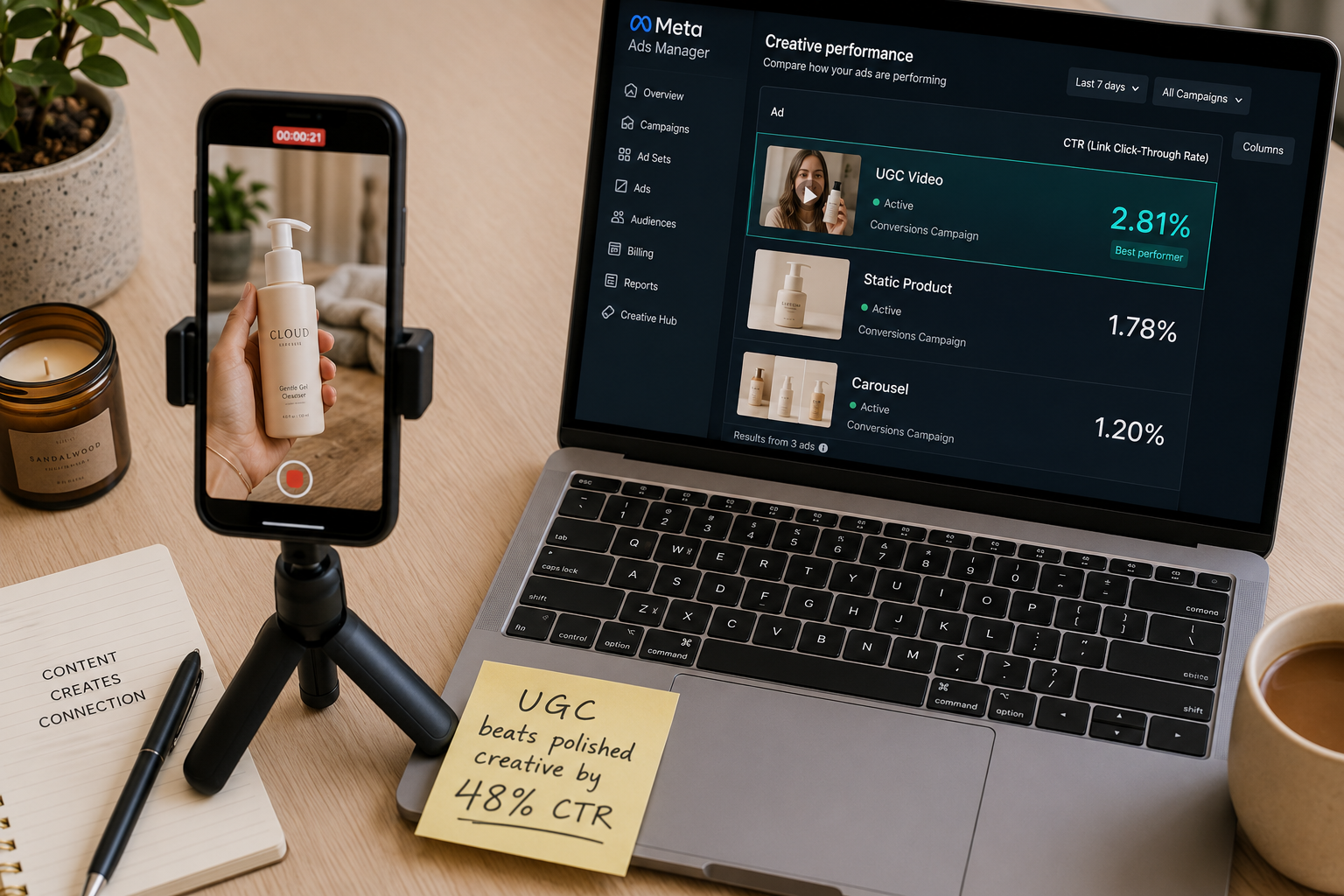
UGC-style video — raw, authentic footage showing real customers or founders demonstrating products — performs best in ASC environments. UGC-style creative beats polished brand creative by approximately 48% on click-through rate and 26% on cost per acquisition inside Advantage+ campaigns. The authenticity signal that UGC carries is precisely what Meta's algorithm learns to optimize toward, because the same authenticity that drives ad engagement also drives post-click conversion.
The reason UGC performs so strongly comes back to the psychology of trust. A real customer showing how a skincare product changed their skin over 30 days generates more purchase intent than a studio-produced product showcase because it answers the question every potential buyer is actually asking: does this actually work for someone like me?
Practical UGC creative sources for Shopify brands in 2026 include asking existing customers to submit 30 to 60 second video reviews, partnering with micro-influencers in your product category for honest product demonstrations, creating founder-led videos that show the product being used in authentic contexts, and repurposing high-performing organic TikTok content as paid Meta creative after testing it organically first.
Static image creative remains valuable for retargeting and catalog ads where product clarity matters more than emotional engagement. High-quality product-on-white images combined with clear value proposition text overlays consistently drive strong conversion rates in bottom-funnel campaigns targeting warm audiences who have already seen video content higher in the funnel.
For creative testing, run a minimum of three to five creative variations within each ASC campaign and allow Meta's algorithm at least two weeks — and ideally 50 conversions per ad — before drawing conclusions about which performs best. Killing creative too early prevents the algorithm from completing its learning phase and produces misleading performance data.
The creative refresh cycle matters too. At $50,000 or more per month in Meta spend, ad fatigue typically sets in within two to three weeks of launching new creative. For smaller budgets, creative can run effectively for four to six weeks before frequency-driven performance decline sets in. Build a content calendar that produces new creative at the pace your spend level requires.
Tracking: Fixing Attribution in a Post-iOS World
The single most underestimated technical requirement for accurate Meta Ads performance in 2026 is server-side tracking through the Conversions API (CAPI). Without it, you are making budget decisions based on data that is missing 20 to 40% of actual conversions.
Here is the problem: the Meta Pixel is browser-based, which means it is blocked by iOS privacy settings, Safari's Intelligent Tracking Prevention, ad blockers, and users browsing in private mode. In a typical Shopify store, the Pixel is missing somewhere between 20 and 50% of purchase events depending on the traffic mix — which means Meta's algorithm is optimizing for an incomplete picture of who actually converts.
The Conversions API solves this by sending conversion events directly from your Shopify server to Meta, bypassing browser-side privacy restrictions entirely. When CAPI and Pixel are running simultaneously — called Event Matching — Meta can deduplicate the events and use the more complete dataset for optimization. Stores that implement CAPI alongside their Pixel typically recover 20 to 40% of previously lost conversion data, which immediately improves campaign optimization quality.
For Shopify merchants, CAPI setup has become significantly more accessible. Shopify's native Meta integration includes server-side event sharing that can be enabled through your Shopify admin without developer assistance. For more complete CAPI implementation with higher event match quality, apps including Elevar and Littledata extend Shopify's native capability with improved customer data matching that increases the percentage of conversions Meta can connect to specific user profiles.
Alongside CAPI, use Meta's seven-day click, one-day view attribution window as your standard setting in 2026. The previous default of 28-day click attribution overstated Meta's contribution by crediting purchases that would have happened organically or through other channels. Seven-day click is the more accurate standard that Meta now recommends and that reflects actual cross-channel behavior more reliably.
Dynamic Product Ads: Your Highest-ROAS Campaign Type
Dynamic Product Ads (DPAs) are the most consistently high-performing campaign type available for Shopify stores on Meta, and they remain underutilized by the majority of independent merchants despite their documented performance advantages.
DPAs automatically generate personalized ad creative showing each viewer the specific products they viewed or added to cart on your Shopify store. The ad is assembled dynamically from your product catalog — pulling the product image, name, price, and availability for the exact item each viewer interacted with — creating a hyper-personalized retargeting experience at scale.
Advertisers typically see ROAS three to five times higher from dynamic retargeting of cart abandoners versus static prospecting ads targeting cold audiences. The reason is intent signal quality: a shopper who added a product to their cart and left has demonstrated stronger purchase intent than any demographic or interest-based targeting can identify, and showing them the exact product they left behind — with optional urgency messaging about stock levels or a limited discount — addresses the specific hesitation that prevented their initial conversion.
To launch DPAs on Shopify, upload your product catalog to Meta via Commerce Manager — or sync it automatically through Shopify's Meta integration — install the Meta Pixel with AddToCart, ViewContent, and Purchase events firing correctly, and enable catalog sales as your campaign objective in Ads Manager.
Segment your DPA audiences for maximum efficiency. Product page viewers who did not add to cart get standard carousel ads featuring the products they viewed. Cart abandoners get urgency-forward messaging — "Still thinking it over? This item is going fast" — with a direct link to their abandoned cart. Past purchasers get cross-sell creative featuring complementary products from categories they have not yet explored. This three-segment approach to catalog audiences typically lifts overall ROAS by 20 to 35% compared to running DPAs with a single unsegmented audience.
The Measurement Framework That Actually Works
Platform-reported ROAS is a directional signal in 2026, not a decision-making tool. Using it as your primary performance metric leads to misallocated budget and poor scaling decisions because it overstates Meta's contribution by 15 to 40% due to iOS attribution gaps, view-through attribution overlap, and cross-device behavior.
The measurement framework that gives accurate performance data uses Marketing Efficiency Ratio (MER) as the primary decision-making metric. MER is calculated as total online revenue divided by total marketing spend — all channels combined. If your store generated $400,000 in revenue in April and spent $100,000 on all marketing including Meta, Google, email, and SMS, your MER is 4.0x.
MER is immune to platform attribution disputes because it measures what actually happened at the bank account level rather than what each platform claims credit for. It captures cross-channel contribution accurately and does not overstate any single platform's role. When MER improves after a budget change, the change is working. When MER declines, you are overspending somewhere in your marketing mix.
Use Meta-reported ROAS directionally — as a signal for which specific campaigns, ad sets, and creative are performing relatively better or worse within your Meta account. Use MER as the signal for whether your overall Meta investment should increase, hold steady, or decrease relative to other channels.
The break-even ROAS calculation is the other metric every Shopify merchant needs to know before running any Meta campaign. Break-even ROAS equals one divided by your net profit margin after COGS and fulfillment. If your margin is 35%, your break-even ROAS is 2.86x — meaning any campaign delivering above 2.86x is generating profit, and any campaign below that threshold is losing money regardless of what the platform dashboard shows.
Knowing your break-even ROAS prevents the common mistake of scaling campaigns that look profitable on the surface but are actually generating negative contribution margin once all costs are accounted for.
Campaign Scaling: The Right Way to Grow Without Breaking Performance
When your Meta campaigns are generating consistent ROAS above your break-even threshold and you have at least 50 conversions per week per campaign, it is time to scale. How you scale determines whether performance is maintained or destroyed.
Horizontal scaling means duplicating winning ad sets with new audience segments or creative variations rather than increasing budget on existing ad sets. This approach expands reach without disrupting the learning phase of existing campaigns and is the safer of the two scaling approaches for accounts under $50,000 per month.
Vertical scaling means increasing budget on existing winning campaigns. The rule that prevents performance degradation on vertical budget increases is the 20 to 30% increment rule — increase campaign budgets by no more than 20 to 30% every three to five days. Budget increases beyond this threshold reset Meta's optimization algorithm and can spike costs significantly while the campaign relearns its optimal audience and delivery pattern.
Accounts that scale budgets in 20 to 30% increments consistently outperform those that double overnight — the incremental approach preserves learning while expanding reach, whereas overnight doubling frequently triggers learning phase resets that temporarily crater performance.
Use Advantage Campaign Budget (ACB) when scaling horizontally across multiple ad sets. ACB dynamically allocates budget toward the highest-performing ad set in real time, reducing manual oversight required and ensuring your budget flows toward what is working without constant manual adjustment.
What Good Meta Ads Performance Looks Like for Shopify in 2026
Setting realistic expectations prevents both premature campaign killing and prolonged investment in genuinely underperforming activity.
For Shopify ecommerce stores in 2026, the benchmarks worth targeting by funnel stage are:
Top-of-funnel video campaigns targeting cold audiences: cost per 1,000 impressions (CPM) of $15 to $25 in Tier-1 markets (US, UK, Australia), video completion rate above 25%, click-through rate above 1%.
Middle-of-funnel consideration campaigns: cost per click of $0.80 to $2.50 depending on category, landing page view rate above 70% of link clicks, add-to-cart rate above 5% on warm traffic.
Bottom-of-funnel conversion campaigns: cost per purchase that delivers ROAS above your break-even threshold (calculated individually per store), with Advantage+ Shopping Campaigns targeting 3.5x to 4.5x blended ROAS on new customer acquisition and retargeting DPAs targeting 5x to 10x on cart abandoner audiences.
For new Shopify stores running Meta Ads for the first time, the learning phase typically requires four to six weeks and a minimum of 50 purchase conversions per campaign before the algorithm has enough data to optimize reliably. During this period, ROAS will be unstable and sometimes below break-even. This is expected and does not indicate campaign failure unless it persists beyond the learning phase.
The Complete Account Structure for Shopify Meta Ads in 2026
The optimal Meta Ads account structure for a Shopify store spending $5,000 to $30,000 per month looks like this:
Campaign one — Advantage+ Shopping Campaign (70 to 80% of budget): Broad audience, full product catalog, UGC-heavy creative, purchase conversion objective. Exclude recent purchasers (30 to 60 days). This is your primary acquisition and prospecting campaign.
Campaign two — Dynamic Product Ads (10 to 15% of budget): Segmented catalog audiences covering product viewers, cart abandoners, and past purchaser cross-sell. Purchase conversion objective. This is your highest-ROAS retargeting campaign.
Campaign three — Manual creative testing (10 to 15% of budget): Controlled environment for testing new creative concepts, hooks, messaging angles, and formats before feeding winners into ASC. Traffic or conversion objective depending on budget available for testing.
This three-campaign structure covers the full conversion funnel while giving ASC enough budget to optimize effectively, maintains dedicated DPA retargeting for warm audiences, and provides a testing pipeline that continuously feeds new creative into your primary acquisition campaign.
Final Thoughts
Meta Ads in 2026 reward a different set of skills than they did in 2022. Audience research has been largely superseded by creative quality as the primary performance variable. Manual targeting precision has been largely superseded by AI optimization through Advantage+. And platform-reported attribution has become a directional signal to be checked against real revenue data rather than a trusted source of truth.
The Shopify brands winning on Meta in 2026 have internalized these shifts. They invest in UGC creative production rather than audience research. They run Advantage+ with appropriate budget allocation rather than fighting the algorithm with manual overrides. They track MER alongside platform ROAS rather than making decisions from a single attribution model. And they structure their campaigns across all three funnel stages rather than betting everything on bottom-of-funnel conversion campaigns competing for the same warm audiences at ever-increasing cost.
The platform still works. The strategy just needed to evolve with it.
Need help building or restructuring your Meta Ads strategy for your Shopify store, or want an expert to audit your current campaign setup for performance gaps? Get in touch with EcomFixify — we specialize in Shopify development and ecommerce growth strategy for brands ready to scale.
You May Also Like To Read
Shopify Notifications How to Get 28% Click-Through Rates on Mobile
Voice Commerce on Shopify: How to Optimize Your Store for Voice Search