
Voice Commerce on Shopify: How to Optimize Your Store for Voice Search
Voice Commerce on Shopify: How to Optimize Your Store for Voice Search in 2026
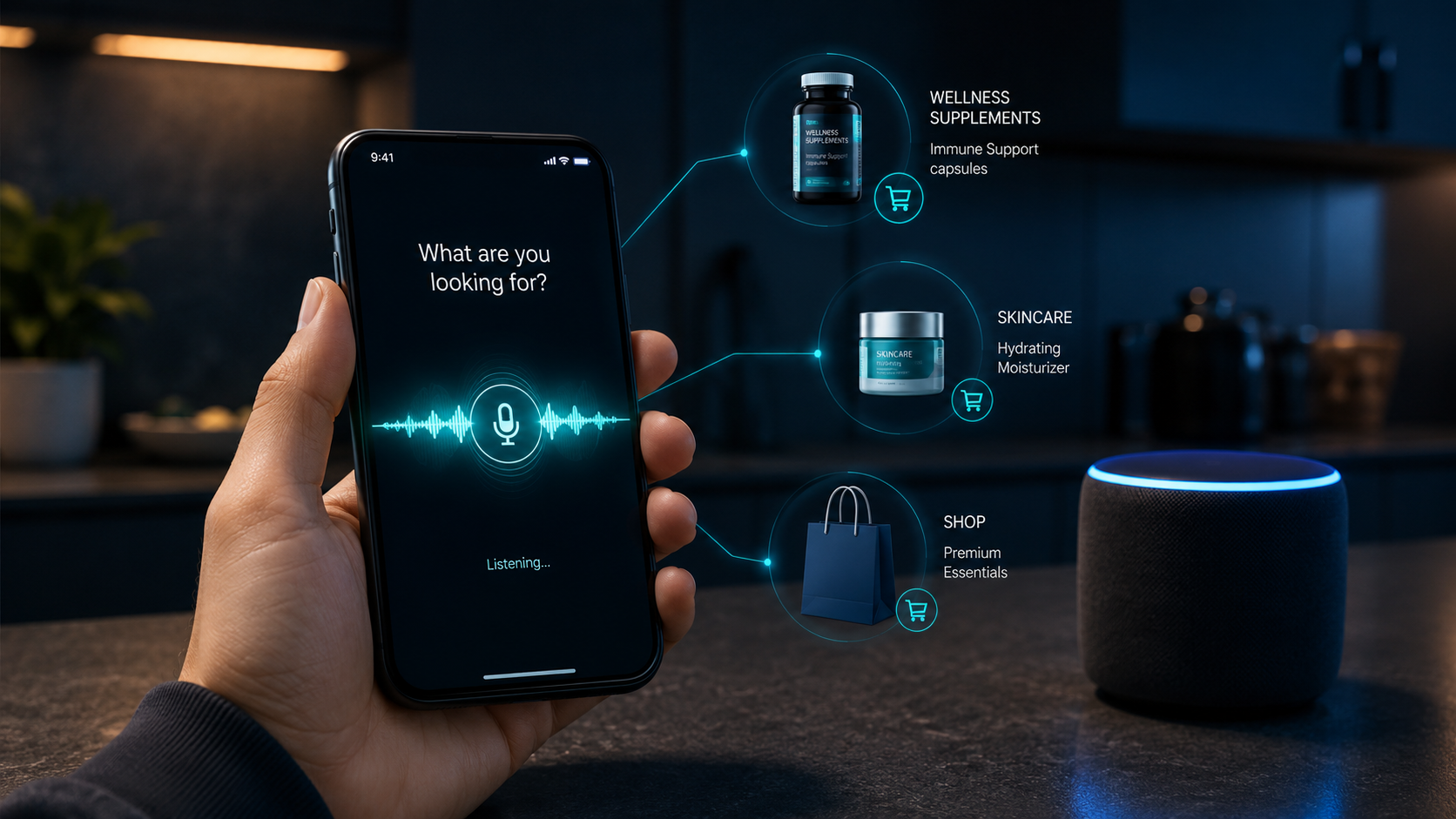
Here is a number most Shopify store owners have not seen yet: 8.4 billion active voice assistant devices are operating worldwide in 2026. That number has surpassed the global human population for the first time. Every smartphone, smart speaker, car infotainment system, and wearable device now comes equipped with a voice interface — and a growing percentage of the people using those devices are searching for products, researching purchases, and completing transactions through voice rather than text.
Voice commerce — purchases initiated or influenced through voice search — is projected to reach between $55 billion and $80 billion globally in 2026 and is growing at 17 to 25% annually. 49.6% of US consumers have used voice search for shopping. 71% of consumers prefer voice search over typing when possible. And 27% of all online queries in 2026 are now being made through voice.
Yet most Shopify stores are entirely invisible to voice search.
No FAQ sections. No conversational content. No schema markup. No local voice optimization. Product pages written for typed keyword searches that look nothing like how a person actually asks a question out loud.
That gap is exactly where the opportunity lives. Voice search optimization on Shopify is still early enough that the merchants who move now will build a meaningful traffic and revenue advantage before the rest of the market catches up. This guide covers everything you need to do it correctly.
How Voice Search Works Differently From Text Search
Before diving into optimization tactics, understanding why voice search requires a fundamentally different approach than conventional SEO is essential. The two are not the same discipline with the same techniques.
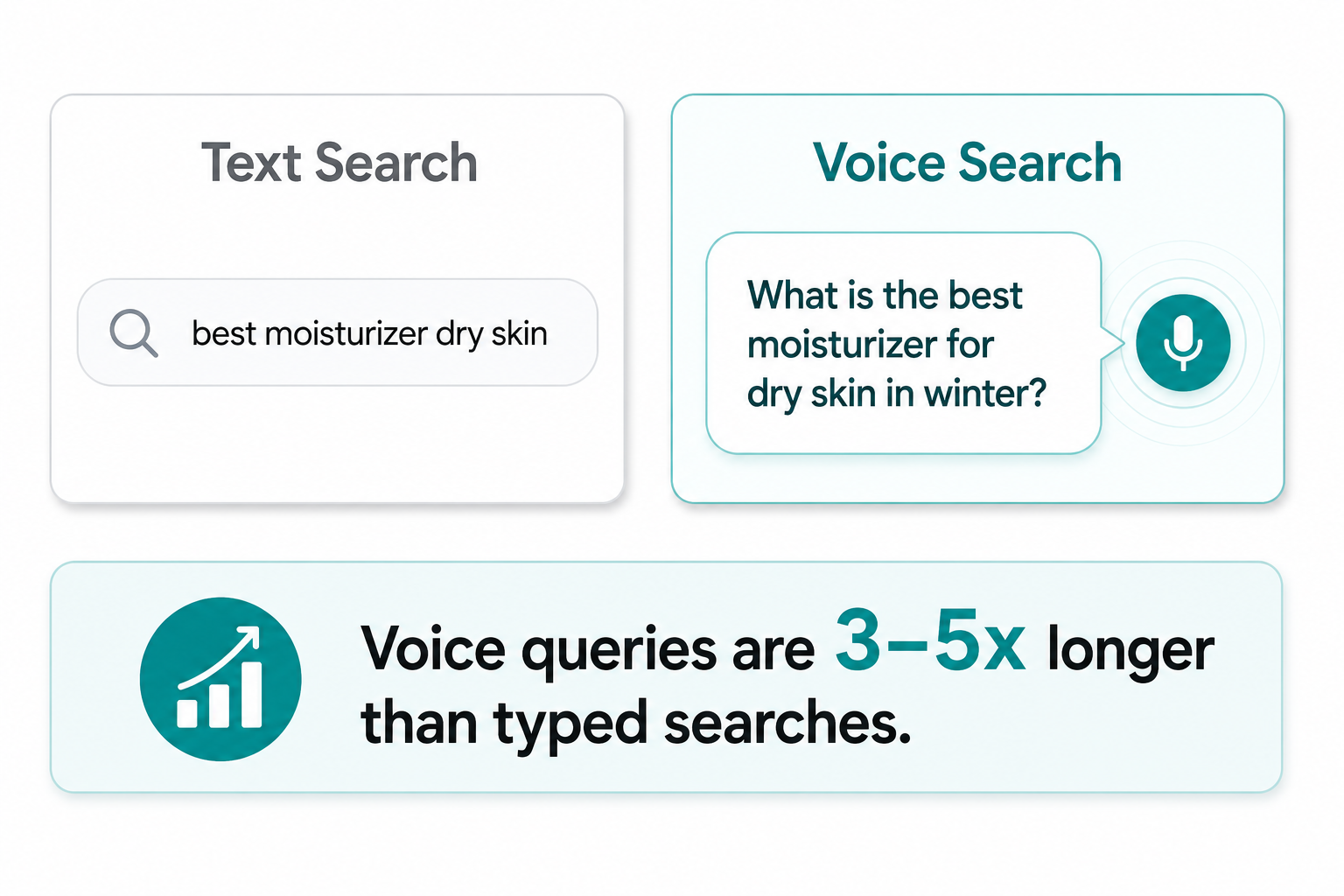
The core difference is linguistic. When someone searches by typing, they use shortened, keyword-heavy queries: "best moisturizer dry skin" or "Shopify leather wallet men." When the same person searches by voice, they speak naturally: "What is the best moisturizer for dry skin?" or "Where can I buy a men's leather wallet near me?"
Voice searches are 3 to 5 times longer than typed searches. 72% of voice search queries are phrased as complete questions. 70% of voice queries are conversational in structure. These patterns are consistent across platforms — Google Assistant, Siri, Alexa, and Cortana all process natural language queries that no conventional keyword strategy directly captures.
The consequence for Shopify stores is significant. A product page optimized for the keyword "wireless earbuds" will not appear when someone asks "What are the best wireless earbuds for running in the rain?" — even if your product is the perfect answer to that question — unless your content is structured to address the question in conversational language.
Voice search results also come from a narrower pool of sources than text search results. While a Google text search returns ten blue links, a voice assistant returns one answer — the result it judges most relevant, authoritative, and correctly formatted for voice delivery. Featured snippets — the answer boxes that appear above organic results in Google — account for 40.7% of all voice search answers. Pages with schema markup are 33% more likely to appear in voice results. And 75% of voice search results come from the top three desktop search results.
The implication: voice SEO is about becoming the single best answer to a specific question — not ranking somewhere on the first page.
The Voice Commerce Landscape in 2026: What Shopify Brands Need to Know
Voice commerce is not evenly distributed across product categories. Understanding where voice shopping is concentrated helps prioritize which products to optimize first.
The global voice commerce market reached approximately $55 to $80 billion in 2026, representing 6.2% of US ecommerce transactions. Consumer goods lead by volume at 39.2% of voice commerce revenue. Grocery and household supplies account for 38% of all voice orders. Personal care follows at 18%, entertainment and media at 14%, and apparel at 8%.
The average voice commerce order value is $34 — significantly lower than the $86 average for screen-based ecommerce. This reflects the reality that voice commerce currently skews heavily toward replenishment purchases — buying the same product again without needing to see it, compare options, or read detailed descriptions. A subscriber asking Alexa to reorder their daily vitamins is voice commerce. A first-time buyer researching premium headphones is voice search that influences an eventual screen-based purchase.
This distinction matters for Shopify optimization strategy. Stores selling replenishment products — supplements, skincare consumables, household supplies, pet food, coffee, personal care — have the highest direct voice commerce conversion potential. Stores selling higher-consideration products benefit from voice search at the top of the funnel, influencing research and discovery before the eventual purchase happens on screen.
Amazon's Alexa for Shopping, launched May 2026, accelerated the direct purchase angle significantly. The platform replaced the earlier Rufus chatbot with a fully agentic purchasing assistant that can find products, compare options, and complete purchases on third-party sites using stored payment credentials. Voice has genuinely evolved from an assistant into a transaction layer — and Shopify catalog readiness for these agents is now an operational requirement, not a future consideration.
The 7 Voice Search Optimization Tactics That Work for Shopify in 2026
1. Target Conversational Long-Tail Keywords
The first and most foundational shift in voice SEO is keyword strategy. Move away from short, typed-search keywords and toward the longer, question-based phrases that voice users actually speak.
For every product category you sell in, identify the questions your customers would ask a knowledgeable friend about that product. "What is the best collagen supplement for women over 40?" "How do I choose the right yoga mat thickness?" "Which wireless earbuds have the longest battery life?"
These conversational long-tail keywords are what voice users are saying into their devices. Long-tail keywords perform 2.5 times better for voice search optimization than short-tail keywords. Shopify stores optimized for question-based long-tail keywords see 28% more voice-originated traffic.
The practical tool for finding these keywords is Google's People Also Ask section, which appears in search results and shows the exact questions real users are asking about your product category. Answer the Public is another tool that visualizes question-based search queries around any keyword. Both give you the raw material for a conversational keyword strategy.
2. Add FAQ Sections to Product Pages and Key Landing Pages
FAQ sections are the most direct translation of voice search queries into on-page content. A well-structured FAQ section that answers the specific questions voice users ask about your products is one of the most reliable paths to appearing in voice search results.
Each FAQ question should be phrased exactly as a customer would ask it out loud. Each answer should be concise — 40 to 60 words — conversational in tone, and complete enough to stand alone as a spoken voice answer. Voice assistants read out answers, so content that sounds natural when spoken aloud performs better than content written in formal documentation style.
On product pages, FAQ content should address the most common purchase hesitations and research questions for that specific product. On collection pages, FAQ content should address category-level questions. On your homepage and about page, FAQ content should address brand-level and operational questions — shipping, returns, sizing, and how to contact you.
3. Implement Structured Data Schema Markup
Schema markup is the technical foundation of voice search visibility. It is code added to your Shopify store's HTML that tells search engines — and voice assistants — exactly what type of content is on each page, what products you sell, what questions you answer, and how your business is structured.
Pages with schema markup are 33% more likely to appear in voice search results than equivalent pages without it. Featured snippets, which supply 40.7% of all voice answers, are significantly more likely to be awarded to pages with correct schema implementation.
The most important schema types for Shopify stores are Product schema on every product page — including price, availability, rating, and review data; FAQ schema on any page with question-and-answer content; LocalBusiness schema if you have a physical location or serve a specific geographic area; Organization schema on your homepage and about page; and BreadcrumbList schema to help search engines understand your site structure.
In Shopify, schema markup can be added through your theme's Liquid files for experienced developers, or through SEO apps including Schema Plus, JSON-LD for SEO, and Smart SEO, which automate the implementation of the most critical schema types without requiring code edits.
4. Optimize for Featured Snippets
Featured snippets — the answer box that appears above the first organic result in Google — are the primary source of voice search answers. Winning a featured snippet on a relevant question effectively gives you voice search ownership of that query.
The content formats most likely to win featured snippets are direct question-and-answer paragraphs where the question is phrased naturally and the answer is 40 to 60 words, numbered lists for process-oriented questions, comparison tables for product comparison questions, and definition paragraphs for "what is" queries.
The practical strategy is to identify questions in your product category that currently show featured snippets in Google search results, analyze what the current snippet answer looks like, and create content that answers the same question more completely, more accurately, or more concisely — then structure that content in the format Google is already rewarding for that query type.
On your Shopify blog, this means writing posts specifically structured around answering questions in featured-snippet-ready formats. On product pages, it means adding concise, well-structured answers to common product questions in the description or FAQ section.
5. Optimize Your Store for Mobile Speed
Voice search is overwhelmingly a mobile activity. 89.5% of voice assistant users interface primarily on smartphones. After a voice search leads a customer to your store, they arrive on a mobile device — and page speed is the variable that determines whether they stay or bounce.
Voice-optimized pages load in under 4.6 seconds on mobile. Voice search results on Google load 52% faster than average web pages. These benchmarks exist because users who arrive via voice search have a lower tolerance for slow-loading pages — they just asked a question and expect an instant answer.
For Shopify stores, the mobile speed optimization steps that most directly support voice search performance are converting all product images to WebP format, enabling lazy loading for images and video, removing unused apps that add JavaScript payload to every page, and using a lightweight, performance-optimized theme.
Check your current mobile speed in Google PageSpeed Insights and target a Largest Contentful Paint under 2.5 seconds. Voice search referral traffic will not convert at meaningful rates on pages that take longer than that to load on mobile.
6. Build a Robust Local Voice Search Presence
76% of voice searches have local intent — users asking for businesses, products, or services near their location. Even for Shopify stores that do not have a physical location, local search optimization matters because voice assistants use location signals to filter and rank results.
58% of all consumers use voice search to learn about local businesses. 27% visit a local business website after finding it through voice search. 76% of smart speaker users perform local searches at least weekly. These are not niche behaviors — they are mainstream patterns that affect which stores voice assistants recommend.
For Shopify stores with a physical location, a complete and accurate Google Business Profile is the foundational requirement for local voice search visibility. Every field should be filled in completely — business hours, product categories, service area, photos, and regular posting. Businesses with complete Google Business Profiles are 70% more likely to attract location-based voice queries.
For online-only Shopify stores, local voice optimization means including city, region, and country references naturally throughout your homepage and about page content, in your meta titles and descriptions, and in your structured data schema. Mentioning where your brand is based, where you ship from, and what markets you serve gives voice assistants the geographic context they need to surface your store for relevant local queries.
7. Make Your Product Catalog Agent-Ready
This is the most forward-looking voice optimization requirement in 2026 and the one most merchants have not yet addressed. With agentic shopping assistants like Alexa for Shopping, Google AI Mode, and Perplexity's Buy with Pro now completing purchases and making recommendations automatically, your Shopify product catalog's technical quality has become a direct voice commerce ranking signal.
Approximately 60% of ecommerce catalogs carry missing GTINs or inconsistent product attributes. Products that fail basic catalog completeness checks are excluded from AI and voice assistant recommendation pools entirely — before any SEO optimization even matters.
For Shopify stores, catalog readiness for voice and agentic commerce means ensuring every product has a complete and accurate GTIN or barcode, full attribute coverage including size, color, material, weight, and any category-specific attributes, accurate and consistently formatted pricing, real-time inventory availability signals, and product descriptions that answer the questions voice users ask rather than just listing features.
Feed freshness also matters. AI shopping agents expect inventory and pricing to update within approximately a 15-minute window. Stores relying on nightly inventory batch updates rather than real-time API sync create discrepancies between what voice assistants believe is available and what is actually in stock — resulting in either poor recommendations or failed purchases that damage customer trust.
Voice Search Content Strategy: What to Create
Knowing the technical requirements of voice SEO, the natural next question is what content to actually create. The answer follows directly from how voice users search.
Voice users ask questions. Your content strategy should be organized around systematically answering the questions your customers ask at every stage of their purchase journey — awareness, consideration, decision, and post-purchase.
Awareness stage questions are broad and informational: "What is the difference between whey and plant protein?" "How do I know what size yoga mat I need?" These questions belong in your Shopify blog as standalone posts structured for featured snippet capture.
Consideration stage questions are more specific and comparative: "Which protein powder tastes best?" "Is the Manduka yoga mat worth the price?" These belong in comparison blog posts and on collection pages as educational content that helps shoppers evaluate options.
Decision stage questions are product-specific and purchase-ready: "Does the Manduka PRO yoga mat come in 6mm thickness?" "Is this protein powder available in chocolate?" These belong in product page FAQ sections and product descriptions structured to answer the specific questions shoppers ask before buying.
Brands that pair conversational content with their storefront see 12 to 23% conversion lifts from voice-originated traffic, 25% higher average order value on AI-assisted orders, and up to 35% better abandoned cart recovery when voice commerce paths are supported with clear purchase completion flows.
Practical Voice SEO Checklist for Shopify Stores
Work through this checklist to assess your current voice search readiness and identify the highest-priority gaps:
Content and keywords: Do your product pages include FAQ sections with conversational question-and-answer content? Are your blog posts structured around answering specific questions rather than covering topics broadly? Have you mapped question-based long-tail keywords for your top product categories?
Technical SEO: Is Product schema correctly implemented on every product page, including price, availability, and review data? Is FAQ schema implemented on pages with question-and-answer content? Is your mobile page speed under 2.5 seconds Largest Contentful Paint?
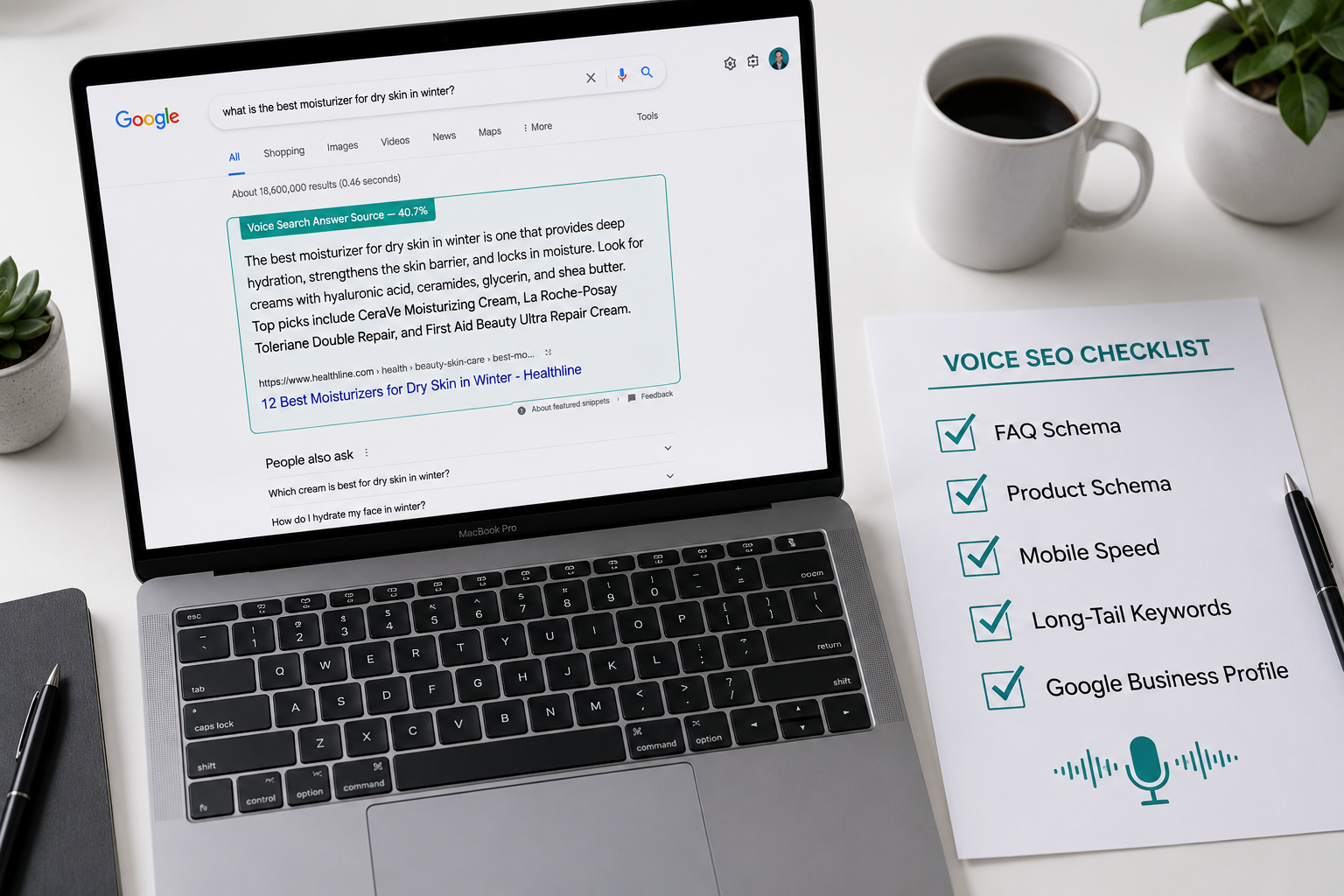
Local optimization: Is your Google Business Profile complete with accurate hours, categories, and location information? Does your homepage content include natural geographic references relevant to your target markets?
Catalog readiness: Do all products have GTINs or barcodes? Are product attributes complete and consistently formatted? Is inventory updating in real time or through nightly batches?
Featured snippets: Have you identified the featured snippets currently shown for your most important product category questions? Have you created content specifically structured to answer those questions in snippet-ready format?
The Competitive Window That Is Still Open
57% of businesses had optimized for voice search in 2025. That sounds like substantial adoption — but it means 43% of businesses, including the majority of independent Shopify stores, have made no meaningful voice search investments at all. In a competitive environment where most businesses are still focused entirely on conventional text SEO, voice optimization is one of the clearest remaining white-space opportunities in Shopify SEO.
Voice search does not require building a new channel from scratch. The technical work — schema markup, FAQ content, page speed optimization, catalog completeness — overlaps substantially with conventional Shopify SEO best practices. You are not starting a parallel strategy; you are extending and adapting what you are likely already working on.
The merchants who make these changes now are building voice search visibility as the channel grows from 27% of queries today toward the projected 50% of queries by 2027. Their FAQ content will have accumulated authority. Their featured snippets will be established. Their catalog will be agent-ready. And the Shopify stores that wait will be trying to catch up in a more competitive landscape with less time advantage.
Voice search is not coming in 2026. It is here. The question is only whether your store is visible when customers ask.
Need help implementing voice search optimization on your Shopify store, or want a technical audit of your schema markup and page speed for voice readiness? Get in touch with EcomFixify — we specialize in Shopify development and SEO optimization for growing brands.