
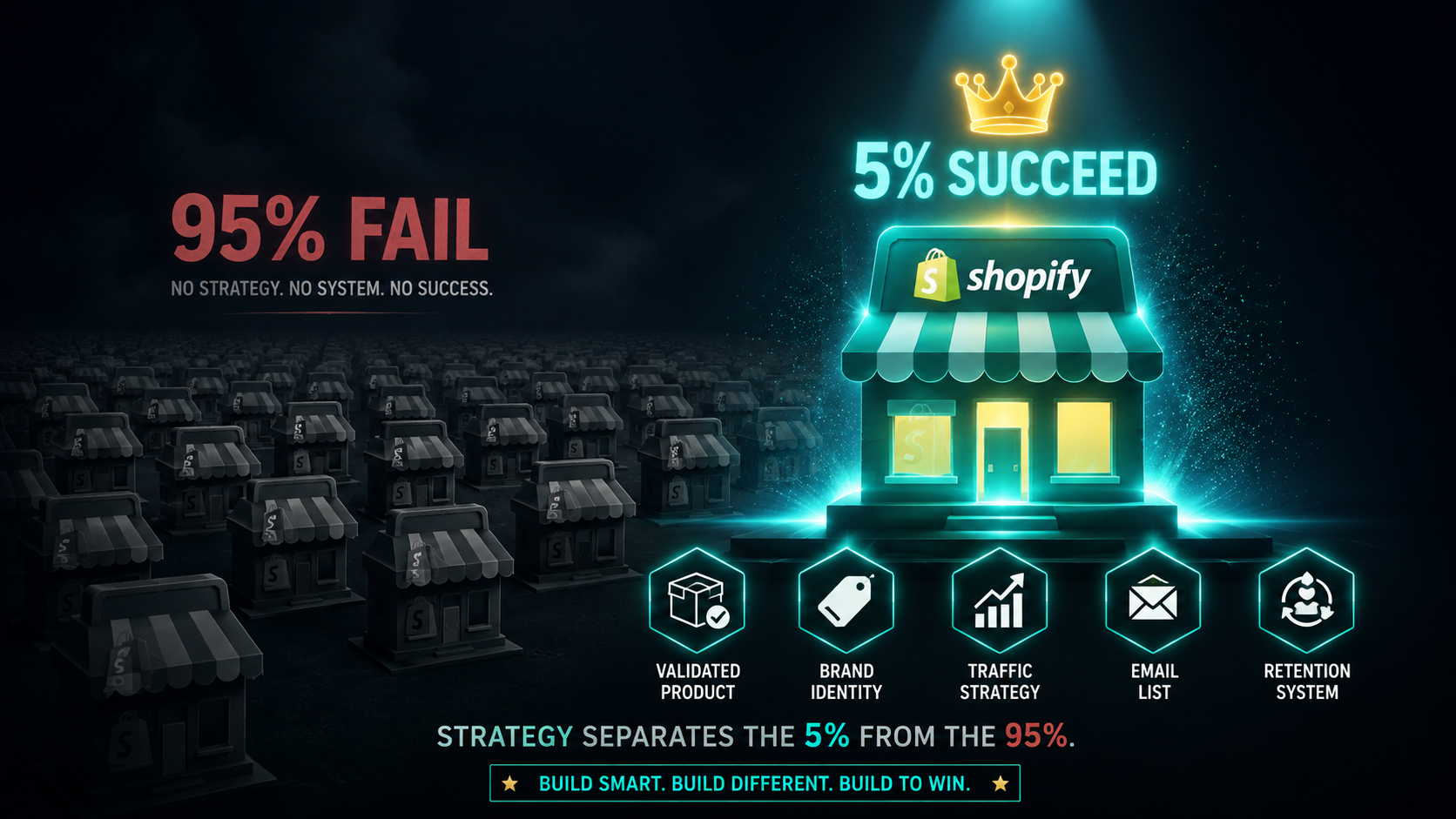
Why 95% of Shopify Stores Fail in Their First Year
There are currently 2.9 million live Shopify stores worldwide. Shopify merchants generated $100.7 billion in gross merchandise volume in the first quarter of 2026 alone. The platform works. The market is growing. And yet the failure rate for new Shopify stores sits between 80 and 95% within the first year — with roughly 90% not surviving their first 120 days. Why 95% of Shopify Stores Fail in Their First Year
Those numbers coexist because Shopify is not a business. It is a platform. Giving a merchant access to Shopify is like giving someone a commercial kitchen — the equipment is professional grade and genuinely excellent, but it does not know how to cook. The people who succeed are not the ones who found better equipment. They are the ones who showed up with a clear plan, a validated product, an understanding of unit economics, and the discipline to build systems rather than just open a store and hope.
The reasons Shopify stores fail are not mysterious. They are remarkably consistent across niches and business models — and because they are consistent, they are predictable. And because they are predictable, they are avoidable.
This guide covers the eight most common reasons Shopify stores fail in their first year — and exactly what the 5% who succeed do differently.
The Reality Behind the Failure Rate
Before diving into the reasons, it is worth understanding what failure actually means in the Shopify context — because the number is often misinterpreted.
A significant portion of the 2.9 million stores counted as "active" are technically open but generating zero revenue. They are paying the monthly subscription while doing nothing with the platform — zombie stores from merchants who set up a store, got overwhelmed, and never launched or abandoned it weeks after launch without gaining traction.
True business failure — building a store, launching products, investing in traffic, and still failing to build a sustainable operation — is driven almost entirely by predictable strategic mistakes rather than market conditions or platform limitations. The US Bureau of Labor Statistics shows approximately 22% of new US businesses close within their first year across all industries. Shopify stores show higher failure rates largely because the barrier to entry is so low that many merchants launch without the business fundamentals that offline business owners are forced to work through before signing a lease and hiring staff.
The low barrier is both Shopify's greatest strength and the reason its failure rate looks so alarming. Anyone can launch a Shopify store in a day. Not everyone who launches has thought through what it takes to make it profitable.
Reason 1: Selling Products Nobody Wants — Without Validation
The single most common reason Shopify stores fail is product-market misalignment — merchants who select a product based on personal enthusiasm, a YouTube video about winning products, or a trend that peaked months ago, without validating that real demand exists at a price point that generates sustainable margins.
The pattern looks like this: a merchant sources a product, builds a store, runs ads, gets traffic, and generates almost no sales. They conclude the problem is their ads, their store design, or their pricing — and spend more money testing variables that are not the actual problem. The actual problem is that nobody wanted the product at that price to begin with.
Product validation before investment is the foundational habit that separates merchants who launch with confidence from those who launch with hope. The validation process does not need to be complex:
Google Trends should show a stable upward trend or a consistent seasonal pattern — not a spike that peaked eight months ago and is now declining. Amazon Best Seller Rank in the relevant category should be falling over time — indicating growing sales rather than a product category in decline. TikTok Shop review counts for similar products should show real purchase volume from real buyers, not a product that looks interesting but has no sales history. A pre-sale test — driving paid traffic to a landing page for a product before sourcing inventory — is the most reliable validation method available. If a product cannot generate purchase intent from cold traffic at a viable cost per acquisition, adding inventory does not change that equation.
The merchants in the 5% who succeed do not fall in love with products before validating them. They fall in love with validated demand signals and then build products around those signals.
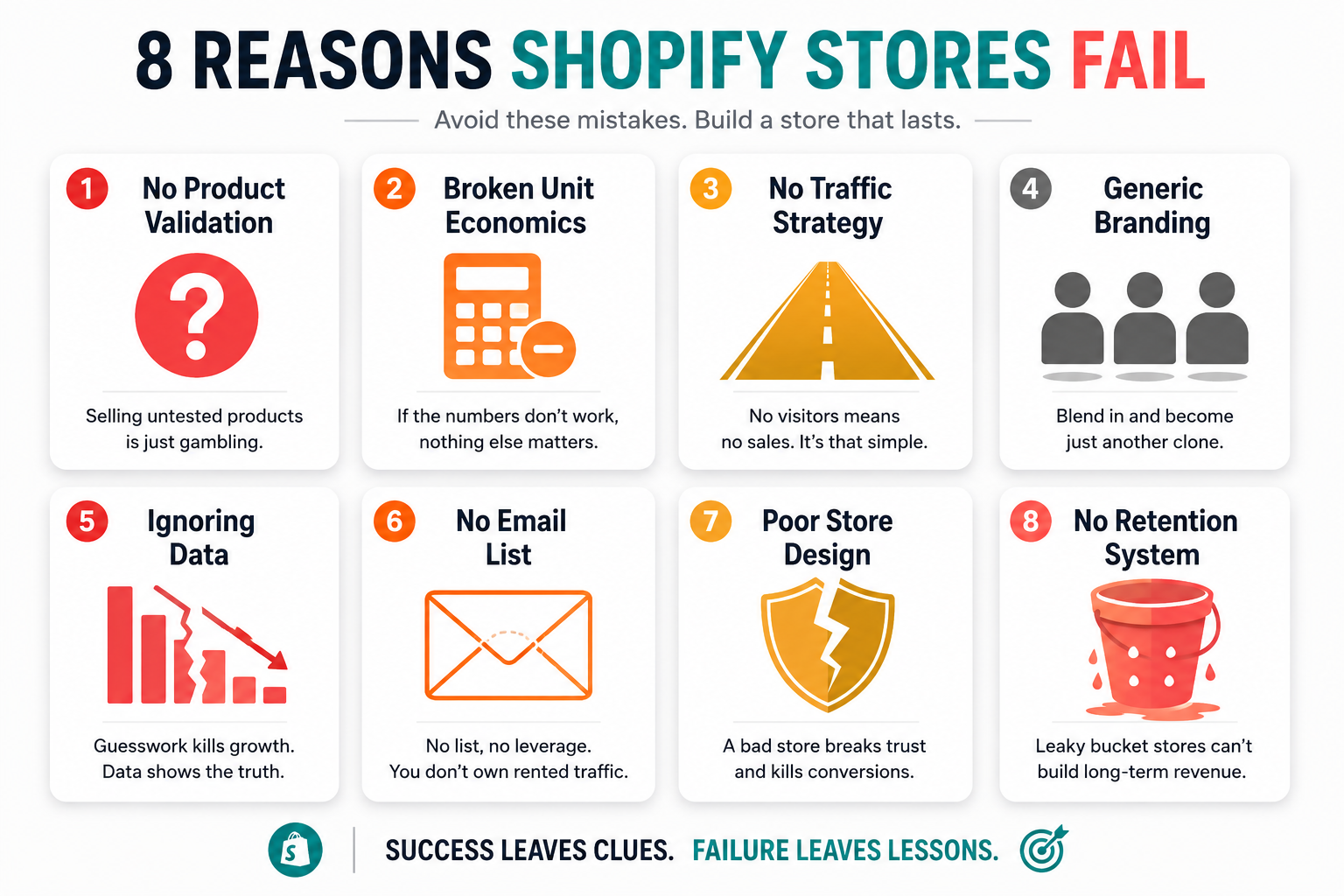
Reason 2: Broken Unit Economics From Day One
A Shopify store can have a validated product, a well-designed storefront, and consistent traffic — and still fail. The mechanism is broken unit economics: the cost of acquiring a customer and fulfilling the order exceeds the revenue generated, creating a business that loses money with every sale it makes.
The fully loaded calculation that every Shopify merchant needs to complete before scaling any product is:
Revenue per order minus cost of goods minus shipping and fulfillment minus transaction and payment fees minus attributed customer acquisition cost equals contribution margin per order.
If that number is negative, scaling the business means accelerating the losses. If it is positive but thin — under 15% of revenue — any unexpected cost increase (shipping surcharges, supplier price increases, rising ad costs) pushes the store into loss territory.
The most dangerous failure pattern is a merchant who calculates gross margin on cost of goods alone — "I buy it for $15 and sell it for $45, so my margin is 67%" — without accounting for shipping, transaction fees, return costs, and the customer acquisition cost required to generate each sale. When those costs are added, the 67% gross margin frequently becomes a 5 to 10% contribution margin that cannot sustain a profitable business.
Success requires knowing your break-even ROAS before running a single ad. If your gross margin is 40%, your break-even ROAS is 2.5x — meaning every dollar spent on ads must generate $2.50 in revenue just to avoid losing money, before accounting for any fixed overhead. Set minimum margin thresholds and treat them as non-negotiable constraints rather than targets to optimize toward over time.
Reason 3: The "Build It and They Will Come" Trap
The most consistent strategic delusion in new Shopify store failures is the assumption that a live store generates traffic. It does not. A live Shopify store with no traffic strategy is a storefront on a street that does not exist — beautifully designed, fully stocked, and completely invisible.
Traffic requires deliberate, sustained effort through at least one channel that the merchant commits to understanding and executing consistently. The channels available in 2026 are not a mystery: organic search through SEO, TikTok organic content, paid Meta and Google advertising, Pinterest, email marketing to a built list, and influencer or affiliate partnerships. The merchants who succeed typically commit deeply to one or two channels rather than spreading effort across six channels superficially.
The common failure pattern is spending 90% of launch effort on store design and product sourcing, then allocating a small ad budget, running it for two weeks without meaningful results, and concluding that the business does not work. Two weeks of paid ads with a small budget and an unoptimized ad account generates data — it does not generate a verdict on whether the business is viable.
Building an audience before launching — an email list, a social media following, a community of potential customers who already know and trust the merchant — is the single highest-leverage pre-launch activity available. Every subscriber at launch is a potential customer on day one rather than day 90. Merchants who build an audience before building a store consistently outperform those who do the reverse.
Reason 4: Generic Branding That Competes on Price and Loses
In 2026, there are 2.9 million Shopify stores. The majority of them look identical. Same free themes, same stock product photography, same generic descriptions copied from supplier listings, same category — competing with thousands of other stores selling the same products at similar prices to the same audiences.
When every store is interchangeable, customers make decisions based on price alone. And in a price competition, the store with the lowest price wins — which is almost never an independent Shopify merchant competing against established brands, mass-market retailers, or Amazon marketplace sellers.
The stores in the 5% are not trying to win on price. They are building brands that give customers a specific, compelling reason to choose them over alternatives — a distinctive point of view, a specific audience they understand deeply, a brand story that resonates, a visual identity that communicates professionalism and trust before a customer reads a single product description.
Branding is not expensive. It requires clarity about who you are selling to, what makes your product different or better for that specific audience, and consistency in how you communicate that difference across every customer touchpoint. A merchant who sells protein supplements to women over 40 who are returning to fitness after years away has a specific audience, a specific message, and a specific product positioning that no amount of generic supplement marketing can replicate for that customer.
Failed stores look interchangeable. Successful stores look like they were built for a specific person — and that person, when they find the store, feels immediately understood.
Reason 5: Ignoring Data Until It Is Too Late
The merchants who fail rarely look at their analytics. The merchants who succeed are obsessive about them.
The specific analytics failure pattern looks like this: a merchant runs ads, checks revenue, is disappointed, adjusts the creative, checks revenue again. No product page conversion rate by device. No add-to-cart rate. No checkout abandonment rate. No customer acquisition cost by channel. No lifetime value segmentation. No return on ad spend by campaign. The merchant is making decisions from one lagging indicator — total revenue — without the leading indicators that explain why revenue is at its current level and which specific variables need to change.
A store that gets 10,000 monthly visitors and generates 100 orders has a 1% conversion rate. That number is not useful without context: what is the add-to-cart rate? If it is 8%, the problem is between add-to-cart and purchase — checkout, shipping cost revelation, or trust signals. If it is 1.5%, the problem is on the product page — imagery, copy, price presentation, or social proof. The same revenue number can result from completely different problems that require completely different solutions.
The merchants in the 5% set up Google Analytics 4 and Shopify's native analytics correctly from launch day. They review conversion rate by device weekly, identify the specific funnel stage where visitors drop off, and make data-driven changes to those specific elements rather than guessing. Blind optimization — changing things without measuring the specific change — is the most expensive strategy available to a new Shopify merchant.
Reason 6: No Email List and Total Dependence on Paid Traffic
A Shopify store with no email list has no customer relationships — only transactions. Every customer who buys leaves without a connection to the brand that can be activated for a second purchase. Every customer the store needs is a new customer that must be acquired through paid channels at the current market cost for that audience.
Ad costs have risen more than 60% since 2020. Stores built entirely on paid traffic face rising customer acquisition costs with every passing year while their owned marketing assets — zero — generate no compounding return. A store with 10,000 email subscribers generates revenue from every campaign it sends at near-zero marginal cost. A store with no email list pays the full acquisition cost for every customer it needs.
Building an email list from day one — through a popup with a compelling lead magnet or discount, through post-purchase capture, through social media promotion — creates an owned audience that delivers compounding returns for the life of the business. The merchants who succeed in year two and three are often the ones who spent year one building their list while their paid traffic funded the customer acquisition. The merchants who fail spent year one paying for traffic and kept nothing from it.
Reason 7: Poor Store Design That Breaks Trust Before It Can Be Built
A Shopify store that looks unfinished, loads slowly, has sparse product imagery, no reviews, a missing return policy, and an unclear contact method loses customers before they engage with any marketing. Trust is the first conversion — before a customer can buy, they have to believe the store is legitimate.
The specific trust failures that kill new stores are: page speed below 3 seconds on mobile, which 79% of shoppers cite as a reason to abandon a site; no visible return policy, which 92% of customers check before buying from an unfamiliar brand; product pages with one or two images and no reviews, which signals a store that is not yet established enough to have customers; and no visible customer service contact method, which leaves potential buyers with no recourse if something goes wrong.
None of these trust signals require expensive development work. Shopify's native themes — Dawn, Refresh, Sense — are well-designed, fast-loading, and professional out of the box. The problem is merchants who choose premium themes and customize them poorly, accumulate too many apps and slow the store down, or launch before the product pages have sufficient imagery and social proof to convert a first-time visitor.
The bar for trust is not high — but it must be cleared. A customer who does not trust a store will not buy from it regardless of how good the product is or how low the price is. Trust is the prerequisite for everything else.
Reason 8: No Retention System — Constantly Starting Over
The merchants who fail treat every month as a fresh acquisition challenge. The merchants who succeed build systems that compound over time — email flows that generate revenue automatically, loyalty programs that bring customers back without paid re-acquisition, review collection that builds social proof, and post-purchase sequences that turn one-time buyers into repeat customers.
The mathematics of retention are straightforward and commercially decisive. Acquiring a new customer costs 5 to 25 times more than retaining an existing one. A 5% increase in customer retention increases profits by 25 to 95%. A store with a 30% repeat purchase rate generates significantly more revenue from the same traffic than a store with a 5% repeat purchase rate — because a portion of its revenue base is self-sustaining rather than entirely dependent on ongoing acquisition spend.
The stores that fail have no retention infrastructure. When the ad spend stops, the revenue stops. The stores that succeed have an email list that generates revenue on every campaign, automated flows that recover abandoned carts and win back lapsed customers, and a loyalty program that gives customers a financial reason to return rather than exploring competitors.
The 5% Checklist: What Successful Shopify Stores Do Differently
Looking across the stores that build sustainable, profitable operations on Shopify in 2026, the pattern of what they do differently is consistent enough to serve as a practical checklist.
They validate product demand before investing in inventory or advertising — using Google Trends, Amazon BSR, TikTok Shop data, and where possible pre-sale testing.
They calculate their fully loaded unit economics — including CAC, shipping, returns, and transaction fees — before running their first ad, and they know their break-even ROAS before spending a dollar.
They commit to one or two traffic channels and learn them deeply — understanding the algorithm, the creative, the targeting, and the optimization levers — rather than spreading superficial effort across six channels.
They build a brand with a specific audience, a distinctive visual identity, and a clear point of differentiation that does not compete on price with larger, better-capitalized competitors.
They build an email list from day one and treat it as their most valuable owned asset — growing it consistently and activating it through automated flows rather than relying entirely on paid traffic.
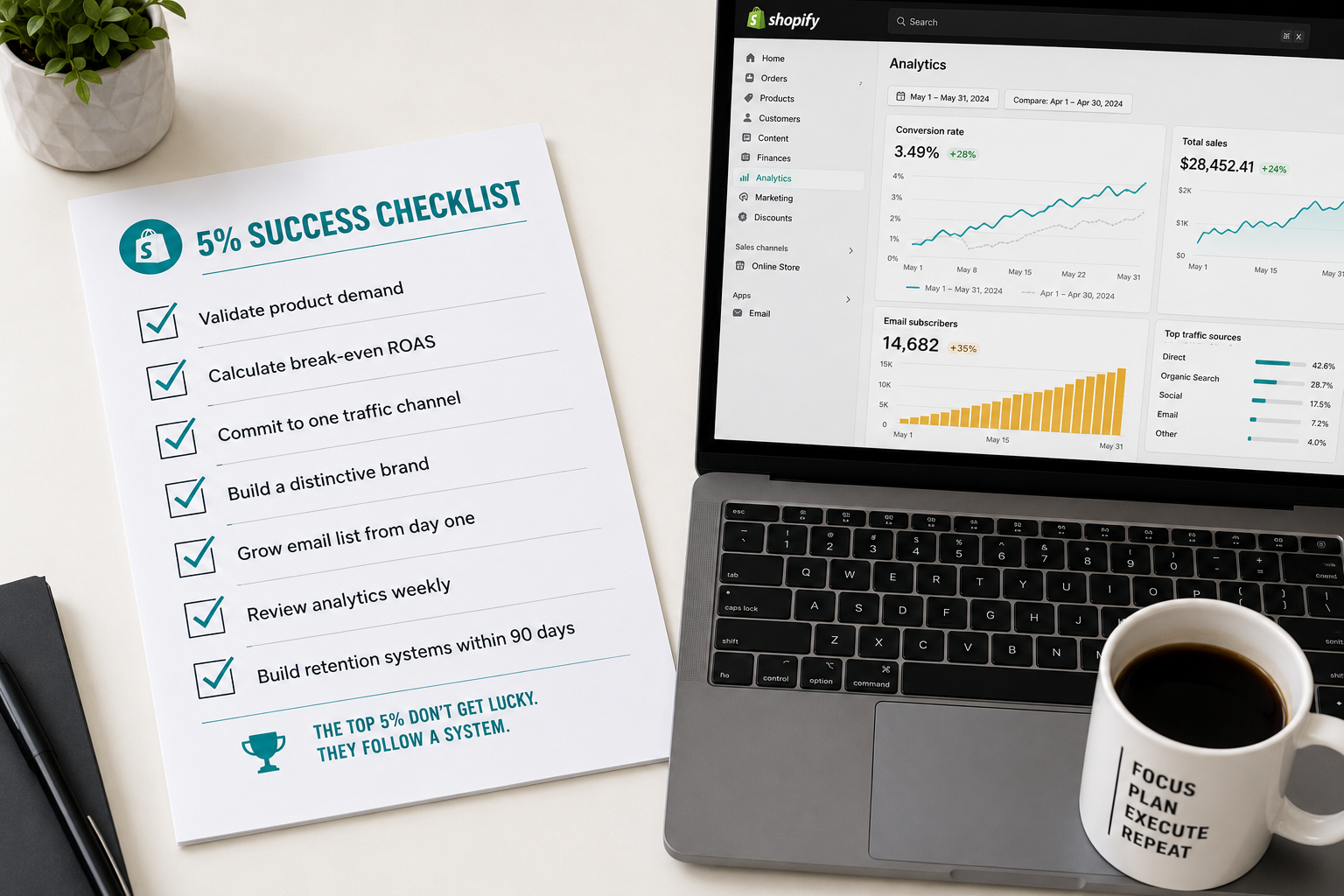
They set up analytics correctly from launch and review conversion rate, add-to-cart rate, and checkout abandonment rate by device weekly — making data-driven decisions rather than intuition-driven changes.
They build retention infrastructure — email flows, loyalty programs, post-purchase sequences — within the first 90 days so that the store compounds in value rather than starting over each month.
And they treat the first year as a learning period rather than a get-rich-quick event. The stores that become durable businesses are almost never overnight successes. They are stores that iterated persistently, learned from data honestly, and compounded the results of each improvement into the next.
Final Thoughts
The 95% failure rate is real. So is the path to being in the 5%. They just require different things from a merchant.
Failure requires none of the foundational work — launch fast, run ads, hope the store converts, give up when it does not. That path is easy, free, and well-travelled.
Success requires validating the product, understanding the economics, building a brand, developing a traffic strategy, growing an owned audience, reading the data honestly, and building the retention systems that compound over time. That path is harder at the beginning and significantly easier at the end — because the systems do the work rather than the merchant doing everything manually every month.
The 5% are not smarter than the 95%. They are more disciplined, more patient, and more willing to do the foundational work that most merchants skip in their excitement to launch and sell. Every element covered in this guide is learnable, executable, and within reach of any merchant who commits to doing it properly.
Need help building a Shopify store with the right foundation, or want an expert to audit your current store for the specific gaps that are holding your revenue back? Get in touch with EcomFixify — we specialize in Shopify development and ecommerce growth strategy for brands building for the long term.