
What Augmented Reality Means for Shopify Stores Today
What Augmented Reality Means for Shopify Stores Today
Every Shopify store owner knows the feeling. A product goes out, the customer is excited, and then the return request arrives. Wrong size. Didn't look like the photos. Larger than expected. Didn't match the room.
These aren't bad customers. They're customers making purchasing decisions with incomplete information — and online shopping, by its nature, has always forced people to buy with an imagination gap between what they see on screen and what they'll actually receive.
Augmented reality closes that gap entirely.
Brands using AR report 25–40% fewer returns and 94% higher conversion rates for products with AR experiences. That's not a modest improvement — it's a fundamental shift in purchase confidence that addresses the two most expensive problems in ecommerce simultaneously: customers who don't buy, and customers who buy and send products back.
The AR in ecommerce market was valued at $6.62 billion in 2024 and is forecast to reach $139.1 billion by 2034 at a 35.6% compound annual growth rate, with North America holding 41.6% of global share.
And for Shopify merchants specifically, 2026 is the inflection point where AR moves from a luxury feature reserved for enterprise brands into an accessible, affordable, and measurable competitive advantage for stores of any size.
This guide covers exactly what AR does, why it works, which product categories benefit most, how to implement it on your Shopify store, and the real cost of getting started.
What Is AR in Ecommerce, and Why Does It Work?
Augmented reality ecommerce describes the use of AR technology within online shopping — letting customers see 3D products in their real environment before buying.
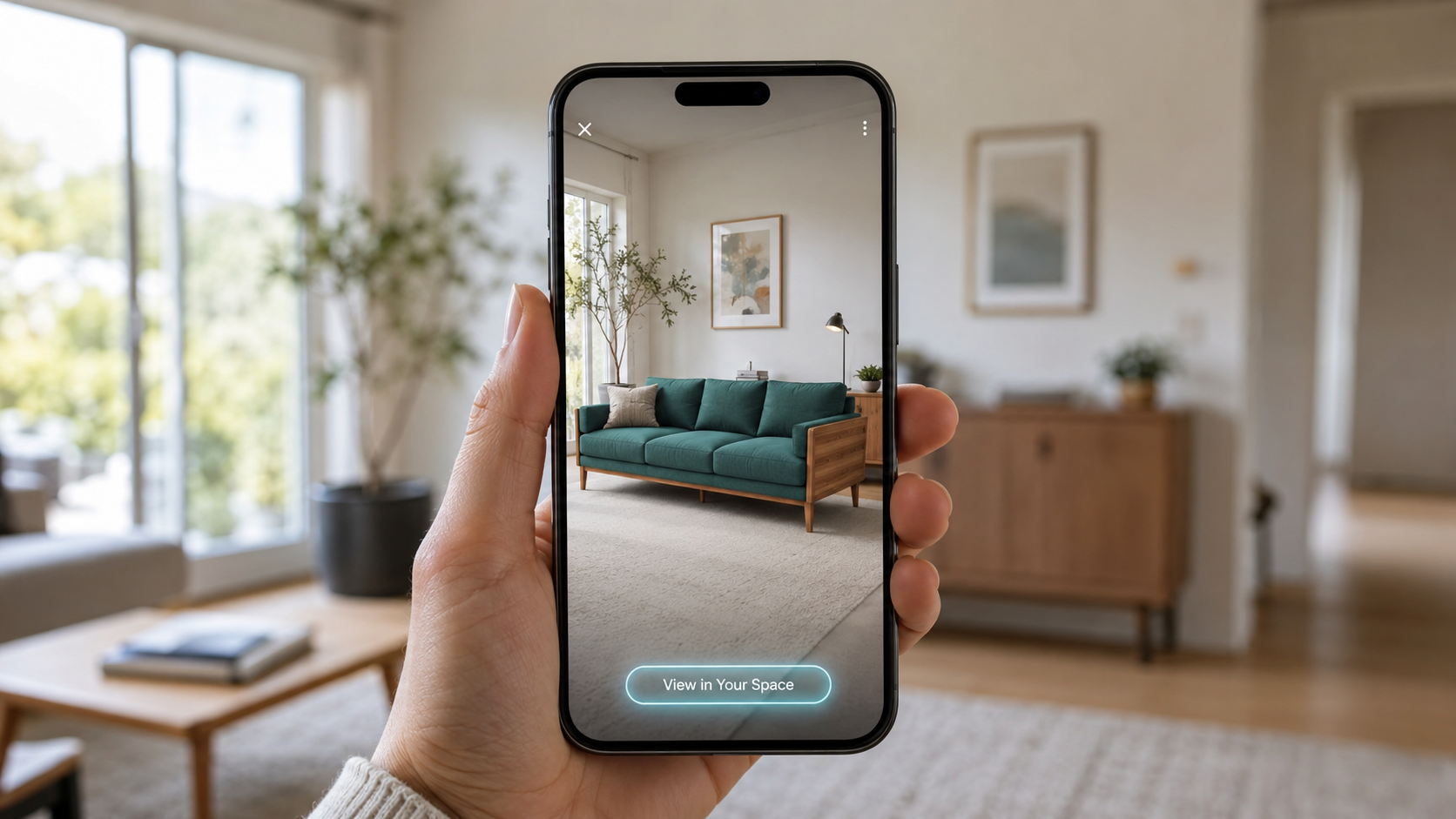
Unlike virtual reality, which replaces the real world with a simulated one, AR keeps the shopper's actual surroundings and overlays a digital product on top. A customer points their smartphone camera at their living room, selects a sofa from your store, and sees a true-to-scale 3D model of that sofa sitting in their actual room — in the right position, at the right size, in the real lighting conditions of their home.
The reason this drives such dramatic results goes back to the fundamental psychology of purchase hesitation. AR turns browsers into buyers by letting them inspect products before checkout. The single biggest obstacle in online shopping has always been the inability to touch, try, or see a product in context. AR removes that obstacle.
Multiple studies support this: one survey found that 71% of shoppers would shop more frequently if AR were available, as it makes the experience more realistic.
Snap Inc. reported that consumers who engage with AR are 2.4 times more likely to make a purchase than those who do not interact with AR features.
The confidence that AR creates doesn't just drive conversions — it drives better purchasing decisions. When customers know exactly what they're getting, returns fall because the gap between expectation and reality disappears.
The Return Rate Problem AR Directly Solves
Returns are one of the most expensive operational realities in ecommerce, and they're getting worse. AR cuts product return rates by 22–40%, addressing an $849.9 billion US returns problem.
That figure deserves context. Returns don't just cost you the shipping expense — they cost you restocking labor, potential damage write-offs, customer service time, and the margin on any product that can't be resold at full price. For high-ticket or fragile items, a single return can eliminate the profit margin from multiple successful sales.
The reason AR reduces returns so dramatically is that it solves the specific decision failures that cause most returns in the first place:
Size and scale misestimation. "It looked smaller in the photos" is one of the most common return reasons for furniture, home décor, and large appliances. When a customer places a true-to-scale 3D model in their actual room, they can see immediately whether it fits — and make the right size decision before purchasing.
Color and finish mismatch. Product photos are shot under studio lighting that rarely reflects how a product looks in a customer's home environment. AR rendering in the customer's actual lighting conditions gives a dramatically more accurate representation of how a product will appear in its real setting.
Fit and proportion uncertainty. In fashion and accessories, the gap between how a product looks on a model and how it looks on the customer's specific body shape drives enormous return volumes. Virtual try-on AR overlays the product directly on the customer's camera view, addressing this gap at the point of decision.
Shopify reports that 3D and AR product media can lower returns by 40% by aligning customer expectations with reality.
Every percentage point reduction in return rate is pure margin recovery — revenue you've already earned that stops leaking out through the returns process.
The Conversion Rate Case: The Data Is Unambiguous
Merchants with 3D models report up to 94% higher conversion rates according to Shopify.
That headline number is the one most commonly cited, and it's real — but the more granular data from specific brand implementations shows exactly where the lift comes from.
When fashion brand Rebecca Minkoff experimented with 3D models, shoppers were 44% more likely to add an item to their cart after interacting with it in 3D, customers were 27% more likely to place an order after interacting with a product in 3D, and visitors were 65% more likely to place an order after interacting with a product in AR.
Wayfair's room-placement AR delivered 92% higher conversions and 43% fewer returns.
IKEA Place: AR-engaged users show a 189% higher conversion lift, with true-to-scale 3D models from the entire catalog reducing purchase mistakes for furniture.
Houzz saw an 11x conversion boost and Overstock.com reported up to 200% higher conversions after adding AR product visualization.
These aren't outlier results from brands with uniquely expensive or complex products. They reflect a consistent pattern across categories: when customers can see a product in their real environment or on their real body, their confidence in the purchase decision increases substantially, and that confidence converts to sales.
AR users spend 75 seconds on product pages with 3D viewers versus 49 seconds without. This signals to search engines that the page provides relevant content, lowering bounce rate and improving Core Web Vitals engagement signals.
The SEO benefit compounds the direct conversion benefit. More time on page, lower bounce rate, and higher engagement metrics send positive ranking signals that improve organic visibility over time.
Which Product Categories Benefit Most From AR
AR delivers the clearest ROI in categories where the gap between online images and physical reality is widest. Not every product benefits equally — knowing which categories justify AR investment helps you prioritize your implementation.
Furniture and Home Décor
Room visualization uses a smartphone's camera and built-in LiDAR or depth sensors to scan the physical environment and create a spatial map. The shopper then selects a product — a couch, a lamp, a rug — and places a true-to-scale 3D model in their room. They can walk around the virtual product, adjust its position, and see how it interacts with existing furniture and lighting.
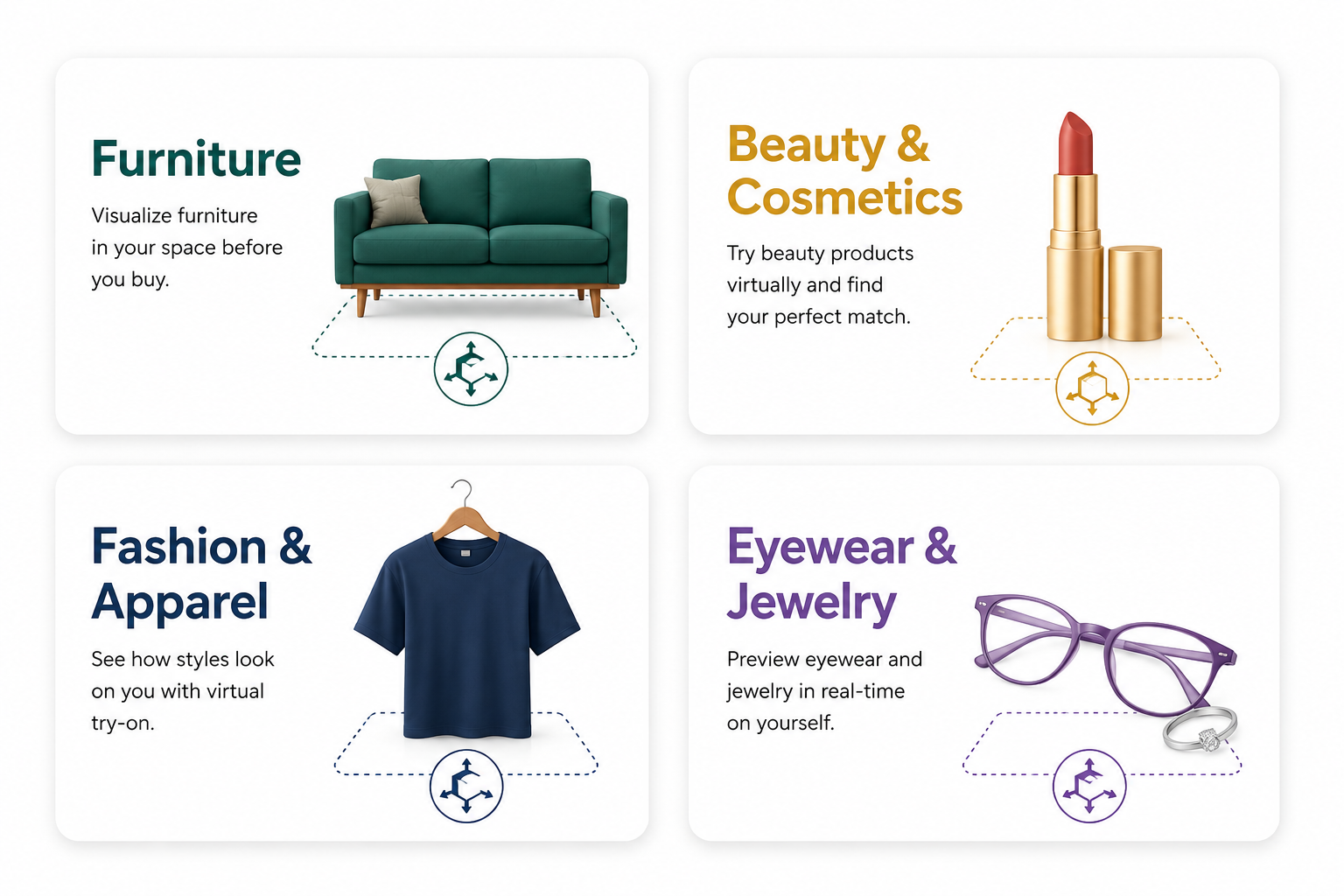
This category sees the largest absolute conversion gains from AR because room-placement visualization answers questions catalog photos fundamentally cannot: will it fit, will it match, and how big is it actually? Size anxiety is the primary barrier to furniture purchase online, and AR removes it entirely.
Fashion and Apparel
Virtual try-on for clothing overlays garments on the customer's live camera view, showing fit, drape, and proportion on their specific body shape. The return rate impact in fashion is particularly significant because fit-related returns account for the majority of clothing returns industry-wide. Beauty brands report 2–3x higher conversion rates and 25% fewer returns when customers can see products on their own face.
Cosmetics and Beauty
Cosmetics try-on allows customers to see how foundation shades, lipstick colors, eye shadow, and other makeup products look on their skin. ModiFace, now owned by L'Oréal, Perfect Corp's YouCam, and Banuba provide try-on SDKs that integrate with Shopify.
L'Oréal's ModiFace try-on cut returns 31%. Sephora's Virtual Artist AR app recorded over 8.5 million try-ons in its first year, giving users the confidence to purchase cosmetics online.
Eyewear and Jewelry
Jewelry try-on enables customers to see how rings, bracelets, necklaces, and earrings look when worn. AR overlays the jewelry on the customer's hand, wrist, neck, or ear using the device camera. This addresses the primary hesitation in online jewelry shopping: uncertainty about size, proportion, and appearance on the customer's specific features.
Eyewear brands like Warby Parker built their entire online conversion strategy around virtual try-on — the ability to see frames on your own face eliminates the primary reason shoppers historically hesitated to buy glasses online.
Large and Configurable Products
For large items like dog kennels from Gunners Kennels, AR lets customers see if they're choosing the right size for their pet and their home by actually showing how it looks in a room. Any product where customers need to verify size, compatibility, or fit within an existing environment benefits from AR — including outdoor furniture, fitness equipment, appliances, and pet products.
How Shopify Natively Supports AR
Shopify has invested significantly in making AR accessible to merchants at the platform level, meaning the infrastructure is already in place — you just need to create the 3D content.
Merchants who add 3D content to their stores see a 94% conversion lift on average. Merchants can take advantage of these features by adding the Shop channel and uploading 3D content to their catalog on Shopify. 3D and AR features automatically appear on the product detail page for products with 3D content.
On any Shopify product page with a 3D model uploaded, compatible devices — iPhone and iPad with ARKit, Android devices with ARCore — automatically display a "View in your space" button. No additional app is required on the merchant side. Customers tap the button, their camera activates, and they can place the product in their real environment.
Shopify supports two 3D file formats: GLB for Android AR via ARCore, and USDZ for Apple AR via ARKit. Both files need to be uploaded to the product in Shopify admin for cross-platform compatibility.
3D models must be compressed for fast mobile loading. Target file sizes under 5 MB for GLB and under 10 MB for USDZ. Use tools like glTF Transform or Vntana's optimizer to reduce polygon count and compress textures without visible quality loss. Implement lazy loading so 3D assets only download when the shopper interacts with the viewer.
The Best Shopify AR Apps in 2026
Beyond Shopify's native 3D model support, several apps extend AR capabilities significantly — adding virtual try-on, multi-variant support, cross-channel deployment, and advanced analytics.
LEVAR Transform your store with 3D, AR (See in Your Space), and Virtual Try-On across all channels — product pages, email, SMS, social, and landing pages. The highly-rated, one-click integration supports variant customization, letting customers view, try on, and place products virtually — no app download needed. Upload existing 3D models or let the team create professional ones.
LEVAR is one of the strongest options for merchants who want AR deployed across multiple touchpoints simultaneously — not just on product pages but also in email campaigns, SMS flows, and social content.
Zakeke A visual commerce platform offering 3D product configurators, AR visualization, and virtual try-on in a single integration. Particularly strong for configurable products — furniture with color/fabric options, apparel with sizing variations, and products where customers need to see their specific customization in AR before committing.
Aryel WebAR-focused platform that delivers AR experiences directly in the mobile browser without any app download requirement. Aryel's strength is accessibility — 100% of smartphone users can access WebAR experiences, compared to app-based AR which requires installation. Includes AR analytics showing exactly which products are being viewed in AR, for how long, and what percentage of AR viewers convert.
Threekit Enterprise-grade 3D and AR platform used by brands including Crate & Barrel, Restoration Hardware, and GE Appliances. Full product configurator capabilities, photorealistic rendering, and robust analytics. Best for Shopify Plus merchants with complex configurable catalogs and significant AR budgets.
Shopify AR (Native) For merchants who want to start with minimal cost and complexity, Shopify's native 3D model support with no third-party app required is the simplest entry point. Create your 3D models, upload both GLB and USDZ files to your products, and the "View in your space" button appears automatically. Zero monthly app cost — just the 3D model creation expense.
How to Create 3D Models for Your Shopify Products
The historical barrier to AR adoption was 3D model creation cost. That barrier has largely disappeared.
Creating a 3D model suitable for AR previously cost $500–$5,000 per product through specialist agencies. Today, automated photogrammetry tools, AI-assisted 3D modeling, and simplified creation platforms have reduced costs to $50–200 per model, making AR accessible to Shopify brands of all sizes.
Your options for creating 3D models in 2026:
AI photogrammetry from smartphone photos. Apps like Polycam and KIRI Engine generate store-ready 3D models from a set of smartphone photos taken from multiple angles. For products with simple geometry — boxes, bottles, flat objects — results are excellent. For complex organic shapes, quality varies.
Professional 3D modeling services. Platforms like Vntana, CGTrader, and Shopify's own partner network connect merchants with 3D artists who create photorealistic models from product photos or technical specifications. Cost ranges from $50–$500 per model depending on complexity and quality level.
Manufacturer CAD files. For products with existing engineering CAD files — electronics, furniture, appliances — these can often be converted to AR-ready GLB and USDZ formats at significantly lower cost than building from scratch.
LEVAR's managed 3D creation. LEVAR offers a service where merchants ship products to their studio team, who create photorealistic 3D models and upload them directly to your Shopify store. Higher cost than DIY but guaranteed quality and compatibility.
Most brands start with a small pilot of 10–20 products before scaling. Starting with your highest-traffic, highest-return-rate products gives you the clearest ROI signal and the fastest payback period on model creation costs.
How to Add AR to Your Shopify Product Pages: Step by Step
Step 1: Identify your pilot products. Choose 5–10 products where AR would most directly address purchase hesitation — your highest-return SKUs, your highest-ticket items, or your most visually complex products.
Step 2: Create your 3D models. Use photogrammetry, a professional modeling service, or LEVAR's managed creation. Ensure you receive both GLB (for Android) and USDZ (for iOS) files for each product.

Step 3: Optimize file sizes. Compress models to under 5 MB for GLB and under 10 MB for USDZ before uploading. Oversized files create slow load times that undermine the AR experience and hurt page speed.
Step 4: Upload to Shopify admin. Navigate to your product in Shopify admin, scroll to the Media section, and upload your 3D model files. Shopify automatically detects the file type and enables the "View in your space" button on compatible devices.
Step 5: Install your chosen AR app if extending beyond native. If you want virtual try-on, multi-variant AR support, or cross-channel deployment, install LEVAR, Zakeke, or Aryel and connect your existing 3D models.
Step 6: Test on real devices. Open your product page on an actual iPhone and an actual Android device. Verify the AR button appears, launches correctly, and that the 3D model renders at the right scale and quality. Browser emulation cannot replicate real AR performance.
Step 7: Track your metrics. Track conversion rate comparing AR users to non-AR users on the same SKUs, average session duration on AR-enabled product pages, and return rate changes at 60 and 90 days post-launch. These three metrics directly demonstrate ROI.
The Real Cost of AR on Shopify: What to Budget
Shopify's native AR feature is free — you only pay for 3D model creation. For a pilot of 10 products using professional modeling services at $150 per model, total investment is $1,500.
For a store with a 2% conversion rate, 50,000 monthly visitors, and $80 average order value, that pilot generates $80,000 per month in baseline revenue. If AR improves conversion rate on those 10 products by even 20% — well below the documented benchmarks — the monthly revenue increase is $16,000. The $1,500 investment pays back in less than three days.
Using conservative improvements below values reported by Shopify and IKEA, the investment pays for itself within one to two months.
The combination of higher conversion rate and lower return rate means AR pays back twice — once on sales that wouldn't have happened without AR confidence, and again on returns that don't happen because customers made better-informed purchasing decisions.
What to Expect: Realistic Timelines and Results
Most Shopify merchants see measurable impact from AR within 30–60 days of launch. The pattern typically looks like this:
Weeks 1–2: Launch AR on pilot products, verify technical implementation, begin accumulating session data.
Weeks 3–4: First meaningful conversion data emerges. AR users typically convert at higher rates immediately because the technology self-selects highly engaged, high-intent shoppers.
Weeks 5–8: Return rate data becomes meaningful as the first wave of AR-influenced purchases flows through the 30-day return window.
Weeks 9–12: Full ROI picture is visible. Conversion lift and return rate reduction together give you the data needed to justify expanding AR to your broader catalog.
The cost and complexity of AR implementation have dropped by roughly 70% since 2022. The technology that generated enterprise-level results for IKEA, Wayfair, and Rebecca Minkoff is now accessible on a Shopify Basic plan. The merchants who implement it now are building a measurable conversion and retention advantage while the majority of their competitors are still selling with static photos.
Want help adding AR product previews to your Shopify store, or need a development partner to implement 3D models and optimize your product pages for conversion? Get in touch with EcomFixify — we specialize in Shopify development and ecommerce optimization for growing brands.