
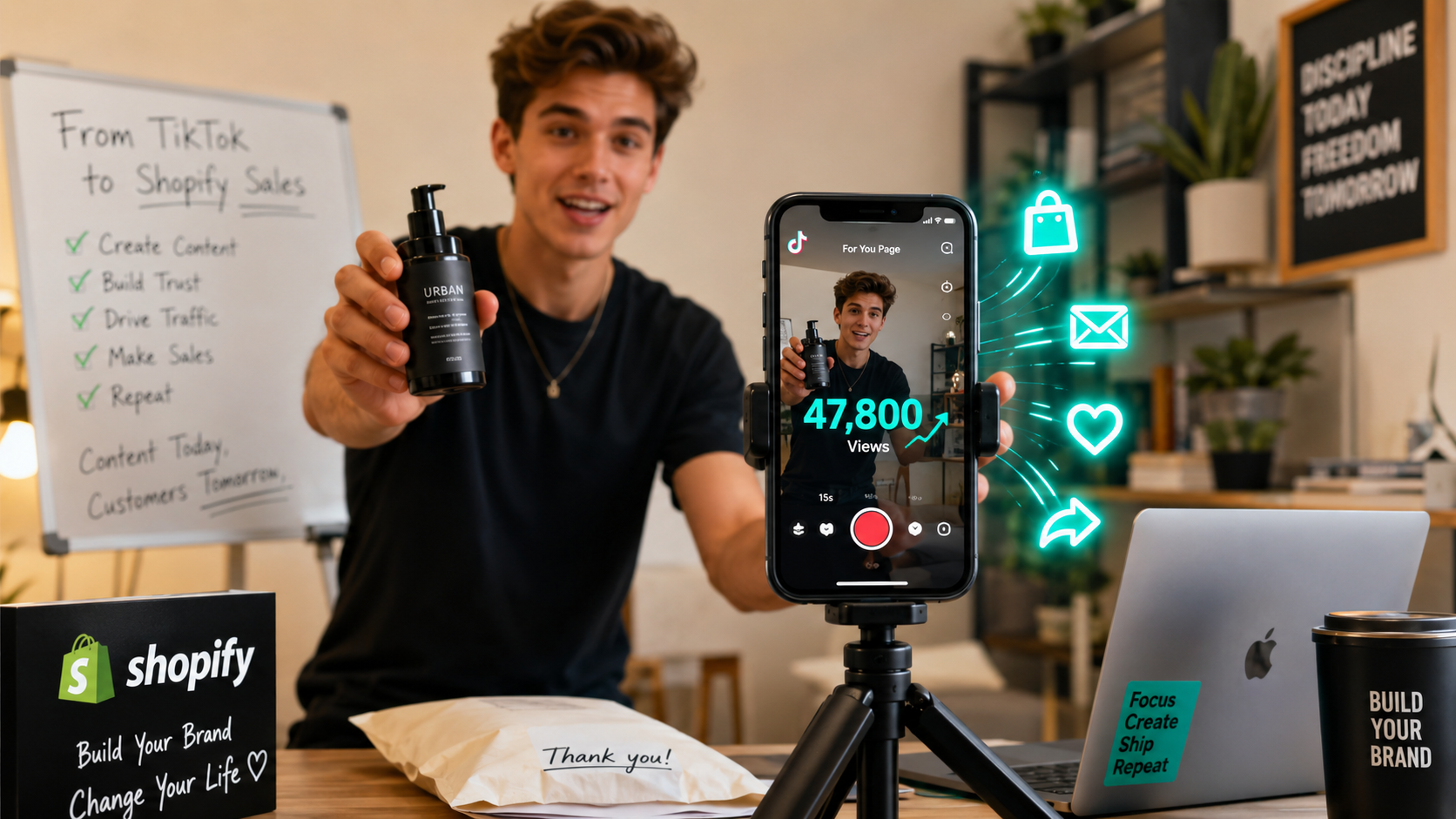
Use TikTok Organic to Drive Free Traffic to Your Shopify Store in 2026
Most Shopify merchants believe that getting traffic requires spending money. Facebook ads, Google Shopping, influencer sponsorships — money goes out before any money comes in. That belief is not wrong for most channels. But it has never been less true for TikTok. Use TikTok Organic to Drive Free Traffic to Your Shopify
TikTok is the only major social platform in 2026 where a Shopify store with zero followers and zero ad budget can post a video today and wake up tomorrow to thousands of visitors and real sales. The algorithm does not care how long your account has been active, how many followers you have accumulated, or whether you have ever spent a dollar on TikTok ads. It cares about one thing: does this content make people stop scrolling and keep watching?
That meritocratic discovery engine is what makes TikTok organic the most powerful free traffic channel available to Shopify merchants right now. TikTok's own research shows that 74% of users say the platform inspired an unplanned purchase — not from a paid ad, but from organic content that appeared in their For You Page because the algorithm decided it was worth surfacing. Brand discovery through social media now matches conventional search engines for US consumers, with 38% preferring each channel for product research.
The opportunity is real. But the bar has shifted significantly since 2023. Posting a product demo with trending audio and a text overlay no longer reliably generates views. TikTok's algorithm in 2026 heavily rewards what the platform calls original content with narrative structure — videos that tell a story, demonstrate a transformation, or create genuine emotional engagement rather than simply showcasing a product. Understanding exactly what that means in practice is the difference between an account that generates consistent free traffic and one that posts daily and wonders why nothing happens.
This guide covers the complete TikTok organic strategy for Shopify stores in 2026 — from account setup and content pillars through hook formulas, posting cadence, and how to convert TikTok viewers into Shopify customers and email subscribers.
Why TikTok Organic Still Works When Other Free Channels Have Declined
Instagram organic reach has collapsed to single-digit percentages of followers for brand accounts. Facebook organic reach for business pages is effectively zero without paid amplification. Pinterest traffic builds slowly over months before generating meaningful volume. SEO takes three to six months minimum before new content ranks for competitive terms.
TikTok organic is structurally different from every one of these channels because of how its algorithm distributes content. When you post a video on Instagram, it is shown primarily to your existing followers. When you post a video on TikTok, it enters a testing pool regardless of your follower count. TikTok shows the video to a small initial audience of 200 to 500 people. If that audience watches most of the video, replays it, comments, or shares it, TikTok interprets that engagement as a quality signal and expands distribution to 5,000 people, then 50,000, then 500,000 — with no follower requirement and no spend.
That distribution mechanic means TikTok is the only major platform where organic reach scales based on content quality rather than account age or advertising budget. A new Shopify store that posts one genuinely compelling product video can reach more potential customers in 48 hours than months of Instagram posting would deliver.
The catch is that genuinely compelling has become harder to achieve as TikTok has matured. The platform's user base has grown significantly more sophisticated since its explosive 2020 to 2022 growth period. Users have developed strong pattern recognition for content that feels like advertising. The formats that felt fresh in 2022 — product closeups with trending audio, unboxing videos with simple text overlays — now generate scroll-past behavior rather than engagement. The content that works in 2026 is more narrative-driven, more authentic, and more specifically targeted to a defined audience.
Setting Up Your TikTok Account for Shopify Success
Before your first post, the account setup decisions you make determine how the algorithm categorizes your content and which audiences it tests your videos against.
Create a dedicated TikTok Business Account for your Shopify store rather than a personal account. Business accounts give access to TikTok analytics — which shows who is watching your content, when they are most active, and which videos are driving the most profile visits — and enable the link in bio functionality that sends viewers to your Shopify store. Switch to Business account in Settings, then Manage Account, then Switch to Business Account.
Complete your profile fully before posting. A clear, recognizable profile photo, a bio that states specifically what your store sells and who it is for in two lines or fewer, and a link to your Shopify store or a Linktree that includes your store URL. TikTok reduces the discoverability of accounts with incomplete profiles, so a complete setup before your first video ensures your initial content is distributed properly.
The niche signal you send in your first ten videos is critical for how the algorithm categorizes your account. TikTok assigns content to topic categories based on the caption keywords, audio used, and engagement patterns of early videos. An account whose first ten videos are all clearly about skincare gets categorized as a beauty account and its subsequent videos are shown to users the algorithm has identified as interested in beauty. An account that posts across multiple unrelated categories confuses the categorization signal and receives lower distribution.
Post exclusively within your product niche for at least the first four weeks. If you sell home decor, every video in the first month should be home decor content. If you sell supplements, every video should be fitness, wellness, or nutrition content. The consistency of niche signal in your early content is the foundation that makes everything posted afterward reach the right audience.
The TikTok Content Pillars That Drive Shopify Traffic
The merchants generating consistent free traffic from TikTok organic are not posting randomly. They organize their content around a small number of repeatable pillars — content categories that consistently generate the views, profile visits, and link clicks that translate into Shopify traffic.
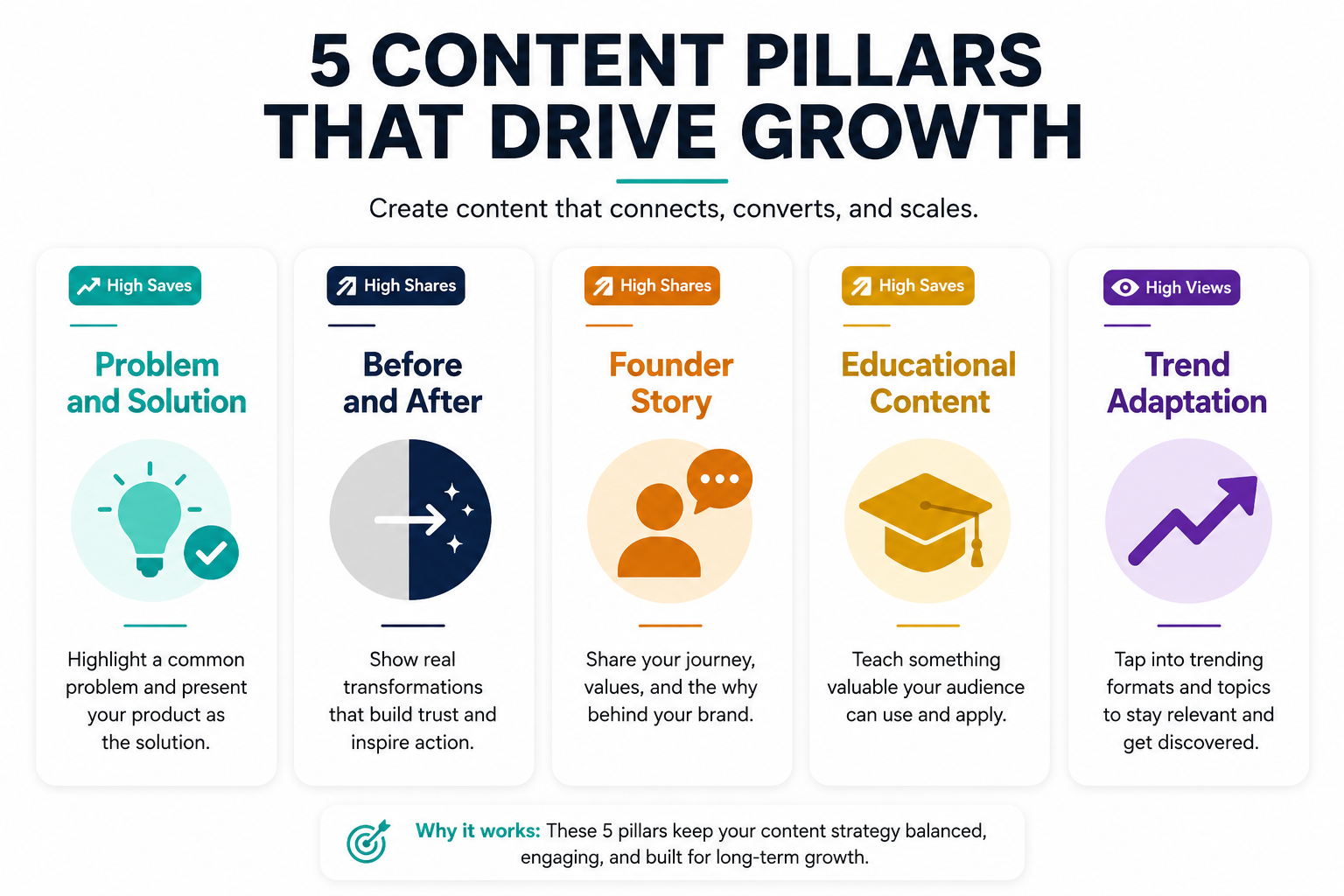
Pillar 1: Problem and Solution Demonstrations
This is the highest-converting content format on TikTok for Shopify stores in 2026. The structure is simple: identify a problem your target customer experiences, demonstrate the problem vividly in the first three seconds, then show your product solving it completely.
The reason this format works so consistently is attention mechanics. TikTok viewers are scrolling constantly. The content that makes them stop is content that either resonates with a problem they experience personally or surprises them with something unexpected. A video that opens with "If you have dry skin that flakes through your foundation, watch this" is targeting a specific viewer who immediately recognizes their own experience and stops to watch.
The problem does not need to be dramatic or serious. It can be a minor inconvenience, an aesthetic issue, or a daily frustration. What matters is that it is real and specific to your target customer — specific enough that the right viewer immediately recognizes themselves in the description.
Pillar 2: Before and After Transformations
Transformation content is TikTok's most shared content format because it combines visual impact with an emotional arc. Starting from a clearly imperfect before state and arriving at a dramatically better after state creates the kind of satisfying content completion that drives replays, saves, and shares.
For Shopify brands, before and after works across almost every product category. A cleaning product transforming a stained surface. A skincare product improving skin texture over 30 days. A home organization product turning a chaotic drawer into a pristine storage solution. A hair tool transforming damaged hair. Each of these creates a visually compelling story that the algorithm rewards with extended distribution.
The most effective before and after videos on TikTok in 2026 show the transformation happening in real time within the video rather than cutting between two static images. Watching something change is more compelling than seeing that something changed — and watch time is the metric TikTok optimizes against most strongly.
Pillar 3: Founder and Behind-the-Scenes Content
The most underused content pillar for Shopify brands on TikTok is also one of the most powerful: showing the human behind the store. Founder-led content — where the person who built the brand talks directly to camera about why they made the product, how they source it, how they package orders, or what building the business is actually like — generates significantly higher engagement and brand loyalty than product-focused content.
The reason is trust. A viewer who watches five videos from the same founder and feels like they understand who that person is and why they care about what they make is not just a potential customer — they are a potential brand advocate who recommends the store to their network, defends it in comments, and chooses it over cheaper alternatives because the relationship with the founder matters to them.
This pillar does not require storytelling talent or on-screen charisma. It requires authenticity. A founder packing orders while talking about why they care about the product quality is more compelling than a polished product showcase produced in a studio. The rawness is the point.
Pillar 4: Educational and Value-First Content
Educational content — teaching your audience something useful related to your product category — builds the audience that becomes customers over time rather than immediately. This pillar is most valuable for brands with complex products or products that require education before purchase.
A supplement brand explaining the specific benefits of magnesium glycinate versus magnesium citrate is providing genuine value to anyone interested in sleep quality. A skincare brand explaining the difference between AHA and BHA exfoliants is educating potential customers who will eventually buy from the brand they trust most on the topic. A home organization brand sharing the specific folding technique that makes small closets work is generating saves and follows from exactly the people most likely to eventually buy their storage products.
Educational content generates higher save rates than most other formats — and saves are one of TikTok's strongest quality signals, which drives extended algorithmic distribution.
Pillar 5: Trend Adaptation
Every week on TikTok, specific audio tracks, content formats, and challenge structures trend across the platform. Participating in these trends while tying them to your product extends your reach beyond your established audience to anyone engaging with that trend broadly.
The key is adaptation rather than adoption. Copying a trending format without connecting it to your product generates trend views but not product awareness or store traffic. Adapting a trending format so that your product is a natural part of the execution generates trend reach with product discovery simultaneously.
This pillar requires faster content creation because trends move quickly — a format that trends this week may be dated in ten days. Brands that build the habit of checking TikTok's Trending Now section daily and asking "how could this format showcase my product?" consistently extend their organic reach beyond what niche-specific content alone can achieve.
The Hook Formula That Stops the Scroll
The first two to three seconds of every TikTok video determine whether the algorithm ever has the opportunity to distribute it. If viewers scroll past in the first two seconds, the video receives minimal distribution regardless of how good the content is after that point.
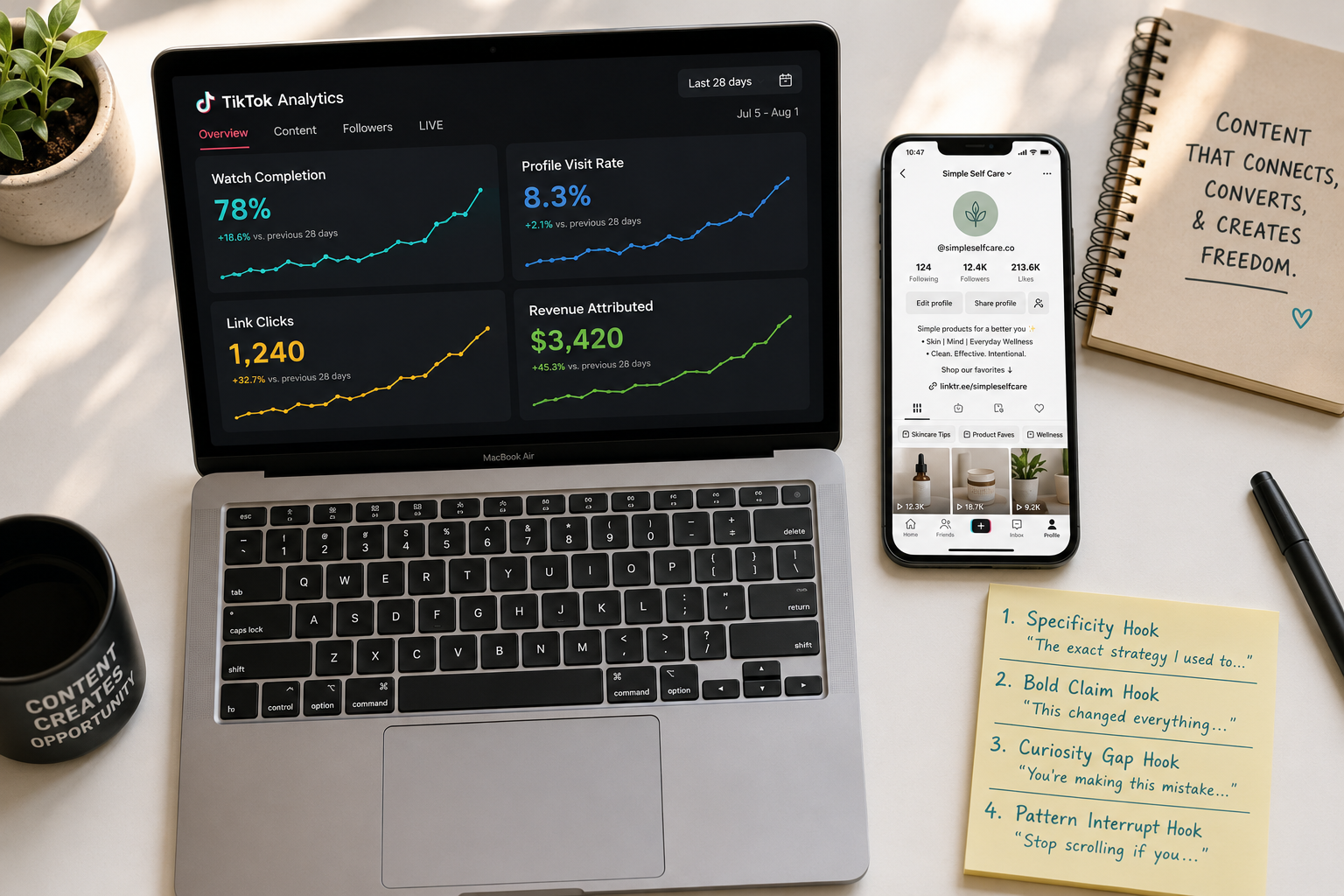
The hook — the opening statement, image, or action that captures attention immediately — is the most important element of any TikTok video for a Shopify brand. Several hook structures consistently outperform others in 2026.
The specificity hook targets a precise viewer identity. "If you have oily skin that breaks out in your T-zone" is more powerful than "for people with acne" because the specificity makes the right viewer feel personally addressed. The more precisely the hook describes the viewer, the higher the stop-scroll rate among that viewer segment.
The bold claim hook makes a statement that demands resolution. "This $12 product replaced my $80 moisturizer" creates a tension that the viewer needs to resolve by watching the video. The claim does not need to be extraordinary — it needs to be specific enough to be interesting and credible enough to be believable.
The curiosity gap hook withholds information the viewer wants. "The reason your skincare routine is not working has nothing to do with your products" opens a knowledge gap that the viewer needs to close. This format works particularly well for educational content because it frames the video as revealing something the viewer does not already know.
The pattern interrupt hook does something unexpected in the first frame. A surprising visual, an unexpected statement, or an incongruous combination — anything that does not match the viewer's expectation for the next piece of content in their feed. Pattern interrupts leverage the brain's automatic response to novelty and buy the critical two to three seconds needed for the hook to work.
Posting Cadence and Account Warming
New TikTok accounts should post one to three times per day for the first two weeks to warm up the account and signal to the algorithm that the account is active and producing regular content. During this warming period, quantity matters more than perfection — the goal is establishing the posting signal, not producing award-winning content.
After the initial two-week warming period, quality becomes more important than quantity. Posting five mediocre videos per day is significantly less effective than posting one genuinely compelling video. The algorithm's distribution decision is driven by engagement rate — the percentage of viewers who watch through, comment, share, or save — not by posting volume. A single video with strong engagement will outperform ten videos with weak engagement every time.
Once your account is established, three to five posts per week maintains the algorithmic distribution you have built while allowing enough production time to maintain content quality. The worst posting pattern for an established account is inconsistency — posting five videos in one week and zero videos the next. Consistent presence signals to the algorithm that the account is reliable, which influences how aggressively it distributes new content.
The best posting times for Shopify-relevant content in 2026 are Tuesday through Thursday from 7am to 9am, 12pm to 2pm, and 6pm to 10pm in your target market's timezone. These windows align with peak TikTok usage among the 18 to 35 demographic that represents the majority of the platform's purchasing behavior.
Converting TikTok Viewers Into Shopify Traffic and Email Subscribers
Generating views is only the first step. Converting those views into Shopify store visits and eventually into email subscribers is what transforms TikTok organic from a vanity metric into a business asset.
The bio link is your primary conversion mechanism. TikTok allows one clickable link in your bio. That link should go to your Shopify store's most relevant collection page or a dedicated landing page that captures email addresses before or alongside showing products. A generic homepage link wastes the high-intent traffic arriving from specific product videos — if someone clicked your link after watching a video about your moisturizer, they should land on your moisturizer collection, not a homepage that requires them to navigate to find what they were interested in.
Using a Linktree or a similar multi-link tool in your bio allows you to direct traffic to different destinations — your store, a lead magnet, your email signup, or your TikTok Shop — with separate tracking links that tell you which destination is converting best from your TikTok traffic.
A dedicated lead magnet specifically for TikTok traffic significantly improves email capture rates from the channel. Rather than linking directly to a product page that shows prices and requires an immediate purchase decision, a lead magnet page — "Download our free skincare routine guide" or "Get 15% off your first order" — captures the email address first and allows you to nurture the relationship through your email flows before asking for the purchase commitment.
UTM parameters on every link from TikTok — adding source equals tiktok and medium equals organic to your URLs — allow Google Analytics to track TikTok-sourced traffic separately from other channels. This data tells you which specific videos drove the most store visits, how long TikTok visitors stayed on your site, which products they viewed, and what percentage converted into purchases. Without UTM tracking, TikTok traffic disappears into your direct traffic bucket and you cannot measure the channel's actual contribution.
TikTok Organic to TikTok Shop: The Friction Reduction Strategy
For Shopify merchants who have connected their store to TikTok Shop — as covered in earlier EcomFixify guides — organic content becomes a direct purchase channel rather than just a traffic channel. A viewer who sees a product tag in your organic video and taps it to purchase does so entirely within TikTok, without the friction of clicking a bio link, waiting for an external site to load, finding the product, adding to cart, and completing checkout across platforms.
That friction reduction is commercially significant. Every additional step between a viewer's purchase intent and the completed transaction costs a percentage of conversions. TikTok Shop removes approximately four of those steps, which is why TikTok Shop-connected organic content consistently converts at higher rates than bio link traffic for the same products.
The optimal setup in 2026 uses organic content to drive both TikTok Shop purchases — through in-video product tags — and Shopify store traffic — through the bio link — simultaneously. In-video product tags convert the impulse buyers who will not navigate to an external store. Bio link traffic captures the higher-consideration customers who want more information, more product options, or the full brand experience that your Shopify store provides.
The Metrics That Tell You Whether Your TikTok Organic Is Working
Measuring TikTok organic performance requires looking beyond views to the metrics that indicate whether content is actually building your Shopify business.
Profile visit rate — the percentage of viewers who visit your profile after watching a video — tells you whether content is generating curiosity about your brand beyond the single video. A view rate above 5 to 10% indicates that viewers are interested enough in who is making this content to explore further.
Link click rate from profile visits to your bio link — trackable through UTM parameters in Google Analytics — tells you what percentage of profile visitors convert into store visitors. Improving this rate means improving either your bio copy and profile presentation or the relevance of your bio link destination.
Follower conversion rate — the percentage of video viewers who follow the account — tells you whether your content is compelling enough that viewers want to see more. A healthy follower conversion rate for a growing account is 0.5 to 2% of video viewers.
Watch time and completion rate are TikTok's primary quality signals and the metrics most directly correlated with algorithmic distribution. A video with 80% average watch time is being distributed aggressively by the algorithm. A video with 20% average watch time is being suppressed. Check these in TikTok analytics for each video and use them to understand what is keeping viewers engaged versus what is causing them to scroll away.
Revenue attributable to TikTok organic — tracked through UTM parameters and your Shopify analytics — is the ultimate metric. All other metrics are leading indicators. This is the outcome that determines whether your TikTok organic investment of time and creative energy is generating a business return.
Common TikTok Organic Mistakes That Kill Growth
Treating TikTok like a product catalog rather than a content platform is the most common and most costly mistake Shopify merchants make. A grid of product photos with prices and features reads like an advertisement to a TikTok audience trained to scroll past promotional content. Every video needs to provide value, entertainment, or genuine curiosity — with the product as the natural solution to the problem being addressed rather than the subject of a sales pitch.
Giving up after the first ten videos is the second most common mistake. TikTok organic requires persistence because the algorithm needs data to understand what your content is, who it is for, and when to distribute it. Most accounts see one video unexpectedly perform well between videos 15 and 40 — that breakout video is the algorithm finally finding your audience. Accounts that quit before that point never discover their content-audience fit.
Copying competitor content rather than developing original angles. TikTok's algorithm identifies duplicate or derivative content and reduces its distribution. More importantly, viewers who have already seen the original format respond poorly to imitations. Competitive research — watching what works in your niche — is valuable for understanding the category. Copying the format directly produces diminishing returns.
Ignoring comments is a missed relationship-building and research opportunity. Comments on your best-performing videos contain the exact language your audience uses to describe their problems and desires — language that should feed directly back into your hook writing and content planning. Responding to comments also increases the comment count and engagement rate of the video, which signals quality to the algorithm and extends distribution.
Final Thoughts
TikTok organic is not passive income. It requires consistent content production, creative iteration based on performance data, and the patience to let the algorithm learn what your content is worth distributing broadly. The total overhead of running a TikTok organic strategy for your Shopify store runs $50 to $80 per month in platform costs — compared to $2,000 or more monthly for a meaningful paid ads budget.
What TikTok organic builds that paid ads cannot is an audience that chose you. Every follower on your TikTok account decided, based on your content, that they wanted to see more of what you make. Every viewer who clicks your bio link and visits your Shopify store is arriving with a level of brand familiarity and interest that cold paid traffic cannot replicate. And every email subscriber captured through TikTok organic is a customer relationship built through content rather than purchased through advertising — which means it compounds in value rather than requiring continuous spend to maintain.
The Shopify brands that invested in TikTok organic in 2023 and 2024 are now generating meaningful free traffic from audiences they built systematically. The brands that start today are building the same asset — on a platform that still, uniquely among major social channels, surfaces genuinely good content to genuinely interested audiences regardless of how much money is behind it.
Need help connecting your Shopify store to TikTok Shop, or want a content strategy audit for your TikTok organic approach? Get in touch with EcomFixify — we specialize in Shopify development and social commerce integration for growing brands.