
The Truth About Shopify Dropshipping Margins in 2026
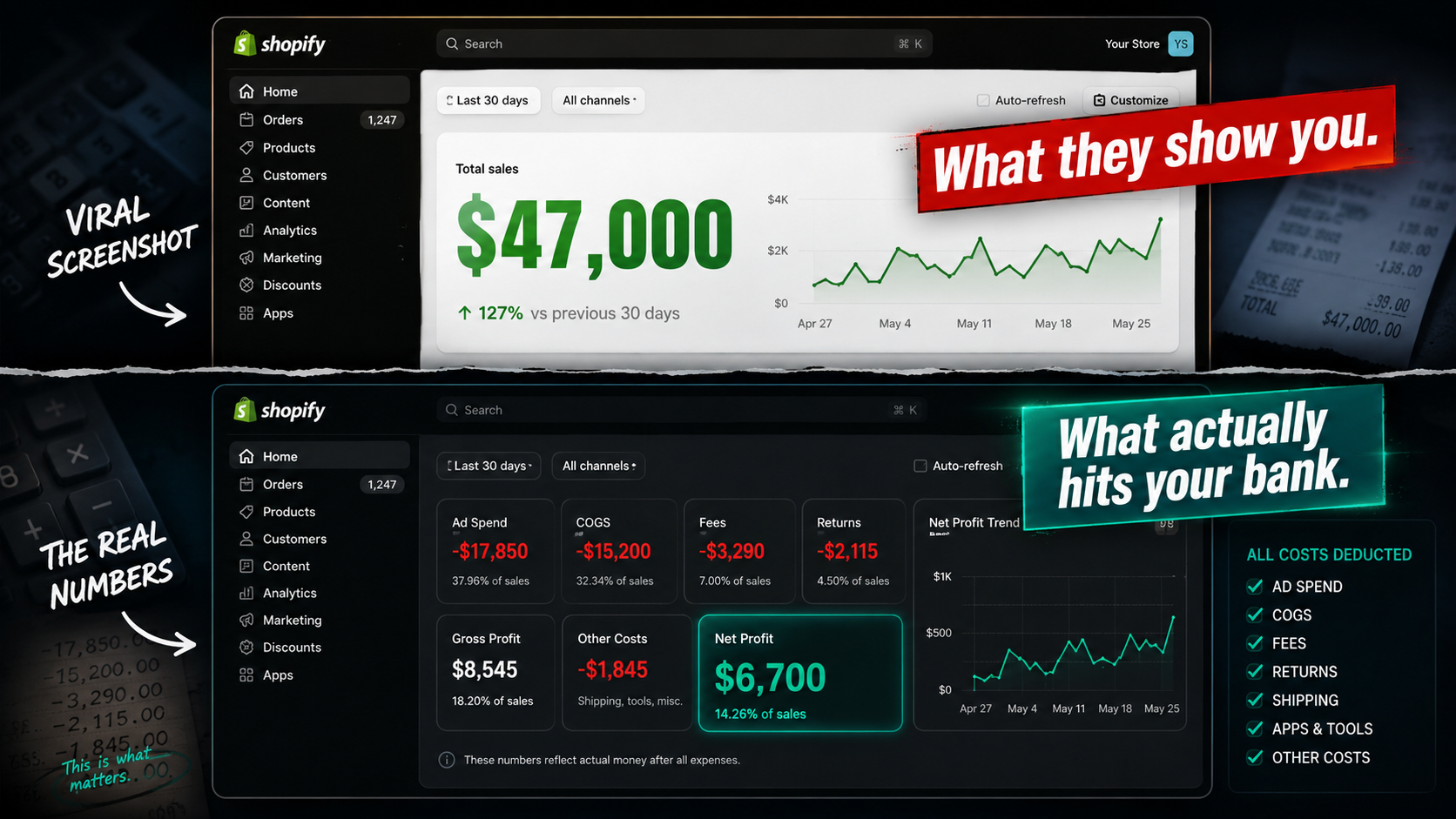
Here is the screenshot you have seen a hundred times: a Shopify dashboard showing $47,000 in monthly revenue, posted to YouTube or TikTok by someone selling a course about how they did it. It looks extraordinary. It is designed to look extraordinary. What it never shows is the next screen — the one with the ad spend, the supplier costs, the Shopify subscription, the payment processing fees, the returns, and the chargebacks.
A store doing $50,000 in monthly revenue might profit $3,000 after all costs. That is 6% net margin. It is real money. It is not the $50,000 the screenshot suggests.
This is not a post about whether dropshipping is dead. It is not dead — merchants are still launching dropshipping stores in 2026 and some of them are making significant money. It is a post about the actual numbers. What the margins really look like. Where the money goes between the customer clicking Buy and you pocketing a profit. And what the merchants who are genuinely profitable in 2026 are doing differently from the ones who generate impressive revenue screenshots while losing money every month.
If you are going to build a dropshipping business on Shopify in 2026, understanding these numbers before you start is the difference between building something that works and spending six months discovering why it does not.
The Margin Math Nobody Shows You
The YouTube guru version of dropshipping margins looks like this: buy a product for $10, sell it for $30, keep $20. A 67% margin. Easy money.
The real version looks like this.
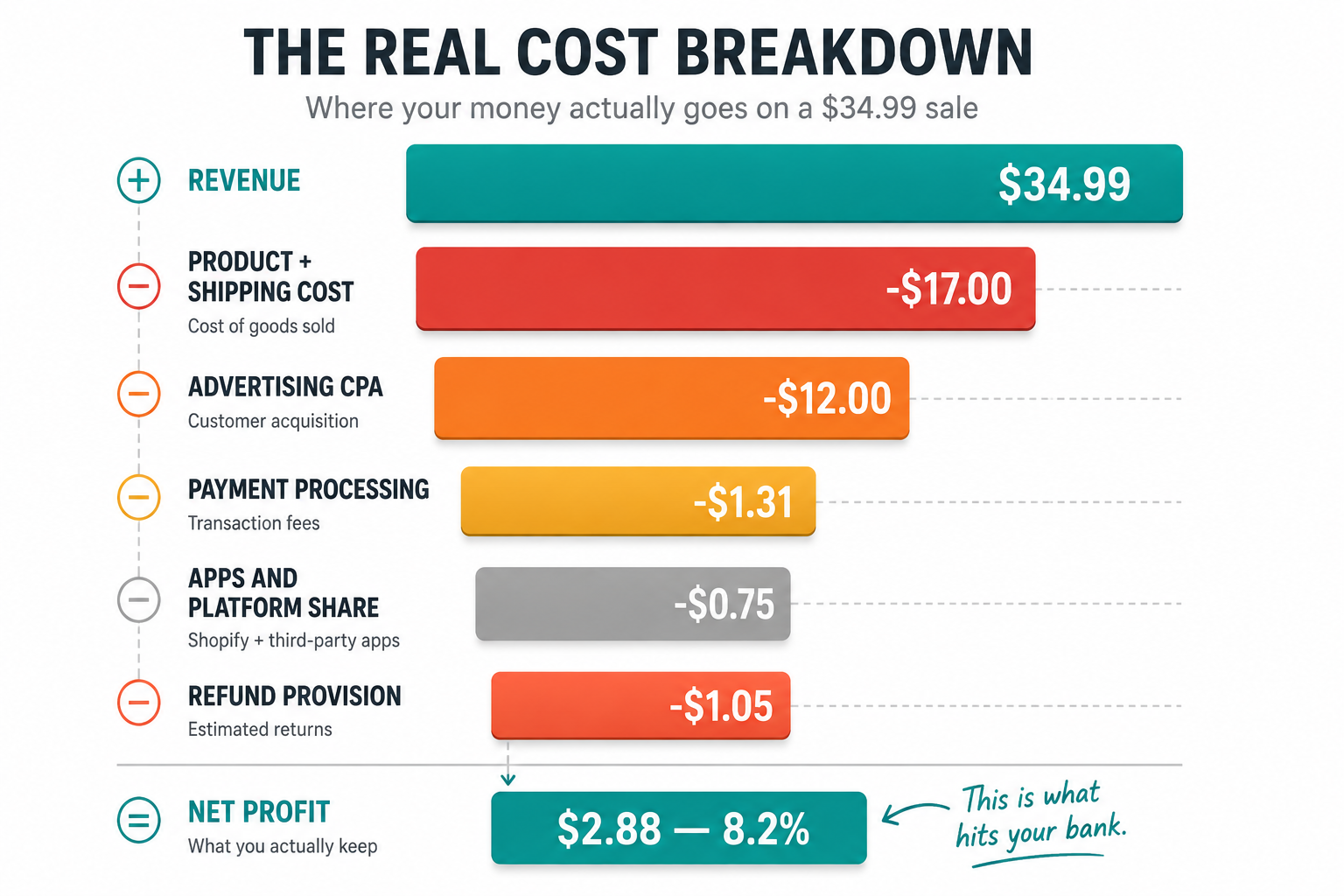
You find a product on a supplier platform — AliExpress, CJ Dropshipping, or a domestic supplier — for $10. But that $10 is the product cost only. Shipping from your supplier to your customer adds $7. Your actual cost of goods sold is $17, not $10. You sell the product for $34.99 to maintain what looks like a reasonable margin on paper.
To get someone to buy that $34.99 product, you run Meta ads. Your cost per acquisition — the amount you spend on advertising to generate a single purchase — is $12. That is relatively efficient. Many new dropshipping stores spend $20 to $40 per acquisition before finding a product and creative combination that converts well enough to bring CPA down.
Shopify Payments charges 2.9% plus $0.30 per transaction. On your $34.99 sale that is $1.31.
Your Shopify Basic plan costs $39 per month. You have three apps — a review app, an upsell app, and an email marketing tool — costing a combined $60 per month. Those fixed costs spread across your monthly order volume reduce per-order margin as a function of total volume.
Your refund and chargeback rate runs at 3% of revenue — standard for ecommerce, manageable but real.
The math on a single $34.99 order:
Revenue: $34.99 Product and shipping cost: $17.00 Advertising cost per acquisition: $12.00 Payment processing: $1.31 Share of fixed monthly costs (apps and platform): varies by volume Refund provision: $1.05
Net profit per order before fixed cost allocation: approximately $3.63 — a 10.4% net margin.
On 300 orders per month, that store generates $10,497 in revenue. It profits approximately $1,089 before fixed costs. After $99 in fixed monthly costs, the actual net profit is approximately $990 per month.
That is the honest version of what a $10,000 per month Shopify dropshipping store looks like in 2026. Not $10,000 in profit. $990 in profit. A 9.4% net margin on a business model that required real time, real skill, and real capital to build.
This is not a catastrophic result. Scaled to $50,000 in monthly revenue with improved margins from better sourcing and more efficient advertising, a well-run dropshipping store can generate $5,000 to $10,000 per month in net profit. That is a legitimate business. It is just not the passive income miracle the screenshot implies.
The Full Cost Stack: Every Fee That Eats Your Margin
Understanding every cost in the stack prevents the margin surprises that cause most dropshipping stores to fail financially while appearing to succeed on the revenue line.
Cost of Goods Sold
The product cost from your supplier is only one component of COGS. Add to it: shipping from supplier to customer, which for AliExpress and international suppliers ranges from $3 to $15 depending on destination and shipping method; packaging costs if you use branded packaging; quality control inspection costs if you use a third-party QC service; and any import duties or taxes applicable to your target market.
Domestic supplier partnerships — US, UK, or EU-based suppliers who stock inventory locally — dramatically reduce shipping time and eliminate most import-related costs but typically charge 20 to 40% more for the product itself than overseas alternatives. The margin impact of domestic sourcing varies by product and must be modeled specifically rather than assumed.
Advertising Costs
Advertising is the largest single cost in most Shopify dropshipping operations and the most variable. For a store scaling on Meta Ads, advertising spend typically consumes 30 to 40% of revenue. The merchants at the profitable end of that range are achieving customer acquisition costs that leave meaningful margin after all other costs. The ones at the unprofitable end are acquiring customers at a cost that exceeds the margin available on the product.
In 2026, average Meta advertising CPMs have risen significantly compared to 2020 and 2021 when many of the success stories circulating online were generated. The same budget that acquired 100 customers in 2021 acquires 60 to 70 in 2026. This does not make advertising-dependent dropshipping impossible — it makes product selection, creative quality, and post-purchase LTV optimization more important than they have ever been.
The merchants who maintain profitable advertising metrics in 2026 share specific characteristics: they test more creative variations, they optimize for lifetime value rather than first-order ROAS, they build email and SMS lists that allow repeat purchase marketing at near-zero marginal cost, and they target higher-AOV products that provide enough margin to absorb the cost of more expensive customer acquisition.
Shopify Platform and App Costs
Shopify's plan costs in 2026 run from $39 per month for Basic through $105 per month for Shopify and $399 per month for Advanced. For dropshipping stores doing meaningful volume, the Shopify plan ($105 per month) typically makes financial sense — the reduced transaction fee (1.0% versus 2.0% on Basic for non-Shopify Payments orders) pays for the plan upgrade at relatively low order volumes.
Payment processing through Shopify Payments charges 2.9% plus $0.30 per transaction on Basic, 2.6% plus $0.30 on Shopify, and 2.4% plus $0.30 on Advanced. For stores using third-party payment processors instead of Shopify Payments, Shopify adds an additional transaction fee of 2.0%, 1.0%, or 0.6% depending on the plan — a significant additional cost that many new merchants miss when calculating their margin structure.
Apps accumulate cost faster than most merchants expect. A review app ($15 per month), an upsell app ($30 per month), an email marketing platform ($20 to $100 per month depending on list size), a currency converter ($10 per month), a returns management app ($20 per month), and an analytics platform ($30 per month) collectively add $125 to $205 per month in fixed costs before you have done anything unusual. These costs are real and need to be factored into your margin calculations from the first month of operation.
Refunds, Returns, and Chargebacks
The average ecommerce refund and return rate is 20 to 30% across categories. For dropshipping specifically — where product quality is harder to control and shipping times are longer — return rates can run higher, particularly in fashion and electronics categories.
Chargebacks — disputes initiated through the customer's bank rather than through your store — are particularly costly for dropshipping businesses. Each chargeback costs the disputed transaction amount plus a chargeback fee of $15 to $25 from your payment processor, and excessive chargeback rates can result in account suspension. Dropshipping stores that source from low-quality suppliers and ship slowly are more susceptible to chargebacks than stores with better supplier relationships and realistic shipping time communication.
Provisioning 3 to 5% of revenue for returns and chargebacks in your margin calculations is conservative and accurate for a well-managed dropshipping operation. Stores with product quality issues or slow shipping can see this figure exceed 10%.
The Minimum Margin Target: 40% Gross Before Advertising
The margin benchmark that separates potentially profitable dropshipping products from ones that are mathematically impossible to profit from in 2026 is 40% gross margin before advertising costs.
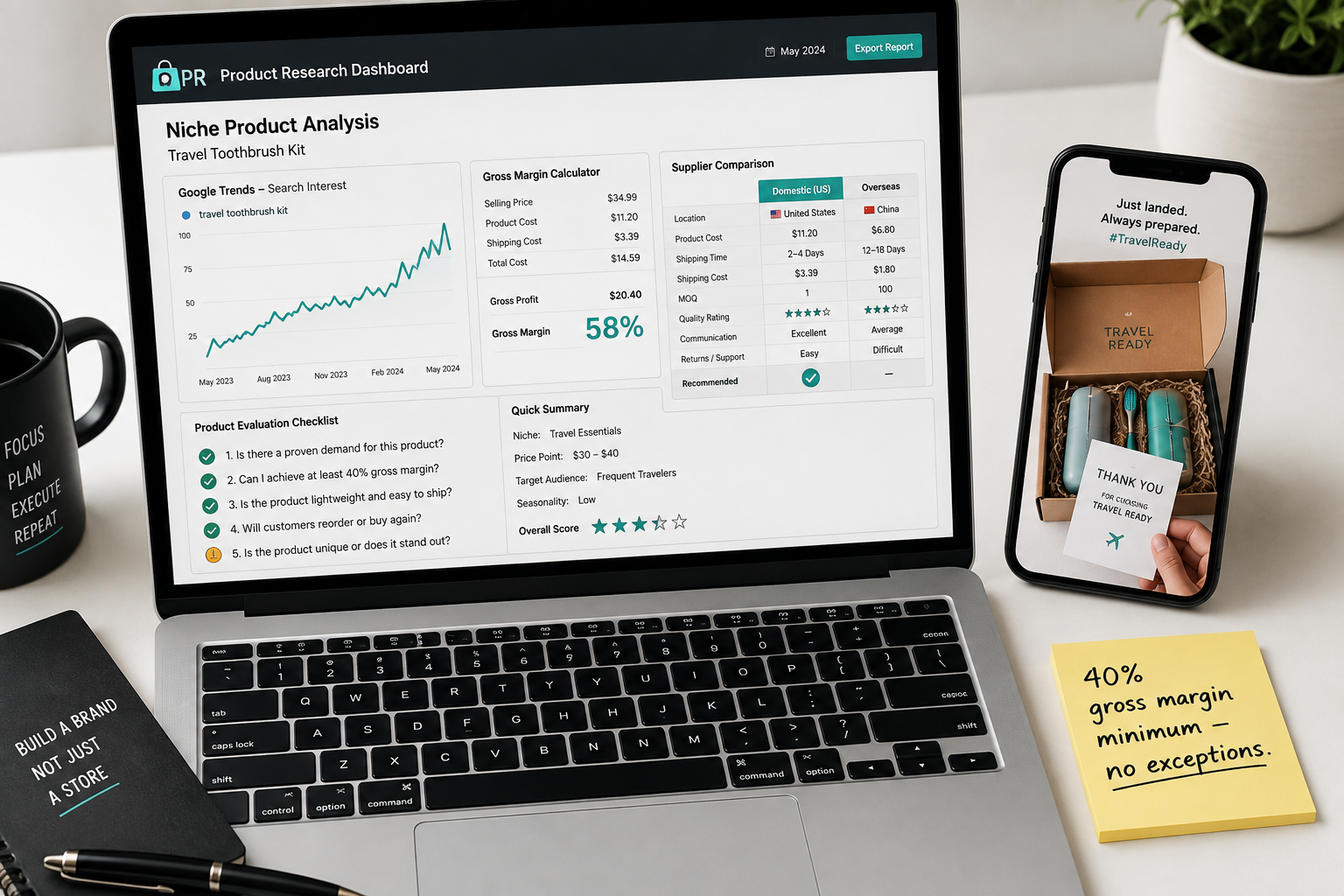
Gross margin in this context means your selling price minus COGS — the product cost plus shipping — expressed as a percentage of selling price. If a product costs you $17 (product plus shipping) and you sell it for $34.99, your gross margin is ($34.99 − $17) / $34.99 = 51.4%.
That 51.4% gross margin must cover advertising (typically 30 to 40% of revenue at scale), platform and app fees (3 to 5% of revenue), refunds (3 to 5% of revenue), and leave net profit. At 40% gross margin, you have almost no room for any of those costs. At 50% gross margin, you have room for a modest advertising spend and thin net profit. At 60% or more, you have meaningful room to build a profitable, scalable business.
Most commodity products — phone cases, generic jewelry, mass-market home décor — offer only 10 to 30% gross margin because supplier pricing is competitive, shipping costs are high relative to product cost, and selling prices are suppressed by Amazon and established competitors. Products in these categories are not dropshipping opportunities in 2026. They are race-to-the-bottom exercises in discovering how little margin a business can survive on.
The products worth dropshipping in 2026 are the ones that support 50% or more gross margin — which means higher selling prices relative to supplier cost, supplier relationships that provide genuine pricing advantage, or product categories where established marketplace competition is thin enough to support premium pricing without a price war.
What Is Actually Working in 2026: The Profitable Model
The dropshipping model that generated most of the success stories before 2022 — find a viral product on AliExpress, run Facebook ads, scale — largely stopped working as ad costs rose, consumers became more sophisticated about dropshipping quality and shipping times, and competition saturated every obvious niche within weeks of a product going viral.
The dropshipping model that is generating real profit in 2026 looks significantly different.
Niche Specialization Over Generic Products
The merchants generating sustainable margins in 2026 are not selling general products to general audiences. They are serving specific communities with products that those communities cannot easily find at comparable quality and price elsewhere.
A store selling generic fitness accessories competes with Amazon, Walmart, and hundreds of other dropshippers on price, and the margin available after that competition is minimal. A store that specializes in equipment for a specific training methodology — powerlifting, yoga with props, kettlebell training — serves a community that values specialist knowledge, trusts curated recommendations, and is willing to pay slightly more for products chosen by someone who understands their needs.
Niche specialization reduces advertising costs by improving targeting precision. It improves organic traffic potential through niche-specific SEO. It creates natural content opportunities — blog posts, social media content, email newsletters — that build community and reduce dependence on paid acquisition. And it generates word-of-mouth within the niche community that compounds over time.
Domestic Supplier Partnerships That Solve the Shipping Problem
The most common reason customers leave negative reviews and initiate chargebacks on dropshipping stores is shipping time. A customer who orders a product expecting delivery in five to seven days and receives it in 25 days from an overseas supplier is a customer who will dispute the charge, leave a one-star review, and tell everyone they know about the experience.
Domestic supplier partnerships — with US, UK, or EU-based suppliers who hold inventory locally — solve this problem fundamentally. Orders ship in two to five days. Customers receive what they expected when they expected it. Return rates drop. Chargeback rates drop. Repeat purchase rates increase.
The trade-off is COGS. Domestic suppliers typically charge 20 to 40% more than overseas alternatives for equivalent products. This requires either a higher selling price — justified by faster shipping, which is a genuine value proposition for most customers — or tighter sourcing negotiations to maintain margin.
The math still works for products with 50% or more gross margin potential. It does not work for commodity products where every percentage point of gross margin is already spoken for.
Private Label and Branded Dropshipping
The most margin-protective evolution in dropshipping in 2026 is the move toward private label — working with suppliers to produce products under your own brand name, with your own packaging, at exclusive pricing that prevents direct price comparison with competitors selling identical items.
Private label dropshipping requires more supplier relationship work, typically a minimum order commitment, and a slightly longer setup time than generic dropshipping. In exchange, it provides three significant commercial advantages: brand recognition that builds with every delivery, pricing power that commodity products can never achieve, and customer loyalty that generic dropshipping stores structurally cannot generate.
A customer who receives a product in your branded packaging, with a branded insert card and a QR code linking to your store's loyalty program, has had a brand experience — not just a fulfillment event. That experience creates the repeat purchase potential and word-of-mouth advocacy that transforms dropshipping from a thin-margin transaction model into a genuine brand-building business.
Email and SMS as Margin-Protection Channels
The dropshipping stores that achieve the highest net margins in 2026 are not the ones paying the lowest COGS. They are the ones generating the most repeat purchases through owned channels — email and SMS — that cost virtually nothing per send once the list exists.
A customer acquired through $15 in Meta ad spend who makes one $35 purchase generates approximately $3 in net profit at standard margins. The same customer who makes three purchases over six months, with the second and third purchases generated through email flows at negligible marginal cost, generates $9 in cumulative net profit from the same $15 acquisition cost.
Building the email list is not optional for profitable dropshipping in 2026 — it is the primary mechanism through which acquisition costs are amortized across multiple purchases. Every dropshipping store should be capturing email at checkout, running a post-purchase flow that nurtures toward a second order, and building a browse abandonment flow that recovers purchase intent from visitors who did not convert on their first session.
The Realistic Profit Timeline
The TrueProfit 2026 Dropshipping Profitability Outlook, which analyzed thousands of dropshipping stores, identifies three stages in the typical profitable store's development — and the stage that most failed stores never reach.
Stage one is buying data. The first 30 to 90 days of running a new dropshipping store should not be evaluated on profitability. They should be evaluated on information quality. What creative drives the lowest CPA? What audience converts at the highest rate? What products generate the fewest returns? The advertising spend in this stage is paying for answers to those questions, not for immediate profit.
Stage two is refining. The store has found at least one product and one creative combination that generates a CPA low enough to leave margin. The focus shifts to reducing CPA through better creative and targeting, improving COGS through better supplier negotiations, and building the email list that will fund future growth without proportionally increasing ad spend.
Stage three is scaling with systems. The product is proven, the economics are understood, and the operational infrastructure — supplier relationships, customer service, returns management, email flows — is established well enough to support volume growth without proportionally increasing labor costs.
Most dropshipping stores that fail do so in stage one — spending money on data collection without the analytical discipline to extract and act on what the data is saying, or giving up before a profitable product-market fit is found. The successful stores are the ones that treat stage one as a structured learning investment rather than an expectation of immediate return.
The Margin Reality Check: Product Selection Is 80% of Your Result
Product selection determines 80% of your dropshipping success. This is not a motivational platitude — it is the operational reality of a business model where margins are structurally thin and the product is the primary lever available to improve them.
The product evaluation framework that consistently identifies potentially profitable dropshipping products in 2026 requires answering five questions before adding any product to your testing lineup.
Does the product support 50% or more gross margin at a price customers will actually pay? Calculate COGS including shipping before you answer. Not the product cost alone.
Is there demonstrable demand that is not already saturated by Amazon, established brands, or hundreds of other dropshippers? Use Google Trends, TikTok product research, and Amazon BSR to answer this before testing with ad spend.
Does the product have a demonstration or transformation angle that works in video creative? Products that show dramatic results on camera — before-and-after transformations, unexpected utility, satisfying unboxing — consistently achieve lower CPAs on video-focused platforms because the creative does the selling work that generic image ads cannot.
Does the product have a natural repeat purchase cycle that makes email retention meaningful? Consumables, products with natural upgrade paths, and items that fit into a category where customers regularly buy more are structurally superior to one-time purchases for building LTV.
Can a domestic or regional supplier provide this product at competitive cost? If the only viable supplier is overseas with 20-day shipping, the customer experience disadvantage is a cost that will show up in your return rate and chargeback rate rather than your margin calculation.
Every product that passes all five tests is worth testing. Every product that fails any one of them requires a specific reason why the failed criterion does not apply before it earns testing budget.
The Bottom Line on Dropshipping Margins in 2026
Dropshipping on Shopify in 2026 is not the passive income machine the gurus sell. It is also not dead. It is a business model with real margin constraints, real operational requirements, and a realistic path to profitability that looks nothing like the revenue screenshots designed to sell courses.
The stores that profit are the ones that choose the right products — ones with 50% or more gross margin potential in underserved niches — partner with suppliers who can deliver in a timeframe that meets customer expectations, build email and SMS channels that generate repeat purchases at minimal marginal cost, and treat the first 90 days as a data-buying exercise rather than a profit expectation.
The stores that fail are the ones that chase viral products at thin margins, spend advertising budget without the analytical discipline to understand what the numbers are saying, and measure success by revenue rather than net profit.
Revenue does not pay the bills. Net profit does. And in dropshipping, net profit starts with understanding exactly where every dollar of revenue goes before it reaches your pocket — which is exactly what this guide exists to help you do.
Need help building a Shopify dropshipping store with the right margin structure and operational setup? Get in touch with EcomFixify — we specialize in Shopify development and ecommerce growth strategy for brands building for the long term.