
Sustainable Ecommerce: How Shopify Brands Are Winning
Sustainable Ecommerce: How Shopify Brands Are Winning With Green Practices in 2026
Sustainability has moved from a niche differentiator to a mainstream purchasing criterion — and the Shopify brands that recognized this shift early are now collecting the commercial rewards that come with it.
The numbers are no longer marginal. 80% of consumers actively try to buy from brands whose values match their own. 55% are willing to pay more for sustainable products. According to PwC's Voice of the Consumer survey, shoppers are paying an average 9.7% premium for products from brands with verified sustainability credentials — even as inflation and cost-of-living pressures push them to economize everywhere else.
The sustainable goods market crossed half a trillion dollars globally in 2025 and is growing two to three times faster than conventional retail. Brands like Allbirds, Patagonia, Tentree, and Rothy's — all running on Shopify — have turned environmental commitment into the core of their brand identity and built loyal, high-LTV customer bases that competitors with better-priced but less principled products consistently struggle to match.
This is not a story about doing the right thing at the expense of profit. It is a story about how doing the right thing has become one of the most durable competitive advantages in ecommerce.
This guide breaks down why sustainability matters more than ever in 2026, which green practices Shopify brands are implementing most effectively, how to communicate sustainability without falling into the greenwashing trap, and the specific apps and tools that make implementation practical for stores of any size.
Why Sustainability Has Become a Commercial Imperative, Not Just an Ethical Choice
The consumer shift toward sustainable purchasing is not a trend driven by a small group of activists. It is a mainstream behavioral change driven by generational wealth transfer and growing environmental awareness across all demographics.
Generation Z and Generation Alpha are now the fastest-growing consumer cohorts by purchasing power. These generations grew up with climate change as a lived reality rather than an abstract concern. They research brands before purchasing. They check sourcing claims. They share and amplify both authentic sustainability stories and greenwashing exposés with equal enthusiasm on social media.
47% of shoppers say they are willing to change their habits to shop more responsibly according to DHL's 2025 E-Commerce Trends Report, which surveyed 24,000 consumers across 24 countries. That is nearly half of your potential customer base actively thinking about where their money goes.
The business case for sustainability in ecommerce in 2026 operates on three levels simultaneously:
Customer acquisition: sustainable positioning attracts a growing segment of consumers who actively seek out and prefer green brands, often without price sensitivity.
Customer retention: consumers who buy from brands that share their values repurchase at higher rates and advocate for those brands to their networks, reducing customer acquisition costs over time.
Margin protection: sustainable products command price premiums that conventional products in the same category cannot. A 9.7% average premium on your entire product range is a significant margin contribution that compounds as your brand's sustainability credentials become more established and verifiable.
The brands missing this opportunity in 2026 are not just leaving ethical ground ceded to competitors. They are leaving revenue on the table.
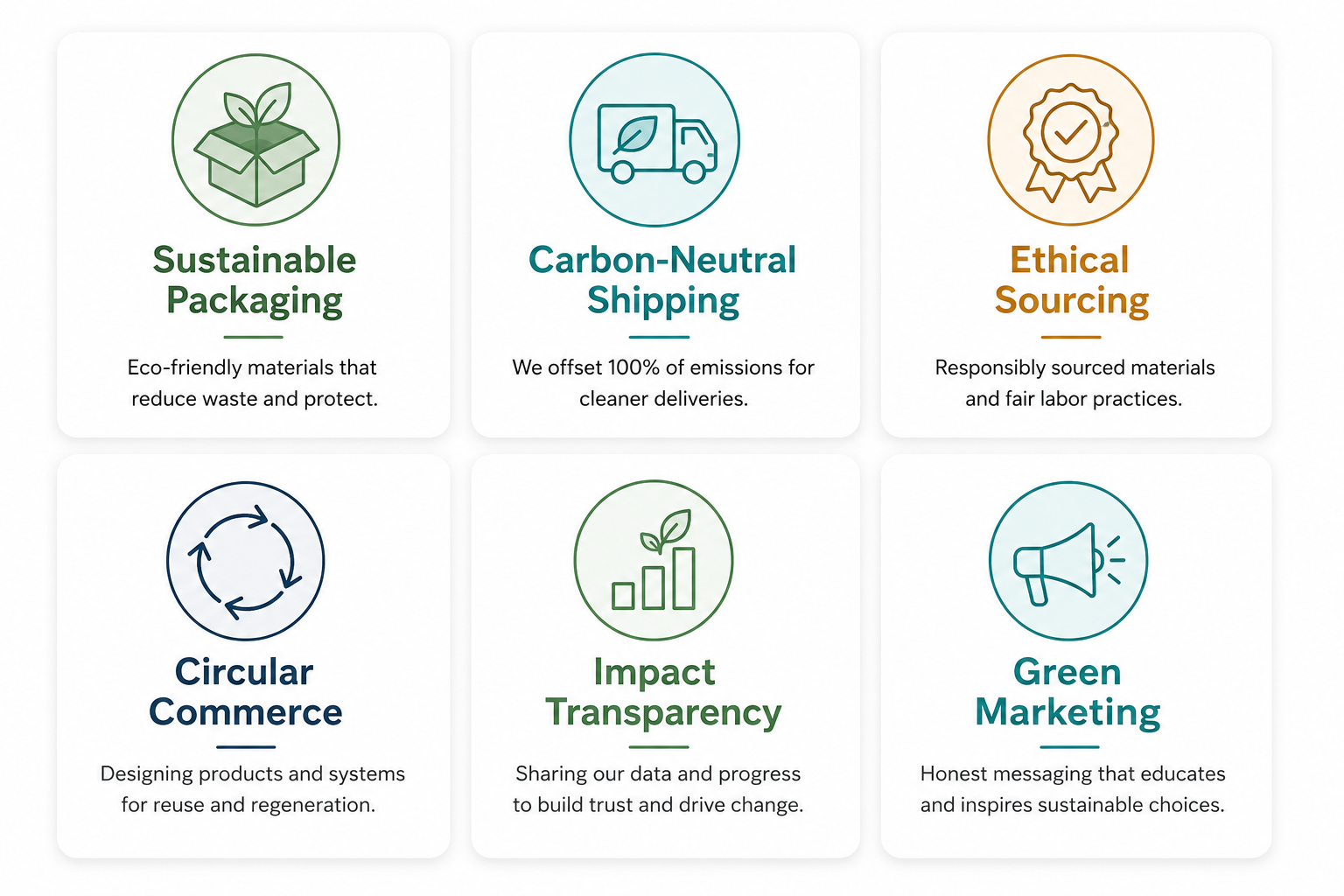
The 6 Sustainability Practices Winning Shopify Brands Use in 2026
1. Sustainable Packaging That Customers Actually Talk About
Packaging is the most tactile expression of your brand's environmental commitment. It is also the sustainability choice customers interact with most directly — they hold it, they open it, and in 2026, they increasingly photograph it and share it.
Rothy's built its packaging strategy into a core brand story. Its shoeboxes are strong enough to ship without additional outer packaging, biodegradable, and made with 85% post-consumer recycled materials. The brand has transformed over 200 million plastic water bottles into shoes and bags. When customers receive a Rothy's order, the packaging reinforces the brand's environmental commitment at the exact moment of peak excitement — the unboxing.
For Shopify brands not yet at Rothy's scale, the practical starting points are switching from virgin plastic mailers to recycled or compostable alternatives, eliminating unnecessary interior packaging materials, right-sizing boxes to reduce void fill and shipping weight, and printing shipping labels and packing slips on recycled paper.
Each of these changes has a direct cost implication — sustainable packaging materials typically cost 5 to 15% more than conventional alternatives — but the customer response in reviews, social sharing, and repeat purchase rates consistently justifies the investment for brands that communicate the change clearly.
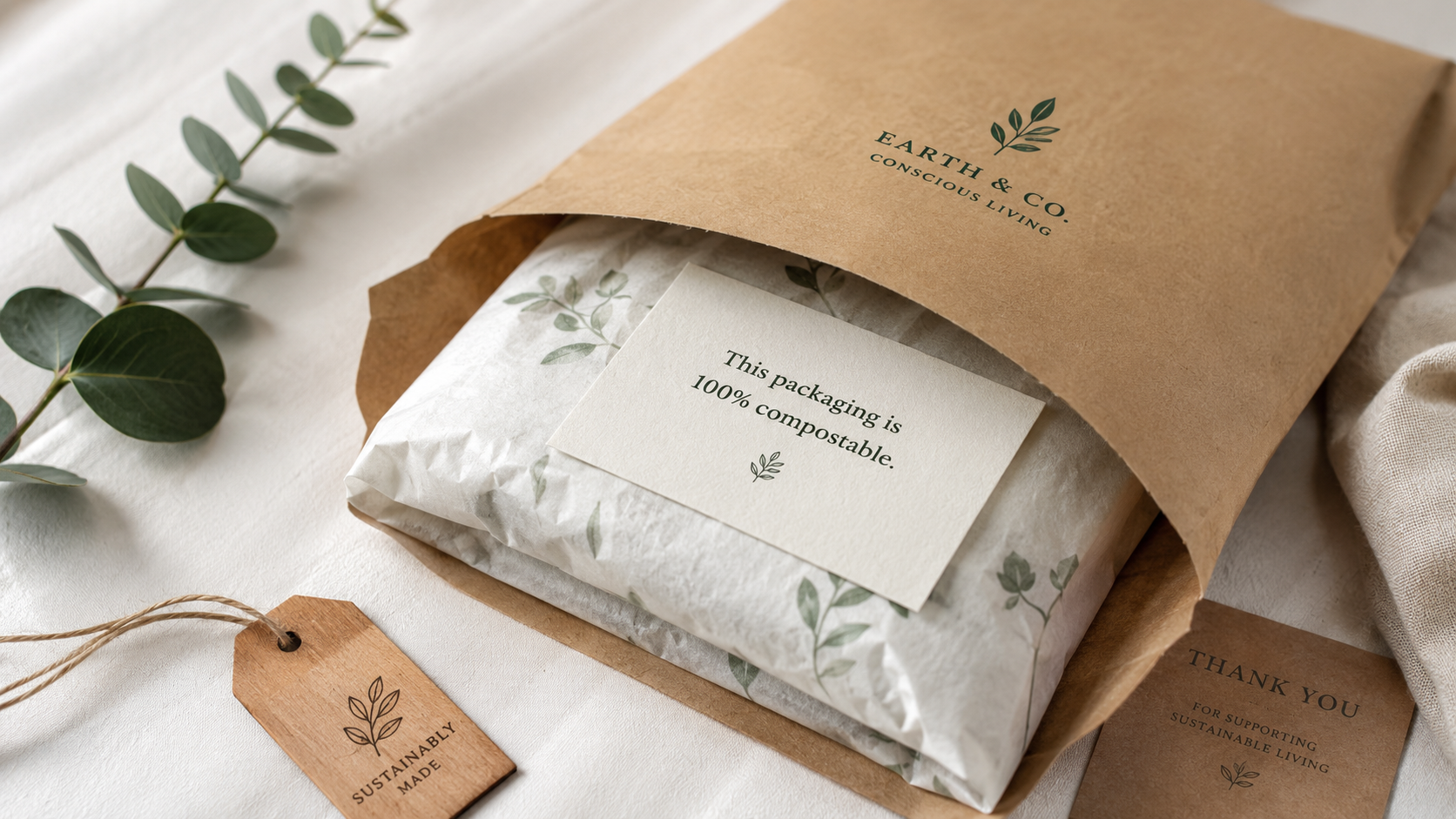
The key is communicating on the packaging itself. A small printed note inside the box — "This mailer is 100% compostable and breaks down in 90 days" — transforms a packaging choice into a brand story moment. Customers who notice and appreciate this detail become advocates.
2. Carbon-Neutral and Carbon-Offset Shipping
Shipping is the largest source of carbon emissions in most ecommerce operations, and it is the sustainability lever most customers associate directly with online shopping.
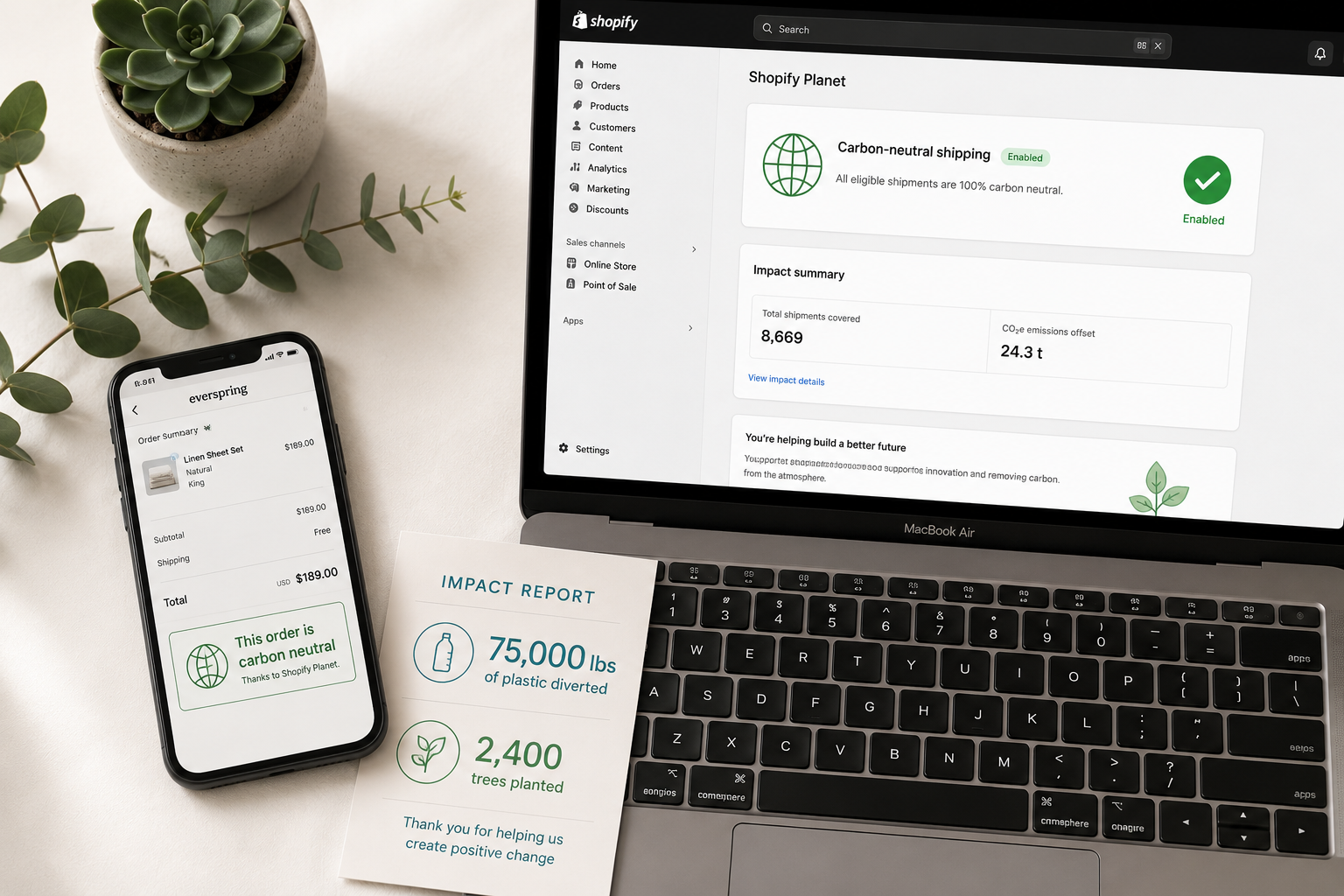
Shopify Planet, available directly through Shopify, lets merchants offer carbon-neutral shipping on every order by funding vetted carbon removal projects. The cost per order is minimal — typically a few cents — and can be absorbed by the merchant, offered as an opt-in for customers, or presented as a default that customers can choose to remove.
EcoCart is an alternative app that shows customers the carbon footprint of their specific order at checkout and offers a one-click carbon offset option. Brands using EcoCart report meaningful engagement from environmentally conscious customers who actively seek out and appreciate the transparency.
The business angle here is worth emphasizing. Offering carbon-neutral shipping is not just an environmental gesture — it is a conversion tool for the growing segment of customers who will actively choose a slightly slower or slightly more expensive shipping option from a brand that offsets its impact over a cheaper option from one that does not.
3. Sustainable and Ethical Sourcing
What goes into your products matters as much as how they are packaged and shipped. Consumers in 2026 are increasingly research-literate — they look up certifications, they check about pages, and they share what they find.
Allbirds built its entire brand on materials transparency. Every product displays its carbon footprint in grams of CO2 equivalent on the product page — not just a vague sustainability claim, but a specific, auditable number. The brand uses merino wool, sugarcane-based soles, and eucalyptus tree fibers. This specificity is what separates genuine sustainability from marketing language that consumers have learned to distrust.
Patagonia pledges 1% of all sales to environmental groups through its 1% for the Planet commitment, uses recycled materials throughout its product lines, and has run repair programs for decades that extend the life of products customers already own. The brand does not just claim sustainability — it builds it into the financial and operational structure of the business.
For smaller Shopify brands, the entry point to sourcing sustainability is choosing suppliers with verifiable certifications relevant to your product category: GOTS certification for organic textiles, FSC certification for paper and wood products, Fair Trade certification for food and handcrafted goods. These certifications are earned through third-party auditing, which gives customers the verification they increasingly require before trusting sustainability claims.
4. Circular Business Models — Resale, Repair, and Take-Back Programs
The most forward-looking sustainable Shopify brands in 2026 are not just focusing on how products are made and shipped. They are redesigning their business models around what happens to products at the end of their first life.
Circular commerce — resale programs, repair services, take-back initiatives, and product refill schemes — extends the useful life of products, reduces waste, and creates additional revenue streams that conventional linear sales models cannot access.
Tentree, which plants a tree for every product sold and has built an interactive impact tracker into its homepage, connects customers to the measurable environmental impact of every purchase. The brand uses an automated email system to send customers updates about the trees planted on their behalf — turning a purchase made months ago into an ongoing relationship and a reason to come back.
Recurate and Trove are Shopify apps that power branded resale programs — allowing brands to buy back products from customers and resell them through a dedicated pre-owned section of their Shopify store. This model captures customers who would otherwise buy second-hand from a marketplace, keeps them within your brand ecosystem, and generates a second margin event on the same physical item. The unit economics on resale are genuinely compelling once the infrastructure is established.
Loop Returns, the leading returns management platform on Shopify, has added sustainability features that incentivize exchanges over refunds and route returned merchandise to resale or donation rather than landfill. Even a 10% reduction in your return rate is one of the highest-impact sustainability improvements an ecommerce brand can make — fewer returned products means fewer emissions from reverse logistics and less product waste.
5. Transparency and Impact Reporting That Customers Can Verify
Here is the most important commercial lesson from the brands winning on sustainability in 2026: vague environmental claims do not build trust. Specific, auditable impact data does.
According to a recent survey referenced in Shopify's green marketing research, only one in five consumers believes brands' claims about their green efforts. The trust deficit is real and growing. The brands overcoming it are the ones publishing actual numbers rather than aspirational language.
Bite, a toothpaste tablet brand, published a detailed impact report showing exactly how much plastic it kept out of landfills — 75,000 pounds in a single year. That specific number is credible in a way that "committed to reducing plastic waste" never can be.
Their Jewelry publishes its environmental goals publicly including a zero-waste 2026 target, holds Climate Neutral and 1% for the Planet certifications, and displays all of this on its About page rather than hiding it in a PDF that no customer finds.
For Shopify brands building toward this level of transparency, the practical starting point is tracking and publishing at least one specific impact metric — trees planted, plastic diverted from landfill, carbon offset in kilograms, or percentage of recycled materials in your packaging. One real number, updated regularly, does more for customer trust than any amount of sustainability-adjacent language.
6. Green Marketing That Communicates Authenticity
The way you communicate your sustainability practices matters as much as the practices themselves. Greenwashing — making misleading or exaggerated environmental claims — has become one of the fastest ways to generate negative press and social media backlash in 2026, as consumers and journalists have become significantly more sophisticated at identifying it.
The brands winning with green marketing follow a consistent set of principles:
They make specific claims, not vague ones. "Made with 80% recycled aluminum in a factory powered by wind" is credible. "Eco-smart" is not.
They show their work. About pages that read like mission statements explain sourcing, manufacturing processes, and carbon reduction methodology in plain language. If customers can find and verify the claim, they will share it. If they cannot, they will assume it is marketing.
They acknowledge limitations honestly. Shopify's own green marketing guide recommends saying things like "We still use plastic pumps, but we are testing aluminum options for 2026" — because honesty about imperfection builds more loyalty than pretending to have it all figured out. Consumers who see genuine progress are more forgiving of current limitations than consumers who feel misled by perfection claims.
They use certifications as proof, not decoration. B Corp certification, 1% for the Planet membership, Fair Trade verification, and similar third-party credentials are valuable because they represent external validation of internal claims. When customers see these on your About page and product pages, they see evidence rather than assertions.
The Shopify Sustainability App Stack Worth Building
The practical implementation of sustainability goals on Shopify is supported by a growing ecosystem of apps that connect merchant commitments to verifiable consumer-facing impact.
Shopify Planet is the foundational starting point — native to Shopify, it funds carbon removal on every order at minimal cost per transaction. If you implement only one sustainability app, this is the one. It requires no configuration beyond installation and generates a sustainability badge that appears in your checkout.
EcoCart adds carbon footprint transparency at the product and order level. Customers see the specific environmental impact of their order and can choose to offset it at checkout. The brand-side benefit is data — EcoCart provides merchant-facing analytics showing what percentage of your customers engage with carbon offset options and how that engagement varies by product category.
GoodAPI covers tree planting, ocean plastic removal, and charity donations through a single billing interface with a public impact dashboard. For brands that want to link purchases to multiple verified environmental actions without managing separate app relationships, GoodAPI is a strong single-point solution.
Loop Returns handles the return side of the circularity equation — reducing return rates through exchanges and credits, routing unavoidable returns away from landfill, and providing the sustainability-focused analytics that show how your return policy is performing on environmental metrics.
Recurate or Trove power branded resale programs for brands ready to add a pre-owned channel to their Shopify store. Implementation requires more setup than the apps above but delivers ongoing margin from existing inventory and creates a customer acquisition channel for shoppers who prefer secondhand purchasing.
For impact reporting, most of these apps generate exportable data that can be compiled into an annual or quarterly impact report. Publishing this report — even as a single blog post with specific numbers — is one of the most effective sustainability marketing actions available to a Shopify brand at any size.
The Greenwashing Risk: What to Avoid
The commercial downside of getting sustainability wrong is significant and growing. Regulatory bodies in the EU, UK, and increasingly the US are cracking down on unverified environmental claims. The EU Green Claims Directive, coming into force progressively from 2026, requires that sustainability claims be independently verified before they can be used in marketing. Brands making claims they cannot substantiate face both regulatory risk and the more immediate commercial risk of social media backlash.
The most common greenwashing patterns to avoid are general claims without evidence — words like "eco-friendly," "green," or "sustainable" without specific supporting data; cherry-picked claims that highlight one sustainable attribute while ignoring a larger harmful practice; and aspirational future commitments presented as current achievements.
The safe test for any sustainability claim is asking whether a skeptical journalist could verify it. If the answer is no, the claim needs to be either substantiated with specific data or removed until it can be.
How to Start: A Practical Roadmap for Shopify Brands
If your brand is at the beginning of its sustainability journey, the progression that delivers the most credibility for the least complexity looks like this:
Month 1: Switch to sustainable packaging materials for a single product line and communicate the change on product pages and in order confirmation emails. Install Shopify Planet for carbon-neutral shipping on all orders. Measure your baseline — what is your current packaging material usage, return rate, and shipping volume?
Month 2 to 3: Identify one verifiable sustainability metric to publish — trees planted, plastic diverted, or carbon offset. Create a dedicated sustainability page on your Shopify store that explains your current practices, your goals, and your progress. Be specific about what you are doing and honest about what you are still working toward.
Month 4 to 6: Evaluate third-party certifications relevant to your product category. Begin the application process for the most relevant one. Research your supplier sustainability practices and make sourcing adjustments where the business case supports it.
Month 7 to 12: Publish your first impact report. Consider adding a circular commerce element — a repair program, a take-back initiative, or a branded resale channel — if your product category supports it. Review your entire packaging and shipping operation against your initial baseline and measure the progress.
This is not a transformation that happens overnight. The brands with the most credible sustainability positioning in 2026 built it over years of genuine operational change and transparent communication. But every brand starts somewhere, and the consumers who will be your most loyal customers in three years are actively looking for brands that are making genuine progress right now.
What Shopify Offers at the Platform Level
Shopify has built sustainability into its own operations and provides merchant-facing infrastructure that makes green practices easier to implement and verify.
The platform operates with carbon-neutral operations and actively invests in climate solutions. For merchants, it provides access to Shopify Planet for carbon-offset shipping, sustainability apps including EcoCart and GoodAPI through the Shopify App Store, and tools that support recycling, resale, and circular business models.
The platform's native schema support and clean HTML rendering also matter for sustainability marketing — structured product data that includes material sourcing and certification information is increasingly surfaced by AI shopping assistants that are beginning to recommend sustainable options by default when helping users make purchasing decisions. Brands with detailed, structured sustainability information on their Shopify product pages are better positioned for this AI-driven discovery channel than brands with vague or absent sustainability data.
Final Thoughts
The Shopify brands winning with sustainability in 2026 are not doing so by accident. They made deliberate operational choices — about packaging, sourcing, shipping, and business model design — and they communicated those choices with specificity and honesty rather than marketing language.
The commercial returns are documented and growing. Premium pricing power, stronger customer retention, lower acquisition costs from word-of-mouth advocacy, and increasing regulatory protection as greenwashing penalties make genuine sustainability a competitive advantage rather than just a cost center.
The window to build genuine sustainability credentials is still open. The brands that move in the next twelve months will have established track records, certifiable impact data, and authentic customer communities built around shared values before the brands waiting for a better time even begin.
Sustainability is not a cost of doing business in 2026. For a growing and increasingly powerful segment of consumers, it is the reason for doing business with you at all.
Need help implementing sustainability features on your Shopify store, or want to optimize your store's content and structure to communicate your green credentials more effectively? Get in touch with EcomFixify — we specialize in Shopify development and ecommerce growth strategy for forward-thinking brands.