
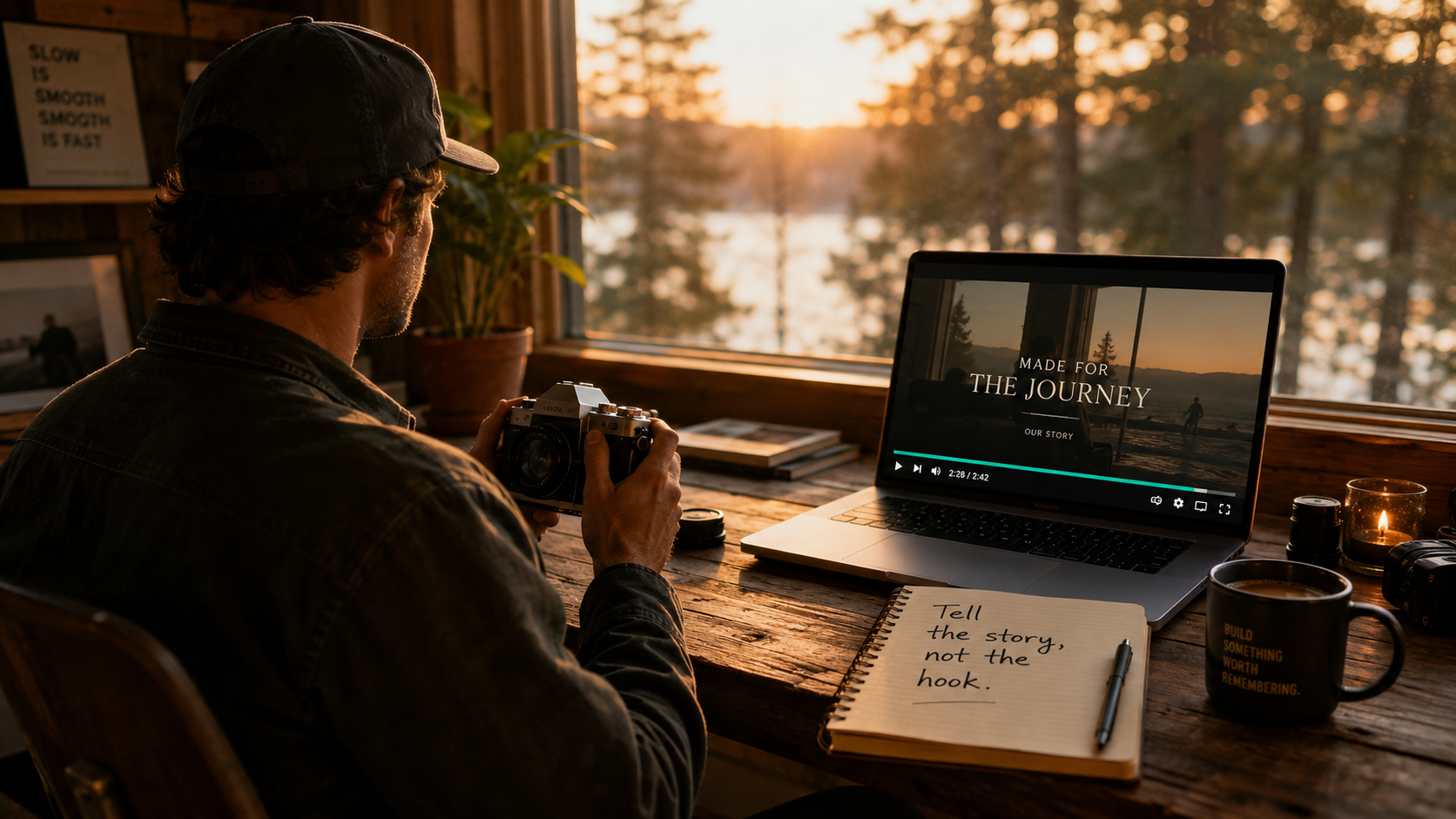
Slow Content Strategy: Why Shopify Brands Are Ditching Viral Hooks
Slow Content Strategy: Why Shopify Brands Are Ditching Viral Hooks
For the past five years, the dominant content advice in ecommerce has been relentlessly consistent: hook in the first two seconds, make it punchy, jump cut every second and a half, engineer for the algorithm, and chase the trend before it dies.
It worked. For a while.
In 2026, the brands winning on content are doing something that looks almost counterintuitive by those standards. They are slowing down. They are telling longer stories. They are investing in content that takes more than seven seconds to appreciate — and they are building deeper customer relationships, higher retention rates, and more defensible brand equity than anything a viral moment ever delivered.
This is not a rejection of content marketing. It is a maturation of it.
The shift has a name. Industry insiders are calling it slow content — a deliberate move toward longer-form storytelling, cinematic brand videos, editorial newsletters, and community-building content that prioritizes resonance over reach. And for Shopify brands that have been stuck on the content treadmill of posting more, faster, louder — it represents one of the most significant strategic opportunities available in 2026.
What Is Slow Content, and Why Is It Happening Now?
Slow content is not about being boring. It is about being memorable.
The contrast with conventional viral content is precise. A typical TikTok optimized for the algorithm features 27 jump cuts in 60 seconds, a hook engineered to stop the scroll in the first three frames, and a call to action packed into the final two seconds before the viewer is already gone. The content is optimized to get watched. It is almost never optimized to be remembered.
Slow content takes a different approach. It is designed for depth rather than duration of attention — a one and a half minute brand film that follows a founder through their morning routine, an editorial newsletter that unpacks the sourcing story behind a single ingredient, a behind-the-scenes series that shows the craft involved in a handmade product line.
The psychological case for slow content is articulated clearly by Grace Clarke, Shopify's former head of community marketing, who has been outspoken about this shift in 2026. People's nervous systems are haywire, especially consumers. Slowing down is calming — it actually gives consumers a chance to latch onto something. A 60-second TikTok with 27 jump cuts and no clip longer than a second and a half is attention-getting, but it is not resonance-building. And resonance is what drives purchases. Psychologically, the longer someone holds a single thought, the more likely they are to take action because of it — because they are motivated, not stressed out.
That distinction between attention and resonance is the core insight behind the slow content movement. Viral content captures attention. Slow content builds resonance. And in a market where consumers are increasingly skeptical of brands, comparison shopping across multiple platforms before buying, and relying on community recommendations over advertising claims — resonance is what actually converts.
The Brand That Started the Conversation
The most frequently cited example of slow content done right in 2026 is Sonsie, a skincare brand whose cofounder Pamela Anderson posted a video on TikTok in October 2025 showing her rules for tending her garden. The video was one minute and 39 seconds long. For TikTok, that is a significant departure from convention. Its pace was leisurely, its style cinematic, and its content — a founder caring for her garden — had nothing to do with selling skincare in any direct sense. There was no product shot. No limited time offer. No "link in bio." The video worked precisely because of what it was not. It did not feel like marketing. It felt like an intimate look into someone's actual life and values — values that aligned with the Sonsie brand's positioning around natural, considered skincare. Kailey Bradt, CEO of Sonsie, described the response to the video as the beginning of a content strategy shift the brand is doubling down on in 2026. The short film format gives opportunity for brand storytelling that is not constrained by the seven-second rule. It is more creative, more fun to produce, and it builds a different kind of relationship with the audience — one where they feel they actually know and trust the brand, rather than one where they were interrupted by it.
What Sonsie discovered is something content marketing researchers have been documenting across the industry: the content that goes viral is often not the content that builds a brand. And building a brand is what generates long-term revenue.
Why Viral Content Alone Is No Longer Enough
The data on viral content ROI in ecommerce has always been murkier than the excitement around viral moments suggests. A video that gets five million views and generates 50,000 website visits and 200 conversions has a 0.4% conversion rate on traffic — indistinguishable from organic search performance and significantly below what a well-executed email campaign delivers.
The deeper problem is strategic. Brands built primarily on viral moments are perpetually chasing the next one. The content team is optimizing for what the algorithm rewards this week, which changes every few months. The audience is engaged in individual moments but does not develop a durable relationship with the brand that survives between those moments. And when a viral moment eventually generates a flood of one-time buyers with no particular loyalty to the brand, the customer lifetime value math rarely justifies the creative investment.
Content marketing expert Robert Rose of the Content Marketing Institute articulated this clearly in his 2026 outlook: the edge will come from depth, not speed. Building communities that co-create rather than just consume. Fewer, higher-quality pieces across formats rather than high-volume posting to feed algorithms.
By 2026, chasing one-off viral hits is demonstrably less effective than building deep resonance in smaller, more engaged communities. The platform data supports this. Engagement rates on branded content have been declining across every major social platform as the volume of AI-generated content floods feeds and consumer skepticism grows. The content that cuts through is not louder or faster — it is more human, more specific, and more authentically connected to a brand's actual identity.
What Slow Content Actually Looks Like for Shopify Brands
Slow content is not a single format. It is a strategic orientation toward depth over volume that expresses differently depending on a brand's audience, product, and platform.
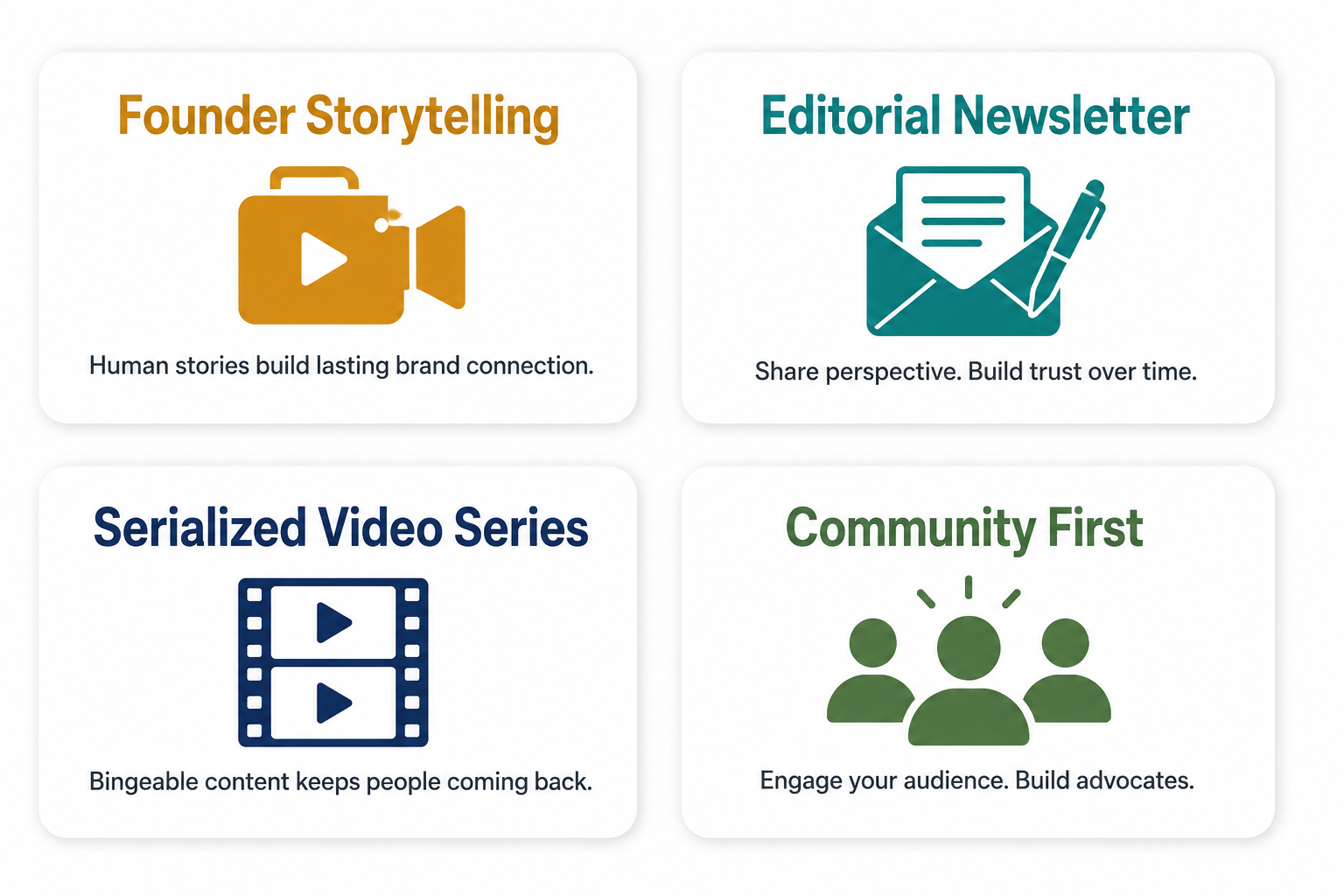
Founder-Led Brand Storytelling
2026 is being called the year of the founder brand. Brands where a real person's story, values, and perspective are visible in the content consistently outperform faceless brand accounts. Founder-led video content — where the person behind the brand talks directly to the camera about why they built the product, what they care about, and what the brand stands for — builds the kind of trust that product-focused content cannot replicate.
The format does not require professional production. Authenticity consistently outperforms polish on every major platform in 2026. A founder at their kitchen table explaining why they became obsessed with formulating a clean moisturizer will outperform a studio-produced product showcase in engagement, saves, and eventually in conversion for the segment of consumers who prioritize trust.
Gina Michnowicz, CEO and chief creative officer of The Craftsman, captured this in her 2026 content marketing outlook: quality storytelling will outperform sheer content volume. Craft stories that connect from brand to demand and influence purchase decisions through meaningful, integrated experiences.
Editorial Newsletters and Long-Form Email
Brands like American Eagle and Abercrombie and Fitch are exploring Substack and Beehiiv as content platforms in 2026 — not because email is new, but because subscription-based editorial content creates a fundamentally different relationship with readers than promotional email blasts.
An editorial newsletter that subscribers opt into because it delivers genuinely interesting content — not just deals and new arrivals — builds an audience that returns to the brand between purchases. Walmart's head of content described the appeal of long-form editorial this way: it is about diving deeper, unpacking something, finding information, establishing a new routine. That kind of content engagement is the opposite of the scrollable, interruptive experience of most ecommerce marketing.
For Shopify brands, launching an editorial newsletter does not require a Substack-scale operation. A monthly email that goes beyond product announcements to share sourcing stories, community spotlights, behind-the-scenes content, or genuine category education establishes a different relationship with subscribers than a promotional email — and that relationship compounds in retention and lifetime value over time.
Serialized Video Content
The next evolution beyond one-off viral hits is serialized content — recurring episodes, characters, or themes across TikTok, Reels, Shorts, or YouTube that encourage binge-watching and return visits. This is the shift from thinking about content as individual posts to thinking about content as a show that people follow.
Think less about random marketing moments and more about creating something with continuity — a series that follows a product from raw material to finished item, a recurring format where customers share how they use the product in their lives, a weekly behind-the-scenes look at the brand's operations. Each episode reinforces the brand story and gives returning viewers a reason to keep watching that individual viral moments cannot create.
Serialized content also solves the algorithm problem. Platforms algorithmically reward accounts that keep audiences coming back — and serialized formats, by their nature, train audiences to return.
Community-First Content Strategy
The most sophisticated slow content strategy in 2026 is not about content at all in the traditional sense. It is about community — creating spaces where customers engage with each other and the brand in ways that generate organic advocacy, user-created content, and word-of-mouth that no paid campaign can replicate.
Discord servers, private Facebook groups, Instagram broadcast channels, and branded Slack communities are where the highest-engagement customer relationships are being built by forward-looking Shopify brands. Grace Clarke calls this optimizing for the group chat rather than the public Instagram story — content that generates real conversations between real customers in spaces where trust is higher and peer recommendations carry more weight than brand messaging.
Content in these community spaces is slow by definition. It is discussion, it is response, it is co-creation of the brand story with the people who care most about it. And the customer lifetime value of community members consistently exceeds that of customers who engage only through public social channels.
How Slow Content Performs Against Standard Metrics
A legitimate concern with slow content is measurability. If success is no longer defined by view counts and viral reach, what does success look like — and how do you justify the investment?
The honest answer is that slow content requires different metrics than viral content. The numbers to track are engagement rate over reach, return visit rate for editorial content, community membership growth and retention, customer lifetime value segmented by acquisition source, and brand sentiment trends over time.
These metrics are slower to accumulate than view counts. A serialized video series builds its audience over months, not days. An editorial newsletter compounds in value as subscriber lists grow and open rates stabilize. A community strategy generates its highest returns after the community reaches critical mass.
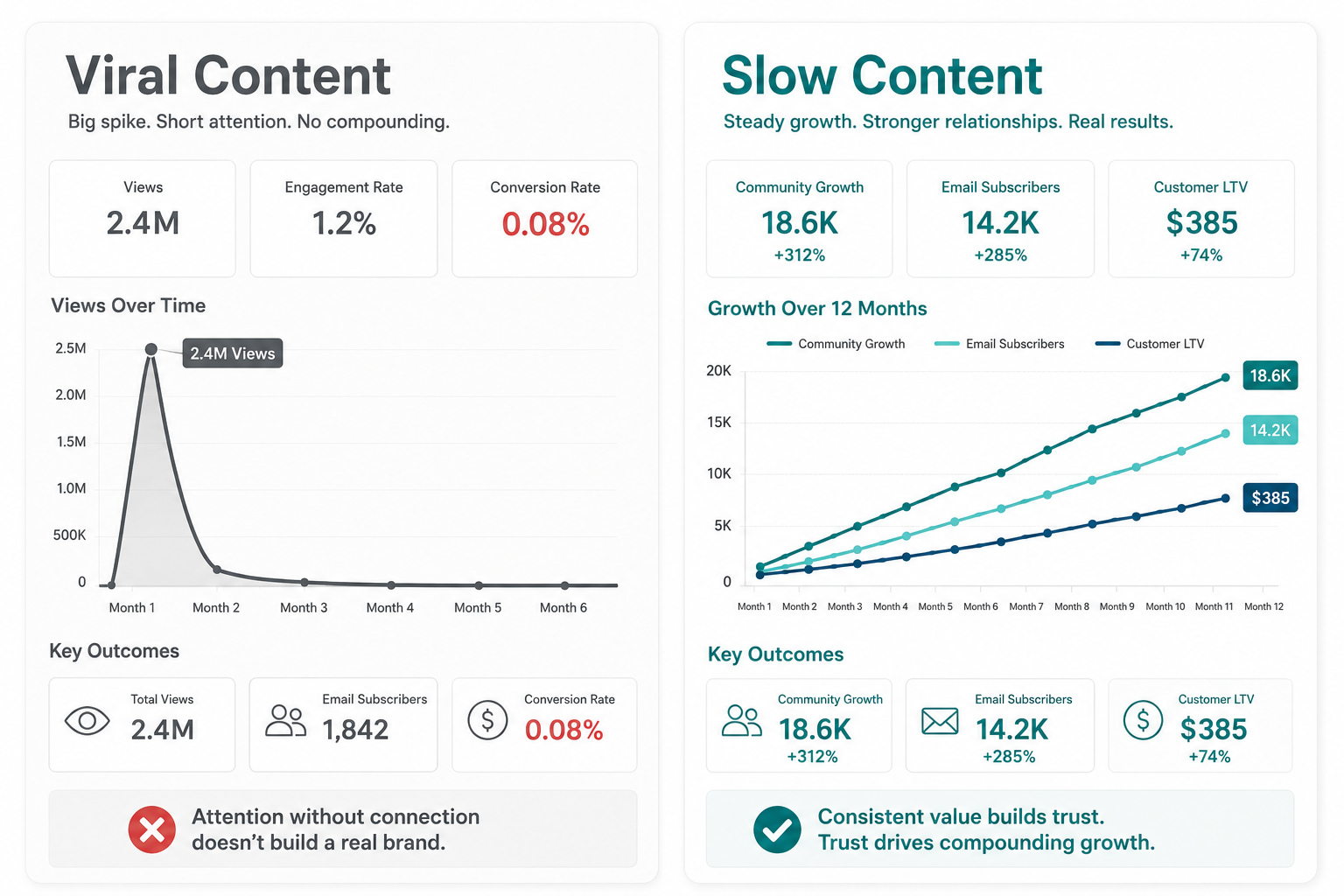
The commercial case becomes clearer when you compare customer lifetime value by acquisition source. Customers acquired through branded community content and editorial content consistently show higher repeat purchase rates, higher average order values, and lower churn than customers acquired through paid advertising or viral content — because the relationship that preceded the purchase was deeper and more trust-based.
One content marketing expert put it directly: stop obsessing over follower count and stop celebrating viral posts that do not convert. Track engagement rate, click-through rate, conversion rate, and customer lifetime value. If you spent a thousand dollars on content and it generated five thousand dollars in customer value, you earned a 400% return. Track this quarterly and shift resources toward what drives that return, not toward what generates views.
Implementing Slow Content on Your Shopify Store
The practical starting point for a slow content strategy does not require abandoning what is currently working. It requires adding a layer of depth to your content mix that builds brand equity alongside the performance content that drives immediate traffic.
Start with the 60-40 content budget framework that is gaining traction among sophisticated ecommerce content teams in 2026: allocate 60% of content budget to performance content — short-form video, product-focused social posts, promotional email — and 40% to brand-building content, the slower, deeper pieces that build relationships over time.
Map your content pillars before you create anything. For a Shopify brand, these typically include product education, founder or team stories, customer spotlights and user-generated content, behind-the-scenes brand operations, and your brand's larger mission or values. Every piece of slow content you create should connect to one of these pillars — it is how the content compounds into a coherent brand narrative over time rather than a collection of unrelated posts.
Choose one slow content format to commit to for 90 days. A bi-weekly editorial email. A serialized video series posted every Thursday. A founder-led Instagram series where you talk directly to your audience for three minutes. The format matters less than the commitment to consistency — slow content builds its commercial value through repetition and compounding, not through individual viral moments.
Measure what matters and ignore what does not. View counts on individual slow content pieces will never match the reach of algorithm-optimized viral content. That is not the goal. The goal is community growth, email subscriber growth, engagement rate, and ultimately the customer lifetime value of the audience that slow content attracts and retains.
The AI Content Problem That Makes Slow Content More Valuable
There is a structural reason why slow content is becoming more valuable, not less, as AI-generated content floods every content channel in 2026.
AI is raising the baseline quality of content everywhere. The average produced piece of content — blog post, social caption, product description, email — is measurably better than it was two years ago because AI tools are accessible, capable, and widely used. But as the baseline rises, the content starts to converge. It sounds similar. It hits the same structures. It covers the same ground.
The content that cuts through this homogeneity in 2026 is not better-optimized AI content. It is irreducibly human content — founder stories that only that founder can tell, behind-the-scenes glimpses that only exist inside one brand, community conversations that emerge from the specific culture of one brand's customer base.
As one expert noted: AI becomes a tool that creates a higher baseline. It is what happened with smartphones — everyone got access to cameras and the bar for content increased. With AI, you get a lot of standard content that feels inauthentic. The people doing authentic, creative work are valued more than ever.
For Shopify brands, the practical implication is clear. Use AI for the content tasks it genuinely accelerates — SEO blog posts, product descriptions, email drafts, social captions. Invest human creativity, time, and voice in the slow content that AI cannot replicate: founder stories, community building, serialized narratives, and editorial perspective that reflects a genuinely specific point of view about the world your brand inhabits.
Final Thoughts
The brands that built their audiences entirely on viral content are discovering in 2026 that virality is a rented asset. The algorithm changes, the trend passes, the audience moves on — and the brand is left starting over with the next hook. The brands investing in slow content are building something different. They are building communities of people who return not because an algorithm served them a video but because they genuinely care about what the brand stands for. They are building editorial audiences that open emails because the content is worth reading, not because a discount code is buried inside. They are building customer relationships that generate repeat purchases, word-of-mouth referrals, and lifetime value that paid acquisition alone can never match.
Slow content is not a retreat from growth. It is a more durable foundation for it. In a content landscape increasingly dominated by AI-generated volume and algorithm-chasing performance content, the Shopify brands that invest in depth, authenticity, and genuine storytelling are building a moat that no viral moment can replicate and no algorithm update can erase.
Need help developing a content strategy for your Shopify brand, or want to build out your store's blog and email presence to support a slow content approach? Get in touch with EcomFixify — we specialize in Shopify development and ecommerce growth strategy for brands building for the long term.