
Shopify vs WooCommerce vs BigCommerce: Which Platform Wins in 2026?
Choosing the wrong ecommerce platform is one of the most expensive mistakes a business owner can make. Not because the monthly subscription is high — that is rarely the problem — but because the wrong platform compounds costs invisibly over time through plugin fees, developer hours, performance limitations, and eventually a full migration that wipes out months of momentum. Which One is Good Shopify vs WooCommerce vs BigCommerce?
The platform you build on shapes your budget, your marketing capabilities, your day-to-day operations, and your ceiling for growth. Getting this decision right from the start is worth far more than the hour it takes to research it properly.
In 2026, the ecommerce market has consolidated around three dominant architectures. Shopify holds approximately 29% of the US ecommerce software market and powers over 5.6 million live stores globally. WooCommerce powers roughly 33% of all ecommerce websites worldwide across 4 million or more active stores. BigCommerce captures approximately 3% of the market with a focused position in mid-market and enterprise commerce. Together these three platforms host the vast majority of independent ecommerce businesses globally — and they are built on fundamentally different philosophies.
This comparison is written without affiliate bias. Each platform wins in specific situations and loses in others. The goal here is helping you identify which situation you are actually in.
The Philosophy Behind Each Platform
Understanding what each platform was built to do is more useful than comparing feature checklists — because the philosophy determines how the platform behaves at scale, not just at launch.
Shopify was built on a single premise: make selling online as simple as possible for anyone. It is a fully hosted, all-in-one solution that launched in 2006 and has evolved into what many analysts describe as a commerce operating system rather than just an ecommerce platform. You pay a monthly subscription, Shopify handles hosting, security, updates, and payment infrastructure, and you focus on products and marketing. The platform makes reasonable decisions on your behalf so you never have to think about server configuration, SSL certificates, or software updates.
WooCommerce was built on a different premise entirely: maximum flexibility on top of WordPress, the world's most widely used content management system. WooCommerce itself is a free plugin. You own your hosting, your codebase, your data, and your destiny. There are no platform restrictions on what you can build, no transaction fees on your sales, and no ceiling on customization — but you are also responsible for hosting management, security patches, plugin compatibility, and performance optimization. The platform makes no decisions on your behalf.
BigCommerce was built to occupy the middle ground: the managed hosting and operational simplicity of Shopify combined with more native enterprise features — B2B pricing, complex catalog management, and API-first architecture — without requiring self-hosted infrastructure. It charges no transaction fees on any plan, which is a meaningful structural advantage over Shopify at scale.
These philosophies produce very different real-world experiences for merchants at different stages and sizes.
Pricing: What You Actually Pay at Each Stage
Platform pricing comparisons that stop at the published monthly subscription fee are misleading because the subscription is rarely the largest cost component at meaningful scale.
Shopify's published pricing in 2026 runs from $39 per month for Basic, $105 for Shopify, and $399 for Advanced, with Shopify Plus starting at $2,300 per month for high-volume merchants. On top of the subscription, Shopify charges transaction fees ranging from 0.5% to 2% on every sale unless you use Shopify Payments — which is only available in supported countries. App costs for functionality that is not native to Shopify — advanced reviews, subscriptions, loyalty programs, B2B pricing, and upsells — typically add $200 to $800 per month for a mid-size store. The total cost of ownership on Shopify runs lower than most alternatives for small to medium stores because the platform handles so much natively, but the transaction fee structure becomes significant at high revenue volumes.
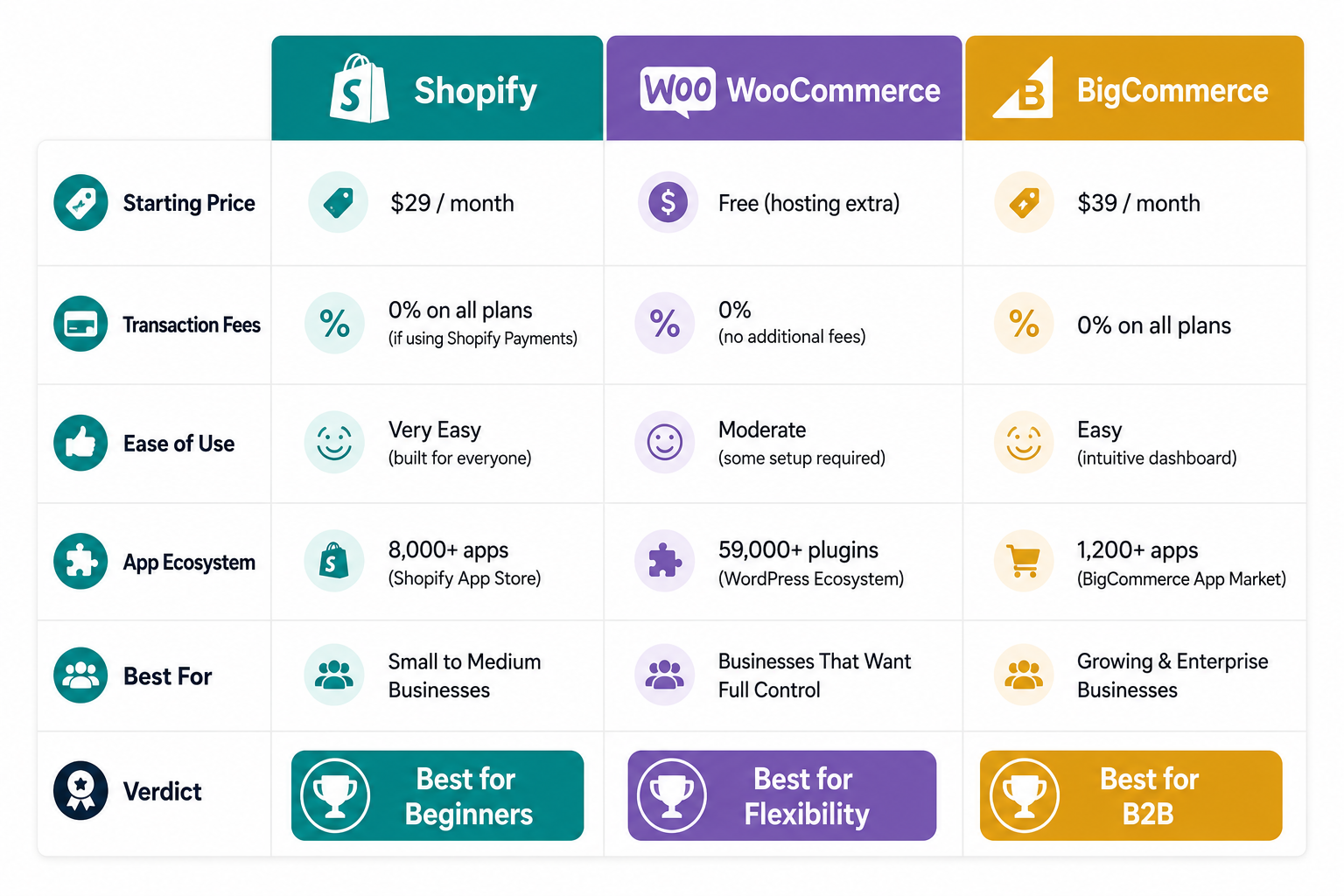
WooCommerce's sticker price is zero — the plugin itself is free. The realistic annual cost, however, runs between $75 and $920 for a small store and $1,400 to $6,500 or more per year for a mid-size store with premium plugins, quality managed hosting, and professional theme investment. The hosting cost alone varies dramatically: basic shared hosting runs $5 to $15 per month while managed WordPress hosting on platforms like Kinsta or WP Engine — which genuinely performs well under ecommerce load — runs $30 to $150 per month depending on traffic volume. There are no transaction fees on WooCommerce regardless of sales volume, which becomes increasingly significant as revenue grows. The hidden cost that most WooCommerce comparisons understate is developer time — maintaining plugin compatibility through WordPress and WooCommerce updates requires ongoing technical attention that either consumes your time or costs you money.
BigCommerce's published pricing mirrors Shopify's entry tiers at $39, $105, and $399 per month with an Enterprise tier for high-volume merchants. BigCommerce charges zero transaction fees on all plans regardless of which payment processor you use — a structural advantage over Shopify that compounds significantly at scale. The platform's 2026 pricing update lowered several revenue thresholds for automatic plan upgrades, meaning fast-growing stores may find themselves bumped to higher tiers sooner than expected. BigCommerce's overall total cost of ownership runs roughly 45% higher than Shopify's according to platform comparison research, primarily because its more limited native functionality relative to its price point requires more third-party app investment to fill feature gaps.
Ease of Use: Who Can Actually Run Each Platform?
This dimension separates platforms more definitively than any feature list.
Shopify is the fastest path from zero to live store in ecommerce. A complete non-technical founder can deploy a functional, professional storefront with products, payment processing, and shipping configured in two to three hours using Shopify's admin interface. The platform makes setup decisions opinionated enough that beginners are guided through the right choices rather than paralyzed by options. Ongoing store management — adding products, running promotions, managing orders, reviewing analytics — all happens inside a clean admin that requires no technical knowledge to navigate.
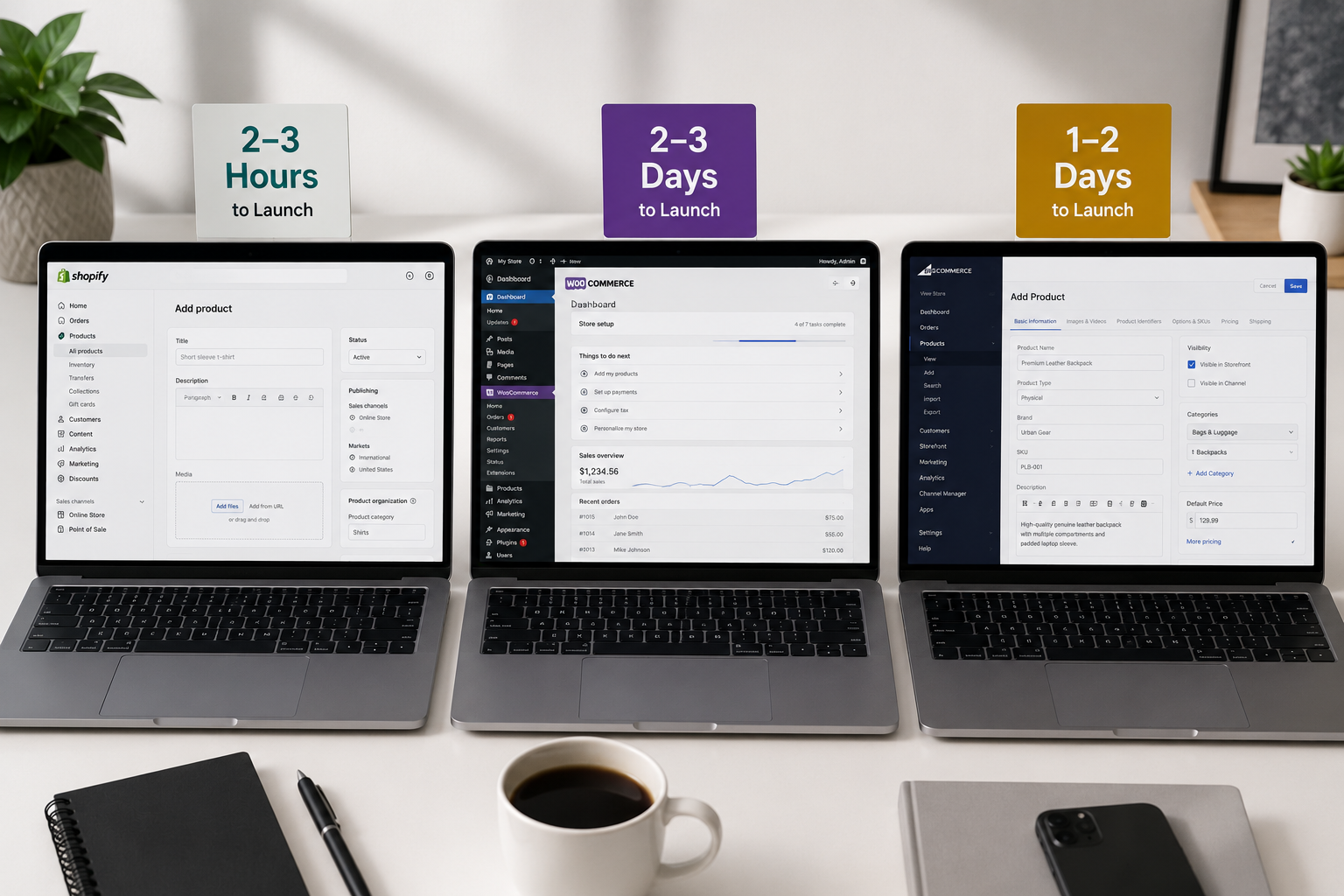
WooCommerce assumes significantly more technical capability from its users. Before you can install WooCommerce, you need a WordPress installation, which requires a hosting account, domain configuration, and WordPress setup. The WooCommerce plugin itself then needs to be installed and configured. Each piece of additional functionality — subscriptions, reviews, loyalty programs, booking systems — requires finding, evaluating, installing, and configuring separate plugins. Performance optimization requires knowledge of caching, CDN configuration, and image compression. Security requires active maintenance and regular updates. A WooCommerce store run correctly by a technical founder or with developer support can be an extremely powerful ecommerce asset. Run by a non-technical merchant without support, it is frequently a source of ongoing frustration.
BigCommerce sits between the two. Setup is simpler than WooCommerce because the platform is fully hosted and removes infrastructure concerns. The admin interface is more complex than Shopify's — with more configuration options exposed at the surface level — which makes it more powerful for merchants who need that configuration depth and more intimidating for beginners who do not. Most merchants who find BigCommerce's complexity manageable have either prior ecommerce platform experience or developer support available.
Performance and Speed
Page speed directly affects conversion rates, SEO rankings, and paid advertising quality scores — making platform performance a commercial consideration, not just a technical one.
Shopify's infrastructure is among the most reliable in ecommerce. The platform runs on globally distributed CDN infrastructure, handles automatic scaling during traffic spikes including peak sale events, and merchants never need to think about server capacity. Shopify's own infrastructure benchmarks show that 93% of Shopify stores achieve fast storefront performance scores. The performance ceiling for a Shopify store is largely determined by theme quality, app count, and image optimization — not by the underlying infrastructure.
WooCommerce performance is highly variable and entirely dependent on hosting quality and technical configuration. An unoptimized WooCommerce store on shared hosting with multiple heavyweight plugins produces some of the worst Core Web Vitals scores in ecommerce. A properly configured WooCommerce store on managed WordPress hosting with caching, CDN, and optimized image delivery can match or exceed Shopify's performance benchmarks. The variance between floor and ceiling is enormous — which means WooCommerce performance is unpredictable without technical expertise applied deliberately to optimization.
BigCommerce operates on Google Cloud Platform infrastructure, providing enterprise-grade reliability and performance for all plans. Performance is consistent and managed by the platform rather than the merchant, similar to Shopify. BigCommerce generally sits between Shopify and a well-optimized WooCommerce installation in performance benchmarks, with more configuration options for performance tuning than Shopify allows at the standard plan level.
App Ecosystems and Extensibility
No ecommerce platform does everything natively. The quality and cost of available extensions determines how effectively you can extend each platform's baseline capabilities.
Shopify's App Store contains over 8,000 apps covering virtually every ecommerce use case imaginable. The quality of Shopify's app ecosystem is its most significant competitive advantage over all alternatives — the depth of available integrations, the reliability of leading apps, and the speed of native integration with Shopify's data model create an extensibility ceiling that far exceeds what is natively possible in the platform itself. The cost of running multiple paid apps adds up — a typical scaling Shopify store runs $200 to $800 per month in app subscriptions — but the functionality delivered is consistently high and the integration quality generally reliable.
WooCommerce's plugin ecosystem spans over 59,000 plugins through the WordPress Plugin Directory and hundreds of premium plugins through third-party marketplaces. The breadth exceeds Shopify's. The quality variance, however, is significantly wider — the WooCommerce plugin ecosystem includes many outdated, poorly maintained, and incompatible plugins alongside excellent ones. Evaluating plugin quality, compatibility, and update frequency requires knowledge that new merchants typically do not have. The best WooCommerce plugins for ecommerce are excellent. The worst can introduce security vulnerabilities, performance degradation, and compatibility conflicts that require developer intervention to resolve.
BigCommerce's app marketplace is smaller than both — approximately 1,000 integrations available as of 2026. The platform compensates by building more functionality natively, reducing the app dependency that Shopify and WooCommerce require for common features. B2B pricing, multi-currency support, complex promotion rules, and faceted navigation are all native to BigCommerce at price points where Shopify and WooCommerce require paid apps. For merchants whose needs align with BigCommerce's native feature set, this reduces total cost of ownership. For merchants who need functionality outside that set, the smaller ecosystem can become a meaningful constraint.
SEO Capabilities
All three platforms can rank well in Google search results when properly optimized. The differences are in what each platform does natively versus what requires manual configuration or plugins.
Shopify handles the technical SEO fundamentals automatically — SSL certificates, canonical tags for product variants, sitemap generation, mobile-responsive themes, and schema markup for product pages. The platform's SEO limitations are structural: URL structure for collection pages cannot be fully customized, the blog functionality is more basic than WordPress, and duplicate content management for variant pages requires careful configuration. For most Shopify merchants, these limitations are manageable and do not prevent strong organic ranking performance.
WooCommerce on WordPress is the strongest platform for content-driven SEO. The combination of WordPress's mature content management capabilities, full URL structure control, and plugins like Rank Math or Yoast SEO gives technically capable merchants complete control over every SEO variable. For businesses where content marketing is a core traffic and revenue strategy — publishing regular in-depth guides, building topical authority through blogging, targeting informational keywords alongside commercial ones — WooCommerce on WordPress has a structural SEO advantage over Shopify.
BigCommerce's SEO capabilities are similar to Shopify's in scope. The platform handles technical fundamentals automatically and generates clean, crawlable HTML for product and collection pages. Its faceted navigation implementation is generally considered more SEO-friendly than Shopify's for large catalogs, because it handles parameter-based filtering without creating excessive duplicate content issues. BigCommerce's blog functionality is more limited than both Shopify and WordPress.
Which Platform Is Right for Which Business?
The honest answer to "which platform wins?" is that no single platform wins for every situation. The winner depends entirely on what your business actually needs.
Shopify is the right choice for the majority of new Shopify merchants, established brands scaling from $0 to $5 million in annual revenue, stores without dedicated technical resources, merchants who want to focus on marketing and product rather than technical maintenance, and any business selling through multiple channels — TikTok Shop, Instagram Shopping, Amazon, and physical retail — from a single admin. 42.2% of top 10,000 enterprise launches chose Shopify in 2026, which signals its viability well beyond the startup phase.
WooCommerce is the right choice for businesses already deeply embedded in the WordPress ecosystem, content-first brands where a sophisticated blog and editorial strategy is central to traffic acquisition, merchants with technical resources available for ongoing maintenance and optimization, businesses that cannot pay transaction fees at their revenue volume, and stores requiring deep customization that Shopify's theme architecture cannot accommodate without custom development.
BigCommerce is the right choice for mid-market brands with complex B2B or wholesale requirements, merchants who need native multi-currency and multi-storefront capabilities without app overhead, businesses with large and complex product catalogs that benefit from BigCommerce's native faceted navigation, and any store doing significant volume where Shopify's transaction fees would represent meaningful cost savings at zero transaction fee structure.
The Migration Question
A significant number of merchants reading this guide are evaluating platforms because they are considering switching from one to another. The migration cost — both financial and operational — is a variable most platform comparisons omit.
Migrating from WooCommerce to Shopify is the most common migration direction in 2026. The process involves product data export, customer record migration, URL redirect mapping, and theme rebuild. For a store with several hundred products and a clean data structure, a competent developer can complete this migration in two to four weeks. For a store with thousands of products, custom functionality, or years of accumulated technical debt, the timeline and cost expand significantly.
Migrating from Shopify to WooCommerce or BigCommerce is less common and typically driven by transaction fee economics at scale or B2B functionality needs. The process is similar in structure but requires careful planning around URL redirects to preserve existing search rankings.
The most expensive migration mistake is treating redirects as optional. Every URL that changes without a proper 301 redirect loses its accumulated search ranking authority, which can take months to rebuild. Any platform migration involving more than a handful of pages requires a comprehensive redirect mapping strategy built and tested before launch.
The Verdict
If you are starting a new ecommerce business in 2026 with no existing technical infrastructure and no dedicated developer, start on Shopify. The speed to launch, the quality of native integrations, the reliability of the infrastructure, and the depth of the app ecosystem make it the lowest-risk starting point for the widest range of merchant situations.
If you are a content-driven brand with WordPress already at the center of your marketing operation, a significant blog audience, and either technical capability in-house or a trusted developer relationship, WooCommerce gives you more control and lower transaction costs at the expense of more operational responsibility.
If you are a mid-market brand with complex B2B requirements, large catalog management needs, or significant revenue volume where transaction fees represent a meaningful margin cost, BigCommerce deserves serious evaluation before assuming Shopify is the answer.
No platform is objectively best. The best platform is the one that fits your technical capability, your growth trajectory, your feature requirements, and your total cost of ownership — not the one with the most enthusiastic marketing or the highest affiliate commission for the comparison article that recommended it.
Running your store on the wrong platform, or thinking about migrating to Shopify? Get in touch with EcomFixify — we specialize in Shopify development, store builds, and platform migrations that preserve your SEO and get you live without losing momentum.