
Shopify vs Etsy: Which Platform Is Right for Your Business in 2026?
If you sell handmade products, creative goods, vintage items, or anything that sits in the craft and independent maker space, you have almost certainly faced this question at some point: should I be on Etsy, on Shopify, or on both?
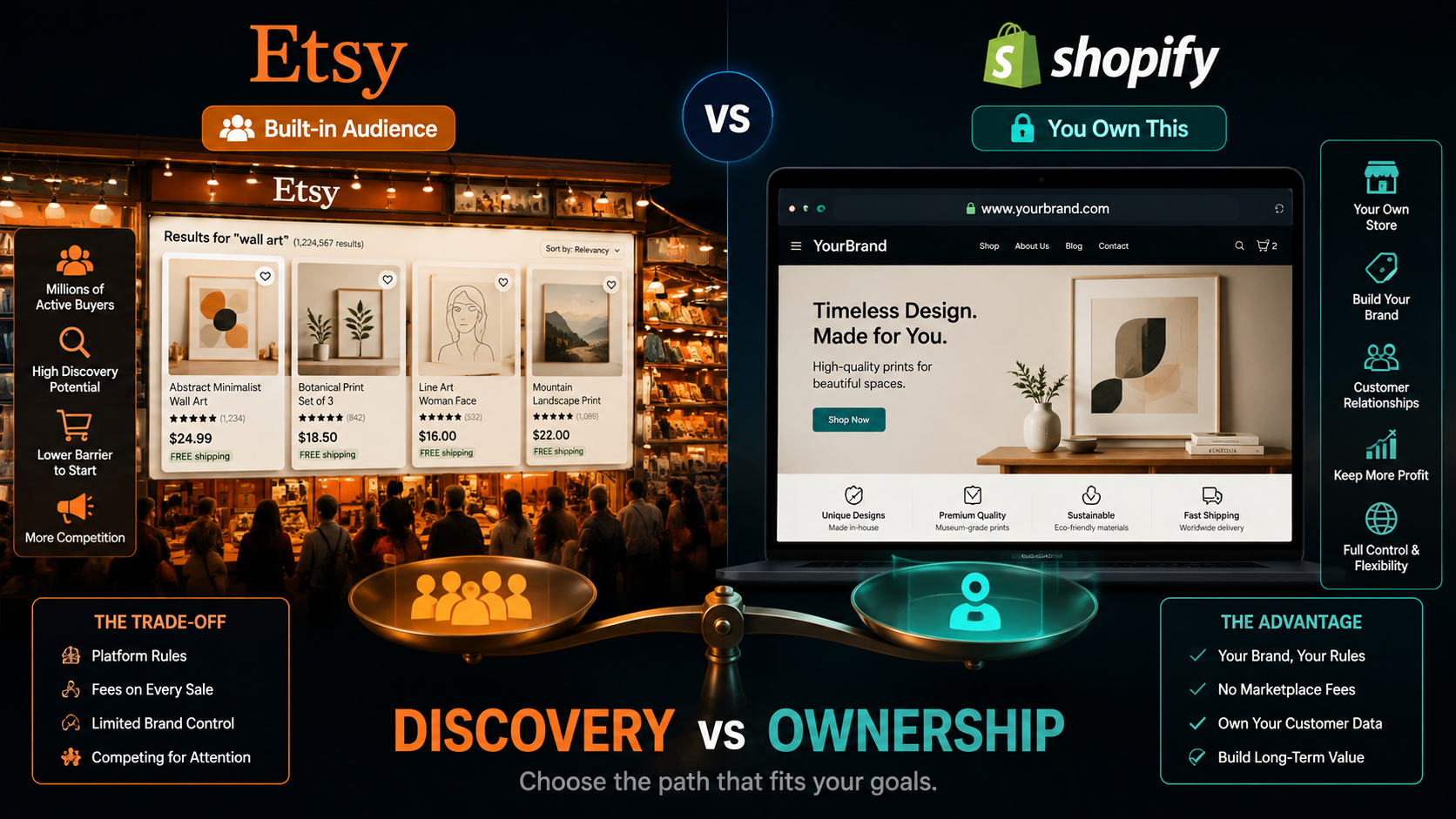
It is one of the most searched ecommerce decisions of 2026 — and one of the most consistently mis framed. Most comparisons present it as a head-to-head competition where one platform wins and the other loses. The reality is that Shopify and Etsy are not competing for the same job. They are designed to solve fundamentally different problems, and understanding that distinction is the actual answer to the question.
Etsy is a marketplace. It hands you an audience of 86.6 million active buyers who are already searching for the types of products you sell — in exchange for higher per-sale fees and very limited control over your brand experience. Shopify is a platform. It gives you total control over your store, your brand, your customer data, and your checkout experience — but it sends you zero traffic. Every visitor to a Shopify store has to be earned or paid for.
That trade-off — audience versus ownership — is the entire Shopify vs Etsy question. Everything else is detail.
Understanding What Each Platform Is Actually For
Before comparing fees, features, or SEO capabilities, it is worth being precise about the fundamental purpose of each platform — because choosing based on feature lists without understanding the core trade-off leads to expensive mistakes.
Etsy's value proposition is discovery. When you list on Etsy, your products appear in front of millions of shoppers who are specifically looking for handmade, vintage, unique, or craft items. You do not need a marketing budget, a social media following, or an email list to make your first sale on Etsy. You need a good product, decent photos, and a correctly optimized listing. The platform does the customer acquisition work for you — and charges you accordingly.
Shopify's value proposition is ownership. When you build a Shopify store, you own the domain, the brand identity, the customer relationship, the email list, and every data point your customers generate. No algorithm can make your store invisible overnight. No policy change can restrict how you communicate with customers who bought from you. No competitor's products appear alongside yours on your product pages. Everything is yours.
The phrase that captures this distinction most precisely: Etsy rents you marketplace space. Shopify lets you own your store.
Renting is faster and cheaper to start. Owning builds long-term equity. Both are true simultaneously — and that is why the honest answer for most sellers is not one or the other, but a deliberate combination of both.
The Real Fee Comparison: What You Actually Pay on Each Platform
The fee comparison between Shopify and Etsy is more nuanced than most comparison articles acknowledge — because the right answer depends entirely on your sales volume.
Etsy's fee structure in 2026 consists of a $0.20 listing fee per item published or renewed, a 6.5% transaction fee applied to the item price plus shipping charged to the customer, and payment processing of 3% plus $0.25 per transaction through Etsy Payments. Etsy Plus, the optional upgrade plan, adds $10 per month for additional customization features and credits. There is no mandatory monthly fee at the basic level — which is Etsy's core appeal for sellers at very low volume.
Shopify's fee structure consists of a monthly plan fee — $39 per month on the Basic plan, $105 on Shopify, and $399 on Advanced — plus payment processing of 2.9% plus $0.30 per transaction through Shopify Payments, with no additional transaction fee when using Shopify Payments.
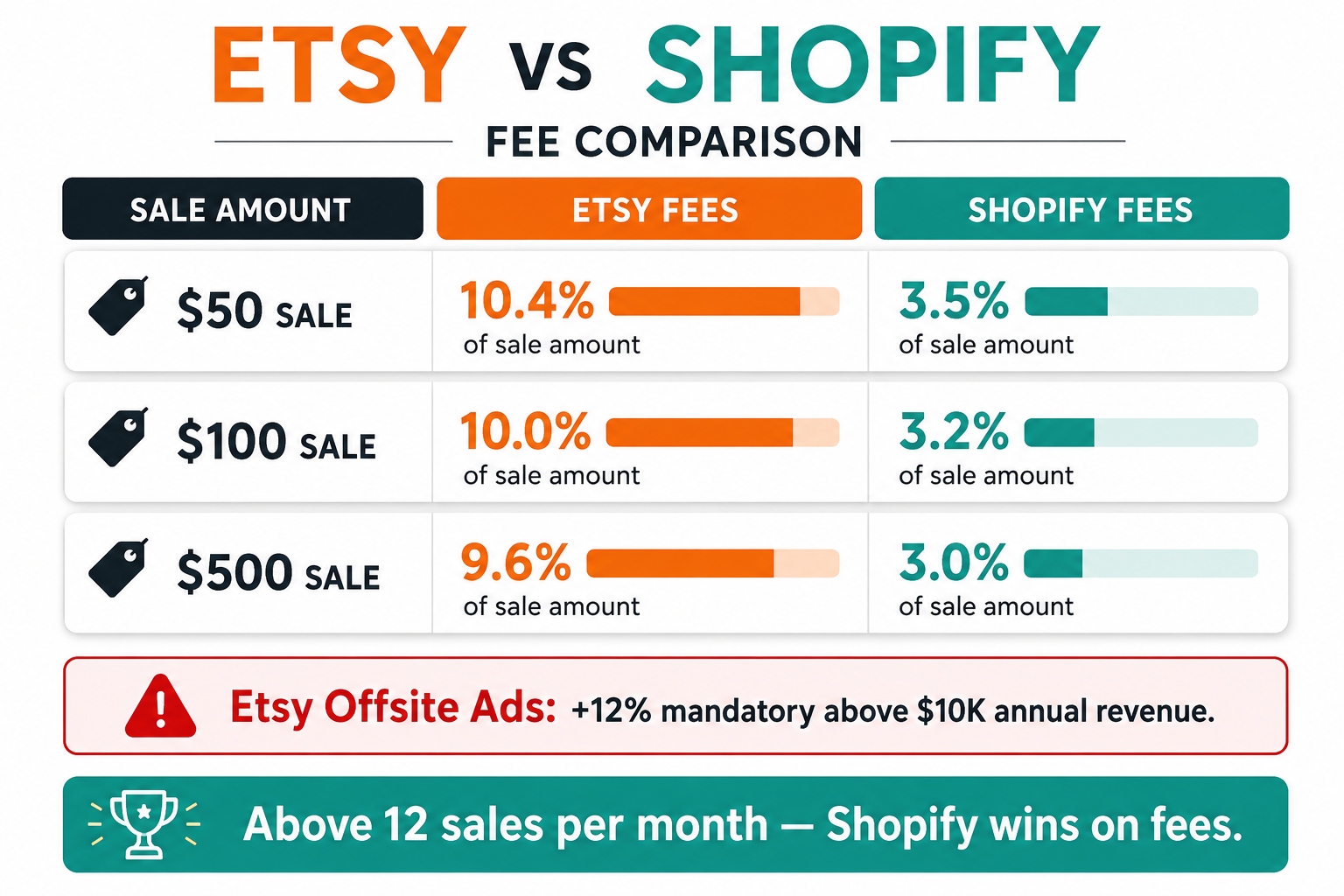
The real-world fee comparison on actual transactions reveals the crossover point clearly. On a $50 sale, Etsy fees total approximately $5.20 — around 10.4% of the transaction. Shopify fees on the same sale total approximately $1.75 in payment processing — around 3.5% — before accounting for the monthly plan cost. On a $100 sale, Etsy takes roughly $9.95 while Shopify takes roughly $3.20. On a $500 sale, Etsy fees reach approximately $47.95 while Shopify fees reach approximately $14.80.
The monthly plan changes the calculation at low volume. If Shopify's lower per-sale rate saves approximately $3.45 per transaction compared to Etsy on a $50 order, the $39 Basic plan is covered at around 12 sales per month. Below that volume, Etsy is cheaper overall. Above it, Shopify's fee advantage compounds with every additional sale.
There is a significant catch in Etsy's fee structure that most comparison articles understate: Etsy's Offsite Ads program. Once a seller crosses $10,000 in annual Etsy revenue, participation in Offsite Ads becomes mandatory. When a customer clicks an Etsy ad on Google, Facebook, Instagram, or Pinterest and then purchases within 30 days, Etsy charges an additional 12% advertising fee on that sale. This fee applies even if you would prefer not to run ads and even if the customer would have found your store without the ad. At $5,000 per month in Etsy revenue, mandatory Offsite Ads fees alone can add $300 to $400 per month in additional platform costs — making Shopify's economics significantly more favorable at any meaningful scale.
Brand Control: The Difference That Matters Most at Scale
On Etsy, your shop lives at etsy.com/shop/yourname. You choose from a handful of banner templates, upload a profile photo, and write a shop description. The product page layout, the checkout experience, the post-purchase communication, and the emails your customers receive are all controlled by Etsy — not by you. A customer who buys from your Etsy shop may remember the product, but they remember buying from Etsy.
On Shopify, your store lives at yourbrand.com. The theme, the colors, the typography, the product page layout, the checkout experience, the confirmation emails, the loyalty program, the review display, and every other customer touchpoint is fully under your control. A customer who buys from your Shopify store knows exactly which brand they bought from — and when you email them next week with a new product launch, they know who that email is from.
This distinction is academic when you are making your first 10 sales. It becomes commercially significant when you are trying to build a customer base that returns, refers friends, and grows your business through loyalty rather than requiring constant new customer acquisition.
Brand equity is the accumulated trust and recognition that makes a customer choose your store over alternatives without needing to be convinced again. Etsy's marketplace structure makes brand equity nearly impossible to build because customers are always presented with alternatives and the Etsy brand is stronger than any individual shop brand within it. Shopify's platform structure is specifically designed to accumulate brand equity over time — and that accumulated equity is what makes a business increasingly valuable and increasingly defensible as it grows.
Traffic and Customer Acquisition: The Most Important Practical Difference
Etsy brings the customers. Shopify requires you to find them.
This is not a minor operational detail. It is the central strategic reality of the Shopify vs Etsy decision, and it determines which platform is right at which stage of business development.
An Etsy seller with a well-optimized listing in a competitive category can make their first sale within days of launching — because Etsy's internal search surfaces their product to buyers who are already on the platform looking for exactly that type of item. The platform handles discovery, which is the most expensive and most difficult part of building an ecommerce business from scratch.
A Shopify seller with a new store and no audience makes no sales until they generate traffic. That traffic must come from somewhere: paid advertising on Meta or Google, organic content on TikTok or Instagram, SEO-driven blog content that ranks on Google, email list building, influencer partnerships, or some combination of all of these. Each of these channels requires either money, time, or both — and none of them produce results as quickly as Etsy's built-in marketplace discovery for a seller starting from zero.
The practical implication: a seller who launches a Shopify store without a traffic strategy or marketing budget will have a beautiful, empty store that generates no sales. The same seller who launches on Etsy with a good product and well-photographed listings will likely generate their first sales within their first week.
This does not mean Shopify is worse. It means Shopify's economics only work when traffic is funded — through paid acquisition, organic content creation, or an existing audience. For sellers who have a marketing budget or an established social following, Shopify's lower transaction fees and complete brand control make it the clearly superior long-term choice. For sellers who are starting with nothing but a product and limited capital, Etsy's built-in audience makes it the practical starting point.
SEO: Which Platform Ranks Better on Google?
Both Etsy and Shopify have strong Google presence — but through different mechanisms.
Etsy listings frequently appear in Google search results for product-specific queries because Etsy's domain authority is extraordinarily high. When someone searches "handmade leather wallet" or "vintage ceramic mug" on Google, Etsy listings regularly appear on the first page — not because the individual seller's SEO is strong, but because Etsy's platform authority carries the listing. Individual sellers benefit from Etsy's domain authority without having to build their own.
Shopify stores rank on Google through their own domain authority — which starts at zero for a new store and builds over time through content creation, backlinks, and technical SEO optimization. A new Shopify store will not rank for competitive product terms in the short term. A Shopify store that has been publishing SEO-optimized blog content, building product page authority, and earning backlinks for 12 to 18 months can rank for specific product and category terms and generate meaningful organic traffic.
The SEO advantage for Shopify becomes strongest in the long term. A seller who publishes consistent, keyword-targeted blog content on their Shopify store for 18 months builds an organic traffic asset that operates independently of any platform's algorithm changes. A seller who relies entirely on Etsy search is dependent on Etsy's algorithm — which changes without notice and can significantly reduce visibility for established shops through policy updates, category restructuring, or shifts in how Etsy weights listing factors.
For sellers in categories with high Google search intent — furniture, jewelry, clothing, home décor — building SEO authority on a Shopify store is one of the highest-ROI long-term marketing investments available. For sellers whose customers primarily discover products through marketplace browsing rather than Google search, Etsy's platform authority remains the more relevant SEO advantage.
Which Product Categories Suit Each Platform
Not all products are equally well-suited to both platforms — and matching your product category to the platform where buyers are actually looking is the most practical dimension of this decision.
Etsy is the dominant platform for handmade and craft products, vintage items and collectibles, custom and personalized gifts, digital downloads and printables, art prints and original artwork, wedding and event supplies, and craft supplies and materials. Etsy's 86.6 million active buyers are disproportionately searching for items in these categories — which means a seller in these categories benefits more from Etsy's marketplace audience than one selling in a category where Etsy is not the primary discovery channel.
Shopify suits a much broader range of product categories because it does not depend on marketplace-driven discovery. Any product category with a defined audience that can be reached through paid advertising, social media, or SEO is viable on Shopify — including fashion and apparel, beauty and skincare, health and wellness, fitness equipment, food and beverage, home goods, electronics accessories, and virtually any category where a branded direct-to-consumer experience adds value.
The practical overlap exists in categories like jewelry, candles, home décor, and clothing — where both Etsy marketplace shoppers and branded DTC buyers actively search. Sellers in these categories often benefit most from a dual-platform strategy.
The Case for Running Both Simultaneously
The "Shopify vs Etsy" framing implies a binary choice. The reality is that many of the most successful independent product brands in 2026 run both platforms simultaneously — with each doing what it is structurally designed to do.
Etsy functions as the discovery and prospecting channel. New customers who would never have found your brand through any other means discover your products through Etsy search, make their first purchase, and experience your product quality for the first time. The Etsy fees on this first transaction are essentially a customer acquisition cost — comparable to what you would pay per conversion through Meta advertising, but without requiring a marketing budget or campaign management.
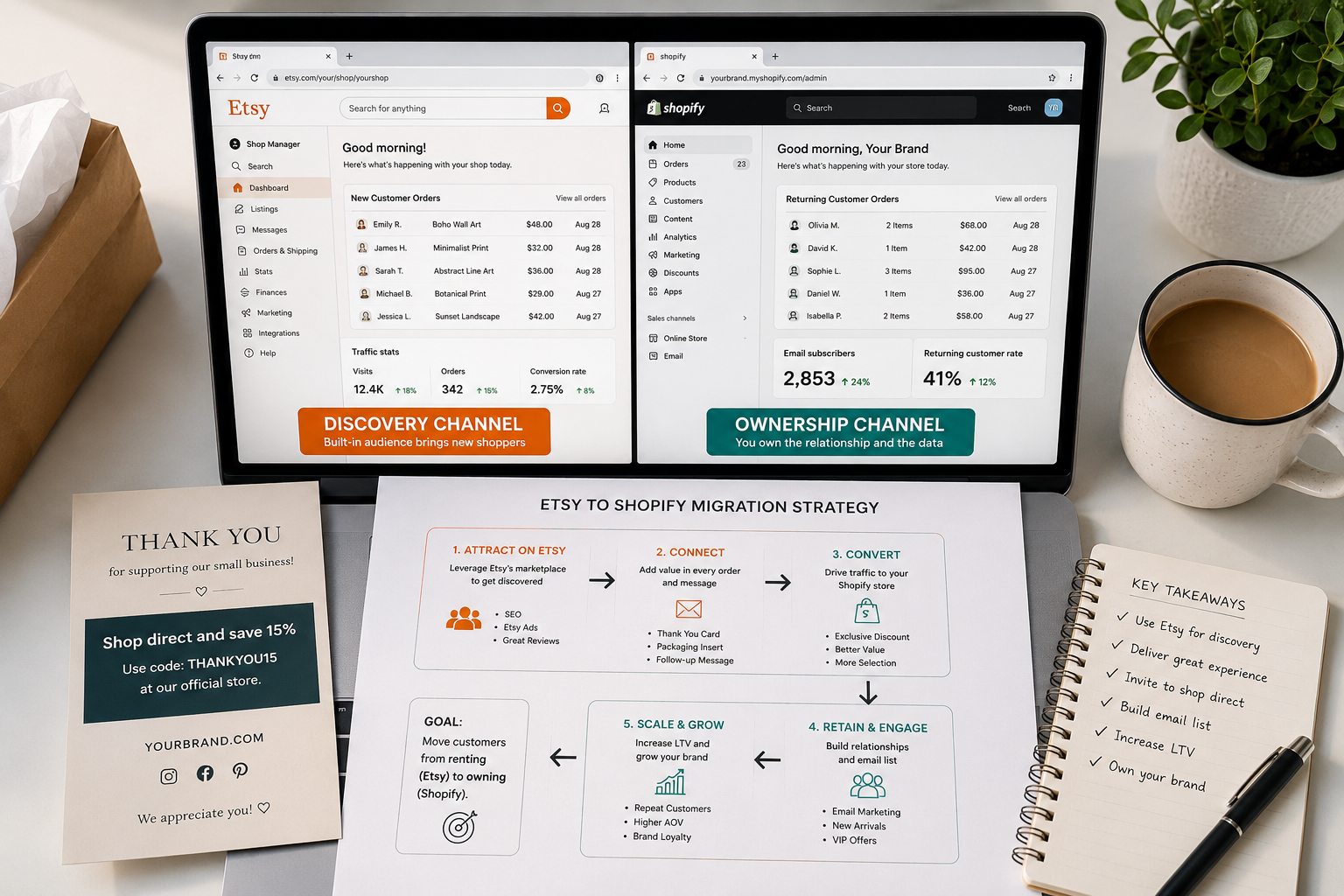
Shopify functions as the retention and brand-building channel. Once a customer has bought from you on Etsy and had a positive experience, the goal is to migrate them into your owned ecosystem — your email list, your Shopify store, your loyalty program. A packaging insert that invites Etsy customers to your Shopify store with an exclusive discount, a post-purchase email from your branded domain, or a loyalty program available only through your direct store all serve this migration function.
The long-term trajectory of this dual-platform strategy is the gradual shift of revenue from Etsy — where you pay high fees and have no ownership — to Shopify — where you pay lower fees, own the customer relationship, and build brand equity with every transaction. Over 12 to 24 months, the proportion of revenue coming through Shopify grows while Etsy continues to feed new customer acquisition at a manageable cost.
This is not a theoretical model. It is the documented path of numerous successful independent brands — starting on Etsy for discovery, adding Shopify as they scale, and progressively building the owned infrastructure that makes the business less dependent on any single external platform.
The Decision Framework: How to Choose Right Now
Stop asking "which platform is better?" Start asking "which platform is right for where my business is right now?"
Choose Etsy as your primary platform if you are at the very beginning with no existing audience, no marketing budget, and a product that fits Etsy's core categories; you want to validate product-market fit before investing in brand infrastructure; your monthly revenue is below $1,000 and the math of Shopify's monthly fee does not yet make sense; and you are not yet ready to commit the time required to build and maintain a traffic strategy for an independent store.
Choose Shopify as your primary platform if you already have an existing audience — on social media, an email list, or through in-person sales — that you can direct to a store on launch day; you are generating enough revenue that Etsy's transaction fees are meaningfully compressing your margins; you want to build a brand that customers recognize and return to without being redirected through a marketplace; and you have or are willing to build a traffic strategy through paid advertising, SEO, or content marketing.
Choose both simultaneously if you are currently on Etsy and beginning to hit its limitations — algorithm dependency, fee compression, inability to communicate directly with customers — but are not ready to abandon Etsy's marketplace audience while you build your Shopify presence; you have the operational capacity to manage inventory and orders across two platforms; and you have a clear migration strategy for moving Etsy customers into your Shopify ecosystem over time.
The majority of serious independent product brands eventually land on both. Etsy for discovery. Shopify for ownership. The question is only which to start with and when to add the other.
Final Thoughts
Shopify and Etsy are not competitors for the same outcome. Etsy is the fastest path to a first sale for a seller starting from zero in the right product category. Shopify is the best infrastructure for building a brand that compounds in value over time.
The sellers who ask "which is better?" are often really asking "which can I start on and stay on forever?" The honest answer is that the most resilient independent brands do not stay on one platform forever. They start where the economics and audience make sense, build toward ownership, and gradually shift the balance of their revenue toward the channel that gives them the most control, the best margins, and the deepest customer relationships.
Start where the market is. Build toward ownership. Use Etsy's audience to fund your Shopify brand's growth. That is the 2026 answer to the Shopify vs Etsy question.
Need help building a Shopify store that works alongside your existing Etsy presence, or want an expert to design your migration strategy from marketplace to owned ecommerce? Get in touch with EcomFixify — we specialize in Shopify development and ecommerce growth strategy for independent brands ready to build something they own.