
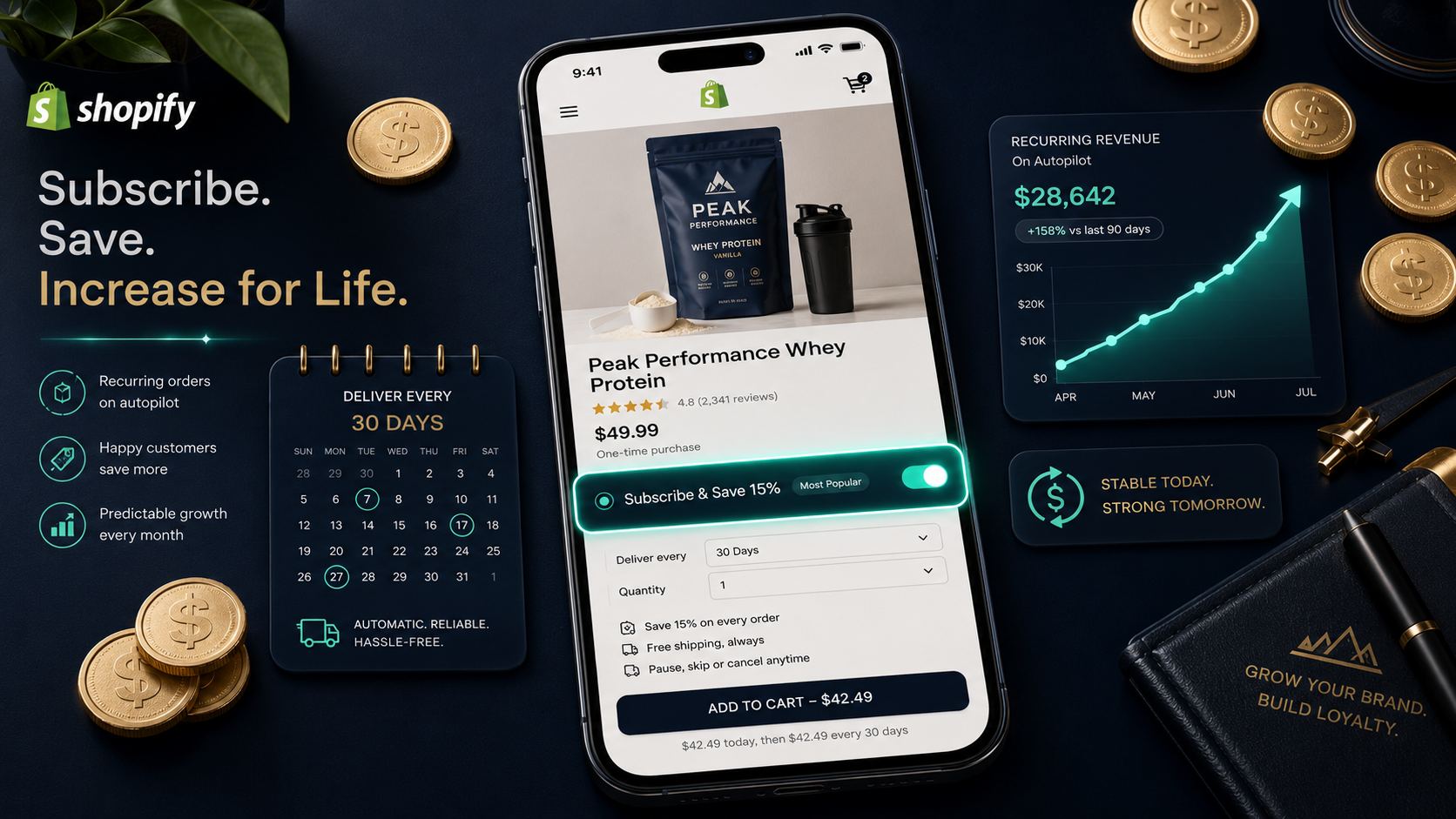
Shopify Subscription Model: How to Add Recurring Revenue to Your Store
Shopify Subscription Model: How to Add Recurring Revenue to Your Store
Most Shopify stores are built on a fundamentally exhausting business model. A customer finds your store, buys something once, and disappears. You spend money acquiring the next one, they buy once, and disappear too. Every single month starts at zero. You're not building a business — you're running on a treadmill.
Subscriptions break that cycle entirely.
<cite index="22-1">Subscription customers have 5–7x higher lifetime value than one-time buyers. A Shopify store with 200 active subscribers at $50 per month average generates $10,000 in predictable recurring monthly revenue. At 500 subscribers, that is $25,000 per month in baseline recurring revenue — regardless of how many one-time orders come in that month.</cite>
That last part deserves emphasis. Regardless of how many one-time orders come in that month. Your revenue floor exists. You can plan inventory, hire staff, and invest in growth from a position of financial stability rather than perpetual uncertainty.
<cite index="22-1">Subscription ecommerce has grown 435% over the past nine years and is now accessible to stores of any size.</cite> <cite index="28-1">In 2026, Shopify merchants who add subscriptions are seeing average order values 2–3x higher than their one-off counterparts.</cite>
This guide covers everything you need to add a subscription model to your Shopify store — the right model for your product type, the best apps to use, how to set it up step by step, and how to reduce churn once subscribers start joining.
Why Recurring Revenue Changes the Economics of Your Store
Before diving into the how, it's worth sitting with the why — because understanding the economic shift subscriptions create changes how you think about pricing, marketing, and product strategy.
<cite index="25-1">The most powerful subscription offers don't just sell a product; they solve a recurring problem. Whether it's the problem of running out of razors or being bored with current snacks, your model must be the clear solution.</cite>
The economics work on multiple levels simultaneously:
Customer acquisition costs spread differently. When a customer subscribes, you pay the acquisition cost once — then they pay you every month for as long as they remain subscribed. A subscriber who stays for 12 months at $40 per month generates $480 in revenue from a single acquisition event. A one-time buyer generating $40 per purchase requires 12 separate acquisition events to generate the same revenue, likely costing you 5–10x as much in total ad spend.
Revenue becomes forecastable. <cite index="25-1">When you have a clear idea of the money coming in each month, you can budget with confidence, make smarter inventory decisions, and plan for growth without the constant stress of unpredictability.</cite> This shift from reactive to planned operations compounds in value as your subscriber base grows.
Inventory management improves dramatically. Subscription orders are scheduled in advance, which means you know how much stock you need to fulfill next month's orders before the month begins. Overstock and stockout situations — two of the most expensive operational problems in ecommerce — become far more manageable.
LTV increases attract better financing. Higher lifetime value per customer improves your unit economics on paper, which matters if you ever seek investment, want to qualify for Shopify Capital, or need to justify higher customer acquisition spend on paid channels.
<cite index="23-1">The subscription economy is projected to hit $330 billion in 2026, growing at 12% annually.</cite> The merchants building subscription revenue today are positioning themselves in a market segment that continues to grow while one-time transactional ecommerce becomes increasingly competitive and margin-compressed.
The 4 Subscription Models That Work on Shopify
Not every subscription model fits every store. Choosing the right structure for your product type and customer behavior is the most important decision in your subscription strategy.
1. Subscribe and Save (Replenishment)
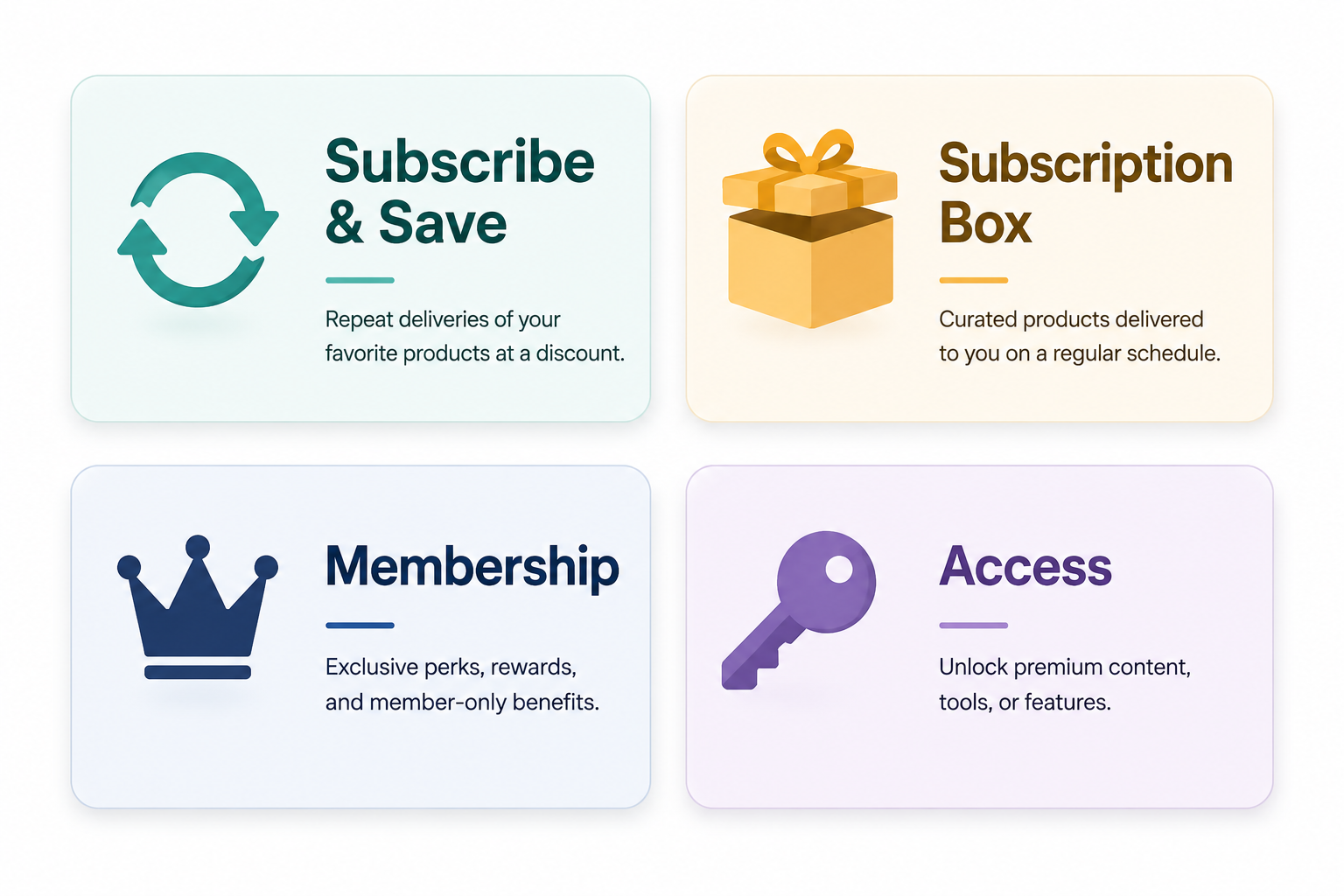
<cite index="28-1">The Amazon-popularised model. Customers subscribe to a product they buy regularly — supplements, coffee, skincare — and get a discount, typically 10–15%, in exchange for commitment.</cite>
This is the starting point for most Shopify merchants adding subscriptions, and for good reason. It maps naturally to customer behavior — they're already buying the product repeatedly, so the subscription formalizes and rewards that pattern. The operational requirements are minimal compared to other models because you're shipping the same product on a predictable schedule.
<cite index="22-1">The ideal subscription product is consumed or replaced on a predictable schedule: coffee, supplements, skincare, pet food, cleaning supplies, baby products, and similar consumables.</cite>
If your product fits this profile and you're not yet offering a subscribe-and-save option, you're leaving the highest-margin revenue model on the table.
2. Curated Subscription Boxes
<cite index="22-1">Customers subscribe to receive a curated selection of products each cycle. The appeal is discovery and surprise — subscribers look forward to seeing what is in this month's box. Examples include beauty boxes, snack boxes, book subscriptions, outfit curation, and hobby kits. Higher perceived value per box, but operationally complex — curation, sourcing variety, higher packaging costs.</cite>
The subscription box model commands premium pricing because the value proposition isn't just the products — it's the curation, the discovery experience, and the anticipation. Brands that execute this well build strong community around their boxes, which dramatically improves retention and word-of-mouth acquisition.
The operational complexity is real. You need to source different products each cycle, manage packaging, maintain surprise and quality simultaneously, and handle customer expectations when a product in the box doesn't land well. Start here only if you have the operational capacity and a genuine curatorial perspective.
3. Membership Subscriptions
<cite index="22-1">Customers pay a recurring fee for ongoing access to benefits — free shipping, member pricing, exclusive products, priority customer service, or content. This model works at any product type because the subscription is to a bundle of benefits, not a specific product. Amazon Prime is the most famous example, but smaller Shopify stores run effective membership programs starting at $5–10 per month.</cite>
Membership models are particularly powerful for brands with strong community or identity elements. The customer isn't subscribing to receive a specific product on a schedule — they're subscribing to belong to something, to access exclusive pricing, or to receive a level of service unavailable to non-members.
<cite index="25-1">Tiered pricing works especially well here — offer multiple subscription levels such as Basic, Pro, and Premium with escalating benefits.</cite> This allows customers to self-select based on how deeply they want to engage with the brand, while giving you clear upgrade paths as the relationship grows.
4. Access Subscriptions
<cite index="22-1">Common for digital products — customers subscribe for ongoing access to templates, presets, software, content libraries, courses, or community platforms.</cite>
For Shopify sellers with a digital product component — design assets, educational content, software tools, or community access — access subscriptions layer high-margin recurring revenue on top of physical product sales without adding meaningful operational complexity.
The Best Shopify Subscription Apps in 2026
<cite index="28-1">Shopify does not offer a built-in subscription product type out of the box, but the platform has built robust infrastructure for third-party apps to plug into. Since 2022, Shopify has offered the Subscriptions API and native Checkout Extensions support, meaning subscription apps now run inside Shopify Checkout — no more janky redirects or separate checkout flows.</cite>
This last point is critical. Earlier subscription implementations required customers to be redirected to a separate checkout page to complete a subscription purchase — a significant source of conversion drop-off. With Checkout Extensions, subscriptions now convert inside Shopify's native checkout, which is the highest-converting checkout experience on the platform.
Here are the apps worth using in 2026:
Shopify Subscriptions (Native App — Free) <cite index="28-1">Shopify's own free app, available since 2023. Limited in features compared to Recharge or Bold, but zero cost and deep platform integration. Perfect starting point for stores new to subscriptions before committing to a paid solution.</cite>
<cite index="23-1">Best for merchants testing subscriptions for the first time or running simple replenishment models with fewer than 500 active subscribers. Limitations include no advanced cancellation flows, limited dunning management, minimal segmentation, and no A/B testing for subscription offers.</cite>
Recharge <cite index="23-1">The market leader in Shopify subscription apps, powering over 20,000 merchants. Pricing starts at $99 per month plus 1.25% and $0.19 per transaction on the Standard plan.</cite> Recharge offers the deepest feature set of any subscription app — advanced cancellation flows, dunning management, bundle subscriptions, loyalty integrations, and robust analytics. The go-to choice for stores doing serious subscription volume.
Skio <cite index="22-1">Modern UI, easier migration from other platforms.</cite> Skio is built for growing DTC brands that want a more polished subscriber-facing interface and smoother onboarding for customers migrating from one-time purchases to subscriptions. Its password-less subscriber portal reduces login friction, which measurably improves portal engagement and reduces churn.
Bold Subscriptions <cite index="28-1">Strong checkout integration, good analytics, and a slightly lower price point than Recharge. Good for mid-market stores.</cite> Bold is particularly strong for stores that need complex subscription logic — mixed carts with subscription and one-time products, tiered billing rules, and B2B subscription scenarios.
Seal Subscriptions <cite index="22-1">Most affordable for small stores.</cite> A strong option for merchants who want subscribe-and-save functionality without committing to the higher monthly fees of Recharge or Bold. Straightforward setup, solid core features, and one of the most cost-effective entry points for subscription commerce.
Loop Subscriptions <cite index="26-1">Especially popular among fast-growing DTC brands looking for advanced retention features and flexible subscription management.</cite> Loop's standout feature is its cancellation flow — a customizable retention sequence that intercepts customers before they cancel and offers alternatives like pausing, swapping products, or applying a discount. This single feature consistently recovers 15–25% of would-be cancellations.
How to Set Up Subscriptions on Your Shopify Store: Step by Step
Step 1: Choose your model and identify your first subscription product. Start with one product and one model rather than launching subscriptions across your entire catalog simultaneously. The simplest starting point for most stores is a subscribe-and-save option on your bestselling consumable product. One product, 10–15% discount for subscribing, monthly billing cycle.
Step 2: Install your chosen subscription app. For stores new to subscriptions, start with the native Shopify Subscriptions app at zero cost. Navigate to the Shopify App Store, search "Shopify Subscriptions," and install. Connect it to your Shopify Payments account — this is required for recurring billing.
Step 3: Create your Selling Plan. Inside the subscription app, create a Selling Plan — the subscription terms for your product. Define the billing frequency (weekly, monthly, every 6 weeks — match it to your product's natural consumption cycle), the discount percentage subscribers receive, and the delivery schedule.
Step 4: Add the subscribe-and-save widget to your product page. The subscription app will add a purchase option widget to your product page — typically a toggle or radio button allowing customers to choose between one-time purchase and subscription. Review how this appears on both desktop and mobile, and ensure the subscription option is the default selection or at minimum equally prominent.
Step 5: Configure the subscriber portal. Every subscription app provides a customer-facing portal where subscribers can manage their subscription — change frequency, swap products, pause, or cancel. Customize this portal with your branding and make sure the URL is accessible from your post-purchase emails and account page.
Step 6: Set up dunning management. Dunning refers to the automated process of recovering failed subscription payments — expired cards, insufficient funds, declined transactions. <cite index="23-1">Dunning management is one of the most underestimated features in subscription commerce. Failed payment recovery typically recovers 20–30% of subscriptions that would otherwise churn involuntarily.</cite> Configure your app's dunning sequence before launch, not after.
Step 7: Create a subscription-specific email flow in Klaviyo. Set up at minimum three triggered emails: a welcome email immediately after subscription signup, an upcoming renewal reminder 3 days before each billing cycle, and a payment failure notification when a charge doesn't process. These three automations alone significantly improve subscriber retention and reduce involuntary churn.
How to Reduce Subscriber Churn
Getting subscribers is only half the equation. Keeping them is where the compounding value of subscriptions actually lives.
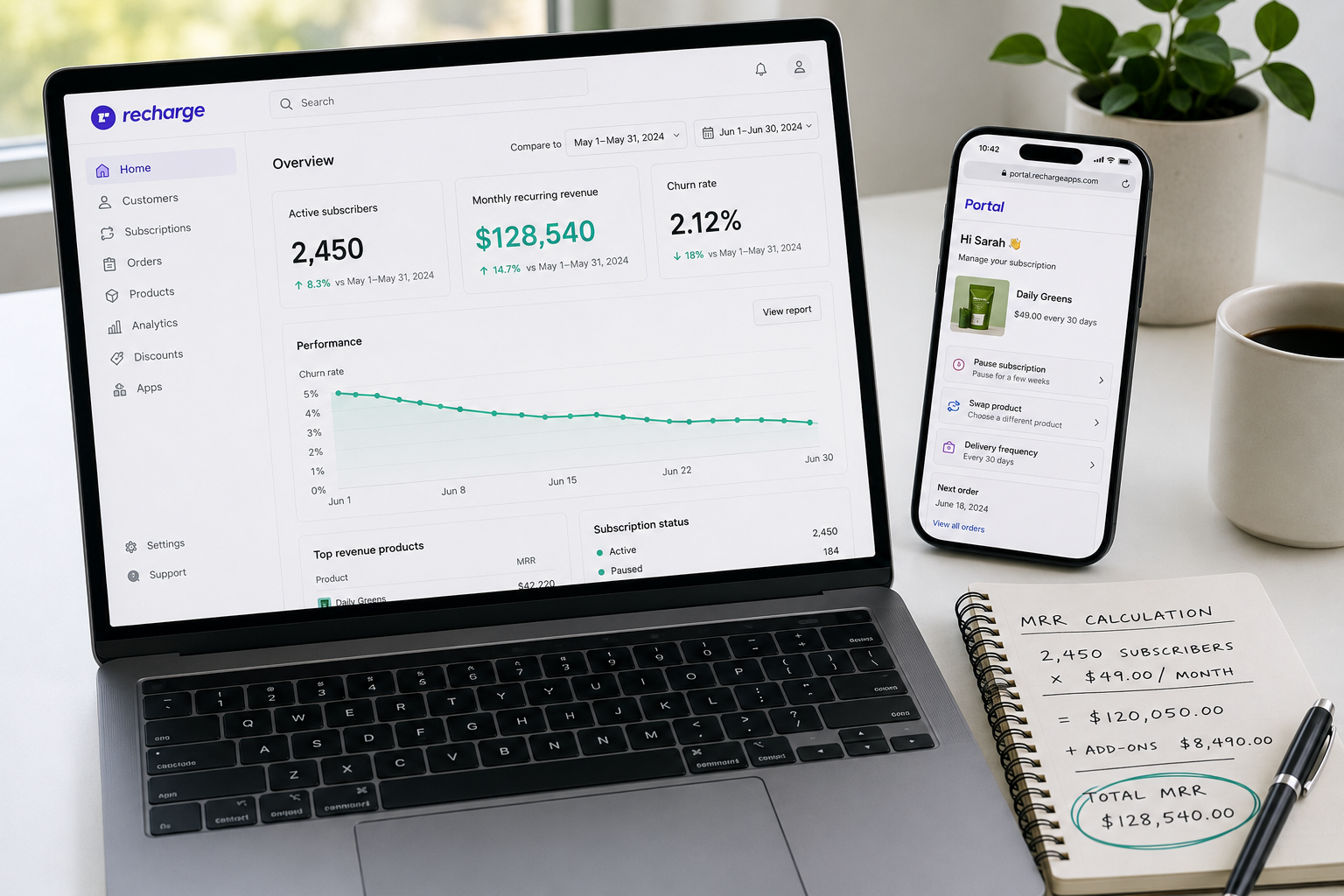
<cite index="22-1">Subscription revenue as a percentage of total should be tracked. Healthy subscription programs reach 20–30% of total revenue within 12 months of launch and continue growing as the subscriber base compounds.</cite>
Churn — subscribers cancelling — is the primary metric to manage once your program is running. There are two types: voluntary churn (the customer decides to cancel) and involuntary churn (failed payment causes the subscription to lapse). Both require different interventions.
For involuntary churn: Dunning management handles most of this automatically. Make sure your app's dunning sequence sends multiple retry attempts and email notifications before marking a subscription as failed. Adding a card update link to payment failure emails is one of the highest-ROI changes in subscription operations.
For voluntary churn: The cancellation flow is your primary defense. Use Loop Subscriptions or Recharge's built-in cancellation flows to intercept subscribers before they cancel and offer alternatives. Common retention offers that work:
- Pause option — allow subscribers to pause for 1–2 months instead of cancelling outright. Many subscribers who would cancel due to temporary circumstances (vacation, overcrowding of product) will reactivate after a pause rather than re-subscribing from scratch. - Product swap — allow subscribers to change which product they receive rather than cancelling. Particularly effective in supplement and skincare subscriptions where product preferences evolve. - Discount offer — a one-time discount on the next billing cycle as a retention incentive. Use this sparingly and only for subscribers who cite price as their cancellation reason. - Frequency change — allow subscribers to shift from monthly to every-6-weeks delivery if they cite "accumulating too much product" as their reason.
Beyond cancellation flows, proactive engagement keeps subscribers invested. Notify them before each box ships. Send personalized product recommendations based on what they've received. Create subscriber-only content, early access events, or exclusive products that reinforce the value of staying subscribed.
Getting Your First 100 Subscribers
The hardest phase of subscription commerce is the beginning — when your MRR is low and you're still proving the model. Here's how the most successful Shopify brands accelerate early subscriber acquisition.
Launch to your existing email list first. Your current customers are the highest-intent audience for your subscription offer. They already know and trust your product. A launch email to your list with a founding subscriber discount — available for the first 30 days only — typically generates the majority of initial subscribers.
Make the subscribe-and-save discount genuinely compelling. A 5% discount rarely moves the needle. 15–20% creates a clear financial incentive that makes the subscription obviously better value than one-time purchasing for customers who know they'll repurchase.
Add subscription to your post-purchase flow. A customer who just bought your product is the warmest possible audience for a subscription offer. An email sent 7–14 days after their first purchase — when they've had time to use and appreciate the product — with a "subscribe for your next order and save 15%" offer consistently converts at 8–12%.
Feature the subscription prominently on the product page. Don't hide the subscribe-and-save option below the fold or make it visually secondary to the one-time purchase option. Test making subscription the default selection with one-time purchase as the alternative — this framing consistently improves subscription conversion rates without meaningfully reducing one-time sales.
Promote through social proof. Once you have even 20–30 active subscribers, feature subscriber testimonials and user-generated content in your marketing. Social proof from subscribers specifically — "I've been getting this delivered every month for 6 months" — is more persuasive than standard product reviews because it communicates long-term satisfaction.
Common Subscription Mistakes to Avoid
Setting the billing cycle too frequently for the product. A monthly subscription for a product that naturally lasts 6–8 weeks creates customer frustration — they accumulate inventory they can't use and eventually cancel. Match your billing frequency to your product's genuine consumption cycle.
Offering too deep a discount upfront. A 30% subscribe-and-save discount may drive initial signups but destroys margin and trains subscribers to expect discounts that aren't sustainable. Start at 10–15% and test whether a smaller discount changes signup rates meaningfully before going deeper.
Neglecting the subscriber portal experience. If subscribers can't easily pause, swap, or manage their subscription themselves, they'll cancel rather than navigate a frustrating process. Invest in a clean, mobile-friendly subscriber portal and test it on actual devices before launch.
Launching without dunning management configured. Involuntary churn from failed payments typically accounts for 20–40% of total subscriber loss for stores that don't have automated recovery sequences in place. Configure dunning before your first billing cycle runs.
Not tracking cohort retention. Month-over-month MRR growth is a useful headline metric, but cohort retention — tracking what percentage of subscribers from each month are still active three, six, and twelve months later — tells you whether your retention is actually improving or whether growth is masking high churn.
Final Thoughts
Adding subscriptions to your Shopify store isn't a complicated technical project. With the native Shopify Subscriptions app or Seal Subscriptions, you can have a subscribe-and-save option live within a day. The harder work is designing an offer compelling enough to convert, a retention experience good enough to keep subscribers, and a communication cadence that keeps the relationship active between deliveries.
The brands that do this well don't just add subscriptions as a feature — they build their entire product and customer experience strategy around the subscription relationship. Every touchpoint becomes an opportunity to reinforce why staying subscribed is better than cancelling.
<cite index="22-1">Once a subscription program reaches scale, 20–30% of total store revenue flows automatically from recurring orders.</cite> That's 20–30% of your revenue that doesn't depend on ad spend, algorithm changes, or seasonal traffic fluctuations. In 2026, that kind of revenue stability isn't just nice to have. It's a structural competitive advantage.
Need help setting up a subscription model on your Shopify store, or want an expert to design a subscribe-and-save experience that actually converts? Get in touch with EcomFixify — we specialize in Shopify development and ecommerce growth strategy for brands ready to build recurring revenue.