
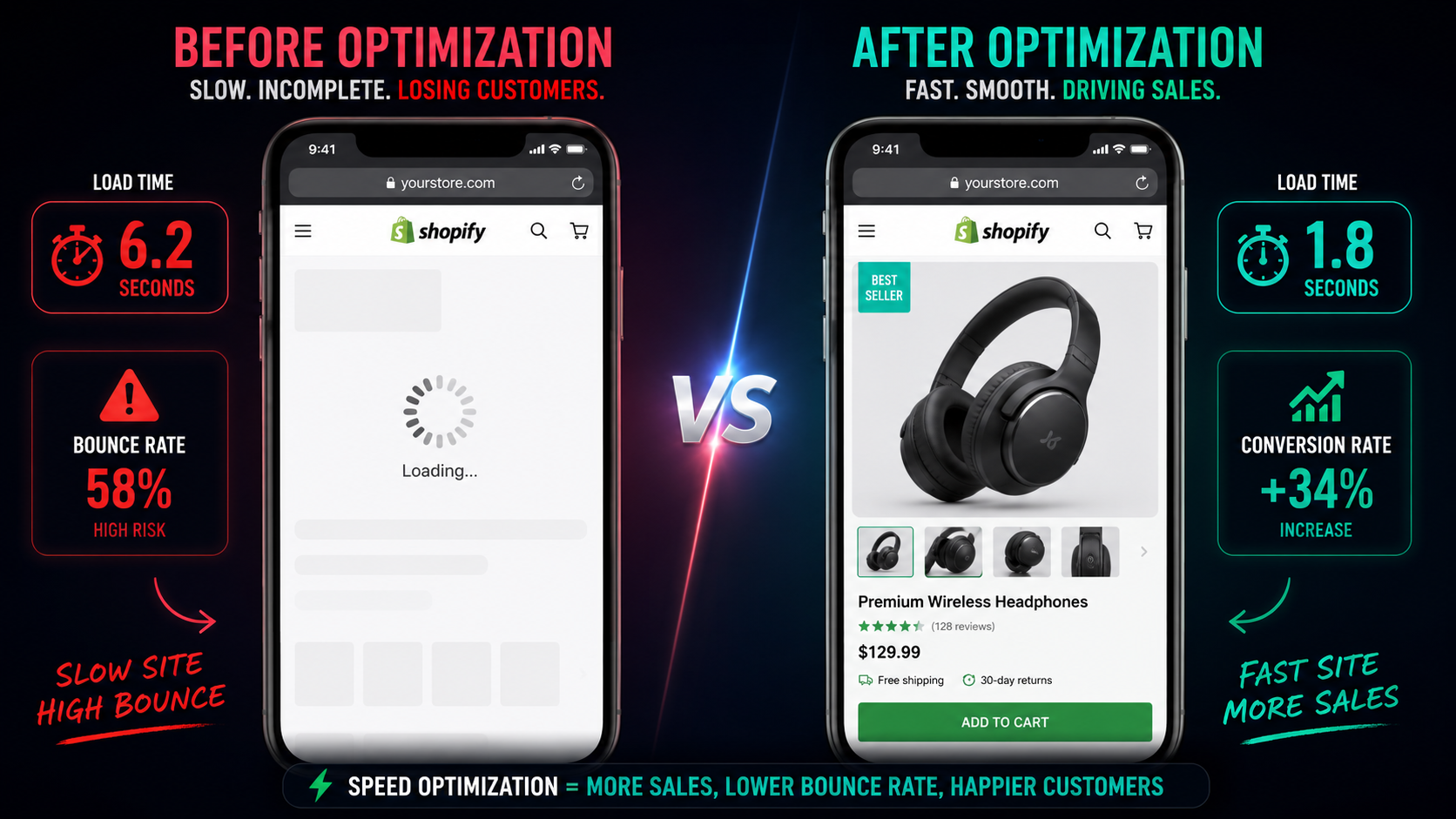
Shopify Speed Optimization: The Complete Checklist for 2026
Every Shopify merchant has heard that page speed matters. Most have run a PageSpeed Insights test, seen a score they did not fully understand, and moved on to something more urgent. The result is a quiet, invisible revenue leak that compounds with every visitor who bounces before the page finishes loading.
The numbers that put this in commercial terms are stark. A one-second delay in page load time reduces conversions by up to 7%. A Shopify store with 5,000 daily visitors and a $60 average order value loses $9,000 per day from a single second of unnecessary load delay. 40% of visitors leave slow-loading websites entirely. And only 47% of websites currently pass all Core Web Vitals thresholds — meaning more than half of Shopify stores are actively losing rankings, traffic, and sales to a performance problem they have not treated as a priority.
In 2026, page speed is no longer just a user experience consideration. It is a confirmed Google ranking factor, a direct determinant of paid advertising Quality Scores and cost-per-click, and one of the strongest predictors of mobile conversion rate. A store loading in 1.5 to 3 seconds consistently outperforms one loading in 5 to 8 seconds across every relevant metric simultaneously.
This guide gives you the complete Shopify speed optimization checklist for 2026 — organized by impact, with clear explanations of what to fix, why it matters, and how to verify each improvement.
Understanding What Google Actually Measures: The Three Core Web Vitals
Before touching your store, you need to understand which metrics matter and why. There are dozens of speed metrics — PageSpeed Insights alone surfaces over twenty — but Google uses three Core Web Vitals as confirmed ranking signals. Everything else is diagnostic context.
Largest Contentful Paint (LCP) measures how quickly the main content of a page loads — specifically, when the largest visible element renders on screen. For most Shopify product pages, this is the hero product image. Google's good threshold is under 2.5 seconds. Stores hitting 4 seconds or above are actively losing rankings and conversions simultaneously. LCP is the metric most directly correlated with perceived load speed — it is what users feel when they decide whether a page is fast or slow.
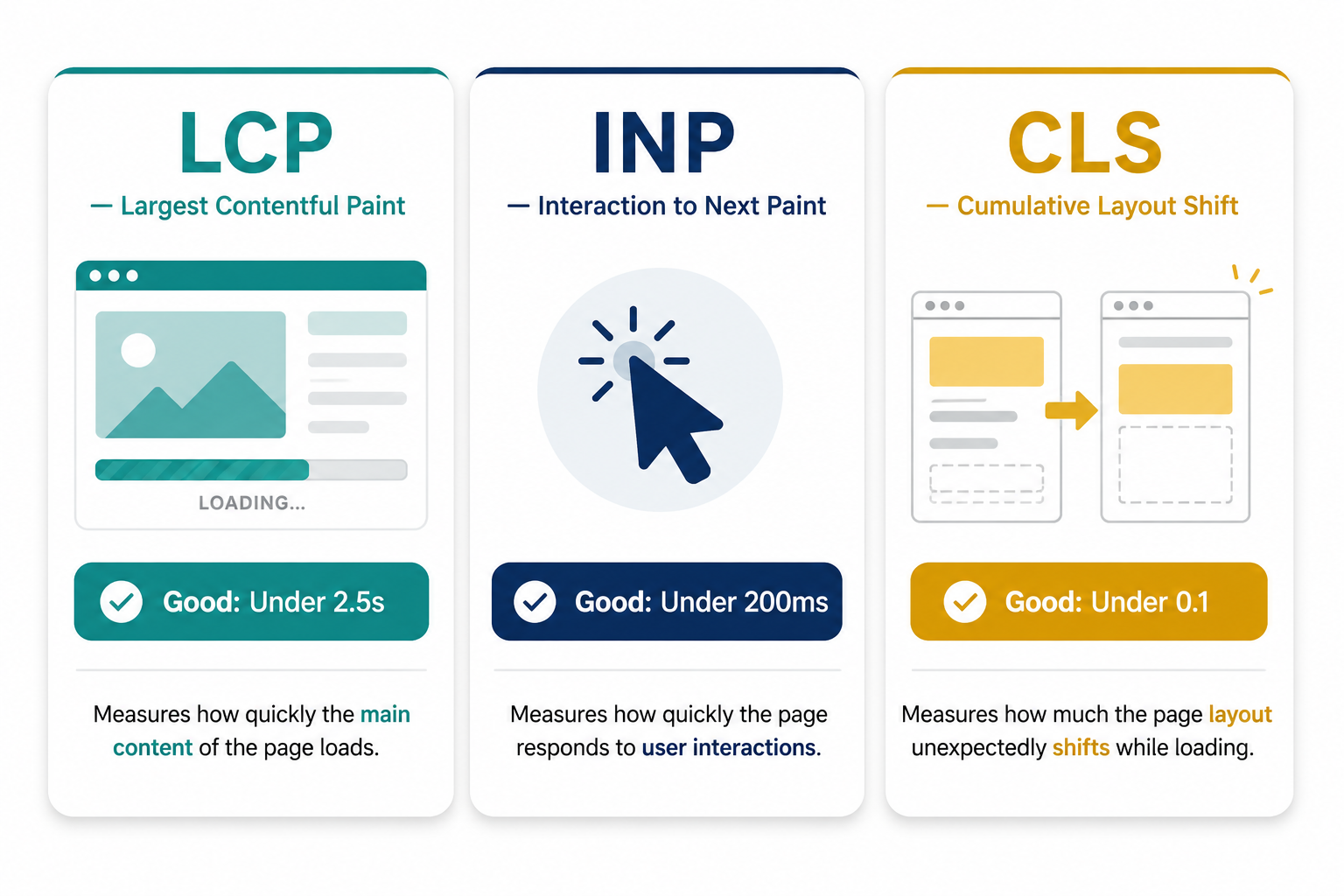
Interaction to Next Paint (INP) replaced First Input Delay in 2024 and measures overall interactivity responsiveness throughout an entire page visit, not just the first interaction. Every time a user clicks, taps, or types and waits for the page to respond, INP captures that delay. Google's good threshold is under 200 milliseconds. Heavy JavaScript — the primary culprit in Shopify's app-heavy ecosystem — is the leading cause of INP failures, as scripts block the main thread and prevent the browser from responding to user input.
Cumulative Layout Shift (CLS) measures visual stability. When elements move around while the page is loading — a product image jumping down when an app banner loads above it, a button relocating as a font renders, a price changing position when a discount badge appears — CLS captures the disruption. Google's good threshold is under 0.1. High CLS scores are not just a rankings problem — they cause misclicks, accidental purchases, and general frustration that increases bounce rates independently of load time.
The most important diagnostic principle: lab data diagnoses, field data judges. Google's PageSpeed Insights lab score tells you what might be causing problems. Google Search Console's Core Web Vitals report tells you what real users are experiencing on your actual store. Always prioritize field data when assessing whether your speed improvements are working. A store can score 95 on PageSpeed Insights in lab conditions and still fail Core Web Vitals in field data if real users on slower mobile connections are experiencing delays the lab does not replicate.
How to Audit Your Shopify Store Speed: Starting From the Right Place
Before making any changes, establish a baseline that reflects what Google actually sees — not just what you see on your fast office WiFi connection on a desktop computer.
Open Google Search Console and navigate to Core Web Vitals under the Experience section. This shows you real user data segmented by page type — homepage, collection pages, product pages — on both mobile and desktop. Note which templates are failing and which are passing. A product template that is failing LCP is a high-priority fix because that single template multiplies across every product in your catalog.
Open Google PageSpeed Insights at pagespeed.web.dev and test your five most important pages individually — homepage, your two or three highest-traffic collection pages, and your two or three highest-traffic product pages. Do not test only the homepage. Shopify stores are template-driven, and the performance of your product template on a specific URL determines performance across thousands of product pages simultaneously.
Run each test on mobile rather than desktop. Google uses mobile-first indexing, which means your mobile performance is what determines your search rankings regardless of how well your desktop version performs. 70% of ecommerce traffic in 2026 arrives on mobile devices — mobile performance is not a secondary concern, it is the primary one.
Document your baseline scores before making any changes. You cannot measure improvement without a starting point, and well-intentioned speed optimizations that do not actually move the metrics you care about are a common waste of development time.
The Complete Shopify Speed Optimization Checklist
Section 1: Image Optimization
Images account for the majority of page weight on most Shopify stores and are the single highest-impact category for speed improvement.
Convert all images to WebP or AVIF format. Shopify's CDN automatically serves images in AVIF format through its native image rendering pipeline for browsers that support it — but only if your theme is using Shopify's image URL parameters correctly. Themes using hardcoded image URLs that bypass Shopify's rendering pipeline miss this optimization. Check your theme's image output code to confirm it uses Shopify's URL parameters rather than static file paths.
Implement lazy loading on all images below the fold. Lazy loading delays image downloads until they are about to enter the viewport, preventing the browser from simultaneously downloading every image on a product page that might have twelve photos in the gallery. Shopify's native lazy loading attribute is available through the image tag in Liquid. Verify your theme implements it on gallery images, related products, and any other below-fold imagery.
Preload the LCP image explicitly. The hero product image on product pages is almost always the LCP element — the largest visible item that Google measures. Adding a preload hint in the head section of your theme tells the browser to begin downloading this image immediately, before it discovers it through normal HTML parsing. This change alone typically reduces LCP by 0.3 to 0.8 seconds on product pages. In your theme.liquid or base.json, add a preload link tag for your primary product image template.
Set explicit width and height attributes on all images. When images load without size declarations, the browser cannot reserve the correct layout space until the image arrives — causing elements below the image to shift downward as it renders. This is one of the primary causes of high CLS scores on Shopify stores. Every image element in your Liquid templates should include width and height attributes matching the rendered dimensions.
Compress images before uploading. Even with Shopify's CDN optimization, the source file size affects upload times and the quality of CDN-generated variants. Use a tool like Squoosh, ImageOptim, or TinyPNG to compress product images before uploading them to Shopify. Target under 200KB for most product images and under 500KB for hero images. The compression investment at upload time compounds across every page load for the life of that image.
Avoid using images for text or decorative elements. Text rendered as image files requires the browser to download the full image before displaying the content, cannot be indexed by search engines, and scales poorly across screen sizes. Any text that currently exists as an image — promotional banners, font-heavy hero overlays, sale badges — should be replaced with CSS-rendered text equivalents.
Section 2: App Audit and JavaScript Reduction
This is the most underestimated speed bottleneck in the Shopify ecosystem. Every app installed on your store adds JavaScript to your storefront — regardless of whether that app is used on the specific page loading. An app installed for a single use case affects every page on your store.
Audit your installed apps systematically. In your Shopify admin, go to Apps and list every installed app. For each app, ask: is this app currently generating measurable value that exceeds its performance cost? An app that adds 0.4 seconds of JavaScript loading to every page across 50,000 monthly sessions needs to generate more than the revenue cost of those delays to justify its presence.
Use Shopify's built-in Theme Inspector — accessible through the Shopify admin's theme preview — to identify which apps are contributing the most JavaScript weight to your most important page templates. Focus on apps adding more than 50KB of JavaScript to product or collection templates, as these are most likely to be contributing to INP failures.
Remove unused apps immediately. Apps that were installed for a trial, a single campaign, or a feature you never fully implemented continue loading their JavaScript on every page even after you stop using them. Removing these apps is the highest-ROI speed improvement available because it requires no development work and delivers immediate results.
Load apps asynchronously where possible. Apps that are not required for the initial page render — chat widgets, loyalty pop-ups, exit-intent tools — should load after the critical page content has rendered rather than blocking it. This requires either developer configuration of the app's installation script or using a tag management tool like Google Tag Manager to control loading order and timing.
Consolidate overlapping app functionality. Many Shopify stores have multiple apps performing similar functions — two different review apps, a loyalty app and a referral app that overlap significantly, an email popup and a separate exit-intent popup. Consolidating onto fewer apps that each cover more functionality reduces total JavaScript load while maintaining the same capabilities.
Section 3: Theme Optimization
Your theme is the foundation on which every other optimization is built. A heavily customized older theme accumulates performance debt that compounds with every app and content addition.
Evaluate your current theme's baseline performance. Create a test product page with only the theme's default content — no apps installed, no custom scripts — and test it in PageSpeed Insights. This gives you the theme's baseline performance independent of app impact. If a clean installation of your theme scores below 60 on mobile, the theme itself is a performance ceiling that app and image optimization cannot overcome.
Use a performance-optimized theme as the foundation. Shopify's free Dawn theme is built specifically for Core Web Vitals compliance and consistently scores 90 or above on mobile in clean installations. Paid themes including Impulse, Prestige, and Streamline are also engineered with performance in mind. If you are planning a theme change, prioritize themes that publish their PageSpeed scores publicly and maintain them as the platform evolves.
Minimize render-blocking resources in your theme's head section. Any CSS or JavaScript in the head that the browser must download and parse before rendering visible content adds to LCP. Audit your theme's head section for scripts and stylesheets that can be deferred or removed. Critical CSS — the styles needed to render above-the-fold content — should be inlined in the head. Non-critical CSS should be loaded asynchronously after the initial render.
Remove unused CSS from your theme. Most Shopify themes include CSS for features and sections you are not using. Unused CSS increases the stylesheet download and parse time without contributing to any rendered element. Tools including PurgeCSS and Shopify's Theme Inspector can identify CSS rules with zero references in your current theme configuration.
Defer non-critical JavaScript. JavaScript that is not needed for the initial page render — analytics scripts, marketing pixels, app functionality that only activates on user interaction — should use the defer or async attribute to prevent it from blocking HTML parsing. This is particularly impactful for themes that load marketing and tracking scripts synchronously in the head, which is unfortunately common in both free and paid Shopify themes.
Section 4: Third-Party Scripts and Tracking
Third-party scripts are the invisible speed tax most merchants pay without realizing it. Every tracking pixel, analytics tag, marketing platform integration, and chat widget is a script loaded from an external server that the browser must download, parse, and execute before it can respond to user interactions.
Audit every third-party script currently loading on your store. Open Chrome DevTools on your store's product page, go to the Network tab, filter by Script, and look for requests to third-party domains — anything that is not myshopify.com or your own domain. Document what each script is, which app or service installed it, and whether that service is actively in use.
Remove abandoned tracking scripts immediately. Every paid advertising platform or analytics service you have ever connected to your Shopify store potentially left a tracking pixel that continues loading even if you stopped using the service years ago. These abandoned scripts add load time with zero benefit. Remove them from your theme code or use a script manager to disable them.
Use Google Tag Manager for script consolidation. Loading all your third-party scripts through a single GTM container — rather than individually embedded in your theme — allows you to control the loading order, set up triggers so scripts only load on pages where they are relevant, and add or remove scripts without touching your theme code. The performance benefit of loading scripts conditionally — only firing conversion tracking on checkout pages, only loading chat widgets on product pages — can be significant on high-traffic stores.
Limit the number of analytics and attribution tools running simultaneously. It is common for Shopify stores to have Google Analytics, Meta Pixel, TikTok Pixel, Klaviyo tracking, Triple Whale, and a heat mapping tool all running simultaneously. Each adds load time. Evaluate whether the attribution intelligence from multiple overlapping tools justifies their collective performance cost, and consolidate where possible.
Section 5: Font Optimization
Web fonts are a commonly overlooked source of both LCP delay and CLS. When a page loads and the specified web font is not yet downloaded, the browser either hides text until the font arrives (Flash of Invisible Text) or renders text in a fallback font that then shifts when the web font loads (Flash of Unstyled Text). Both degrade user experience and contribute to CLS.
Preload critical web fonts. Any font that is visible in the above-the-fold content — your heading font, your price font, your add-to-cart button font — should be preloaded in the head section with a preload link tag. This tells the browser to begin downloading the font file before it processes the full stylesheet, reducing the delay between page render and correct typography.
Use font-display: swap in your font-face declarations. This CSS property tells the browser to render text in the fallback font immediately while the web font downloads, then swap to the web font when it arrives. The brief visual change is far preferable to invisible text, and the reduced perception of delay improves overall user satisfaction with page speed.
Limit the number of web font variants loaded per page. Each font weight and style — Regular 400, Bold 700, Italic 400 — is a separate file download. Many Shopify themes load six or more font variants across the page when only two or three are actually used in visible content. Audit your font loading declarations and remove variants that do not appear in your above-the-fold content.
Consider system font stacks for body text. System fonts — the fonts already installed on a user's operating system — load at zero cost because no download is required. Using a system font stack for body text while loading web fonts only for headings and critical brand typography can reduce font-related page weight by 80% or more on text-heavy pages.
Section 6: Shopify-Specific Technical Optimizations
Beyond the general web performance principles above, several optimizations are specific to how Shopify handles themes, CDN delivery, and checkout.
Enable Shopify's built-in image CDN optimization for all images. Shopify automatically delivers images through its global CDN, but the optimization level depends on how your theme requests the image. Using the | image_url filter with explicit size parameters in Liquid generates properly sized, CDN-optimized image URLs. Themes using raw image source URLs bypass this optimization and serve oversized images regardless of the display size.
Minimize the number of Liquid sections on high-traffic templates. Each Liquid section on a Shopify template is a separate render block that the server must process before returning the HTML. Templates with 20 or more sections — common on heavily customized homepages — add server-side rendering time that appears as Time to First Byte (TTFB) delay in PageSpeed Insights. Consolidate sections where functionality overlaps.
Use Shopify's native search and filtering rather than third-party replacements where adequate. Third-party search and filter apps that replace Shopify's native functionality are among the heaviest JavaScript loads in the app ecosystem. Shopify's native filtering, introduced through Online Store 2.0, handles a significant proportion of use cases that previously required third-party replacement. Using native filtering where it meets your requirements eliminates one of the most common INP failure sources on collection pages.
Optimize your checkout for performance separately from your storefront. Shopify's hosted checkout is one of the fastest in ecommerce — it runs on Shopify's infrastructure independently of your theme performance issues. However, Checkout Extensibility apps and scripts do add load time to the checkout experience. Audit any checkout-specific apps for performance impact, particularly if your checkout abandonment rate is higher than average.
Section 7: Continuous Monitoring and Maintenance
Speed optimization is not a one-time task. Every app installation, theme update, new product photo upload, and content change creates potential for performance regression. Treating speed as an ongoing operational metric rather than a one-time project is what separates consistently fast stores from stores that are fast for a month after an optimization sprint and slow six months later.
Set up automated Core Web Vitals monitoring. Several tools provide continuous real-user monitoring that alerts you when performance degrades below your thresholds. Google Search Console sends email alerts when Core Web Vitals fail thresholds on a meaningful number of URLs. Third-party monitoring tools including DebugBear, Calibre, and SpeedCurve provide more granular alerting and historical trending that makes regression analysis faster.
Run a speed audit before installing any new app. The single best habit for maintaining speed after optimization is testing the performance impact of each app before committing to it. Install the app on a theme preview, test the affected page templates in PageSpeed Insights, and evaluate whether the functionality justifies the performance cost before activating on your live store.
Audit your speed after every significant theme update. Theme updates frequently reintroduce removed scripts, change image handling, or add new JavaScript that reverses previous optimizations. A post-update speed test on your most important templates takes fifteen minutes and prevents months of unnecessary performance regression.
Schedule quarterly speed audits as a standing maintenance task. Using your documented baseline from the initial audit, run PageSpeed Insights on the same set of pages every quarter and compare against previous results. Catching gradual performance degradation early — before it compounds into a significant ranking or conversion problem — is far less expensive than diagnosing and fixing a serious speed failure after it has already affected traffic and revenue.
What Scores to Target: Realistic Benchmarks for 2026
The goal is not a perfect 100 on PageSpeed Insights. Lab scores do not rank stores — field data does. The practical performance targets that correspond to passing Core Web Vitals thresholds and competitive commercial performance in 2026 are:
LCP under 2.5 seconds on mobile for product pages, collection pages, and homepage. This is the single most impactful threshold for both rankings and conversion rates. Stores achieving LCP under 2.0 seconds have a meaningful advantage over stores at 2.5 seconds, but the critical step is getting below the 2.5 second threshold first.
INP under 200 milliseconds for all interactive elements — add-to-cart buttons, variant selectors, search inputs, filter controls, and quantity adjusters. INP failures are the most conversion-damaging performance issue because they make users feel the store is broken or unresponsive rather than simply slow.
CLS under 0.1 on all page templates. CLS failures are the most annoying user experience problem in ecommerce because they cause the page to visually jump at unpredictable moments. Any store with a CLS score above 0.25 is creating a genuinely frustrating experience that contributes to abandonment independently of load speed.
PageSpeed Insights mobile score above 60 as a floor, with 75 to 85 as a realistic target for well-optimized stores running standard app configurations. Stores scoring 90 or above typically have very few third-party apps, lightweight themes, and dedicated performance development resources. For most Shopify merchants with standard app stacks, 70 to 85 on mobile represents excellent real-world performance.
The Revenue Case for Speed Optimization
The commercial math on Shopify speed optimization is cleaner than almost any other investment available to store owners.
For a store generating $50,000 per month, a 7% conversion improvement from a one-second LCP reduction is $3,500 per month — $42,000 per year — from unchanged traffic. A one-time development investment of $2,000 to $5,000 for comprehensive speed optimization pays back in five to fourteen weeks and continues generating returns permanently.
For stores running Google Ads or Meta Ads, the indirect benefit compounds the direct conversion benefit. Faster landing pages generate higher Quality Scores in Google Ads, which reduces cost-per-click and improves ad ranking simultaneously. The same budget buys more traffic at better positions — a double benefit that makes speed optimization one of the highest-leverage paid acquisition investments available.
For stores dependent on organic search traffic, the ranking benefit of passing Core Web Vitals thresholds can generate traffic increases that dwarf the conversion rate improvement alone. A store that moves from failing to passing Core Web Vitals in a competitive category can see meaningful organic ranking improvements within 60 to 90 days of the change — improvements that bring more qualified traffic to the optimized pages.
The Complete Speed Optimization Checklist: Quick Reference
-
Use this reference before starting, during optimization, and in quarterly audits:
-
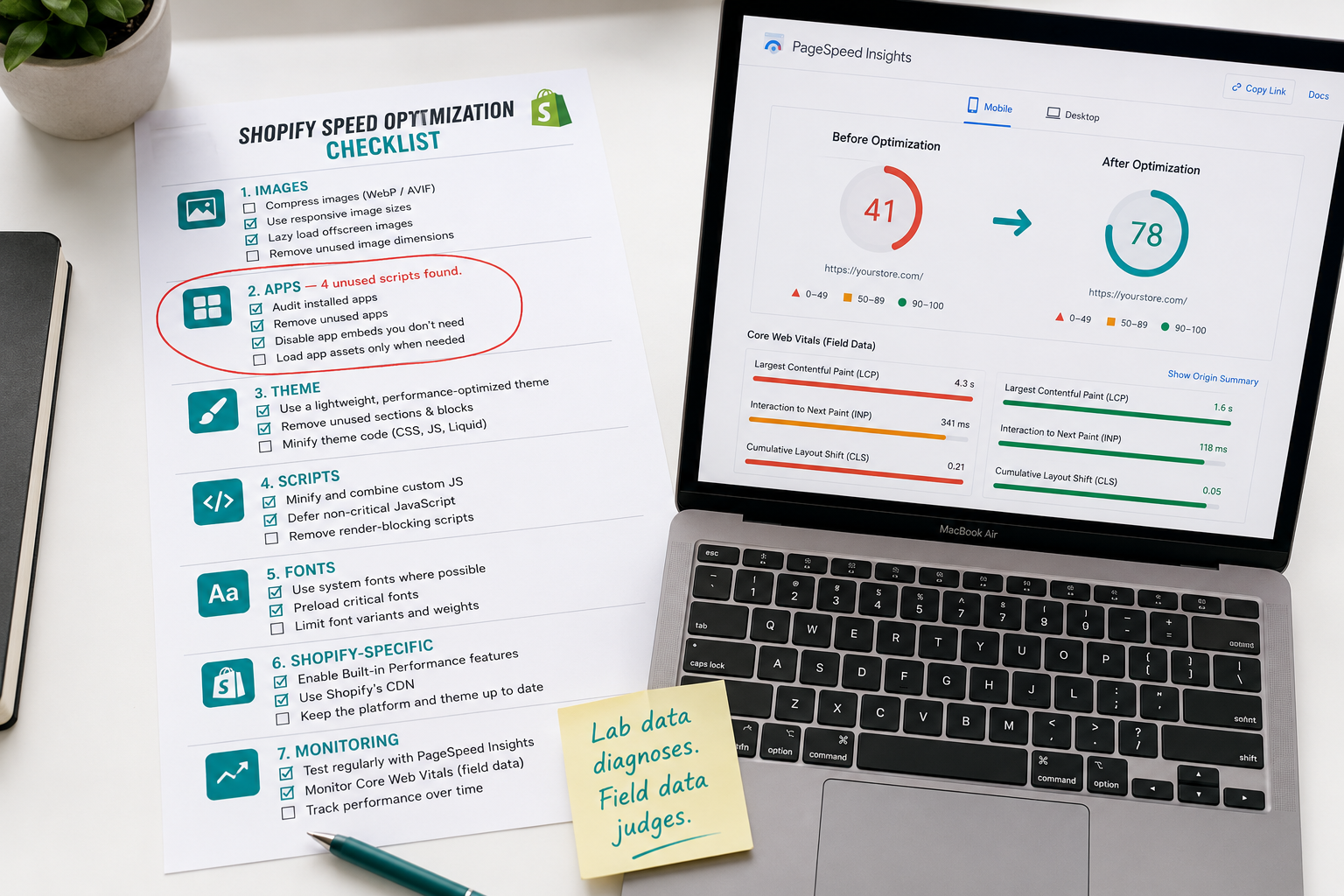
Audit: Baseline field data from Search Console, lab data from PageSpeed Insights on five key pages, mobile only.
-
Images: WebP or AVIF format confirmed, lazy loading on below-fold images, LCP image preloaded, explicit width and height on all images, source files compressed under 200KB.
-
Apps: Unused apps removed, JavaScript audit completed, non-critical apps loading asynchronously, overlapping functionality consolidated.
-
Theme: Performance-optimized theme in use or confirmed, render-blocking resources removed from head, unused CSS removed, non-critical JS deferred.
-
Scripts: Third-party script audit completed, abandoned tracking scripts removed, Google Tag Manager configured for conditional loading.
-
Fonts: Critical fonts preloaded, font-display swap applied, unused font variants removed.
-
Shopify-specific: Image CDN using native URL filter, Liquid section count reviewed on key templates, native filtering used where adequate.
-
Monitoring: Search Console alerts configured, pre-install speed testing habit established, quarterly audit scheduled.
-
Targets confirmed: LCP under 2.5 seconds, INP under 200 milliseconds, CLS under 0.1 — all on mobile field data.
Final Thoughts
Most Shopify speed optimization advice tells you to compress images and install a speed app. Compressing images is genuinely useful — it is on this checklist for good reason. Speed apps are not — they almost always add their own JavaScript overhead that exceeds any savings they claim to produce.
The optimizations that actually move Core Web Vitals on Shopify stores are unglamorous and specific: preloading the LCP image, removing unused apps and abandoned scripts, reserving layout space for images so nothing shifts, and ensuring that JavaScript required for interactivity does not block the main thread.
None of these require specialized tools. All require knowing what you are looking for and where to look for it. This checklist tells you both.
The stores treating speed as a quarterly operational metric rather than a one-time task are building a compounding advantage in search rankings, conversion rates, and paid advertising efficiency that strengthens every month they maintain it. The stores that optimize once and move on watch that advantage gradually erode until the next crisis.
Speed is not a technical consideration. It is a revenue consideration — one that affects every visitor, every campaign, and every sale your store processes.
Need a professional speed audit of your Shopify store, or want an expert to implement Core Web Vitals improvements that move rankings and conversions? Get in touch with EcomFixify — we specialize in Shopify development and performance optimization for growing brands.