
Shopify Pricing Strategy: How to Charge More and Sell More
Most Shopify merchants price their products the same way. They calculate their cost, add a markup they feel comfortable with, check what competitors are charging, and land somewhere in the middle. Then they wonder why their margins are thin, why customers constantly ask for discounts, and why raising prices feels impossible without losing sales.
The problem is not the products. The problem is the pricing model — and the assumptions embedded in it.
Price is not a number. It is a signal. A $50 product and a $75 product marked down to $50 are identical items, but the discounted version converts higher. A product priced at $97 outsells the same product at $100 despite costing three dollars more in the customer's pocket. A premium supplement brand charges four times what a drugstore brand charges for functionally similar ingredients — and generates stronger repeat purchase rates and brand loyalty than the cheaper alternative.
These outcomes are not accidents. They are the predictable result of pricing psychology applied systematically — and they are available to every Shopify store regardless of product category, brand size, or marketing budget.
This guide covers the pricing principles, psychological mechanisms, and specific strategies that allow you to charge more for your products while simultaneously converting more of the visitors who see them.
Why Most Shopify Merchants Underprice Their Products
Before building a better pricing strategy, understanding the psychology behind systematic underpricing helps you recognize it in your own store.
Cost-plus pricing — calculating your unit cost and adding a fixed percentage markup — is the default approach for most new merchants because it feels safe and logical. If the product costs $20 and you add 50% markup, the price is $30. The margin is predictable and the calculation is simple.
The fundamental problem with cost-plus pricing is that it anchors price to your costs rather than to your customers' perception of value — and these two numbers are almost never the same. A customer buying a premium skincare serum is not thinking about what the raw ingredients cost. They are thinking about what clear, healthy skin is worth to them. That value is almost always significantly higher than any cost-plus calculation produces — which means cost-plus pricing systematically leaves money on the table.
The second reason merchants underprice is competitive anchoring — checking what competitors charge and pricing at or below that level to appear competitive. This logic is only valid when your product is identical to competitors' products and price is the only buying criterion. For branded, differentiated, or quality-differentiated products, pricing below premium competitors signals lower quality rather than better value — and actively reduces conversion rates among the premium-minded buyers who are most likely to be your best customers.
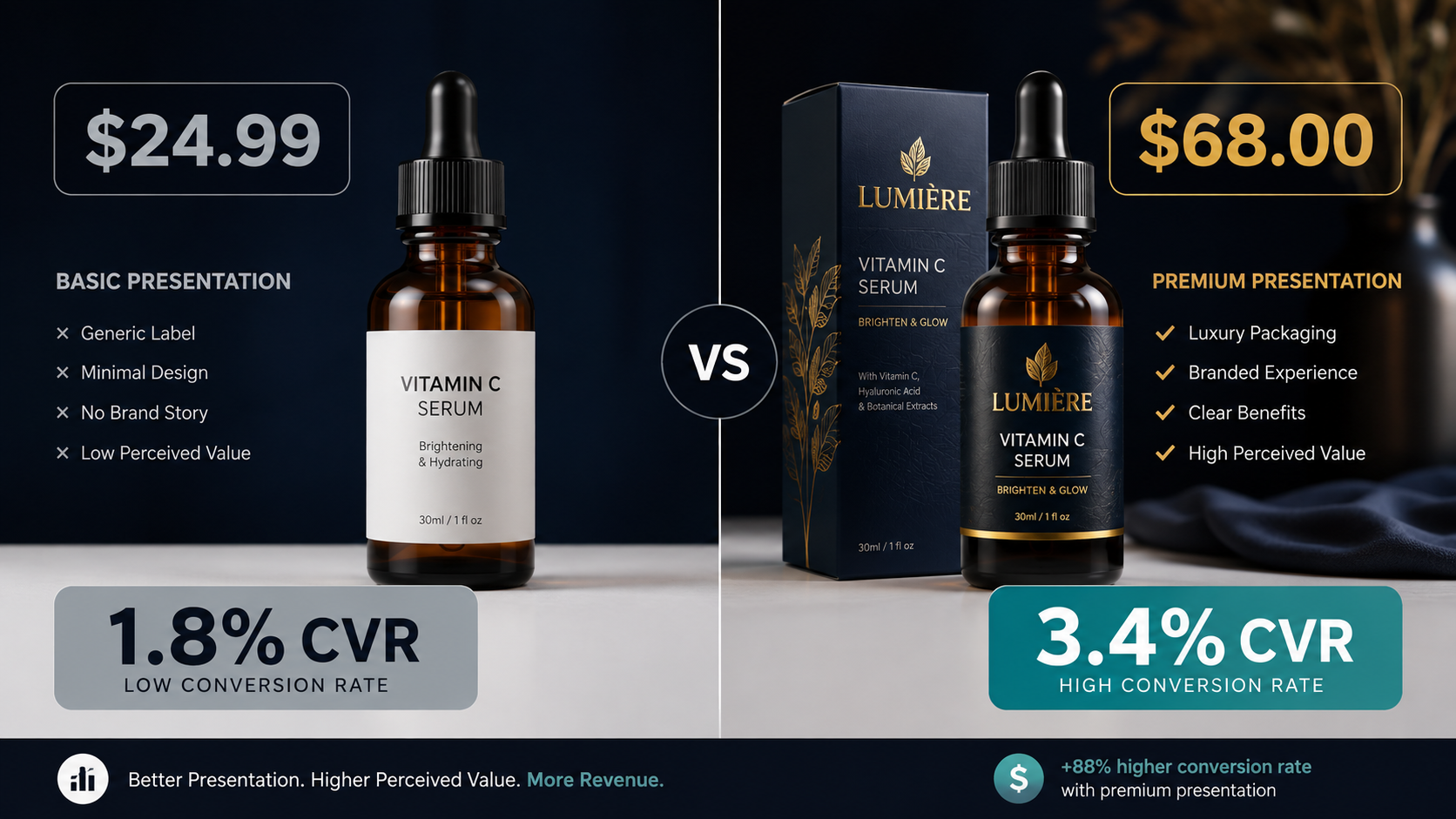
Research consistently demonstrates that consumers use price as a quality signal when they cannot directly evaluate quality before purchase. A moisturizer priced at $24 and one priced at $68 will be assessed by most shoppers as having meaningfully different quality — regardless of their actual formulation. If your product genuinely competes with premium alternatives but is priced like a commodity, you are not attracting value-seeking customers. You are repelling quality-seeking customers.
The Fundamental Shift: From Cost-Based to Value-Based Pricing
Value-based pricing starts with a different question entirely. Instead of "what does this product cost me plus margin?" it asks "what is this product worth to the customer who buys it?"
The answer to that second question is almost always higher than a cost-plus calculation produces — and closing the gap between the two is where significant margin improvement lives without any change to the product itself.
To implement value-based pricing, map the specific outcomes your product delivers to the customer who buys it. A fitness supplement that helps customers lose 15 pounds in three months is worth significantly more than its cost of ingredients plus manufacturing. A productivity tool that saves a professional two hours per week is worth a calculable hourly rate multiplied by the weeks of use. A skincare product that resolves a chronic skin concern is worth the cost of the dermatologist visits it replaces.
Most products deliver value that is dramatically larger than their price — and the merchants who learn to articulate that value clearly on their product pages, in their marketing, and in the way they frame their pricing unlock the ability to charge more without reducing conversion.
The practical test for whether your current pricing is value-based or cost-based: if you raised your price by 20% tomorrow, what would happen? If your honest answer is "we would lose most of our sales," your pricing is not differentiated by value — customers are buying primarily on price, which means your product, positioning, or marketing is not communicating the value that justifies a premium. If your honest answer is "some customers would leave but the ones who stayed would more than make up the margin difference," you are already underpricing.
Pricing Psychology Principle 1: Anchoring
Anchoring is the single most powerful concept in pricing psychology and the one with the most immediate practical application for Shopify stores.
The anchoring bias describes the human tendency to rely heavily on the first piece of numerical information encountered when making subsequent judgments. In ecommerce pricing, this means the first price a customer sees becomes their reference point for evaluating everything that follows.
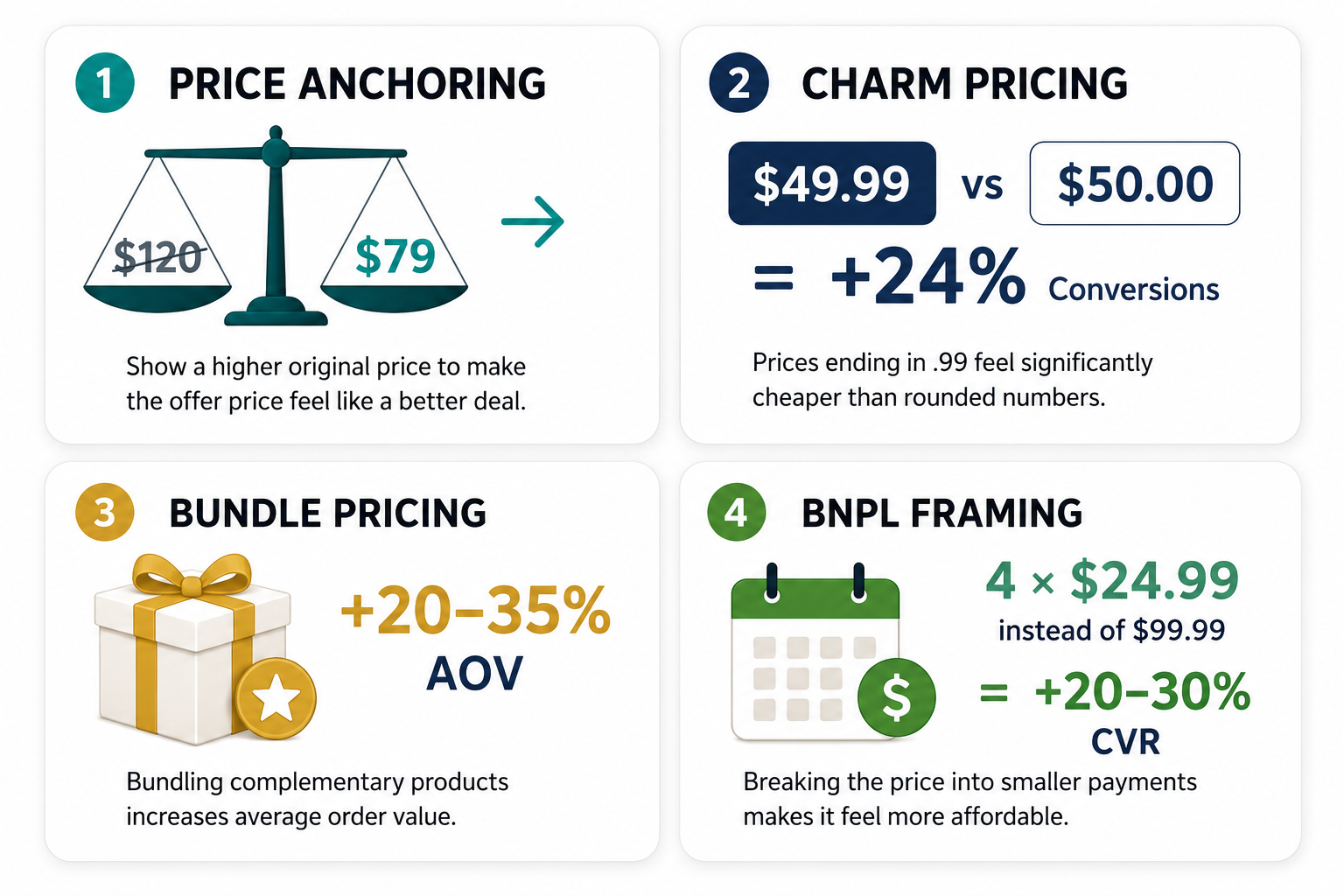
A product displayed at $120 that is discounted to $79 is evaluated by customers as a $79 price with $41 of perceived value gained — a deal. The same product displayed at $79 with no original price is evaluated as simply a $79 product — with no relative value signal attached. The products are identical. The price is identical. The conversion rate is not.
Charm prices increase sales by an average of 24% compared to rounded numbers, with the effect strongest when the leftmost digit changes. A product at $49.99 converts better than the same product at $50.00 — not because customers cannot do the math, but because the brain categorizes $49.99 as a "$40 something" price rather than a "$50 something" price before the rational mind finishes processing the number.
For Shopify stores, anchoring applies in three practical contexts:
Sale pricing: always display an original price alongside a sale price, with the markdown percentage clearly shown. The original price is the anchor; the sale price is evaluated relative to it. Without the anchor, the sale price has no reference point.
Premium tier positioning: in a product lineup with multiple options, the highest-priced tier anchors the perceived value of the entire range. A customer who sees a $200 product followed by a $80 product perceives the $80 product as reasonable — anchored against $200. The same customer who encounters only the $80 product has no such anchor.
Bundle pricing: presenting a bundle at a price alongside the sum of its components — "worth $85, available as a bundle for $64" — uses anchoring to make the bundle price feel like a saving even when the bundle margin is healthy for the merchant.
Pricing Psychology Principle 2: The Price-Quality Signal
Premium pricing signals quality — and quality signals trust — in ways that lower pricing cannot replicate. This is the price-quality heuristic, and it operates most powerfully in categories where customers cannot directly evaluate quality before purchase, which describes virtually all ecommerce.
Multiple studies have demonstrated that consumers rate the same product as higher quality when it is priced higher — even when the product is physically identical. In one frequently cited wine experiment, participants rated the same wine as more enjoyable when told it was more expensive. Brain imaging confirmed the effect was not merely self-reported preference but reflected genuinely different pleasure responses triggered by the price expectation.
For Shopify merchants, the practical implication is that pricing below premium competitors in a quality-differentiated category does not position you as better value — it positions you as lower quality. A skincare brand charging $38 for a serum that competes with $85 brands is not giving customers a better deal. It is signaling that the product does not deserve to sit at $85.
Premium pricing signals in 2026 Shopify practice include round numbers rather than charm prices for luxury or premium positioning — $100 feels more deliberate and confident than $97; minimal discounting that preserves the full price as a genuine signal of value rather than an artificial anchor; high-quality product photography that reflects the product's price positioning; and brand storytelling that articulates the craftsmanship, sourcing, or formulation investment that justifies the premium.
The brands in your category charging the most are not necessarily the ones with the best products — but they are the ones who have best understood that premium pricing is a brand positioning decision, not just a margin decision.
Pricing Psychology Principle 3: Bundle Pricing and Perceived Savings
Bundle pricing — offering multiple products together at a combined price lower than buying each individually — is one of the highest-ROI pricing strategies available to Shopify merchants, consistently increasing average order value by 20 to 35% across most product categories.
The psychology behind bundle effectiveness operates on two mechanisms simultaneously. The first is the perception of savings — customers feel they are receiving more value for their spend, triggering the same positive response as a discount without requiring you to reduce the price of any individual product. The second is decision simplification — a bundle removes the cognitive effort of selecting and pricing individual components, making the purchase decision easier and faster.
The critical factor in bundle performance is relevance. Bundles must contain products that logically belong together — a skincare routine bundle, a coffee and equipment starter kit, a beginner yoga bundle of mat, blocks, and strap. Products that belong together naturally reinforce each other's value in the customer's mind. Random bundles assembled purely to increase order value feel forced and convert poorly because the customer has to do extra cognitive work to understand why the combination makes sense.
Bundle pricing implementation in Shopify benefits from several techniques. Name the bundle around the outcome it delivers rather than listing its contents — a "Clear Skin Starter Kit" converts better than "Cleanser + Toner + Moisturizer Bundle" because the outcome framing speaks to why the customer wants the products rather than simply what they are. Show the individual item prices alongside the bundle price to establish the anchor from which the bundle discount is evaluated. And position the bundle as the recommended option — not an alternative — on product pages where individual items are also available for customers who specifically want single units.
Pricing Psychology Principle 4: BNPL and Installment Framing
Buy Now Pay Later options — Klarna, Afterpay, and Shop Pay Installments — do not just make products more affordable. They fundamentally change how customers evaluate price, and that psychological shift drives conversion lift that applies even when customers could easily afford the full price.
Displaying "4 payments of $24.99" instead of "$99.99" works for two separate reasons. First, it triggers the left-digit effect at the installment level — $24.99 is evaluated as a $20-something payment rather than a $99-something purchase. Second, it reduces price shock by breaking a single large number into a series of smaller ones — the pain of paying feels distributed across time rather than concentrated in a single moment.
Stores offering BNPL options see 20 to 30% higher conversion rates on items above $50. The conversion lift is not limited to customers who cannot afford the full price — it applies across income levels because the psychological framing of smaller periodic payments feels less costly regardless of financial capacity. It is the same mechanism that makes monthly subscriptions easier to accept than annual lump sums even when the math favors the annual price.
For Shopify stores, enabling BNPL options through Shopify Payments is a configuration change in your payment settings that takes minutes and generates ongoing conversion improvement on all products above the $50 threshold where the effect is most pronounced.
How to Test a Price Increase Without Losing Your Customer Base
The most common reason Shopify merchants never raise prices is fear — specifically, the fear that raising prices will immediately destroy conversion rates and tank revenue. This fear is consistently overestimated.
Most Shopify stores that test price increases find that conversion rates decline less than expected — and that the margin improvement from the higher price more than compensates for the modest volume reduction. A 20% price increase that reduces units sold by 10% increases revenue by 8% and improves margin substantially on every unit still sold.
The practical approach to testing a price increase on Shopify:
Start with your lowest-elasticity products — the ones customers buy for a specific reason that alternatives do not satisfy, the ones with the strongest reviews and highest repeat purchase rates. These products have more pricing power than your commodity SKUs and are the safest starting point for a price increase test.
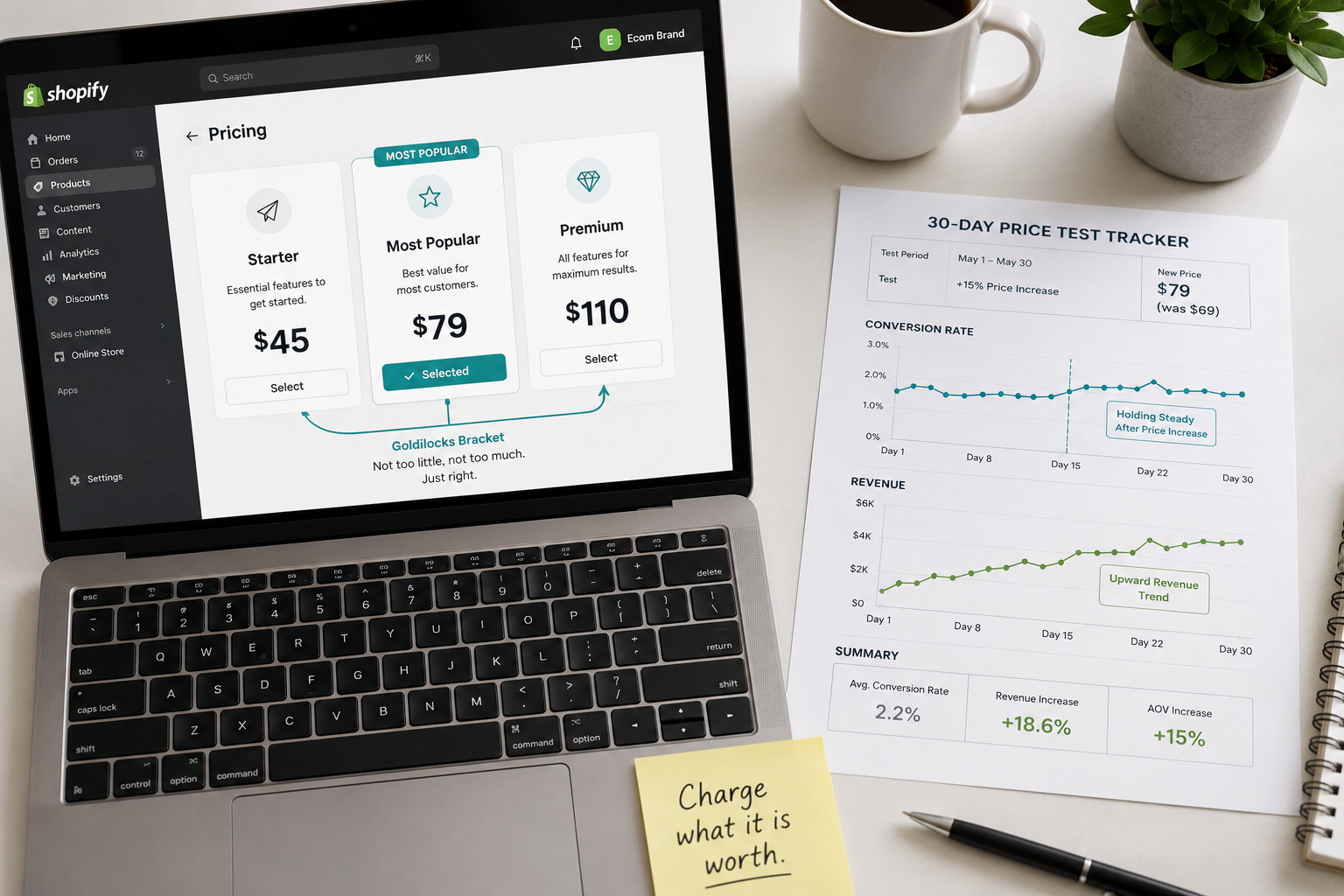
Increase the price by 10 to 15% and monitor conversion rate, add-to-cart rate, and revenue per visitor over a 30-day period before drawing conclusions. Short-term fluctuations are normal; a 30-day window captures enough data to identify a genuine trend.
If conversion rate declines less than the price increase percentage — meaning revenue per visitor is higher at the new price than the old — the test has confirmed that the product was underpriced. Roll the increase permanently and test the next product.
If conversion rate declines more than the price increase percentage, the product is price-sensitive at this level. Investigate whether the decline is from the price change itself or from other variables, and consider whether improving the product page — better photography, stronger social proof, clearer value proposition — would restore conversion before concluding the price ceiling has been reached.
Discount Strategy: How to Offer Sales Without Destroying Your Brand
Discounts are the most misused tool in Shopify pricing. Used well, they drive urgency, reward loyalty, and move inventory. Used carelessly, they train customers to never buy at full price, compress the brand's perceived quality, and create a discount dependency that becomes impossible to break.
The race-to-the-bottom pattern — blanket discounting on everything, always — is the fastest way to undermine a Shopify brand's pricing power. When customers learn that your products are always available at 20% off through a perpetual sale or a permanent popup discount, the full price loses its meaning. It becomes a fictional anchor — present on the page but not credible as a real price.
Discount strategies that protect margin and brand value while driving conversion:
Limited-time urgency discounts — flash sales that genuinely start and end within 24 to 48 hours — create real urgency that drives action without conditioning customers to always expect a discount. The key is that the sale genuinely ends. A countdown timer on a sale that keeps resetting is worse than no sale at all, because customers who see it twice understand the urgency is manufactured.
Exclusive discounts for specific segments — email subscribers, loyalty members, VIP customers — make discounts feel earned and special rather than universally available. A 15% discount available only to email subscribers is more brand-protective than a 15% discount available to anyone who visits the homepage, because the exclusivity preserves the full-price perception for non-subscribers while rewarding the segment that has the deepest relationship with the brand.
Welcome discounts for first-time buyers — a 10 to 15% first-purchase incentive — drive the initial conversion that gets a customer into your ecosystem without training them to expect ongoing discounts after the first purchase. Once they are on your email list and in your loyalty program, the retention mechanisms that drive repeat purchases operate independently of discounting.
Tiered Pricing: Giving Customers a Choice That Naturally Anchors Upward
The most powerful structural change most Shopify stores can make to their pricing is adding a premium tier above their current offering — even if the majority of customers will continue buying the mid-tier option.
The Goldilocks effect — the documented tendency for customers to choose the middle option when presented with three price tiers — means that introducing a premium option above your current offering lifts the average transaction value even for customers who do not choose the premium tier. The premium tier anchors the mid-tier as the reasonable, sensible choice — which is exactly the position you want your most profitable SKU to occupy.
A supplement brand selling a 30-day supply for $45 that introduces a premium 90-day supply for $110 will see a portion of customers upgrade to the premium tier and will see the remainder evaluate the $45 option more favorably — because it now sits as the middle of three options rather than the top of two. The revenue impact compounds across both the price of the premium tier and the improved conversion rate of the existing mid-tier.
For Shopify implementation, tiered pricing works through product variants for physical products, subscription tier options for recurring revenue products, and bundle sizing for products typically bought in consumable quantities. The visual presentation matters — display all tiers side by side with the premium tier featured prominently and the value-per-unit calculation shown clearly for size or quantity variants.
Geographic Pricing: Charging Market-Appropriate Prices Across Shopify Markets
Shopify Markets enables automatic currency conversion for international customers — but converting your home market prices at the spot rate consistently produces both psychologically awkward numbers and missed pricing power opportunities in markets where willingness to pay differs from your home market.
The UAE, Australia, and the UK all represent markets where premium positioning supports higher absolute pricing than the US dollar equivalent of your home market price. Customers in these markets expect to pay a premium for imported or DTC products and are not converting against your home market price — they are evaluating against local alternatives. Setting prices at market-appropriate levels — typically 10 to 20% above the currency-converted home market price in premium markets — captures this additional pricing power without affecting your home market positioning.
Charm pricing conventions also vary by market. In the UK, .99 endings are standard and effective. In Germany and the Netherlands, round numbers are often preferred for premium positioning — €40 can signal more confidence than €39.99 in these markets. In Japan, prices ending in 0 or 8 are culturally preferred. Shopify Markets' price rounding rules allow you to set market-specific prices that apply the locally effective psychological format — a configuration available in your Markets settings that takes minutes and generates ongoing conversion improvement in each market.
The Compounding Value of Getting Pricing Right
Every pricing decision in your Shopify store compounds over time in ways that make getting it right early disproportionately valuable.
A product priced 15% higher today does not just generate 15% more revenue on this month's sales. It generates 15% more revenue on every sale for as long as the product is in your catalog. It allows you to spend more on customer acquisition because each customer generates more contribution margin. It funds better photography, better packaging, and better product development — all of which further justify the premium price in a reinforcing cycle.
The brands that achieve sustainable profitability on Shopify are almost universally not the ones with the lowest prices. They are the ones that have learned to articulate and capture value — through product quality, brand positioning, psychological pricing, and the confidence to charge what their products are genuinely worth.
Start with value-based pricing. Establish a clear anchor. Use bundle pricing to raise average order value. Test a 10 to 15% increase on your lowest-elasticity product. Protect your discounts for moments of genuine urgency or genuine exclusivity.
Charge more. Sell more. The two outcomes are not in conflict — they are the compounding result of the same pricing intelligence applied consistently over time.
Need help reviewing your Shopify store's pricing strategy or want a development partner to implement tiered pricing, bundle structures, or Shopify Markets pricing for international markets? Get in touch with EcomFixify — we specialize in Shopify development and ecommerce growth strategy for brands ready to scale profitably.