
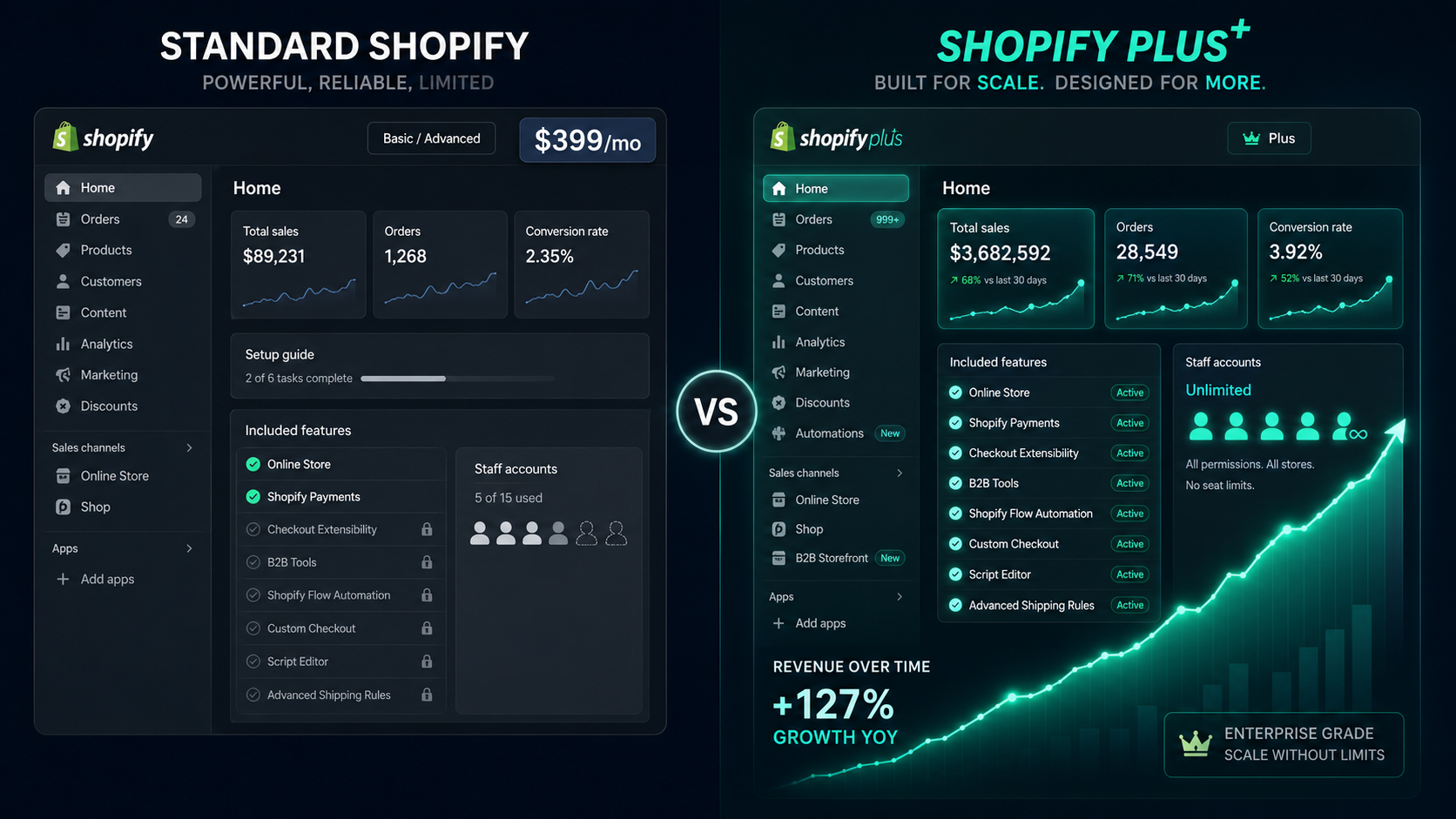
Shopify Plus vs Standard Shopify: Is the Upgrade Worth It
Shopify Plus vs Standard Shopify: Is the Upgrade Worth It for Your Store?
At some point in every growing Shopify store's life, the question surfaces. You are generating consistent revenue, your team is expanding, and you start noticing friction — higher transaction fees than you would like, a checkout experience you cannot customize the way you want, API limits that slow down your integrations, and a support structure that does not match the scale of what you are trying to build.
Someone mentions Shopify Plus. The price — starting at $2,300 per month — lands like a cold splash of water.
The honest answer to whether the upgrade is worth it is not a simple yes or no. It is a math problem with a clear breakeven point, a feature comparison with clear winners and losers at different revenue levels, and a strategic question about what your store actually needs versus what sounds impressive in a feature list.
This guide gives you all three: the real pricing structure including what standard plans charge at volume, the feature differences that actually move revenue, and the specific signals that tell you whether upgrading now will make your business more money or simply cost more.
The Real Pricing Comparison: Standard Shopify vs Shopify Plus
The comparison almost always starts with the headline numbers, but the headline numbers are misleading if you look at them in isolation. The full picture requires comparing total cost of ownership at different revenue levels, including transaction fees, which are where the math gets interesting at scale.
Standard Shopify plans in 2026 are priced as follows: Basic at $39 per month, the middle tier (called Shopify) at $105 per month, and Advanced at $399 per month. These are fixed monthly fees regardless of revenue volume, with the key variable being transaction fees on third-party payment gateways — 2% on Basic, 1% on the middle tier, and 0.6% on Advanced.
Shopify Plus starts at approximately $2,300 per month on an annual term, or around $2,500 per month on a month-to-month agreement. Its pricing structure is different from standard plans: you pay either the flat base fee or 0.4% of monthly platform-processed revenue — whichever is higher — capped at approximately $40,000 per month at very high volume. The transaction fee on third-party payment gateways drops to 0.2% on Plus, compared to 0.6% on Advanced.
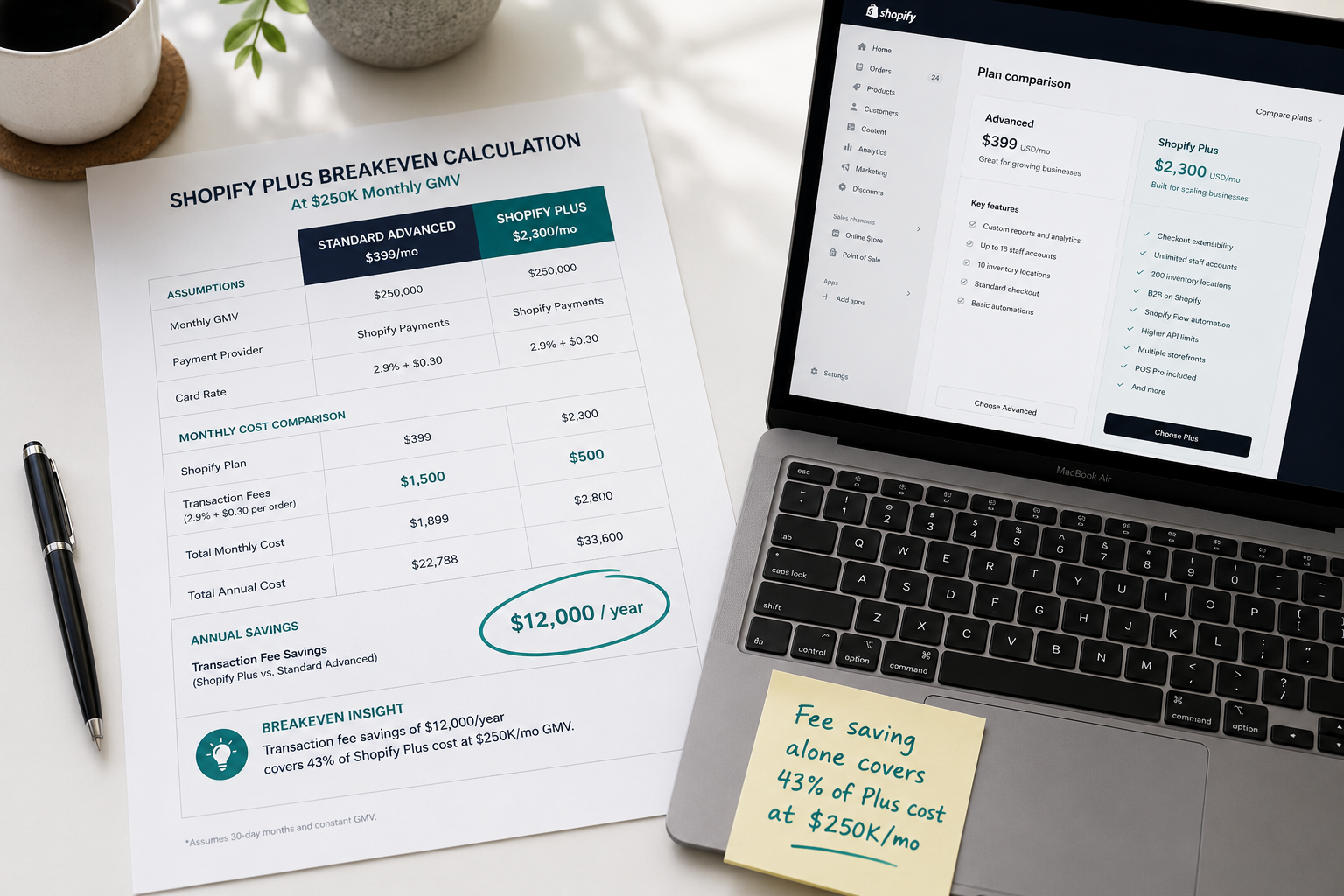
That transaction fee difference is where the upgrade math flips at scale. A store doing $250,000 per month using a third-party gateway like Stripe on the Advanced plan pays 0.6% in transaction fees — $1,500 per month purely in gateway fees. On Plus, that drops to 0.2%, or $500 per month. The difference is $1,000 per month, or $12,000 per year, from transaction fees alone.
At $500,000 per month, the fee saving is $2,000 per month — $24,000 per year. At $3,000,000 in annual revenue using a third-party gateway, the 0.4% fee reduction saves approximately $12,000 per year before touching a single Plus-exclusive feature. For many stores at this volume, the transaction fee saving alone covers a meaningful portion of the monthly Plus subscription cost.
The practical breakeven calculation is straightforward: if your monthly transaction fee saving from switching to Plus's 0.2% rate gets you within $1,000 to $1,500 of the Plus subscription cost, the additional Plus features are essentially free at your current revenue level. For most merchants using third-party gateways, this math works out between $80,000 and $200,000 in monthly revenue.
The total monthly cost picture on Plus is worth understanding clearly: the platform fee is the entry point, but the real monthly spend for a Plus merchant typically runs $5,000 to $25,000 or more once apps, custom development, and integrations are included. This is not a hidden cost — it reflects the reality that Plus merchants are typically running more sophisticated operations with more complex tooling. The platform fee is the floor, not the ceiling.
What Standard Shopify Does Well (And Where It Stops)
Before cataloguing Plus-exclusive features, it is worth being clear about what standard Shopify — specifically the Advanced plan — handles extremely well, because one of the most common mistakes in the Plus conversation is upgrading for features that Advanced already covers adequately.
Standard Shopify on the Advanced plan gives you online store with full theme customization, up to 15 staff accounts with permission levels, Shopify Payments with competitive card processing rates, basic Shopify Flow automation, Shopify Markets for up to 50 international markets with localized currencies and languages, third-party carrier-calculated shipping, advanced report builder, and up to 10,000 inventory locations.
For the majority of Shopify stores doing under $1 million in annual revenue, this capability set is comprehensive. One leading Shopify Plus agency reports that their standard recommendation below $1 million GMV in a single market with no B2B requirements and no headless plans is to stay on standard Shopify — it delivers approximately 90% of the value of Plus at a tenth of the cost.
Where standard Shopify starts bleeding real money at scale is in four specific areas: transaction fees on third-party gateways, checkout customization rigidity, API rate limits on enterprise integrations, and the absence of native B2B selling infrastructure.
These four areas define the genuine Plus versus standard decision — not the length of the feature list.
The Shopify Plus Features That Actually Move Revenue
Shopify Plus adds a significant number of features over standard plans. Not all of them are equally valuable. These are the ones that generate measurable commercial impact and that drive the majority of real upgrade decisions.
Checkout Extensibility: The Biggest Functional Upgrade
On standard Shopify, your checkout experience is largely locked. You can apply your brand colors, upload a logo, and that is approximately the extent of checkout customization available. Shopify deliberately restricts checkout modification on standard plans for security, speed, and reliability reasons — and the checkout they provide is excellent, but it is their checkout.
On Shopify Plus, Checkout Extensibility opens the checkout experience to meaningful customization through a suite of developer tools including Checkout Extensions and Shopify Functions. You can embed custom upsell blocks directly inside the checkout flow, add loyalty point balance displays that show customers their available rewards before completing purchase, build custom discount logic that standard Shopify discount codes cannot achieve, add custom fields for gift messages or special order instructions, and create post-purchase offer pages that trigger immediately after the order confirmation.
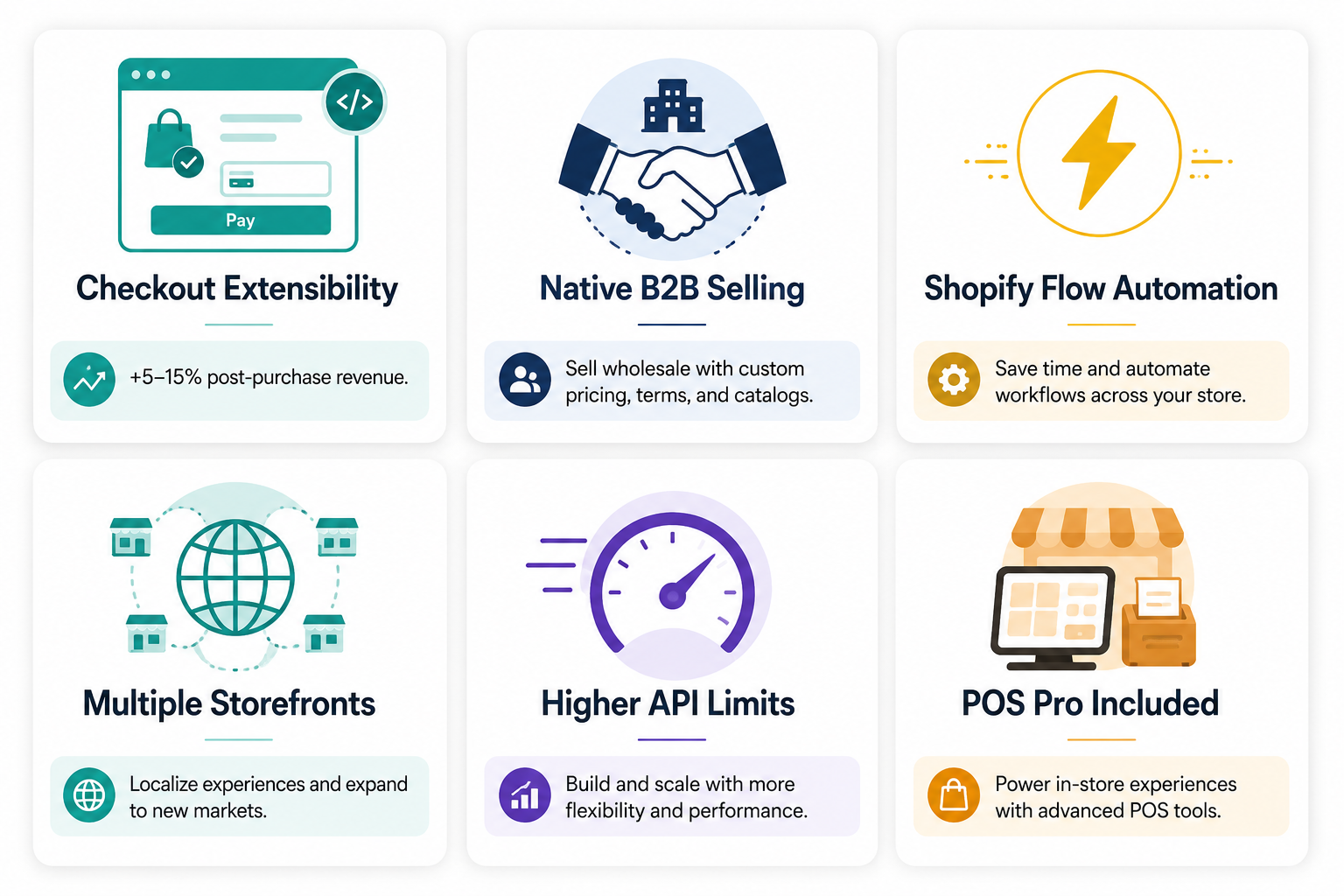
The commercial impact of checkout customization at scale is documented and significant. Post-purchase upsell blocks inside the checkout — available only on Plus through Checkout Extensibility — consistently generate 5 to 15% additional revenue from completed orders at zero additional customer acquisition cost. For a store processing $200,000 per month, a 10% post-purchase uplift adds $20,000 in monthly revenue with no incremental ad spend.
Shopify Flow: Enterprise Automation Without Developers
Standard Shopify includes basic Flow automation capabilities. Shopify Plus unlocks the full Flow feature set — and for operations teams managing high order volumes, the difference is substantial.
Plus-tier Flow enables automated workflows that cover inventory management, customer segmentation, fraud detection, fulfillment routing, loyalty program triggers, B2B order processing, and campaign scheduling through Launchpad. These workflows run entirely in the background, eliminating manual tasks that at standard plan volumes require dedicated staff hours or workaround app solutions.
Launchpad — available exclusively on Plus — allows you to schedule major campaigns in advance: product launches, flash sales, price changes, and inventory updates can all be configured to go live at a precise time with no manual intervention required during the event. For brands running high-volume promotional events where manual execution introduces timing errors and operational risk, Launchpad is a genuinely significant operational capability.
Native B2B Selling Infrastructure
If your business model includes wholesale or B2B selling alongside direct-to-consumer, Shopify Plus's native B2B features are one of the most commercially compelling upgrade justifications available in 2026.
Standard Shopify has no native B2B infrastructure. Merchants handling wholesale on standard plans rely on third-party apps, workarounds like password-protected collections, or separate Shopify stores — each creating operational complexity and integration overhead that adds cost and introduces errors.
Shopify Plus includes native B2B with company profiles that track multiple buyers under a single business account, custom price lists that set wholesale pricing per company without visible to retail customers, net payment terms (net 30, net 60) managed directly through Shopify, draft order management for custom B2B quotes, and the ability to manage B2B and DTC operations from a single admin backend without separate stores.
For brands where B2B represents 15% or more of revenue, the operational savings from consolidating onto Plus's native B2B infrastructure — eliminating third-party B2B apps, reducing manual order management, and improving buyer experience through self-serve company portals — frequently justifies the subscription cost independently of every other Plus feature.
Multiple Storefront Management
Shopify Plus includes up to nine expansion stores alongside your primary store, all managed from a single admin. Each expansion store operates independently with its own domain, product catalog, language, and currency — but shares the same Shopify Plus subscription.
For brands operating in multiple countries with genuinely different product ranges, pricing structures, or brand identities that require separate storefronts rather than Shopify Markets localization, the expansion store capability eliminates the cost of maintaining separate Shopify plans for each storefront. A brand operating primary storefronts in the US, UK, and Australia on separate Advanced plans spends $1,197 per month for three stores. Shopify Plus at $2,300 per month covers all three plus six additional expansion stores — a net cost advantage that compounds with every additional market you add.
API Rate Limits and Enterprise Integration Capacity
Standard Shopify imposes API rate limits that become binding constraints as your tech stack grows. High-frequency inventory syncs, real-time ERP integrations, customer data platform connections, and third-party fulfillment systems all generate API calls that standard plan limits throttle at volume.
Shopify Plus raises API rate limits significantly — to four times standard plan limits on the Admin API — which enables enterprise integrations that standard plan rate limits prevent. For brands running ERPs like NetSuite, Brightpearl, or SAP alongside Shopify, or connecting to 3PLs that require real-time inventory API access, Plus's higher API ceilings are an operational requirement rather than a luxury.
Unlimited Staff Accounts and Granular Permissions
Standard Shopify Advanced allows up to 15 staff accounts. Shopify Plus allows unlimited staff accounts with granular role-based permission controls.
For growing teams where different staff members require different levels of access — marketing teams who should see reports but not process refunds, warehouse staff who can fulfill orders but not access financial data, agency partners who need theme editor access without admin privileges — the permission granularity on Plus eliminates the security compromises that standard plan limits force on larger organizations.
Shopify Plus Certified Apps and Dedicated Support
Shopify Plus merchants get access to the Plus Certified App list — a curated selection of enterprise-grade applications that have been vetted by Shopify for performance, support quality, and scalability under high order volumes. These are not simply standard apps with a "Plus compatible" badge; they have passed a more rigorous technical review and come with service level agreements that standard App Store apps do not offer.
The merchant success support structure also changes on Plus. Standard plan support is handled through the general Shopify support queue. Plus merchants receive a dedicated merchant success manager and access to a priority support queue with faster response times and higher-level technical escalation paths. For brands where platform issues during peak trading periods translate directly into significant revenue loss, the support tier difference has real commercial value.
POS Pro Included at No Additional Cost
This one flies under the radar for merchants with physical retail operations. On standard Shopify plans, Shopify POS Pro costs $89 per month per location. For a brand with five retail locations, that is $445 per month purely for POS Pro.
Shopify Plus includes POS Pro for all locations at no additional cost. For a brand with ten retail locations currently paying $890 per month for POS Pro on a standard plan, upgrading to Plus at $2,300 per month effectively costs $1,410 per month net of the POS Pro saving — a very different value calculation than the headline $2,300 figure suggests.
When Upgrading to Plus Makes Clear Financial Sense
The signals that indicate Plus will pay for itself rather than simply cost more money:
Your monthly GMV consistently exceeds $80,000 to $150,000 and you are using a third-party payment gateway. At this volume, transaction fee savings cover a meaningful portion of the Plus subscription, and you are approaching the revenue level where checkout customization delivers significant incremental revenue.
You are leaving money in checkout. If your checkout abandonment rate is above 65% and you cannot implement custom trust signals, loyalty point displays, or post-purchase offers because standard plan locks prevent it, Plus's Checkout Extensibility directly addresses a quantifiable revenue leak.
B2B is part of your revenue model and you are managing it through third-party apps or workarounds. The operational simplification and buyer experience improvement from native B2B on Plus justifies the subscription cost for most brands where wholesale represents meaningful revenue.
You are managing multiple markets as separate Shopify stores. Consolidating onto Plus expansion stores reduces subscription costs, simplifies administration, and creates a unified data model across your business.
Your development team or agency is hitting API rate limits. Integration failures due to rate limiting have a direct operational cost — incorrect inventory, delayed order processing, failed ERP syncs. Plus's higher limits eliminate a problem that compounds in severity as order volume grows.
When Standard Shopify Is Still the Right Choice
The upgrade does not make sense in several common situations that are worth being explicit about:
Your annual revenue is under $1 million and you are selling to a single market with no B2B requirements. Standard Advanced at $399 per month covers your needs at a fraction of Plus cost, and the features you would gain on Plus would not generate meaningful incremental revenue at your current scale.
You are using Shopify Payments as your primary payment processor. The transaction fee saving argument — the most common financial justification for upgrading — disappears entirely when you are on Shopify Payments, which charges no additional transaction fee on any plan. Without the fee arbitrage, the Plus subscription needs to be justified entirely on features and support, which is a higher bar for smaller stores.
Your team is small and your operations are simple. Plus delivers maximum value to brands with dedicated operations teams, complex integration requirements, and high order volumes that need automation. A three-person team running a straightforward DTC operation does not need unlimited staff accounts, enterprise API limits, or dedicated merchant success management.
You are considering upgrading primarily for Shopify Markets. Standard Shopify supports up to 50 international markets through Shopify Markets — the same infrastructure Plus merchants use. International expansion alone is not a Plus upgrade trigger.
The Transition: What the Upgrade Actually Involves
For merchants on standard Shopify upgrading to Plus, the transition is significantly smoother than most expect because it is the same platform. Your store, theme, apps, products, orders, and customer data all remain exactly where they are. There is no migration in the traditional sense.
What changes is the capability layer: checkout extensibility APIs become available, B2B features are activated, Flow automation expands, and API rate limits increase. The typical Advanced-to-Plus upgrade timeline for a straightforward transition is two to six weeks depending on how much of the Plus feature set you are activating on day one and whether you are implementing custom checkout extensions that require development work.
If you are bringing in a Shopify Plus partner agency for the upgrade — which is recommended if you want to implement custom checkout flows, B2B infrastructure, or complex automation from day one — budget four to ten weeks for a comprehensive Plus onboarding that includes configuration, development, and testing.
A theme-based Plus launch from an existing standard plan store with custom checkout extensions typically runs $25,000 to $50,000 in development costs. If you are also implementing headless architecture, the development investment is higher. These are one-time costs that need to be included in your upgrade ROI calculation alongside the ongoing subscription difference.
The Honest Verdict: A Decision Framework
The Shopify Plus decision is fundamentally a financial calculation with a strategic layer on top.
Run the transaction fee math first. If your monthly GMV using a third-party gateway exceeds $150,000, calculate your current monthly transaction fee spend at 0.6% and compare it to the Plus equivalent at 0.2%. The difference is your fee saving. Subtract that from the incremental monthly cost of Plus over your current plan. The remainder is what Plus features need to generate in additional revenue to justify the investment.
Then evaluate the feature gaps. Are you losing revenue to checkout limitations you cannot work around on standard? Do you have a B2B operation that would run more efficiently on native infrastructure? Are API rate limits creating real operational problems? Each of these has a quantifiable cost that belongs in your upgrade ROI calculation.
If the fee saving covers the majority of the subscription cost and you have one or more clear feature gaps that Plus fills — upgrade. The math works and the features compound in value as your revenue grows.
If your transaction fee saving is minimal and your standard plan meets your operational needs without workarounds — stay on Advanced. The ceiling of standard Shopify is higher than most merchants realize, and upgrading before you genuinely need Plus's enterprise capabilities is a cost without proportional return.
The stores that regret Plus are almost always the ones that upgraded before they needed it. The stores that love it are the ones whose growth the platform actively removes friction from — because at scale, that friction is not hypothetical. It is measuring itself in lost revenue every month.
Wondering whether upgrading to Shopify Plus makes sense for your store's current revenue and operational needs? Get in touch with EcomFixify — we can run the upgrade ROI calculation with your actual numbers and give you a straight answer.