
Shopify Dropshipping What Still Works and What You Should Avoid
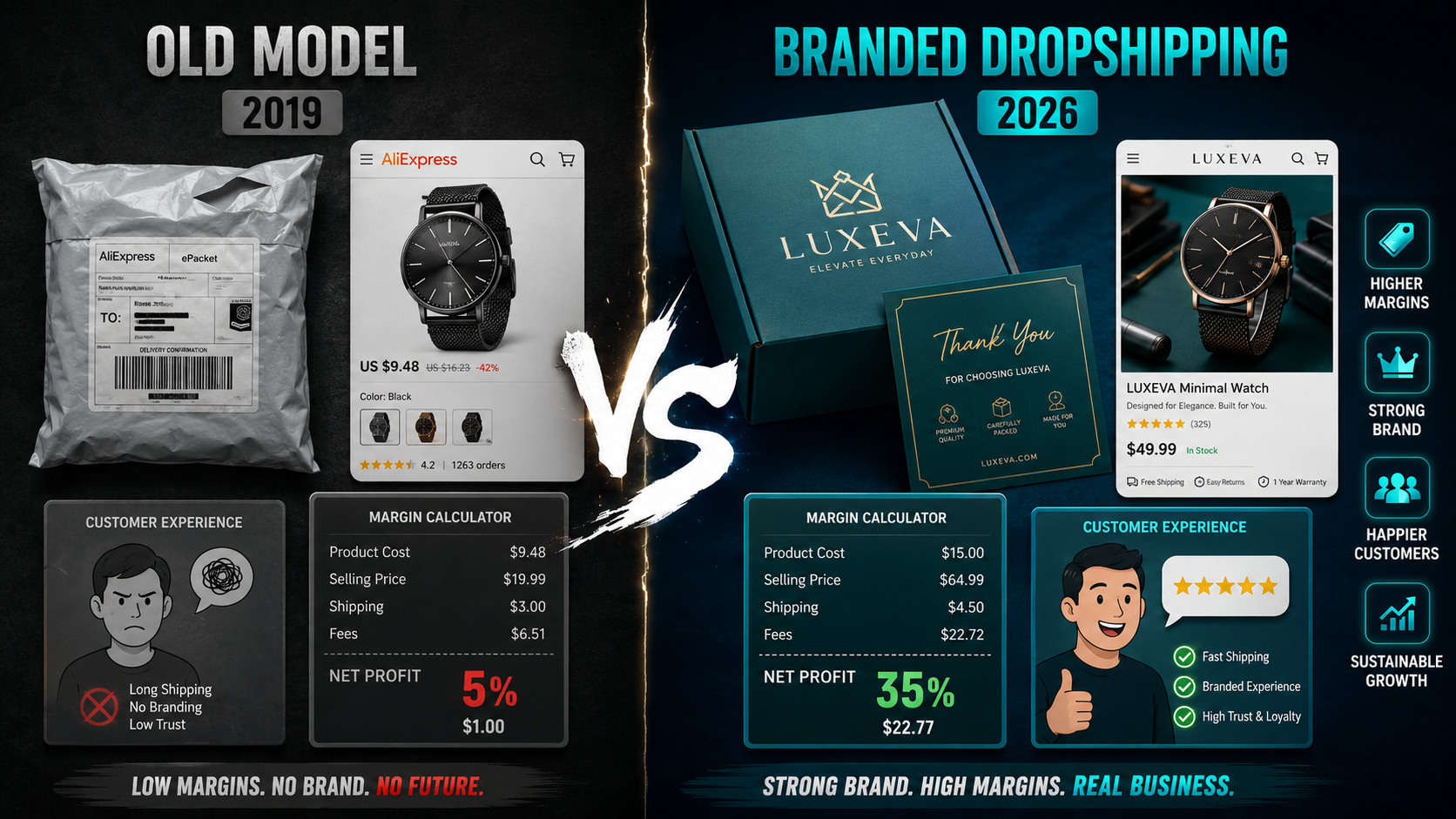
Let us be direct about something most dropshipping content refuses to say out loud: the version of dropshipping that dominated YouTube tutorials between 2018 and 2022 is largely dead.
The model where you find a trending product on AliExpress, copy the listing to a generic Shopify store, run Facebook ads to cold traffic, and pocket the margin while your Chinese supplier ships a flimsy product in a poly mailer with no branding — that model has been gutted by rising ad costs, consumer skepticism, supply chain unpredictability, and competition from thousands of stores running the exact same playbook with the exact same products.
If that is the version of dropshipping you are considering, you should know the full picture before investing time and money into it.
But here is what most pessimistic takes on dropshipping miss: the model itself is not dead. The global dropshipping market is valued at $351 billion in 2026, growing at 23 to 25% annually. It accounts for 27% of all ecommerce fulfillment. Shopify powers an estimated 30% of all dropshipping businesses worldwide. The model is not dying — it is evolving. And the merchants who understand what has changed and what has not are building profitable, scalable businesses on Shopify right now.
This guide covers the honest reality of Shopify dropshipping in 2026 — what models actually generate sustainable margin, what to avoid categorically, how to pick products that have a real chance, and what the path from $0 to profitable actually looks like.
The State of Dropshipping in 2026: Real Numbers
Before diving into strategy, grounding this in real market data matters — because the gap between what dropshipping gurus promise and what the numbers show is significant.
The global dropshipping market is valued at $351 billion in 2026 and is projected to reach $850 billion by 2030 — a genuinely massive market with real growth. The US market alone represents $95 billion. These numbers confirm that dropshipping as a fulfillment model is not disappearing.
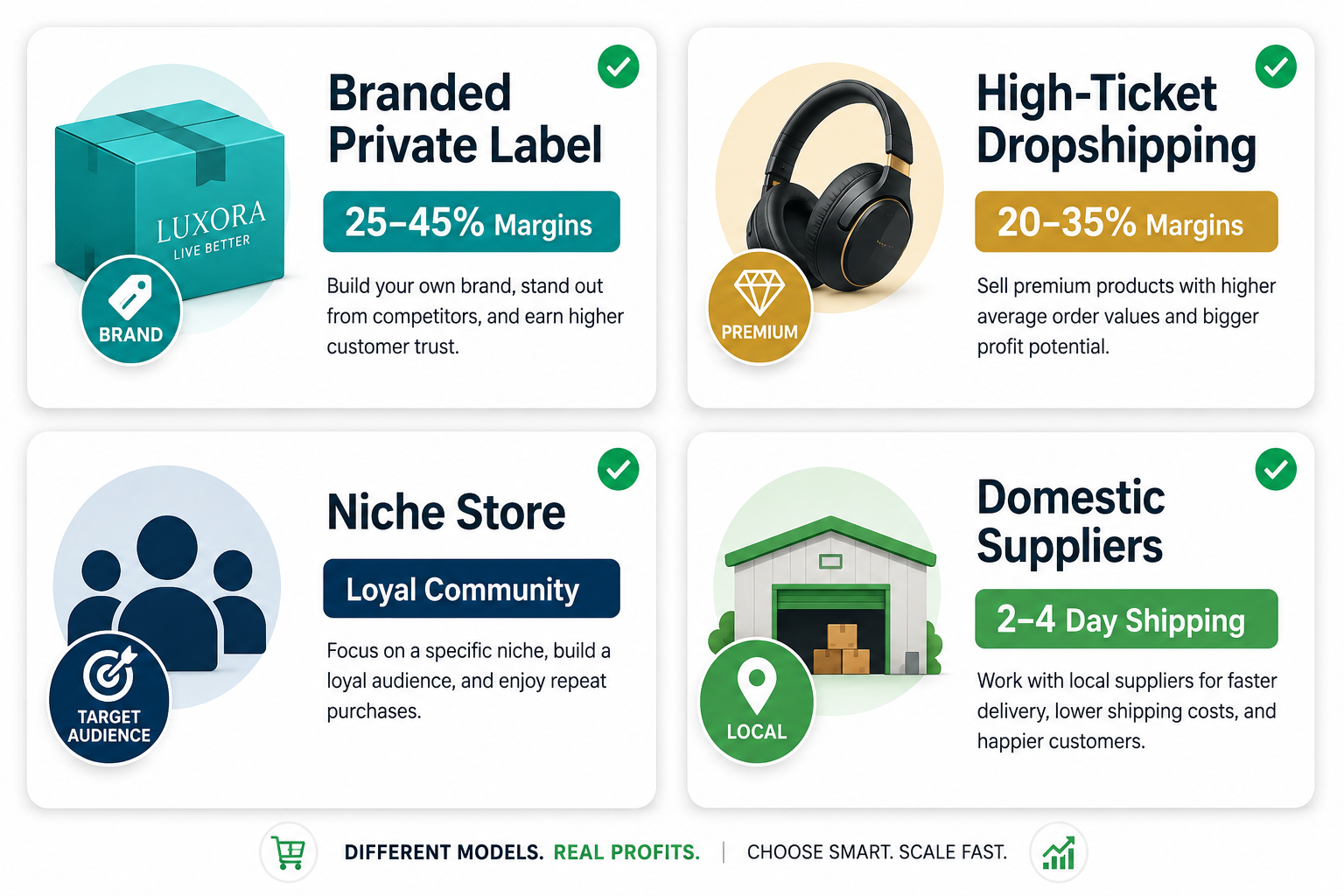
But the margin reality is sobering. Average gross profit margins for dropshipping run 15 to 30% before advertising costs and 5 to 15% net after all expenses. Low-ticket commodity dropshipping on products priced $10 to $30 achieves 10 to 20% gross margins. High-ticket dropshipping on products priced $200 and above achieves 20 to 35% margins. Branded dropshipping with private-label products achieves 25 to 45% margins.
The success rate data is equally sobering. Approximately 10 to 20% of dropshipping businesses become profitable within their first year. The primary failure reasons are poor product selection at 35%, ineffective marketing at 30%, supplier quality issues at 20%, and giving up too early at 15%. Stores that survive their first year have a 50 to 60% chance of remaining profitable long-term.
The conclusion from these numbers is not that dropshipping does not work. It is that the model is being bifurcated into two distinct categories: commodity dropshipping, which is commoditizing itself to death, and branded dropshipping, which is the version generating real margins and building real business value.
What No Longer Works: The Approaches to Avoid in 2026
Understanding what has definitively stopped working saves you from investing time and budget into models that the market has moved past.
Generic AliExpress Dropshipping
The original dropshipping playbook — find a product with a 15% margin on AliExpress, copy the product listing and photos to a Shopify store, run paid ads, collect the spread — is the most oversaturated and margin-compressed approach in ecommerce in 2026.
The arithmetic is merciless. A generic jewelry piece costs $8 on AliExpress and sells for $25 on a generic Shopify store. At 15% net margin that is $3.75 profit per order. A customer acquisition cost of $15 on Meta — which is optimistic in 2026 for cold audience targeting — means every new customer costs $11.25 more than they generate. You need a repeat purchase or a significant upsell just to break even on the first transaction.
The problem compounds: that same product is available on 4,000 other Shopify stores, on Amazon at a lower price, and directly from the AliExpress listing itself if a consumer does five minutes of reverse image searching. There is no brand, no loyalty, no reason for the customer to return, and no defensible competitive position.
Long Shipping Times With No Transparency
The era of 18 to 25 day shipping from Chinese warehouses with vague tracking and no communication was tolerated by consumers when it came with significant price advantages and when Amazon Prime had not yet set the expectation for two-day delivery as the baseline standard.
In 2026, consumers expect delivery within five to seven days for standard shipping and two to three days for expedited. Any store with shipping times beyond that range that does not communicate them prominently and offer real compensation in the form of significantly lower prices is generating refund requests, chargebacks, and negative reviews that compound into store closure.
If your supplier cannot reliably deliver to your primary market within seven business days, you need a different supplier or a different market before building any traffic strategy around that product.
One-Product Viral Stores Built on Trending Items
The one-product store model built around a trending item — a fidget spinner, a magnetic bracelet, a viral kitchen gadget — works occasionally and spectacularly, and then stops working completely. The lifecycle of a trending product from discovery to saturation to collapse has compressed from 12 to 18 months in 2020 to four to eight weeks in 2026, driven by TikTok's viral acceleration.
By the time a trending product appears on your radar through a YouTube tutorial or a competitor research tool, the early adopters have already captured the market, and the saturation phase has usually begun. Building a store around a trend you read about rather than one you discovered independently is typically arriving late to a party that is already winding down.
Stores With No Brand Identity
A Shopify store with no name that means anything, no visual identity, no consistent voice, and no reason to exist beyond selling a product that is available cheaper elsewhere has no customer acquisition cost advantage, no word-of-mouth, no repeat purchase behavior, and no retention. It is not a business — it is a transaction processor competing solely on paid traffic efficiency, which is the most expensive and least sustainable competitive position in ecommerce.
What Still Works: The Dropshipping Models Generating Real Revenue in 2026
Branded Private Label Dropshipping
This is the highest-margin, highest-growth dropshipping model in 2026 and the one that separates the merchants building real businesses from those running short-term arbitrage plays.
Private label dropshipping is a fulfillment model where a third-party supplier produces or sources a product, applies your brand's custom packaging, labels, and inserts, and ships it directly to your customer under your brand identity. You hold no inventory. Your supplier fulfills on demand. But from the customer's perspective, they receive a branded product in a branded box with a branded insert — not a generic poly mailer with someone else's supplier label.
The commercial impact of branded packaging alone is significant. Customers photograph branded products more. They share them on social media. They remember the brand name when they want to repurchase. They do not share a generic poly mailer. Brand recall — the difference between a customer searching "your brand name" versus "kitchen gadget" for their next purchase — is what distinguishes retention from perpetual cold acquisition.
Branded dropshipping generates 25 to 45% gross margins compared to 10 to 20% for generic commodity dropshipping. The higher margin is justified by the brand premium, the reduced competition at the product level since your product is presented under your own brand rather than listed alongside identical items, and the significantly higher customer lifetime value that comes with brand loyalty.
The workflow for private label dropshipping on Shopify starts with product validation using generic dropshipping to confirm demand before any branding investment. Once a product demonstrates consistent sales — 20 or more orders per day is a common threshold — you negotiate private label terms with the supplier including custom packaging, branded inserts, and logo placement on the product or packaging. The supplier ships under your brand name. Your Shopify store presents the product as your own.
Suppliers capable of private label dropshipping at low minimum order quantities include USAdrop, Zendrop, AutoDS private label, and direct Alibaba suppliers with OEM capability. The key supplier requirements are custom packaging support, blind shipping that removes supplier branding from the parcel, and shipping times that meet your market's delivery expectations.
High-Ticket Dropshipping
High-ticket dropshipping targets products priced $200 and above — furniture, outdoor equipment, fitness machines, specialized tools, and premium appliances — where the higher price point generates meaningful absolute margin per sale even at a lower gross percentage.
A 20% margin on a $400 product generates $80 per sale. The same 20% margin on a $25 product generates $5. The customer acquisition economics of high-ticket dropshipping are fundamentally more forgiving because each conversion event generates enough margin to absorb the higher customer acquisition costs that come with lower-frequency purchase categories.
High-ticket products also compete differently from commodity products. A customer researching a $400 standing desk or a $600 outdoor grill is conducting deliberate evaluation — comparing specifications, reading reviews, considering brand credibility. A well-built Shopify store with strong product content, clear shipping and warranty terms, and credible trust signals can compete effectively in this evaluation process in a way that a generic $20 product store cannot.
The challenge with high-ticket dropshipping is supplier vetting and return management. Damage during shipping is more common with large, heavy items. Return logistics for a 50-kilogram piece of fitness equipment is operationally complex and expensive. Before launching in any high-ticket category, define your damage and return policy clearly and negotiate those terms explicitly with your supplier before your first order.
Niche Stores With Genuine Audience Specificity
Generic stores selling "home goods" or "fashion accessories" have no natural audience, no SEO target, no community to build, and no organic content strategy. Niche stores built around a specific audience with specific needs — left-handed golfers, miniature painting hobbyists, van life enthusiasts, competitive swimmers — have all of the above.
A niche store built around competitive swimmers, for example, has a natural SEO strategy around competitive swimming search terms. It has a natural content strategy around swim training, technique improvement, and gear reviews. It has a natural community — swim clubs, masters swimming groups, competitive meets — where organic promotion can happen. And it has a product selection framework — if a competitive swimmer would use it, it belongs in the store — that makes catalog decisions intuitive rather than arbitrary.
The narrow definition that seems limiting at first is actually the accelerant. It concentrates your marketing message to an audience that self-identifies with the niche, generates word-of-mouth within communities that trust peer recommendations, and creates the conditions for repeat purchases because your entire catalog is relevant to your customer's ongoing needs.
Profitable niche categories for Shopify dropshipping in 2026 include outdoor and adventure gear, pet accessories for specific breeds or activities, home organization for specific room types, hobby-specific supplies, and professional tools for specific trades. The common thread is specificity — a defined customer with a defined set of needs.
Domestic Supplier Dropshipping
One of the most underrated shifts in dropshipping in 2026 is the growing viability of domestic supplier partnerships — particularly in the US, UK, and Australia — where suppliers hold local inventory and can ship within two to four business days at competitive wholesale pricing.
Domestic dropshipping eliminates the shipping time problem that kills conversion rates and generates refund requests for international sourcing. It reduces the customs and import duty complications that international shipping generates. And it provides a genuine "ships from [country]" trust signal that resonates with consumers who have learned to associate long shipping times with disappointing product quality.
Platforms including Faire, Spocket, Modalyst, and SaleHoo connect Shopify merchants with domestic suppliers across a wide range of categories. Product margins are typically lower than Chinese sourcing — 15 to 25% rather than 30 to 40% — but the conversion rate improvement from reliable local shipping and the reduction in customer service overhead from fewer delivery complaints typically more than compensates for the margin difference on a net profit basis.
How to Pick Winning Products in 2026
Product selection is where 35% of dropshipping businesses fail — the single most common failure reason in the market data. The products that work in 2026 share a consistent set of characteristics that can be evaluated before ordering a single unit.
The product validation criteria that matter most:
A clear problem-solving proposition. Products that solve a specific, frustrating problem that the buyer recognizes immediately convert better than products that are merely interesting or visually appealing. "Eliminates the need to rewash dishes because the drying rack drips onto the counter" is a problem. "Stylish kitchen accessory" is not.
A visual demonstration angle. Products that can be shown working — before and after, transformation, unexpected utility — are natural organic content generators on TikTok and Instagram. A product that can only be understood through text description has a significant organic content disadvantage in 2026 when video is the primary discovery mechanism for new products.
Repeat purchase potential or natural product ecosystem. Products that customers buy once and never need again generate zero lifetime value beyond the initial order. Products that deplete, wear out, or belong to a category where the initial purchase naturally leads to complementary purchases — supplements, skincare, hobby supplies — generate retention revenue that compounds over time.
Margin that survives paid acquisition. At 2026 Meta ad pricing, a customer acquisition cost of $15 to $30 is realistic for most categories. Any product where your gross margin per unit is below $25 to $30 — typically products priced below $60 at 30 to 40% gross margin — will struggle to generate positive ROAS on paid traffic without a repeat purchase or upsell strategy. Calculate your break-even customer acquisition cost before testing any product with paid ads.
Not sold by Amazon as a commodity. If Amazon is selling your product for a lower price with Prime shipping, the majority of informed consumers will buy there. Products where Amazon's selection is limited, branded alternatives are priced at a premium, or where your product has genuine differentiation have a fighting chance in direct comparison. Generic commodity products where Amazon is the default purchase destination do not.
The Supplier Vetting Process You Cannot Skip
Poor supplier quality is the third most common cause of dropshipping business failure at 20% of failures. The consequences of a bad supplier are not limited to product quality complaints — they include shipping delays that generate chargebacks, inconsistent product quality that generates negative reviews, and inventory availability issues that result in orders you cannot fulfill after the customer has paid.
The supplier vetting checklist for any new dropshipping relationship:
Order samples before selling. This is non-negotiable. Order your own product, time the delivery, photograph the packaging, use the product, and evaluate it honestly against the product description and price point. A product that disappoints you on inspection will disappoint your customers at scale.
Check reviews from other merchants. Supplier platforms including Spocket, AutoDS, and CJ Dropshipping display merchant reviews and fulfillment metrics. Look specifically for feedback on shipping consistency, packaging quality, and communication responsiveness during problems — because problems will occur, and how a supplier handles them is more important than their performance when everything goes smoothly.
Test customer service responsiveness. Send a question through the supplier's communication channel and time the response. A supplier who takes 48 hours to respond to a pre-sales inquiry will take longer when you have an urgent fulfillment problem with a real customer order.
Clarify return and damage policies in writing before your first sale. What happens when a customer receives a damaged product? Who bears the cost of reshipping? Is a refund or replacement required? These terms need to be established before your return policy is published to customers, not negotiated under pressure after a complaint arrives.
Realistic Starting Budgets for Shopify Dropshipping in 2026
The "start with $0" promise that circulates in dropshipping content is not accurate and sets up beginners for failure by creating unrealistic expectations about the investment required to launch and test a viable business.
Realistic starting budgets by approach:
Generic dropshipping with paid testing: $500 to $1,500 to cover Shopify subscription, initial ad testing budget of $500 or more, basic app setup, and sample ordering. At this budget level, expect to test two to three products before finding one with positive unit economics. Expect most tests to lose money.
Branded dropshipping with private label: $2,000 to $5,000 to cover product validation phase, branded packaging design and setup costs, initial inventory for quality control, and a more substantial ad testing budget. The higher initial investment is justified by the higher margins and retention that branded dropshipping generates.
High-ticket dropshipping: $3,000 to $8,000 to cover a professional store design that builds credibility, content production for complex products, and advertising on channels like Google Shopping and Meta where high-ticket purchase intent can be targeted. High-ticket requires a more polished store and more sophisticated ad strategy than low-ticket.
Domestic niche dropshipping: $1,000 to $3,000, primarily toward Shopify setup, content creation for the niche, and initial organic traffic building through social media and SEO — with paid ads as a secondary rather than primary traffic strategy.
The honest starting point is treating the first $1,000 to $2,000 as research and validation spend rather than expected profit. The brands that build sustainable dropshipping businesses treat early testing losses as the cost of finding a viable product-market fit rather than as failures.
The Path From Launch to Profitable: A Realistic Timeline
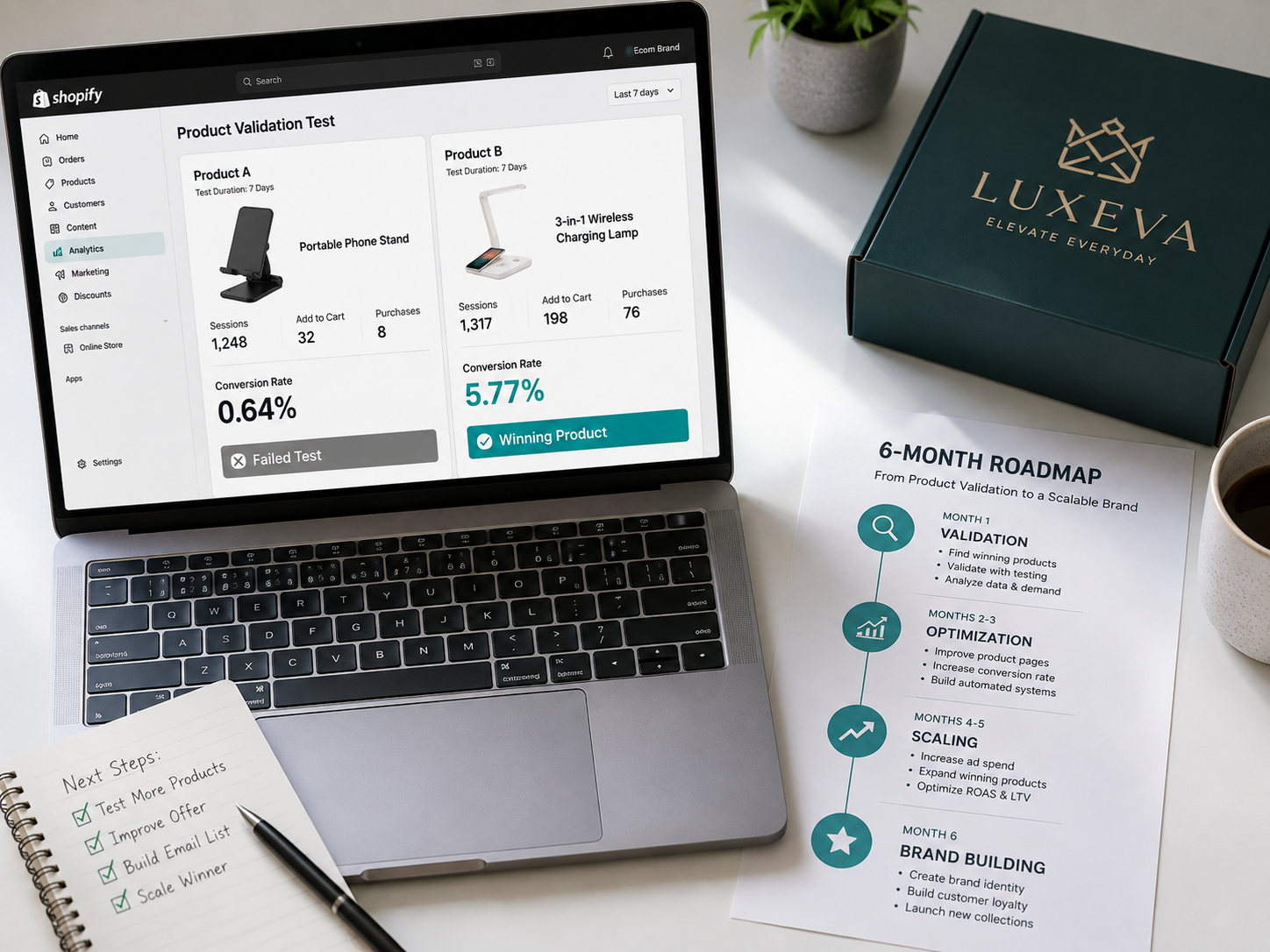
Month one to two — validation phase. Test two to four products using paid or organic traffic. Measure add-to-cart rate, conversion rate, and average order value per product. The goal is finding at least one product with a viable unit economics profile — sufficient margin above customer acquisition cost to generate positive contribution after all variable costs.
Month two to four — optimization phase. Once a viable product is identified, optimize the product page, product description, and creative. Introduce email capture and a basic abandoned cart flow. Begin building towards branded packaging if margins support it.
Month four to six — scaling phase. Increase traffic to the proven product. Expand the product catalog with complementary items that increase average order value. Launch a post-purchase email sequence to drive repeat purchases.
Month six to twelve — brand building phase. Transition toward private label packaging if not already done. Begin building organic content around the product category. Invest in retention infrastructure — loyalty program, SMS marketing, review collection — that reduces dependence on cold paid traffic for each new customer.
The merchants who describe dropshipping as dead are typically the ones who attempted the generic model, failed within 90 days, and concluded that the model does not work. The merchants who are running profitable operations in 2026 share one characteristic: they treated dropshipping as the starting point of a brand-building process rather than the entire strategy.
Final Thoughts
Shopify dropshipping in 2026 is neither the get-rich-quick opportunity it was marketed as in 2019 nor the dead model that cynical content creators now proclaim. It is a real, viable business model with documented market scale and documented failure rates — and the gap between success and failure is almost entirely explained by which version of the model you pursue and how seriously you treat it as a business rather than a side hustle.
The generic, no-brand, race-to-the-bottom version of dropshipping is losing. The branded, niche-specific, supplier-vetted, retention-focused version is winning.
Start with product validation. Add branding as quickly as unit economics allow. Build the customer relationships that generate repeat revenue without paid acquisition. And treat every decision — product selection, supplier choice, store design, marketing approach — as if you are building a brand you intend to own for five years.
That is the version of dropshipping that works in 2026.
Need help building or optimizing your Shopify dropshipping store, or want an expert to review your product page and conversion setup for maximum performance? Get in touch with EcomFixify — we specialize in Shopify development and ecommerce growth strategy for brands at every stage.