
Shopify Customer Service Turn Support Into a Revenue Channel in 2026
Most Shopify store owners treat customer service as a cost center — a necessary expense that drains time, money, and energy without contributing anything measurable to revenue. Answer the complaint. Process the return. Move on.
That framing is not just outdated. It is actively costing you money.
Every support interaction is a touchpoint with a customer who has already bought from you or is actively considering it. How you handle that interaction determines whether they buy again, whether they tell their friends, whether they leave a five-star review, and whether they stay loyal to your brand or switch to a competitor the moment a better price appears somewhere else.
89% of consumers switch brands after a poor customer service experience. A 5% increase in customer retention increases profits by 25 to 95%. And the brands treating support as a revenue function — not a complaint resolution queue — are generating measurable sales directly from customer conversations through pre-purchase chat, proactive outreach, and support interactions that end with product recommendations rather than just problem resolutions.
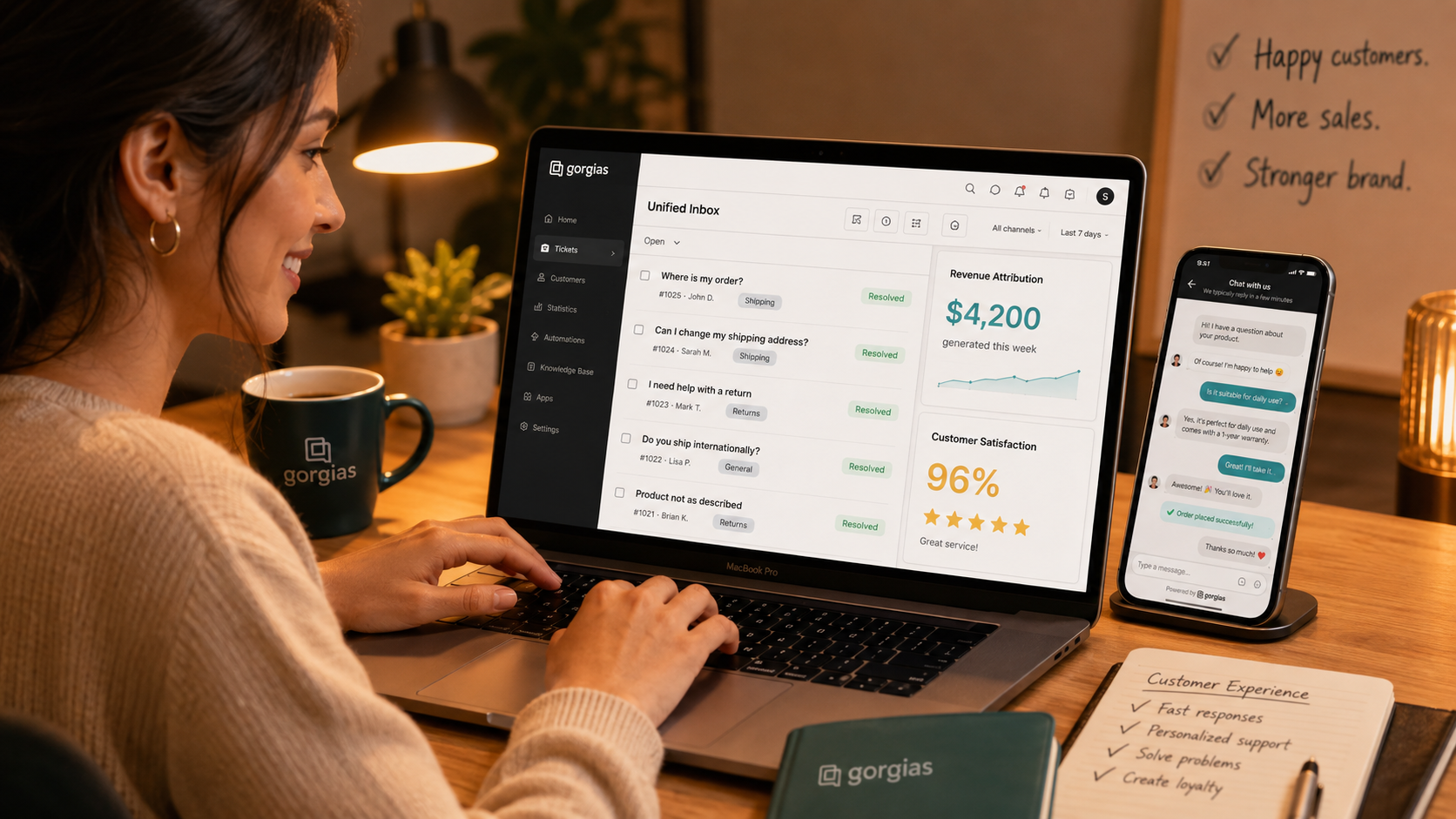
Gorgias, Shopify's only Premier Partner for customer experience, has tracked over $500 million in revenue driven through support conversations across its 17,000 plus merchant base at an average 4.2x ROI. That is revenue directly attributed to support interactions — not revenue that happened to occur around the same time, but sales that began as customer questions and converted through the support channel.
This guide covers how to build a customer service operation for your Shopify store that generates revenue, reduces churn, and creates the kind of customer experience that compounds in loyalty over time.
Why Customer Service Is the Most Underrated Revenue Channel in Ecommerce
The conventional model of customer support treats every incoming ticket as a problem to close as quickly as possible. Resolution speed is measured. Customer satisfaction scores are tracked. The goal is efficiency — handle as many tickets as possible with as little cost as possible.
This model misunderstands what a customer service interaction actually represents. A customer who contacts your support team is not an interruption to your business — they are one of your most engaged customers at one of their highest-attention moments.
Consider what happens in a typical support interaction. A potential customer chats your store asking about sizing before buying. If the agent answers the sizing question and closes the chat, that is a resolved inquiry. If the agent answers the sizing question, recommends the right size based on the customer's measurements, mentions that the same style comes in a color that would match what the customer described, and offers free shipping on orders over the current cart value — that is a revenue interaction that generates an order that might not have happened or might have been smaller.
The difference between those two outcomes is not technology. It is intent. It is whether your support team understands their role as revenue contributors rather than problem solvers.
Studies across ecommerce platforms consistently show that customers who contact support and have a positive experience spend 25% more with that brand in the following 12 months than customers who never needed support. The act of having an issue resolved well deepens loyalty more than a frictionless experience that required no contact at all. That counterintuitive finding has a name in customer experience research — the Service Recovery Paradox — and it is one of the most commercially significant dynamics in ecommerce retention.
The Four Ways Customer Support Generates Revenue for Shopify Stores
Understanding the specific mechanisms through which support drives revenue helps you design your support operation intentionally around each one.
1. Pre-Purchase Conversion Through Live Chat
A customer browsing your product page with an unanswered question is a customer who will either find the answer and buy, not find it and leave, or find it on a competitor's site and buy there instead. Live chat deployed on product pages converts this uncertainty into sales by providing the missing information exactly when the customer needs it.
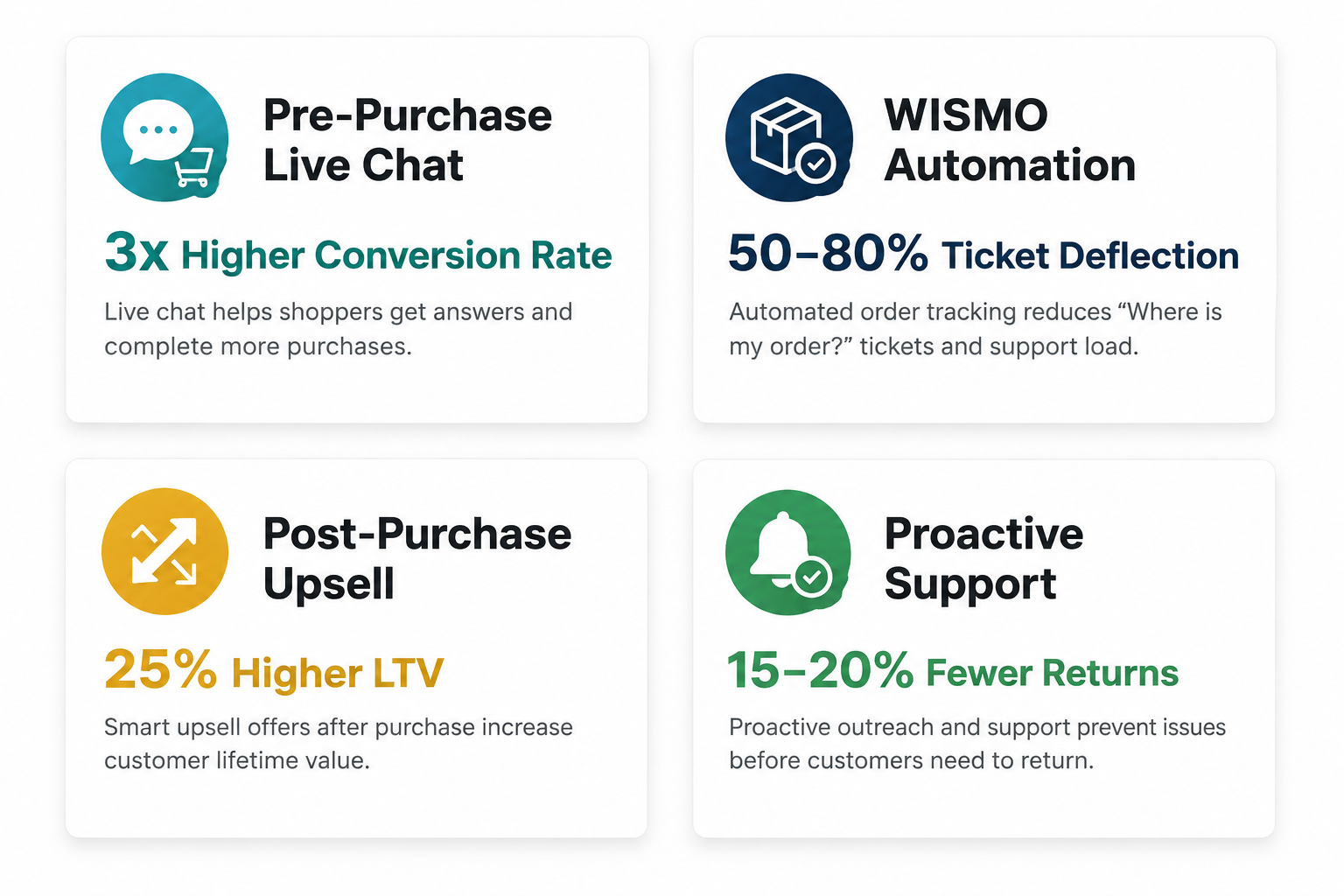
The conversion data on pre-purchase live chat is consistently strong. Customers who engage with live chat before purchasing convert at three times the rate of those who browse without chat interaction. The average order value from chat-assisted purchases is 10 to 15% higher because agents who understand the product catalog can recommend complementary items, suggest the optimal variant for the customer's stated use case, and address the specific objection preventing the customer from buying.
For Shopify stores with a wide product catalog, live chat is most valuable on collection pages — where customers are in selection mode — and on high-traffic product pages where the most common pre-purchase questions cluster. Deploying chat selectively on these high-intent pages rather than site-wide reduces agent workload while concentrating support where it generates the highest revenue impact.
2. WISMO Automation That Frees Agents for Revenue Work
WISMO — Where Is My Order — is the single most common support inquiry for every Shopify store that ships physical products. It is also the least revenue-generating interaction in your support queue. A customer asking where their order is does not represent a sales opportunity — it represents a customer who needs reassurance and will disengage from your site until the package arrives.
Automating WISMO inquiries with AI — so they resolve instantly without agent involvement — accomplishes two things simultaneously. It resolves the customer's question faster than any human could manage, because the AI checks the order status and provides the tracking link in seconds rather than waiting for an agent to pull up the order in Shopify. And it frees every agent hour previously spent on WISMO for pre-purchase chat, upsell conversations, and complex support interactions where human judgment and product knowledge generate revenue.
Only 6% of Shopify stores currently use AI for support automation. The ones that do report 50 to 80% ticket deflection on routine inquiries. At 80% deflection on WISMO volume — which typically represents 30 to 40% of total ticket volume — an agent team that previously spent three hours per day on order status inquiries now has that time available for revenue-generating interactions.
3. Post-Purchase Upsell and Cross-Sell Through Support
The order confirmation page and post-purchase email get significant attention as cross-sell surfaces. The post-purchase support interaction is equally powerful and almost universally ignored.
A customer who contacts support after receiving their order — to ask how to use a product correctly, to report a minor issue, or to provide feedback — is at a specific moment of high engagement with your brand. They have received the product. They are thinking about it. They are in a conversation with your team.
An agent who resolves the inquiry, confirms the customer is satisfied, and then says "Since you bought the X, a lot of our customers also love the Y — would you like me to add a 15% first-time discount to your account for your next order?" is executing a cross-sell in a context where the customer's guard is completely down and their satisfaction with the brand is at its highest.
This approach requires training, the right tooling, and a support culture that measures revenue contribution alongside resolution time. But the commercial output is measurable — Gorgias tracks this revenue attribution natively on its Pro plan and above, showing exactly how much revenue each agent generates through support interactions.
4. Proactive Support That Prevents Churn Before It Happens
Reactive support handles problems after they occur. Proactive support identifies customers who are likely to have a problem and reaches out before the problem triggers a complaint, a return, or a churn event.
The most common proactive support trigger for Shopify stores is delivery delay. When a customer's order is showing a shipping delay — an event visible in your order management data — a proactive message acknowledging the delay, providing an updated estimated delivery date, and offering a discount on their next order as an apology converts what would have been an angry inbound complaint into a positive experience that increases retention.
Proactive post-delivery outreach — checking that the product arrived in good condition and asking if the customer has any questions about using it — reduces return rates by 15 to 20% and increases review submission rates significantly. Customers who receive a check-in message after delivery feel cared for, are more likely to leave a positive review, and are less likely to return the product over minor issues that a brief guidance message could resolve.
These proactive interactions are virtually impossible to execute manually at scale. They require automation tools that monitor order status data and trigger outreach at the right moment — which is exactly the capability that the leading Shopify support platforms provide.
Building Your Shopify Customer Service Stack
The right support infrastructure depends on your store's stage, ticket volume, and support team size. Here is how to think about building the stack at each stage.
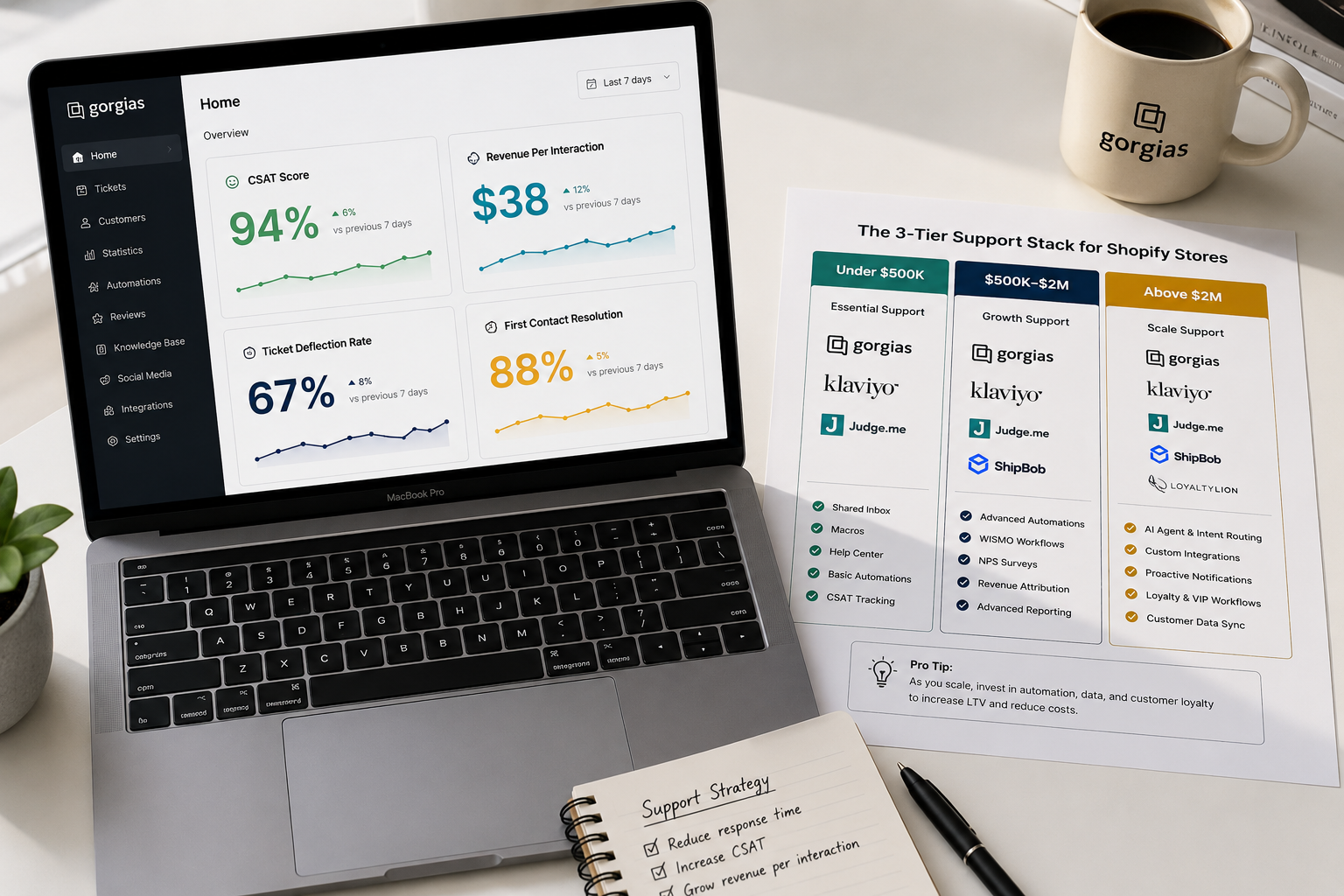
For Stores Under $500K Annual Revenue: Start Simple
At this stage, your primary goal is response speed and consistency. A single support agent — the founder or a part-time hire — handling all tickets through a structured system is more effective than an elaborate helpdesk with no one trained to use it.
The minimum viable support stack at this stage:
A dedicated support email address that is not shared with a personal inbox. Mixing personal and business email is the fastest way to miss tickets, lose thread history, and provide inconsistent responses.
A simple FAQ page on your Shopify store that answers the ten most common questions your customers ask. A well-designed FAQ page reduces incoming ticket volume by 15 to 25% by answering questions before customers need to ask them. Build this in your first month and update it quarterly.
Tidio or Re:amaze as entry-level live chat and helpdesk platforms. Both offer Shopify integrations, basic automation for WISMO and order status questions, and pricing structures appropriate for stores with lower ticket volumes. Tidio's Lyro AI handles a meaningful percentage of incoming inquiries automatically on its paid plans.
Response time targets: 4 hours or less for live chat, 24 hours or less for email. These are the benchmarks at which customer satisfaction remains high. Response times beyond 24 hours for email or beyond 10 minutes for live chat show measurable drops in customer satisfaction scores.
For Stores Between $500K and $2M Annual Revenue: Professionalize the Operation
At this revenue level, customer service volume has grown to the point where a structured platform, defined processes, and basic automation deliver measurable ROI compared to ad-hoc ticket management.
Gorgias is the platform of choice for the majority of Shopify stores at this stage. It is Shopify's only Premier Partner for customer experience, serves 17,000 plus brands, and provides the deepest native Shopify integration available — pulling order data, customer history, and product information directly into every ticket so agents never need to switch between systems.
The Gorgias features that deliver the highest immediate value:
The unified inbox consolidates every channel — email, live chat, Instagram DMs, Facebook messages, SMS, and WhatsApp — into a single queue. A customer who DMs your Instagram account gets the same response speed as one who sends an email, because the agent sees both in the same place.
Macros — templated responses for common questions — eliminate the time spent composing repetitive answers from scratch. A well-built macro library covering your top 20 most common inquiries reduces average handling time significantly and ensures consistent, on-brand responses regardless of which agent handles the ticket.
The Gorgias AI Agent in 2026 handles Tier 1 ticket resolution autonomously — order tracking, return eligibility checks, subscription management, and basic product questions — without agent involvement. Gorgias claims the AI handles up to 60% of common support inquiries, with resolution quality ratings comparable to human agents on routine ticket types.
Rules and automation — triggered by order status, tags, customer lifetime value, and other Shopify data — allow you to route tickets intelligently, prioritize high-value customers, and trigger proactive outreach based on specific events in the order lifecycle.
For Stores Above $2M Annual Revenue: Build for Scale and Revenue Attribution
At significant revenue scale, customer service transitions from a support function into a strategic revenue driver with measurable attribution and dedicated team management.
The additional capabilities that matter most at this stage:
Revenue statistics and attribution reporting — available on Gorgias Pro and above — show exactly which support conversations resulted in purchases, which agents generate the most revenue, and how support interactions influence customer lifetime value. This data transforms the conversation about support from "how much does it cost?" to "what is its ROI?" — a fundamentally different strategic framing that justifies investment in team size, training, and tooling.
Customer tier routing ensures your highest-value customers — those with the highest lifetime value or order history — receive priority routing to your best agents or dedicated account management. A VIP customer whose package arrives damaged and who reaches your best agent in under two minutes has a fundamentally different retention probability than the same VIP who waits 24 hours in a standard queue.
Integration with Klaviyo and your loyalty program allows support interactions to trigger email flows — a post-support follow-up sequence, a loyalty point grant following a complaint resolution, or a win-back flow for customers whose support experience ended poorly despite the agent's best efforts.
The Support Metrics That Actually Matter
Most Shopify merchants who track customer service metrics at all are tracking the wrong ones. First response time and resolution time measure efficiency. The metrics that measure revenue impact are different.
Customer Satisfaction Score (CSAT) is collected by sending a brief post-resolution survey asking customers to rate their support experience. A CSAT above 90% is achievable for most well-run Shopify support operations and is the baseline for a support experience that does not actively hurt retention.
Revenue per support interaction tracks the direct revenue generated through chat-assisted purchases, post-support cross-sells, and pre-purchase conversations that convert. This metric is only available with platforms like Gorgias that attribute revenue to specific conversations. Tracking it transforms how your team thinks about every interaction.
Ticket deflection rate measures what percentage of potential tickets are resolved without agent involvement — by your FAQ page, your AI Agent, or your self-service knowledge base. A deflection rate above 50% indicates your automation is working effectively. Below 30% indicates your FAQ content is insufficient or your automation is not covering the most common inquiry types.
Repeat contact rate measures what percentage of customers contact support more than once about the same issue. A high repeat contact rate indicates that first resolutions are not actually resolving the underlying problem — a content, policy, or product issue that needs addressing upstream rather than managing ticket by ticket.
First contact resolution rate measures what percentage of issues are resolved in a single interaction without requiring follow-up. High first contact resolution correlates directly with customer satisfaction and retention because customers who resolve their issue in a single interaction are more satisfied than those who engage in extended back-and-forth before reaching resolution.
Training Your Support Team to Sell
The operational infrastructure covered above is only as effective as the people using it. Building a support culture that drives revenue requires explicit training, clear incentive structures, and ongoing reinforcement of the behaviors that generate commercial outcomes.
The training shift that matters most is reframing the definition of a "resolved ticket." In a cost-center support culture, a resolved ticket is one where the customer's complaint is closed. In a revenue-generating support culture, a resolved ticket is one where the customer's issue is addressed and the agent has taken at least one action that deepens the customer's relationship with the brand — a product recommendation, a loyalty point acknowledgment, a proactive mention of an upcoming sale, or a sincere personal note that makes the customer feel valued rather than processed.
This shift does not require aggressive selling or scripted upsell pitches that feel transactional. The most effective revenue-generating support interactions are the ones that feel most like genuine help. An agent who knows your product catalog deeply enough to recommend the right product for a specific use case is providing a service. A customer who receives that recommendation and makes a purchase because of it is responding to genuine expertise — not a sales script.
Incentivize revenue contribution alongside resolution metrics. If your support team's performance is measured exclusively on response time and CSAT, that is the behavior you will get. When revenue generated through support conversations is tracked and recognized, agents naturally develop product knowledge, identify cross-sell opportunities, and approach interactions with a different intent.
Self-Service Infrastructure That Reduces Tickets and Builds Trust
Before a customer contacts your support team, most of them will search for an answer themselves. The quality of your self-service infrastructure determines whether they find the answer — and whether that answer builds or erodes their confidence in your brand.
A knowledge base — a structured collection of help articles covering your most common customer questions — is the highest-leverage self-service investment available to most Shopify stores. Gorgias includes an integrated knowledge base on its Pro plan and above, but standalone knowledge base tools including Helpjuice and Document360 also integrate with Shopify.
The articles that generate the most self-service resolution are order tracking and shipping timeline information, return and exchange policy with the step-by-step process clearly spelled out, sizing guides with actual measurements rather than just small, medium, and large labels, product care and usage instructions, and subscription management instructions for stores with recurring revenue programs.
Update your knowledge base articles quarterly based on the questions your support team receives most frequently. The articles that exist in your knowledge base represent questions that are no longer creating tickets — which is the closest thing to a passive ticket reduction system available to any Shopify store.
Real Examples: Support Done Right
Chewy, the pet supplies brand, built its reputation almost entirely on support excellence rather than product or price differentiation. The brand is famous for sending handwritten cards to customers when their pets pass away — an interaction that has gone viral on social media dozens of times and generated millions of dollars in brand awareness that no paid campaign could replicate. Their support philosophy is not efficient ticket resolution. It is relationship building through human interaction at moments of customer vulnerability.
For a Shopify brand at any scale, the equivalent is not a handwritten card — it is the agent who reads the customer's message carefully enough to notice that they mentioned it is their first time buying skincare online and takes an extra thirty seconds to explain exactly how to use the product and what to expect in the first few weeks. That thirty seconds is the difference between a one-time buyer and a loyal customer.
Lively, the lingerie brand, built pre-purchase chat into a central pillar of its conversion strategy. Customers browsing product pages with sizing questions are met by agents trained specifically on the brand's fit philosophy and size inclusivity positioning. The resulting conversations convert at significantly higher rates than unaided browsing because the agent provides the specific, personalized guidance that a product page description cannot replicate.
Final Thoughts
Customer service is the last part of a Shopify store that most merchants think about and the first thing customers remember. The gap between those two priorities is where customer lifetime value is either built or destroyed, one interaction at a time.
The transition from cost center to revenue channel does not require a large team or expensive technology. It requires a clear decision to treat every support interaction as an opportunity — to solve a problem, deepen a relationship, and create the conditions under which a customer chooses to come back.
The infrastructure exists. The AI handles the routine. The agents who remain in the conversation have the opportunity to generate real revenue through genuine helpfulness — which turns out to be the most commercially durable kind of customer service there is.
Need help setting up Gorgias or a customer service system for your Shopify store, or want an expert to design your support workflows for maximum efficiency and revenue impact? Get in touch with EcomFixify — we specialize in Shopify development and ecommerce growth strategy for brands building for the long term.