
Shopify Abandoned Cart Recovery: How to Get Back 15% of Lost
The average Shopify store loses 70.2% of its potential revenue before a single order is placed. That is not a traffic problem, a product problem, or a pricing problem. It is an abandonment problem — and it is happening on every store, every day, whether or not the merchant is doing anything about it. Shopify Abandoned Cart Recovery: How to Get Back 15% of Lost
For a store generating $50,000 per month in actual revenue, that abandonment rate means somewhere between $11,500 and $24,750 in recoverable cart value is walking out the door every single month. Not permanently gone — recoverable. The customer found the product, added it to their cart, and left for a reason. That reason is almost always fixable. And the moment they abandoned, a recovery window opened that most stores either do not have a system to exploit or are exploiting poorly.
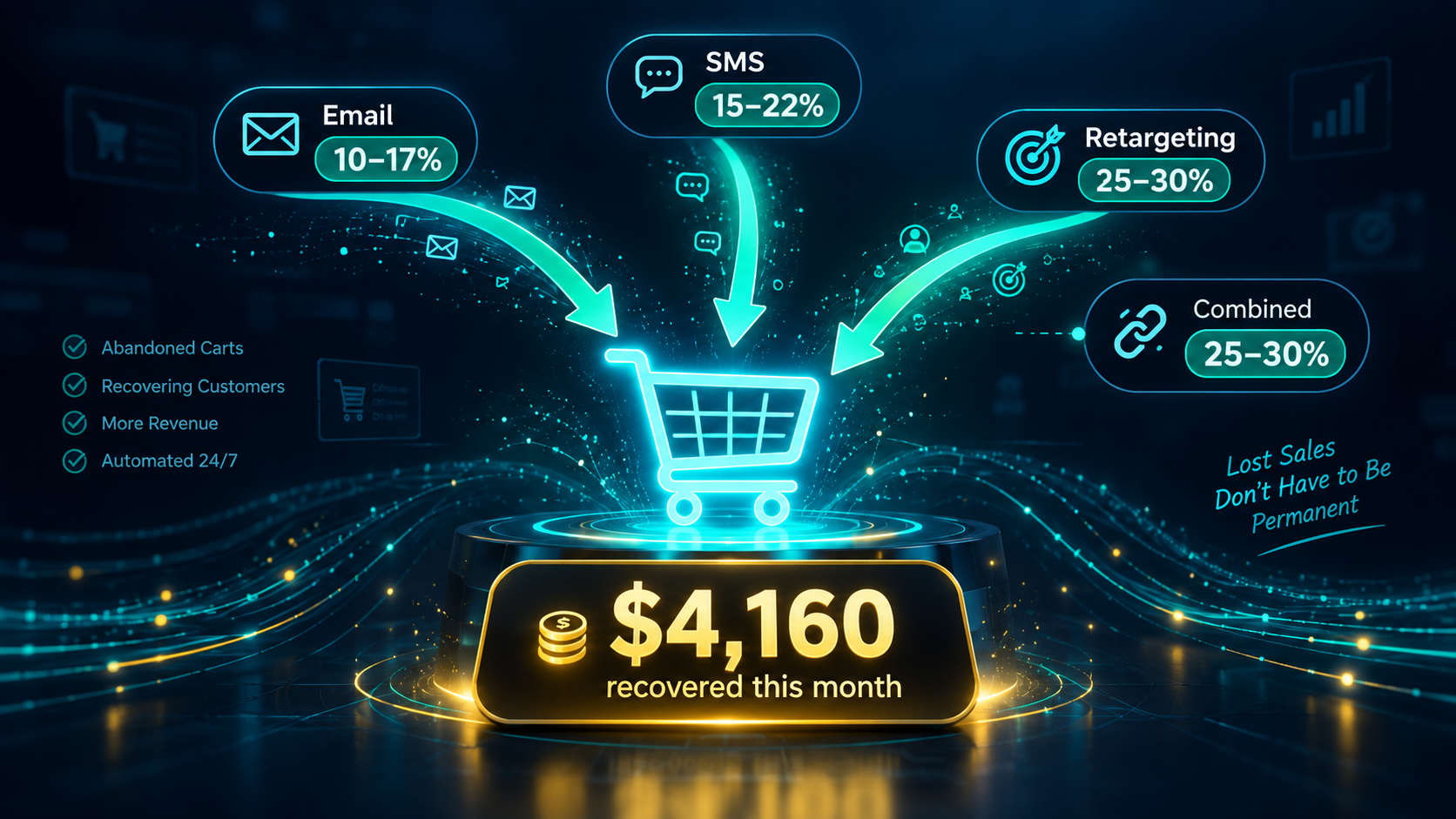
A single recovery email recovers 5 to 8% of abandoned carts. A three-email sequence recovers 10 to 17%. Adding SMS to the email sequence pushes recovery to 15 to 22%. Adding retargeting ads and exit-intent popups to the full stack pushes top-performing stores toward 30% and above.
The 15% recovery rate referenced in this guide's title is not a best-case scenario. It is the documented result of a properly configured multi-step email sequence — the middle of the performance range, achievable by any Shopify store with the right setup. Everything above 15% is incremental gain from adding channels and sophistication to the recovery stack.
This guide covers the complete Shopify abandoned cart recovery system — from understanding why customers leave to the exact channel, timing, copy, and segmentation strategies that bring them back.
Why Customers Abandon Carts: The Reasons That Point to Solutions
Abandoned cart recovery is most effective when it addresses the specific reason the customer left — not a generic "you forgot something" message that ignores why they actually walked away.
The research on abandonment reasons in 2026 is consistent across large-scale studies. Unexpected costs — shipping, tax, and fees appearing for the first time at checkout — account for 47 to 49% of all abandonment. This is nearly half of every cart that leaves your store walking away because the final price was higher than what the product page suggested. A recovery email that shows the abandoned product without addressing the cost surprise that caused the abandonment is recovering a fraction of what it could.
Required account creation before purchase drives 24% of abandonment — customers who are ready to buy but unwilling to create an account to do so. A checkout that does not offer guest checkout is leaking a quarter of its potential completions through a configuration choice.
Slow or complicated checkout processes account for 18% of abandonment. Concerns about payment security drive 19%. Not enough payment methods — no PayPal, no Buy Now Pay Later, no express checkout — drives 13%.
Understanding these specific reasons shapes every element of your recovery strategy. A customer who left because of unexpected shipping costs needs a different recovery message than one who left because the checkout process was complicated. Segmenting your recovery communications by abandonment trigger — where the customer dropped off in the checkout flow — produces four to seven times higher recovery rates than generic messages sent to the entire abandonment pool.
The Foundation: Shopify's Native Recovery Tool and Its Limits
Before adding any third-party app, understanding exactly what Shopify's native abandoned checkout email does — and what it cannot do — prevents the common mistake of assuming the built-in tool is covering your recovery needs when it is doing very little.
Shopify's native abandoned checkout email only triggers for visitors who reached the checkout page and entered their email address before leaving. It does not cover customers who added items to their cart and left before reaching checkout. It sends a single email with no multi-step sequence option. It has no SMS capability, no behavioral personalization, no segmentation by abandonment reason, and no A/B testing for subject lines or content.
The native tool recovers approximately 1 to 3% of abandoned checkouts in the narrow audience it can reach — which, because it only sees customers who entered an email, is typically 15 to 20% of your total traffic. Of the 80 to 85% of visitors who abandon without entering an email, Shopify's native tool reaches none of them.
This is why third-party recovery tools — Klaviyo, Omnisend, Postscript, and Recart — generate recovery rates five to ten times higher than the native tool. They expand the reach of your recovery system to logged-in customers, email subscribers, and SMS opt-ins who may have abandoned without entering their email at checkout.
Configure Shopify's native abandoned checkout email as a baseline — it is free and requires five minutes of setup — but treat it as the floor of your recovery capability, not the ceiling.
The Three-Email Recovery Sequence: Structure, Timing, and Copy
The three-email abandoned cart sequence is the highest-ROI recovery setup available to most Shopify stores and the configuration that delivers the 10 to 17% recovery rate referenced earlier. Each email serves a specific function in the recovery arc, and all three need to be present for the sequence to perform at its potential.
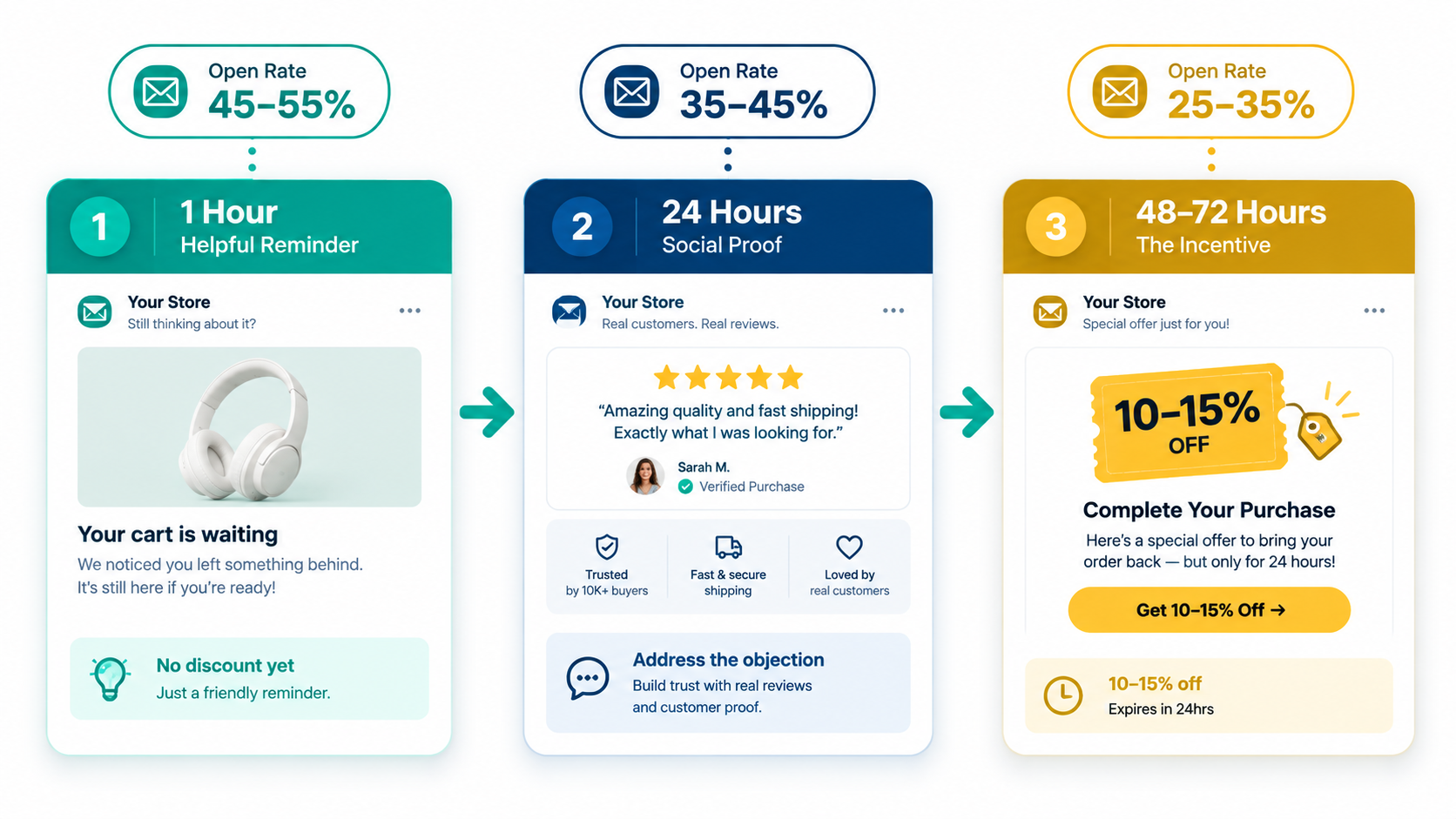
Email 1: The Helpful Reminder — Sent 1 Hour After Abandonment
The first email is a simple, pressure-free reminder. Its job is to catch the large percentage of abandoners who left for a genuinely low-friction reason — they got distracted, their phone rang, they switched apps and forgot to come back. These customers need only a gentle nudge.
The format that consistently outperforms in 2026: a short subject line with the customer's first name and no emoji — "Sarah, you left something behind" — followed by a single product image of the abandoned item, the product name and price, and one clear call to action button that links directly to the cart. Two sentences of body copy maximum. No discount, no urgency pressure, no sales language. The tone should feel like a helpful friend noticing something was forgotten, not a brand desperate to close a sale.
Email 1 carries the highest recovery rate of the three — approximately 40 to 50% of all recovered carts in a sequence come from this first touch — because many abandoners simply needed the reminder. Discount-first strategies that open with an incentive in Email 1 recover this group at a lower margin than necessary, training customers to abandon intentionally and wait for the offer.
Open rate benchmark for Email 1: 45 to 55%.
Email 2: Social Proof and Reassurance — Sent 24 Hours After Abandonment
The second email targets abandoners who saw Email 1, considered returning, and still hesitated. The hesitation at this stage is almost always driven by doubt — doubt about the product, doubt about the brand, or a specific unanswered question from the purchase decision.
Social proof is the most effective tool for resolving doubt at scale. Pull two or three genuine reviews of the specific abandoned product and feature them prominently — star rating, reviewer name, and a one or two sentence quote that addresses the most common purchase hesitation for that product. If customers frequently ask about sizing, feature a review that confirms fit. If they ask about results, feature a before-and-after review.
The body copy for Email 2 addresses the most common objection in your product category directly. For apparel: "Not sure about the fit? We offer free exchanges on sizes — no questions asked." For electronics: "Every order ships with full technical support included." For supplements: "Thousands of customers have seen results in the first 30 days — or we refund the order in full."
No discount yet. Adding a discount to Email 2 is a common mistake — it rewards the hesitation rather than resolving it, and it conditions customers to delay their decision past Email 1 because they have learned an incentive arrives in Email 2.
Open rate benchmark for Email 2: 35 to 45%.
Email 3: The Incentive and Final Urgency — Sent 48 to 72 Hours After Abandonment
Email 3 is for abandoners who have received two reminders and still have not returned. At this stage, the recovery probability is significantly lower — which is exactly why saving the incentive for this email preserves margin across the 80 to 90% of recoveries that happen without ever needing it.
Introduce a time-limited incentive — free shipping, a 10 to 15% discount code, or a small gift with purchase — with a clear expiry of 24 to 48 hours. The expiry must be genuine. A discount code that never actually expires will be noticed by customers who test it after the deadline, and the trust damage from that discovery is permanent.
The copy formula for Email 3: acknowledge that the customer has been thinking about the decision, introduce the offer clearly, explain the expiry date specifically, and include a single call to action. Keep it short. At this stage, the customer knows your product — they do not need more information. They need a reason to act today rather than tomorrow.
Recovery rate for Email 3 alone is modest — 15 to 20% of total sequence recoveries — but because these are customers who would otherwise be lost entirely, every recovery at this stage is pure incremental revenue.
Adding SMS: The Channel That Doubles Recovery Rates
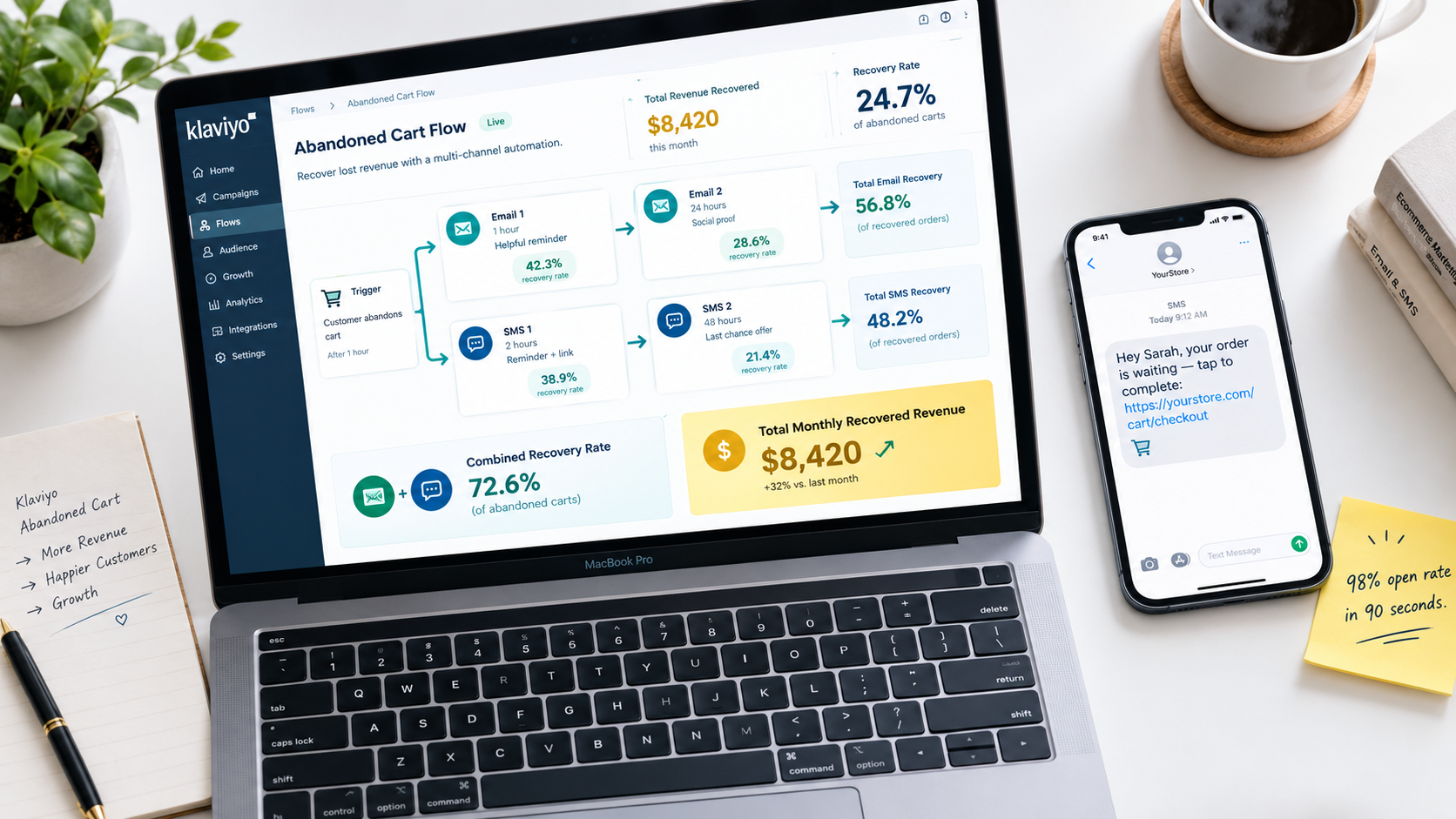
SMS abandoned cart messages have 98% open rates compared to 42% for email, and the average response time is 90 seconds versus 90 minutes for email. These are not comparable channels for time-sensitive cart recovery — SMS is categorically faster and more visible than email, and the recovery rates reflect that difference.
SMS recovers 10 to 15% of abandoned carts on its own — comparable to a full three-email email sequence — and the combination of SMS plus email consistently achieves 15 to 22% recovery, with the average revenue per recovered order higher in SMS-influenced recoveries because the immediacy of the channel catches customers while their intent is freshest.
The SMS abandoned cart strategy that performs best in 2026:
Send the first SMS 30 to 60 minutes after abandonment — before or instead of Email 1 for SMS-opted customers — with a direct cart link and no incentive. Keep it under 160 characters. The copy formula: "Hey [First Name], your [product name] is still waiting. Complete your order here: [cart link]". Nothing more. The brevity signals confidence — you are not desperate, you are helpful.
If the SMS does not recover the cart within 24 hours, the email sequence continues as planned. The SMS and email channels complement each other — SMS catches the immediate, high-intent window; email provides the detailed follow-up that builds trust and introduces incentives progressively.
SMS recovery requires explicit opt-in — customers must consent to receive marketing text messages from your store. Build SMS opt-in into your email signup form, your checkout flow, and your post-purchase communications. Every SMS opt-in you collect increases the percentage of your abandoned cart audience you can reach with your fastest recovery channel.
Postscript and Attentive are the leading dedicated SMS platforms for Shopify, with the deepest native integration and most sophisticated abandoned cart automation available. Klaviyo handles both email and SMS in a single platform if you prefer to manage both channels in one tool.
Exit-Intent Popups: Catching Abandoners Before They Leave
The most cost-effective abandoned cart recovery intervention is the one that happens before the customer leaves — intercepting them at the moment of departure with an offer that changes their decision on the spot.
Exit-intent technology detects cursor movement toward the browser's address bar or back button on desktop, and scroll-back behavior on mobile, triggering a popup in the final seconds before the visitor navigates away. Well-timed exit-intent popups on cart and checkout pages recover 5 to 10% of would-be abandoners who would otherwise enter the recovery sequence — converting them before they leave rather than after.
The offers that convert best in exit-intent popups are free shipping unlocks — "Wait — you qualify for free shipping on this order" — small discount codes with a tight expiry, and email capture gates that exchange a discount for an email address, ensuring the customer who leaves is now recoverable through email regardless of whether they were logged in or had previously subscribed.
Exit-intent on the cart page performs differently from exit-intent on the checkout page. Cart page exit-intent catches customers who are still in browsing mode — a more compelling offer may be needed to convert them. Checkout page exit-intent catches customers who were close to completing and hesitated at a specific moment — reassurance and friction removal perform better here than additional discounts.
OptiMonk, Privy, and Justuno are the leading exit-intent popup apps for Shopify in 2026, each offering cart and checkout-specific targeting and deep integration with Klaviyo for subscriber handoff.
Retargeting Ads: Re-Engaging Abandoners Across Platforms
Retargeting ads — paid advertisements shown specifically to visitors who have left your store without purchasing — extend your recovery reach to audiences you cannot contact through owned channels. Every abandoner you do not have an email or phone number for is invisible to your email and SMS sequences. Retargeting makes them visible again.
Meta's Dynamic Product Ads automatically generate personalized ad creative showing each viewer the specific products they viewed or added to cart on your Shopify store. The targeting is handled by the Meta Pixel, which fires when a customer adds to cart and enables retargeting across Facebook and Instagram for 30 to 180 days after the session.
Retargeting ad recovery rates are lower than email or SMS on a per-impression basis — 2 to 5% recovery rate — but their value lies in reaching the large percentage of abandoners who are not reachable through owned channels. Combined with email and SMS, retargeting ensures that every abandoner who left your store is followed across the channels they use for the subsequent 30 days, maximizing the total percentage of abandoned carts that eventually convert.
The retargeting creative that performs best for cart recovery in 2026 shows the specific abandoned product — not a generic brand ad — with minimal copy and a clear return path. "Still thinking about [product name]?" combined with the product image and a single call to action consistently outperforms awareness-style brand creative for cart recovery retargeting because it is specific to the behavioral signal that triggered the campaign.
Segmentation: The Difference Between 5% and 25% Recovery Rate
Generic recovery emails sent to every abandoner regardless of their behavior, cart value, or relationship with the brand recover approximately 3% of carts. Segmented recovery emails recover four to seven times that — and the segmentation required to achieve this lift is simpler than most merchants expect.
The four segmentation variables that produce the highest recovery lift:
Cart value segmentation. High-value cart abandoners — typically those above your 75th percentile cart value — warrant a different recovery approach than low-value abandoners. High-value abandoners may have additional cost hesitation or require stronger trust signals before committing to a larger purchase. A personalized recovery sequence that acknowledges the cart value — "You were this close to completing a $180 order" — and addresses the specific hesitations of a larger purchase decision consistently recovers high-value carts at higher rates than a one-size-fits-all sequence.
Abandonment stage segmentation. A customer who abandoned the product page never reached the cart. A customer who abandoned the cart page almost purchased. A customer who abandoned at the payment step was one click away. Each stage represents a different level of intent and a different hesitation requiring a different recovery message. Shopify's analytics show where in the funnel each abandonment occurred — and Klaviyo's flow branching can deliver different recovery sequences to each segment automatically.
Customer relationship segmentation. A first-time visitor who abandons has no prior relationship with your brand — they need trust-building content and social proof before they will risk a purchase with an unknown merchant. An existing customer who abandons has already bought from you — they trust the brand and are hesitating for a different reason, likely price or timing. The recovery message for an existing customer can skip the trust-building content and go directly to a product reminder and a loyalty incentive.
New vs. returning visitor segmentation. Klaviyo identifies whether an abandoner is a new subscriber or a returning one. New subscribers in their welcome series who also have an abandoned cart need a recovery message that acknowledges their newness — featuring your return policy, your customer reviews, and your brand story prominently alongside the cart reminder. Returning subscribers need a simpler, more direct recovery message that assumes the trust relationship is already established.
The Recovery Stack: What Each Tool Recovers and When to Add It
Building your abandoned cart recovery system in the order that delivers the fastest ROI with the least complexity:
Start with Klaviyo's three-email abandoned cart sequence configured in your first two weeks. This single automation covers the majority of your email-contactable abandonment pool and delivers the baseline 10 to 17% recovery rate from which everything else is incremental.
Add exit-intent popups within the first month — OptiMonk or Privy configured on both cart and checkout pages. This catches abandoners before they enter the recovery sequence and improves the quality of the email list fed into your Klaviyo flows by capturing emails at the moment of highest intent.
Add SMS recovery in month two — either through Klaviyo's SMS module or Postscript if you want a dedicated SMS platform with more advanced segmentation. SMS opt-in collection should begin immediately but the automation is worth implementing once you have 500 or more SMS subscribers to justify the monthly platform cost.
Add Meta retargeting in month three — a dedicated abandoned cart campaign using Dynamic Product Ads targeting your Add to Cart event audience. This ensures abandoners who cannot be reached through owned channels are followed across Meta's platforms until they either purchase or the 30-day retargeting window expires.
At this full-stack configuration — email sequence, exit-intent, SMS, and retargeting — you have the infrastructure to recover 20 to 30% of abandoned carts, with the exact performance dependent on your product category, average order value, and the quality of the copy and creative in each channel.
Measuring Your Recovery Performance
The metrics that tell you whether your abandoned cart recovery system is working — and which elements need optimization — are straightforward once you know what to look for.
Overall recovery rate is the percentage of abandoned carts that eventually convert to completed orders. Track this as your headline metric and segment it by recovery channel to understand which channels are contributing most to your total recovery.
Revenue per email sent — also called revenue per recipient — measures how much revenue each email in your sequence generates per contact. Klaviyo's benchmark across 143,000 abandoned cart flows shows an average of $5.81 revenue per email sent across a three-email sequence. If your sequence is generating significantly below this benchmark, the problem is likely in your subject lines, your product imagery, or your call-to-action copy.
Email open rate by position tells you whether each email in your sequence is earning the open. Email 1 should achieve 45 to 55% open rate. If it falls below 40%, your subject line or send timing needs testing. Email 2 at 35 to 45% and Email 3 at 25 to 35% are the benchmarks for a well-configured sequence.
Unsubscribe rate on recovery emails is the early warning for aggressive recovery tactics. If your unsubscribe rate on recovery emails exceeds 0.5% per email, you are either sending too frequently, introducing discounts too early in the sequence, or your copy feels too pressured for your audience's comfort level.
Common Abandoned Cart Recovery Mistakes That Limit Results
Offering a discount in Email 1 is the single most expensive mistake in abandoned cart recovery. It trains the 40 to 50% of abandoners who would have recovered without any incentive to delay their purchase specifically to receive the discount. Over time, your customer base learns to add to cart, abandon, and wait for the email with the code. The revenue impact of this training compounds every month — and reversing it once the pattern is established is difficult.
Sending recovery emails to customers who have already purchased. Without a proper suppression filter in Klaviyo, a customer who abandoned one cart, purchased through a different session, and then receives your recovery email for the original cart has a confusing and trust-damaging experience. Configure a filter that exits customers from the recovery flow the moment a purchase is recorded.
Using generic copy that does not reference the specific product abandoned. "You left something in your cart" with no product image or name performs dramatically worse than an email that shows the exact product, at the exact price, with the exact variant the customer selected. The specificity is not optional — it is the mechanism that makes the email feel relevant rather than automated.
Stopping the recovery effort after three days. Recovery rates decline sharply after 72 hours, but they do not go to zero. A fourth touchpoint at seven days — either an email or a retargeting ad — catches a small additional percentage of later-deciding customers who needed more time than the initial sequence allowed.
Sending recovery messages at the wrong times. Recovery emails sent between midnight and 6am local time consistently underperform those sent during the morning or early evening. SMS recovery messages sent outside of 8am to 9pm local time generate opt-outs at significantly higher rates than those sent during daylight hours. Configure time-zone-aware sending in Klaviyo and apply send-time windows to your SMS automations.
The Revenue Math: What 15% Recovery Means for Your Store
For a Shopify store with 5,000 monthly sessions, a 60% add-to-cart rate of 500 sessions, and $80 average order value, the abandoned cart pool represents approximately 350 carts per month — $28,000 in potential revenue leaving without converting.
A 15% recovery rate on that pool recovers 52 orders per month — $4,160 in monthly revenue from customers who had already found your product and chosen it. At zero additional acquisition cost. At a platform cost of $100 to $300 per month for the email and SMS tools that generate the recovery.
Scaling that math to a store generating $100,000 per month with a typical 70% cart abandonment rate: approximately $70,000 in monthly abandoned cart value, with $10,500 per month recovered at a 15% recovery rate. A 25% recovery rate recovers $17,500 per month from the same abandoned pool.
Cart abandonment recovery is the closest thing to free money in ecommerce — not because it requires no effort, but because the effort is a one-time setup that generates ongoing revenue without ongoing management. The flows run, the SMS sequences fire, the exit-intent popups trigger, the retargeting ads follow, and the recoveries accumulate every day whether or not you touch the system.
Need help setting up your abandoned cart recovery system on Shopify, or want an expert to audit your existing Klaviyo flows for recovery rate improvement? Get in touch with EcomFixify — we specialize in Shopify development and ecommerce growth strategy for brands ready to stop leaving revenue on the table.