
Print on Demand on Shopify: The Honest Guide to What Works in 2026
Most guides about print on demand on Shopify read like recruitment brochures. They lead with passive income promises, skip the uncomfortable math, and leave you six months in wondering why your revenue is growing while your actual take-home profit refuses to move.
This guide is different. It covers what print on demand actually looks like in 2026 — the real margins, the real supplier differences, the niches that still work, the ones that have been saturated beyond recovery, and the specific decisions that separate stores generating real profit from stores generating impressive-looking revenue numbers that pay nobody a salary.
Print on demand is genuinely viable on Shopify in 2026. The global POD market is projected to exceed $39 billion by 2033, and the model has matured significantly — better suppliers, faster fulfilment, broader product catalogs, and deeper integration with Shopify's ecosystem than existed three years ago. But the business has also gotten more competitive, more margin-compressed in the wrong niches, and less forgiving of the generic "design five t-shirts and hope for the best" approach that worked in 2019 and barely survives today.
Here is the honest picture.
What Print on Demand Actually Is — and What It Is Not
Print on demand is a fulfillment model where a third-party supplier prints and ships custom products directly to your customers only after an order is placed. You design the products, list them on your Shopify store, set your retail price, and keep the difference between your retail price and the supplier's base cost after an order is fulfilled.
You never hold inventory. You never pre-purchase stock. You never pack a box. That zero-inventory, zero-upfront-cost entry point is what makes POD genuinely attractive as a business model — and it is what most guides emphasize correctly.
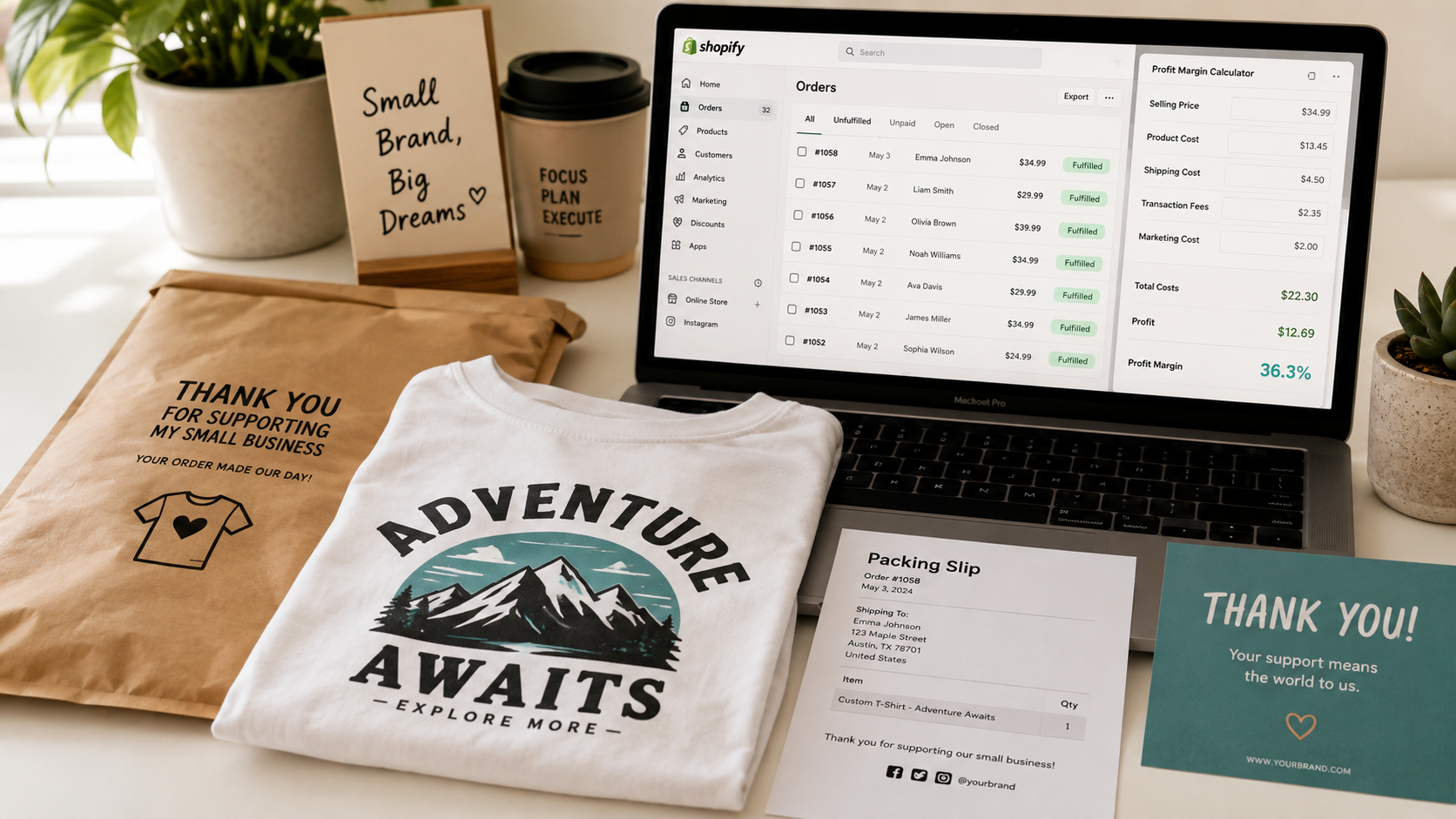
What most guides underemphasize is the cost structure that comes with that convenience. Every POD product carries a base cost that includes production, the supplier's margin, and packaging. Add shipping on top of that — typically $4 to $8 for domestic US orders, $10 to $18 for international — and then your Shopify transaction fees, your payment processing fees, and any advertising spend used to acquire the customer.
After all of that, successful POD sellers on Shopify typically see 25 to 45% net profit margins. That is not a bad margin — it is competitive with many product categories. But it is not the 70 to 80% margin that the gross markup on individual products suggests when you subtract only the base production cost and ignore everything else.
Understanding this cost structure before choosing your products, your supplier, and your pricing strategy is the difference between building a profitable business and building a revenue-generating hobby that pays you less than minimum wage per hour of effort invested.
The Honest State of POD Niches in 2026
The single most important decision in a print on demand business is niche selection. It determines your competition level, your customer acquisition cost, your ability to differentiate through design, and ultimately whether the business generates meaningful profit or perpetual mediocrity.
Here is the honest breakdown of where POD niches stand in 2026:
Oversaturated and margin-compressed: Generic humor t-shirts, motivational quote apparel, basic zodiac sign products, general pop culture references without licensing, and generic pet breeds on mugs and t-shirts. These niches were profitable in 2019 and 2020. In 2026, they are dominated by sellers with thousands of designs and years of SEO authority. New entrants competing in these categories almost universally fail to generate meaningful traffic or profit.
Competitive but viable with strong design: Niche fandoms with passionate communities, specific hobby communities (trail running, bouldering, home brewing, aquarium keeping), profession-specific humor and gifts, specific dog breeds with unique design angles, and geographic pride products for underserved locations. These niches have competition but reward sellers who invest in genuinely strong design and specific community positioning.
High opportunity in 2026: Personalization-heavy products where each item is made to order with customer-specific details — custom name jewelry, photo gifts, anniversary products, pet portraits, personalized map prints, and occasion-specific gifts. According to 2026 Shopify research, 61% of consumers are more likely to purchase from brands offering personalized product experiences. Personalization commands premium pricing, reduces price comparison shopping (because no two items are identical), and generates stronger word-of-mouth than generic POD products.
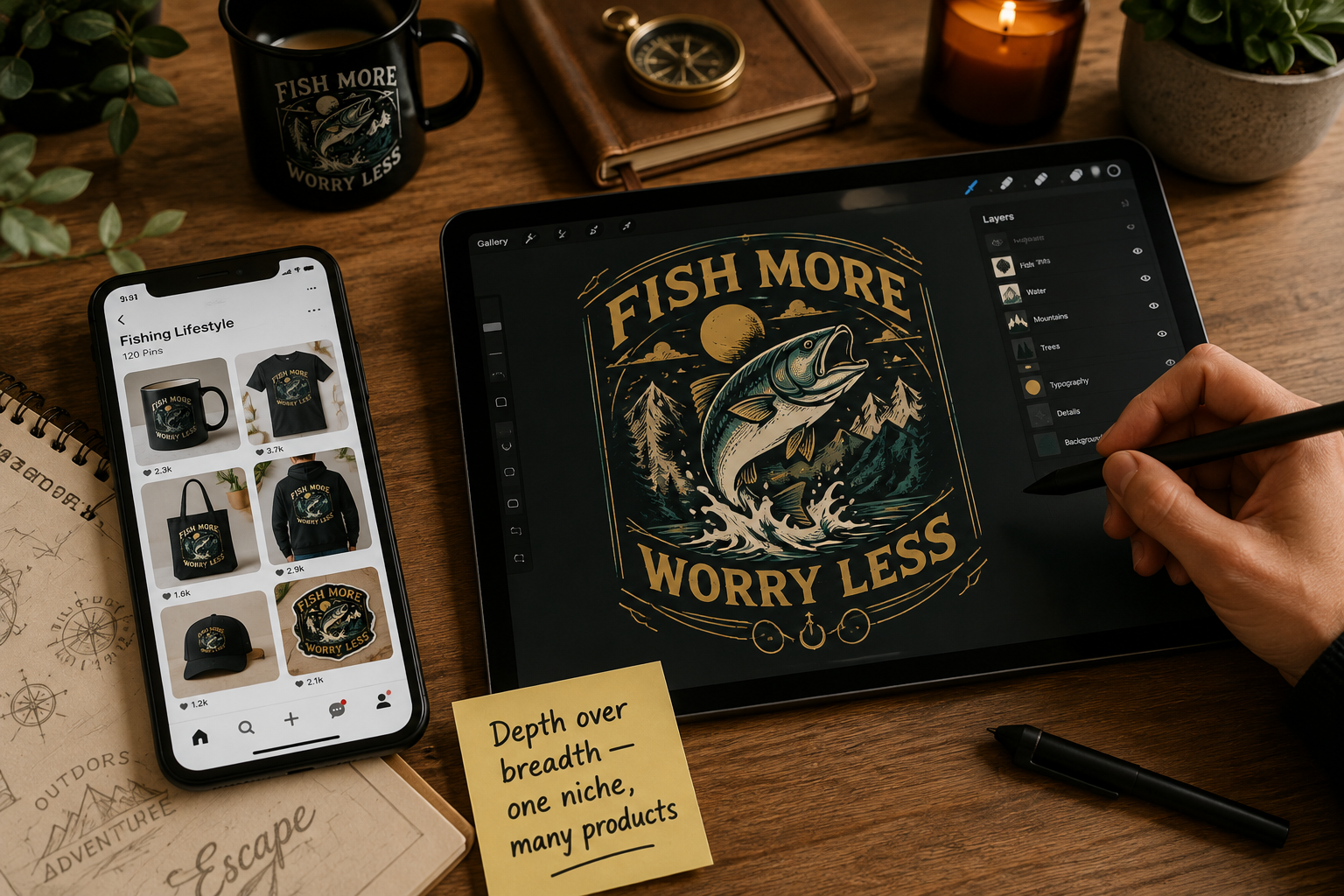
The pattern among profitable POD stores in 2026 is depth over breadth. Not hundreds of generic designs scattered across dozens of niches — a focused catalog of strong designs serving one specific community with products that feel made for them specifically. Category expertise and design quality compound in value over time as SEO authority builds and community reputation grows.
The Real Margin Math: What POD Products Actually Return
Here is the margin reality by product category, based on 2026 supplier pricing across the major platforms. These are gross margins after production cost before shipping, advertising, and platform fees:
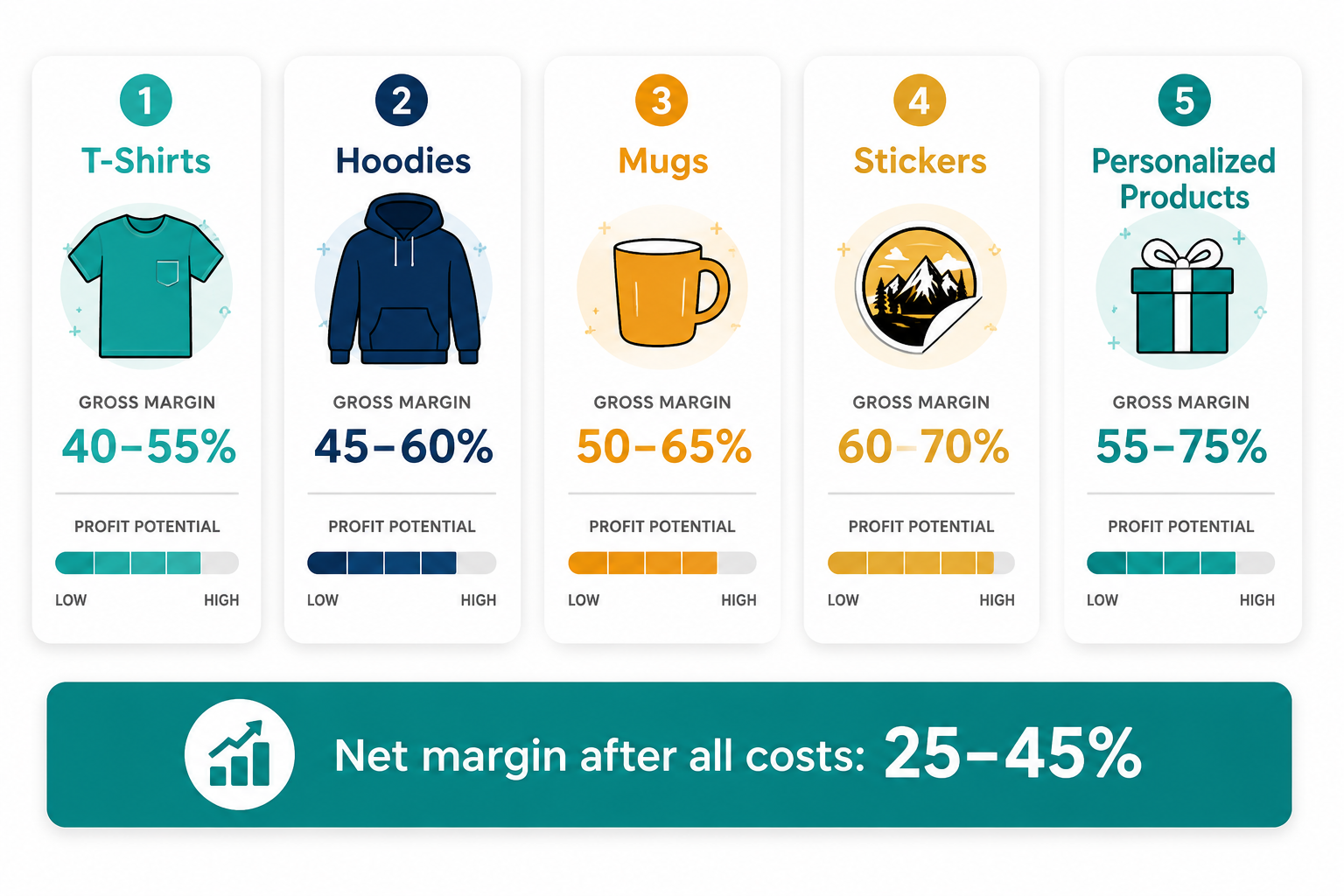
T-shirts and apparel — 40 to 55% gross margin at typical retail pricing of $25 to $35. After shipping ($4 to $6 domestic) and payment processing (2.9% plus $0.30), net margin per organic order runs approximately 30 to 42%. Add a $10 customer acquisition cost from paid advertising and profitability requires average order values above $35 or consistent repeat purchase behavior.
Hoodies and premium apparel — 45 to 60% gross margin at retail pricing of $45 to $65. The higher price point supports better absolute dollar margins even at similar percentage margins. A $55 hoodie at 50% gross margin returns $27.50 before shipping versus a $28 t-shirt at 45% returning $12.60. Premium apparel is significantly more profitable per unit than t-shirts for POD sellers who can build the perceived value to support premium pricing.
Mugs and drinkware — 50 to 65% gross margin at retail pricing of $18 to $28. Lightweight products with manageable shipping costs. The challenge is that mugs are the most competitive POD category by listing volume, meaning organic search visibility requires either exceptional design or highly specific niche targeting.
Stickers and prints — 60 to 70% gross margin at retail pricing of $5 to $20 for stickers and $20 to $50 for art prints. Stickers are high-margin but low absolute dollar value per order unless sold in packs. Giclée canvas prints and art prints carry some of the highest absolute dollar margins available in POD — a $45 canvas print at 60% gross margin returns $27 before fulfillment costs.
Tote bags — 50 to 70% gross margin at retail pricing of $22 to $35. Low production cost relative to perceived value. Tote bags are increasingly popular in sustainability-conscious niches and gift categories.
Personalized products (jewelry, photo gifts, custom maps) — 55 to 75% gross margin with retail pricing that often reaches $40 to $80 depending on product type. The highest-margin POD category because personalization eliminates direct price comparison and supports premium positioning. Suppliers like ShineOn specialize in personalized jewelry with message cards — a category with above-average margins and strong gift purchase conversion rates.
The Major Shopify POD Suppliers: An Honest Comparison
Choosing your supplier is the most consequential operational decision in a POD business. It determines your product quality, your fulfillment speed, your margin structure, and your customer experience. Here is an honest assessment of the major options in 2026:
Printful is the premium quality standard in POD. Its DTG printing quality is consistently better than cheaper alternatives, its packaging presentation is professional, and its Shopify integration is seamless with automatic order routing and real-time tracking. The trade-off is pricing — Printful's base costs are 20 to 30% higher than budget competitors, which compresses margins at lower retail price points. Printful works best for stores positioning in the premium segment where design quality justifies higher retail pricing and buyers are less price-sensitive.
Printify is the largest supplier network in POD, connecting merchants to a marketplace of print providers across the US, Europe, and Asia. Its primary advantage is pricing flexibility — by choosing the right print provider within Printify's network, margins can be 15 to 25% better than Printful for comparable products. The challenge is consistency — different providers within Printify's network produce different quality levels, and merchants need to order samples from multiple providers before committing to a supplier for a specific product. Printify Premium at $29 per month reduces base costs further and is worth the investment for stores generating consistent monthly volume.
Gelato is the strongest option for merchants selling internationally. Gelato fulfills orders through local print partners in over 30 countries, meaning a UK customer's order is printed and shipped from within the UK rather than from the US — dramatically reducing international shipping times from two to four weeks to three to seven days. For POD stores with significant international traffic, Gelato's local fulfillment model eliminates one of the most common customer complaints in cross-border POD.
Gooten serves mid-to-large volume sellers with competitive pricing and a broader product catalog than most competitors. Its API and automation capabilities make it strong for sellers running high design volume who need reliable bulk order processing.
ShineOn specializes in personalized jewelry and gift products — necklaces, bracelets, and rings paired with printed message cards. Its margins are above average for the category and its focus on occasion-driven gifting (Mother's Day, anniversaries, birthdays) aligns with high-conversion seasonal traffic patterns.
The practical recommendation for most new POD stores starting on Shopify in 2026 is to pick one supplier and commit to it for the first 90 days. Splitting your catalog across multiple suppliers simultaneously adds operational complexity, complicates shipping cost calculations, and dilutes your focus when you most need it. Master one supplier's product catalog and quality standards before expanding.
What Actually Drives Traffic to a Shopify POD Store
Traffic is the other half of the POD equation that most guides underserve. Building a beautiful store with strong designs generates zero revenue without visitors. The most effective traffic channels for POD stores in 2026 are not equal — and which channels you prioritize depends on your niche, your budget, and your content capabilities.
SEO and organic search is the highest-ROI long-term traffic channel for POD stores. Optimizing your product titles, descriptions, and collection pages for the specific search terms your target customers use — "personalized dog mom mug," "ultralight backpacking t-shirt," "funny nurse gift" — builds compounding organic traffic that does not require ongoing ad spend. The downside is time: meaningful SEO traffic for a new Shopify store typically takes three to six months to develop. Write SEO-optimized product descriptions for every listing from day one, not as an afterthought.
Pinterest drives significant free traffic to POD stores and is massively underused relative to its potential. Pinterest users are in active shopping mode — they are searching for gift ideas, home décor inspiration, fashion ideas, and personal products with buying intent built in. A niche-focused Pinterest account with consistent pinning of product images and lifestyle mockups generates sustained referral traffic without paid spend. Pinterest drives 33% more referral traffic to shopping sites than Facebook, yet the majority of POD sellers are not running a structured Pinterest strategy.
TikTok organic is the highest-upside free traffic channel for POD stores whose products have visual demonstration value. A niche POD brand with a consistent posting strategy — behind-the-scenes design process videos, product unboxings, community-focused content — can generate significant organic reach without paid ad spend. The key is posting consistently (three to five times per week) within a specific niche community rather than targeting broad general audiences.
Google Shopping delivers the highest-intent paid traffic for POD products with established search volume. Shoppers searching "funny retirement gift mug" on Google are further along the purchase journey than social media browsers — they are actively looking to buy. Google Shopping campaigns for POD require well-optimized product feeds with keyword-rich titles, accurate categorization, and high-quality images.
Meta Ads require the strongest margin floor to operate profitably. A 55 to 65% gross margin is generally the minimum viable threshold for running paid traffic to a POD store — anything lower and customer acquisition costs eat the profit before it is realized. Do not start with paid ads until your organic traffic has validated which products and niches your audience actually responds to.
Design: The Variable That Determines Everything
In a business where the product manufacturing is identical across hundreds of competitors selling similar items, design quality and niche specificity are the only real differentiators available.
The sellers consistently outperforming in POD in 2026 share one characteristic: they invest more in design than their competitors. Not necessarily more money — more research, more iteration, and more genuine understanding of what their specific niche community finds meaningful, funny, or collectible.
Strong POD design is not generic. It speaks directly to a specific identity — a profession, a hobby, a community, a value system — in a way that makes the buyer feel seen. "This was made for me" is the emotional response that converts a browser into a buyer and a buyer into a repeat customer who shares the product with people in the same community.
Your mockup presentation matters as much as the design itself. A mediocre design on a professional lifestyle mockup outperforms a strong design on a flat white-background product mockup in almost every niche because buyers purchase the vision of themselves using the product, not the product in isolation. Invest in lifestyle mockups — tools like Placeit and Creative Fabrica offer extensive mockup libraries for every major POD product category at accessible price points.
The Mistakes That Kill Shopify POD Stores
Launching without margin modeling. Most POD failures are not marketing failures — they are math failures. Calculate your net profit per unit before listing any product. Base cost plus shipping plus payment processing plus your target customer acquisition cost must leave a meaningful positive margin. If it does not, adjust the retail price or choose a different product.
Choosing the wrong niche for your skills. If you cannot create designs that resonate with a specific community, do not try to serve that community. POD niche selection should be informed by where your design skills and genuine interest intersect with underserved market demand — not by where you have heard other sellers are making money.
Spreading across too many niches simultaneously. New POD stores that launch with products across five unrelated niches build SEO authority in none of them, attract inconsistent audiences that do not develop community loyalty, and produce data that does not reveal which direction to invest further. Pick one niche, build depth within it, and expand only after you have proven the model there.
Ignoring print quality control. Every supplier produces different quality levels for different products. Order samples of every product you plan to sell before listing it. A customer who receives a blurry print or a shirt that fades after two washes will not return and will leave a negative review. The cost of samples is the cheapest quality control investment in the business.
Pricing too low to compete on price. Competing on price in a commodity business model is a race to zero. Price your products at the level that reflects genuine design quality and niche specificity — and invest the resulting margin into better marketing, better mockups, and more design development. Customers in specific niches pay premium prices for products that feel made for them. The $35 niche t-shirt with a specific design that speaks directly to trail runners outperforms the $22 generic running t-shirt every time.
Scaling a POD Store That Is Working
Once a POD store has validated its niche and proven its design approach with consistent organic sales, scaling follows a clear pattern.
Expand within the proven niche before entering new territory. If mugs are your top performer in a specific niche, test matching tote bags, t-shirts, and prints with the same design family before entering a completely different niche. The audience that bought the mug is the most likely buyer for complementary products — and cross-selling within an established community requires no additional customer acquisition cost.
Use Shopify's automation capabilities to reduce manual operations. Automated order routing through your POD supplier, automated email flows for abandoned carts and post-purchase sequences, and automated review request emails all reduce the time cost of managing growing order volume without adding headcount.
Test international markets through Gelato's local fulfillment network once domestic sales are consistent. If your analytics show organic traffic from the UK, Germany, or Australia that is not converting at domestic rates, international shipping time and cost is almost certainly the barrier. Gelato's local fulfillment for those markets removes that barrier without requiring a separate operational setup.
Build an email list from day one. POD stores that capture customer emails and run post-purchase sequences generate significantly higher repeat purchase rates than stores that treat every sale as a one-time transaction. A customer who bought a niche-specific mug from your store is the warmest possible prospect for the next niche-specific product you release for the same community.
Is Print on Demand Worth Starting in 2026?
Yes — with the right expectations and the right approach. The business model is genuinely viable, the tools have never been better, and the market is large enough to support many more successful stores than currently exist.
What is not viable in 2026 is the generic approach. Five designs, no niche focus, Printful's standard product catalog, and a Shopify store that looks like every other POD store launched in the past five years. That approach competed poorly in 2020 and has no realistic chance in 2026.
What works is deep niche focus, genuine design investment, a supplier chosen for quality and margin compatibility with your pricing strategy, and a traffic strategy that builds compounding organic authority over time. Stores built on these principles generate sustainable, growing profit — not just impressive revenue numbers that do not survive honest cost accounting.
The market rewards specificity, quality, and genuine community connection. Build for a specific audience with designs they cannot find anywhere else, price to reflect that specificity, and treat the business as a long-term brand rather than a passive income experiment — and print on demand on Shopify remains one of the most accessible genuine business opportunities available in ecommerce today.
Need help building or optimizing your Shopify store for print on demand, or want an expert to review your store's design, structure, and conversion setup? Get in touch with EcomFixify — we specialize in Shopify development and ecommerce growth strategy for brands at every stage.