
Live Shopping on Shopify: How to Host a TikTok or Instagram Live
Live Shopping on Shopify: How to Host a TikTok or Instagram Live
Most Shopify merchants have heard of live shopping. Far fewer have actually tried it — and almost none are running it with the consistency and strategy that turns it into a reliable revenue channel rather than a one-off experiment.
That gap is a significant competitive opportunity in 2026.
Live shopping converts at 8 to 12% on TikTok — compared to 2 to 4% for traditional ecommerce. During peak interactive sessions, conversion rates can hit as high as 76%, driven by real-time urgency, direct host engagement, and the psychological pull of watching other people buy. Live commerce events generate 10 times higher conversion rates than standard social posts. The US live shopping market is projected to reach $55 to $68 billion in 2026, growing at 36% year-over-year.
These are not numbers from an emerging channel. Live shopping is here, it is measurable, and the Shopify brands treating it as a systematic sales operation rather than an occasional event are generating serious revenue from it.
Made by Mitchell, the cosmetics brand founded by a TikTok creator, generated over $2 million in sales during a single week of live events by combining creator-hosted sessions with targeted product promotions. HeftyBerry, a handmade wreaths and décor brand, generated over $50,000 in sales in 24 hours through an authenticity-focused live approach. These are not outliers — they are the result of applying the right strategy to a channel that rewards engagement over production value.
This guide covers exactly what you need to know to host TikTok and Instagram lives that actually sell — from setup and product selection to host performance, audience building, and the metrics that tell you whether it is working.
Why Live Shopping Works: The Psychology Behind the Conversion Rate
Before jumping into tactics, understanding why live shopping converts so much better than standard ecommerce product pages helps you design sessions that deliberately trigger those conversion drivers.
Live shopping works on four psychological levers simultaneously.
Urgency is the most immediate. When a host says "We only have 30 units of this left and 800 people are watching," the scarcity is real and visible. Viewers can see inventory depleting in real time. That kind of urgency is impossible to manufacture authentically on a static product page — but in a live session it happens naturally.
Social proof is compressed. In a live session, viewers can see hundreds of other people engaging, asking questions, expressing excitement, and — most powerfully — buying. On-screen notifications showing "Sarah just bought this in size Medium" provide the peer validation that review sections attempt to replicate but can never match in real-time impact.
Trust transfers from host to product. When a founder or a creator you follow holds a product, uses it on camera, shares genuinely how it works and what they like about it, the trust they have built with their audience transfers to that product in a way that a product description page never achieves. Creators influence one in every two purchase decisions among younger generations — and that influence is amplified significantly in the live format where they are present in real time.
Friction is removed at the purchase moment. Both TikTok Shop and Instagram Shopping allow viewers to complete purchases without leaving the app. The moment a viewer decides to buy, the checkout is one or two taps away. Compare that to the typical ecommerce path — exit the app, find the store, navigate to the product, add to cart, complete checkout — and the live shopping conversion advantage becomes structurally obvious.
TikTok Live Shopping vs. Instagram Live Shopping: Which Platform to Start With
The two dominant live shopping platforms for Shopify brands in 2026 are TikTok and Instagram, and they are not interchangeable. Choosing the right starting point depends on your product category, your existing audience, and your content capabilities.
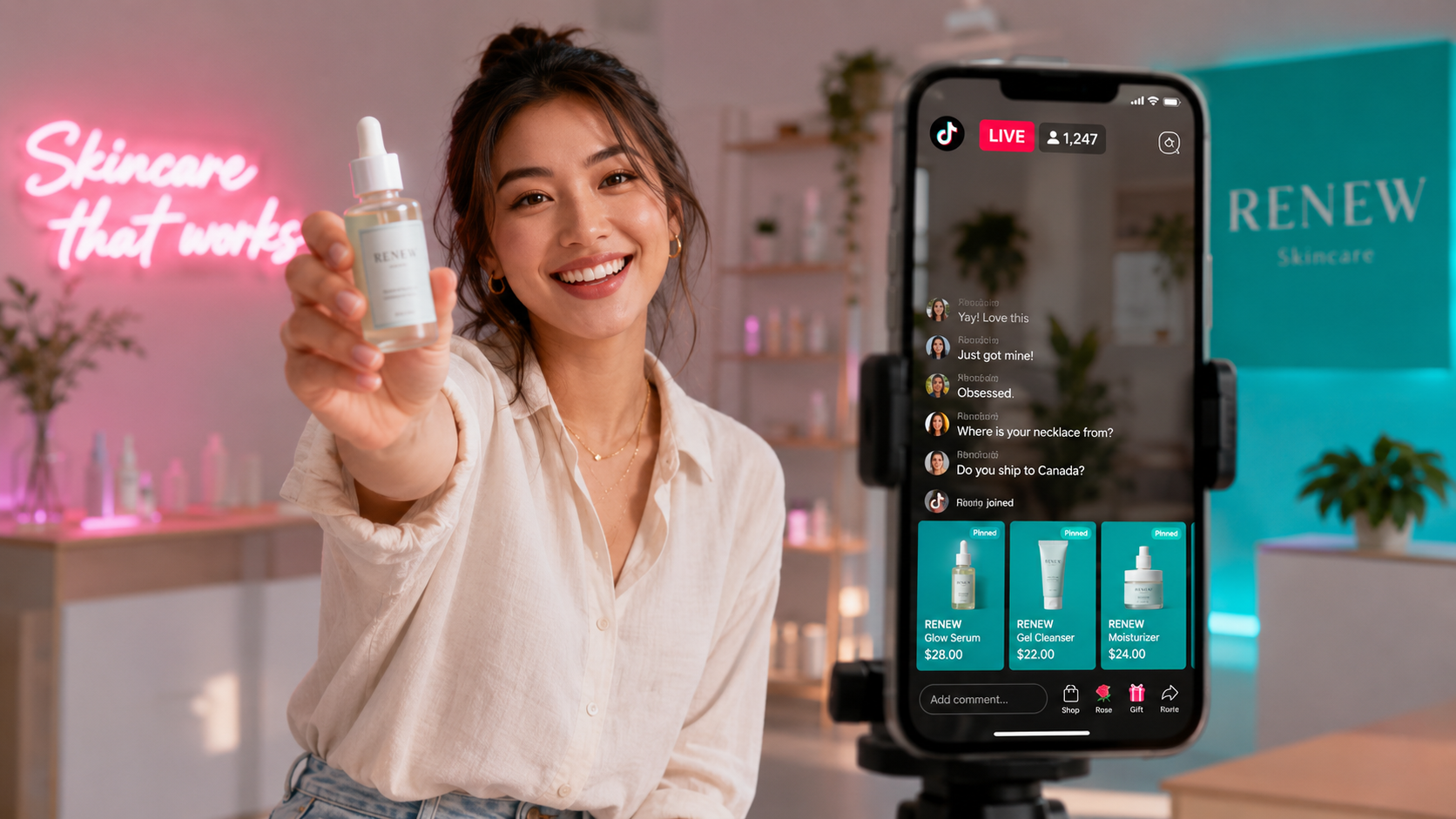
TikTok Live Shopping is the higher-conversion, higher-discovery channel. The platform's algorithm surfaces live content to viewers who do not already follow your account — which means every live session is also a customer acquisition opportunity, not just a retention play. TikTok's audience skews younger, with the highest concentration in the 18 to 34 age range, and the platform's culture strongly favors authenticity over polish. TikTok Live Shopping integrates natively with TikTok Shop, which syncs directly with your Shopify product catalog. Products pinned during a live appear as tappable links that take viewers directly to in-app checkout.
TikTok generally delivers higher conversion rates and higher impulse purchase frequency. The average order value is lower — typically $38 to $55 — but purchase frequency is high. If you sell beauty, supplements, fashion, home goods, or any product with a strong visual demonstration angle, TikTok Live is your primary channel.
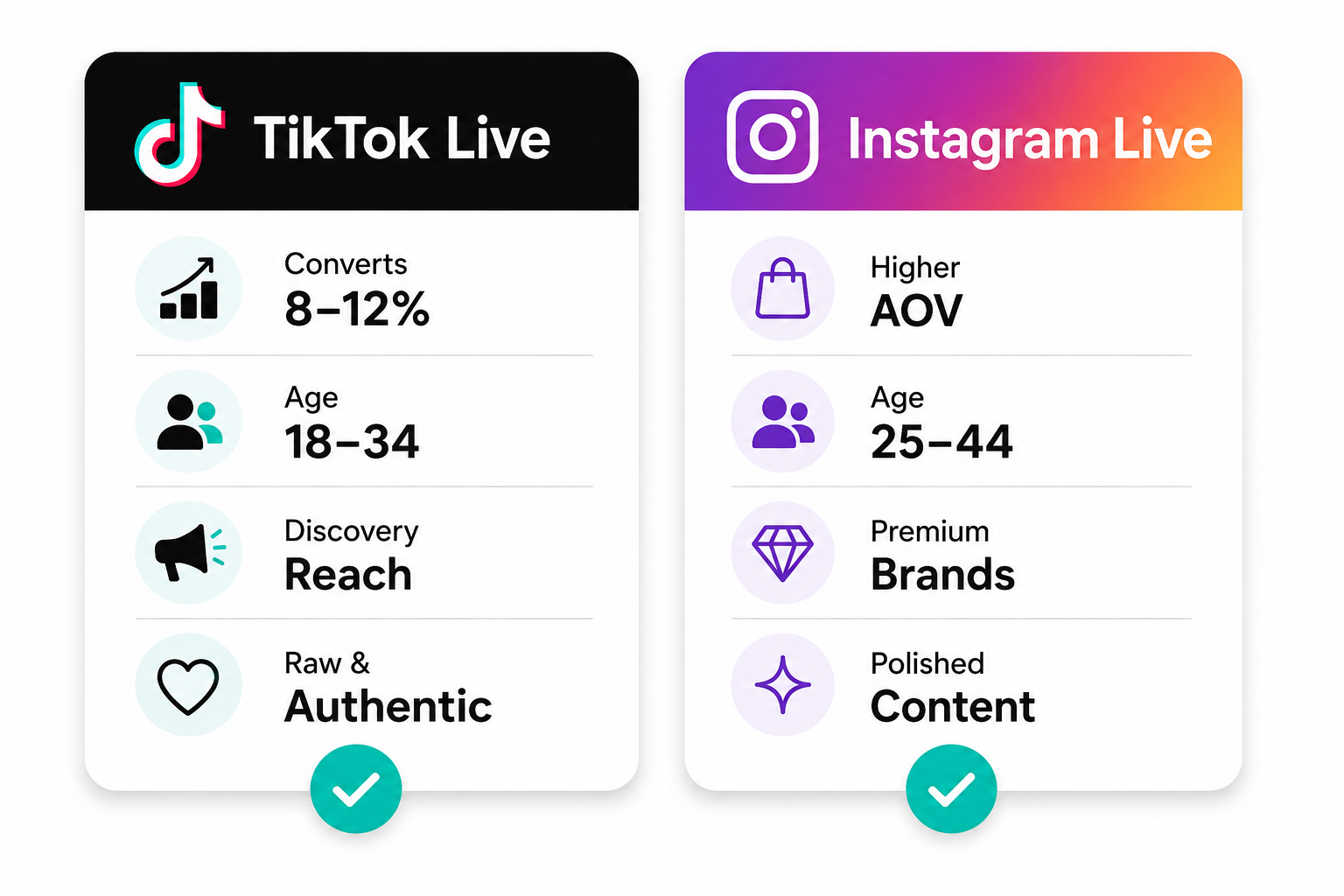
Instagram Live Shopping suits brands with a slightly older audience — the platform's core shopping demographic is 25 to 44 — and higher average order values. Instagram has 2.1 billion users actively engaging with shopping features monthly, and the platform's aesthetic skews more toward premium brand presentation than TikTok's raw authenticity. In 2026, Meta has made significant improvements to Instagram's live shopping tools, allowing brands to pin products in real time during lives and enabling in-app checkout for eligible accounts.
One critical note: Facebook Live Shopping is no longer active as of 2023. Any guide suggesting Facebook as a live shopping channel is outdated. Stick to TikTok and Instagram for live commerce in 2026, with YouTube as a strong supplementary option for brands with existing YouTube audiences.
For most Shopify brands starting live shopping in 2026, the recommendation is to launch on TikTok first. The organic reach potential for new sellers is higher, the conversion rate data is stronger, and the Shopify integration is the most seamless. Once your TikTok live rhythm is established, add Instagram as a secondary channel targeting a different segment of your audience.
Setting Up Shopify for Live Shopping: The Technical Foundation
Before your first live session, the technical setup needs to be correct — because a live that drives purchase intent but fails at checkout kills both the sale and the viewer's trust.
For TikTok Live Shopping, the starting point is the Shopify TikTok app. Navigate to the Shopify App Store, install the official TikTok app, and connect your TikTok for Business and TikTok Shop accounts. The app syncs your product catalog — including titles, images, prices, and inventory — automatically. Any update you make in Shopify reflects in TikTok Shop within minutes.
Once connected, go into TikTok Seller Center and review your synced products. Ensure every product you plan to feature in lives has complete information — clear product titles, high-quality images, accurate pricing, and detailed descriptions. Products with incomplete information are either excluded from TikTok Shop's recommendation systems or display poorly when pinned during a live, undermining the conversion opportunity at exactly the moment you need it most.
For Instagram Live Shopping, you need a Facebook Commerce Account connected to an Instagram Business profile, with your Shopify product catalog synced through Meta's Commerce Manager. The Shopify Facebook and Instagram app handles this integration. Once approved, you can tag products during lives from your connected catalog and viewers can complete purchases in-app.
One operational detail worth getting right before your first live: test the full purchase journey on both platforms from a viewer's perspective. Watch your own test live on a separate device and complete a test purchase. You will catch checkout issues, product image problems, or inventory discrepancies before they affect real customers during a live event.
How to Plan a Live Shopping Session That Converts
The difference between a live that sells and a live that does not is almost never production quality. It is preparation, structure, and host performance.
The brands consistently generating revenue from live shopping plan every session around a repeatable framework rather than improvising in front of the camera and hoping something lands.
Choose Products Deliberately
Not every product in your catalog belongs in a live. The products that convert best in live shopping share specific characteristics: they have a visual demonstration angle that a camera can capture clearly, they solve an obvious problem that can be articulated in under 30 seconds, they carry enough margin to support a live-exclusive discount without destroying profitability, and they are in stock in sufficient quantity to handle a demand spike.
For your first several lives, choose three to five hero products rather than attempting to showcase your entire catalog. Depth of presentation on fewer products consistently outperforms surface-level coverage of many. A viewer who watches you demonstrate a product thoroughly for four minutes and sees it genuinely working understands why they should buy it. A viewer who sees twelve products breezed through in 45 minutes converts poorly on all of them.
TikTok's A.C.E. framework — Assortment, Content, Empowerment — recommends prioritizing products with a visual wow factor or clear problem-solving capability for live demonstration. Products that transform something, show dramatic before-and-after results, or demonstrate unexpected utility are the highest-converting live products regardless of category.
Build a Run-of-Show
Every successful live shopping event has a structure. It does not need to be rigid — the best live selling feels spontaneous and conversational — but a planned framework keeps the session moving, ensures you cover every product, and prevents the dead air that kills live shopping momentum.
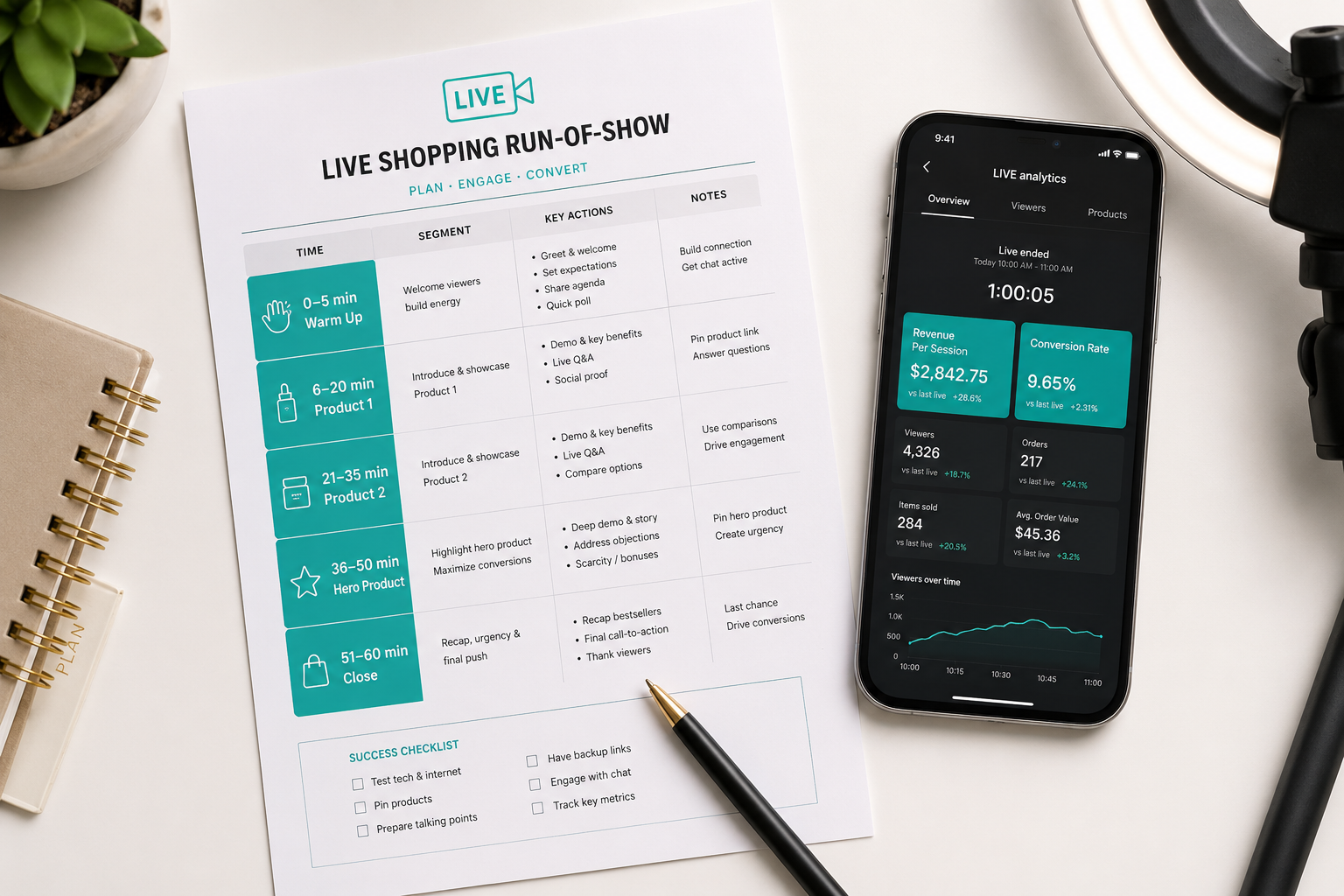
A proven structure for a 45 to 60 minute live session:
Minutes 1 to 5 — warm-up and audience building. Welcome viewers, introduce yourself and what you are selling today, and tease what is coming. Do not start selling immediately. Let the audience accumulate before you reveal your best offers.
Minutes 6 to 20 — feature product one. Demonstrate it thoroughly. Show it working. Share the specific problem it solves. Read and respond to comments. Create the first urgency moment — "We only have 50 of these available at the live price, and I see 600 people watching."
Minutes 21 to 35 — feature product two. Apply the same framework. Acknowledge new viewers who just joined. Reference what product one sold — "If you missed our first offer, we still have a few left, but moving on..."
Minutes 36 to 50 — feature product three, typically your hero product or your best deal. Build maximum urgency here. This is the highest-conversion window of the session as the audience is now warmed up, trust is established, and FOMO among non-buyers is at its peak.
Minutes 51 to 60 — close and call to action. Recap what was offered, announce the next live date and time, and if any stock remains on featured products, give a final push.
Create Urgency Without Manipulation
Urgency is the most powerful conversion lever in live shopping — and the most abused. Artificial scarcity on a product you have 500 of is immediately detectable by experienced live shoppers and permanently destroys trust once spotted.
Effective urgency in live shopping is real urgency: actual limited inventory, live-exclusive pricing that genuinely expires when the session ends, a bundle or gift-with-purchase available only during the live, or early access to a new product before it goes live on the website.
Pin a countdown timer in your live when a time-limited offer is active. Show inventory depleting in real time by announcing remaining quantities periodically. When 50 units sell during a session, tell the audience — it validates that other people are buying and creates authentic social proof that accelerates remaining purchases.
The Host: Your Single Biggest Conversion Variable
Everything about a live shopping session can be technically perfect — the setup, the products, the timing, the offers — and it will still underperform if the host is not engaging.
The host's job is not to read product specifications into a camera. It is to have a genuine, energetic conversation about products they know and believe in, while simultaneously managing the chat, acknowledging viewers by name, responding to questions in real time, and maintaining the momentum and urgency of the session.
That is a specific skill set. The best live shopping hosts are conversational, warm, knowledgeable about the products without sounding scripted, and genuinely reactive to what is happening in the chat. They call out viewers by name — "Great question, @username" — creating the feeling of a personal connection at scale that no other shopping format can replicate.
If you are the founder hosting your own lives, you have a significant authenticity advantage. Nobody knows your products better than you, and nobody can speak about why you made them with more genuine conviction. Lean into that. Your imperfect presentation and evident passion for what you make will consistently outperform a polished script delivered by someone who does not care about the product.
If you are using creator partners — which is the strategy behind some of the largest live shopping revenue numbers in 2026 — choose creators whose audiences align with your customer demographics and who have genuine affinity for your product category, not just whoever has the largest follower count. Nano and micro-influencers with 10,000 to 100,000 followers deliver 60% higher engagement rates and 20% higher conversion rates than macro-influencers in live shopping contexts, because their audience trusts their recommendations more specifically.
Building Your Audience Before Going Live
A live shopping session with no audience converts nobody. Building an audience that shows up consistently for your lives requires investment before, not during, the session.
Email is the most reliable pre-live promotion channel. Build a dedicated email list for live shopping events — as Misha Hawaii did with their Friday Instagram lives — and send a reminder 24 hours before and another 1 hour before each session. Subject lines that work consistently follow this pattern: "Going live tonight at 7pm — exclusive deals only available during the stream."
Short-form video content promoting upcoming lives outperforms static posts on both TikTok and Instagram. A 15 to 30 second teaser posted the day before — showing a sneak peek of what will be featured, hinting at the exclusive price or bundle — drives significantly higher live attendance than a text-based announcement.
Consistency matters more than any individual session. Successful Shopify brands in live shopping are streaming three to five times per week. The algorithm rewards accounts with regular live schedules by amplifying their content to broader audiences over time. Going live once a month does not give the algorithm enough data to optimize your reach or your audience enough reason to build a habit around your sessions.
Schedule your lives at the same time on the same days each week. Your most engaged customers will build the habit of showing up when they know when to expect you.
What to Measure: The KPIs That Actually Matter
In 2026, vanity metrics like views or shares are no longer enough to justify a live shopping investment. The metrics that tell you whether your live shopping operation is working are revenue-centric.
Revenue Per Session is the total revenue generated during and immediately after a live. This is your primary headline metric and the one to track from your first session onward. Revenue Per Viewer divides total session revenue by peak concurrent viewers and tells you how efficiently you are converting your live audience. Conversion Rate measures purchases divided by unique viewers and is the clearest indicator of host performance, product selection quality, and offer strength.
Beyond revenue, track Peak Concurrent Viewers to understand when your audience engagement is highest during a session and use that timing data to schedule your best offers. Track comment velocity — comments per minute — as a proxy for audience engagement quality. A session with 200 viewers and 50 comments per minute is significantly more engaged than one with 600 viewers and 10 comments per minute, and the conversion rates will reflect that gap.
Review each session's performance within 24 hours while the details are fresh. Which products sold fastest? Which offers generated the most chat activity? When did viewers join and when did they drop off? Use that data to improve the structure and product selection of the next session.
Common Live Shopping Mistakes That Kill Conversion
Starting without a warmed-up audience is one of the most common early mistakes. Opening your live and immediately launching into product pitches before you have accumulated viewers costs you the first five minutes of potential conversion. Spend the opening building anticipation and letting the algorithm surface your live to more viewers before your main selling begins.
Pinning too many products at once creates decision paralysis. A live with 20 products pinned simultaneously confuses viewers about what they should be looking at. Pin one to three products at a time and rotate them deliberately based on what you are actively demonstrating.
Ignoring the chat destroys the format's core advantage. The chat is where trust is built in real time. A host who does not read and respond to comments is running a broadcast, not a live shopping event. Viewers who feel seen and acknowledged convert dramatically better than passive viewers who feel like an undifferentiated audience.
Inconsistent scheduling prevents algorithmic growth. One live per month generates novelty, not a business. Three to five sessions per week, at consistent times, is the cadence that builds habitual attendance and algorithmic reach.
Measuring success by view count rather than revenue leads to chasing the wrong outcomes. A live that attracts 5,000 viewers and generates $500 in sales is worse than a live with 300 viewers and $2,000 in sales. Revenue Per Session and conversion rate are the metrics that determine whether your live shopping operation is working.
Getting Started: Your First Live Shopping Session Checklist
Technical setup complete — Shopify TikTok or Instagram app installed, product catalog synced, test purchase completed successfully from a viewer's device.
Product selection finalized — three to five products chosen with clear demonstration angles, adequate inventory, and live-exclusive pricing or bundles prepared.
Run-of-show drafted — timing structure for the session written out, including when each product will be featured and what urgency mechanism will be used for each.
Audience promoted — email to your list sent 24 hours prior, teaser short-form video posted 24 to 48 hours before the session.
Equipment ready — smartphone with front-facing camera, ring light or good natural lighting, clean and relevant background, stable mount or tripod, strong WiFi connection tested.
Metrics tracking prepared — note your starting inventory for each featured product and have a way to track revenue in real time so you can reference it authentically during the session.
The first live will feel awkward. The second will feel less awkward. By the fifth, you will have enough data on what your specific audience responds to that your sessions will start converting consistently. The brands generating thousands of dollars per live started exactly where you are starting — with a phone, a product they believed in, and the willingness to show up on camera before they had it figured out.
Need help connecting your Shopify store to TikTok Shop or Instagram Shopping, or want an expert to review your social commerce setup for conversion readiness? Get in touch with EcomFixify — we specialize in Shopify development and social commerce integration for growing brands.