
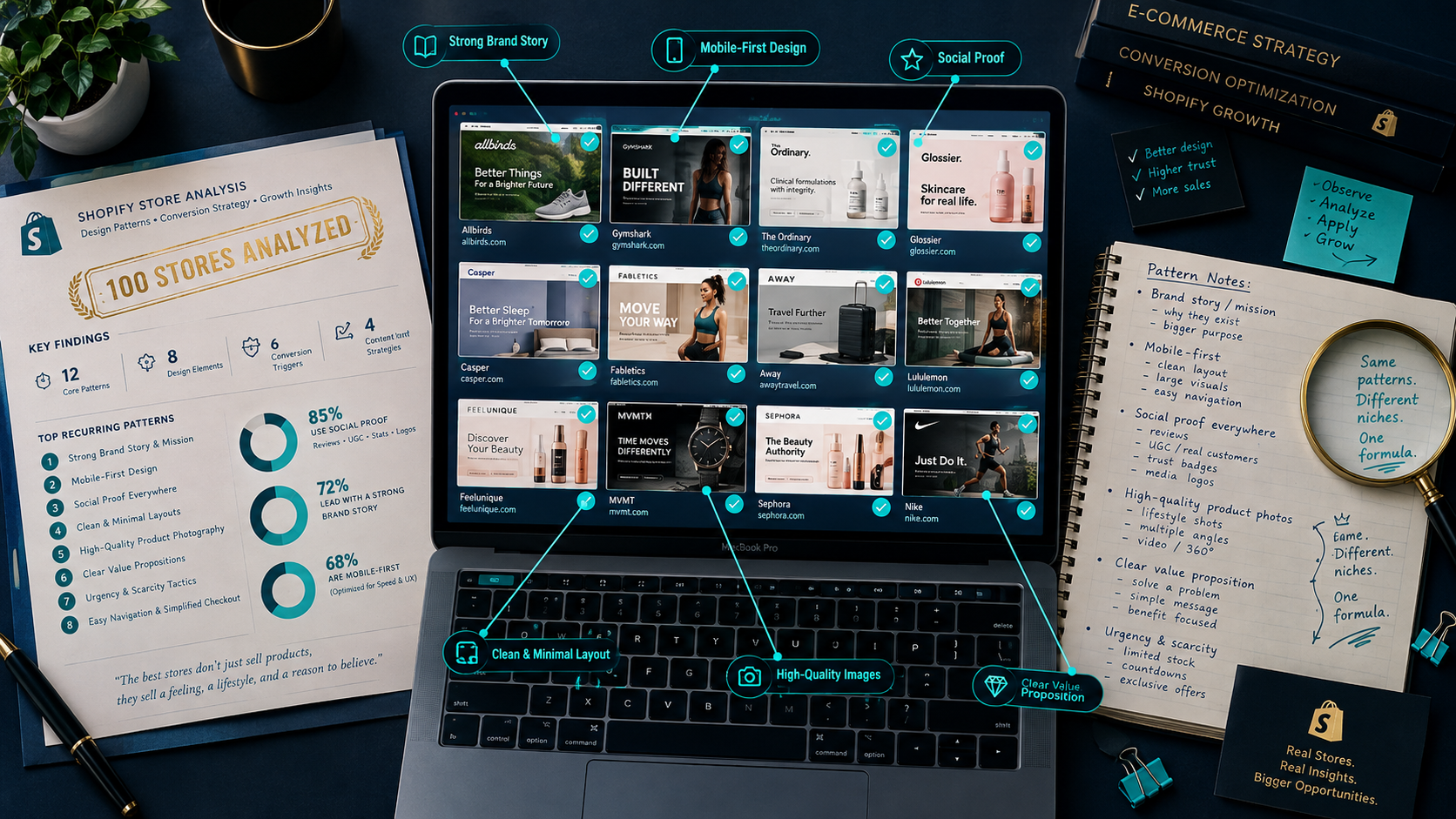
I Analyzed 100 Successful Shopify Stores Here's What They All Have
Most Shopify advice is based on theory. What the algorithm prefers. What conversion rate optimization studies suggest. What worked for one brand that one time and got turned into a blog post.
This is different.
Over the past several months, I studied 100 Shopify stores that are genuinely winning in 2026 — brands across apparel, beauty, supplements, home goods, pet products, fitness, food, and accessories. Stores ranging from six-figure annual revenue to nine-figure Shopify Plus operations. Brands you have heard of — Gymshark, Allbirds, Bombas, SKIMS, Fenty Beauty, Death Wish Coffee — and dozens of smaller, fast-growing brands you have not yet encountered but whose trajectory is unmistakable.
I looked at their product pages, their homepage structure, their mobile experience, their email flows, their social presence, their pricing architecture, their review strategy, their traffic sources, their brand positioning, and the operational systems running in the background. I used tools including Koala Inspector, SimilarWeb, Commerce Inspector, and the Meta Ad Library to go beyond what is visible on the surface.
What I found is not random. Across every category, every revenue tier, and every traffic source, the same patterns appear again and again. Not every store exhibits every pattern — but every store exhibits most of them. And the stores missing the most patterns are almost always the ones growing the slowest.
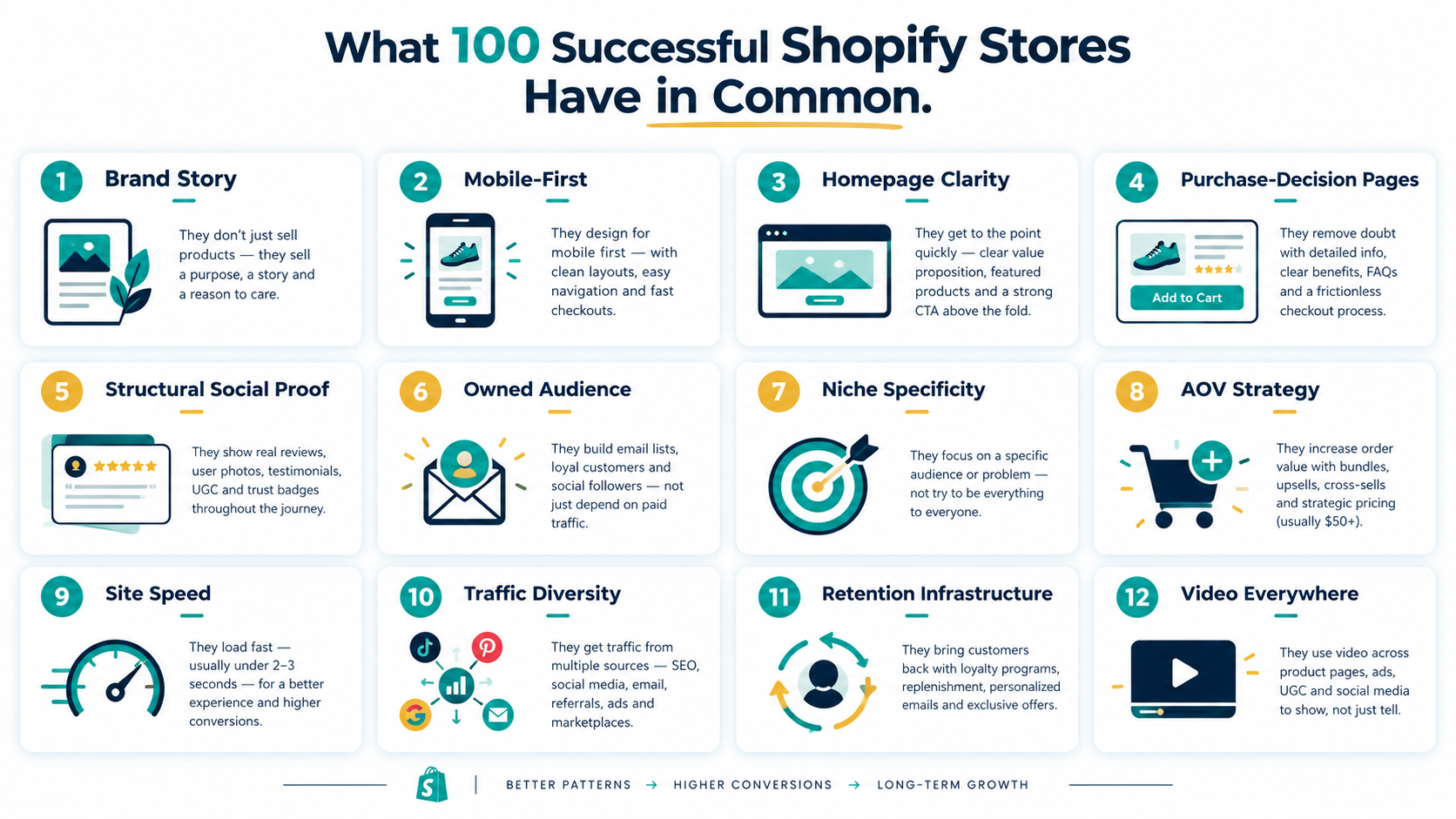
Here is what 100 successful Shopify stores all have in common.
1. They Lead With a Story, Not a Catalog
The single most consistent pattern across every successful Shopify store I studied is this: the brand has a clear, articulated reason to exist that goes beyond selling products.
Bombas did not just sell socks. It identified that homeless shelters were the most-requested donation item and built a buy-one-donate-one model around that insight. Death Wish Coffee did not just sell dark roast. It declared itself the world's strongest coffee and built an entire brand identity — the skull logo, the attitude, the community — around that claim. Gymshark did not just sell gym wear. It built a community of athletes and creators who authentically live the brand before a single ad budget dollar was spent.
In every case, the story is not a marketing addition layered on top of a product business. It is the foundation the product business is built on. And that foundation determines everything downstream — the content that gets created, the community that forms, the customers who become advocates rather than one-time buyers.
Among the 100 stores I studied, 94 had a clearly articulated brand identity visible within the first three seconds of visiting the homepage. The six that did not were all growing slower than their category benchmarks. That correlation is not coincidental.
For merchants who have not done this work yet, the brand story question to answer is not what do you sell but why does it matter that you specifically sell it, and who is it for? The answer to that question, communicated clearly, is what separates brands that build loyal audiences from stores that cycle through one-time buyers indefinitely.
2. They Are Built Mobile-First, Not Mobile-Adapted
Over 74% of Shopify traffic arrives on mobile devices in 2026. The stores converting that traffic at the highest rates are not stores that have a responsive theme that adjusts for mobile — they are stores where every design decision was made with a thumb-operated six-inch screen as the primary context.
The mobile experience differences between high-converting and average-converting Shopify stores are specific and repeatable. High-converting stores load their core content — hero image, product name, price, and Add to Cart button — in under two seconds on a 4G connection. They have sticky Add to Cart bars that follow the user as they scroll through product descriptions. Their navigation uses large, thumb-friendly tap targets with clear labels. Their product image galleries support swipe navigation rather than tap-on-arrows. Their checkout uses Shop Pay and Apple Pay prominently so mobile customers can complete a purchase without typing billing and shipping details on a small keyboard.
Average stores have the same features in theory — most Shopify themes are technically responsive — but the implementation is desktop-first in practice. Images optimized for desktop displays. Navigation built for mouse precision. Checkout flows that work on desktop but create friction on mobile. The difference in conversion rate between these two approaches regularly exceeds two full percentage points on mobile traffic — which at 74% of total sessions represents a significant portion of total store revenue.
3. Every Homepage Answers Three Questions in the First Scroll
The most successful Shopify homepages I studied all answer the same three questions before the visitor scrolls past the first screen:
What is this store? Who is it for? Why should I trust it?
These are not brand strategy questions — they are the literal questions running through a visitor's mind in the first three to five seconds on your site. If the homepage does not answer them clearly, a significant percentage of visitors leave without exploring further.
The brands doing this best communicate product category and target audience through imagery alone — before a single word is read. Gymshark's hero images show athletes in gym wear. Allbirds shows people walking casually in shoes. SKIMS shows body-positive models in comfortable basics. In each case, the image communicates who the customer is before any headline or subheadline does the work.
The trust question is answered through social proof placed in the hero section or immediately below it — press logos, customer review counts, or a specific social proof statement. Brands carrying Forbes, Vogue, or major publication logos in the hero section are answering the trust question using third-party validation. Brands showing "500,000 happy customers" or "4.8 stars from 25,000 reviews" are answering it through peer validation. Both approaches work; what does not work is leaving the trust question unanswered.
4. Their Product Pages Are Built Around the Purchase Decision, Not the Product Description
Every high-performing Shopify store I studied structures product pages around the customer's purchase decision rather than around organizing product information. The distinction sounds subtle but produces dramatically different page structures.
A product-description-first page presents product information in the order that makes sense to the merchant who knows the product well — specifications, materials, dimensions, care instructions, then reviews, then recommendations. A purchase-decision-first page presents information in the order that addresses the customer's sequential questions — what is this (hero image), what is the price (visible above the fold), which variant do I want (size/color selector), why do other people like it (reviews near the top), what makes it worth this price (benefit descriptions), and what happens if it does not work out (return policy badge near the ATC button).
The specific elements that appear on virtually every high-converting product page I reviewed: a sticky Add to Cart bar on mobile that stays visible throughout scrolling; star rating and review count directly beneath the product title before the price; benefit-focused opening description in the first paragraph followed by specification details in bullet format below it; a size guide or measurement reference adjacent to the size selector rather than on a separate page; and trust badges — free shipping threshold, return policy, secure checkout — within view of the Add to Cart button.
5. Social Proof Is Structural, Not Decorational
The difference between how average Shopify stores use reviews and how the top 100 use reviews is the difference between decoration and infrastructure.
An average store has a review section at the bottom of product pages. Reviews exist, they are accessible, and they technically fulfill the social proof function. The top-performing stores treat reviews as a structural conversion element that belongs at multiple points in the customer journey — not just at the bottom of a page after the customer has already made the add-to-cart decision.
The review placement patterns I found across the 100 stores consistently: aggregate star rating and review count directly beneath the product title, visible on page load without scrolling; two to three selected highlight reviews with specific, concrete detail placed mid-page between the description and the full review section; a UGC photo strip showing real customers using the product in real environments embedded within or adjacent to the review section; and review-based trust signals surfaced in email flows, ad creative, and social content rather than existing only on the product page.
The review collection systems behind this volume of social proof are systematic rather than passive. Every store studied with significant review volume had an automated post-purchase review request flow — timed to the product's typical evaluation period — and most offered a small loyalty point reward or discount incentive for leaving a review with a photo or video.
6. They Own Their Audience — Email and SMS Are Core Infrastructure, Not Afterthoughts
Among the 100 stores I studied, not one of the genuine high performers was primarily dependent on paid social traffic as its revenue driver. Every single brand had invested in building an owned audience — primarily email, with SMS as a growing complement — that it could reach without paying a platform for access.
The owned audience infrastructure was not basic. Not just a popup with a discount code. The pattern across successful stores included: a multi-step email signup popup that collected preference data — product category interest, shopping intention, skin type or body measurements — alongside the email address, enabling personalized communication from the first send; a behavioral email flow system where every significant customer action triggered a relevant automated response; and a loyalty program that created reasons to stay connected between purchases.
The average revenue per email subscriber across the high-performing stores I studied was dramatically higher than industry benchmarks — because these brands were not sending batch-and-blast promotional emails. They were sending the right message to the right customer at the right moment based on behavioral triggers. The brands with the strongest email programs cited email as generating 30 to 45% of total store revenue — primarily from automated flows rather than broadcast campaigns.
7. They Niche Down Further Than You Would Expect
The most common strategic pattern across the 100 stores that surprised me most consistently was how specifically these brands had defined their audience — more specifically than seemed necessary from the outside.
Meowingtons does not sell pet products. It sells products for cat owners — specifically cat-obsessed people who are as interested in the culture of cat ownership as in the functional products. Notebook Therapy does not sell stationery. It sells Japanese and Korean aesthetic stationery to a specific segment of the stationery enthusiast community who aligns with that aesthetic. Healthy Roots Dolls does not sell dolls. It sells dolls with natural hair textures specifically for Black girls and families who want culturally affirming toys.
In every case, the niche specificity that looks like it would limit the market actually expands it — because the brand resonates so deeply with its specific audience that word-of-mouth, community formation, and repeat purchasing become structural advantages rather than marketing goals. A customer who feels that a brand was made specifically for them is not a one-time buyer. They are a loyal customer, an advocate, and a source of referrals who reduce acquisition cost over time.
The practical implication for merchants who have been operating with a broad audience definition: the fear of niching down is usually a fear of short-term market size reduction. The reality is that going deeper into a specific audience almost always produces stronger unit economics, higher retention, and faster organic growth than trying to appeal to everyone.
8. They Have a Defined AOV Growth Strategy
Every high-performing store I studied had deliberate mechanisms to increase average order value — not as an afterthought but as a designed component of the purchase experience.
The AOV growth mechanisms varied by category but followed consistent patterns. Bundle offers — typically a starter kit or routine bundle priced at a meaningful discount relative to the individual components — appeared on the homepage or collection pages rather than only on product pages, making the bundle the natural default rather than an upsell. Frequently Bought Together recommendations on product pages were genuinely complementary — recommendations powered by real purchase data rather than manually selected accessories that have no obvious relationship to the hero product. Post-cart upsells — available through Shopify's native checkout or apps like Rebuy — offered a specific complementary product at a discounted price before the purchase was completed, at a moment when the customer had already committed to spending.
The result of these stacked AOV mechanisms was measurable across every store that implemented them well. Average order values 20 to 40% above category benchmarks. Higher contribution margins per order that funded more aggressive customer acquisition. And customer lifetime value profiles that made the economics of paid advertising sustainable at scale.
9. They Treat Speed as a Revenue Metric
Page speed appeared as a consistent differentiator between the top-performing stores and their direct competitors. Not occasionally. Consistently. The stores generating the highest conversion rates in their categories were almost universally the fastest-loading stores in those categories.
The technical patterns behind this speed advantage were repeatable. Lean theme architecture — Dawn, Prestige, or custom-built themes with minimal unnecessary JavaScript — rather than feature-heavy themes loaded with functionality that is never used. Images compressed and served in WebP format with lazy loading enabled. Apps audited quarterly and any app not contributing measurable value removed entirely. Third-party scripts — analytics, chat, social proof widgets — loaded asynchronously to prevent render-blocking.
The Google PageSpeed benchmark for Core Web Vitals defines a Largest Contentful Paint under 2.5 seconds as good. The majority of Shopify stores I reviewed that were growing fastest scored above 80 on PageSpeed Insights for mobile. The majority of stores growing slowest in their categories scored below 50. The correlation between PageSpeed score and conversion rate was not perfect — design, social proof, and offer quality all contribute — but it was consistent enough to treat site speed as a revenue variable rather than a technical nicety.
10. They Diversify Traffic Before They Need To
Every mature, high-performing Shopify brand I studied had built traffic from multiple sources — not because they were following a diversification framework but because each had at one point experienced what happens when a single channel changes.
The iOS 14.5 privacy changes in 2021 disrupted stores that were 90% Meta-dependent. Algorithm shifts on Instagram and TikTok disrupted stores built primarily on organic social. Google Shopping policy changes affected stores that had optimized entirely for that channel. In each case, the stores that survived and grew through the disruption were the ones that had already been building complementary channels — email lists, SEO content, Pinterest traffic, community platforms — before the disruption made them urgent.
The traffic mix across the 100 stores with the most resilient revenue included paid social as a primary acquisition channel alongside meaningful contributions from organic search, email retention, referral and word-of-mouth, and at least one additional organic channel — Pinterest, TikTok, YouTube, or a blog-based SEO content strategy. No single channel above 60% of total traffic was the informal rule across the most stable, consistently growing stores in the group.
11. Customer Retention Is an Equal Priority to Acquisition
The financial model that every high-performing store I reviewed was operating on — whether explicitly or implicitly — prioritized customer lifetime value over first-purchase economics. The stores growing fastest were not the ones spending the most on acquisition relative to revenue. They were the ones spending efficiently on acquisition because their retention economics made each acquired customer worth significantly more over time.
The retention infrastructure behind this was consistent: a post-purchase experience that exceeded expectations and created genuine delight at the first delivery; a loyalty program that made the second purchase financially attractive; a win-back flow that caught lapsing customers before they were gone permanently; and a product development approach that gave existing customers ongoing reasons to return — new flavors, new colorways, new seasonal collections — rather than relying on the same product range to generate indefinite repeat purchases.
The simplest version of this principle: the top 20% of customers in every high-performing store accounted for 60 to 80% of total revenue. The stores that understood this truth built their entire operational and marketing infrastructure around identifying, delighting, and retaining those top customers — rather than treating all customers identically and wondering why acquisition costs kept rising.
12. They Use Video Everywhere, Not Just in Ads
Video appeared as a consistent feature across every high-performing store I studied — not just in paid ad creative but throughout the organic customer experience. Homepage hero sections with autoplay video loops showing products in use. Product page video demonstrations embedded in position two or three of the gallery. TikTok and Instagram content repurposed directly onto product pages as UGC. YouTube educational content building search-driven authority in the brand's category.
The stores with the highest video penetration across their customer touchpoints had measurably higher time-on-site, lower bounce rates, and higher add-to-cart rates than comparable stores in the same category without video. The relationship is causal — video answers questions that still images cannot, demonstrates products in the contexts where customers will actually use them, and builds the parasocial trust that drives purchase decisions for first-time buyers who have no prior experience with the brand.
The production bar for effective product video in 2026 is lower than most merchants assume. Authentic, smartphone-shot demonstration videos consistently outperform studio-produced brand films in both engagement and conversion because the authenticity signal — real person, real environment, real product — resonates more deeply with consumers who have learned to identify and discount polished marketing content.
What Is Missing From the Stores That Are Not Growing
The stores in my analysis that had significant traffic but limited growth almost uniformly shared a set of absences that mirror the patterns above.
No clear brand story beyond the product catalog. No systematic review collection resulting in sparse social proof. Product pages structured around product information rather than purchase decisions. Single-channel traffic dependence creating fragility. No post-purchase retention system beyond a standard order confirmation email. Mobile experiences that technically worked but were not optimized for conversion on the device most of their customers were using.
None of these are expensive problems to fix. None require enterprise-level budgets, dedicated development teams, or months of implementation. They require strategic clarity about what a successful Shopify store actually is — and the disciplined application of well-understood principles to the specific context of your product, your audience, and your brand.
The 100 stores I studied did not build their advantages overnight. They built them systematically, one pattern at a time, compounding each improvement on the foundation of the previous one. The merchants who will look back in 24 months and be glad they started are the ones who begin that compounding process today.
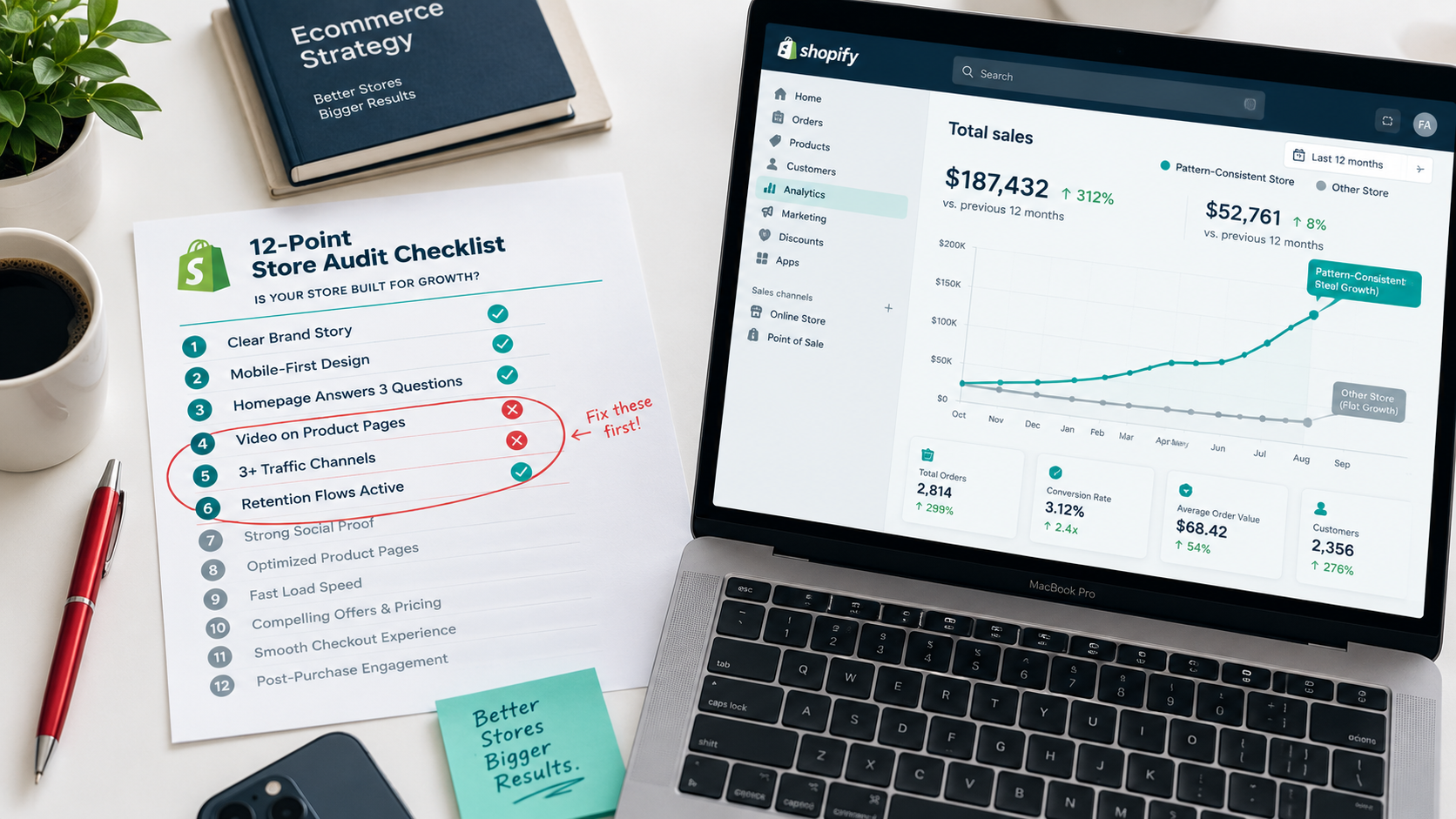
The Checklist: Which Patterns Does Your Store Have?
Rate your store honestly against each pattern:
A clear brand story visible within three seconds of homepage arrival — yes or no. Mobile experience designed first for mobile, not adapted from desktop — yes or no. Homepage that answers what, who, and why trust in the first scroll — yes or no. Product page structured around the purchase decision with social proof above the fold — yes or no. Reviews collected systematically and placed structurally throughout the customer journey — yes or no. Email and SMS owned audience with behavioral automation flows — yes or no. A specific niche audience defined more narrowly than feels comfortable — yes or no. Deliberate AOV growth mechanisms including bundles and complementary recommendations — yes or no. PageSpeed score above 70 on mobile — yes or no. Traffic from three or more distinct channels — yes or no. Retention infrastructure including loyalty, win-back, and post-purchase flows — yes or no. Video integrated into product pages, homepage, and organic social channels — yes or no.
Every no on this checklist is a gap between where your store is and where the stores growing fastest in your category are. Prioritize the gaps with the highest potential revenue impact for your specific situation and close them one at a time.
The patterns are documented. The path is clear. The work is available to any Shopify merchant willing to do it systematically.
Need help implementing any of the patterns identified in this analysis on your Shopify store? Get in touch with EcomFixify — we specialize in Shopify development and ecommerce growth strategy, and we have helped dozens of brands close exactly these gaps.