
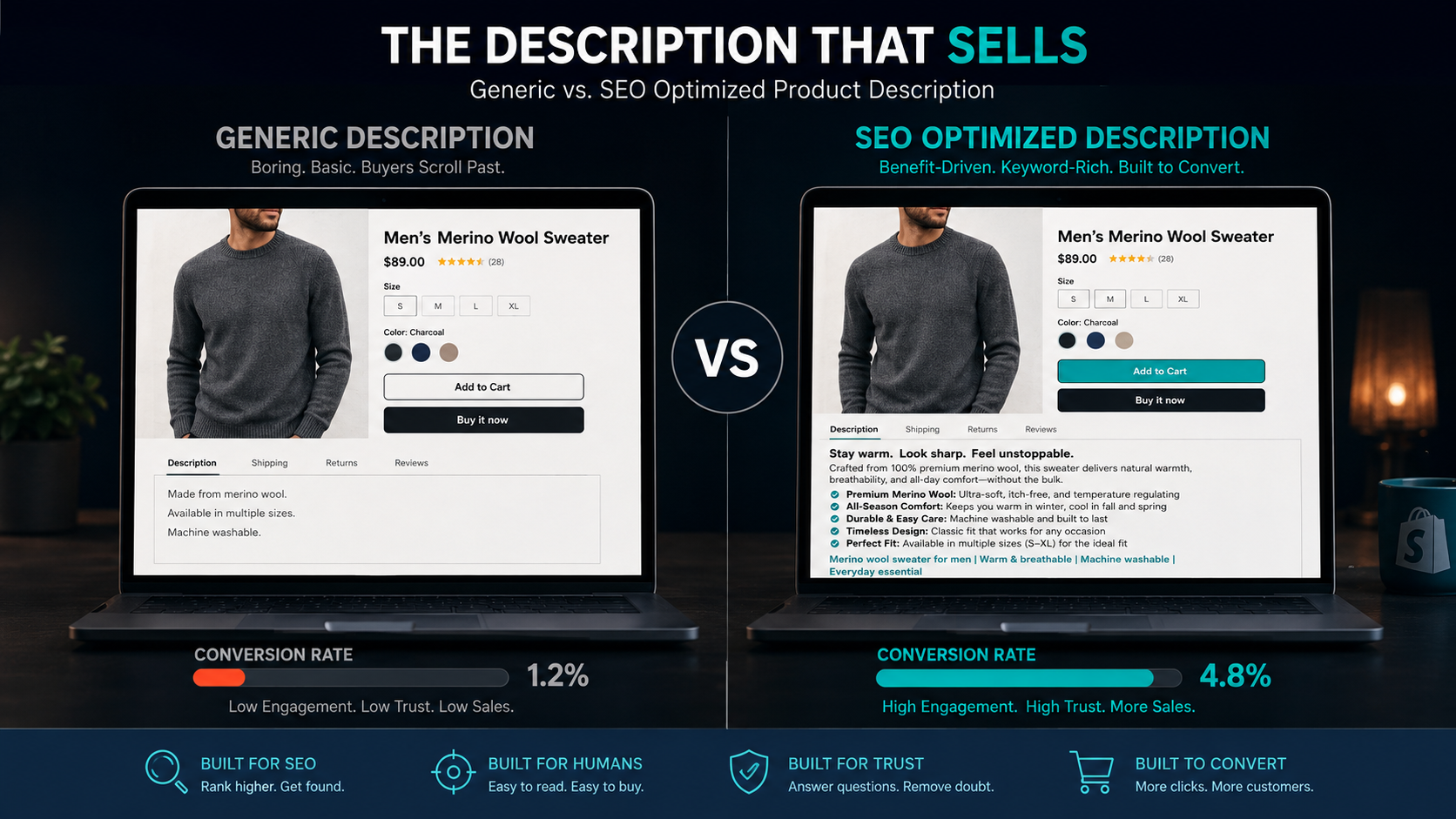
How to Write Shopify Product Descriptions That Rank on Google
Your Shopify product description is doing two jobs simultaneously — and most store owners are failing at both.
The first job is ranking. Your product description is one of the primary signals Google uses to understand what your product page is about and which search queries it should appear for. A description that does not contain the terms real buyers type into Google is a description that will not appear when those buyers search. How to Write Shopify Product Description That Rank on Google
The second job is converting. A visitor who lands on your product page from Google, an ad, or social media has a question — is this the right product for me? Your description is responsible for answering that question persuasively enough that they click Add to Cart rather than Back.
Most Shopify product descriptions fail at both simultaneously. They either use manufacturer copy that Google has already indexed on a dozen other sites — which achieves nothing for SEO — or they list features without explaining why those features matter to the buyer — which achieves nothing for conversion.
SEO-optimized Shopify stores achieve conversion rates up to 250% higher than non-optimized ones, with product descriptions being a primary driver of that gap. The stores at the top of that range are not running exotic strategies. They are writing product descriptions that serve both Google and the human reader simultaneously — and this guide shows you exactly how.
Why Most Shopify Product Descriptions Fail on Both Counts
The two most common product description mistakes in Shopify stores in 2026 are so widespread that they have become almost invisible to the merchants making them.
The first is using manufacturer or supplier descriptions verbatim. When you copy a product description from your supplier's website or data feed, you are publishing content that already exists — often on dozens or hundreds of other websites. Google recognizes duplicate content and either filters it from search results entirely or assigns it very low ranking priority compared to unique, original descriptions. Every product page on your Shopify store with copied supplier content is a page that Google is actively choosing not to rank, regardless of how good your other SEO signals are.
The fix is not complicated but it does require effort: write unique descriptions for every product in your catalog. Even two products that are nearly identical — the same item in different sizes or colors — need distinct descriptions that highlight the differences specific to each variant. Duplicate content across your own product pages carries the same SEO penalty as content copied from external sources.
The second mistake is writing feature lists without benefit translation. A feature describes what a product has or is. A benefit describes what that feature does for the customer. Features live in the warehouse. Benefits live in the customer's life.
"Made from 100% merino wool" is a feature. "Stays odor-free for multiple wears so you can pack lighter and rewear without the laundry run" is the benefit that makes the customer care about the merino wool feature. The visitor reading your product description is not thinking about material composition — they are thinking about their problem, their life, and whether this product solves something for them. Benefits translate features into that language.
Every feature in your product description should pass the "so what?" test. Ask yourself: so what does this feature mean for the person buying it? The answer to that question is the benefit — and the benefit is what converts.
The SEO Foundation: Keyword Research for Product Descriptions
Before writing a word of product description copy, you need to know which specific terms real buyers use when searching for your product. This is keyword research — and for product pages it is more precise and more commercially valuable than the keyword research most merchants do for blog content.
Product page keywords fall into two distinct categories with different commercial intent.
Specific product searches are the highest-converting keyword category for Shopify product pages. These are buyers who know exactly what they want and are searching for the best place to buy it: "men's merino wool base layer," "portable espresso maker," "vegan leather crossbody bag." The commercial intent is explicit and the conversion rate from organic traffic on these terms is significantly higher than for informational keywords.
Category and comparison searches represent buyers who are narrowing their decision: "best moisturizer for dry skin," "leather vs vegan leather bag," "lightweight running shoes for flat feet." These queries have slightly lower commercial intent than specific product searches but represent buyers who are close to a decision and will convert when your description answers their comparison question better than competitors.
The tools that surface these keywords most efficiently for Shopify product pages are Google's own search results — look at the autocomplete suggestions, the People Also Ask section, and the related searches at the bottom of results for your product category. These are the exact phrases real buyers are using, provided by Google from its own search data.
Ahrefs, SEMrush, and Ubersuggest extend this research with volume and competition data, allowing you to prioritize between keyword variations. For most Shopify merchants, the highest-value targets are medium-volume, low-competition long-tail keywords that describe your specific product with enough detail to attract buyers rather than browsers: "organic cotton muslin swaddle blankets for newborns" rather than "baby blankets."
Once you have identified your primary keyword and two to three secondary keywords for each product, you have the SEO foundation your description needs to rank.
The Anatomy of a Product Description That Both Ranks and Converts
High-performing Shopify product descriptions in 2026 follow a consistent structure that serves both search engines and human readers. The structure is not rigid — your brand voice and product category shape how it expresses — but the hierarchy of elements is consistent across the top-converting stores.
The Opening Paragraph: Benefit First, Keyword Second
Your opening paragraph has two jobs: hook the reader with the most compelling benefit your product delivers, and include your primary keyword naturally in the first 100 words.
The hook comes from your deepest understanding of why customers actually buy your product — not what it is, but what it does for them or how it makes them feel. A high-converting opening paragraph for a wool running sock does not begin with "These running socks are made from 80% merino wool." It begins with "Most runners quit their training runs early because of blisters, not fitness — these socks fix that."
That opening immediately speaks to the problem the buyer has, establishes that the product solves it, and creates the reading motivation that carries them through the rest of the description. The material specification that follows has context and meaning because the benefit framing gave it relevance.
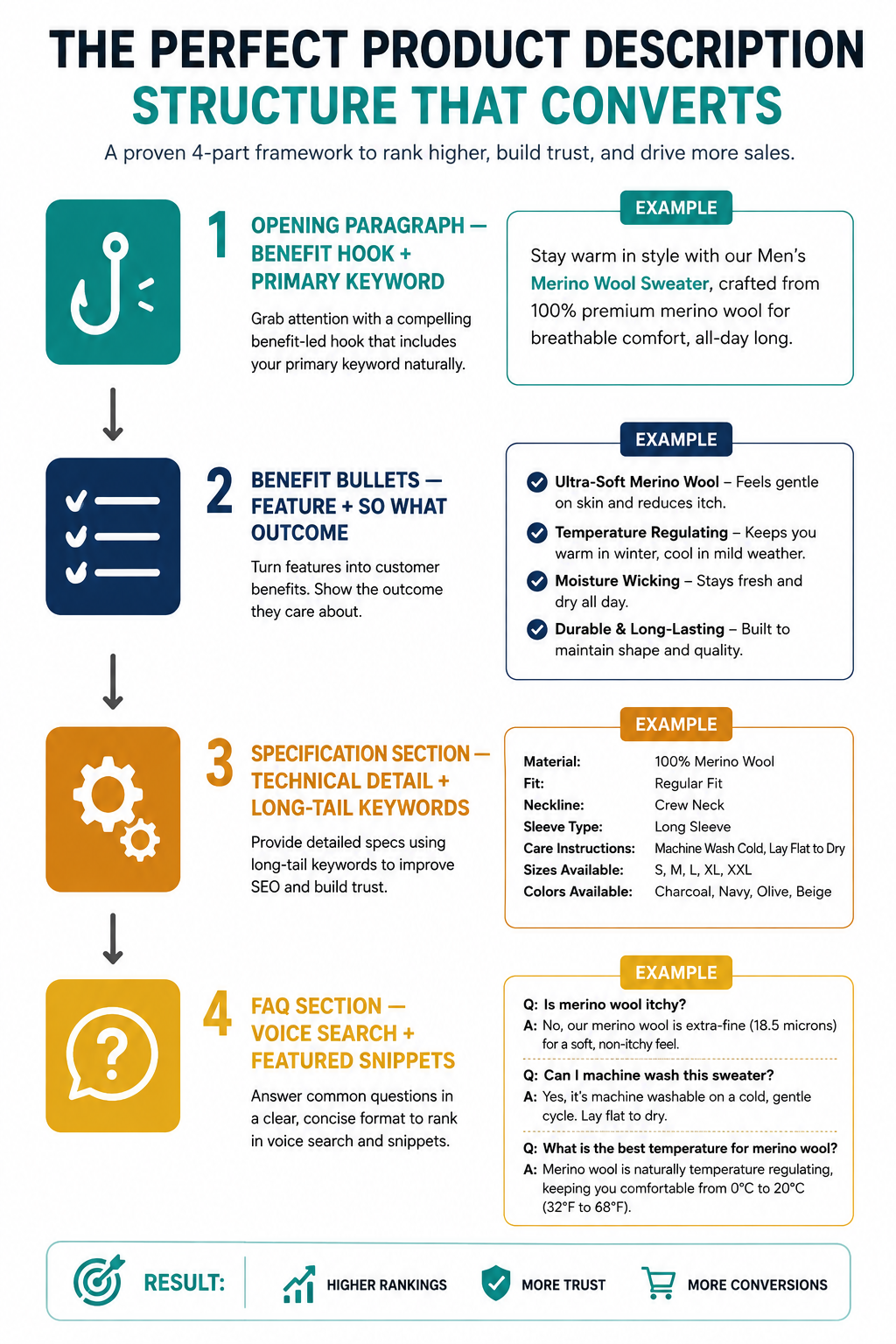
Include your primary keyword in this opening paragraph naturally. If your primary keyword is "merino wool running socks," a sentence like "Our merino wool running socks are engineered around the specific pressure points and moisture patterns of distance running" includes the keyword while continuing the benefit narrative rather than interrupting it.
The Benefit Bullet Section: Scannable, Specific, Conversion-Oriented
Most visitors do not read product descriptions linearly from top to bottom. They scan. They look for the information most relevant to their specific purchase decision, and they form that decision faster than any linear reading experience would suggest.
Three to six bullet points following your opening paragraph capture those scanners. Each bullet should translate a single feature into a specific benefit in one sentence — structured as feature plus outcome for maximum clarity and persuasiveness.
The formula that works consistently is: "[Feature] so you can [specific outcome the buyer cares about]."
"Temperature-regulating merino fiber so you stay comfortable from mile one to mile twenty without needing separate warm and cold weather socks."
"Anatomical left-right construction so pressure is distributed evenly across the exact contact points where blisters typically form."
"Machine washable at 30 degrees so you can pack three pairs for a ten-day trip without worrying about laundry."
Each bullet answers a different "so what?" and collectively they build a comprehensive case for the purchase without requiring the visitor to read dense paragraphs. Include secondary keywords naturally in the bullet section — "running socks for long distance" or "blister prevention running" — without forcing them into sentences where they read awkwardly.
The Specification Section: Features, Materials, and Technical Detail
Below the benefit bullets, include a clear technical specification section covering the information buyers need to confirm compatibility and suitability: materials and composition percentages, dimensions and weight, size guide or compatibility chart, care instructions, and any certifications or compliance information relevant to your product category.
This section serves a different reader than the opening paragraph and bullets. The visitor who has reached the specification section has already been convinced by the benefits — they are now confirming the details. Present this information in a format optimized for quick scanning: a structured list or a two-column table rather than prose.
The specification section is also where additional long-tail keywords appear naturally, because technical product specifications use the precise language buyers search for: "80% merino wool 15% nylon 5% elastane," "EU 38-42 / UK 5-8 / US 6-9," "OEKO-TEX certified." These terms appear in search queries from buyers who know exactly what they need and are searching with that precision — and your specification section is the natural home for that language.
The FAQ Integration: Capturing Voice Search and Featured Snippets
Below the specifications, a three to five question FAQ section structured around the actual questions customers ask about your product category captures two distinct SEO opportunities simultaneously.
The first opportunity is featured snippets — the answer boxes that appear above the first organic result in Google and supply the majority of voice search answers. A concise, direct answer to a commonly searched question about your product category — structured as a question in bold followed by a 40 to 60 word answer — is exactly the format Google rewards with featured snippet selection.
The second opportunity is long-tail keyword capture for questions that have dedicated search volume in your category. "Are merino wool socks good for running?" "How do you wash merino wool socks?" "What percentage of wool should running socks have?" These question-format searches represent buyers in the research phase whose entry into your product page through an FAQ answer is often the beginning of a purchase journey.
Write each FAQ answer in conversational language that sounds natural when read aloud, because the same answer that captures a featured snippet will be read by a voice assistant to someone who asked the question through Siri, Google Assistant, or Alexa.
SEO Technical Elements That Work Alongside Your Description
The description copy itself is the foundation — but four technical elements amplify its SEO impact and are worth configuring correctly for every product in your catalog.
The product title — the H1 heading on your Shopify product page — is the single highest-weight SEO element on the page. It should include your primary keyword and describe the product specifically enough that a buyer who landed on the page from Google would immediately confirm they found what they searched for. "Merino Wool Running Socks — Blister Prevention for Long Distance Running" achieves both — keyword inclusion and immediate relevance confirmation.
The meta title and meta description — configured in the SEO section at the bottom of each Shopify product edit page — control what appears in Google search results before a buyer clicks. Your meta title should match or closely resemble your product title and stay under 60 characters. Your meta description — under 160 characters — should summarize the most compelling benefit and include a subtle call to action. Meta descriptions do not directly influence rankings but they do influence click-through rate, which affects how quickly your page gains ranking traction.
The product URL should be clean, keyword-containing, and human-readable. Shopify auto-generates URLs from your product title — review these and remove stop words and unnecessary characters. "yourstore.com/products/merino-wool-running-socks" is preferable to "yourstore.com/products/merino-wool-running-socks-blister-prevention-long-distance-lightweight-2026-edition." Shorter, cleaner URLs rank and click-through better.
Alt text on every product image serves double duty: it is the text that describes the image to visually impaired visitors using screen readers, and it is the signal that tells Google what the image depicts. "Merino wool running socks close up showing cushioned heel and toe construction" is descriptive alt text that includes the primary keyword naturally. "IMG_4572.jpg" is not.
The Before and After: What Transformation Looks Like in Practice
The difference between a generic product description and an optimized one is most visible in concrete before-and-after comparison.
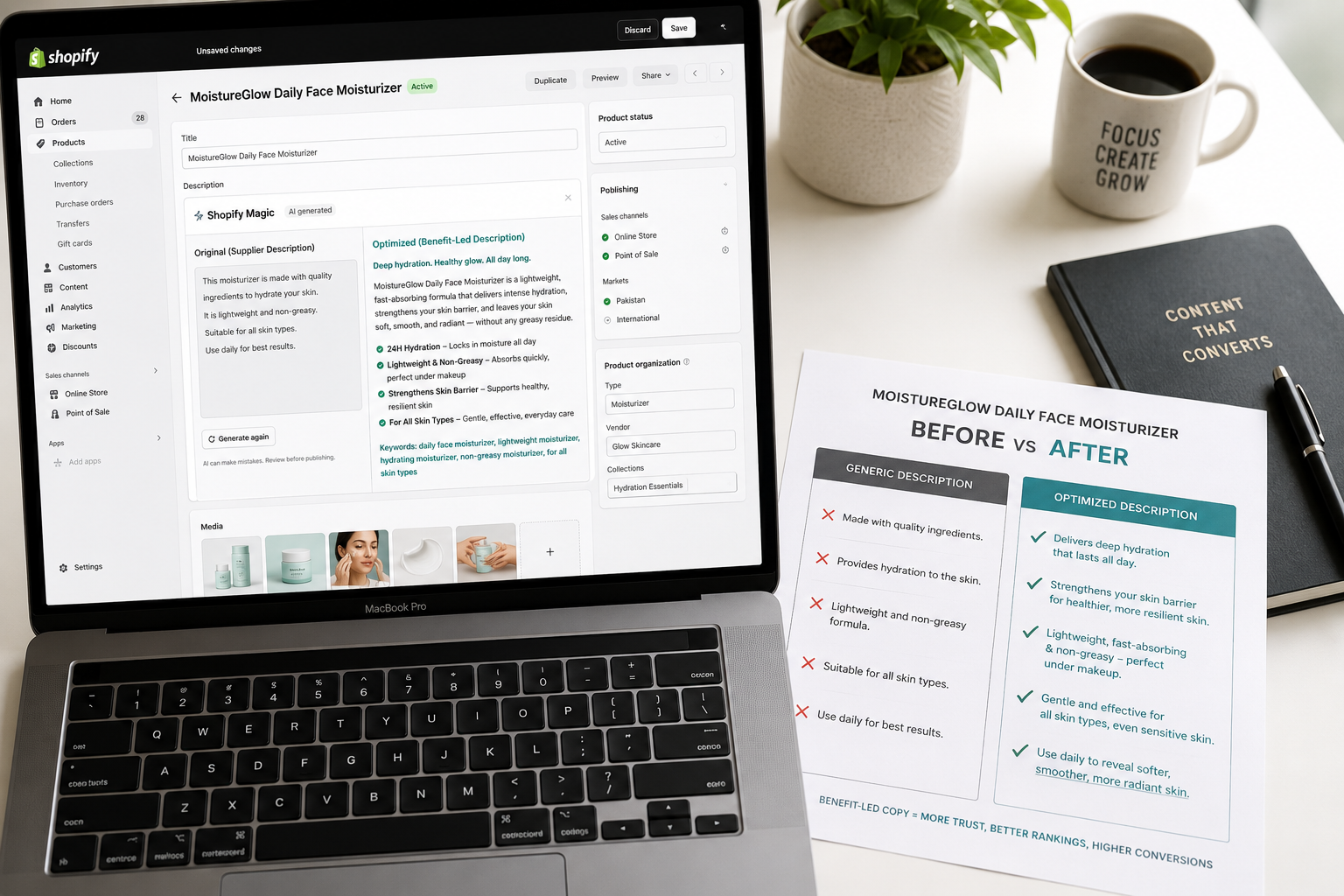
A generic product description for a facial moisturizer might read: "This moisturizer contains hyaluronic acid, vitamin C, and niacinamide. It is suitable for all skin types. 50ml."
That description fails on both counts. It gives Google no keyword context beyond the ingredient names — it could describe any of the thousands of moisturizers indexed with identical specifications. And it gives the buyer no reason to care about those ingredients — the features are listed with no benefit translation.
An optimized version addresses both failures: "If your skin feels tight by mid-afternoon despite moisturizing in the morning, this is the formula dermatologists recommend for extended all-day hydration. Hyaluronic acid pulls moisture from the air and locks it into skin cells for 12 hours — which means no top-up routine, no heavy layers, and no feeling that you skipped your skincare step by noon. Vitamin C brightens while niacinamide balances oil production, so dry and combination skin types both use this without adjustment. 50ml — approximately 60 days of daily use."
The second version opens with a problem the buyer recognizes, translates each ingredient into a specific outcome the buyer cares about, addresses two different skin types to expand its relevance, and closes with a practical usage detail that removes a common purchasing uncertainty. It is also naturally rich with long-tail keywords — "extended hydration moisturizer," "moisturizer for tight skin," "hyaluronic acid all-day hydration" — that appear throughout without any forced keyword insertion.
The SEO result: the first version competes with ten thousand nearly identical moisturizer descriptions. The second version ranks for specific combinations of keywords that fewer competitors are targeting with equivalent specificity.
The conversion result: the first version gives the buyer no reason to choose this product over any other with the same ingredient list. The second version speaks directly to a recognizable experience — the afternoon skin tightness problem — and positions this specific formulation as the solution.
Using Shopify Magic to Write Descriptions Faster Without Losing Quality
Shopify Magic — the AI writing assistant built natively into Shopify admin — accelerates product description writing significantly without replacing the strategic thinking that makes descriptions convert.
The most effective workflow with Shopify Magic treats the AI as a first-draft generator and the writer as the editor who transforms that draft into brand-specific, benefit-led, keyword-optimized copy.
When generating a description with Shopify Magic, input your primary keyword, two to three key benefits you want the description to emphasize, and your target customer context. The more specific your input, the more useful the AI output. "Generate a product description for merino wool running socks targeting long-distance runners who struggle with blisters, emphasizing temperature regulation and moisture management, using a direct confident tone" produces a more workable first draft than "write a description for running socks."
Review the AI output against the structure covered in this guide. Does it open with a benefit rather than a feature? Does it include the primary keyword in the first 100 words? Do the bullet points follow the feature-plus-outcome formula? Are there secondary keywords appearing naturally in the specification section?
Edit where the answer to any of those questions is no. The goal is a description that Shopify Magic helped you write in ten minutes rather than forty — not a description that reads like it was written by AI rather than by someone who genuinely understands the product and the buyer.
One technical note: Shopify's guidance is explicit that merchants are responsible for the accuracy of all content published to their store, including AI-generated descriptions. Review every specification, ingredient claim, and compatibility statement the AI generates before publishing. Factual inaccuracies in product descriptions generate returns, complaints, and the exact expectation mismatch that both hurts conversion and increases return rates.
The Duplicate Content Problem and How to Solve It at Scale
For Shopify stores with large catalogs, writing unique descriptions for every product is genuinely time-consuming — which is why so many merchants default to supplier copy or minimal descriptions that say almost nothing.
The solution is not to write every description from scratch with equal depth. It is to prioritize description investment by commercial potential.
Identify your top 20% of products by traffic or revenue — these are your Category A products, and they deserve fully optimized descriptions with the complete structure covered in this guide. Invest the most writing effort here, because these pages generate the most revenue when conversion rates improve even marginally.
For your mid-tier products — the next 30% by traffic or revenue — use a templated structure that ensures keyword inclusion, a benefit opening, and a specification section without requiring the same depth as Category A descriptions. Shopify Magic accelerates this tier significantly.
For long-tail catalog products with minimal search traffic — the bottom 50% — even a brief unique description of two to three sentences that is not copied from any supplier is preferable to duplicate content. The SEO penalty for duplicate content is real, and even minimal unique copy avoids it.
This tiered approach ensures your highest-value pages get the most optimization attention, your mid-tier pages are protected from duplicate content penalties, and your overall catalog is unique throughout — without requiring that every product receive the same level of copywriting investment.
Measuring Whether Your Descriptions Are Working
Descriptions that rank and convert produce measurable signals in your Shopify analytics and Google Search Console data. These are the metrics that tell you whether your optimization is working and where additional attention is needed.
In Google Search Console, the Performance report shows impressions and clicks for each product page. A page with high impressions but low click-through rate has a meta description problem — it is appearing in search results but not generating clicks, which means the meta description is not communicating compelling enough value for the effort of clicking. Rewrite the meta description with a stronger benefit statement and a clearer call to action.
A page with low impressions has a keyword relevance problem — Google is not seeing it as relevant enough to the searches your target buyers are making. Review the description against your target keywords and strengthen the keyword integration in the title, opening paragraph, and specification section.
In Shopify Analytics, the conversion rate by product page reveals which descriptions are converting visitors most effectively. A product page with above-average traffic but below-average conversion rate has a content problem — the description is not persuasive enough given the intent of the visitors arriving. Review it against the benefit-first, feature-translation principles in this guide and test a rewrite.
Review these metrics quarterly rather than weekly. SEO results from description optimization typically take 30 to 90 days to fully materialize as Google recrawls and reindexes your updated content. Conversion rate changes from description rewrites are visible sooner — typically within two to four weeks of sufficient traffic.
Final Thoughts
A product description that ranks and converts is not the result of keyword stuffing or feature listing. It is the result of understanding your buyer deeply enough to speak to their specific problem, translating every product feature into an outcome they care about, and using the exact language they search for naturally throughout the content.
The gap between a generic product description and an optimized one is the difference between a product page that Google ignores and a customer bypasses — and one that Google recommends and the customer trusts enough to buy.
Every product page in your Shopify catalog is an opportunity to appear in front of a buyer who is actively searching for exactly what you sell. The description is what determines whether that opportunity converts into revenue or disappears into a bounce.
Write for the buyer first. Serve the search engine in the process. The intersection of those two goals is where product descriptions that rank and convert actually live.
Need help rewriting your Shopify product descriptions for SEO and conversion, or want an expert to audit your product pages for ranking and revenue gaps? Get in touch with EcomFixify — we specialize in Shopify development and ecommerce growth strategy for brands ready to compete on search.