
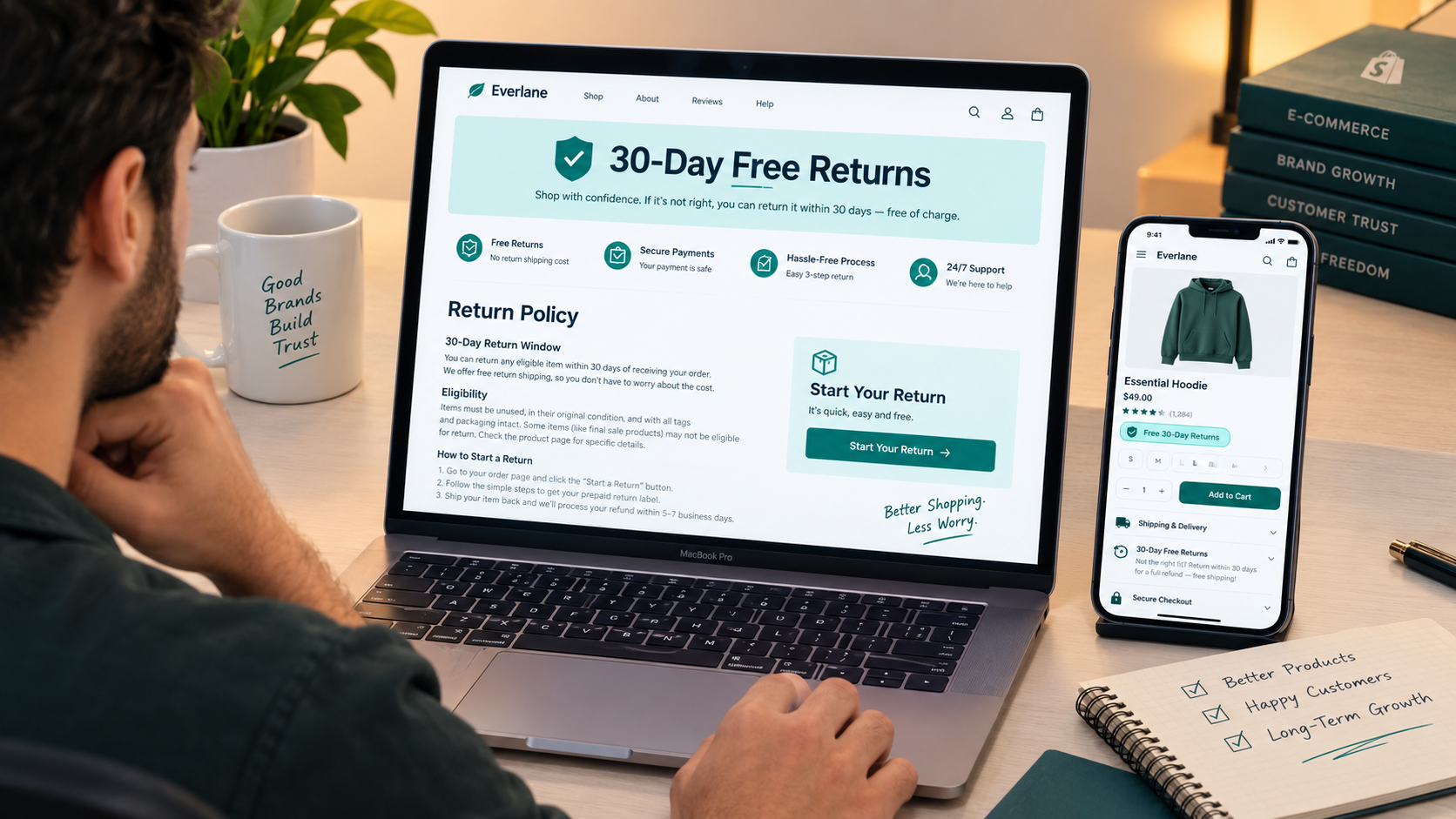
How to Write a Shopify Return Policy That Builds Trust
Most Shopify merchants treat their return policy the same way they treat their privacy policy — a legal formality to copy from a template, paste into the footer, and forget. Something to have, not something to use. How to Write a Shopify Return Policy That Builds Trust
That approach is quietly costing them sales every single day.
67% of online shoppers check a store's return policy before making a purchase. Not after something goes wrong — before they buy. For first-time visitors with no existing relationship with your brand, your return policy is answering the most important question in their mind: what happens if this does not work out? If that question goes unanswered, or if the answer they find is restrictive, confusing, or buried in legal language, many of them simply leave without buying.
A well-written Shopify return policy does not just protect you operationally. It functions as a pre-purchase trust signal, a conversion tool, and a customer retention mechanism — all simultaneously. Retailers who expand their return policies and communicate them clearly see 20 to 30% higher conversion rates on product pages where the policy is visible. And the counterintuitive finding that researchers in consumer behavior have replicated across multiple studies is this: a generous, clearly communicated return policy increases conversion rates more than it increases return rates.
This guide covers how to write a Shopify return policy that converts browsers into buyers, how to display it for maximum impact, and the specific language choices that build confidence rather than create anxiety.
Why Most Shopify Return Policies Fail
Before writing the better version, understanding where standard return policies go wrong prevents recreating the same mistakes in a new format.
The most common failure mode is that the policy is written to protect the merchant rather than to reassure the customer. Legal defensiveness produces language like "items must be returned in their original, undamaged, unworn, unwashed condition with all original tags attached within 14 days of delivery in the original packaging" — a sentence designed to minimize the merchant's exposure to fraudulent returns rather than to make a hesitant customer feel confident enough to complete a purchase.
That framing works against conversion in two ways. First, it makes the customer do mental work — parsing restrictive conditions at a moment when they are evaluating whether to trust a brand they have never bought from before. Second, it implicitly communicates that the merchant expects the customer to return something, and is defending against that expectation — which raises rather than lowers purchase hesitation.
The second common failure is invisibility. A return policy linked only from the footer of a website is encountered almost exclusively by customers who are already looking for a reason to not buy, not by customers who are on the edge of purchasing and need a final reassurance to push them over. The policy needs to be visible at the exact moment the purchase hesitation is highest — which is on product pages and at checkout, not in the footer.
The third failure is complexity. A return policy with twelve conditional clauses, multiple exception categories, different rules for different product types, and a multi-step return process described in dense paragraphs makes customers feel that returning something will be difficult — which means buying something feels risky. Complexity in a return policy does not protect the merchant. It reduces conversion.
The Seven Elements Every Shopify Return Policy Needs
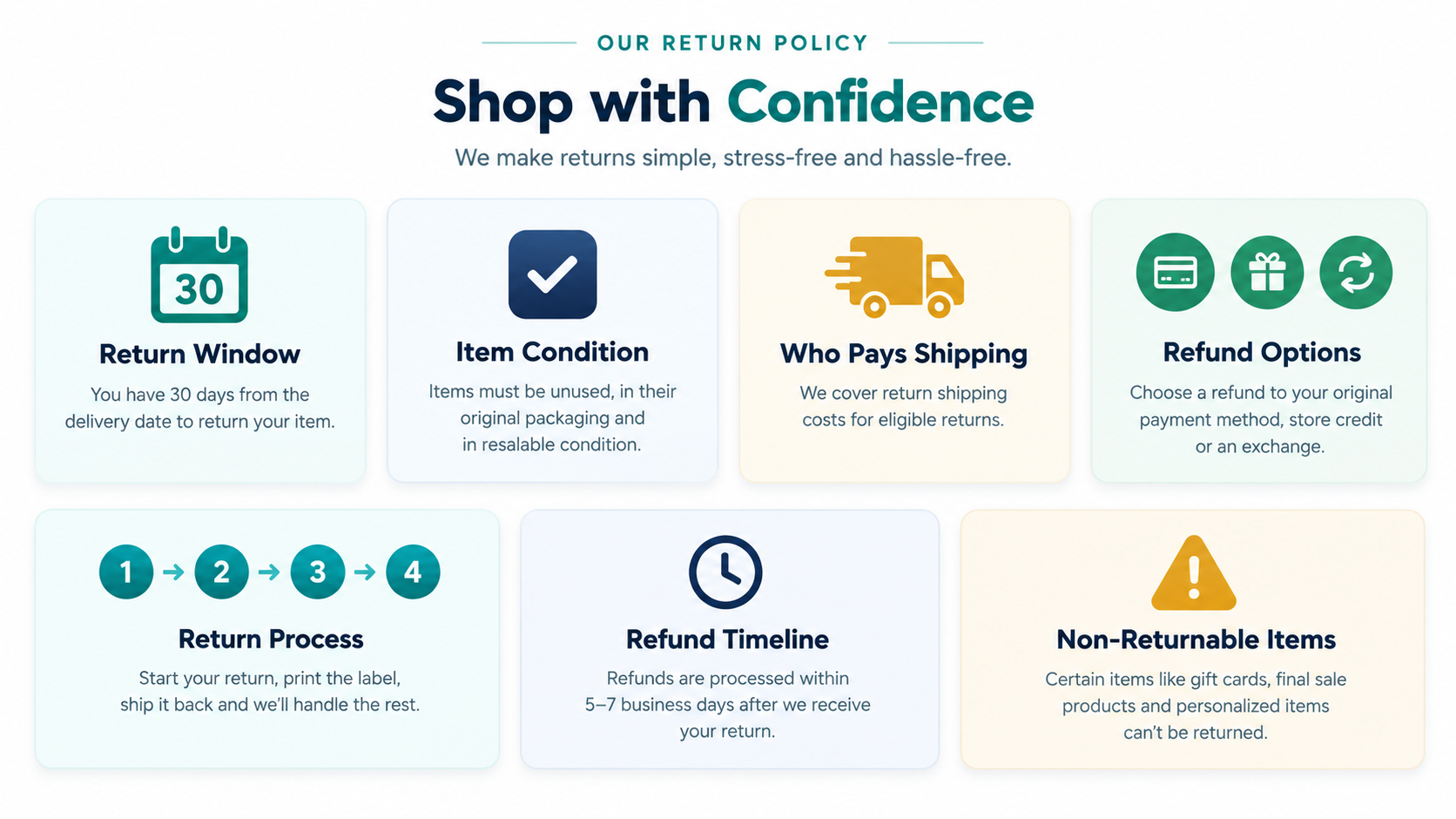
A complete Shopify return policy answers seven questions that every customer has before buying. Each question must be answered clearly, in plain language, without requiring the customer to infer the answer from conditional clauses.
1. How Many Days Does the Customer Have to Return?
The return window is the first thing most customers look for and the element that has the most direct impact on conversion rate. The standard for most Shopify stores is 30 days from delivery. Extending to 60 days signals confidence in the product and has been shown to increase conversion meaningfully, particularly for high-consideration purchases above $50. For high-ticket items — electronics, furniture, premium skincare — 90 days builds the strongest trust signal and positions the brand as genuinely standing behind what it sells.
The counterintuitive truth about return window length: extending from 30 to 60 days does not double the return rate. Research across ecommerce stores consistently shows that the majority of customers who are going to return a product do so within the first two weeks regardless of how long the window is. The extended window primarily benefits conversion — by removing the urgency anxiety that a short window creates for customers who are not yet sure they will keep the product — rather than significantly increasing the volume of returns.
Write the return window in the most visible, prominent position at the top of your policy page. Not buried in paragraph three. Not in a footnote. The number of days — "30-day returns" or "60-day free returns" — should be the first thing a customer reads when they arrive at your policy.
2. What Condition Must the Product Be in to Be Eligible for Return?
Condition requirements are necessary but should be written in customer-friendly language rather than legal-defensive language. The goal is to prevent abuse while reassuring legitimate buyers that returning something is straightforward if it genuinely did not work for them.
Instead of "items must be returned in their original, undamaged, unworn, unwashed condition with all original tags attached," write "we want you to love what you ordered — if something is not right, send it back unworn and in the same condition it arrived and we will sort it out."
The substance is identical. The first version feels like a courtroom brief. The second version feels like a brand that trusts its customers and expects the trust to be reciprocated. The customer reading both versions experiences a completely different emotional response — and that emotional response affects whether they complete the purchase.
For digital products, bundles with consumable components, or personalized items, clearly state these as non-returnable in a dedicated section. Non-returnable items listed transparently build trust. Non-returnable items discovered after attempting to return create complaints, chargebacks, and negative reviews.
3. Who Pays for Return Shipping?
Return shipping cost is one of the most significant factors in purchase hesitation for new customers. A customer who is uncertain about a product and knows they will have to pay $8 to $15 to return it if it does not work out is calculating that uncertainty against a cost — which reduces the probability of purchasing.
Free return shipping on all orders is the gold standard and is worth the operational cost for most Shopify stores once the conversion improvement is measured against the return shipping expense. If free return shipping on all orders is not financially viable at your current scale, consider offering it selectively — free return shipping on exchanges but not on refunds, which creates a natural incentive for the exchange-first behavior that retains revenue. Or free return shipping above a minimum order value threshold, which is consistent with your free shipping incentive structure.
Whatever your return shipping policy is, state it explicitly. "We cover return shipping on all orders" or "return shipping is the customer's responsibility" both build trust through clarity. The worst outcome is a customer who assumes return shipping is free, discovers it is not when they initiate a return, and feels misled — which generates a negative review that no return policy language can prevent.
4. What Refund Options Are Available?
Three primary refund options exist for Shopify stores — refund to original payment method, store credit, and exchange for a different product. Your policy should clearly state which options are available and whether any of them carry incentives.
The framing that builds conversion while protecting margin: present store credit and exchange as the primary or recommended options, with refund to the original payment method available for customers who specifically need it. A policy that says "we offer instant store credit with an additional 10% bonus value, or a straight exchange for any product in our store — we can also process a refund to your original payment method if you prefer" communicates generosity while naturally steering customers toward the options that retain revenue.
Do not hide the refund option or make customers feel they have to fight for it. Customers who feel they have to argue for a legitimate refund leave negative reviews and dispute charges with their card issuer. A refund offered gracefully retains goodwill. A refund extracted through escalation destroys it.
5. How Does the Customer Initiate a Return?
The return initiation process described in your policy sets the customer's expectation for how easy or difficult returning something will be. A process that requires emailing support, waiting for a response, receiving a label, packaging the item, and dropping it at a carrier location feels burdensome before it begins. A process that involves clicking a link, answering two questions, printing a prepaid label, and dropping it at a convenient location feels manageable.
Describe your actual return process in the clearest, most concise steps possible. If you use a returns management app — Loop Returns, AfterShip Returns, or Return Prime — the self-service portal makes the process genuinely easy, and your policy should reflect that: "Start your return in under two minutes through our returns portal — no need to contact support."
If your current return process requires emailing support for every return, that is both a customer experience problem and a policy communication opportunity to improve the process before promoting it.
6. How Long Does the Refund Take?
Refund timing anxiety — "when will I actually get my money back?" — is one of the last remaining sources of friction in an otherwise well-handled return experience. Address it preemptively in the policy with a specific timeline rather than vague language.
"Refunds are processed within two business days of receiving your return and typically appear in your account within three to five business days" is actionable and reassuring. "Refunds will be processed in a timely manner" is neither. Specific timelines build trust because they set a clear expectation that the customer can hold you to — which signals confidence that you intend to follow through.
7. What Items Are Non-Returnable?
Every Shopify store has at least some products that cannot be returned for hygiene, safety, or customization reasons — swimwear, pierced jewelry, personalized products, digital downloads, opened food and beverage items. These exclusions are legitimate and customers accept them when they are disclosed transparently.
List non-returnable items in a dedicated, clearly labeled section at the end of your policy. The placement matters: customers who scan a policy to check whether their specific product is returnable will find this section naturally. Placing exclusions in the middle of a paragraph where they might be missed creates the discovery problem — a customer who was not told before purchase that their item was non-returnable will feel deceived regardless of what the fine print said.
Where to Display Your Return Policy for Maximum Conversion Impact
Writing a strong return policy solves half the problem. Displaying it where customers are actually making purchase decisions solves the other half.
The locations where return policy visibility most directly impacts conversion are:
Product pages, in close proximity to the Add to Cart button. A brief summary — "Free 30-day returns" with a link to the full policy — displayed as a trust badge or a single line of text directly beneath the price or the ATC button answers the return question at the exact moment purchase hesitation is highest. Customers who see this and who were uncertain about the purchase are reassured without needing to navigate away from the product page.
The cart page, as a summary statement near the checkout button. A customer who has added products to the cart and is about to proceed to checkout is in the final decision moment. A brief return policy reassurance at this point — "All orders covered by our 30-day return policy" — reduces cart abandonment by addressing the last remaining purchase risk before the customer enters the checkout flow.
The checkout page itself. Shopify automatically links your policy in the checkout footer when configured in Settings — confirm this is active and visible. For Shopify Plus merchants with Checkout Extensibility, adding a custom trust section that highlights your return policy alongside payment security badges in the checkout sidebar directly reduces checkout abandonment among first-time buyers.
Order confirmation emails. Including a brief return policy reminder in the order confirmation — "Your order is covered by our 30-day return policy. If anything is not right, start a return here" — sets the right expectation at peak post-purchase satisfaction and prevents the confusion and anxiety that leads to chargebacks when customers do not know how to return something.
Your dedicated policy page. Linked from the footer, your main navigation under a Help or Support section, and your FAQ page. The dedicated policy page is where customers who are specifically researching your returns process will land — it needs to be complete and well-organized, but it is a support destination rather than a conversion tool. The conversion work happens at the product page and checkout.
The Language Choices That Build Trust vs. Create Anxiety
The same policy content written in two different tones produces measurably different customer responses. The language choices that consistently build trust share specific characteristics:
They assume the best of the customer rather than defending against the worst. "We trust you to return items in the same condition you received them" creates a fundamentally different dynamic than "items returned in damaged or used condition will not be accepted and will be returned to the customer at their expense." Both communicate the same policy. One feels like a business that trusts its customers. The other feels like a business that is already anticipating a conflict.
They focus on what the customer gets rather than what the merchant requires. "You will receive a full refund to your original payment method within five business days" is the customer-focused version of "refunds will be issued within five business days upon receipt and inspection of the returned item." Again, identical substance. Profoundly different customer experience.
They use first and second person — we and you — rather than third person passive voice. "We will cover your return shipping" feels like a promise from a real person. "Return shipping costs will be covered by the company in applicable circumstances" feels like a legal document. The conversational version builds trust; the passive version creates distance.
They are specific about timelines and processes rather than vague about outcomes. Every vague statement in a return policy — "returns will be processed in due course" or "refunds may take several business days" — requires the customer to fill in the blank with their worst-case assumption. Specific statements — "processed within two business days, in your account within five" — leave nothing to imagination and signal that you have done this before and know exactly how long it takes.
How to Add Your Return Policy to Shopify
Adding and publishing your return policy in Shopify takes less than five minutes and requires no technical knowledge.
Navigate to your Shopify admin and go to Settings, then Policies. Scroll to the Refund Policy section. You can either use Shopify's built-in template as a starting point — which you should edit significantly to match the principles in this guide — or paste your own policy directly into the text editor.
Once saved, Shopify automatically links your refund policy in three locations: the footer of your storefront, the checkout page, and your account's legal pages. All three are active immediately after saving without any additional configuration.
To add the policy to additional locations — product pages, cart pages, email templates — you or your developer will need to edit the relevant theme sections or configure your email platform to include the policy link. For most Shopify themes, adding a trust badge section beneath the Add to Cart button is a one-time theme editor change that does not require code editing — it is available as a built-in section in themes like Dawn, Impulse, and Prestige.
Before and After: What a Conversion-Optimized Return Policy Sounds Like
The difference between a standard return policy and a conversion-optimized one is visible at the sentence level. Here is the same content written in both styles:
Standard version: "Items must be returned within 30 days of delivery in their original condition. All returns must be initiated by contacting customer support via email. Return shipping costs are the responsibility of the customer. Refunds will be processed within 5 to 7 business days of receipt of the returned item. Certain items are not eligible for return including sale items and items that have been opened or used."
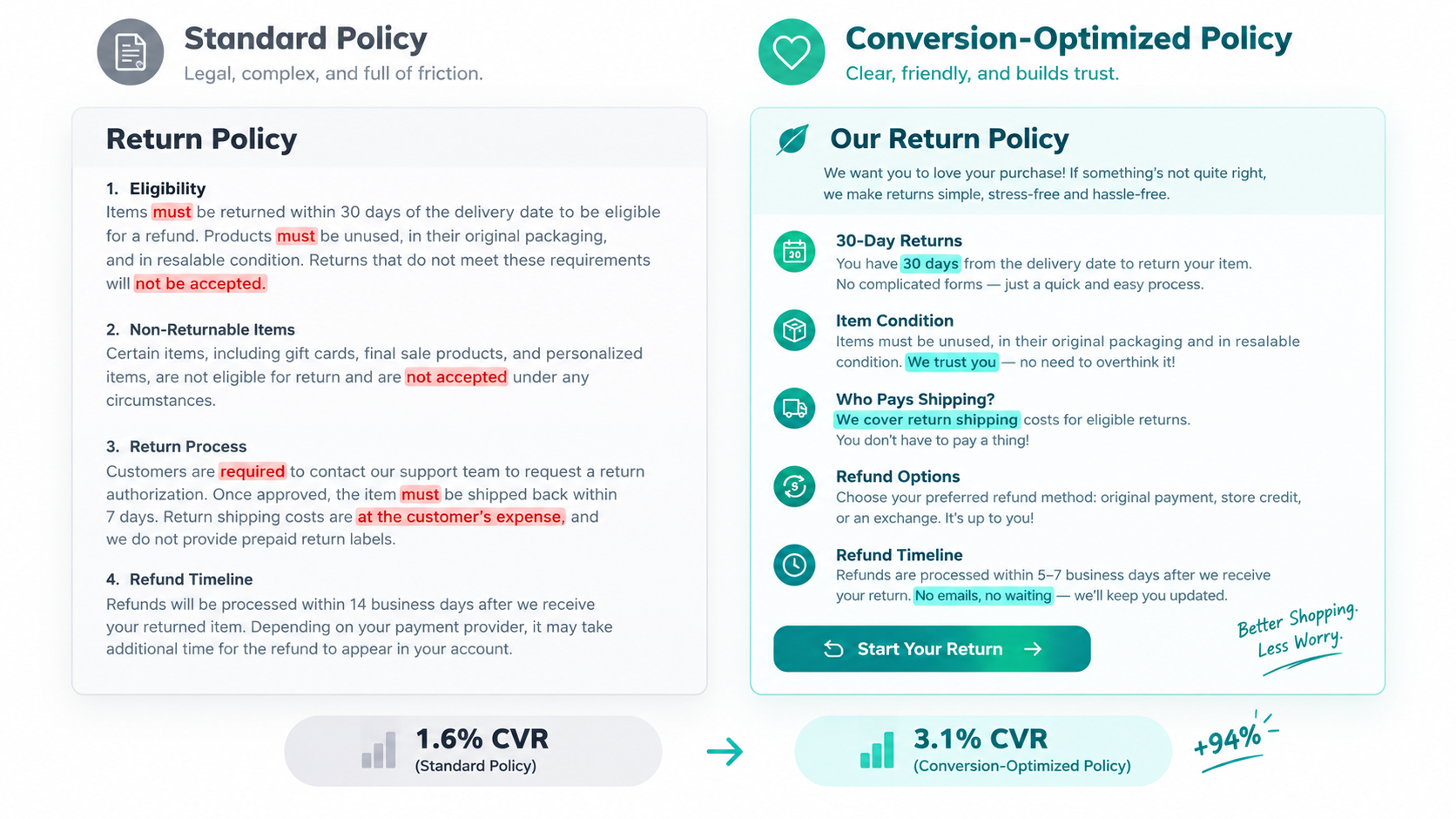
Conversion-optimized version: "We want you to love what you ordered — if something is not right, you have 30 days from delivery to send it back. Starting a return takes two minutes through our self-service portal — no emails, no waiting. We cover return shipping on all exchanges. Refunds hit your account within five business days of us receiving your return. A small number of items — sale items and opened consumable products — are not eligible for return and are clearly labeled on their product pages."
Both policies communicate the same rules. The first creates anxiety and anticipates conflict. The second communicates confidence, generosity, and simplicity. The customer reading the second version feels cared for. The customer reading the first version feels that returning something will be a fight.
The Trust Architecture: How Your Return Policy Fits the Bigger Picture
Your return policy does not operate in isolation — it is one element of a broader trust architecture that customers use to evaluate whether to buy from a brand they have not purchased from before.
The other elements of that trust architecture include the quality of your product photography, the depth of your customer reviews, the presence of trust badges near the checkout button, the visibility and speed of your pre-purchase live chat, and the professionalism of your overall store design.
A strong return policy embedded in a store that lacks other trust signals will help, but not as much as the same policy in a store where every trust element is present and well-executed. Review your store holistically against the trust architecture framework — product photography, review count and quality, visible contact information, trust badges, policy visibility — and address the weakest element first rather than optimizing your return policy in isolation from the rest of the customer trust experience.
Protecting Against Return Abuse Without Undermining Trust
A small percentage of customers will abuse a generous return policy — using products and returning them as new, returning different items than what was sent, or claiming non-delivery on orders that tracking confirms as delivered. These are genuine operational risks that need to be managed without undermining the trust that the generous policy is designed to build.
The protections that work without creating friction for legitimate customers are: inspecting returned items before issuing refunds and photographing the received condition for any items that show signs of use; tracking return frequency per customer and flagging accounts with return rates above 50% across multiple orders for review; requiring photo evidence of damage or defect for returns citing product quality issues; and requiring returns to be delivered to your warehouse before issuing refunds rather than issuing refunds on shipment confirmation.
None of these protections need to appear in the customer-facing version of your policy in intimidating detail. The customer-facing policy should communicate the generous, trust-building version of your process. Your internal operations protect against abuse without broadcasting defensive posture to the 95% of customers who have no intention of abusing the system.
Final Thoughts
Your Shopify return policy is not a legal document. It is a customer trust document that happens to have legal implications. The merchants who understand this distinction write policies that build confidence, display them where purchase decisions are made, and use language that treats customers as partners rather than potential fraudsters.
The metrics that validate a well-written return policy are visible and measurable: higher add-to-cart rates on product pages where the policy is displayed, lower cart abandonment rates at checkout, fewer chargeback disputes from customers who felt deceived, and higher repeat purchase rates from customers whose return experience exceeded their expectations.
Write the policy your best customer deserves to read. Display it where your most hesitant customer will see it. And let both of those decisions compound into the conversion rate, the customer retention, and the brand reputation that a genuinely customer-first returns approach consistently produces.
Need help writing or redesigning your Shopify return policy for maximum conversion impact, or want an expert to audit your store's trust signals and checkout experience? Get in touch with EcomFixify — we specialize in Shopify development and conversion rate optimization for growing brands.