
How to Use User-Generated Content to Increase Shopify Conversions
How to Use User-Generated Content to Increase Shopify Conversions
Here is a question worth sitting with: why does a customer trust a blurry photo taken by a stranger on their phone more than a professionally shot product image that cost your brand $500 to produce?
The answer reveals something fundamental about how purchase decisions actually get made. Shoppers do not need perfect information — they need credible information. And content created by real customers who have nothing to gain from making your product look good is inherently more credible than content created by brands that obviously do.
This is the engine behind user-generated content, and the numbers that explain why the most competitive Shopify brands have made it the cornerstone of their conversion strategy in 2026.
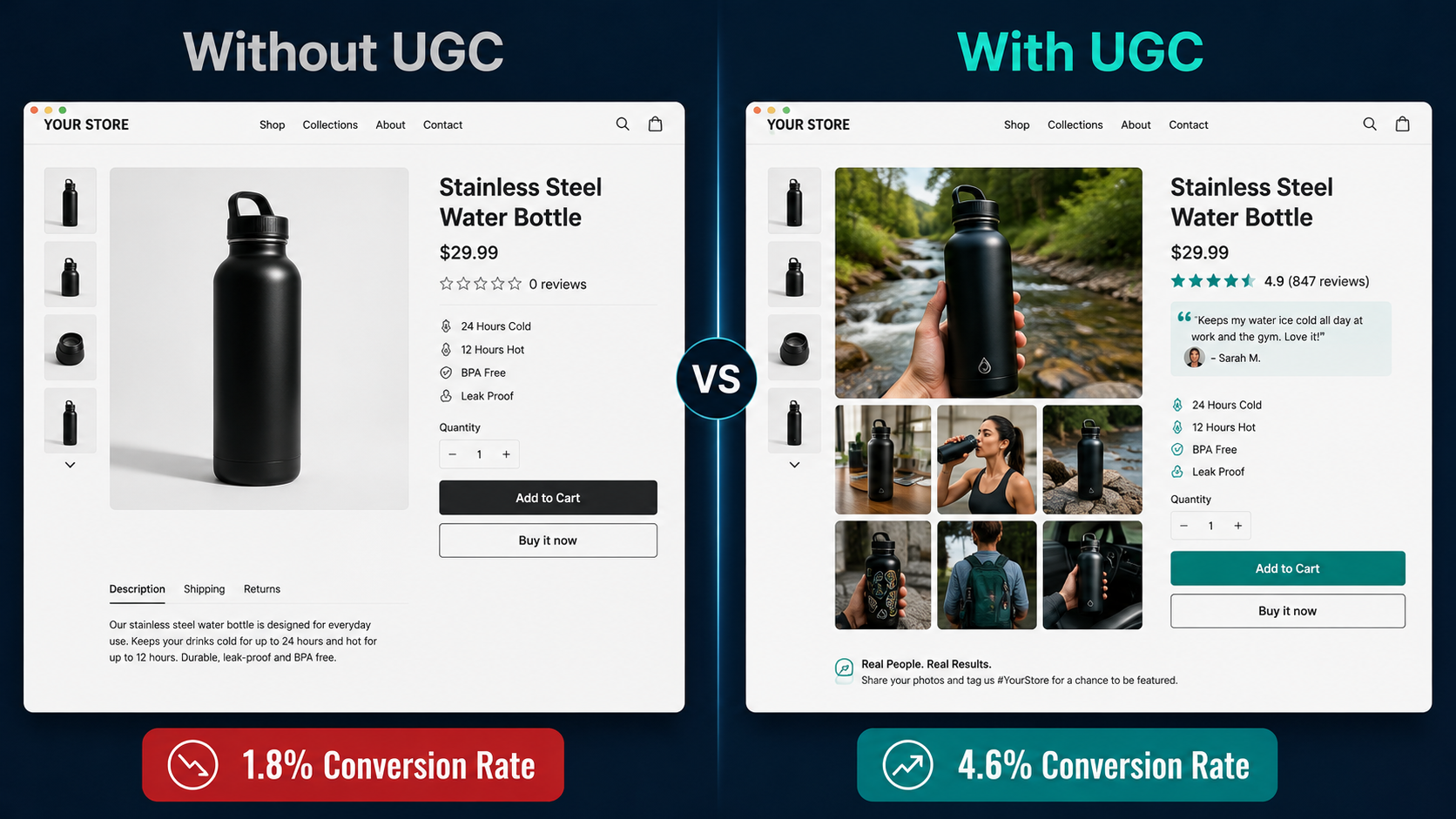
Brands using UGC see 29% more web conversions overall. UGC-enabled product pages generate 161% higher conversion rates than pages without it. UGC-driven conversions increased 57% quarter-over-quarter from Q4 2025 to Q1 2026. Website visits to pages featuring UGC were 4.11 times higher than those without it. 40% of shoppers refuse to purchase products without UGC on the page. And 13% will abandon their cart entirely if no customer content exists anywhere on the product page.
The performance gap between stores that have systematically built UGC into their marketing infrastructure and those still relying exclusively on brand-produced content is widening rapidly. This guide covers what UGC actually is in a Shopify context, why it outperforms branded content, how to collect it at scale, where to deploy it for maximum conversion impact, and the apps that make the system work.
What UGC Actually Means for a Shopify Store in 2026
User-generated content is any content created by your customers — photos, videos, reviews, testimonials, unboxing clips, social posts, Q&A answers — rather than by your brand or your paid creative team.
For a Shopify store, UGC exists on a spectrum of formality and intent. At the most organic end, it is an Instagram Story from a customer who loved their purchase and tagged your brand without being asked. In the middle is a review with photos, left in response to a post-purchase email request. At the more structured end is a commissioned UGC creator — a customer or content creator who produces raw, authentic-feeling video content for a fee, specifically designed to look like organic customer content rather than polished advertising.
All three types carry the same underlying psychological advantage: they represent a perspective the brand did not write, style, or control. That absence of brand authorship is precisely what makes UGC trustworthy in a way that brand content cannot replicate.
92% of consumers trust UGC more than traditional advertising. 82% of consumers are more likely to make a purchase from a brand using UGC in their marketing. 60% believe user-generated content is the most authentic form of marketing content available. And 79% of consumers say UGC directly impacts their buying decisions.
For Shopify merchants, UGC is not a social media nice-to-have. It is conversion infrastructure — content that helps shoppers understand the product, trust the promise, see real use cases, and feel less risk before they buy.
Why UGC Outperforms Brand Content at Every Stage of the Funnel
The performance advantage of UGC over brand-produced content shows up at every touchpoint in the customer journey, not just on product pages.
At the top of the funnel, UGC-based ads earn 56% more clicks than brand-produced creative. UGC content drives around 60% of brand engagement on TikTok. And social media posts featuring UGC drive over 10 times higher conversion rates than posts without it. This is the discovery and awareness stage where UGC's authenticity signal creates the initial trust that makes subsequent funnel stages possible.
At the consideration stage — when a shopper is researching and comparing — the presence of customer photos and video reviews on your product pages does the work that no amount of copywriting can replicate. Product pages with customer photos convert 30 to 45% better than those with professional photos only. Pages with video reviews convert 40 to 60% better than text-only pages. And 81% of ecommerce marketers say visual UGC has a greater impact on purchase decisions than professional product photography.
The reason for this is the imagination gap problem in online shopping. When a customer looks at a product photo shot on a white studio background with a professional model, they are looking at an idealized representation of the product. When they look at a photo taken by a real person in their actual home or while actually using the product, they are looking at evidence. The evidence closes the imagination gap in a way the ideal cannot.
At the bottom of the funnel — the final purchase decision — UGC reduces the perceived risk of buying. The single most common reason a qualified shopper does not complete a purchase is not price, and it is not distraction. It is uncertainty about whether the product will actually deliver what is promised. Customer reviews, photos, and testimonials directly address that uncertainty with evidence from people who already made the same decision.
The 6 Types of UGC Every Shopify Store Should Collect
Not all UGC formats serve the same purpose or perform the same function in your marketing stack. Understanding which types to prioritize for your specific product category and audience saves significant collection effort.
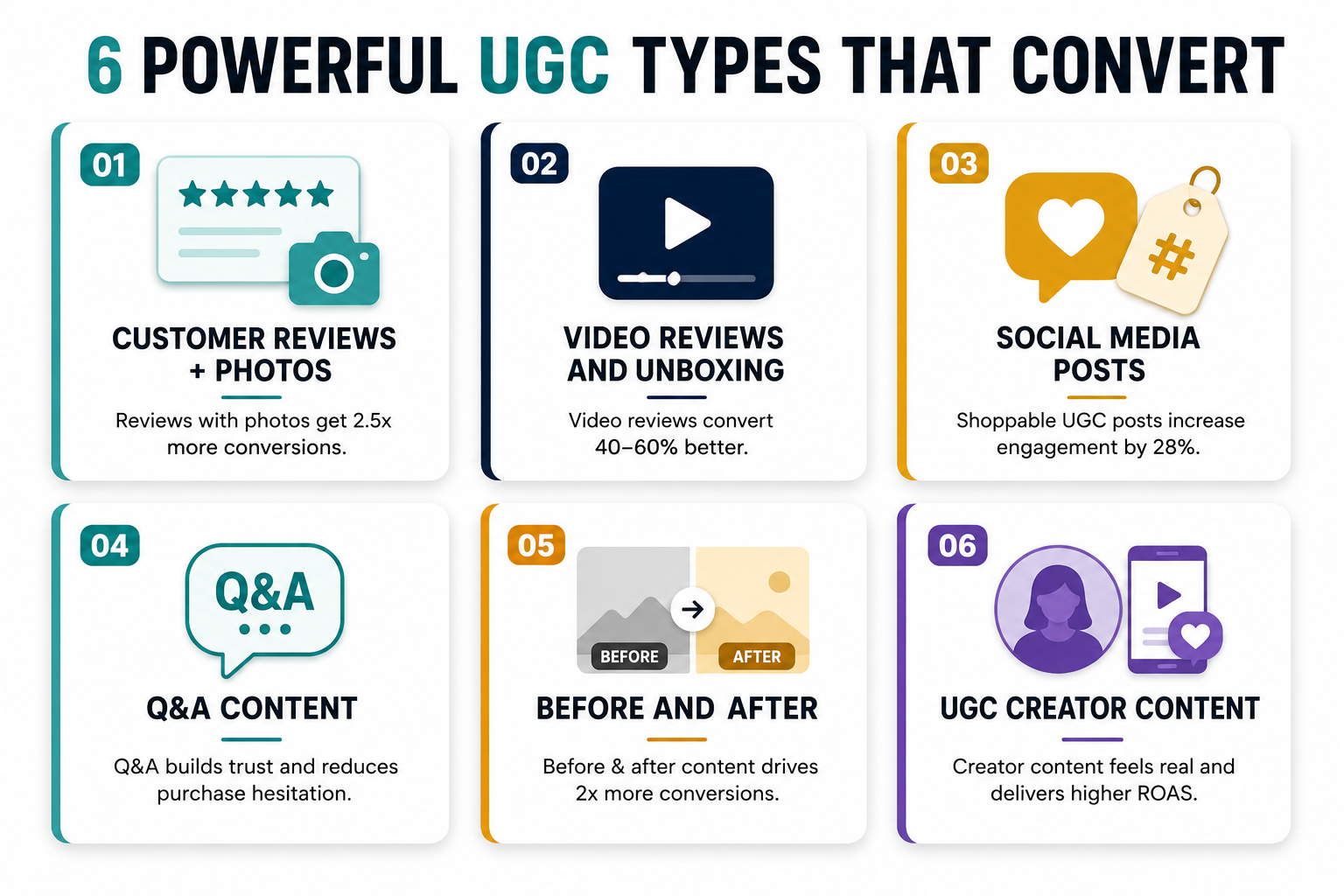
Customer Reviews With Photos
The foundational UGC format for Shopify product pages. Text reviews provide specific, searchable information about product performance. Photos transform text claims into visual evidence. The combination consistently generates the highest conversion lift of any single UGC addition.
The Baymard Institute reports that review sections are the most frequently consulted element on product pages by shoppers who eventually convert — more than product descriptions, more than specifications, and more than brand messaging. Detailed reviews that address specific use cases, comparisons with alternatives, or honest assessments of limitations are more persuasive than uniformly positive five-star praise, because they signal authenticity.
Customer Video Reviews and Unboxing Content
Video reviews convert at 40 to 60% higher rates than text reviews for the same products. The combination of showing the product in use, demonstrating its size and quality through physical interaction, and hearing a real voice describe the experience creates the closest approximation to an in-store try-on or product demonstration that online shopping can offer.
Unboxing videos are particularly high-performing UGC for products where the delivery and packaging experience is part of the brand proposition. For premium or gift-oriented products, an unboxing video that shows thoughtful packaging reinforces the purchasing decision at the exact moment the customer is most emotionally engaged.
Social Media Photos and Posts
Organic customer photos tagged on Instagram, TikTok, Facebook, and Pinterest are among the highest-value UGC available because they were created with no brand prompting and therefore carry the strongest authenticity signal. A customer who spontaneously photographed their new skincare shelf, tagged the brand, and wrote an enthusiastic caption has provided a stronger endorsement than any amount of paid creative.
Almost 28% of ecommerce marketers consider Instagram the top platform for generating the most engaging UGC. TikTok follows closely for brands in categories with strong organic creator communities — beauty, fitness, food, home decor, and fashion in particular.
Q&A Content From Existing Customers
Q&A sections on product pages — where potential buyers ask questions and existing customers answer them — create a form of peer-to-peer consultation that is uniquely persuasive. When a shopper reads an answer from another customer rather than from the brand, the information carries a different weight even when the answer is identical in content.
Q&A content also has strong SEO value. Customer questions are phrased in natural language that mirrors how people search — making product page Q&A sections a reliable source of long-tail keyword content that improves organic ranking without any additional writing effort from your team.
Testimonials and Before-and-After Content
For products with transformation outcomes — fitness, skincare, wellness, home improvement — before-and-after testimonials are among the most persuasive content formats available. They answer the core purchase question of every motivated buyer — does this actually work? — with visual evidence that no product description can replicate.
The authenticity requirement is particularly important for before-and-after content. Artificially enhanced or staged transformation imagery generates backlash when discovered and actively damages trust. Genuine customer transformations, imperfect and specific, consistently outperform polished alternatives.
UGC Creator Content
The structured end of the UGC spectrum — commissioned from creators who produce authentic-feeling content for a fee — has grown into a significant content category in 2026. UGC creators are not traditional influencers promoting products to their own audiences. They create content that looks like organic customer content, specifically designed to be used in paid advertising, product pages, and email campaigns rather than on the creator's own social channels.
Close to 75% of US companies are expected to use some form of influencer or creator marketing by the end of 2026. Nano and micro-influencers — creators with 1,000 to 100,000 followers — deliver 60% higher engagement rates and more cost-effective UGC creation than macro-influencers because their audiences are more tightly targeted and their content feels more relatable.
How to Collect UGC at Scale: The Systems That Work
The most common UGC collection failure is passive hoping — brands that post a branded hashtag, wait for organic content to appear, and wonder why the volume never materializes. Systematic collection requires deliberate mechanisms at multiple customer touchpoints.
Post-Purchase Email Sequences
The highest-volume UGC collection channel for most Shopify stores is a post-purchase email sequence that asks for reviews and photos after the customer has had adequate time to use the product. The timing depends on your product category — a skincare product that takes four weeks to show results needs a different review request timing than a kitchen gadget that is used the same day it arrives.
The review request email with the highest response rates combines three elements: a genuine expression of appreciation that does not feel automated, a specific ask that tells the customer exactly what you want ("Share a photo of how you are using it"), and a direct link to the review submission page that requires zero navigation. Every additional step between a customer's willingness to leave a review and the act of submitting it costs you a percentage of completions.
For Shopify stores, Klaviyo handles this sequence natively through behavioral triggers. Set the review request to fire seven to fourteen days after the fulfillment confirmation, depending on your product's use cycle, and include a secondary send to non-openers at seven days after the first email.
Branded Hashtags and Social Campaigns
A branded hashtag gives organic UGC a home and makes it discoverable. The hashtag should be short, unique, and memorable — not your brand name itself, but a phrase that customers would naturally use in the context of showing their purchase. Allbirds uses #weareallbirds, which creates a community framing that invites customers to identify with the brand through the content they share.
Active hashtag campaigns that incentivize posting — a discount on the next order, entry into a monthly giveaway, or featured placement on the brand's social channels — generate significantly higher UGC volume than passive hashtag promotion alone. The incentive does not need to be large to be effective. The recognition of being featured by the brand is itself a meaningful reward for many customers.
On-Site Review Prompts With Photo Upload
Making photo submission easy and prominent in the review form dramatically increases the rate of photo-attached reviews. A review form that requires a customer to locate, resize, and upload a photo through a complex interface generates far fewer photo reviews than one where the photo upload is a single tap on mobile with automatic image handling.
The review apps listed below all include mobile-optimized photo submission that removes friction from the upload process. On mobile specifically — where the majority of review submissions happen in 2026 — a one-tap photo selection from the camera roll that uploads instantly is the difference between 10% photo review attachment rates and 30%+ rates.
Post-Purchase Packaging Inserts
A physical insert in the shipping box asking for a review or social share, with a specific hashtag or QR code linking to the submission page, reaches customers at the peak moment of product excitement — the unboxing. Customers who are physically holding your product and feel positively about the experience are more likely to act on an immediate review request than one that arrives days later via email when the initial excitement has faded.
The most effective inserts are not generic "Please review us" cards. They are specific invitations: "Show us how you style it with #brandhashtag for a chance to be featured" or "Snap your first unboxing and get 15% off your next order." Specificity converts significantly better than generic appreciation.
Loyalty Programs Rewarding UGC Actions
Integrating UGC actions into your loyalty program creates a systematic incentive for content creation that compounds over time. Loyalty points for submitting a review, uploading a photo, or sharing a post with the branded hashtag convert your existing customer base into a consistent content production engine.
Smile.io and Rivo — the leading Shopify loyalty apps — both support custom point actions for UGC submissions. A setup where customers earn 50 points for a text review and 150 points for a photo review creates a tiered incentive that naturally increases photo submission rates without requiring any additional manual effort once configured.
Where to Deploy UGC on Your Shopify Store
Collecting UGC is only the first step. The conversion impact comes from strategic deployment across every touchpoint where a shopper is making a purchase decision.
Product Pages: The Highest-Impact Deployment
Product pages are where UGC produces its most measurable conversion lift. The placement principles that maximize impact are:
Review count and star rating visible above the fold, adjacent to the product title or price — seen by every visitor before any scrolling. Customer photo gallery embedded in or adjacent to the product image gallery — showing real-world use alongside the professional product shots. A Q&A section below the main product information that addresses common questions with answers from existing customers. Full review content accessible through a scroll or tab on the same page, not a redirect to a separate reviews page.
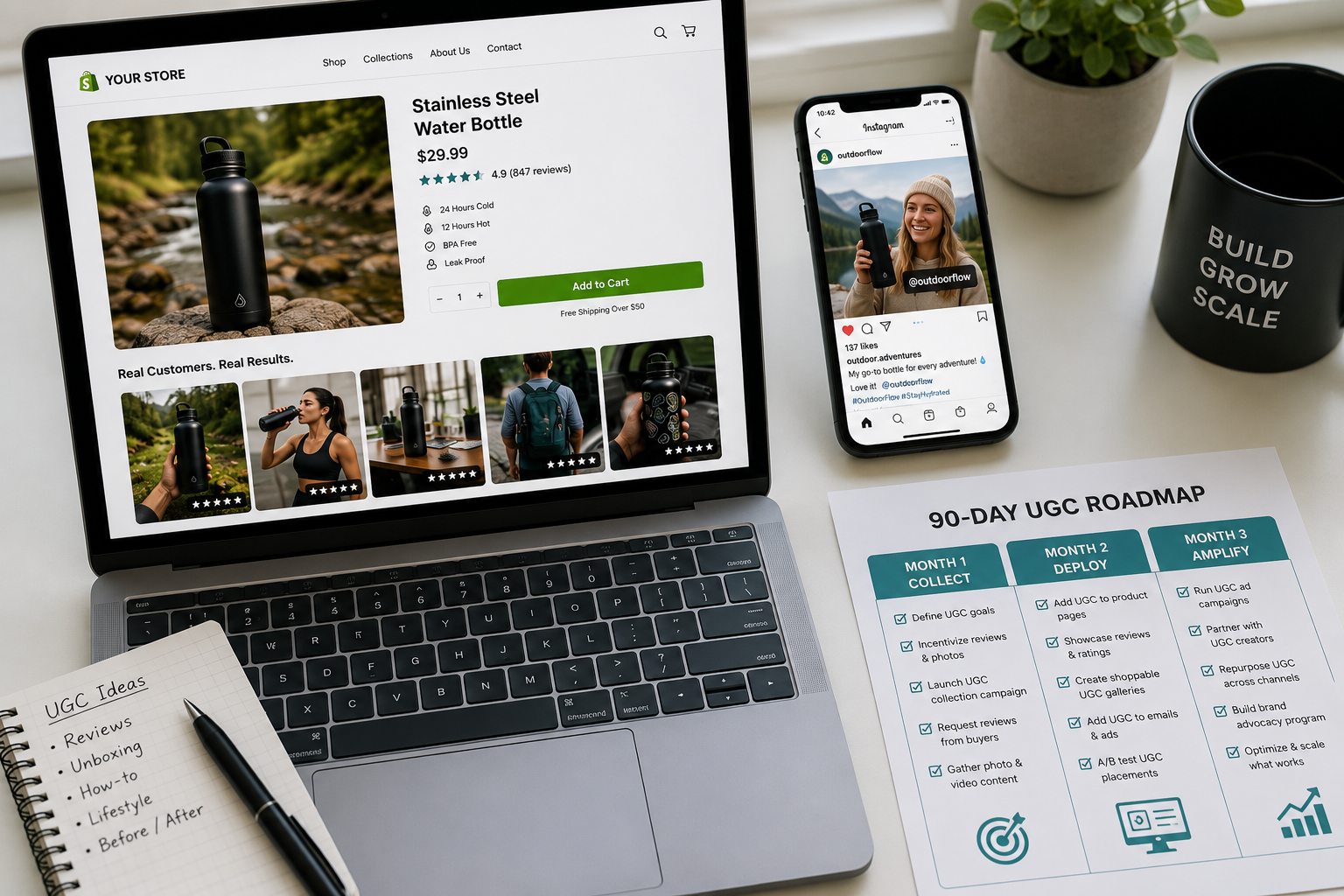
The sequencing matters. A new visitor lands on your product page with zero trust in your brand. The review count and rating are the first trust signal they encounter. The customer photos show them what the product looks like in real life. The Q&A section answers the specific question they have that neither the product description nor the photos addressed. By the time they reach the add-to-cart button, they have encountered three separate forms of peer validation. This is the architecture of a high-converting product page.
Meta and TikTok Ads: UGC Creative Outperforms Brand Creative
UGC-style video ads outperform polished brand creative by approximately 48% on click-through rate and 26% on cost per acquisition in Meta's Advantage+ Shopping Campaigns. The reason is audience response — UGC content does not trigger the ad-recognition response that causes people to mentally discount the content before engaging with it. It looks like something a friend might have posted, which is exactly why it performs better than something that obviously looks like an ad.
The most effective UGC ad format for Shopify in 2026 is a 30 to 60 second video starting with a genuine customer problem statement — "I tried every moisturizer for dry skin and nothing worked until..." — followed by authentic product use and a visible outcome. No branded intro cards. No professional voiceover. Raw camera quality. Real lighting.
Repurposing your highest-engagement organic customer content as paid creative is both cost-effective and strategically sound — you are amplifying content that has already proven it resonates with real people rather than investing in brand creative that may or may not connect.
Email Marketing: UGC in Flows and Campaigns
Customer photos embedded in email campaigns increase click-through rates by 73% compared to emails using only brand photography. For abandoned cart emails specifically, including a UGC photo of the exact product the customer left behind — showing a real person using it — adds social proof at the exact moment purchase hesitation is at its highest.
In your post-purchase email sequence, featuring customer testimonials from buyers who match the profile of the email recipient creates the peer comparison that drives repeat purchases. A customer who bought a skincare starter kit and sees a testimonial from someone with the same skin type saying "I finally found my routine" is being shown a version of their own possible outcome.
Welcome flows for new subscribers benefit from UGC-heavy content that establishes trust before the first purchase rather than after. A welcome sequence that includes "What our customers say" sections with specific quotes and photos converts higher than brand-led sequences relying on marketing copy alone.
Social Media: Building Organic Community Presence
Reposting organic customer UGC on your brand's social channels — with explicit permission and customer credit — creates a content feed that reflects genuine customer experience rather than carefully staged brand imagery. Brands that build their Instagram grid primarily around customer content typically generate higher organic engagement rates than those posting only brand-produced photography, because their audience is literally seeing themselves and people like them reflected in the brand's own channels.
Instagram Stories featuring customer UGC — reposts with the original customer's handle and a genuine response from the brand — build the kind of parasocial relationship between brand and community that drives organic advocacy at scale.
Paid Google Shopping and Display Ads
Seller ratings — the aggregate review score that appears directly beneath your brand name in Google Shopping results — are fed by your Shopify review platform. A product listing showing 4.8 stars and 847 reviews consistently outperforms the same listing with no reviews or lower ratings, even when pricing is similar.
Ensure your review platform syncs with Google's seller ratings program. Yotpo, Okendo, Judge.me, and Stamped all support Google seller ratings integration. The SEO and paid search impact of seller ratings on click-through rate and Quality Score makes this integration one of the highest-ROI technical configurations available for stores running Google Shopping campaigns.
The Best Shopify UGC Apps in 2026
The UGC app landscape has matured significantly. These are the tools delivering the most comprehensive capabilities for Shopify merchants in 2026.
Judge.me is the highest-value review platform for most Shopify stores. At $15 per month for the Pro plan, it includes unlimited reviews, photo and video review submission, Q&A functionality, Google seller ratings sync, and native Shopify integration with automatic post-purchase review request emails. The free plan covers basic text reviews with no photo capability. Judge.me's review widget is the most customizable in its price tier, fitting cleanly into any Shopify theme without developer intervention.
Okendo is the premium standard for DTC brands investing seriously in social proof. Its reviewers are uniquely rich — shoppers can tag product attributes in their review (perfect for showing which color or size a reviewer purchased), which significantly increases review relevance for browsers filtering by specific variants. Okendo's integration with Klaviyo, Gorgias, and loyalty apps makes it the strongest choice for brands building a connected marketing stack. Pricing starts at $19 per month.
Yotpo is the enterprise UGC platform on Shopify, offering reviews, visual UGC galleries, loyalty programs, and SMS marketing in a unified platform. The full feature set requires a higher investment than Judge.me or Okendo, making it most appropriate for brands doing above $500,000 in annual revenue where the cross-feature integration value is meaningful.
Stamped.io sits between Judge.me and Yotpo in capability and cost. Strong review collection, photo galleries, a Net Promoter Score tool, and Google seller ratings integration. Particularly good for stores wanting review analytics and UGC performance tracking beyond what basic platforms provide.
For UGC galleries specifically — shoppable photo and video grids displaying customer content on product pages and homepages — Tagshop (formerly TagEmbed) and Loox specialize in the visual commerce layer. Loox is the most widely used photo review app on Shopify, with a particularly clean gallery widget that integrates without theme modification. Tagshop's 2026 update added AI-powered content ranking that surfaces the highest-converting UGC first rather than displaying content chronologically.
Building a UGC Strategy That Compounds: The 90-Day Framework
A UGC strategy that delivers compounding returns requires treating content collection as an ongoing operation rather than a one-time campaign. The framework that produces sustainable results runs in a 90-day cycle.
Month one is infrastructure. Install your chosen review platform, configure the post-purchase email sequence with photo submission prompts, establish your branded hashtag, and set up loyalty points for review submission. Do not try to collect or deploy simultaneously — get the collection system working first.
Month two is collection and initial deployment. Your first wave of post-purchase emails begins returning reviews. Deploy what you receive immediately on product pages. Do not wait for a critical mass of reviews before publishing — a product with 12 reviews is already more trustworthy to a new visitor than a product with zero reviews. Set up the UGC gallery on your highest-traffic product pages.
Month three is amplification. Take your highest-quality customer photos and video reviews and test them as paid creative on Meta. Feature your strongest testimonials in your abandoned cart email sequence. Create a "Customer Stories" section on your homepage. Start the process of building a systematic content library organized by product, use case, and customer type.
Beyond 90 days, the system becomes self-reinforcing. Reviews attract new customers who leave more reviews. UGC ads perform better than brand creative, generating more sales from more customers who generate more UGC. The collection rate increases as your review request emails reach more customers. Your UGC library grows in volume and diversity, enabling increasingly precise matching of customer content to buyer intent throughout the funnel.
Moderation and Permission: The Rules That Matter
Publishing customer content without explicit permission is both a legal risk and a trust risk. Every piece of UGC you use in paid advertising, email campaigns, or prominent on-site placement requires documented consent from the creator.
Most review platforms automatically obtain permission through their terms of service when a customer submits a review — the submission itself grants usage rights within defined parameters. For organic social media UGC collected through branded hashtags or direct messaging, explicit written permission is required before using content in paid advertising.
The practical mechanism for obtaining permission is simple: send a direct message to the original poster with a specific description of how you intend to use their content, and request their consent with a clear "Reply with YES to approve." Document the approvals. This process protects you legally and frequently generates additional goodwill — customers are often excited to see their content featured by a brand they love.
Content moderation — reviewing submitted UGC for quality, relevance, and compliance with your guidelines before publishing — is a weekly operational task that prevents low-quality or inappropriate content from appearing on your product pages. Most review platforms include a moderation queue that holds submissions for approval before they go live, allowing review without requiring immediate manual intervention.
The Competitive Reality of UGC in 2026
Investment in UGC has doubled since 2021, with 67% of retailers planning to increase UGC budgets further over the next twelve months. The global UGC platform market is growing at 29.7% CAGR, from $7.10 billion in 2026 to a projected $43.87 billion by 2032.
The brands that have built systematic UGC collection and deployment as a core operational function — not a marketing campaign — are building a compounding asset that improves in value every month. A review library with 5,000 reviews and 800 customer photos is not just more persuasive than one with 50 reviews — it is structurally more difficult for a competitor to replicate, because the time required to accumulate genuine customer evidence cannot be shortcut with budget.
The Shopify brands starting this year have the advantage of beginning with the tools, strategies, and best practices refined by the brands that built these systems over the past four years. The starting point is lower friction than ever. The compounding returns are unchanged.
Start with one collection mechanism — a post-purchase email with a photo upload prompt. Deploy what you collect immediately on your product pages. Measure the conversion difference between product pages with customer photos and those without. That measurement will tell you everything you need to know about whether to invest more.
Need help setting up a UGC collection and deployment system for your Shopify store, or want an expert to audit your current product pages for social proof gaps? Get in touch with EcomFixify — we specialize in Shopify development and conversion rate optimization for growing brands.