
How to Use Klaviyo With Shopify to Grow Your Email Revenue by 30%
Most Shopify store owners install Klaviyo, set up a basic welcome email, and consider themselves email marketers. Then they check their Klaviyo dashboard once a month, see some open rates, and move on to whatever feels more urgent. How to Use Klaviyo With Shopify to Grow Your Email Revenue
That is not email marketing. It is email presence. And there is a significant difference between the two.
Email marketing done correctly — with proper segmentation, behavioral flows, predictive analytics, and a revenue attribution model that tells you exactly which emails are generating sales — should account for 25 to 45% of your total Shopify revenue. Brands operating in that range are using Klaviyo the way it was built to be used. Brands below 20% have an underperforming email program that is leaving compounding monthly revenue on the table.
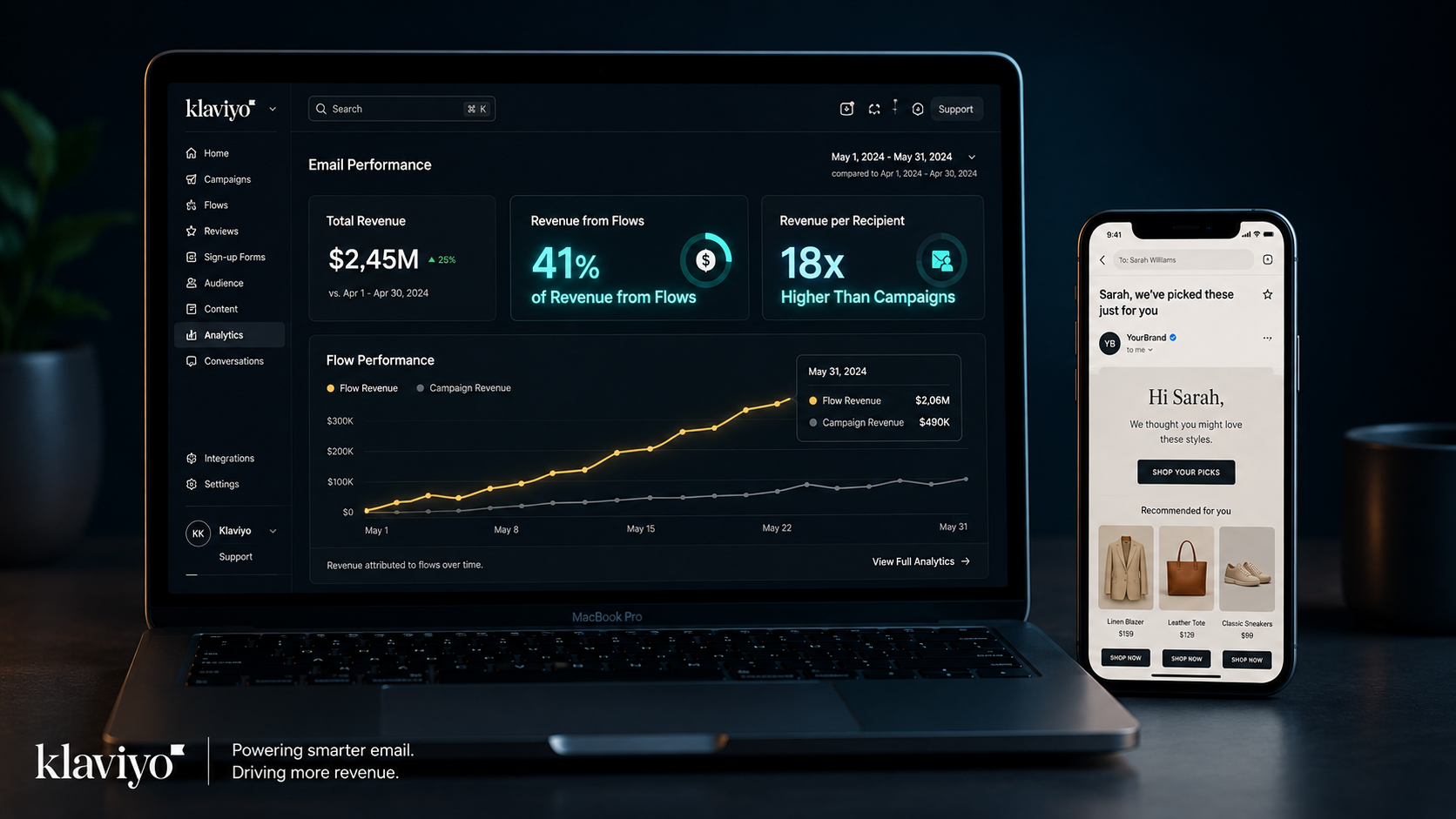
Klaviyo's own 2026 benchmark data, drawn from more than 183,000 active brands, shows that automated flows generate approximately 41% of total email revenue from just 5.3% of email sends. Revenue per recipient on flows runs approximately 18 times higher than on standard campaign emails. The implication is clear: most Shopify stores have their email effort backwards — they send too many campaigns and build too few flows, which inverts the ratio that actually generates revenue.
This guide covers how to connect Klaviyo to Shopify correctly, which features actually move revenue, how to build the segmentation and flows that generate consistent returns, and the specific optimizations that push email contribution above 30% of total store revenue.
Why Klaviyo Is the Right Platform for Shopify Stores in 2026
Before getting into setup and strategy, understanding why Klaviyo specifically — rather than Shopify Email, Mailchimp, or any other alternative — is the right choice for Shopify stores at meaningful scale clarifies every decision that follows.
Klaviyo is not built for sending emails. It is built for generating revenue from customer behavioral data. That distinction is fundamental and it explains why the platform consistently outperforms alternatives for ecommerce.
The core difference between Klaviyo and Shopify's native email tool is revenue attribution. Shopify Email shows you opens and clicks. Klaviyo shows you exactly which email — which specific flow, which specific send, which specific segment — drove which specific purchase, at what order value, for which customer. That granularity transforms email from a channel you manage by feel into a channel you manage by evidence.
Klaviyo's integration with Shopify passes event-level order data in real time — within 200 milliseconds of each customer action according to Klaviyo's own technical documentation. Product page views, add-to-cart events, checkout starts, purchases, and refunds all flow into Klaviyo automatically and are available for segmentation and flow triggering within seconds of occurring. This real-time behavioral data is the raw material from which every high-performing Klaviyo strategy is built.
Shopify holds a significant equity stake in Klaviyo, which explains why the integration is deeper than any competitor can replicate and why Klaviyo is Shopify Plus's officially recommended email solution. That relationship means Shopify's development roadmap and Klaviyo's feature development are coordinated rather than parallel — which gives Klaviyo merchants access to Shopify data and functionality that other email platforms simply cannot reach.
Step 1: Connect Klaviyo to Shopify Correctly
The integration between Klaviyo and Shopify is straightforward, but doing it correctly from the start prevents data gaps that silently undermine your flows and segmentation.
In your Shopify admin, navigate to Apps and search for Klaviyo in the Shopify App Store. Install the official Klaviyo Email Marketing and SMS app and authenticate with your Klaviyo account. During setup, Klaviyo will ask which historical data to sync — select all available historical data, including customer records, order history, and product catalog. This historical sync is critical for predictive analytics to function correctly: Klaviyo's lifetime value predictions and churn risk scores require purchase history to generate meaningful forecasts, and accounts synced without historical data start from a blank slate that takes months of live data to recover.
Once the integration is live, verify that the following events are firing correctly by placing a test order on your Shopify store and checking Klaviyo's Activity Feed for the corresponding events: Placed Order, Ordered Product, Fulfilled Order, and Cancelled Order. Also verify that Viewed Product and Added to Cart events are tracking correctly — these require the Klaviyo tracking snippet to be installed on your Shopify theme, which the app handles automatically on Shopify Online Store 2.0 themes but may require manual verification on older or heavily customized themes.
Step 2: Migrate Transactional Emails to Klaviyo
This is the most overlooked setup step in Klaviyo for Shopify and the one with the highest immediate impact on email performance visibility.
Shopify's native transactional emails — order confirmation, shipping notification, delivery confirmation — are sent from Shopify's infrastructure and are invisible to Klaviyo's analytics. You cannot see who opened them, who clicked them, or how they influence subsequent purchase behavior. You cannot add cross-sell product blocks, customize the design beyond Shopify's limited editor, or use them as behavioral triggers for follow-up flows.
Migrating these transactional emails to Klaviyo changes all of that. Transactional emails consistently generate the highest open rates of any email type — order confirmations average 70 to 80% open rates because customers are actively looking for them. An email achieving a 75% open rate that you cannot measure or optimize is a significant missed opportunity.
In Klaviyo, create flows for Order Confirmation, Shipping Notification, and Delivery Confirmation using Shopify's corresponding event triggers. Disable the equivalent emails in Shopify's notification settings to prevent duplicates. The Klaviyo versions of these emails give you full design control, revenue attribution on every click, the ability to add dynamic product recommendation blocks, and the option to trigger follow-up flows based on customer behavior within the email.
Step 3: Build Segmentation That Actually Drives Revenue
Klaviyo's segmentation capabilities are the feature that most fundamentally separates it from every alternative — and most Shopify merchants use approximately 10% of what is available.
Klaviyo segmentation is not tag-based or condition-based in the traditional sense. It is behavioral and predictive — built on what customers have actually done, what they are predicted to do next, and what their engagement patterns suggest about their relationship with your brand.
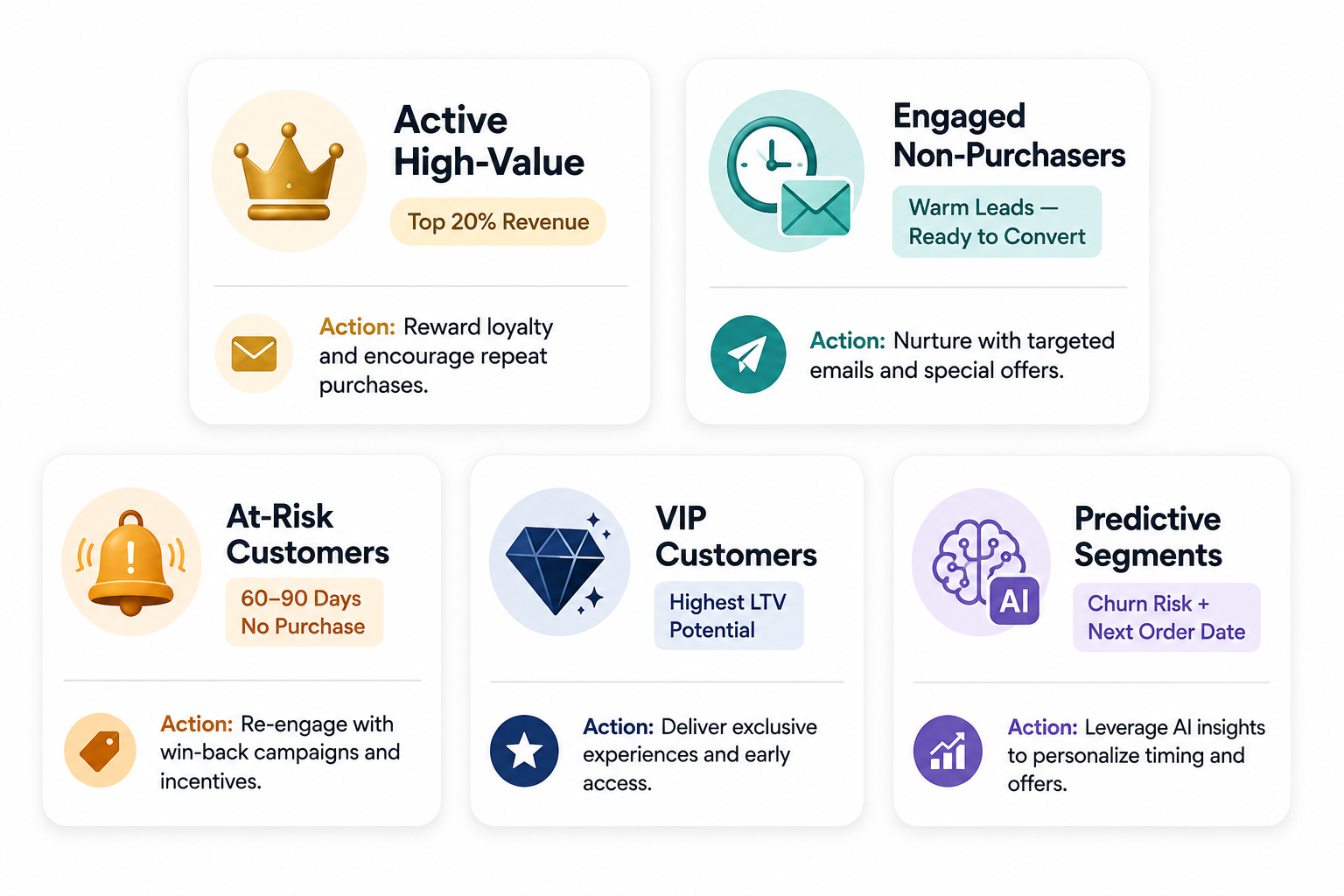
The five segments that generate the most immediate revenue improvement when properly configured are:
Active high-value customers are your top-spending customers who have purchased within the past 90 days. This segment receives your highest-frequency campaigns, early access to new products, and loyalty program communications. These are your most profitable customers at their most engaged — they deserve more communication, not less.
Engaged non-purchasers are subscribers who have opened or clicked emails in the past 30 to 60 days but have not yet made a purchase. These are warm leads who are familiar with your brand but have not yet converted. They respond well to social proof emails, educational content, and purchase-incentive offers because they need a final push rather than initial awareness.
At-risk customers have purchased previously but have not engaged with emails or visited your store in 60 to 90 days. This segment is approaching the churn threshold — they are not yet gone, but they are disengaging. Win-back flows and targeted re-engagement campaigns deployed to this segment at the 60-day mark consistently recover 5 to 10% of customers who would otherwise lapse.
VIP customers are defined by cumulative spend above a threshold you set based on your average order value and expected purchase frequency. These customers have demonstrated the highest lifetime value potential and respond to exclusive treatment — early sale access, dedicated support pathways, and loyalty program tier recognition.
Predictive segments — available through Klaviyo's Predictive Analytics feature — include customers predicted to make their next purchase within the next 90 days, customers at high risk of churning, and customers with predicted lifetime value above a defined threshold. These segments are calculated automatically from your historical data and update in real time as customer behavior changes. They are among the most commercially valuable segments in your entire email program and require no manual maintenance once configured.
Build these five segments in Klaviyo before launching any campaigns. Every email you send performs better when you are sending it to the right segment rather than your entire list.
Step 4: Build the Revenue-Generating Flow Stack
Flows are where Klaviyo generates 41% of its email revenue from 5.3% of sends. Building the right flows in the right order is the highest-leverage action available to any Shopify merchant using Klaviyo.
Rather than repeating the full seven-flow breakdown covered in our earlier blog post on email flows, this section focuses on the Klaviyo-specific features and configurations that maximize flow performance — the things that are unique to Klaviyo rather than universal email marketing principles.
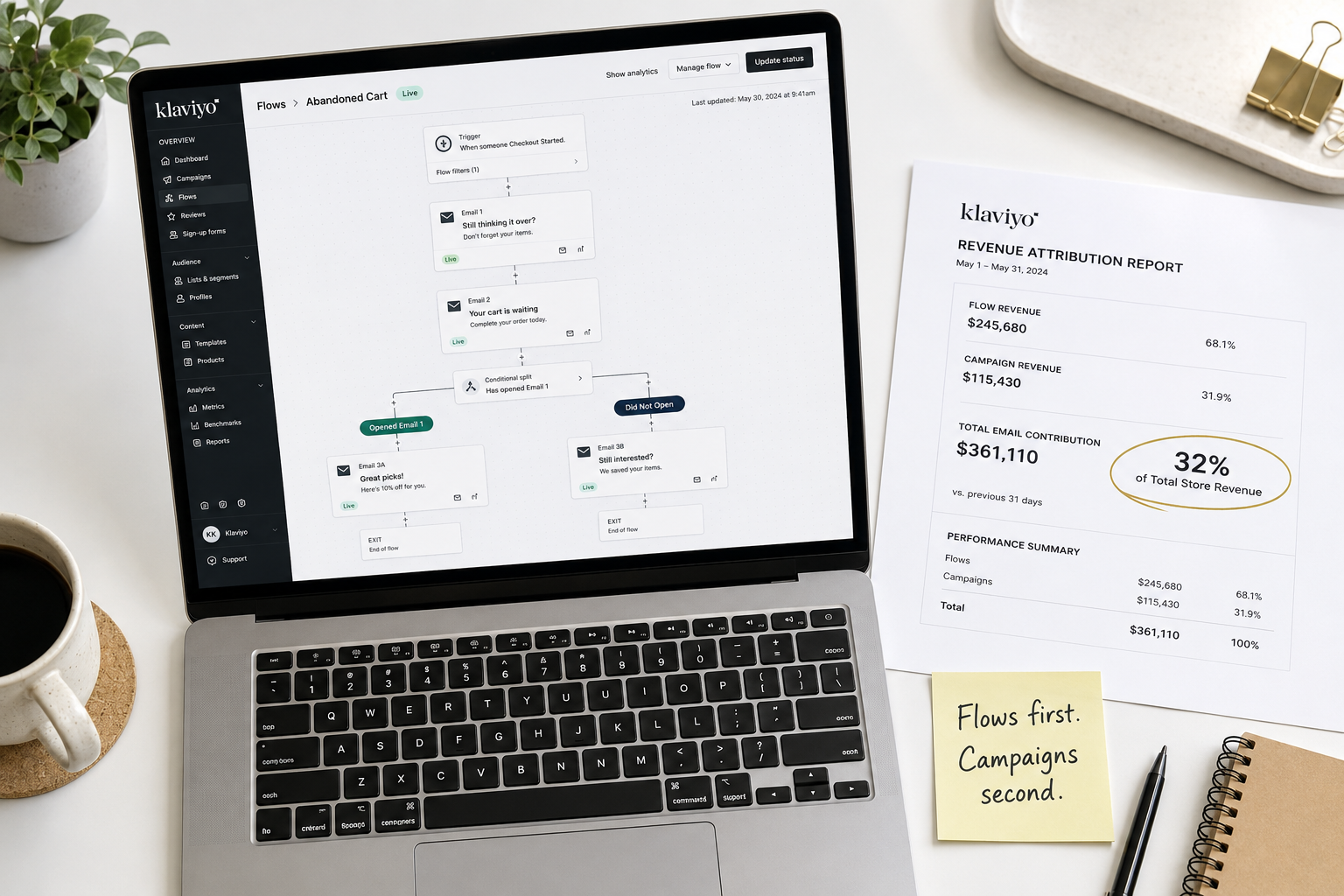
Conditional splits within flows are one of Klaviyo's most powerful features and the one most commonly underused. A conditional split divides a flow's audience at a specific point based on a condition — whether a subscriber has purchased before, what their predicted lifetime value is, whether they opened the previous email, what product category they most frequently browse. Instead of one linear flow that sends the same emails to everyone, conditional splits allow a single flow to send meaningfully different paths to different customer types based on real behavioral signals.
An abandoned cart flow with a conditional split at Email 2 — sending a social proof email to subscribers who opened Email 1 and a stronger re-engagement hook to those who did not — consistently outperforms a linear three-email flow by 15 to 25% on revenue per recipient. The split does not require additional email content creation beyond the variation; it requires configuring the Klaviyo flow logic correctly.
A/B testing within flows allows you to test subject lines, send times, email content, and conditional logic within your automated sequences — not just in campaigns. Most Klaviyo merchants use A/B testing only in campaigns, where the stakes are lower and the audience is colder. Applying A/B tests within flows — where behavioral targeting is strongest and revenue per recipient is highest — generates the most commercially meaningful test data available in your email program.
Smart sending is a Klaviyo setting that prevents a subscriber from receiving more than one email within a configurable time window regardless of how many flows they are enrolled in simultaneously. Without smart sending, a subscriber who makes a purchase might simultaneously receive a welcome email, an abandoned cart follow-up, and a post-purchase email — all within hours of each other. Enabling smart sending with a 16-hour minimum window prevents this and significantly reduces unsubscribe rates among your most active customers.
Flow timing optimization — setting flows to send at times most likely to drive opens and purchases for your specific audience — is available in Klaviyo through its Smart Send Time feature, which analyzes your historical engagement data and recommends the optimal send time for each flow. The difference between a flow email sent at 7am versus 2pm varies by audience, but the Klaviyo-recommended time consistently outperforms arbitrary time selections by 10 to 20% on open rate for accounts with sufficient historical data.
Step 5: Configure Predictive Analytics to Anticipate Customer Behavior
Klaviyo's Predictive Analytics feature is the capability that most clearly separates it from every alternative platform and the one with the highest commercial impact when properly configured and activated.
Predictive Analytics calculates four key metrics for every customer in your Klaviyo account: predicted lifetime value over the next 90 days and 12 months, predicted next order date, predicted total number of orders, and churn risk score. These predictions are derived from your historical data and update automatically as customer behavior evolves.
The commercial application of these predictions is significant. A customer whose predicted next order date is in the next two weeks does not need a discount to purchase — they are coming back regardless. Sending them a discount at this point is pure margin erosion. A customer whose churn risk score is high represents a retention priority — deploying a win-back offer to this customer at the moment their churn risk peaks maximizes the effectiveness of the offer and the likelihood of recovery.
Build segments based on predictive properties and use them to adjust campaign frequency and offer strategy. Your high predicted lifetime value customers receive more frequent, more exclusive communication. Your high churn risk customers receive targeted retention outreach before they actually lapse. Your customers with imminent predicted purchase dates receive relevant product recommendations rather than generic campaigns that interrupt a purchase journey already in motion.
The predictive data also powers Klaviyo's Product Recommendations feature, which generates personalized product suggestions for each customer based on their purchase history and the behavioral patterns of similar customers. These recommendations appear dynamically in email templates — each recipient sees different products tailored to their specific profile — and consistently outperform static product blocks by significant margins because personalized recommendations are genuinely relevant rather than broadly targeted.
Step 6: Revenue Attribution — Understanding What Is Actually Working
Revenue attribution is the single most important capability that Klaviyo provides for Shopify stores and the one that most fundamentally changes how email marketing decisions are made.
Klaviyo's revenue attribution model ties every email interaction — every open, every click, every email-influenced session — to the orders that follow within a configurable attribution window. The default attribution window is five days for email and 24 hours for SMS, which reflects realistic influence windows for most ecommerce purchase cycles.
The revenue attribution dashboard in Klaviyo shows you the revenue generated by each campaign, each flow, and each email within a flow in the past 30 or 90 days. This data answers the questions that matter most for growing email revenue: which flows are generating the most revenue per recipient; which campaigns are contributing meaningful revenue versus just generating opens that do not convert; which segments respond to which types of content with the highest purchase rates; and where email revenue is concentrated so you know where incremental effort will have the most impact.
The industry benchmark for email's contribution to total Shopify revenue is 25 to 45%. Brands below 25% have either an underperforming email program, a list that is not growing, or a disconnect between their email strategy and their customer acquisition sources. The path from 20% email revenue contribution to 30% almost always runs through one of three improvements: building the automated flow stack completely, improving segmentation so campaigns reach the right audience, or improving list growth so the platform is working with more subscriber data.
Use the revenue attribution dashboard monthly to identify your lowest-performing flows and campaigns. The bottom performers in your email program are the ones whose per-recipient revenue is below your account average — and they are almost always underperforming because of segmentation issues, flow logic gaps, or creative that does not match the behavioral signal that triggered the email.
Step 7: List Growth — The Input That Determines Email Revenue Ceiling
Every optimization to your Klaviyo account — better flows, better segmentation, better predictive analytics — produces larger absolute revenue returns as your list grows. The email revenue ceiling of any Shopify store is directly proportional to the size of its engaged subscriber list.
The highest-converting list growth tactics for Shopify stores in 2026 are popup forms with genuine value exchange, post-purchase email capture during checkout for customers who buy as guests, and interactive lead magnets — quizzes, assessments, preference surveys — that collect zero-party data alongside the email address.
Klaviyo's form builder handles popup creation natively within the platform, allowing you to design, target, and A/B test email capture forms without a separate popup app. The forms sync captured emails directly to Klaviyo lists and automatically enroll new subscribers in your welcome flow — eliminating the sync delays and data gaps that occur when popup apps and email platforms operate independently.
The most important list growth principle for Shopify stores is list quality over list size. A list of 10,000 engaged subscribers who have opted in specifically for your brand generates more revenue than a list of 50,000 collected through low-friction giveaway tactics that attracted people interested in winning a prize rather than buying your products. Klaviyo's engagement metrics — open rates above 25%, click rates above 2%, unsubscribe rates below 0.3% — tell you whether your list growth is collecting genuine brand interest or noise.
Suppress and sunset unengaged subscribers proactively. Klaviyo's sunset flow — a re-engagement sequence targeting subscribers who have not opened or clicked any email in the past 120 to 180 days — serves two purposes: it gives genuinely unengaged subscribers one last opportunity to re-engage with a compelling offer, and it identifies the subscribers who need to be suppressed before they damage your sender reputation by being counted as non-openers at scale. A smaller, more engaged list consistently outperforms a larger, less engaged one on every metric that matters.
Step 8: Klaviyo SMS — Extending Email Revenue Into a Second Channel
Klaviyo's SMS capability is the most underactivated feature among Shopify merchants who are already using the platform for email — and the one with the clearest immediate revenue opportunity for stores that have not yet launched it.
SMS through Klaviyo runs in the same flows and segments as email — meaning a single abandoned cart flow can send an email at 30 minutes and an SMS at 4 hours within the same workflow, or a promotional campaign can deploy across email and SMS simultaneously to subscribers who have opted into both channels. The unified management eliminates the complexity and data fragmentation that comes with managing email and SMS through separate platforms.
SMS open rates average 98% compared to 20 to 22% for email, and the response speed is significantly faster — most SMS messages are read within three minutes of delivery. For time-sensitive communications — flash sale announcements, back-in-stock alerts, and abandoned cart recovery within the first few hours — SMS generates urgency that email cannot replicate simply because it is seen faster.
Launching SMS alongside your existing Klaviyo email program typically adds 10 to 15% to your total Klaviyo-attributed revenue within the first 90 days as your SMS subscriber list builds and your SMS flows mature. Combined with a well-built email program contributing 25 to 30% of total store revenue, a fully configured Klaviyo email and SMS operation consistently delivers 35 to 45% of total Shopify revenue — entirely from owned channels that do not depend on algorithm changes, platform fees, or rising advertising costs.
The 30% Email Revenue Benchmark: What It Takes
Growing email's contribution to 30% of total Shopify revenue is not a complex goal — but it requires completing the full stack rather than implementing partial solutions. The merchants consistently operating at or above 30% email revenue contribution share a specific set of characteristics.
They have all core flows built and active. Not one or two flows but the complete stack — welcome series, abandoned cart, browse abandonment, post-purchase, win-back, VIP, and review request — each configured with conditional splits, A/B tests, and smart sending enabled.
They segment every campaign. No email goes to their entire list unless every subscriber is the right audience for that specific message. High-value customers, engaged non-purchasers, at-risk customers, and VIPs each receive different campaigns at different frequencies.
They review attribution data monthly and act on what it shows. Underperforming flows and campaigns are identified, diagnosed, and improved rather than left running at below-average performance indefinitely.
They grow their list consistently. New signup sources are added when traffic sources or store pages present the opportunity. List quality is protected through regular sunset flow execution and suppression of persistently unengaged subscribers.
They have SMS active alongside email. The second channel adds 10 to 15% to Klaviyo-attributed revenue at minimal incremental cost once the email infrastructure is already in place.
None of these requirements is technically complex. Together they represent a disciplined, systematic approach to email marketing that compounds in value with every month of additional data, every new subscriber added, and every flow optimization that improves revenue per recipient across the entire program.
Final Thoughts
Klaviyo is not a tool you install and forget. It is a platform that rewards attention — rewarding merchants who build their flows completely, segment their audience intelligently, review their attribution data regularly, and grow their list with genuine quality.
The 30% email revenue benchmark is achievable for virtually any Shopify store with a functional product, an engaged traffic source, and the willingness to invest the upfront time in building the infrastructure correctly. The merchants who have built that infrastructure consistently describe it the same way: it runs in the background, generates revenue every day without manual intervention, and compounds in value as the platform learns more about their customers over time.
Set up the integration correctly. Build the flows in order. Segment every campaign. Review the attribution. Add SMS when the email foundation is solid. The 30% benchmark is not a ceiling — it is the floor that a fully configured Klaviyo program builds toward.
Need help setting up or optimizing your Klaviyo integration for your Shopify store, or want an expert to audit your current email flows and segmentation for revenue gaps? Get in touch with EcomFixify — we specialize in Shopify development and ecommerce growth strategy for brands ready to build real retention revenue.