
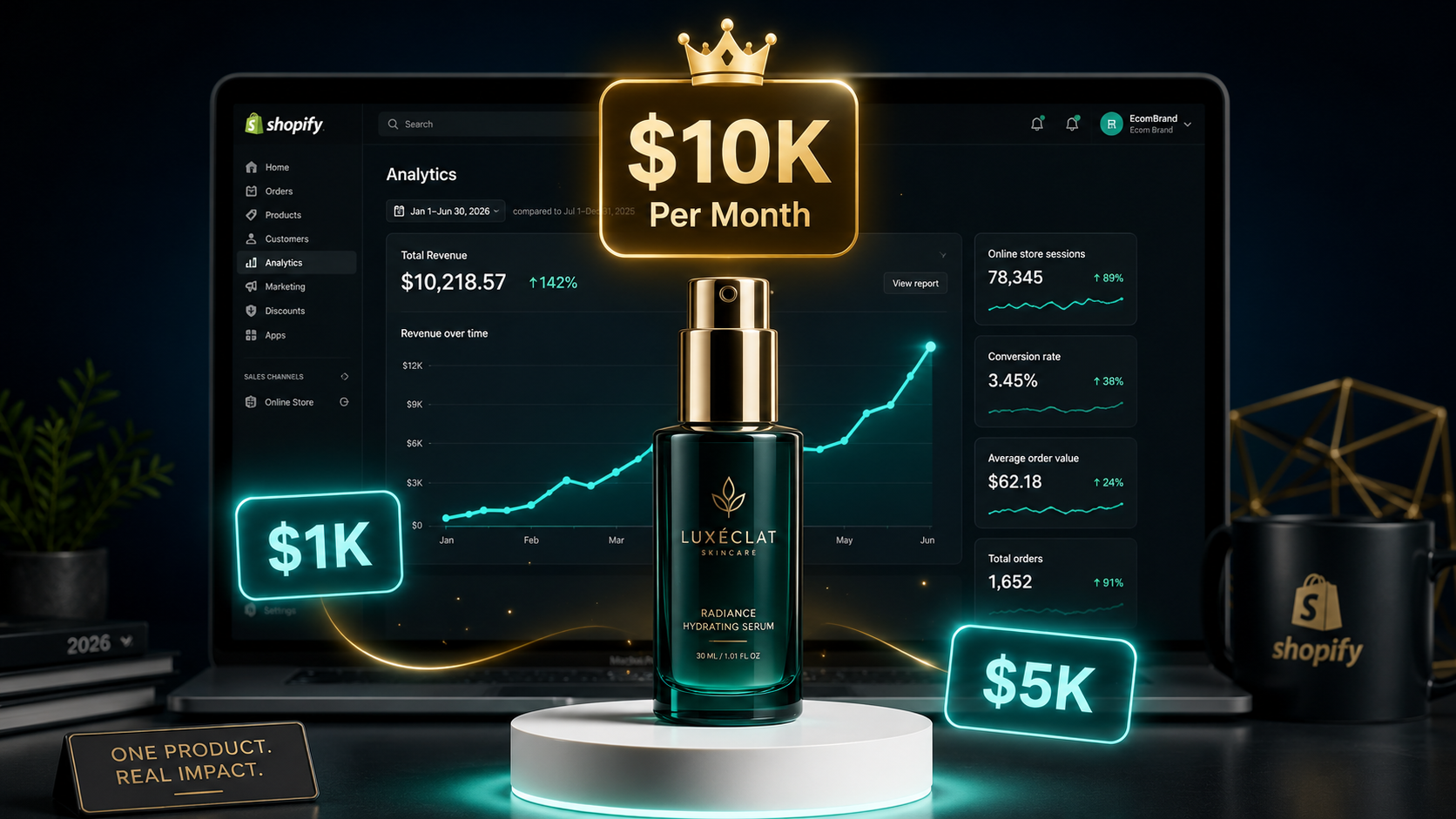
How to Turn One Shopify Product Into a $10K Per Month Business
The conventional wisdom in ecommerce says you need a large catalog, dozens of SKUs, and a wide selection to build a real business. The merchants quietly generating $10,000 to $50,000 per month with a single product are proving that wisdom wrong every day. How to Turn One Shopify Product Into a $10K Per Month Business
Single-product Shopify stores outperform general stores in 2026 in several measurable ways. They convert better because every element of the store — the copy, the design, the social proof, the email flows — is built around one specific customer problem and one specific solution. They scale more efficiently because every marketing dollar goes toward one message, one audience, and one offer. And they build stronger brand recall because customers associate the brand with a single clear outcome rather than a diffuse catalog.
20% of Shopify stores hit $10,000 or more per month after consistent effort and systematic optimization. The gap between the 60% that earn under $1,000 per month and the 20% that reach five figures is not product quality, luck, or a bigger starting budget. It is the presence or absence of a deliberate, stage-by-stage growth system built around a validated product.
This guide is that system. It covers how to select and validate the right product, how to build a store that converts, how to drive traffic without a massive ad budget, and how to optimize the revenue levers that take a working store from $2,000 per month to $10,000 and beyond.
Why Single-Product Stores Work Better Than General Stores in 2026
Before building your strategy, understanding why focus outperforms breadth in ecommerce provides the framework for every decision that follows.
A general store with 200 products has 200 different customer problems, 200 different objections, 200 different use cases, and 200 different sets of search keywords. Marketing a general store means constantly shifting message and audience. The store's homepage tries to be relevant to everyone and ends up feeling relevant to no one.
A single-product store has one customer, one problem, and one solution. The homepage talks directly and exclusively to that customer. The product page addresses every objection that specific customer has. The email flows reference the specific transformation the customer experiences after buying. The ads target the specific audience that has the problem the product solves. Everything compounds in one direction.
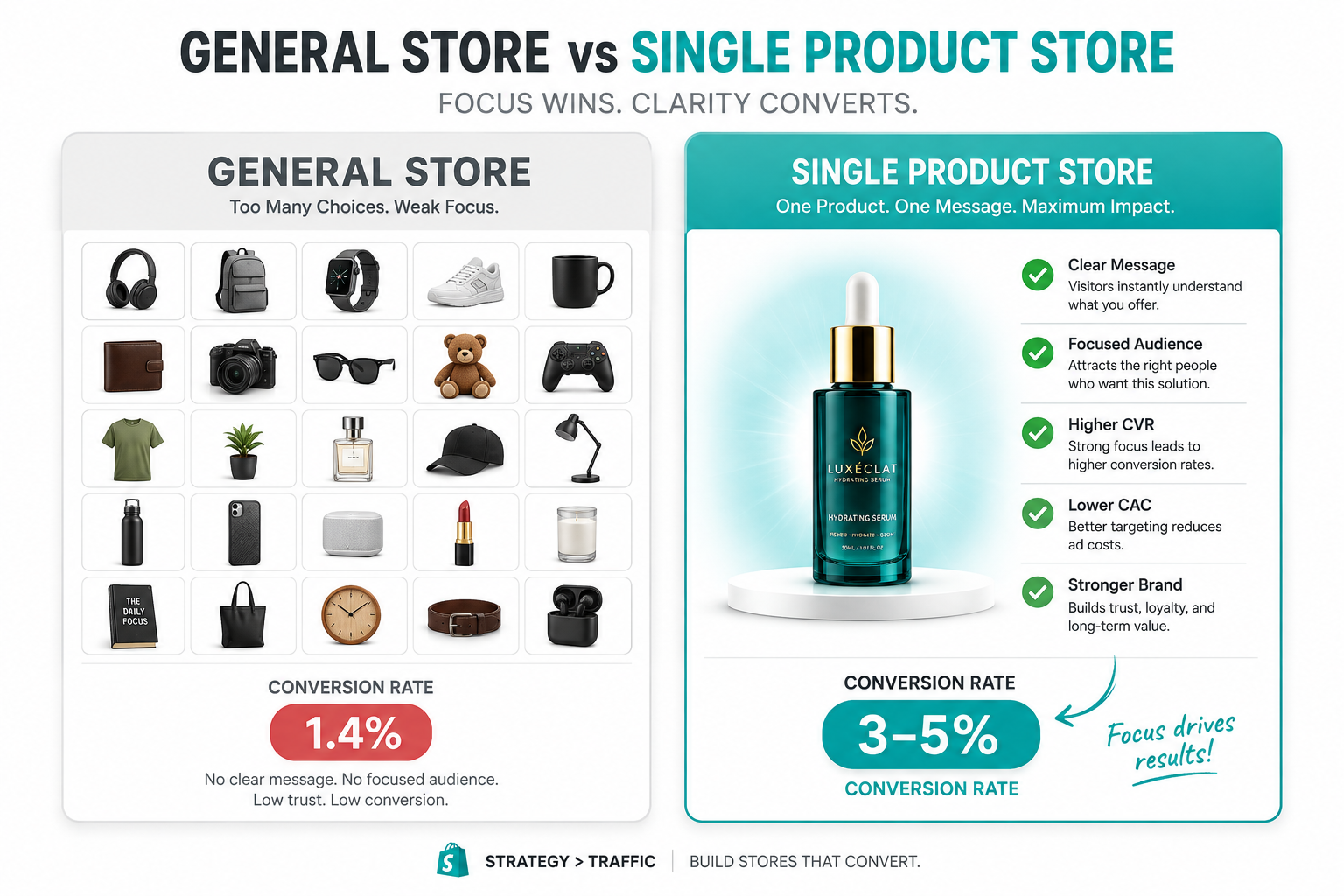
The result is a fundamentally more efficient business. Single-product stores typically achieve conversion rates of 3 to 5% — compared to the 1.4 to 1.8% average for general stores — because the purchase path is frictionless and the messaging is precisely targeted. Customer acquisition costs are lower because the audience is clearly defined and the creative is focused. And brand recall is stronger because the product and the brand become synonymous in the customer's mind.
The ecommerce landscape in 2026 rewards this kind of focus. Consumer attention is fragmented, trust is harder to earn, and the stores that communicate a clear, specific value proposition consistently outperform those offering broad selection without a clear identity.
Step 1: Choosing the Right Product — The Criteria That Matter
Not every product can build a $10,000 per month single-product store. The product selection decision is the most important one you will make, and the criteria that separate scalable single products from ones that plateau are specific and testable.
The product characteristics that correlate with $10K per month potential:
Sufficient margin to support paid acquisition. At $10,000 per month in revenue, you are spending 20 to 35% on marketing — $2,000 to $3,500 per month. Your product needs gross margins above 50% after cost of goods, shipping, and platform fees to sustain profitable customer acquisition at that level. Products with 30% margins cannot absorb the acquisition cost required to scale. Target products where your selling price is three to five times your landed cost.
A clear, demonstrable problem-solution fit. The best single-product store products solve an obvious, specific problem in a way that is immediately visible on camera. Products that transform something — a posture corrector, a skincare tool, a kitchen gadget that solves a specific cooking frustration — generate the UGC and video content that drives organic reach and converts skeptical browsers. If you cannot demonstrate the product's value in 30 seconds of video, it is significantly harder to market in the social-first discovery environment of 2026.
Repeat purchase potential. A product bought once and never again has a customer lifetime value equal to the first order minus acquisition cost. A product that runs out, wears out, or inspires complementary purchases has a customer lifetime value that compounds with each repurchase. At $10,000 per month, your repeat customer rate should be 20 to 30%. Products with natural replenishment cycles — supplements, skincare consumables, specialty foods, household supplies — have structural repeat purchase advantages that discretionary one-time items do not.
Manageable competition in paid and organic channels. Use Google Trends to confirm the product category is growing rather than declining. Check Amazon Best Seller Rank to verify real sales volume exists. Look at Meta Ad Library to see whether brands are running paid ads profitably in the category — active advertising means sustainable margins. If a category has ten entrenched brands with years of customer reviews and significant ad budgets, the entry cost is high. Look for categories where the search volume is validated but the competitive density allows a new entrant to carve out a position.
Not easily found in physical retail. Products available at every Target, Walmart, and pharmacy face an "I'll just pick it up locally" objection that online stores cannot overcome on price or convenience. Products that are hard to find offline — specialty items, emerging categories, niche solutions to specific problems — have a distribution advantage that justifies online purchasing despite shipping costs and delivery times.
Step 2: Validating Demand Before You Invest
The merchants who build $10,000 per month businesses from a single product almost always validated demand before placing their first inventory order. The ones who bought 500 units before confirming anyone would pay for the product learned the same lesson more expensively.
The fastest and most cost-effective validation approach in 2026 uses three data sources in sequence.
First, Google Trends. Search your product category and look for a consistent upward trend over the past two to three years, not a spike that has already declined. Confirm the category is in growth mode and that search interest holds across multiple seasons rather than peaking once. Check the Interest by Region data to identify which markets show the strongest demand — this informs where you target your initial traffic.
Second, Amazon Best Seller Rank. Find the three to five most similar products on Amazon and note their BSR in their primary category. A BSR between 1,000 and 50,000 in a broad category indicates genuine, consistent sales volume — typically several units per day. A BSR above 100,000 suggests low sales velocity, which may indicate insufficient demand. Read the one-star and three-star reviews of the top sellers — they tell you exactly what customers dislike about current solutions, which is your product positioning opportunity.
Third, a pre-sale or minimum-viable test. Before ordering significant inventory, create a basic Shopify store with your product page, drive 200 to 500 visitors through TikTok organic content or a small Meta Ads test budget of $200 to $500, and measure add-to-cart rate and purchase intent. An add-to-cart rate above 8% and any actual purchases from cold traffic confirms you have a real product-market fit. The cost of this test is the single best investment you will make in the product selection process.
Step 3: Building a Store That Converts at 3% or Higher
At $10,000 per month with an average order value of $65, you need approximately 154 orders per month — or roughly five orders per day. With a 3% conversion rate, that requires around 5,100 monthly visitors. With a 1.5% conversion rate, you need 10,200 visitors for the same revenue. Doubling your conversion rate halves the traffic you need — which halves your customer acquisition cost at any given traffic channel.
Single-product store design in 2026 is built around a specific hierarchy that removes every obstacle between a visitor's first impression and their purchase decision.
The homepage of a high-converting single-product Shopify store opens with a headline that names the specific problem the product solves and the specific person it solves it for. Not "premium quality" or "revolutionary design" — but "The Portable Posture Corrector That Eliminates Desk-Job Back Pain in 10 Days." The subheadline adds the mechanism or the proof. The hero section contains a video that shows the product working, not glamour shots of the product sitting on a surface.
Below the hero: social proof numbers — units sold, customer reviews, press mentions — that signal this is not a new or unproven product. A three-step "how it works" section that makes the product feel simple to use. Featured reviews with photos, ideally showing the product in use and the result it produced. A strong FAQ section that addresses every common objection — shipping time, return policy, compatibility, and any product-specific concerns your customer research revealed.
The product page for a single-product store is effectively a long-form sales page. It should be the most conversion-optimized page on your store and should answer every question a reasonably skeptical buyer would have before purchasing. The add-to-cart button should be sticky on mobile, visible without scrolling on desktop, and surrounded by trust signals — guarantee statement, shipping information, and payment security badges.
Shopify themes specifically designed for single-product stores — Streamline, Spotlight, and Craft — provide page structures optimized for this format without requiring custom development. All three support video heroes, long-form product narratives, and mobile-first layouts that maintain conversion performance across devices.
Step 4: The Math to $10K Per Month
Before investing in traffic, knowing the exact numbers required to reach your target is essential — because it tells you whether your current conversion rate and average order value make the goal achievable at a traffic level and cost per click you can actually afford.
The basic formula: Monthly Revenue Goal ÷ Average Order Value = Monthly Orders Required. Monthly Orders Required ÷ Conversion Rate = Monthly Visitors Required.
At $10,000 per month with a $65 AOV and a 2.5% conversion rate:
$10,000 ÷ $65 = 154 orders per month 154 ÷ 0.025 = 6,160 visitors per month
At a $1.50 cost per click from Meta Ads, reaching 6,160 visitors costs approximately $9,240 in ad spend per month — which leaves negative margin on $10,000 in revenue. This is why conversion rate optimization and AOV improvement must precede traffic scaling.
Improve the conversion rate to 3.5% and the visitor requirement drops to 4,400. Improve AOV to $85 through an upsell or bundle offer and the order requirement drops to 118. The combination — 118 orders at 3.5% conversion — requires 3,370 visitors per month. At $1.50 CPC, that costs $5,055 in ad spend, leaving $4,945 in gross revenue before COGS — a workable margin.
This math exercise is the most important planning tool a single-product store operator can use. Run it before scaling any traffic channel, and use it to identify which lever — conversion rate, AOV, or cost per click — has the highest impact on your specific path to $10,000 per month.
Step 5: Driving Traffic — The Three Channels That Work in 2026
Single-product stores in 2026 reach $10,000 per month through a combination of three traffic channels, typically in this sequence: TikTok organic first, then Meta Ads, then email-driven repeat purchase revenue.
TikTok organic is the starting channel for most successful single-product stores in 2026 because it offers discovery reach to zero-follower accounts that no other platform provides. A brand-new TikTok account posting product demonstration videos — showing the product solving the specific problem it addresses — can reach tens of thousands of viewers within days without any advertising spend. The algorithm distributes content based on engagement signals, not follower count, which means a compelling product with a clear visual demonstration can generate meaningful traffic and first sales before a single dollar of paid advertising is committed.
The content formula that works for single-product stores on TikTok is straightforward: short-form videos between 15 and 60 seconds, showing the product being used in a realistic context, with the problem named in the first three seconds and the solution visible within the first ten. Before-and-after formats, "I tried this for 30 days" formats, and reaction formats where the creator expresses genuine surprise at the result consistently outperform scripted product showcase videos. Post three to five times per week with consistent framing rather than randomly experimenting with formats.
Meta Ads become the primary scaling channel once two conditions are met: you have a product page converting above 2.5% from cold traffic, and you have enough customer purchase data — typically 50 or more orders — for Meta's algorithm to build an effective lookalike audience. The campaign structure for a single-product store at this stage is a single Advantage+ Shopping Campaign with a UGC-forward creative pool and a 60-day purchaser exclusion. Budget between $30 and $100 per day to start and scale in 20 to 30% increments every four to five days once ROAS stabilizes above your break-even threshold.
Email revenue is the third channel — and the one that ultimately determines whether you reach $10,000 per month sustainably or plateau below it. At $10,000 per month, email should contribute 25 to 35% of total revenue through automated flows — welcome series, abandoned cart, post-purchase, and browse abandonment — running in the background without manual intervention. Building your email list from day one through a popup offering a discount or lead magnet is not optional. Every visitor who leaves without purchasing is a lost opportunity unless you have captured their email address and have a mechanism to bring them back.
Step 6: Increasing Average Order Value — The Lever Most Merchants Miss
At $10,000 per month, revenue growth through traffic alone requires proportionally more visitors, more ad spend, and more content. Revenue growth through AOV improvement requires none of those things — it generates more revenue from the customers you already have.
The three AOV improvement tactics that work specifically for single-product stores:
Bundle offers — two or three units of the same product at a discount — are the most natural upsell for a product with repeat purchase potential. "Buy 2, get 15% off" or "Family pack — 3 units" converts exceptionally well for consumables where customers already plan to repurchase. A customer who buys three units upfront has three times the AOV of a single-unit purchaser and does not need to be reacquired for the next two purchase cycles.
Complementary product additions are the entry point to expanding beyond a single product without losing focus. If you sell a posture corrector, a lumbar support cushion is a natural addition that serves the same customer solving the same problem. If you sell a specific skincare tool, the cleanser or serum that works with it belongs in a bundle offer. These additions are not catalog expansion — they are AOV optimization for the single customer your brand serves.
Post-purchase one-click upsells — offered immediately after the initial checkout is completed — convert at 15 to 25% without any checkout friction because the customer has already entered their payment information and the additional purchase is processed without re-entering it. Shopify's native checkout extensions support post-purchase offer pages, and apps including Rebuy and ReConvert handle the implementation with pre-built templates.
Step 7: Building the Retention System That Makes $10K Sustainable
Reaching $10,000 per month once is an achievement. Sustaining it month over month while growing requires a retention system that generates repeat purchases without proportional increases in acquisition cost.
At the $10,000 per month milestone, your repeat customer rate should be 20 to 30%. Below 20%, you are on a customer acquisition treadmill — constantly spending to replace customers who buy once and never return. Above 25%, your customer acquisition cost is partially subsidized by repeat revenue, which means each new customer acquired is more profitable than the first-order economics suggest.
The three retention mechanisms that matter most for single-product stores:
A post-purchase email sequence — a thank you email immediately after purchase, a usage tips or onboarding email on day three, a review request on day seven, and a replenishment or cross-sell recommendation on day fourteen — increases repeat purchase rate by 15 to 25% compared to no post-purchase communication. This sequence runs automatically in Klaviyo once built and requires no ongoing maintenance.
A subscribe-and-save option for consumable products converts 10 to 20% of single-purchase customers into recurring subscribers — the highest-LTV customer segment available to any Shopify store. At $10,000 per month, even 50 subscribers at $50 per month generates $2,500 in baseline recurring revenue that exists regardless of new customer acquisition performance in any given month.
A loyalty program that rewards repeat purchases with points redeemable for discounts on future orders creates a structural incentive to return that most single-product stores do not implement until later than they should. A simple points-on-purchases program through Smile.io or Rivo takes under an hour to configure and immediately gives returning customers a reason to choose your store over a competitor whose product is similar.
The Milestone Roadmap: From First Sale to $10K Per Month
The path from zero to $10,000 per month for a single-product Shopify store in 2026 has three distinct phases, each with different priorities.
Phase one — zero to $2,000 per month — is about proof of concept. At this stage, the only things that matter are finding a product that converts from cold traffic, establishing one working traffic channel, and collecting the first customer reviews and UGC that form the social proof foundation for everything that follows. Do not invest in paid advertising until your store converts above 2% from organic traffic. Spend this phase fixing your product page, improving your imagery, and collecting reviews.
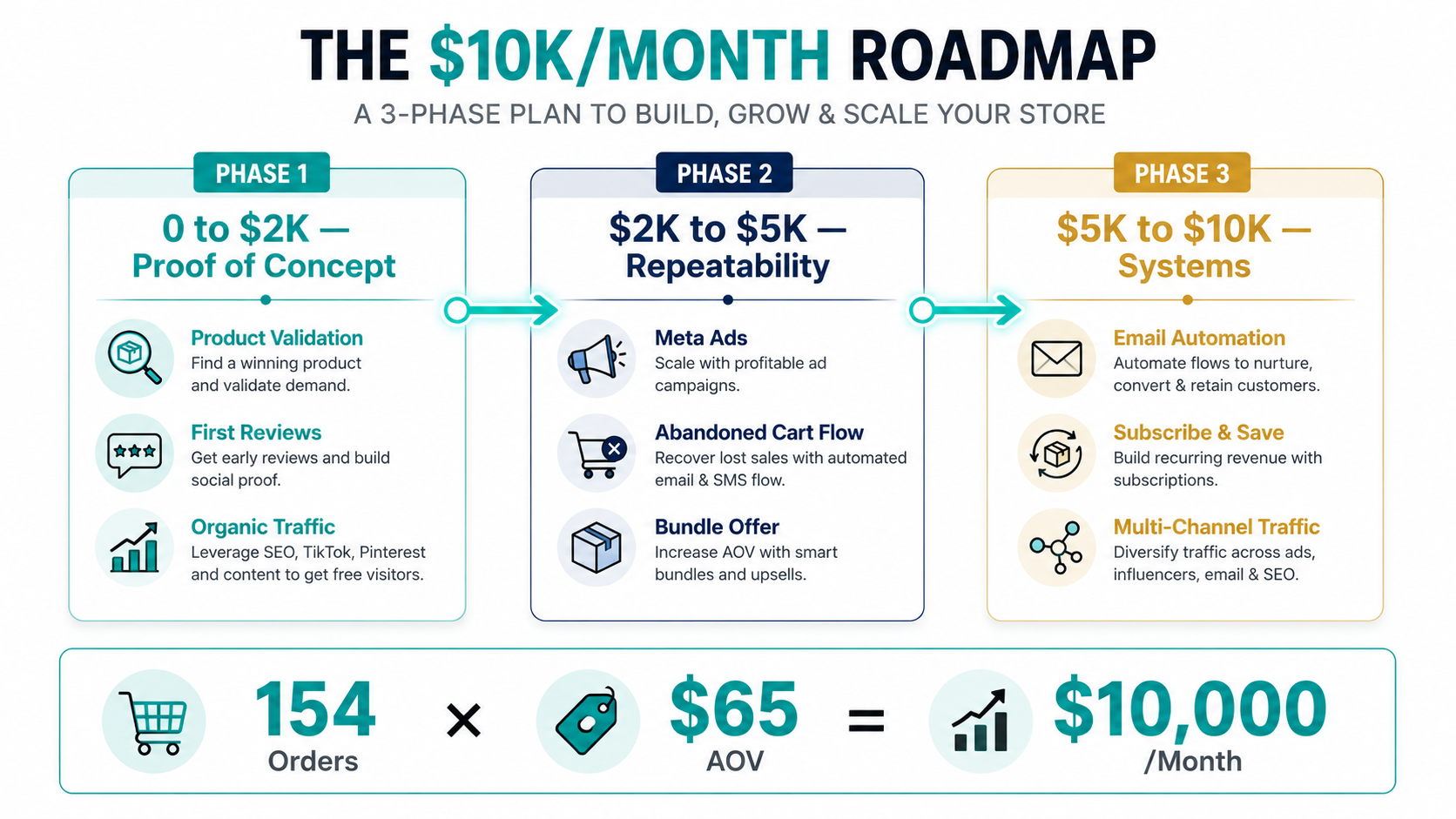
Phase two — $2,000 to $5,000 per month — is about repeatability. You have a product that sells. The question is whether you can acquire customers at a cost that leaves profitable margin. At this stage, introduce Meta Ads at a conservative daily budget, optimize your abandoned cart flow, and implement your first AOV improvement — either a bundle offer or a post-purchase upsell. Your repeat customer rate at this stage should be reaching 15%.
Phase three — $5,000 to $10,000 per month — is about systems and optimization. This is where the focus shifts from hustle to infrastructure. Diversify traffic by adding a second channel — Pinterest for visual products, Google Shopping for high-intent search traffic, or TikTok Shop for impulse-driven categories. Optimize your email program to contribute 25 to 35% of monthly revenue. Introduce a subscribe-and-save option. Run your first A/B test on your hero headline and your product page CTA.
The average Shopify store that applies systematic conversion optimization before scaling ad spend grows 30% faster year-over-year in its first three years than stores that scale traffic into an unconverted store. The sequencing matters as much as the tactics.
Real Single-Product Brands That Prove This Works
Blendjet launched as a single product — a portable blender — with a clear problem-solution fit and a strong visual demonstration angle. Their TikTok and Instagram content showed the blender being used in gyms, offices, and outdoor settings by real people, generating organic reach that funded their paid acquisition. They scaled to eight figures in annual revenue before expanding their product line — proving the single-product model can reach significant scale before diversification becomes necessary.
Crossrope built its business around a single category — weighted jump ropes — with a specific customer: adults who wanted high-intensity workouts without gym access. Their entire content and email strategy addressed that single customer. Their post-purchase onboarding sequence converted first-time buyers into committed athletes who associated the brand with their fitness identity rather than just a piece of equipment. They consistently exceed $10,000,000 in annual revenue from a product category that their competition would describe as niche.
Neither brand required a large starting budget, a seasoned marketing team, or proprietary technology. Both required a specific product, a specific customer, and a systematic approach to converting awareness into purchase and purchase into loyalty.
Final Thoughts
The $10,000 per month milestone is not a mystery. It is a math problem with a known solution — and the inputs to that solution are a product with sufficient margin, a store that converts above 2.5%, a traffic system that acquires customers at a cost the margin can support, and a retention system that generates repeat revenue without proportional increases in acquisition spend.
Single-product stores are not a shortcut. They are a focus strategy. The same effort, creative energy, and marketing budget that a general store spreads across dozens of products is concentrated on one — and that concentration is what produces the conversion rates, brand clarity, and customer relationships that general stores cannot replicate.
Pick the right product, validate before you invest, build a store that eliminates every purchase friction, drive traffic through organic content before scaling with paid ads, increase your AOV with a single bundle offer, and build a retention system before you need it.
Those six steps are the entire roadmap. The merchants generating $10,000 per month from a single product are not doing anything more complex. They are doing these six things more consistently, more patiently, and with more attention to the data that tells them what is working and what is not.
Need help building or optimizing a single-product Shopify store for maximum conversion and scalable growth? Get in touch with EcomFixify — we specialize in Shopify development and ecommerce growth strategy for brands at every stage.