
How to Sell on Shopify With No Money for Ads
Paid ads are sold as the default path to Shopify sales. Install the Meta Pixel, set up a campaign, watch the orders roll in. The problem is that reality rarely matches the pitch. Customer acquisition costs have risen more than 60% since 2020. Competition on every major ad platform increases every quarter. And a new store with no brand recognition, no customer reviews, and no proven creative is competing against established merchants with months of campaign data and optimized funnels. How to Sell on Shopify With No Money for Ads
The merchants who build sustainable Shopify businesses in 2026 are not necessarily the ones spending the most on ads. Many of the most durable ecommerce brands grew their first $10,000, $50,000, and $100,000 in monthly revenue entirely through organic channels — and they built an owned audience in the process that no algorithm change or ad cost increase can take away.
Organic traffic is the lowest customer acquisition cost available. You do not pay per click. The traffic compounds over time rather than stopping the moment your budget runs out. And the customers it generates — who found you through a search, a TikTok video, a Pinterest pin, or a community recommendation — typically have higher purchase intent and higher lifetime value than customers acquired through interruptive advertising.
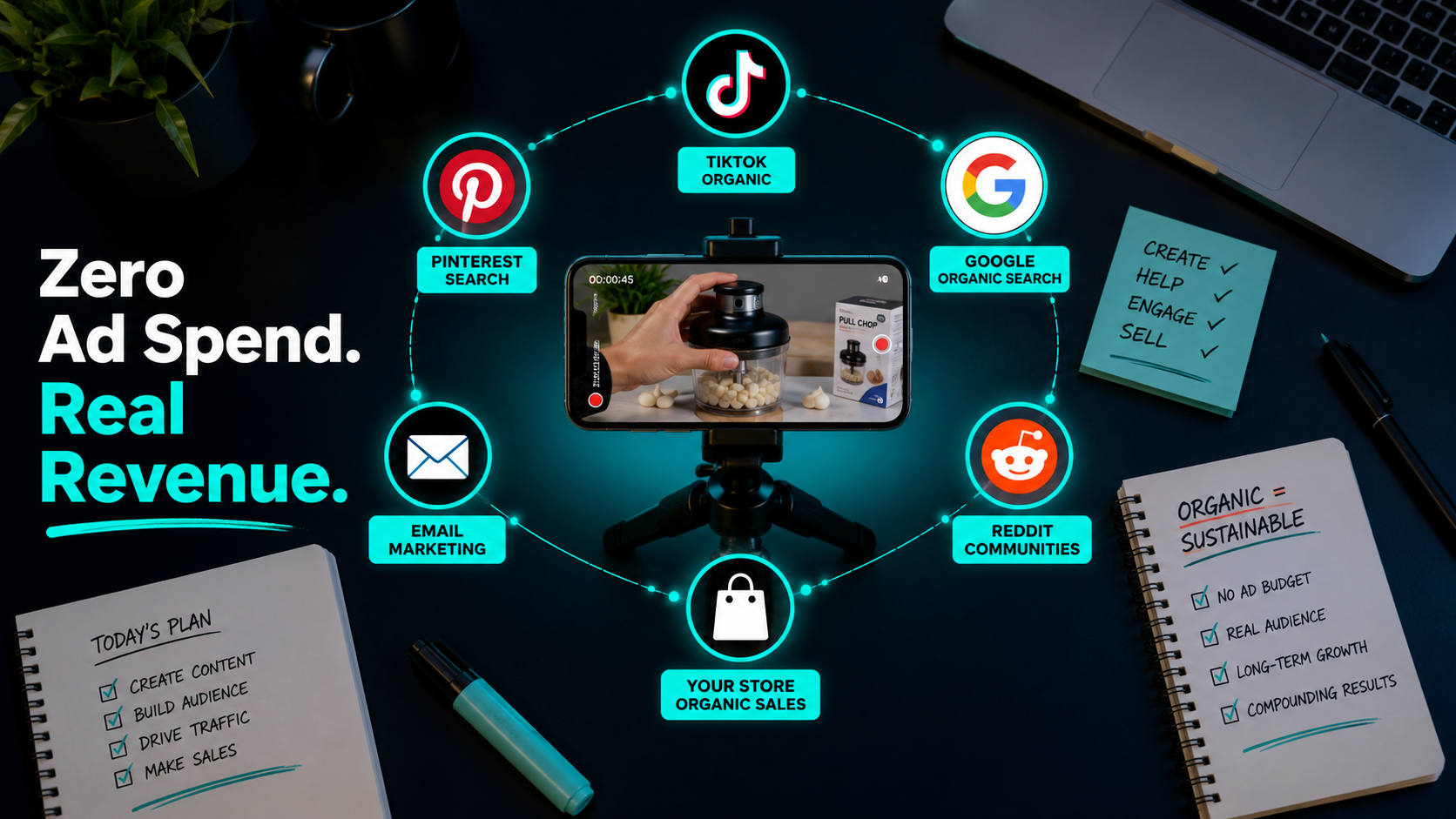
This is the complete organic traffic playbook for Shopify stores in 2026 — six channels, realistic timelines, and the specific tactics that actually generate sales rather than just impressions.
The Honest Timeline: What Organic Traffic Actually Looks Like
Before diving into specific channels, setting realistic expectations prevents the most common organic traffic mistake — abandoning a strategy before it has time to compound.
Paid ads generate traffic immediately. Organic channels work differently. TikTok is the fastest organic channel — stores posting daily typically see initial traction within two to four weeks. Pinterest generates initial traction within four to eight weeks. SEO and blog content typically takes three to six months to produce measurable search traffic. Email marketing generates returns proportional to list size, which itself takes time to build.
The correct response to these timelines is not to default to paid ads — it is to start organic channels now, maintain consistency, and let them compound while you build. A store that starts TikTok organic in month one and SEO in month two will have meaningful free traffic flowing by month four or five. A store that waits for paid ads to become affordable will still be waiting while competitors build organic audiences that do not cost them anything to maintain.
Stores reaching $10,000 to $50,000 per month purely through organic typically post 60 or more TikTok videos monthly, publish weekly blog content, and maintain active Pinterest accounts. The volume sounds intimidating until you realize that a 30-second TikTok video shot on a smartphone and a 1,000-word blog post are the primary units of work — neither requiring expensive equipment, agency support, or production teams.
The overhead for a full organic traffic stack runs approximately $50 to $80 per month in app and tool costs — compared to $2,000 or more monthly for a paid ads operation generating similar traffic volume. The trade-off is time investment rather than financial investment. For merchants with more time than budget, organic is not just an option — it is the smarter choice.
Channel 1: TikTok Organic — The Fastest Free Traffic Source
TikTok's algorithm is the most democratic distribution system in the history of social media. A brand new account with zero followers can post a video today and have it seen by 50,000 people tomorrow if the content resonates. That is categorically not possible on Instagram, Pinterest, or Google — all of which favor established accounts and accumulated authority.
For Shopify merchants, TikTok organic works best for products that are visually demonstrable — products that can be shown solving a problem, delivering a transformation, or producing a result on camera. Kitchen gadgets, skincare products, fitness equipment, pet products, home organization tools, and beauty accessories are among the highest-performing categories on TikTok organic because the content writes itself. The product is interesting to watch.
The content formats that consistently drive Shopify traffic and sales through TikTok organic in 2026:
Problem-solution videos show a relatable frustration in the first three seconds, then demonstrate your product resolving it. The hook must be the problem — not your brand name, not a product feature, not a welcome message. A kitchen gadget video that opens with "I was spending 20 minutes chopping vegetables every night" has a hook. A video that opens with your store logo does not.
Before-and-after content is the highest-converting format for products with visible results — skincare, cleaning products, home renovation items, organizational tools. The transformation itself is the content. A before-and-after that takes 15 seconds to show needs no voiceover, no graphics, and no editing beyond the cut between the two states.
Day-in-the-life and routine content integrates your product into an authentic lifestyle rather than presenting it as an advertisement. A morning routine video that happens to feature your supplement, your skincare product, or your organizational system reaches viewers in a consumption mindset rather than a skeptical advertising mindset.
Trend participation — using a trending sound, format, or challenge and adapting it to your product — dramatically expands reach because TikTok's algorithm amplifies trending content to audiences beyond your existing followers. The key is natural adaptation rather than forced integration. If the connection between the trend and your product requires explanation, it is not the right fit.
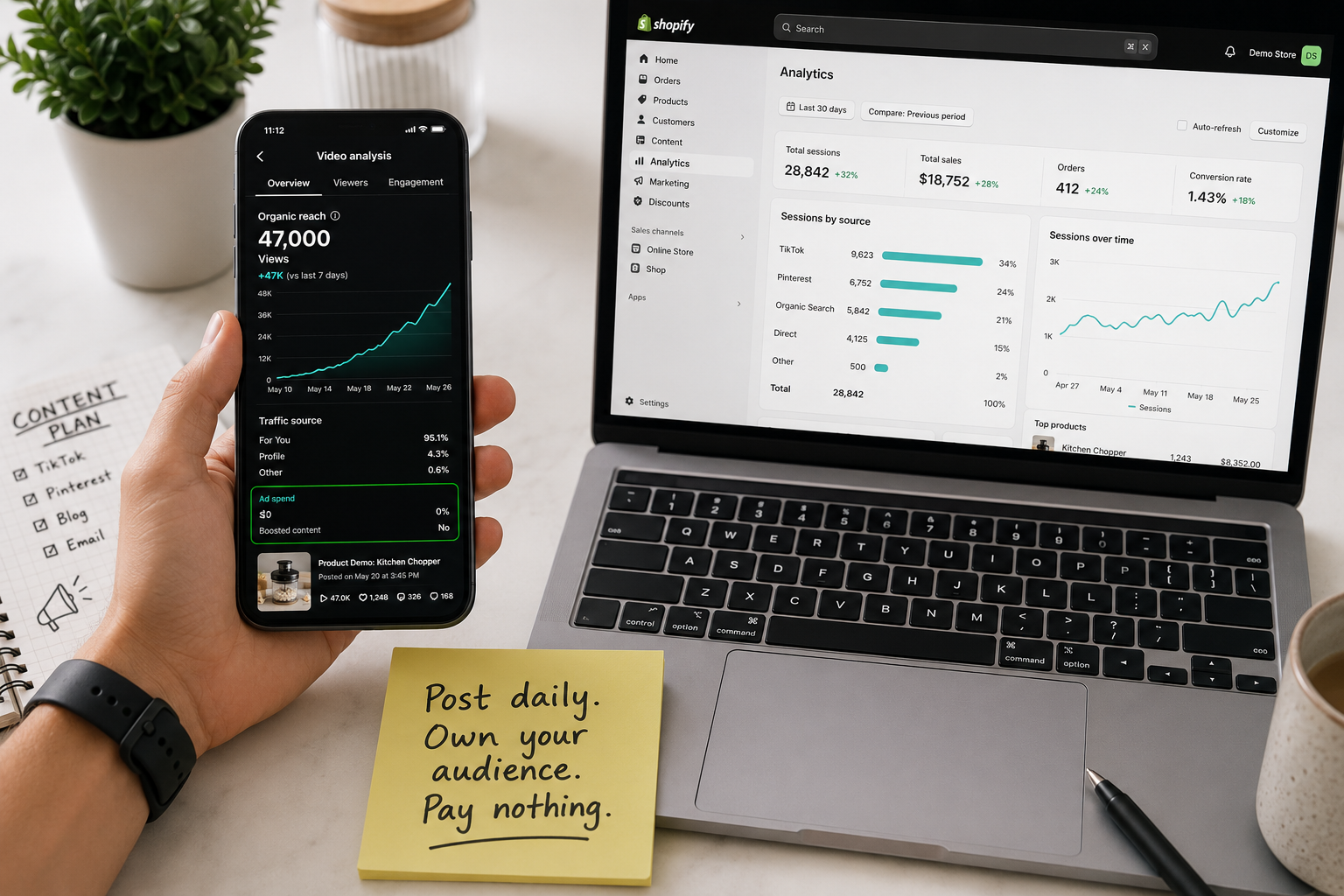
The practical posting frequency that produces results on TikTok organic is one to three videos daily. This volume sounds unsustainable until you recognize that most successful TikTok organic Shopify stores are producing raw, smartphone-shot content in batches — filming ten videos in two hours on a Saturday and scheduling them throughout the week. Production value is irrelevant on TikTok. Authenticity and relevance are everything.
Connect your Shopify store to TikTok Shop so products featured in your organic videos can be directly purchased without leaving the app. The friction elimination between a viewer seeing a product in a video and completing a purchase is the single biggest conversion advantage TikTok Shop provides over driving traffic to an external Shopify URL.
Channel 2: Pinterest — The Evergreen Discovery Engine
Pinterest occupies a unique position in the organic traffic landscape. It is a visual search engine — not a social network — which means content posted on Pinterest does not have the 48-hour relevance window that social posts do. A well-optimized Pinterest pin can drive traffic to your Shopify store for months or years after it was first published.
A kitchen gadget dropshipping store using Pinterest as its primary traffic channel reported $8,200 per month in revenue from 47 product pins and 12 blog-to-pin pieces — with no ad spend and approximately five hours per week maintaining the account. That is the compounding nature of Pinterest in practice: each pin that performs adds to a base of evergreen traffic that grows as more pins accumulate.
Pinterest users are in a distinctly different mindset from other social platform users. They are actively planning — planning a home renovation, planning a fitness transformation, planning a recipe, planning a wardrobe update. That planning intent makes them 10 times more likely to purchase compared to users on other social platforms. For Shopify stores in home décor, fashion, beauty, food, fitness, and lifestyle categories, Pinterest is often the highest-converting organic traffic source available.
The Pinterest strategy that drives consistent Shopify traffic in 2026:
Rich Pins are the technical foundation. Rich Pins automatically pull product title, description, and price information from your Shopify store and display it directly on your pin. When inventory or pricing changes in Shopify, the pin updates automatically. Enable Rich Pins through Pinterest's validation tool using your Shopify store's domain — it takes under ten minutes and immediately makes your product pins more informative and shoppable.
Keyword optimization is how your pins get discovered. Pinterest functions like Google — users search for specific terms and Pinterest returns the most relevant, best-optimized content. Your pin titles and descriptions should include the specific phrases your target customer would search for. Not "cozy blanket" but "chunky knit throw blanket for living room couch" — the longer, more specific phrase that signals exactly what you are offering.
Board strategy organizes your content for both algorithm clarity and user navigation. Create specific, keyword-rich boards around each product category you sell — not a single "Products" board, but individual boards for each distinct category. Pinterest's algorithm uses board membership to understand what each pin is about and show it to relevant searchers.
Consistency compounds on Pinterest in a way that is different from TikTok. Posting five to ten pins per week — a mix of product pins, blog-to-pin content, and lifestyle imagery — builds domain authority on Pinterest progressively. After three to four months of consistent posting, accounts typically see a step-change in organic reach as Pinterest's algorithm begins surfacing content to new audiences based on accumulated engagement signals.
Channel 3: SEO and Blog Content — The Compounding Traffic Foundation
Search engine optimization is the most durable organic traffic channel available to Shopify merchants — and the slowest to produce initial results. Most sites see measurable results from SEO within three to six months of consistent effort. That timeline frustrates merchants looking for immediate traffic but rewards those who invest consistently.
The compound interest analogy applies precisely to SEO. A blog post that ranks on page one of Google for a relevant search term generates traffic every day without any ongoing maintenance cost. Ten such posts generate ten times the traffic. Fifty generate fifty times the traffic. The initial investment of writing each post is a fixed cost that pays returns indefinitely — unlike paid ads where the investment repeats every month for the same traffic.
For Shopify stores, SEO operates on three levels simultaneously.
Product page SEO ensures your product pages rank for the specific terms buyers use when they are ready to purchase. The keywords that matter at this level are transactional — "buy merino wool running socks," "organic shea butter moisturizer," "adjustable standing desk converter" — phrases with explicit purchase intent from people who have already decided they want a product in your category and are searching for a place to buy it.
Collection page SEO targets category-level searches — "women's activewear," "minimalist home décor," "natural skincare products" — that capture buyers earlier in the decision process. Collection pages with keyword-optimized titles, descriptions, and organized product grids rank for these broader terms and introduce your brand to buyers who are exploring options rather than committed to a specific product.
Blog content SEO targets informational searches — "how to choose a yoga mat," "benefits of magnesium supplements," "best gifts for runners" — that reach potential customers at the research stage of their purchase journey. A buyer who finds your blog post answering a question they had, receives genuinely useful information, and sees your relevant products in context is a warmer prospect than a buyer who sees a cold ad. The blog-to-product conversion path takes longer than a direct transaction but produces customers with higher loyalty and lifetime value.
The keyword research process for Shopify blogs is straightforward. Use Google's People Also Ask section to identify the specific questions real buyers are asking about your product category. Each question is a potential blog post topic that, if answered comprehensively and structured correctly, can earn a featured snippet and become a reliable traffic source. Answer the Public is a free tool that generates hundreds of question-based keyword variations from any seed term — a productive starting point for mapping out three to six months of blog content.
Channel 4: Google Shopping Free Listings
Most Shopify merchants do not know that Google Shopping has a free organic tier — Surfaces Across Google — that displays Shopify products in Google Shopping results without any ad spend required.
Enabling free listings takes under fifteen minutes. From your Shopify admin, go to the Google and YouTube app, connect your Google Merchant Center account, and opt into free product listings. Your product catalog syncs to Google Merchant Center and eligible products begin appearing in Shopping results organically.
The traffic volume from free listings is lower than paid Shopping campaigns but the economics are fundamentally different — every click from a free listing costs nothing. For Shopify stores with well-optimized product titles, complete product data, and accurate pricing and availability, free listings generate a meaningful baseline of high-intent traffic from buyers who are actively searching for products in your category.
Optimize your product feed for free listings using the same principles as paid Shopping: keyword-rich product titles that describe what the product actually is, accurate product descriptions, high-quality product images, and up-to-date pricing and inventory availability. Google rewards well-structured product data with better placement in both paid and free results.
Channel 5: Email List Building From Zero
Email marketing generates between $36 and $42 for every dollar spent — but only once you have a list to send to. Building that list without paid traffic requires capturing every visitor who does arrive through organic channels, regardless of how small the initial volume.
The email capture infrastructure every zero-budget Shopify store needs:
A popup with a compelling lead magnet — a discount, a free guide, early access to new products, or exclusive content — that captures email addresses from organic visitors. The popup should appear after 30 seconds on site or at exit intent to avoid immediately interrupting visitors who just arrived. A 3 to 5% email capture rate on organic traffic is achievable with a well-designed popup and a genuinely valuable lead magnet.
A post-purchase email capture for customers who bought as guests. A guest buyer who had a positive experience is a warm prospect for a subscription ask. A post-purchase email that delivers order confirmation and then invites the buyer to create an account and join your email list — framed as a benefit to them, not a request for your benefit — converts at meaningful rates because the customer is at peak satisfaction with your brand.
An email capture integrated into your TikTok and Pinterest content strategy. Every organic video or pin that drives traffic to your Shopify store represents a visitor who may or may not buy on their first visit. A popup that captures their email before they leave converts some of that traffic into an owned audience that you can re-engage through email flows regardless of whether they purchased on the initial visit.
A small but engaged email list of 500 to 1,000 subscribers who found you through organic channels is more commercially valuable than 10,000 followers on a social platform where algorithm changes can reduce your reach to 2% overnight. Your email list belongs to you. No algorithm decides whether your subscribers see your messages.
Channel 6: Community and Forum Marketing
Reddit, Quora, Facebook Groups, Discord communities, and niche forums represent organic traffic sources that are systematically underused by Shopify merchants — despite generating some of the highest-intent, highest-converting traffic available.
The reason community traffic converts so well is trust context. A buyer who finds your product through a genuine community recommendation — not a sponsored post or an ad, but an authentic suggestion from a community member — arrives at your store with a level of pre-existing trust that no advertising format can manufacture.
The approach that works in community marketing is genuinely additive rather than promotional. Joining communities where your target customers gather — relevant subreddits, Facebook groups, Discord servers — and providing genuinely useful answers to questions, sharing relevant expertise, and participating authentically in discussions builds credibility over weeks and months. Once established as a knowledgeable community member, organic mentions of your product when specifically relevant convert at rates that dwarf cold advertising.
The approach that does not work is joining communities specifically to drop promotional links. Moderators remove these posts, communities develop hostility toward the brand, and the merchant accomplishes nothing except burning a potential organic traffic channel permanently.
Quora specifically offers a compounding organic opportunity because answers rank on Google. A detailed, helpful answer to a relevant question on Quora — with your Shopify store mentioned naturally in context — can appear in Google search results for months or years, driving organic traffic from people who were not using Quora but found the answer through search.
The Multi-Channel Approach: Why One Channel Is Never Enough
The most important strategic principle in organic traffic is diversification. Relying on a single organic channel creates fragility — TikTok could restrict your account, Google could update its algorithm, Pinterest could change its distribution rules. Any single-channel organic strategy is vulnerable to events outside your control.
The multi-channel organic approach builds redundancy. TikTok produces fast initial traffic and product validation. Pinterest builds evergreen discovery traffic that compounds over months. SEO builds durable search visibility that provides a stable traffic floor regardless of social platform changes. Email converts and retains the audience built by all other channels. Community marketing adds high-trust, high-intent traffic from buyers who are predisposed to purchase based on social proof.
The recommended build sequence for a zero-budget Shopify store in 2026:
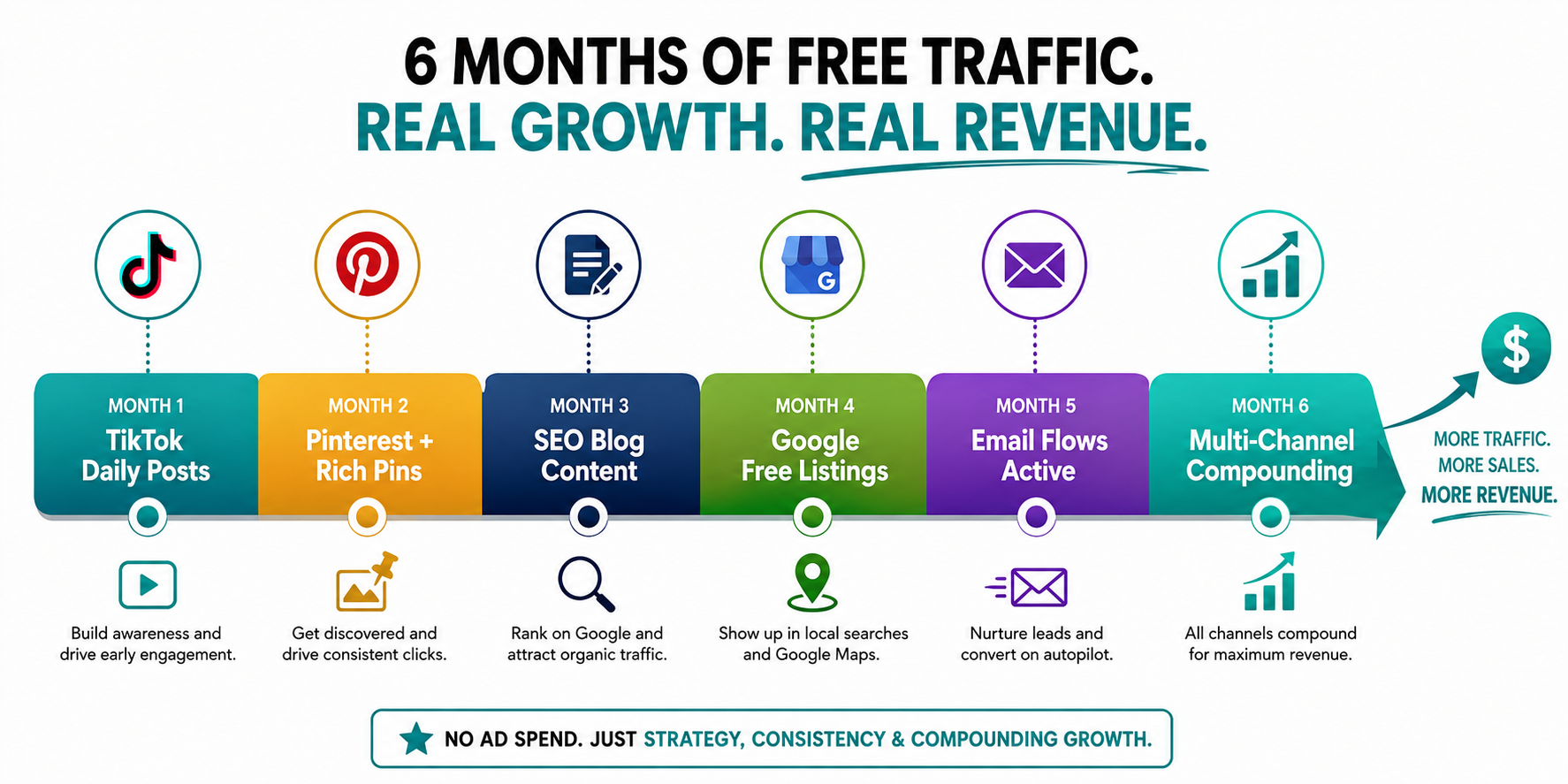
Month one and two: Start with TikTok. Post one to two videos daily. Connect TikTok Shop to your Shopify store. Focus on problem-solution and demonstration content for your hero product. Install an email capture popup to convert the traffic TikTok generates into an owned list.
Month two and three: Add Pinterest. Create product boards, enable Rich Pins, and begin pinning daily from your product catalog and any lifestyle content that relates to your category. Write your first two blog posts targeting informational keywords relevant to your product.
Month three and four: Double down on SEO by publishing one to two blog posts per week consistently. Enable Google Shopping free listings. Begin participating in two to three relevant communities where your target customers gather.
Month four and six: Your email list has grown enough to support automated flows. Configure welcome, abandoned cart, and post-purchase flows in Klaviyo. Your TikTok and Pinterest content has accumulated enough volume to generate consistent organic traffic. Your first blog posts are beginning to rank. The system is working.
This is not a path to overnight success. It is a path to sustainable, compounding, owned traffic that costs you time rather than money — and that builds a business asset in the form of an organic audience rather than a paid traffic dependency that evaporates the moment your budget does.
Realistic Revenue Expectations From Organic Traffic
Setting honest revenue expectations prevents the frustration that leads merchants to abandon organic strategies before they compound.
In month one, a new Shopify store posting consistently on TikTok can realistically expect zero to five sales from organic traffic — primarily from TikTok if the content is genuinely engaging. This is validation, not failure.
By month three, a store executing across TikTok, Pinterest, and email capture can realistically expect $500 to $2,000 in monthly organic revenue — more for visually compelling products in high-engagement categories, less for products that are harder to demonstrate on camera.
By month six, a store that has maintained consistent execution across all channels can realistically expect $3,000 to $10,000 in monthly organic revenue. This is the range where the compounding nature of organic traffic becomes unmistakable — where traffic is arriving daily from multiple sources without ongoing financial investment.
The stores reporting $10,000 to $50,000 per month purely from organic in 2026 have typically been executing consistently for 12 or more months, across multiple channels, with content volume and quality that reflects genuine commitment to building an audience rather than a casual posting schedule.
That commitment is the real barrier to organic traffic success — not technical complexity, not tools, not budget. Consistency over time is the only non-negotiable requirement, and it costs nothing but the discipline to show up.
Need help setting up your Shopify store for organic traffic success, or want an expert to audit your current SEO, social, and content strategy for growth gaps? Get in touch with EcomFixify — we specialize in Shopify development and ecommerce growth strategy for brands building sustainable traffic without paid ad dependency.