
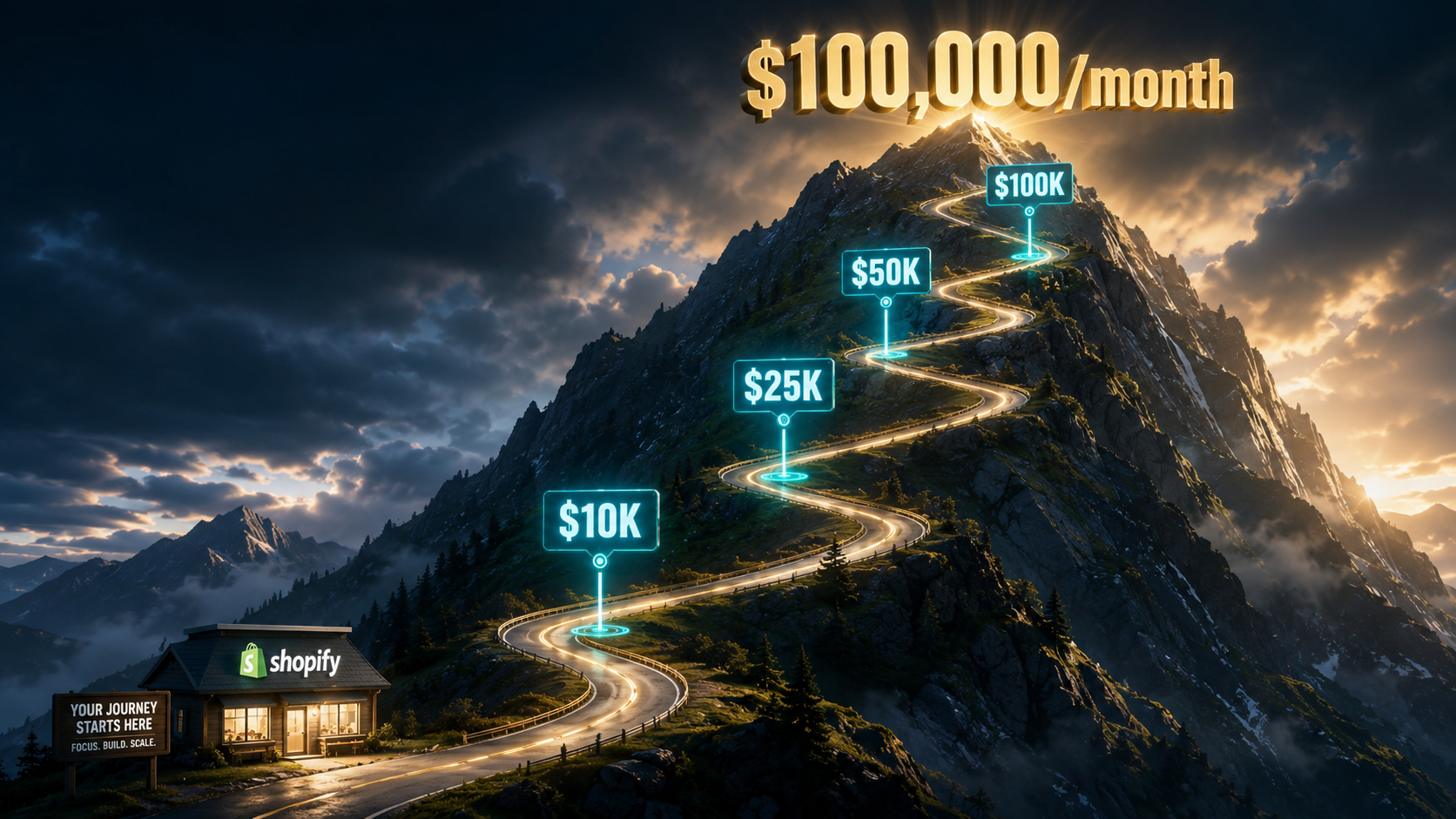
How to Scale a Shopify Store From $10K to $100K Per Month
Getting a Shopify store to $10,000 per month is hard. Most stores never get there. But there is a specific, uncomfortable truth about what happens to the ones that do — and understanding it is the most important thing you can read before trying to scale further. How to Scale a Shopify Store From $10K to $100K Per Month
Most Shopify stores that hit $10,000 per month in their first few months immediately try to replicate what got them there by doing more of it. More ads. More products. More posting. More everything. And for a short period, it works. Revenue climbs toward $15,000, maybe $20,000. Then it plateaus. Then it starts sliding back.
The reason is structural, not tactical. What gets a store to $10,000 per month and what gets it to $100,000 per month are fundamentally different things. The skills, systems, and priorities that worked at stage one become the ceiling at stage two.
The fastest brands in Shopify's growth cohort complete the $10,000 to $100,000 journey in 12 months. The median is 18 to 24 months. The ones who never make it are almost universally the ones who tried to solve a stage-two problem with stage-one thinking — scaling ad spend before fixing conversion, chasing new customers before building retention, adding products before systematizing operations.
This guide covers the real roadmap — the stage-by-stage priorities, the critical transitions, and the specific decisions that separate stores that scale from ones that stall.
Why $10K Per Month Is the Beginning, Not the Destination
Before mapping the path forward, establishing why $10,000 per month represents a beginning rather than an achievement reframes the entire scaling conversation.
At $10,000 per month, a Shopify store has typically proven one thing: product-market fit exists. Some combination of product, audience, and messaging is generating real purchases from real customers who found and trusted the store enough to hand over their payment details. That proof is genuinely valuable — the majority of stores never achieve it.
What $10,000 per month has not proven is whether the business is economically scalable. The unit economics that produced $10,000 per month may be barely profitable or actively cash-flow negative at that revenue level. The ad creative that worked to reach the first customers may be fatiguing. The operations that were manageable when fulfilling 100 orders per month will become chaotic at 500. And the single customer acquisition channel that drove the first revenue spike may not have enough capacity to support 10x growth.
The $10,000 to $100,000 journey is fundamentally about converting proof of concept into a scalable business architecture. Every decision along that path should be evaluated against one question: does this build a system that works at ten times the current scale, or does it only work at today's scale?
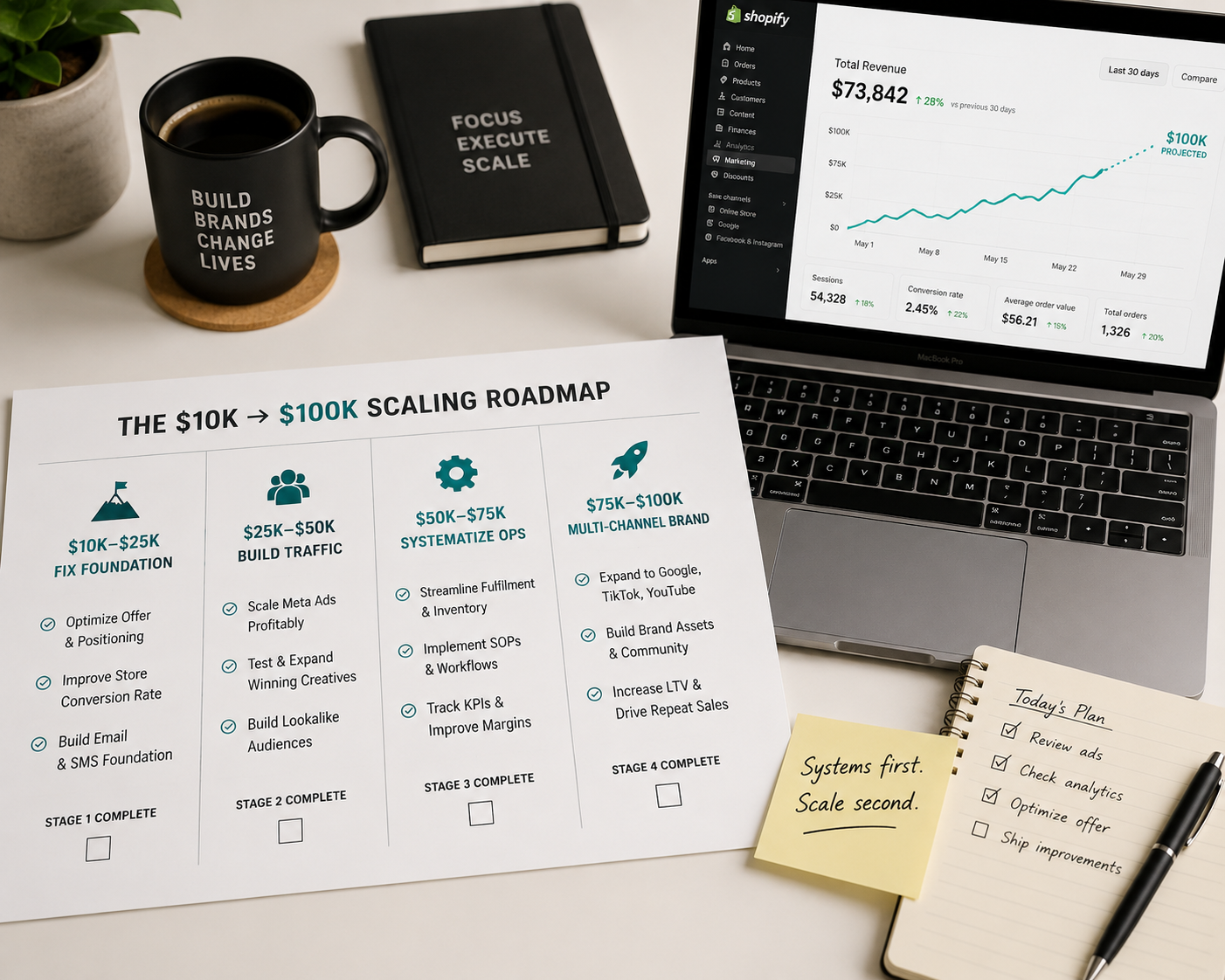
Stage One: $10,000 to $25,000 Per Month — Fix Before You Scale
The single most important principle in the entire $10,000 to $100,000 roadmap is one that most merchants resist because it feels counterintuitive: fix your conversion and retention metrics before scaling your traffic.
The logic is straightforward. If your store converts at 1.5% and your customer acquisition cost is $35, you need $2,333 in ad spend to generate 100 customers who spend $60 each — producing $6,000 in revenue from $2,333 in ad spend. The math is tight and the margin is thin.
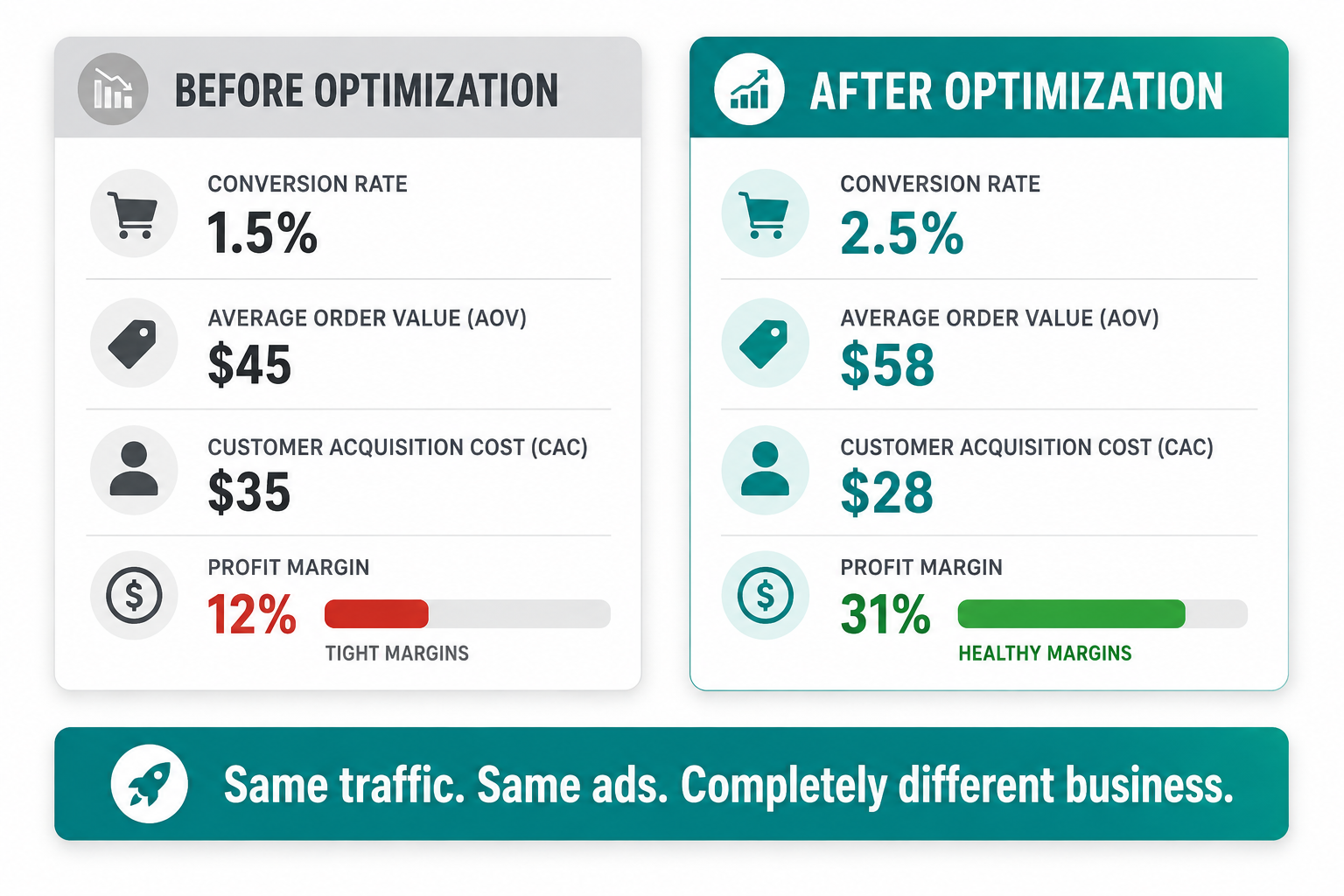
If you fix your conversion rate to 2.5% before scaling, the same $2,333 in ad spend produces 167 customers — a 67% increase in revenue from identical spend. The same traffic. The same ads. A fundamentally different business because the conversion infrastructure is stronger.
The stores that successfully scale from $10,000 to $100,000 per month optimize ruthlessly before they amplify. They fix their conversion rate before buying more ads. They increase average order value before spending on influencers. They build retention systems before acquiring expensive new customers.
At this stage, the three highest-priority optimizations are:
Conversion rate improvement — targeting a minimum of 2.5% overall store conversion rate before scaling paid traffic. The specific interventions that move this number most reliably are a sticky Add to Cart bar on mobile product pages, guest checkout enabled, trust badges near the payment button, and an above-the-fold hero layout that puts price, reviews, and the Add to Cart button visible without scrolling. A store converting at 2.5% generates 67% more revenue from the same traffic as one converting at 1.5%. That compound advantage multiplies with every dollar of additional ad spend.
Average order value improvement — targeting a minimum of 15% above your current AOV before scaling. The interventions that deliver this most reliably are Frequently Bought Together recommendations on product pages, a free shipping threshold set 20 to 30% above your current average order value — showing customers exactly how much more they need to spend to unlock free shipping — and product bundles on your highest-traffic product pages. Collectively, these three changes typically deliver a 15 to 25% AOV lift within 30 days of implementation.
Email retention foundation — setting up at minimum three automated Klaviyo flows before scaling traffic. Welcome series, abandoned cart, and post-purchase sequences together recover a meaningful percentage of the revenue that would otherwise be lost and begin building the repeat purchase infrastructure that becomes critical at higher revenue levels. Stores with these three flows active generate 3.2 times more email revenue than stores running only a welcome email.
Stage Two: $25,000 to $50,000 Per Month — Build the Traffic Engine
Once your conversion and retention foundation is solid, the $25,000 to $50,000 stage is where paid traffic becomes the primary growth lever — but with a structure and discipline that most merchants skip.
Meta Advantage+ Shopping Campaigns should be the core of your paid acquisition at this stage. The campaign structure that works — 70% of budget in ASC with a fresh UGC creative pool, 15% in dynamic product retargeting for cart abandoners and product viewers, and 15% in manual creative testing — consistently delivers 3.5 to 4.5x ROAS when operated correctly. Before scaling Meta budget at this stage, verify that your Conversions API is active alongside your Pixel. The merchants running only a browser-side Pixel in 2026 are missing 20 to 40% of conversion events, which means Meta's algorithm is optimizing on incomplete data and performance is structurally limited regardless of budget level.
Creative is the variable that drives 50 to 70% of Meta Ads performance in the Advantage+ era. The budget allocation that produces the best results at this stage is not more spend on winning ads — it is more investment in new creative production. A fresh UGC video from a real customer or a founder-led demonstration of the product outperforms polished studio creative in ASC environments consistently. Build a creative testing process that produces at minimum two to four new creative concepts per month and feeds winners into your ASC campaign continuously.
Google Shopping through Shopify's Google integration captures purchase-intent search traffic that Meta cannot reach. A customer searching "buy [specific product]" on Google has declared explicit purchase intent that no behavioral targeting or interest category can match. At this revenue stage, a well-structured Google Shopping campaign with a clean product feed, competitive pricing, and strong product page quality scores typically delivers 3 to 5x ROAS on branded and high-intent searches.
Email should be generating 25 to 35% of total revenue at this stage. If your email revenue share is below 20%, the problem is almost certainly an incomplete flow stack rather than list size. Build out browse abandonment, win-back, and VIP flows alongside the three foundation flows from stage one. Each additional flow compounds the percentage of total revenue generated automatically without additional ad spend.
Stage Three: $50,000 to $75,000 Per Month — Systematize Operations
The transition from $50,000 to $75,000 per month is where operational chaos kills stores that should be growing. At this revenue level, order volume, customer service demand, inventory complexity, and team coordination requirements have all grown to a point where the founder-handles-everything model breaks.
The merchants who navigate this transition successfully make two critical moves: they hire their first dedicated role before they feel they have to, and they document and systematize every repeatable process before delegating it.
Hiring sequence that works for Shopify stores at this stage: the first hire is almost always a customer service or operations role — someone who handles the daily ticket volume, order queries, and return management that is consuming four to six founder hours per day. This hire immediately recovers those hours for the higher-leverage work — creative strategy, supplier relationships, growth initiatives — that only the founder can do.
The second hire, typically at $60,000 to $70,000 per month, is a paid media manager or a performance marketing specialist who takes ownership of your Meta and Google campaigns. At this ad spend level — typically $15,000 to $25,000 per month — the complexity and time investment of campaign management justifies a dedicated role and the performance improvement from specialization more than pays for it.
Standard operating procedures for every repeatable process are not bureaucratic overhead at this stage — they are the infrastructure that makes delegation possible and quality consistent. Every customer service response type, every return workflow, every inventory reorder process, and every marketing task that happens more than once per week should be documented before it is delegated. Documentation takes hours. Fixing mistakes from undocumented delegation takes weeks and costs customer relationships.
At this stage, inventory management transitions from a spreadsheet exercise to a system requirement. Demand forecasting that accounts for your paid media schedule — because a campaign launch that triples your daily orders will outpace any inventory buffer you calculated based on organic velocity — requires either a dedicated inventory planning app like Prediko or Inventory Planner or a process for communicating upcoming campaign schedules to your fulfillment and purchasing operations with sufficient lead time.
Stage Four: $75,000 to $100,000 Per Month — Multi-Channel and Brand Building
The final stage of the $10,000 to $100,000 journey requires two strategic shifts that most merchants have been deferring: genuine multi-channel revenue diversification and deliberate brand building that reduces dependence on paid acquisition.
Multi-channel revenue at this stage means generating meaningful revenue from at minimum three distinct sources. The typical combination for a Shopify store approaching $100,000 per month is Meta and Google paid acquisition at 40 to 50% of revenue, email and SMS retention at 30 to 35% of revenue, and a third channel — TikTok Shop, organic search, or a loyalty-driven direct channel — at 15 to 20% of revenue. A store generating 80% of revenue from a single paid platform at this stage is fragile in a way that directly limits how aggressively you can invest in growth — because any algorithm change, policy update, or cost increase on that platform becomes an existential threat rather than a manageable optimization problem.
Brand building — the deliberate investment in content, community, and brand equity that generates customers who seek you out rather than requiring you to find them — becomes commercially important at this stage for a specific financial reason. Customer acquisition cost continues rising on every paid platform every year. The only sustainable response to rising acquisition costs is improving the lifetime value of each customer and generating an increasing percentage of new customers through organic and owned channels rather than paid ones.
The practical brand building investments that compound most effectively at this stage are a content strategy that generates organic search traffic through SEO-optimized blog content on topics relevant to your product category, an email subscriber list that grows independent of paid acquisition through organic social and referral programs, a loyalty program that increases repeat purchase frequency and reduces the effective acquisition cost of each subsequent purchase, and creator partnerships with micro-influencers whose audiences overlap with your customer profile and who generate authentic advocacy rather than transactional promotion.
At $75,000 per month in revenue, a 1% conversion rate improvement translates to $7,500 to $10,000 in additional monthly revenue. This is the stage where systematic conversion rate optimization — A/B testing product page layouts, checkout flows, trust signals, and CTA copy — delivers outsized returns because the traffic volume is large enough that test results become statistically significant within days rather than weeks.
The Unit Economics You Must Track at Every Stage
The merchants who successfully navigate the $10,000 to $100,000 journey are not necessarily the ones spending the most on ads or producing the most content. They are almost universally the ones who track their unit economics with precision and make every growth decision through that lens.
The five metrics that matter most at every stage of this journey:
Customer acquisition cost measures how much you spend to acquire each new customer across all paid channels combined — not per platform, combined. Rising CAC is an early warning signal that your creative is fatiguing, your targeting is saturating, or your conversion infrastructure needs improvement before further budget increases.
Customer lifetime value over 90 and 180 days tracks how much revenue each acquired customer generates beyond their first purchase. LTV that is less than three times CAC signals a retention problem that will make profitable scaling impossible regardless of how efficiently you acquire customers. LTV above four times CAC signals a business with the unit economics to support aggressive growth investment.
Gross margin after all variable costs — product cost, shipping, payment processing fees, return costs, and platform fees — determines how much of each sale is available for marketing, operations, and profit. At below 40% gross margin, it is genuinely difficult to build a profitable scaling model on Shopify. At above 60% gross margin, the math supports aggressive customer acquisition investment and provides meaningful buffer for operational scaling costs.
Marketing efficiency ratio — total revenue divided by total marketing spend across all channels — gives a channel-agnostic view of overall marketing ROI that is immune to the attribution disputes between Meta, Google, and Klaviyo. An MER above 4.0 at this revenue stage indicates healthy overall marketing efficiency. Below 3.0 warrants a systematic audit of which channels are genuinely driving revenue versus claiming credit for revenue driven by others.
Month-over-month repeat customer rate — the percentage of each month's revenue that comes from customers who have bought before — tracks the compounding retention advantage that distinguishes businesses with strong LTV from ones perpetually dependent on new customer acquisition. A healthy Shopify store at $50,000 per month should see 30 to 40% of revenue from repeat customers. At $100,000 per month, that figure should be approaching 40 to 50%.
The Mindset Shift That Makes the Difference
Beyond the tactical roadmap, the merchants who complete the $10,000 to $100,000 journey share a consistent mindset shift that separates them from those who plateau.
At $10,000 per month, most founders are doing everything personally and making most decisions reactively — responding to what is happening rather than planning what should happen. This reactive mode is appropriate and inevitable at early stage when the business is still discovering what works.
At $100,000 per month, the same reactive mode is catastrophic. The business has too many moving parts, too many customer interactions, too many operational dependencies, and too many growth variables for reactive management to keep pace. The founders who complete this journey transition from reactive execution to proactive system building — asking not "what do I need to do today?" but "what systems, people, and processes do I need to build so the business runs without requiring my personal attention on every decision?"
That transition is the most difficult and most consequential shift in the entire scaling journey. It requires letting go of direct control over operational tasks, trusting documented processes and trained people, and redirecting founder time toward the genuinely strategic decisions — product direction, brand positioning, capital allocation, and key partnerships — that only the founder can make.
The merchants who build that system from $10,000 to $100,000 do not just reach $100,000 per month. They build the foundation from which the journey to $1,000,000 per month begins.
Your 90-Day Action Plan to Start the Journey
The first 90 days of your $10,000 to $100,000 journey should focus entirely on stage one — building the conversion and retention foundation before scaling any traffic channel.
Week one and two: audit your current conversion rate by device in Google Analytics 4. Identify the three highest-traffic product pages and run them through the product page audit checklist. Implement a sticky mobile ATC bar, enable guest checkout, and add trust badges near the payment button. Set a free shipping threshold 25% above your current average order value.
Week three and four: audit your Klaviyo account. If you are missing any of the three foundation flows — welcome series, abandoned cart, post-purchase — build the missing ones. If they exist, review their performance and implement the three-email structure with conditional splits if you are currently running single-email flows.
Month two: with conversion and retention foundation in place, audit your paid traffic structure. Implement CAPI alongside your Meta Pixel if not already active. Migrate your primary acquisition campaign to Advantage+ Shopping if still running manual campaign structures. Build a UGC creative production process that generates two to three new creative concepts per month.
Month three: review your unit economics. Calculate your current CAC, LTV at 90 days, gross margin, and MER. Identify which metric is furthest from the benchmarks above and make it the primary focus of the next quarter. Begin building the documentation for your first operational hire so that when revenue justifies the hire — typically around $40,000 to $50,000 per month — the role can be filled and onboarded quickly.
The journey from $10,000 to $100,000 per month is not a sprint. It is a compounding series of system improvements, each of which makes the next one easier and the overall business more durable.
Build the systems first. Scale second. That sequencing is the real roadmap.
Need help building the Shopify infrastructure that supports scaling — from conversion optimization and email automation to technical store performance and paid media integration? Get in touch with EcomFixify — we specialize in Shopify development and ecommerce growth strategy for brands ready to scale.