
How to Run a Shopify Flash Sale That Generates Revenue in 24 Hours
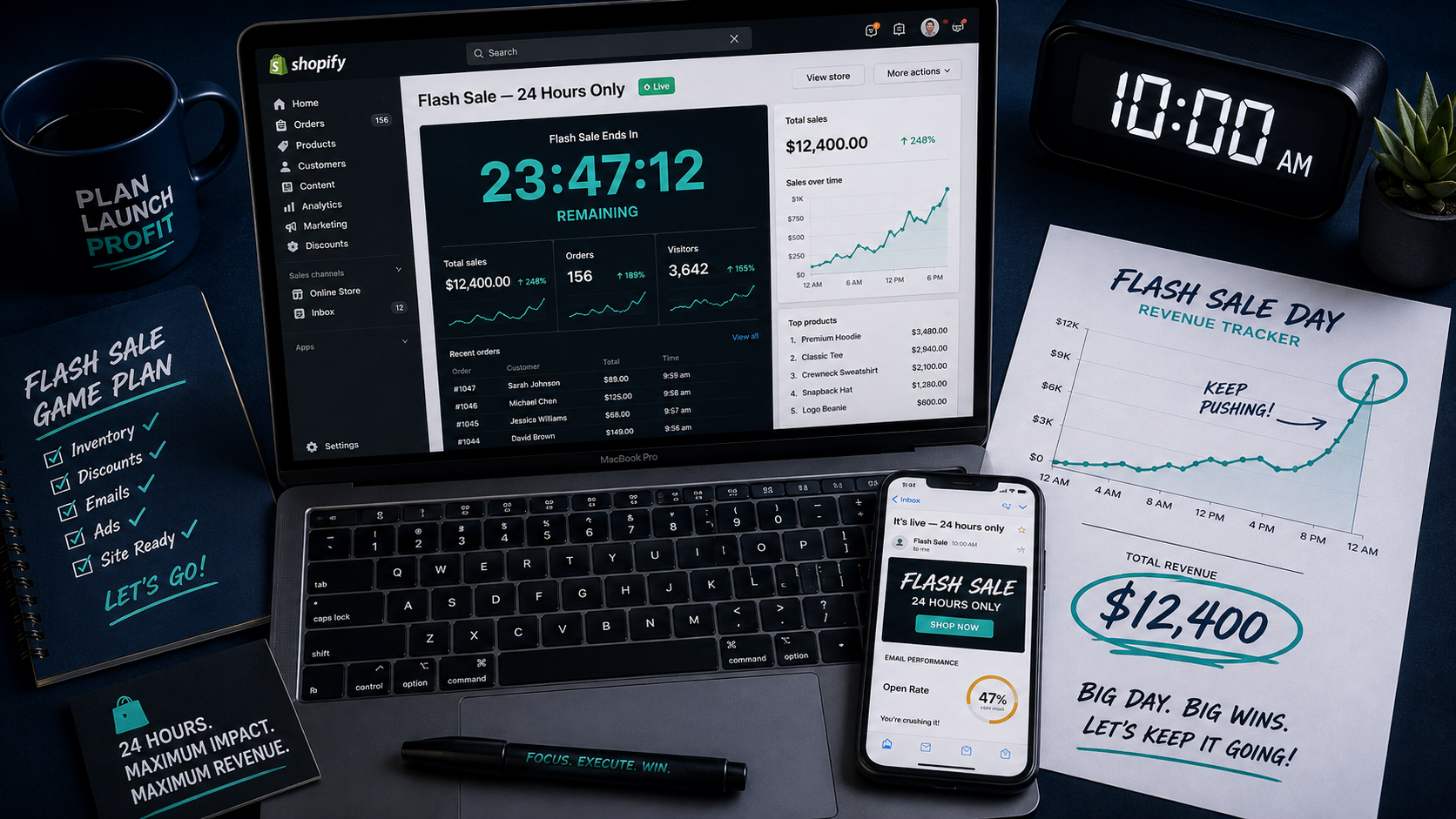
A flash sale done right is the fastest legitimate way to generate a significant revenue spike for your Shopify store without acquiring a single new customer. Your existing list — email subscribers, SMS contacts, social followers — represents an audience that already knows your brand, has already considered buying, and in many cases needs only a compelling reason and a genuine deadline to convert. How to Run a Shopify Flash Sale That Generates Revenue
A 24-hour flash sale provides both.
Flash sales generate an average of 35% of annual ecommerce revenue for stores that run them systematically. The average order value during a well-executed flash sale runs 27% higher than regular trading days because urgency drives customers to add more to their cart before the window closes. And landing pages with countdown timers convert 32% higher than standard product pages because the visible ticking clock creates a psychological pressure that static pricing never generates.
But those results are not automatic. A flash sale that is poorly timed, under-promoted, discounts the wrong products, or lacks genuine urgency consistently underperforms regular trading days — and worse, trains your customer base to wait for sales rather than buying at full price.
This guide covers the complete flash sale playbook for Shopify stores in 2026 — from preparation and product selection through the promotional sequence, technical setup, and post-sale analysis that determines whether your next flash sale performs better than your last.
Why 24 Hours Is the Optimal Flash Sale Window
Flash sale duration is one of the most important structural decisions in your planning — and most merchants either choose randomly or default to whatever feels comfortable without understanding the performance implications.
Analysis of more than 10,000 flash sales reveals that 24-hour windows generate the highest total revenue of any duration. Four to six hour sales generate the highest revenue per hour — the urgency is maximum and conversion rates spike sharply — but the limited window restricts total reach because only the fraction of your audience who sees the promotion in that narrow time window can participate. Longer windows of 48 hours or more dilute urgency to the point where the psychological pressure that makes flash sales effective largely disappears.
The 24-hour window hits the optimal balance: enough time for your full audience across multiple time zones to see at least two promotional messages, enough urgency to drive action rather than passive browsing, and a tight enough deadline that "I'll check back later" frequently becomes "I should buy now before it ends."
The timing within the week matters as much as the duration. Tuesday, Wednesday, and Thursday consistently outperform weekends for flash sales by 22% across most product categories. The mechanism is behavioral: weekday audiences are in a decision-making mode — checking emails during work breaks, browsing between tasks, in a mindset where transactional action feels natural. Weekend audiences are in leisure mode — scrolling more passively, less inclined toward committed purchasing decisions. Lifestyle and leisure products are the exception; outdoor gear, travel accessories, and entertainment products perform better on Fridays and Saturdays when the relevant mindset is active. For most Shopify product categories, Wednesday is the single highest-performing flash sale day of the week.
Launch time within the day also affects performance. A flash sale launched at 10am in your target market's primary time zone catches audiences who have just settled into their morning routine and are most receptive to promotional messaging. Avoid launching between noon and 2pm — the lunch hour is competitive for attention — and avoid evening launches for stores with primarily professional audiences who shift to passive entertainment consumption after 7pm.
Product Selection: What to Put on Sale and What to Protect
The products you include in your flash sale determine both the revenue ceiling of the event and the margin impact of running it. Both need to be considered before the discount structure is set.
The products that perform best in flash sales are not necessarily your bestsellers — in fact, putting your strongest-converting products on deep discount trains customers to wait for the sale rather than buying at full price. The categories that generate the highest flash sale revenue with the lowest brand damage are:
Slow-moving inventory that carries good margin but limited organic discovery. A product that converts well when customers find it but does not generate strong search or social traffic is an ideal flash sale candidate — the price reduction drives discovery among your existing audience without devaluing a product that would otherwise sell at full price to organic new customers.
Bundles created specifically for the flash sale that combine products in a value package unavailable outside the promotional window. Bundle-exclusive offers preserve full-price perception on individual items while delivering the value signal that drives flash sale conversion. A customer who sees individual products at their regular prices but can access a specially configured bundle at a meaningful saving does not develop the expectation that individual items will be discounted — they simply recognize that the bundle is a promotional opportunity.
Second-tier bestsellers — products that are strong performers but not your hero SKUs. These benefit from the flash sale's urgency without training customers to wait on your flagship products.
Products with a strong demonstration angle that can be featured in pre-sale content. The flash sale promotional sequence — covered in detail below — generates significantly higher revenue when the featured products are ones your audience has already seen demonstrated. A product that appears in pre-sale content, that customers have watched working, that they have mentally considered buying — converts at dramatically higher rates when the flash sale window opens than a product being introduced for the first time at a discounted price.
Protect your flagship products. If a product is generating strong organic sales at full price and is central to your brand's identity, discounting it in a flash sale is almost always a mistake. The short-term revenue spike rarely compensates for the long-term erosion of full-price perception.
The Discount Structure That Maximises Revenue Without Destroying Margin
The size of your flash sale discount affects both conversion rate and margin contribution — and the relationship between the two is not linear. Larger discounts generate higher conversion rates up to a point, after which the marginal conversion lift is insufficient to compensate for the additional margin given away.
The optimal discount range for most Shopify flash sales is 20 to 30% off. This range is sufficient to create a genuine value perception and overcome purchase hesitation that has been preventing conversion at full price. It is not so large that it signals quality compromise or trains customers to expect half-price sales on a regular basis.
Discounts below 15% rarely generate the urgency required to drive flash sale behavior. Customers who were not going to buy at full price are generally not converted by a 10% discount — the saving is insufficient to justify immediate action over continued consideration. Discounts above 40% generate strong conversion but raise questions about why the markdown is so large and whether the original price was artificially inflated.
Present discounts as a percentage rather than an absolute amount for products under $100, and as an absolute amount for products above $100. "Save 25%" converts more strongly than "Save $12.50" on a $50 product because the percentage feels larger. "Save $75" converts more strongly than "Save 30%" on a $250 product because the absolute dollar amount feels more substantial than the percentage.
Use price anchoring throughout the promotional sequence and on the flash sale landing page. Every communication that promotes the sale should display both the original price and the sale price prominently — giving customers the reference point that makes the discounted price feel like genuine value rather than simply the current price.
Technical Setup: The Shopify Configuration That Makes Flash Sales Work
Before the promotional sequence launches, the technical infrastructure needs to be in place. A flash sale promotion that drives traffic to a page that is not configured correctly loses conversion at exactly the moment motivation is highest.
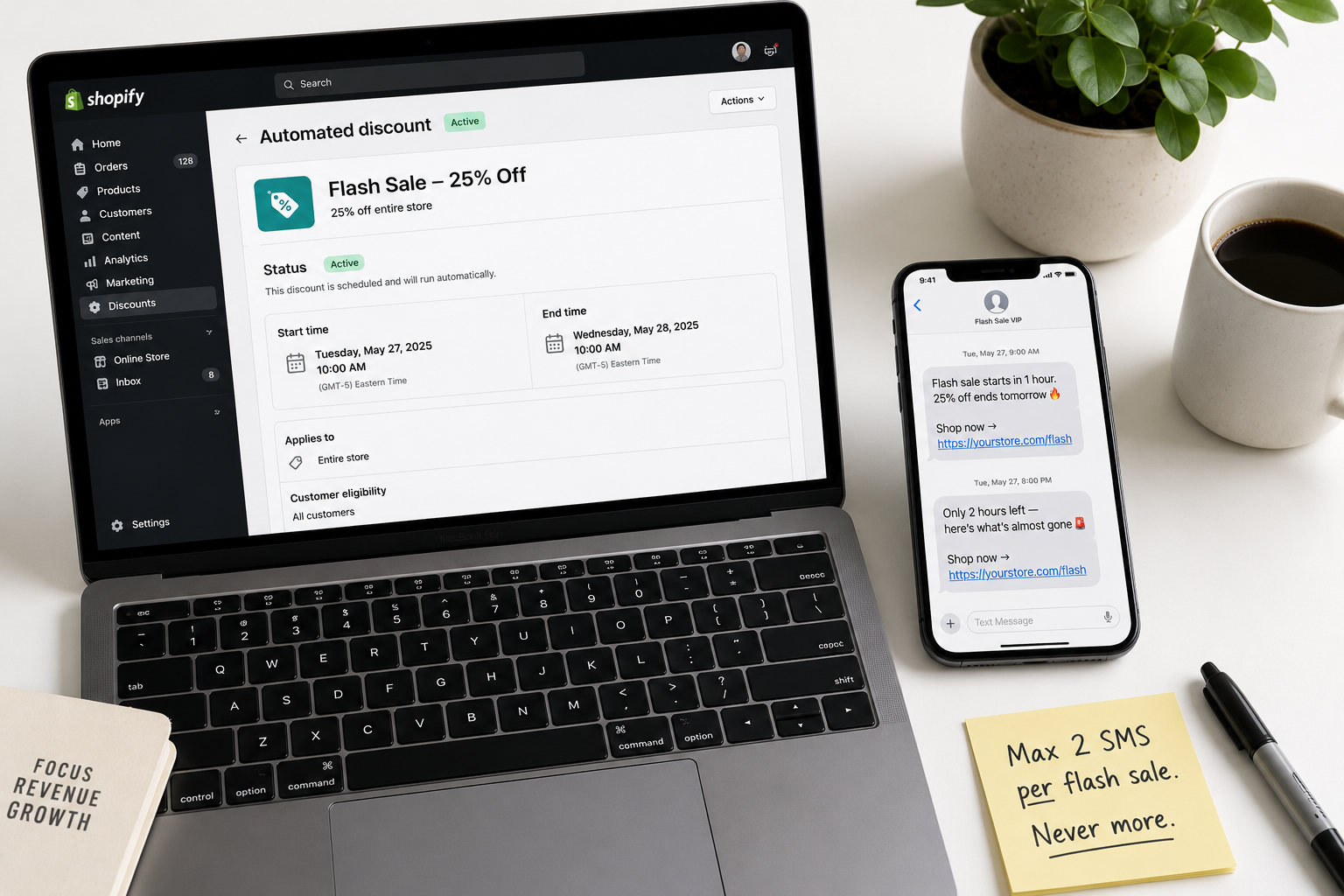
Automated discounts in Shopify Admin are the cleanest implementation for flash sale pricing. Navigate to Discounts in your Shopify admin, select Create discount, and choose Automatic discount. Configure the discount to apply to your selected products or collections, set the percentage off, and set start and end dates and times precisely — the sale starts and ends automatically without manual intervention, which eliminates the operational risk of forgetting to deactivate the discount.
Create a dedicated flash sale collection that contains only the products included in the sale. Direct all promotional links to this collection rather than to individual product pages or your homepage. A visitor who lands on a dedicated sale collection immediately sees the full scope of what is available, which increases both the average number of items viewed and the likelihood of a multi-item cart.
Add a countdown timer to the flash sale collection page and to every individual product page in the sale. Countdown timers on sale pages increase conversion rates by 32% because the visible countdown makes the deadline visceral rather than abstract. Shopify apps including HurryTimer, Countdown Timer Ultimate, and Hextom: Flash Sales all add countdown timers to Shopify store pages with configurable end times.
Configure low stock indicators on your flash sale products if inventory is genuinely limited. When inventory for a variant drops below a defined threshold — typically 10 to 20 units — displaying "Only 8 left" creates authentic scarcity that reinforces the urgency the countdown timer is already creating. Never display low stock indicators for products where inventory is not actually limited — customers who see the same "low stock" message on multiple visits stop trusting it, and the scarcity signal loses all conversion impact.
Set up a flash sale banner or announcement bar at the top of your Shopify store that appears site-wide during the sale window, linking directly to your flash sale collection. Every visitor who arrives on any page during the 24-hour window should see the sale immediately — not just visitors who land directly on the sale page through your promotional links.
The Five-Email Promotional Sequence That Generates 67% More Revenue
Email is the highest-volume revenue driver for flash sales, and the structure of your email sequence has a larger impact on flash sale revenue than almost any other variable you control.
A five-email sequence generates 67% more flash sale revenue than a single announcement email. Each email in the sequence serves a distinct purpose, reaches customers at a different point in their decision-making process, and creates cumulative urgency across the 24-hour window.
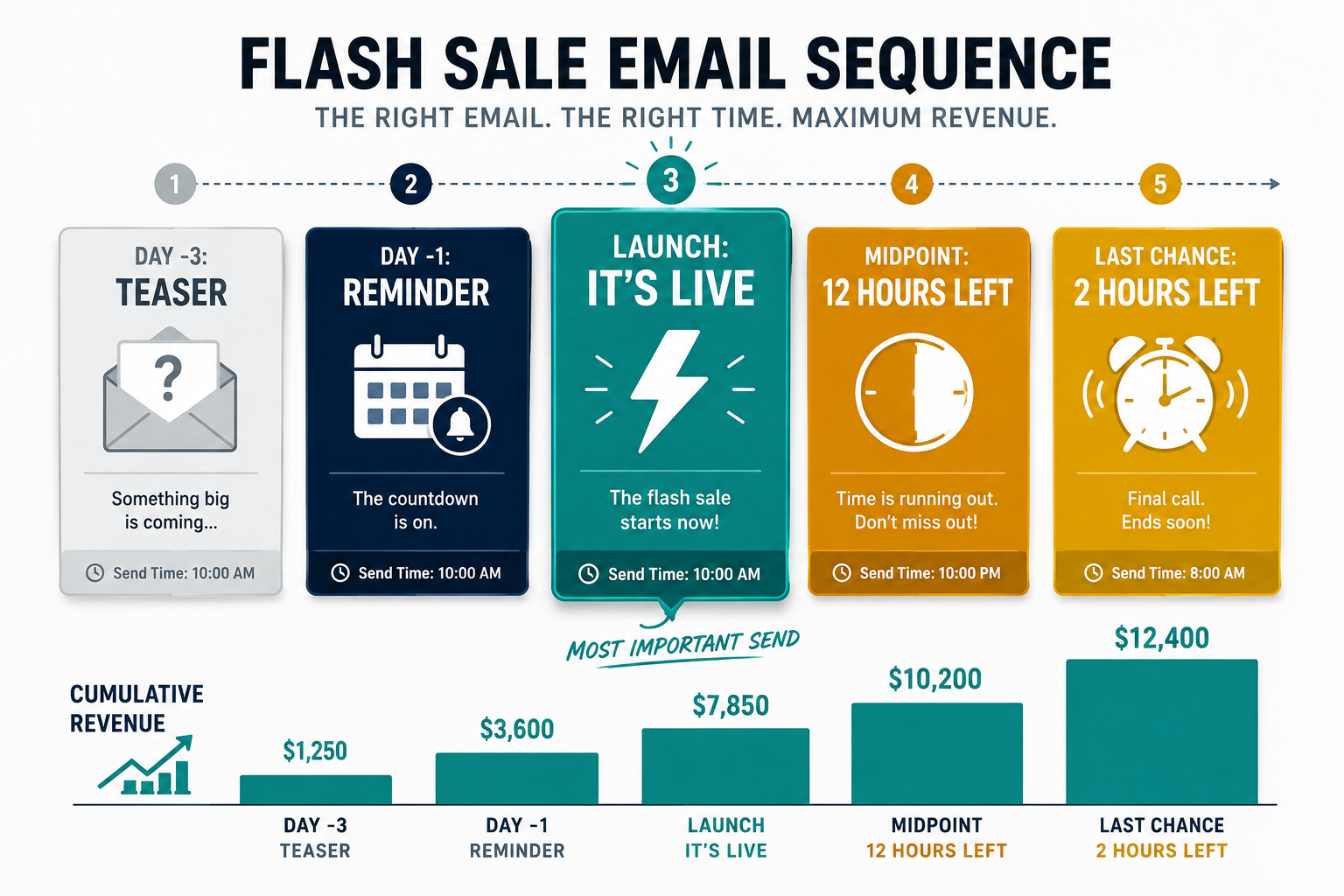
Email 1 — the teaser, sent three days before the sale: build anticipation without revealing the full offer. Subject line: "Something big is coming Thursday." Content: a cryptic hint about the sale, an invitation to mark their calendar, and a strong visual that creates curiosity. This email warms your audience so the launch email lands with a prepared and anticipatory reader rather than a cold one.
Email 2 — the reminder, sent 24 hours before launch: reveal what the sale is and build urgency around the countdown. Subject line: "Tomorrow only: our biggest sale of the quarter starts at 10am." Content: the specific products or category on sale, the discount percentage, the exact start time, and a clear indication of when it ends. Include a "save your cart now" link for stores that support wish list or save functionality.
Email 3 — the launch email, sent at the exact moment the sale goes live: this is your highest-priority email of the sequence and should be sent to your full subscriber list simultaneously with every other channel going live. Subject line: "It's live — 24 hours only." Content: the full offer, your top featured products with before-and-after pricing, a prominent countdown timer image or GIF, and a single clear call to action linking directly to the flash sale collection.
The first 30 minutes after the launch email sends generate the most intense buying activity of the entire 24-hour window. Your launch email, social posts, push notifications, and SMS messages should all fire simultaneously at launch time to create a coordinated surge that maximises the opening momentum.
Email 4 — the midpoint reminder, sent when 50% of the time has elapsed: send to non-openers of Email 3 with a different subject line. "You haven't seen this yet — and it ends in 12 hours." Content: highlight what has sold well so far, surface any low-stock products that are genuinely running out, and reinforce the deadline with urgency language that has specific time remaining rather than vague "ending soon" copy.
Email 5 — the last chance email, sent two to three hours before the sale closes: this email generates a final revenue spike from customers who have been considering but not yet committed. Subject line: "2 hours left — here's what's almost gone." Content: final deadline, specific product stock alerts for any items running genuinely low, and a straightforward call to action. This email should be short — three to four sentences maximum — because customers at this stage need urgency reinforcement, not additional information.
SMS: Your Highest-Engagement Flash Sale Channel
SMS is your highest-urgency promotional channel for flash sales. With a 98% open rate and click-through rates of 15 to 25% on flash sale campaigns, SMS messages are seen and acted on within minutes of sending — which makes them ideal for the time-critical moments in your 24-hour window.
Two SMS messages drive the majority of flash sale revenue for Shopify stores with active SMS lists. The pre-sale text, sent one hour before launch, creates immediate anticipation and drives the highest open rates of the campaign. Keep it under 160 characters: "Flash sale starts in 1 hour. 25% off [collection/products]. Starts 10am — link in bio." Include the direct URL if character count permits.
The last-chance text, sent two hours before close, generates the final urgency spike. "Only 2 hours left on our flash sale. 25% off ends at midnight — grab it before it's gone: [link]." This message catches subscribers who saw the launch but did not convert, subscribers who planned to buy "later" and forgot, and subscribers who are browsing their phone in the evening and see an immediate action opportunity.
SMS campaigns for flash sales generate three to five times higher revenue per message than standard promotional texts. The combination of SMS immediacy with a time-limited offer creates urgency that no other channel replicates at this intensity. Platforms including Postscript, Klaviyo SMS, and SMSBump integrate natively with Shopify and allow you to coordinate SMS sends with your email sequence from a single dashboard.
One firm rule: never send more than two SMS messages in a single flash sale. SMS opt-out rates spike above 3.5% for brands that over-send, and the audience damage from excessive SMS far outweighs the revenue gain from additional messages. Two messages — pre-sale and last chance — is the standard that maximises revenue without damaging your list.
Social Media During the Flash Sale Window
Social media amplifies your email and SMS promotional sequence during the flash sale window and captures audiences who are not yet on your email or SMS lists.
Post a launch announcement across every platform simultaneously when the sale goes live — Instagram Stories, TikTok, Facebook, and any platform where you have an active audience. Stories with countdown stickers on Instagram generate significantly higher engagement than static post formats because the countdown sticker is interactive and shareable.
Post a midpoint reminder when 50% of the time has elapsed, and a last-chance post two to three hours before close. Keep social content short, visually led, and specific — showing the actual products on sale with the discount percentage clearly visible rather than a generic "big sale" graphic that communicates nothing specific about what is available.
For stores with TikTok Shop integration, pin your flash sale products during the window and consider a short live session — even 30 to 45 minutes — that demonstrates featured products and reinforces the deadline urgency for viewers in real time.
Post-Sale Analysis: How to Make Every Flash Sale Better Than the Last
The flash sale ends when the timer hits zero — but the strategic value of the event is only fully captured if you analyse the results and apply those insights to your next event.
The six metrics that tell you everything you need to know about flash sale performance are:
Total revenue generated during the 24-hour window compared to your average daily revenue. A well-executed flash sale should generate five to ten times your average daily revenue. Below three times indicates either insufficient promotional reach, a product selection problem, or a discount that was not compelling enough to drive urgency.
Revenue by email send time, which reveals which messages in your sequence drove the most conversions. If Email 3 — your launch email — drove 60% of total revenue, you have a strong launch but may be losing customers mid-window. If Email 5 — your last chance email — drove a disproportionate share, your customers are strong deadline converters and you should emphasise time remaining more prominently throughout the sequence.
Average order value during the flash sale compared to your store average. Flash sales should produce higher AOV than regular trading because urgency drives customers to add more to their cart before the window closes. If your flash sale AOV is lower than average, your customers are buying single items opportunistically rather than building larger baskets — which suggests your product bundling or cross-sell presentation during the sale is insufficient.
Email open rates and click-through rates by subject line, which identify which messaging angles resonated most with your audience. A subject line that outperforms your average by 20 percentage points in open rate should influence how you frame urgency in future promotional sequences.
Conversion rate on the flash sale landing page by device, which reveals whether your mobile experience is capturing the 72% of flash sale purchases that happen on smartphones. A significant gap between desktop and mobile conversion rates indicates a mobile UX issue on your flash sale page.
Unsubscribe rate following the sequence, which indicates whether the promotional density of a five-email sequence over three days was acceptable to your audience. An unsubscribe rate above your normal campaign baseline by more than 0.1 to 0.2 percentage points suggests the sequence felt too aggressive. An unsubscribe rate at or below your normal baseline confirms the promotional intensity was appropriate.
What to Do After the Flash Sale: Capturing the Revenue Tail
The 48 hours following a flash sale represent a revenue opportunity that most Shopify merchants leave completely uncaptured.
A post-sale email sent within 24 hours of the sale closing to customers who opened but did not purchase is one of the highest-converting emails in any promotional sequence. The subject line frames the follow-up as a service: "Missed the sale? Here is what we still have available." For stores with remaining inventory in the promoted products, offering a 48-hour extended window at a slightly smaller discount — "Sale ended, but we have a few left at 15% off for the next 48 hours" — recovers a meaningful percentage of customers who intended to buy but missed the deadline.
For customers who did purchase, a post-purchase email sent 24 hours after their order that thanks them, confirms their order status, and introduces complementary products at regular pricing captures the elevated engagement window that follows a positive purchase experience. This cross-sell email consistently generates additional revenue from the customers whose purchase intent is highest and whose satisfaction with the brand is freshest.
Segment your purchasers by what they bought and add them to relevant product-specific email flows. A customer who bought a skincare product in your flash sale belongs in a skincare-category email flow that introduces complementary products over the following weeks. A customer who bought apparel belongs in a style-match recommendation flow. The flash sale creates a customer relationship; the post-sale flow deepens it into a long-term revenue stream.
The Flash Sale Calendar: How Often to Run Them
Flash sales work because they are events — defined, time-limited, genuinely special moments in your brand's commercial calendar. Run them too frequently and they stop being events. Your customer base learns to wait for the next one rather than buying at full price, and the urgency that makes flash sales effective evaporates because customers know another one is always coming.
The frequency that preserves flash sale effectiveness while generating meaningful revenue across the year is approximately once per month — no more, and never two within the same three-week window. This cadence keeps flash sales genuinely anticipated rather than permanently expected, and maintains the full-price perception of your catalog between events.
Plan your flash sale calendar at the beginning of each quarter. Identify the highest-impact timing windows in your category — seasonal demand peaks, pre-holiday windows, post-season clearance opportunities — and schedule your flash sales to align with natural buying intent rather than working against it. A flash sale on a product that customers are already actively seeking during a seasonal peak generates significantly higher revenue than the same sale structure run on a product without seasonal relevance.
Final Thoughts
A flash sale is not a discount. It is a coordinated marketing event that creates a specific psychological environment — genuine urgency, real scarcity, a defined window of opportunity — in which your existing audience converts at dramatically higher rates than they would on a regular trading day.
The merchants generating five to ten times their daily revenue from a single 24-hour event are not doing so through bigger discounts or louder promotional copy. They are doing so through precise timing, the right product selection, a five-email sequence that builds cumulative urgency, SMS messages sent at the two moments where immediacy matters most, and a technical setup that turns every page of their store into a conversion environment for 24 hours.
The system is repeatable. Run it once and refine from the data. Run it monthly and it compounds into one of the most reliable revenue levers available to any Shopify store.
Need help setting up your Shopify flash sale infrastructure, configuring automated discounts, or building the email and SMS sequence that maximises revenue from your promotional events? Get in touch with EcomFixify — we specialise in Shopify development and ecommerce growth strategy for brands ready to scale.