
How to Price Your Products on Shopify So You Actually Make Money
Pricing is the decision most Shopify merchants make once, at launch, using gut feel or a quick competitor check — and then never revisit. The product goes live at whatever number felt right in the moment, and that number becomes the permanent foundation of every sale that follows. How to Price Your Products on Shopify to Actually Make Money
That approach is costing most Shopify stores more money than any other single business decision.
A 1% improvement in pricing increases operating profit by an average of 11.1% — more than a 1% improvement in sales volume, and more than a 1% reduction in variable costs. McKinsey's research across industries consistently confirms this: pricing is the highest-leverage profit optimization available to any business. Yet 85% of Shopify stores set prices using intuition rather than strategic methodology.
The merchants who understand pricing — who know their real costs, understand what their customers will pay and why, and use psychology to frame value rather than just compete on numbers — consistently outperform competitors with better products, bigger ad budgets, and larger teams.
This guide covers every major pricing strategy available to Shopify merchants in 2026, the psychology that determines what customers perceive as fair value, and the practical steps to implement smarter pricing across your store — including how to test price increases without killing your conversion rate.
The Pricing Mistake That Kills Shopify Profit Margins
Before building a better pricing strategy, understanding the most common mistake prevents you from recreating it with a fresh coat of logic on top.
The mistake is setting price based on cost alone — calculating what the product costs to source, adding a fixed percentage markup, and calling that the retail price. This approach is called cost-plus pricing, and while it guarantees a positive margin on every unit, it leaves significant money on the table for products where customers would willingly pay more.
A skincare brand that sources a serum for $8, adds a 5x markup, and sells at $40 is making a decision based entirely on their own cost structure — not on what customers actually value or what the market will bear. If competitors are selling comparable products for $65 and customers in this category associate higher price with higher efficacy, the $40 price point is not just leaving money uncollected. It may actually be reducing conversion rates by signaling inferior quality relative to expectations.
The inverse mistake — pricing too high relative to what customers believe the product is worth — is equally damaging but less common among Shopify merchants, who more frequently err toward underpricing in an attempt to compete on cost against competitors with meaningfully different cost structures.
Neither extreme serves your business. The goal is a pricing structure that covers all your real costs, reflects the genuine value you deliver, and is positioned correctly relative to both customer expectations and competitor alternatives.
Step One: Know Your Actual Costs Before Anything Else
The foundation of any pricing decision is an accurate understanding of what each product actually costs — and most Shopify merchants are working with an incomplete cost picture.
Your landed cost per unit is the true cost of getting one unit of a product into your warehouse or fulfillment center, ready to ship. It includes:
The purchase price from your supplier — the actual per-unit cost at your order quantity.
Shipping from supplier to your location — freight, air, or courier costs divided by the number of units in the shipment.
Import duties and customs fees — often overlooked until the invoice arrives, but real and consistent costs that belong in your unit economics.
Packaging — the cost of the boxes, mailers, tissue paper, inserts, and branded materials that ship with each order.
Payment processing fees — Shopify Payments charges 2.4 to 2.9% plus a fixed fee per transaction depending on your plan. Every sale pays this.
Fulfillment costs — if you use a 3PL or fulfillment center, the pick-and-pack fee per order belongs in your unit cost. If you self-fulfill, the labor cost belongs here even if you are not yet paying someone else to do it.
Returns and shrinkage — your actual return rate as a percentage of revenue, since returned products represent cost without revenue.
A product that costs $12 from your supplier feels like it has healthy margin at a $45 retail price — until you add $3.50 freight, $1.80 duties, $1.20 packaging, $1.30 payment processing, $4.00 fulfillment, and $1.50 allocated return cost, bringing your actual per-unit cost to $25.30. At $45 retail, your gross margin is 43.8% — acceptable but not exceptional. At the $35 retail price that felt temptingly competitive when you were researching the market, your gross margin would be 27.7% — a number that leaves minimal room for advertising, customer acquisition, and operational overhead.
Build a unit economics spreadsheet for every product before setting a price. Update it when supplier costs, shipping rates, or Shopify plan fees change. The merchants who price confidently are the ones who know their numbers precisely.
The Three Core Pricing Models and When to Use Each
Cost-Plus Pricing: The Starting Point, Not the Destination
Cost-plus pricing multiplies your total landed cost by a markup multiplier to arrive at your retail price. For most Shopify product categories, a gross margin of 40% or above is the baseline for a viable business — which means a markup multiplier of approximately 1.67x on your landed cost.
The formula: Retail Price = Landed Cost / (1 − Target Gross Margin)
For a product with a $25 landed cost and a 50% target gross margin: $25 / (1 − 0.50) = $50 retail price.
A 50% gross margin — meaning 50 cents of every dollar of revenue remains after product costs — is a reasonable benchmark for a Shopify store with moderate customer acquisition costs. Stores running significant paid advertising typically need 55 to 65% gross margin to remain profitable after marketing spend. Stores with strong organic traffic can operate sustainably at 40 to 45%.
The 2.5x to 3x rule of thumb — retail price equals 2.5 to 3 times your total product cost — is a simplified version of this calculation. It is useful as a quick sanity check but should be verified against your actual margin targets and cost structure rather than applied blindly.
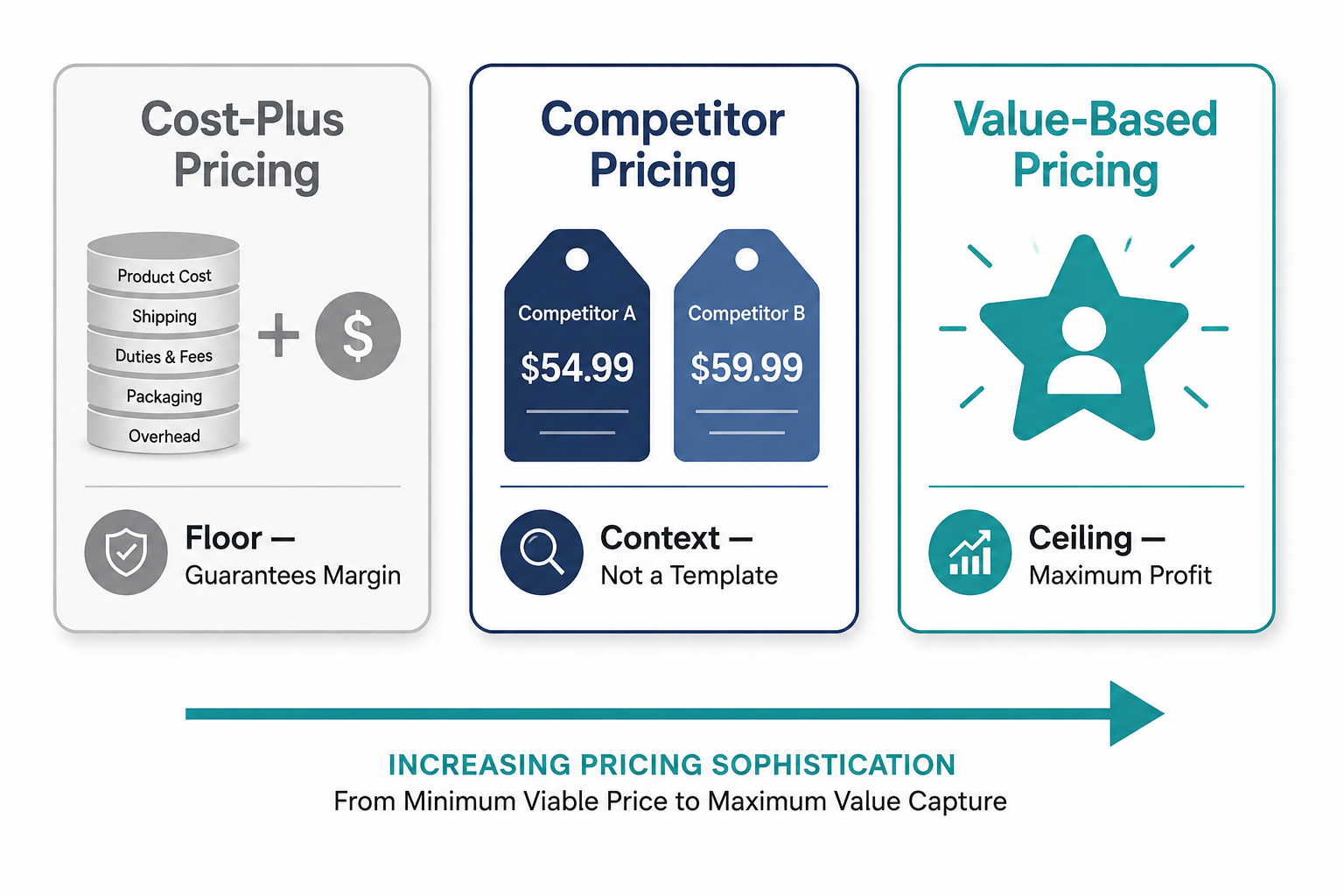
Cost-plus pricing is where you start. It tells you the floor — the minimum price at which you are not losing money. It does not tell you the ceiling — the maximum price at which customers will still buy.
Competitor-Based Pricing: Useful Context, Dangerous Anchor
Competitor pricing research tells you what the market currently accepts for similar products and positions you relative to alternatives customers can find. For products in competitive categories with multiple established players, ignoring competitor pricing is risky — a significant price premium requires a compelling, visible reason to exist, and without that reason it will suppress conversion.
The danger of competitor-based pricing is anchoring your price to whatever competitors happen to charge — which may be wrong for you. A competitor with a larger subscriber base, lower supplier costs, a different cost structure, or a willingness to operate at thin margins is not a rational pricing benchmark for your business. Matching their price may mean matching their margin, which may be insufficient for your operating model.
Use competitor pricing as context rather than a template. Know where your price sits relative to alternatives. Understand what the price leaders are doing and why. Then price based on your own costs, value proposition, and customer positioning — informed by but not determined by what competitors charge.
Value-Based Pricing: Where Profit Actually Lives
Value-based pricing sets the retail price based on what a customer is willing to pay for the outcome or transformation the product delivers — rather than on what the product costs or what competitors charge.
A skincare product that demonstrably reduces fine lines for a customer who values their appearance is not competing on ingredient cost or competitor price — it is priced based on the value of the outcome the customer is buying. If the customer values that outcome at $80, charging $45 because your cost structure allows for a 4x markup leaves $35 per unit on the table.
The practical challenge of value-based pricing is identifying what customers genuinely value and what they will pay for it. The methods that work for Shopify merchants:
Customer interviews — talking directly to your existing buyers about why they chose your product, what alternatives they considered, and what made your price feel right or give them pause. The language customers use to describe value is usually more useful than any pricing framework.
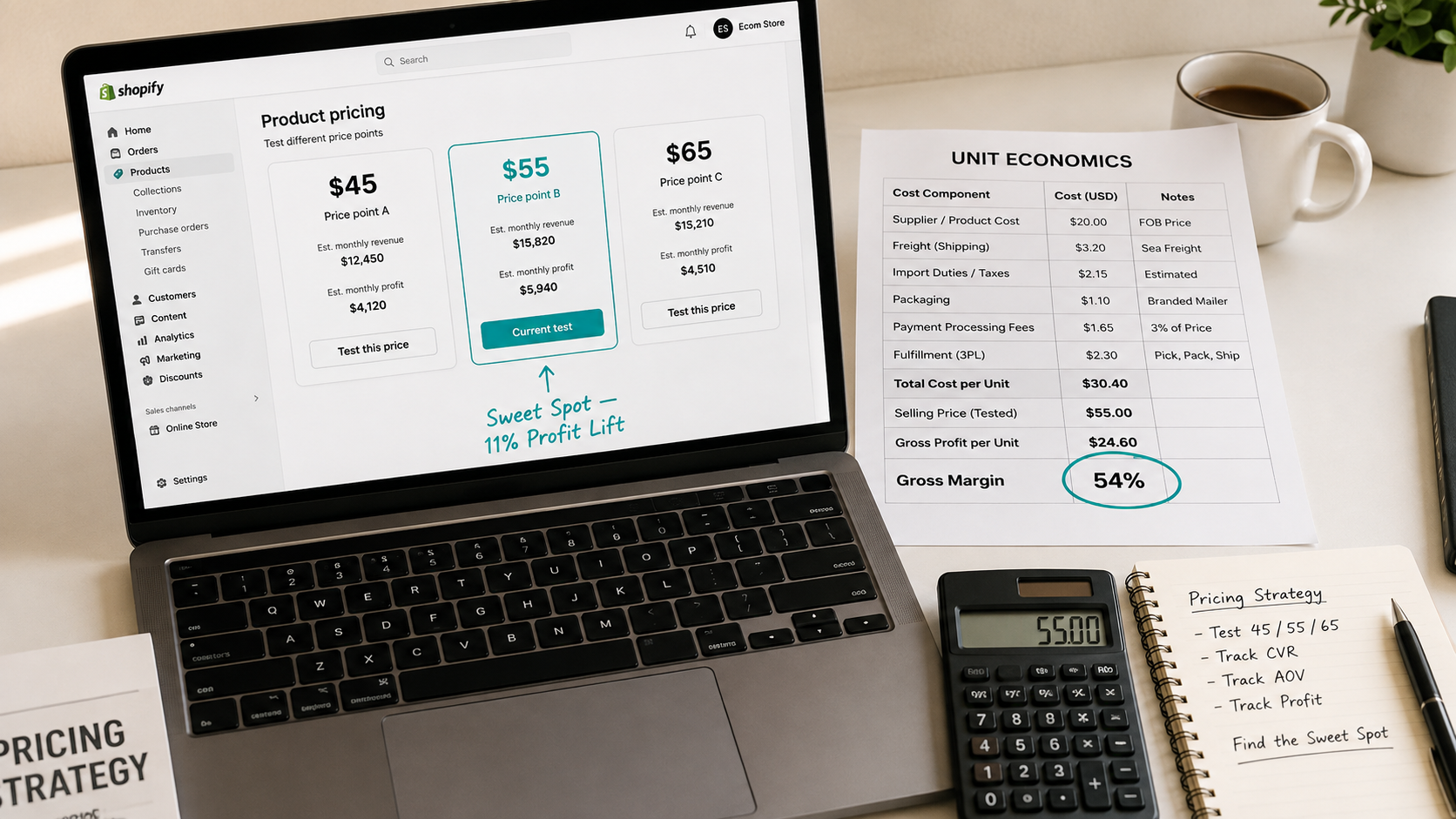
Price testing — running the same product at different price points over defined periods to measure the elasticity of demand. A product moved from $45 to $55 that maintains the same conversion rate is demonstrating that customers value it at $55 or above. A product that sees conversion rate decline sharply at a $5 increase is signaling that you are near the ceiling of what the current positioning supports.
Willingness-to-pay surveys — asking a sample of your target customers or existing buyers what they would expect to pay for a product described with its key benefits, without showing them the actual price. The responses reveal the price range that feels reasonable versus the price that triggers "that's too much" reactions.
Psychological Pricing: How Presentation Changes Perceived Value
Two products at the same price can feel fundamentally different to a buyer based entirely on how the price is presented. Understanding and applying pricing psychology is one of the highest-ROI improvements available to any Shopify store — because it costs nothing to implement and can meaningfully shift conversion rates.
Charm Pricing and the Left-Digit Effect
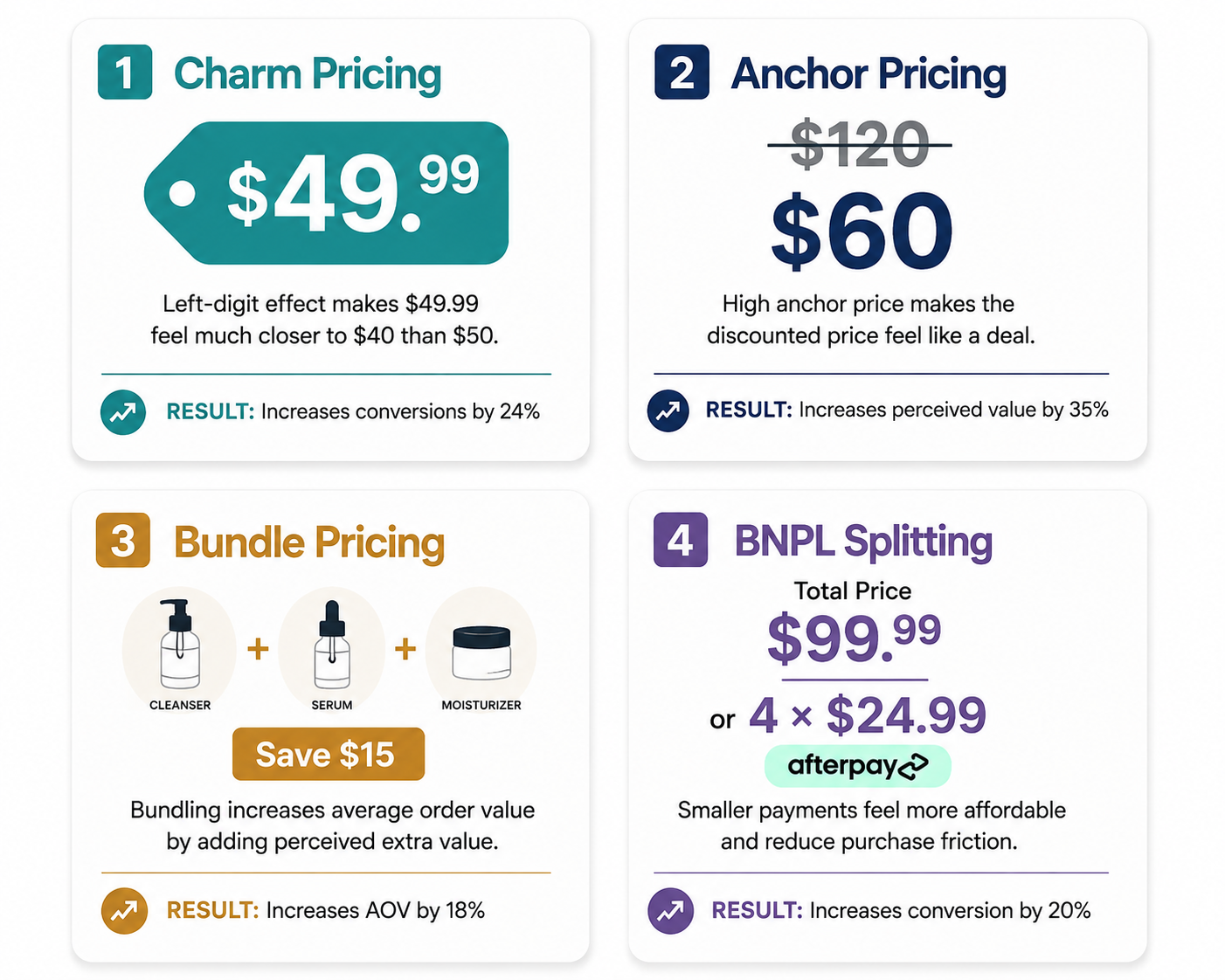
The left-digit effect is one of the most replicated findings in pricing psychology: buyers perceive the difference between $49.99 and $50.00 as larger than the actual $0.01 because they process the leftmost digit first and anchor their value judgment on it. $49.99 registers as "in the forties" while $50.00 registers as "fifty dollars" — a meaningfully different psychological position despite a negligible numeric difference.
Ending prices in .99 or .95 — called charm pricing — exploits this effect consistently. For mid-range products where price sensitivity is moderate and value-seeking behavior is active, charm pricing reliably outperforms round-number pricing on conversion rate.
The exception is premium and luxury positioning. A $200 skincare serum priced at $199.99 feels discounted — which undermines the quality perception that justifies the price in the first place. Prestige pricing — round numbers like $200, $250, $300 — signals confidence in the product's value and is appropriate for brands positioning at the premium end of their category.
Anchor Pricing and the Compare-At Feature
Shopify's native "Compare at price" field — which displays a strikethrough original price alongside the current sale price — is the most straightforward anchor pricing tool available. The compare-at price sets a reference point that makes the current price feel like a deal even when the customer has no independent knowledge of what the product should cost.
The effectiveness of anchor pricing depends on the credibility of the anchor. A compare-at price of $120 on a product retailing at $60 is compelling. A compare-at price of $400 on a $60 product triggers skepticism — the anchor is implausible, and an implausible anchor actively reduces trust and conversion rather than increasing it.
Use compare-at prices that reflect a genuine previous or alternative price: your actual original retail price before a sale, the recommended retail price from your supplier, or the price of a genuinely comparable competitor product. Credible anchors work. Inflated anchors backfire.
Bundle Pricing and Perceived Savings
Bundle pricing groups two or more products together at a price lower than their combined individual retail prices. The customer perceives a saving — and typically spends more in total than they would have on a single product purchase.
A three-product skincare routine priced at $85 as a bundle, versus $35 plus $30 plus $25 individually ($90 total), saves the customer $5 and increases your average order value from a typical single-product purchase. The customer wins on perceived value. You win on revenue per order and inventory turn across the catalog.
Bundling also provides a natural mechanism for moving slower-selling products. Pairing a high-velocity bestseller with a slower-moving complementary product in a bundle at an attractive price clears inventory that would otherwise sit, while giving customers a value proposition that the individual products cannot match alone.
Payment Splitting and BNPL Framing
For products above $50, showing a Buy Now Pay Later installment price alongside the full price reduces price shock and leverages the left-digit effect at the installment level. A $99.99 product shown as "or 4 payments of $24.99 with Afterpay" moves from the double-digit mental bracket to a price that feels comparable to an everyday expense.
Stores offering BNPL options prominently on high-ticket product pages typically see 20 to 30% higher conversion rates on those items. The total revenue is identical — the customer pays the full price over time — but the conversion rate improvement means more customers complete the purchase rather than abandoning because the full price felt like too large a single-transaction commitment.
Testing Price Increases Without Hurting Conversion Rate
Raising prices on established products is the move most Shopify merchants are afraid to make — and the hesitation costs them significant margin. Here is how to do it correctly.
The first principle is that small price increases are rarely noticed by customers the way merchants expect. A product moved from $45 to $49.99 — an 11% increase — is unlikely to generate meaningful conversion rate decline for a product with strong reviews, clear value communication, and healthy organic traffic. The margin improvement is significant and permanent. The conversion impact is typically minimal.
Test price increases on your lower-traffic products first. A product receiving 200 visits per month is not a large enough sample to produce statistically meaningful conversion data quickly, but it is large enough to give you a directional signal about whether demand is elastic or inelastic at higher price points.
The A/B testing method for price changes: run the original price for 30 days, record conversion rate and revenue. Change to the new price and run for another 30 days under comparable traffic conditions. Compare conversion rate and revenue per visitor — not just conversion rate — because a higher price that produces a slightly lower conversion rate may still generate more revenue per visitor than the lower price that converted more frequently at less margin.
Use Shopify's compare-at price to frame price increases as temporary or contextual rather than permanent changes. Moving a product from $45 to $55 with a compare-at of $65 frames the current price as a deal rather than a hike — which can actually improve conversion at the higher price point relative to the unanchored lower price.
Pricing for International Markets With Shopify Markets
For Shopify stores selling internationally through Shopify Markets, pricing decisions multiply across currencies — and the defaults often produce psychologically awkward results.
Converting a $49.99 USD price to Australian dollars at the spot rate produces $77.43 AUD — a number that looks auto-generated rather than intentional. Use Shopify Markets' price rounding rules to convert and round to clean charm prices in each currency. $49.99 USD might round to $79.99 AUD, which looks deliberate, feels like a deal relative to $80, and lands correctly in the local consumer's price perception framework.
Local pricing norms also vary. In the UK, .99 endings are standard and expected. In Germany and the Netherlands, round numbers frequently signal quality and are preferred for premium products. In Japan, prices ending in 0 or 8 carry positive associations. Research the dominant pricing conventions in your target markets before simply converting your home-market pricing and assuming it translates.
Market-specific pricing adjustments through Shopify Markets also allow you to account for the real cost differences between markets — higher shipping costs, import duties, and operational overhead in certain regions — without applying those adjustments uniformly to all markets where they are not justified.
Building a Pricing Review Cadence
Pricing is not a one-time decision. It is a recurring discipline that keeps your margins aligned with your actual costs, your customer's evolving willingness to pay, and the competitive environment as it shifts.
A quarterly pricing review covering the following questions keeps your pricing strategy current without requiring constant daily attention:
Have your supplier costs changed since the last review? Any input cost increase that reduces gross margin below your target threshold triggers a price adjustment evaluation.
Are your conversion rates for each product category moving meaningfully up or down? A declining conversion rate that cannot be explained by traffic quality changes or seasonal factors may indicate pricing pressure. An above-average conversion rate may indicate room to test a higher price.
Have competitors changed their pricing in ways that shift your relative positioning? A competitor price increase creates room to move up. A competitor who has significantly undercut your position requires either a response or a sharpened value communication strategy.
Are there products in your catalog where the margin is consistently insufficient to support your acquisition costs? These products either need a price increase or a cost reduction — because running advertising to sell products that do not generate contribution margin above acquisition cost is a guaranteed path to a loss.
The Pricing Mindset That Separates Scaling Stores From Stagnating Ones
The merchants who price their products correctly share a common orientation: they understand that the price a customer pays is not primarily a reflection of what the product costs — it is a reflection of what the product is worth to the customer who buys it.
That distinction liberates pricing from the cost-plus mentality that keeps most Shopify stores undercharging. It opens the door to pricing based on outcome and transformation rather than input cost. It justifies premium positioning for products with genuine differentiation. And it frames every pricing decision as a value communication challenge rather than a math problem.
Your price is a signal. It tells customers what category your brand plays in, how much quality they should expect, and whether buying from you is a deal or a splurge. Every element of your product page — the photography, the description, the reviews, the trust signals — either supports or undermines the signal your price is sending.
When those elements align with the price, conversion happens. When there is a mismatch — a premium price supported by amateur photography, sparse reviews, and a generic description — the customer senses the disconnect and leaves.
Get the price right. Then build the entire product page experience to make the price feel inevitable.
Need help optimizing your Shopify store's pricing strategy, or want an expert to audit your product margins and identify revenue gaps in your current pricing structure? Get in touch with EcomFixify — we specialize in Shopify development and ecommerce growth strategy for brands ready to build sustainable profitability.