
How to Handle Shopify Returns Without Losing Money or Customers
Returns are the conversation most Shopify merchants avoid having with themselves. They show up in the numbers — in reverse shipping costs, in customer service time, in inventory that comes back damaged or unsellable — but they rarely get the strategic attention they deserve.
The average ecommerce return rate sits between 20 and 30% across industries. For apparel it reaches 40%. For every $100,000 in monthly Shopify revenue, that means $20,000 to $40,000 worth of orders coming back through the door — and the true cost of processing each return runs far higher than just the shipping label.
For a $75 apparel order, the all-in cost of processing a return — reverse shipping, receiving, inspecting, repackaging, and restocking — runs $15 to $25 before accounting for anything else. If the returned item cannot go back on the shelf at full price, add margin erosion on resale. If the customer who returned never buys again, add the $30 to $50 you paid to acquire them through Meta or Google. The real cost of a single return is not the refund. It is the refund plus the processing cost plus the lost lifetime value of a customer who left dissatisfied.
Yet the solution most merchants reach for first — restricting the return policy to discourage returns — consistently makes the problem worse rather than better. Tightening your return policy shifts the problem upstream. Fewer purchases, lower conversion rates, more abandoned carts. The merchants winning on returns in 2026 are not the ones making returns harder. They are the ones making it easier for customers to buy right the first time — and making returns so well-managed that they become a retention tool rather than a revenue drain.
This guide covers exactly how to do both.
Why Returns Happen: The Root Causes Worth Addressing
Before building a returns management system, understanding why customers return products in the first place identifies where prevention is possible versus where process improvement is the only lever available.
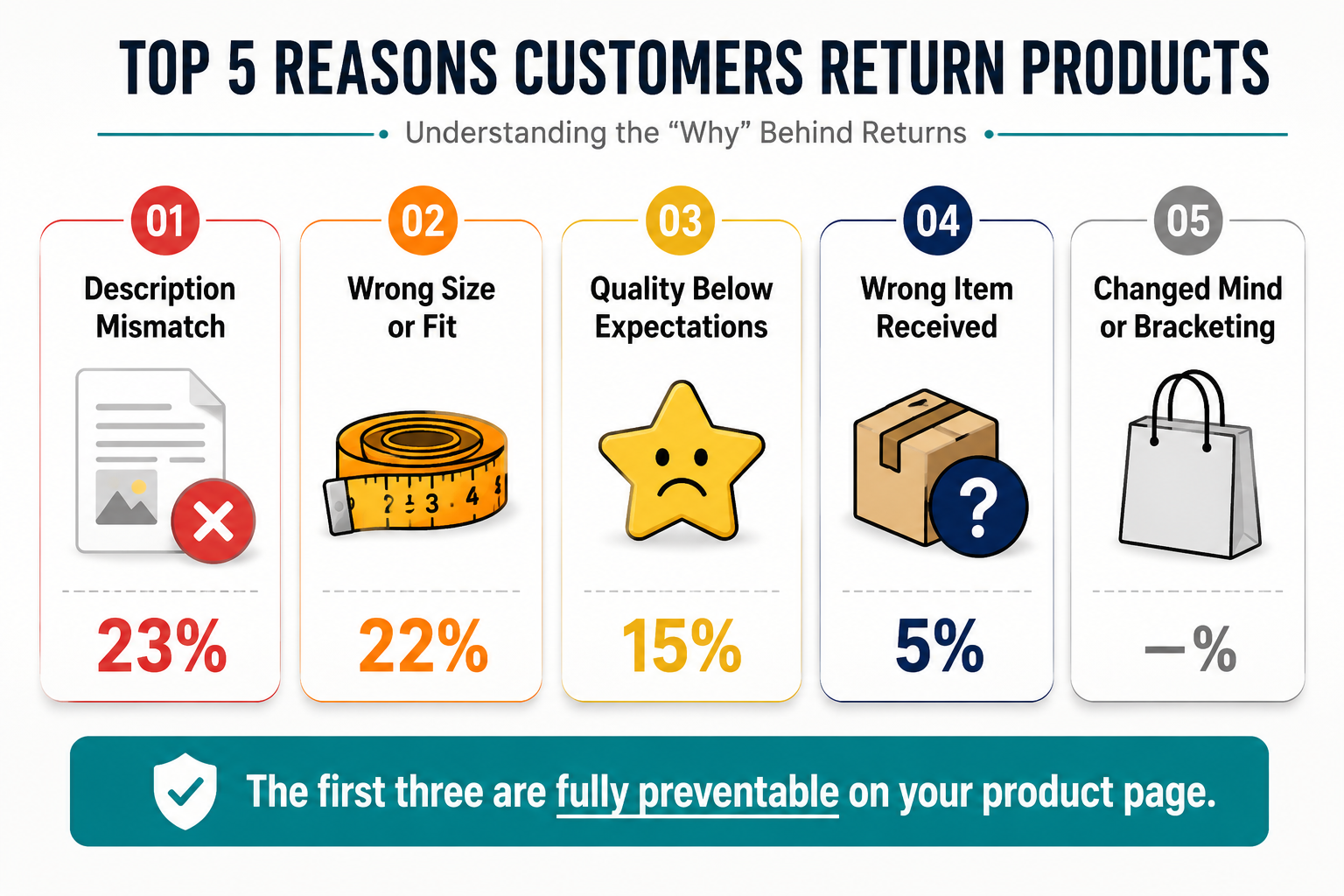
The top return reasons in Shopify ecommerce in 2026 are consistent across categories. Product did not match the description or photos accounts for 23% of returns — the largest single cause across all categories. Size or fit issues account for 22% of returns, concentrated heavily in apparel, footwear, and accessories. Quality below expectations accounts for 10 to 15% — the product felt cheaper or less substantial than the listing suggested. Wrong item received through fulfillment error accounts for approximately 5%. And a smaller percentage are returns without a clear product-related reason — gift items, changed minds, or intentional bracketing where customers order multiple sizes intending to return most of them.
The first three categories — expectation mismatch, sizing uncertainty, and quality perception — are all addressable on the product page before the purchase happens. A return that stems from a description mismatch is a content problem. A return that stems from sizing uncertainty is an information problem. A return that stems from quality perception below expectations is either a product quality problem or a photography problem that is overselling the product.
Every return in these categories that is prevented is both a cost saving and a conversion event retained. The same customer who would have returned based on sizing uncertainty, guided by a detailed size chart and a live chat response that recommended the right size, completes the purchase correctly and receives a product that meets their expectations. No return. No cost. No lost customer. No repeat acquisition spend.
Prevention Strategy 1: Product Pages That Set Accurate Expectations
The most cost-effective returns reduction strategy available to any Shopify merchant requires no app, no workflow, and no policy change. It requires product pages that tell the complete, accurate truth about what the customer is about to receive.
Improving product descriptions and photography reduces returns by 22% on average, according to 2026 data across Shopify stores. That figure makes product page accuracy the single highest-ROI returns reduction lever available — ahead of any app, any policy, or any operational improvement.
The specific product page elements that reduce return rates most effectively are:
Multiple high-quality images showing the product from all relevant angles including scale references that make the actual size immediately understandable. A customer who sees a ceramic mug next to a standard coffee mug in the product gallery has no uncertainty about whether it is the right size for their kitchen. A customer who sees only a single product shot on white has no reference point and will form assumptions that may or may not match reality.
Accurate, detailed product descriptions that address the specific purchase hesitations in your category. For skincare: texture, scent, and finish. For apparel: how the fabric feels, whether it runs large or small, and what the model's measurements are for the size shown. For electronics: compatibility requirements and what accessories are and are not included. The description that prevents the most returns is the one that answers the questions customers would ask a knowledgeable sales associate before buying.
Size guides with actual body measurements — not just labeled sizes — reduce size-related returns by 30 to 50% for apparel and footwear. A size guide that says "our Medium fits chest 38 to 40 inches, waist 30 to 32 inches" is actionable. A size guide that says "if in doubt, size up" is not.
Customer reviews that include fit and sizing feedback give prospective buyers peer-verified information that product descriptions cannot provide. A review that says "I am 5'9" and 165 pounds and the Medium fits perfectly with room in the chest" resolves sizing uncertainty for the next customer more effectively than any brand-authored sizing guidance.
Video demonstrations showing the product in use, at scale, in real-world conditions reduce returns for products where function or appearance in context matters. A 30-second video showing how a bag sits on a person's shoulder, how a piece of furniture looks in an actual room, or how a skincare product applies and absorbs resolves the expectation gap that drives returns in those categories more effectively than any static image.
Prevention Strategy 2: Pre-Purchase Support That Catches Uncertainty Before It Becomes a Return
A customer who is uncertain about whether a product is right for them has two options before buying: contact your support team and get clarity, or buy and hope for the best. When contact is easy and responses are fast, the first option generates a correct purchase. When contact is difficult or unavailable, the second option generates a purchase that frequently generates a return.
Pre-purchase customer service through live chat deployed on product pages resolves the uncertainty that would otherwise result in a return. A customer asking "does this concealer work for fair skin with yellow undertones?" who receives a specific, accurate answer based on real product knowledge completes the purchase with accurate expectations. The 30 seconds an agent spends answering that question eliminates a potential return that would cost $15 to $25 to process.
AI chatbots — Tidio, Gorgias, and similar platforms — handle a significant percentage of pre-purchase questions automatically in 2026, making always-on pre-purchase support accessible to stores that cannot staff live chat continuously. The AI's ability to answer questions about sizing, compatibility, and product specifications from your knowledge base means customers get answers immediately rather than abandoning the purchase because support was unavailable.
Proactive post-purchase communication also prevents returns by ensuring customers know how to use products correctly before they form a negative impression based on incorrect application or use. A post-purchase email sent 24 to 48 hours after delivery — covering how to get the best results from the product, what to expect in the first few uses, and who to contact if they have questions — catches the customers who would otherwise struggle silently and return rather than ask for help.
The Most Financially Impactful Change: Make Exchange the Default, Not the Exception
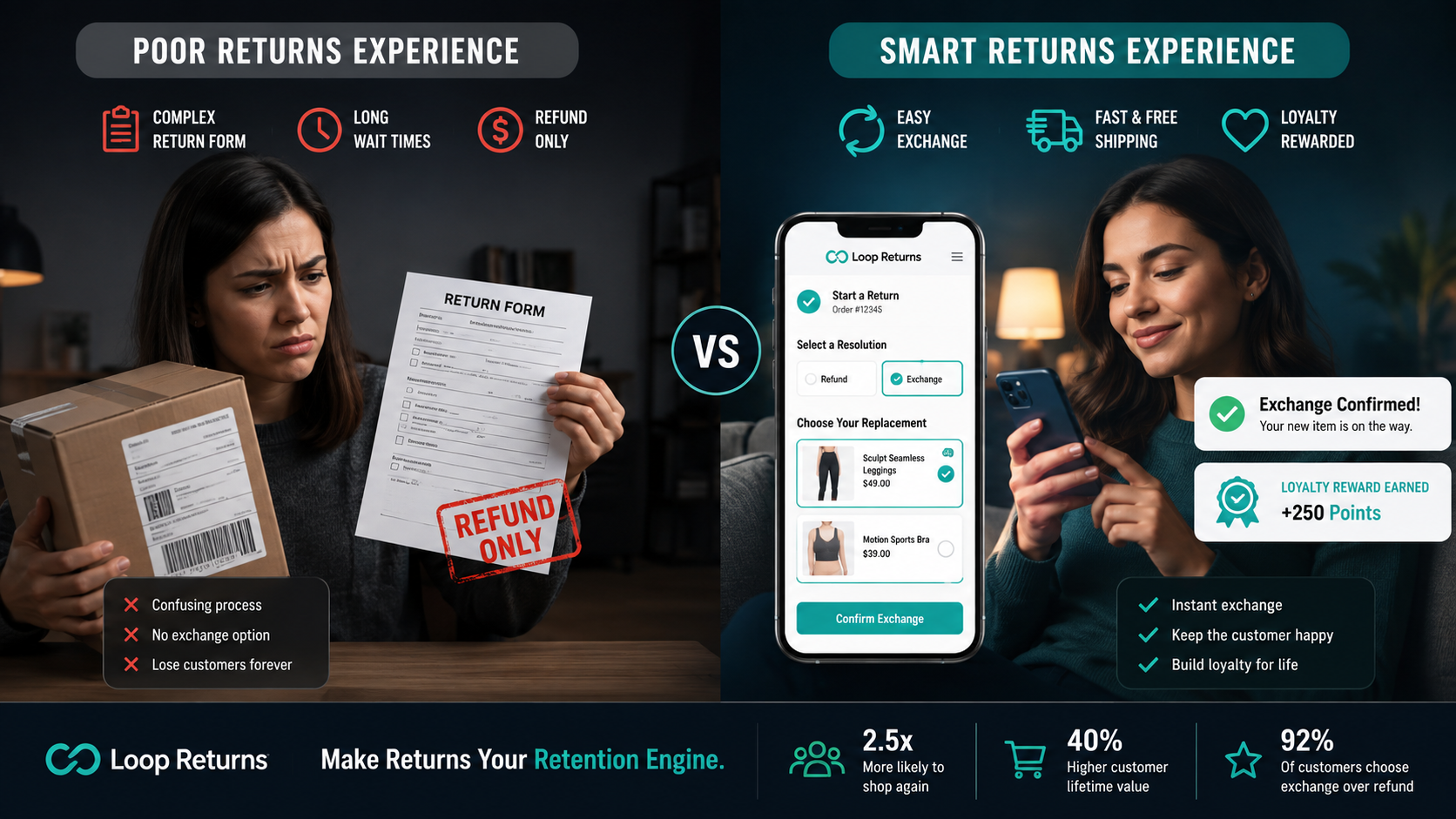
The single most important strategic shift in Shopify returns management in 2026 is making exchange the path of least resistance rather than the afterthought at the bottom of a refund form.
When a customer initiates a return, the first thing they see should be an offer to exchange — for a different size, a different color, or a different product entirely — ideally with an incentive that makes the exchange more attractive than the refund. Free return shipping on exchanges but not on refunds is the most common and most effective structure. Store credit with a 10 to 15% bonus — "return for a $60 refund or take $69 in store credit" — converts a meaningful percentage of would-be refunds into retained revenue.
Every refund that becomes an exchange retains 100% of the sale revenue. Every refund that becomes store credit retains the revenue with a future purchase guarantee. Returns management apps report that 30 to 40% of returns can be converted to exchanges when the exchange process is made genuinely easy and the incentive structure favors exchange over refund. Merchants who offer instant exchanges with free shipping on the replacement item retain 25 to 35% more revenue from return interactions compared to refund-only policies.
Princess Polly, the Australian fashion brand that expanded to the US market through Shopify, built this exchange-first philosophy into their returns operation through Loop Returns. The brand integrated Loop so customers could shop during the return flow with their return credit — browsing and selecting a replacement product before the original return was even received. The result was $1.23 in average upsell per return and a 55% reduction in out-of-stock rates year over year, because the exchange flow helped balance demand across their catalog.
That outcome — a return interaction that generates net incremental revenue rather than net loss — is what a well-designed exchange-first returns process achieves. It requires the right tooling and the right policy structure, but neither is technically complex.
Building a Returns Policy That Converts and Retains
Your returns policy is a conversion tool as much as it is an operational document. 92% of customers say they would buy again from a store that makes returns easy. A generous, well-managed return policy increases conversion rates by 20 to 30% because it removes the purchase risk that holds hesitant buyers back.
The returns policies that convert best in 2026 share specific characteristics:
They are generous in timeframe — 30 days minimum, with 60 days being the standard for brands that want to signal confidence in their product. Extending from 30 to 60 days increases conversion meaningfully and, counterintuitively, does not increase actual return rates significantly. Most customers who are going to return do so within the first two weeks regardless of policy length.
They are specific about process — customers want to know exactly what happens after they initiate a return: how to start the process, how long return shipping takes, when the refund or exchange will be processed, and how they will be notified at each step. Vague language creates anxiety; specific timelines create trust.
They are easy to find — linked from product pages, cart, and checkout. A return policy buried in the footer of a footer is a policy that is not doing its conversion work. Customers check return policies before buying, not after. Placing a link at the point in the purchase journey where hesitation is highest — on the product page, near the price and the Add to Cart button — directly reduces conversion friction.
They differentiate exchange from refund — clearly communicating that exchanges are free while refunds may have a return shipping fee creates a natural incentive structure without feeling punitive. Most customers will choose the easiest path, and designing the policy so that exchange is the easiest path is the most powerful revenue-retention lever in your returns management system.
The Best Shopify Returns Management Apps in 2026
Returns management apps make the exchange-first approach operationally scalable, automate the customer communication that builds trust during the process, and generate the analytics that identify which products are driving the most returns.
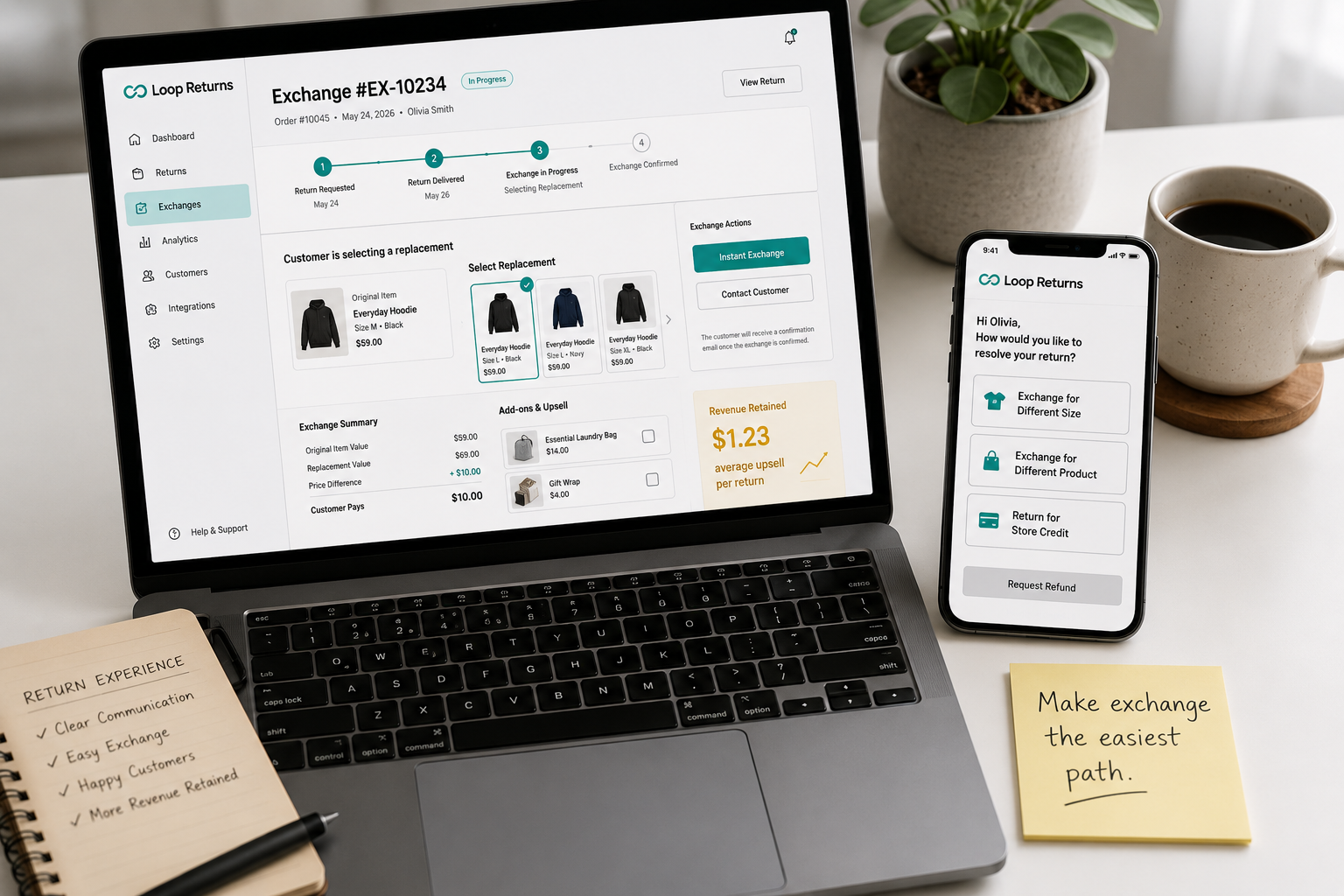
Loop Returns is the most widely recommended returns management app for Shopify brands with significant return volume. Loop powers the exchange-first flow — allowing customers to browse and select replacement products during the return initiation process, supported by instant exchanges that ship the replacement before the original return arrives. The platform reduced out-of-stock rates by 55% for Princess Polly while adding $1.23 in average upsell per return — demonstrating that a well-configured Loop implementation turns returns from a cost center into a revenue event.
AfterShip Returns and Exchanges is rated 4.7 on the Shopify App Store and focuses on post-purchase retention through a branded self-service return portal. Customers initiate returns through a portal that matches your store's branding rather than a generic form, which maintains the customer experience quality through the return process. AfterShip automates approval and status updates and generates analytics that flag specific products and listing issues driving return volume.
Happy Returns, now a UPS company, pairs returns software with a network of physical drop-off locations — 10,000 Return Bar locations nationwide as of April 2026, including more than 5,000 at The UPS Store. Customers return items with no box and no label at a Return Bar, where staff scan and verify the item and issue an immediate refund. The frictionless physical drop-off experience dramatically improves customer satisfaction with the return process — particularly for customers who dislike the hassle of repackaging and scheduling pickup.
Forthroute automates returns management at no cost, allowing customers to initiate returns through a branded portal that collects return reasons, generates prepaid labels, and updates your inventory system automatically. For stores in their early stage that need return automation without paying for enterprise-level functionality, Forthroute's free tier covers the core workflow.
Turning Return Data Into Product and Operations Intelligence
Every return is a data point that tells you something about your product, your listing, or your fulfillment operation. The stores that extract that intelligence and act on it systematically reduce their future return rates continuously — while the stores that process returns without analyzing patterns pay the same return costs indefinitely.
The return analytics that generate the most actionable insight are return rate by SKU, which identifies specific products that are consistently overperforming your store average return rate and need product page, product quality, or sourcing attention; return reasons by SKU, which identifies whether a product's return rate is driven by sizing issues, quality perception, or description mismatch — each of which requires a different intervention; return rate by traffic source, which can reveal that a specific ad audience or creative is generating customers with significantly different expectations than your organic buyers; and return rate trends over time, which flags whether specific interventions — a size chart update, a product photo refresh — are producing measurable improvement.
Review your return analytics monthly. When a specific product's return rate spikes, investigate immediately rather than waiting for the pattern to compound. Common causes of sudden return rate increases include a supplier quality change that has not been caught by incoming inspection, a sizing inconsistency introduced in a new production run, or a product description that has drifted from the actual current product specification.
When return data consistently points to the same root cause — sizing uncertainty across your apparel catalog, for example — invest in the systemic fix rather than managing the symptom. A one-time investment in professional size photography that shows each product on multiple body types reduces sizing-related returns permanently, while processing each individual sizing return only manages the cost of the problem without addressing its source.
Handling Serial Returners: When to Draw the Line
A small percentage of customers — typically 2 to 5% of a store's customer base — account for a disproportionate share of returns. These serial returners either bracket purchases intentionally, buying multiple sizes or colors with the intention of returning most of them, or abuse return policies by using items and returning them as unused.
Identifying serial returners requires tracking return frequency per customer in your order management system or CRM. Customers with return rates above 50% over multiple orders represent a segment worth addressing specifically.
The initial response should be proactive guidance rather than restriction. A customer who consistently returns the wrong size may simply need better sizing guidance — a personal outreach that asks about their sizing experience and offers specific recommendations for their next purchase converts some serial returners into correctly-matched loyal customers.
For customers who are genuinely abusing your return policy — returning used items as new, consistently exceeding the stated return window, or making demonstrably false claims about product condition — restricting return privileges or applying a restocking fee is a legitimate and defensible response. Large retailers including Amazon and Walmart have implemented this approach successfully. The key is applying it to demonstrable policy abuse rather than to customers who simply have a higher legitimate return rate than average.
The Financial Model for Returns Done Right
Understanding the financial model of well-managed returns helps justify the investment in return apps, better product content, and pre-purchase support.
Consider a Shopify store generating $50,000 per month with a 25% return rate — 350 returns per month at a $60 average order value. At $20 average processing cost per return, the baseline cost is $7,000 per month in return processing alone.
Implementing an exchange-first returns flow that converts 35% of returns into exchanges eliminates 122 refunds per month — recovering $7,320 in revenue that would otherwise be lost. Improving product page content that reduces the return rate from 25% to 20% eliminates 42 additional returns per month — saving $840 in processing costs and retaining the revenue on those sales. Adding pre-purchase live chat support that prevents 10% of potential return-generating purchases eliminates 35 returns before they happen.
Combined, these three interventions reduce the return-related revenue loss by more than $15,000 per month — from a starting point that was costing $7,000 in processing plus the full refund value of every return. The investment in Loop Returns, better product photography, and live chat support combined costs a fraction of that monthly gain.
Final Thoughts
Returns are not a problem to be eliminated. In ecommerce, some level of returns is structural and permanent — a product that cannot be touched, tried, or evaluated before purchase will sometimes not match what the customer imagined. The goal is not zero returns. The goal is returns that happen as infrequently as possible, are processed as efficiently as possible, and are converted into exchanges rather than refunds as often as possible.
The merchants who manage returns best in 2026 treat every return as a signal, a service opportunity, and a retention moment simultaneously. They fix the product information that caused the mismatch. They offer the exchange that retains the revenue. And they follow up after the resolution in a way that makes the customer feel so well-served that the return itself becomes a reason to come back — not a reason to leave.
That is the returns management standard worth building toward. Not zero returns. Returns that make customers more loyal.
Need help setting up returns management for your Shopify store, or want an expert to audit your current return policy and product pages for return rate reduction opportunities? Get in touch with EcomFixify — we specialize in Shopify development and ecommerce operations optimization for growing brands.