
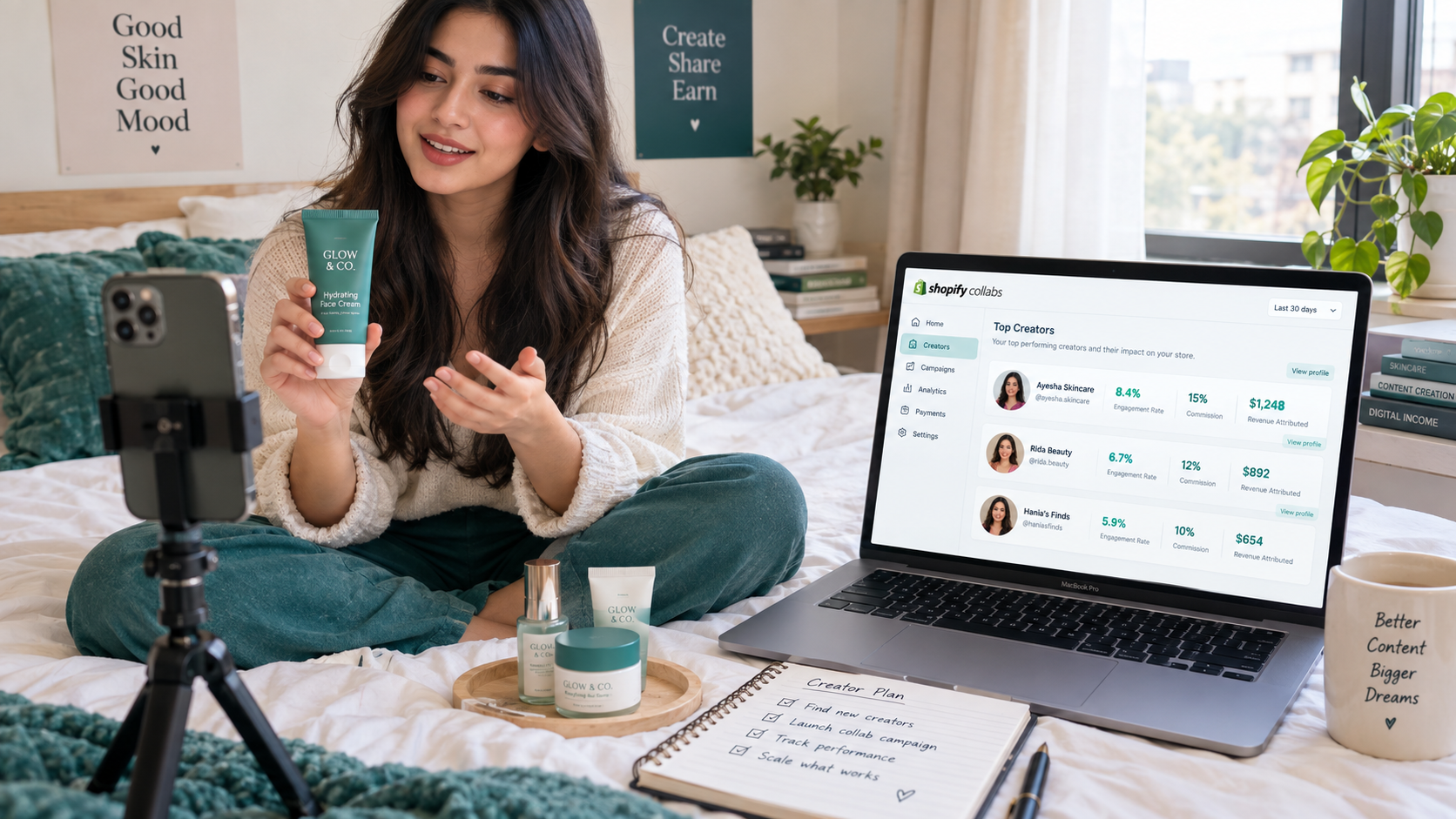
How to Grow Your Shopify Store With Influencer Marketing in 2026
Most Shopify merchants who try influencer marketing do it the same way. They find someone with a large following, send them free product, and wait to see what happens. Sometimes a sale or two comes through. More often, nothing does. They conclude influencer marketing does not work for their store and move on. How to Grow Your Shopify Store With Influencer Marketing in 2026
What they actually concluded is that unstructured influencer marketing does not work. Structured influencer marketing is one of the highest-ROI customer acquisition channels available to Shopify stores in 2026.
The influencer marketing industry reached $32.55 billion in 2025 and is projected to surpass $40 billion in 2026. Brands earn an average of $5.78 for every dollar spent on influencer campaigns — making it the third-highest-ROI channel for Shopify merchants behind email and SEO. 67% of consumers have made a purchase because of an influencer recommendation. And 78% of Shopify merchants generating above $50,000 per month use influencer marketing as an active acquisition channel.
The merchants generating those returns are not finding more famous influencers or spending more money. They are building a system — defined goals, the right influencer tier, clear partnership structures, trackable attribution, and a content reuse strategy that turns a single creator post into weeks of marketing material. This guide is that system.
Why Influencer Marketing Works Differently From Every Other Channel
Before building a strategy, understanding the psychological mechanism behind influencer marketing helps you design campaigns that actually leverage it.
Every other marketing channel — paid ads, SEO, email — puts your brand's message in front of potential customers. Influencer marketing puts someone else's endorsement of your brand in front of their audience. That distinction is not cosmetic. It is the fundamental reason the channel works as well as it does.
Consumer trust in traditional advertising has been declining for years. Ad blindness, iOS tracking restrictions, and a general fatigue with promotional content have made it progressively harder to reach and persuade cold audiences through paid channels alone. At the same time, consumer trust in people they follow online has grown. 67% of consumers trust influencer recommendations, up from 61% in 2025 — a trend moving in exactly the opposite direction from trust in traditional advertising.
The mechanism is borrowed trust. When a creator whose content you watch regularly, whose taste you respect, and whose recommendations you have found reliable before tells you a product changed their morning routine or solved a problem they had been dealing with — you evaluate that recommendation through the lens of everything you already know about that person. The trust you have built with the creator transfers to the brand they are endorsing.
That trust transfer is what drives the purchase rate on influencer content significantly above the purchase rate on equivalent paid advertising reaching the same audience. And it is why the quality of the match between the creator and the product matters more than the size of the creator's following.
The Influencer Tier That Delivers the Best ROI for Shopify Stores
The most counterintuitive and most commercially important insight in Shopify influencer marketing is that smaller creators consistently outperform larger ones on the metrics that matter most for ecommerce conversion.
The influencer tier landscape in 2026:
Nano-influencers have between 1,000 and 10,000 followers. Their audiences are typically composed of genuine friends, family, and close community members — people who know and deeply trust the creator. Engagement rates average 5 to 8%, dramatically higher than larger tiers. The trade-off is reach — a nano-influencer's post may be seen by only 1,000 to 3,000 people, limiting absolute volume.
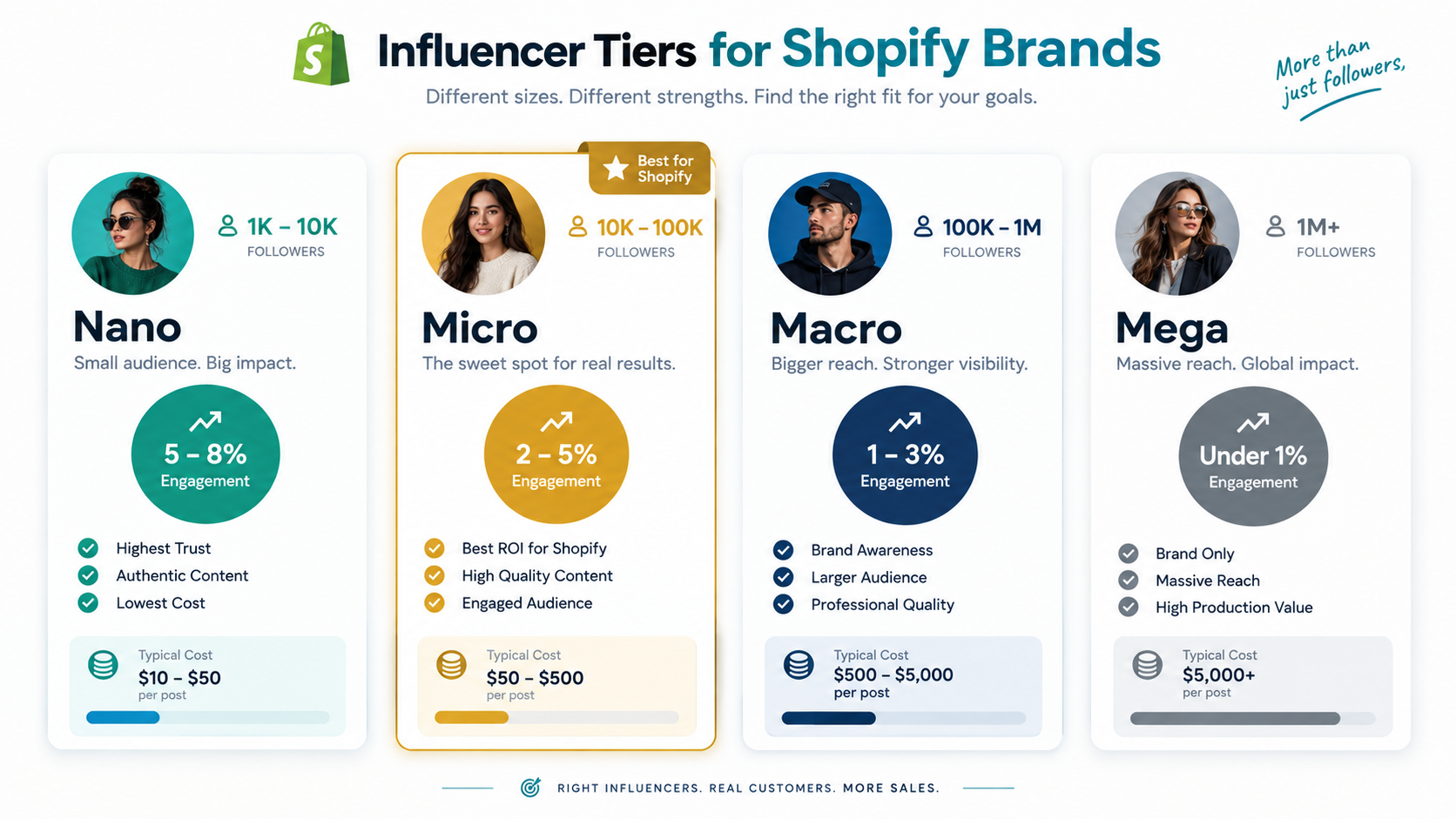
Micro-influencers have between 10,000 and 100,000 followers in a specific niche. This tier represents the highest ROI for most Shopify stores. Engagement rates average 2 to 5%, they maintain strong audience trust, and their cost is a fraction of macro or celebrity rates. The sweet spot for most Shopify merchants is working with 10 to 20 micro-influencers simultaneously rather than investing the same budget in one or two larger creators. This approach distributes risk, generates more diverse content, and allows you to identify which creator-audience combinations convert best before allocating more budget.
Macro-influencers have between 100,000 and 1,000,000 followers. Engagement rates average 1 to 3%, cost per post has risen significantly, and content often feels more polished and less personal — which reduces the authenticity that drives the trust transfer mechanism. Macro-influencers are most valuable for brand awareness goals when you need broad reach quickly, not for direct conversion campaigns where micro-influencers consistently outperform.
Mega-influencers and celebrities have above 1,000,000 followers. Engagement rates average below 1%, costs are extremely high, and the parasocial relationship between creator and audience is so diluted that brand trust transfer is minimal. This tier is appropriate for established brands with brand awareness budgets — not for independent Shopify merchants where every marketing dollar needs to justify itself in measurable return.
For Shopify stores under $100,000 per month in revenue, micro-influencers — specifically the 20,000 to 80,000 follower range in your specific niche — represent the tier with the most favorable combination of trust, engagement, reach, and cost.
Step 1: Define Your Goals Before You Find a Single Influencer
The most common reason influencer campaigns underperform is that merchants launch them without clear goals — and without clear goals, there is no framework for evaluating whether the campaign worked or not.
The three influencer marketing goals that are measurable and commercially meaningful for Shopify stores are:
Direct sales — campaigns where the primary objective is generating trackable purchases attributed to a specific creator. Measured by discount code usage, affiliate link clicks, and Shopify revenue attributed to the creator's unique tracking parameters.
Email list growth — campaigns where the primary objective is growing your owned audience. The creator promotes a lead magnet, a product quiz, or a discount that requires email submission. Measured by new subscribers attributed to the campaign period and traffic source.
Content creation — campaigns where the primary objective is generating authentic user-generated content that you can repurpose in paid ads, product pages, and email flows. The creator delivers video and photo content featuring your product that you can use across your marketing stack with appropriate usage rights.
These three goals require different campaign structures, different creator selection criteria, and different success metrics. A campaign optimized for direct sales uses unique discount codes and affiliate links. A campaign optimized for email growth uses landing pages with email capture. A campaign optimized for content creation specifies creative deliverables in the partnership brief and includes usage rights that cover paid advertising.
Define which goal is primary before approaching any creator — because the campaign structure, the creator brief, and the measurement approach all flow from that decision.
Step 2: Find the Right Influencers in Your Niche
Finding the right influencer is a research task, not a relationship task. The instinct to reach out to creators you personally follow produces creator-brand mismatches that generate poor results. Systematic research produces creator-audience alignment that generates conversions.
The research process that works consistently for Shopify merchants in 2026:
Start with your existing customers. Before looking outward, look at who is already buying from you. Pull your customer email list and search those email addresses or names on Instagram and TikTok. A surprising number of every brand's early customers are creators of some kind — and a creator who already buys your product is the most authentic partner you can find because their endorsement is not manufactured.
Use hashtag research on the platforms your target customers use. Search the hashtags your potential customers browse — your product category, your niche lifestyle terms, the problems your product solves — and identify creators who are consistently producing content in that space. Filter for engagement rate over follower count. A creator with 15,000 followers and a 6% engagement rate represents a more valuable partner than one with 150,000 followers and a 0.6% engagement rate.
Use Shopify Collabs — Shopify's native influencer marketplace — which is free and integrated directly into your Shopify admin. Collabs allows creators to apply to partner with your brand, manages product seeding logistics, generates unique discount codes and affiliate links automatically, and tracks revenue attribution directly in your Shopify dashboard. For most Shopify merchants who are new to influencer marketing, Shopify Collabs is the most efficient starting point because it eliminates the manual outreach and tracking infrastructure that makes influencer marketing operationally complex.
For brands with budget for more targeted research, tools including AspireIQ, Grin, and Upfluence allow you to filter creator databases by niche, follower count, engagement rate, audience demographics, and previous brand partnerships. These platforms also flag creators whose engagement appears artificially inflated — a critical filter because purchased followers and engagement are widespread across all major platforms.
Before reaching out to any creator, evaluate three things. First, audience alignment — does their content attract the same demographic as your target customer? A fitness creator with an audience of 25 to 35 year old women is valuable for women's activewear but irrelevant for men's grooming. Second, engagement authenticity — do the comments on their posts look like genuine responses from real people rather than generic emoji-only comments that signal a bot-driven engagement pattern? Third, content quality — does their content reflect the production values and tone that match your brand's positioning?
Step 3: Structure the Partnership for Maximum ROI
The structure of the partnership determines whether your influencer investment generates measurable return or disappears into the awareness ether with no trackable outcome.
There are four partnership structures available to Shopify merchants in 2026, and they are not mutually exclusive. The most effective campaigns combine elements of two or three simultaneously.
Product gifting is the lowest-cost entry point. You send the creator free product in exchange for their authentic reaction. There is no guaranteed post, no specific creative deliverable, and no payment — which means the creator's content, if they choose to make it, is genuinely authentic because it is entirely voluntary. The trade-off is control. You cannot guarantee a post, you cannot specify creative direction, and you cannot set a timeline.
Product gifting works best as the first step in a relationship with a nano or micro-influencer in your niche. Send the product, let them experience it, and see what they create organically. Creators who post without being asked are the most valuable partners because their audience response to that post is the strongest possible signal of purchase intent.
Paid partnerships involve a flat fee for specific deliverables — a defined number of posts or videos, a specific format, a posting timeline, and content usage rights. Paid partnerships give you control over creative direction and scheduling that gifting does not. They also cost significantly more and require a formal agreement that covers content rights, exclusivity restrictions if any, and FTC disclosure requirements.
Affiliate and commission structures pay the creator a percentage of revenue their content generates — typically 10 to 20% tracked through a unique discount code or affiliate link in Shopify. This structure aligns incentives perfectly: the creator earns more when their content drives more sales, which motivates them to create better content and promote it more actively than a flat-fee arrangement incentivizes. Commission structures also eliminate upfront cost risk for the brand — you only pay when revenue is generated.
Long-term ambassadors are creators who partner with your brand on an ongoing basis — typically monthly or quarterly — rather than for a single campaign. Ambassador relationships generate compounding brand recognition because the creator's audience sees your brand repeatedly rather than once. Repeat exposure through a trusted source builds the brand familiarity that drives purchase decisions over time rather than just in the immediate post period.
For most Shopify merchants starting influencer marketing, the recommended starting structure is gifting to identify which creators respond authentically, followed by affiliate commission arrangements with the creators whose organic posts performed best, followed by paid partnerships with the top performers once attribution data confirms which creator-audience combinations convert.
Step 4: Write a Creative Brief That Gets You Usable Content
Every paid or structured partnership needs a creative brief — a document that communicates what you need from the creator without scripting them so heavily that the content loses its authenticity.
The brief that gets the best results tells the creator the must-include information — your brand name, your key product benefit, your unique discount code, and the call to action — while leaving the creative execution entirely to them. Creators know their audience better than you do. They know which formats get engagement, which hooks work for their specific followers, and how to integrate a product into their content in a way that feels natural rather than sponsored.
Your brief should specify: the content format and platform, the posting window, the one or two key messages you need communicated, the unique discount code or affiliate link to include, the FTC disclosure requirement to disclose the partnership, and the content usage rights you need for repurposing.
What your brief should not specify: the exact script, the exact filming angle, the exact caption wording, or detailed production instructions. Creators who feel micromanaged produce content that reads as forced — and forced content converts at a fraction of authentic content.
If a creator's organic style does not match your brand requirements, they are the wrong creator for your brand — not a creator who needs more detailed instructions to produce what you need.
Step 5: Track Attribution Correctly
The attribution problem in influencer marketing is real and consistently causes merchants to both overvalue campaigns that are not working and undervalue campaigns that are driving significant revenue through channels that are hard to track.
Direct attribution tools that work for Shopify influencer campaigns:
Unique discount codes per creator — the simplest and most reliable tracking mechanism. Every creator gets their own code, every order using that code is attributed to that creator, and revenue per creator is reportable directly in Shopify's discount analytics. The limitation is that customers who see the influencer's content but buy later through a different path — direct search, a return visit — are not captured by the code.
UTM-tagged affiliate links in Shopify Collabs or your affiliate app of choice — these track every click from a creator's content to your store and attribute purchases that occur within a defined window after that click. More complete than discount codes alone because they capture purchases that happen without the discount code being used.
Post-purchase survey attribution — asking customers "how did you hear about us?" in your post-purchase survey captures influencer-driven purchases that neither discount codes nor UTM links track, because some customers remember seeing an influencer's post but come to the store through a direct search days later.
Revenue per creator is the primary metric for evaluating influencer ROI — total Shopify sales using each creator's discount code or affiliate link divided by total cost of the partnership. A micro-influencer paid $300 for a partnership that generates $4,500 in tracked sales is a 15x ROI. A macro-influencer paid $5,000 for a partnership that generates $12,000 in tracked sales is a 2.4x ROI. The micro-influencer wins on efficiency even though the macro-influencer generated more absolute revenue.
Beyond direct revenue, track secondary metrics that capture influencer marketing's broader commercial contribution. Email subscribers acquired during the campaign period, follower growth rate on your social accounts in the days following posts, branded search volume increases in Google Search Console, and traffic source data in Shopify analytics showing referral traffic from creator content — these metrics reveal the brand-building value of campaigns that goes beyond the directly trackable revenue.
Step 6: Repurpose Creator Content Across Your Marketing Stack
The most efficient Shopify influencer campaigns do not end when the creator posts. They generate content assets that continue driving value for weeks or months across every channel in your marketing stack.
Creator-generated content — authentic video and photos of real people using your product — is the highest-converting content type for Meta Ads, TikTok Ads, and Google Performance Max campaigns. UGC-style creative beats professionally produced brand creative by approximately 48% on click-through rate in paid social environments because it carries the authenticity signal that algorithmic ad systems have learned to reward and that audiences have learned to trust.
To repurpose creator content in paid ads, you need content usage rights granted in your partnership agreement before the content is created. Standard usage rights cover organic social reposting. Paid promotion rights — specifically allowing you to run the creator's content as a paid ad — require explicit permission and typically involve a separate usage fee in paid partnerships.
The repurposing workflow that maximises content value: the creator posts organically, you monitor the post's organic performance for 48 to 72 hours, and the posts that generate the strongest engagement and comment intent become your paid ad creative. You are essentially running a free creative test on the creator's audience before investing ad budget in amplifying the best-performing content.
On product pages, creator-generated photos and video testimonials reduce return rates and increase conversion rates by providing the peer social proof that professional product photography cannot replicate. A customer who sees a real person demonstrating how a skincare product applies and absorbs has a significantly more accurate expectation of what they are buying than one who sees only studio product shots.
In email flows, embedding creator video testimonials — particularly in your welcome series, post-purchase flow, and win-back sequence — personalizes the communication with authentic peer validation at moments when customer trust is being evaluated.
Shopify Collabs: The Native Tool Most Merchants Ignore
Shopify Collabs — Shopify's built-in influencer and affiliate management platform — eliminates most of the operational complexity that makes influencer marketing intimidating for merchants who have not done it before.
Collabs creates a branded application page where creators can apply to partner with your store. You review applications, approve partners, and send product directly through the platform. Approved creators automatically receive unique discount codes and affiliate links tracked in Shopify. When a creator's code is used at checkout, the sale is attributed to that creator and the commission is calculated automatically. You pay approved commissions monthly without managing manual tracking spreadsheets or separate payment processes.
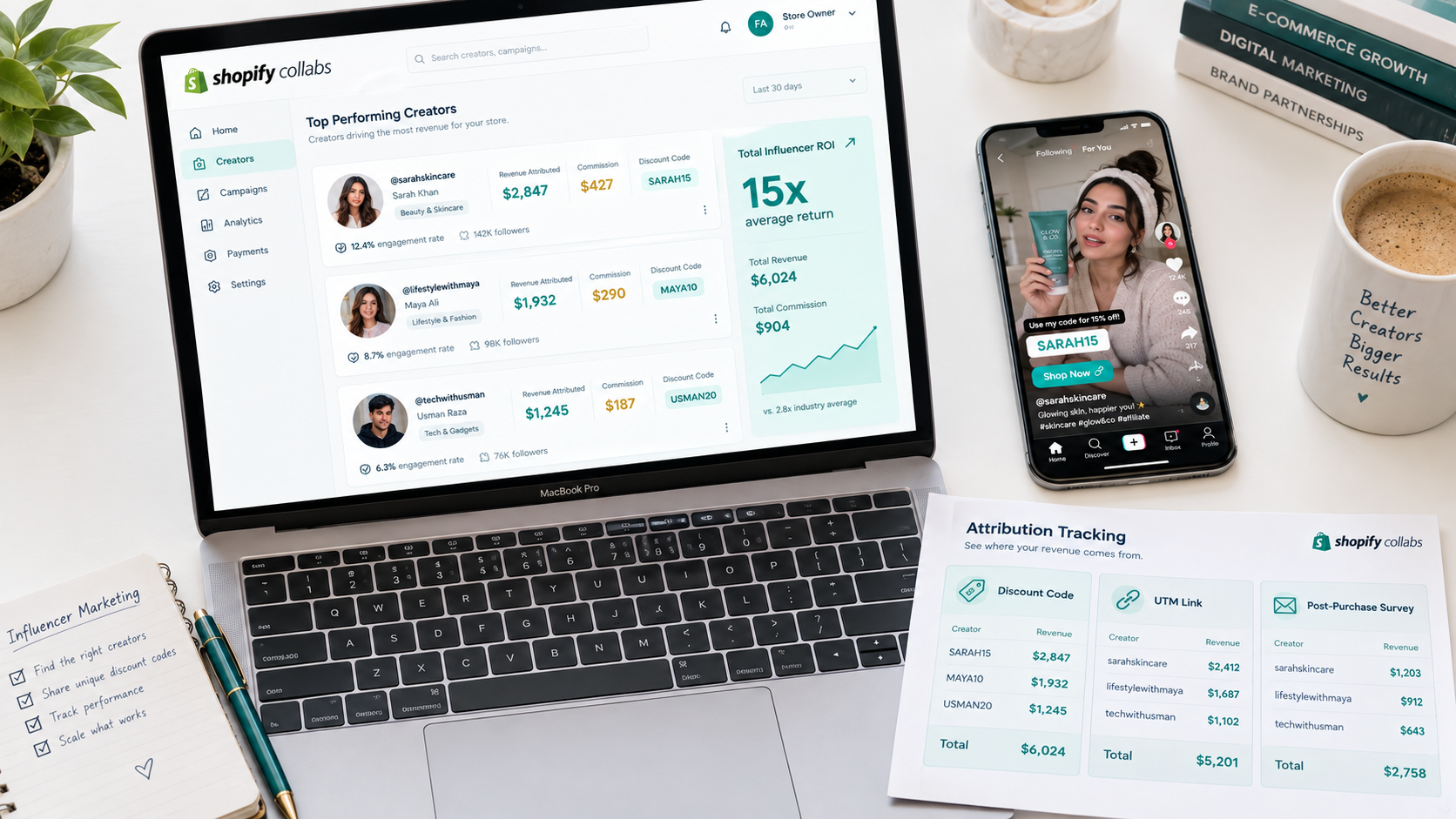
The platform integrates with Shopify's analytics, so creator-attributed revenue appears directly in your Shopify admin alongside your other revenue data. This makes the ROI calculation for each creator relationship straightforward — you can see exactly how much revenue each partner has generated relative to the product cost, commissions paid, and any additional fees.
For Shopify merchants who are new to influencer marketing, Shopify Collabs is the most logical starting point because it eliminates the infrastructure barrier and keeps everything inside the Shopify ecosystem you are already using.
Building a Long-Term Influencer Program: The Compounding Advantage
The most common mistake in Shopify influencer marketing is treating every campaign as a one-off transaction rather than as the beginning of a relationship. Single-post campaigns generate single-moment awareness. Long-term creator relationships generate compounding brand recognition that builds purchase intent over time.
An audience that sees a creator partner with your brand once may or may not register the recommendation. An audience that sees the same creator mention your brand in October, feature a different product in January, and reference their experience with your brand in a March Q&A has encountered your brand three times through a trusted source over five months — which is a fundamentally different brand relationship than a single sponsored post creates.
Building a creator roster of 10 to 20 micro-influencers who post about your brand on a monthly or quarterly basis — through a combination of affiliate commissions, periodic product gifting, and occasional paid campaigns for new launches — creates a sustained brand presence across multiple niche communities simultaneously. Each creator maintains their authentic relationship with their audience while collectively building the multi-touch brand exposure that drives purchase decisions in a category where customers research before buying.
The brands winning with influencer marketing in 2026 are not the ones that found the best single influencer. They are the ones that built the best roster — a diverse set of creator relationships across different platforms, different audience demographics, and different content styles — and invested in those relationships consistently over time rather than launching campaigns when they needed a revenue boost and going quiet the rest of the year.
FTC Compliance: The Requirement You Cannot Ignore
Every paid partnership, gifted product arrangement, and affiliate commission relationship requires explicit disclosure in the creator's content. The Federal Trade Commission's updated 2024 guidelines require that the material connection between a brand and a creator be clearly disclosed in a way that is visible before the viewer makes a decision to engage with the recommendation.
The disclosure must be clear and conspicuous — not buried in a caption full of hashtags, not placed at the end of a long caption after the promotional content, and not omitted because the creator considers the product a genuine recommendation. A simple "ad," "sponsored," or "gifted by [brand]" placed at the beginning of a caption or said verbally at the start of a video satisfies the requirement.
Make FTC disclosure a standard requirement in every creative brief. Creators who are active on brand partnerships are typically familiar with the requirement — but making it explicit in your brief protects both the creator and your brand from regulatory risk. In the UK, the ASA enforces equivalent requirements under the CAP code. In the EU, the Digital Services Act mandates similar commercial communication disclosure. Any Shopify merchant selling internationally should ensure their partnerships comply with the disclosure standards of every market they sell in.
The Influencer Marketing Metrics That Tell You It Is Working
The measurement framework that gives you accurate ROI data for Shopify influencer campaigns tracks four distinct layers:
Awareness metrics — reach, impressions, and video views generated by creator content. These are the weakest commercial indicators but establish baseline exposure for the campaign.
Engagement metrics — likes, comments, shares, and saves on creator content, expressed as a percentage of reach. Engagement rate above 3% on micro-influencer content indicates genuine audience resonance with the product recommendation.
Direct attribution metrics — tracked revenue through discount codes, affiliate links, and UTM parameters. This is the clearest commercial signal but consistently underestimates total campaign impact because it misses customers who convert outside the tracking window.
Blended efficiency metrics — total campaign revenue, including attributed sales and estimated untracked contribution, divided by total campaign investment. Compare this to your MER for other channels to evaluate whether influencer marketing is contributing above or below its proportional share of revenue per marketing dollar spent.
Review these metrics per creator, per campaign, and cumulatively over time. The per-creator analysis identifies which specific partnerships are generating the strongest returns and deserve increased investment. The cumulative analysis builds the business case for scaling influencer marketing as a proportion of your total marketing budget.
Final Thoughts
Influencer marketing works for Shopify stores in 2026 at a scale that most merchants have not yet explored — and the ones generating $5 to $15 return per dollar spent are not running bigger campaigns or finding more famous creators. They are running structured programs with the right influencer tier, clear partnership terms, accurate attribution, and content repurposing strategies that multiply the value of every creator relationship.
The entry barrier is lower than most merchants assume. Shopify Collabs is free and built into your admin. Micro-influencers in almost every product category are actively looking for brand partnerships. Product gifting to ten creators costs only the product itself. And the content those creators generate — authentic, niche-specific, audience-trusted — is the highest-converting creative asset available to any Shopify store in 2026.
Start with your existing customers. Build to micro-influencers in your niche. Track attribution from day one. Repurpose every piece of creator content that performs. And invest in the relationships that convert — because the compounding value of a creator who genuinely loves your product and tells their audience about it repeatedly is worth more than any single campaign budget you will ever spend.
Need help setting up Shopify Collabs or building an influencer outreach strategy for your store? Get in touch with EcomFixify — we specialize in Shopify development and ecommerce growth strategy for brands ready to scale.