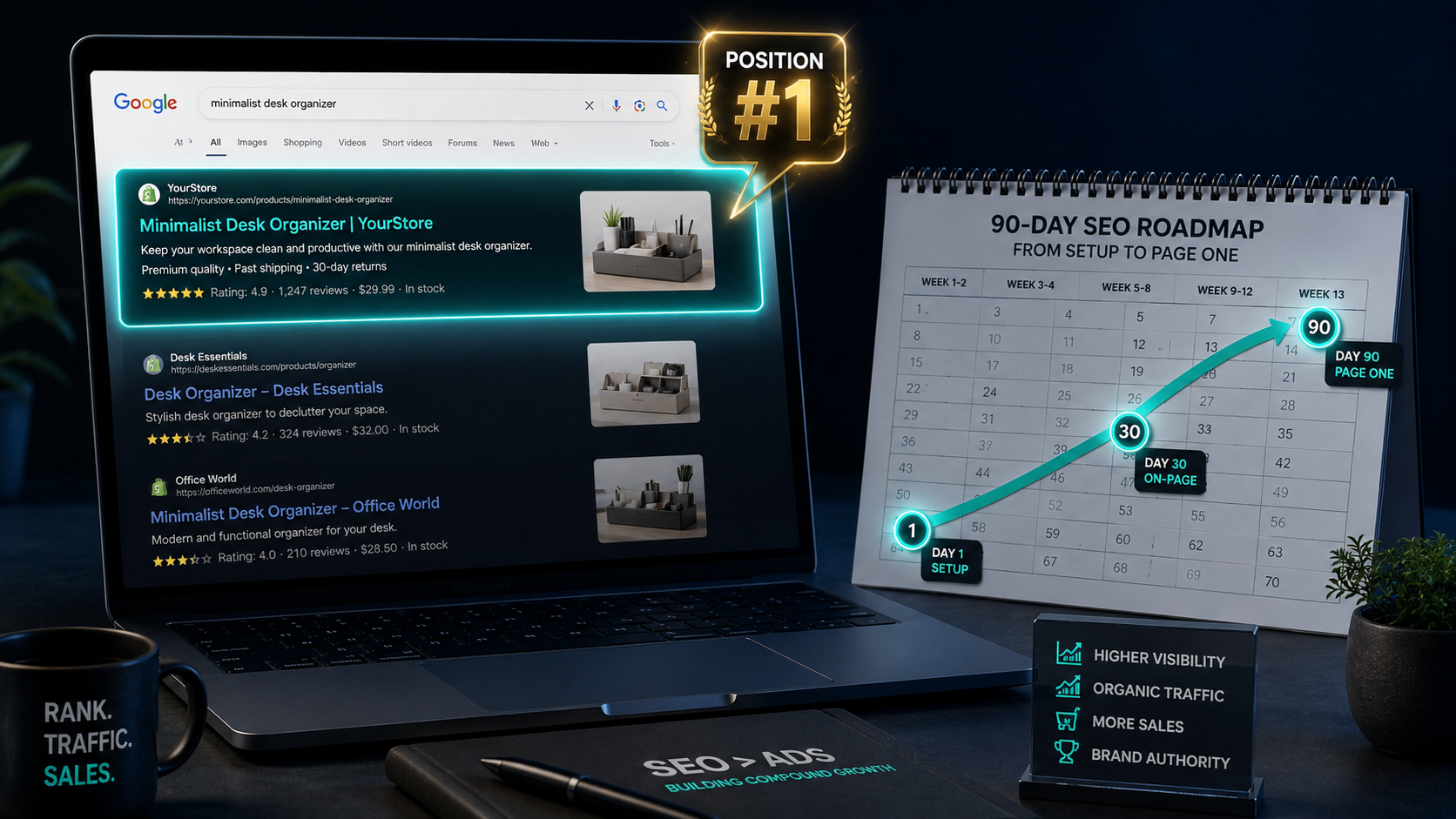
How to Get Your Shopify Store to Page One of Google in 90 Days
Every Shopify merchant running paid ads knows the anxiety. The moment you pause a campaign, the traffic stops. The moment costs rise, your margins compress. The moment the algorithm changes, your results shift without warning. You are renting visibility from platforms that can reprice or remove it at any time.
Organic search is the antidote. A Shopify store ranking on page one of Google for its target keywords receives visitors every single day — without paying per click, without campaign management, and without dependence on any platform's algorithm. One well-optimized Shopify store documented by SEO researchers receives over 800 daily visitors from Google alone — the equivalent of more than $15,000 per month in avoided ad spend — from content and pages that were optimized once and continue delivering years later.
In 2026, Shopify powers approximately 30% of all US ecommerce websites — which means organic search is one of the fiercest competitive arenas for online merchants. Ranking on page one requires more than installing an SEO app and adding keywords to product titles. Google's AI-driven algorithms now evaluate topical authority, page speed, structured data, and user experience as interconnected signals. Get all of them right and page one is achievable in 90 days for the right keywords. Get any of them wrong and your pages will sit on page three indefinitely while competitors with better fundamentals take the traffic.
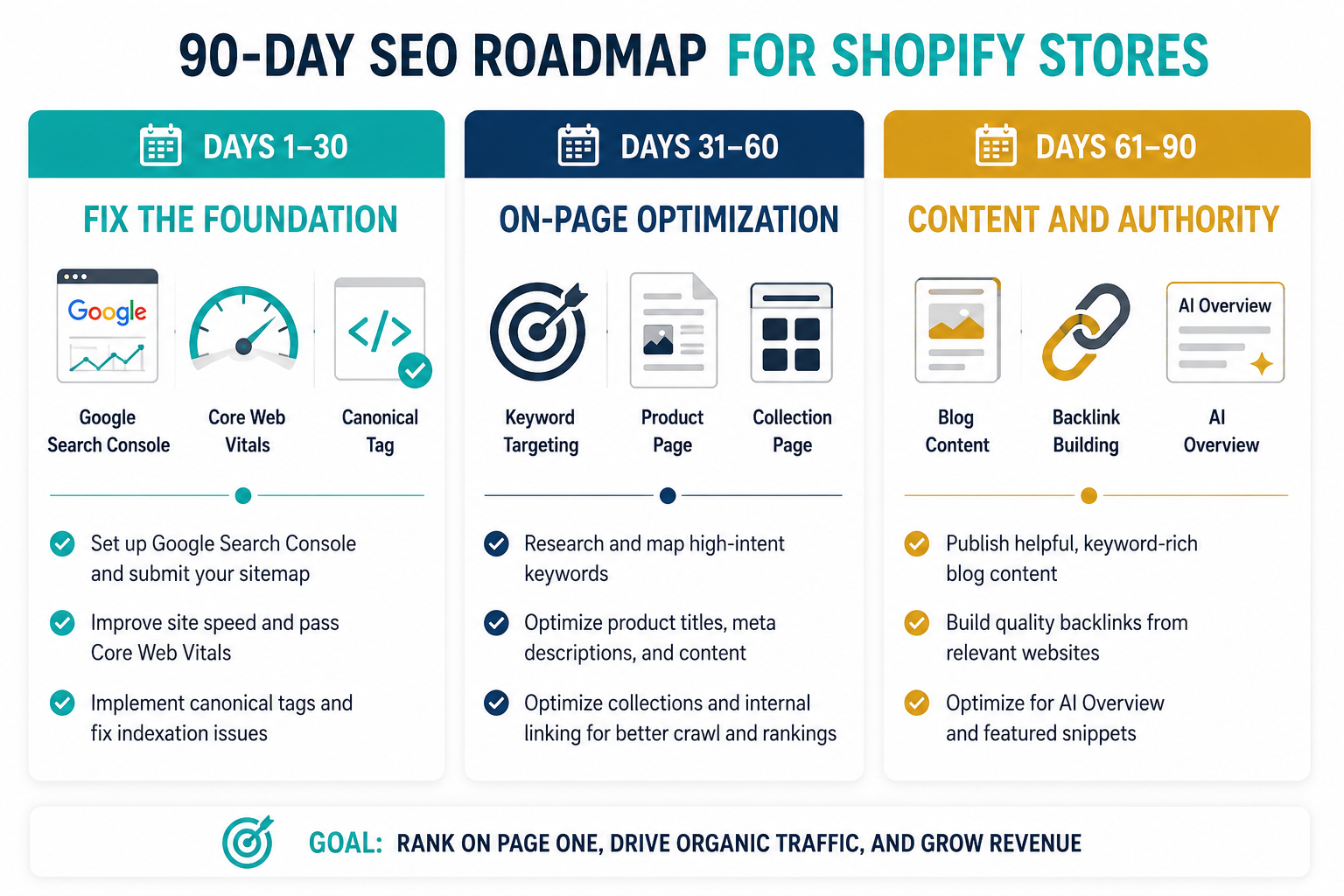
This guide covers the complete 90-day SEO roadmap for Shopify stores — what to do in the first 30 days, the second 30 days, and the final 30 days — with specific, actionable steps at each stage.
Why 90 Days Is the Right Timeline — and What It Requires
Before diving into the roadmap, setting realistic expectations prevents both premature discouragement and misallocated effort.
A brand-new Shopify store targeting competitive head terms — "running shoes," "skincare," "coffee" — will not rank on page one in 90 days regardless of the strategy. These terms are dominated by brands with thousands of backlinks, decade-old domain authority, and dedicated SEO teams. Targeting them with a new store is the fastest way to spend three months working hard and seeing nothing.
The 90-day page one target is entirely achievable — and consistently achieved — for long-tail and medium-competition keywords. A new store can rank on page one for "vegan leather running shoes for wide feet," "subscription skincare box for sensitive skin," or "small batch Ethiopian coffee beans" within 90 days because these terms have genuine search volume, clear purchase intent, and competition levels that a well-executed SEO strategy can overcome.
The practical strategy for new stores is to target a cluster of long-tail keywords first, build topical authority in a specific niche, earn initial backlinks, and progressively move toward more competitive terms as domain authority grows. This approach generates ranking results within 90 days and builds the foundation for competing on higher-volume terms in months four through twelve.
There is also a new layer of urgency in 2026 that makes Shopify SEO more important than ever. Google's AI Overviews — the AI-generated answer summaries appearing above traditional organic results on a significant and growing percentage of searches — pull content from well-structured, authoritative pages. Research shows only 16.7% overlap between AI Overview citations and traditional organic results, meaning standard SEO that gets you ranking in the traditional blue links may not get you into the AI summary that appears above them. The same foundational optimizations that improve traditional rankings also improve AI Overview eligibility — but only if implemented correctly.
Days 1 to 30: Fix the Foundation First
The most common SEO mistake Shopify merchants make is creating content and building links before their technical foundation is correct. Every piece of content you publish and every backlink you earn is less effective if Google cannot crawl your store efficiently or if your pages have structural problems that prevent them from ranking.
Set Up Google Search Console and Submit Your Sitemap
This is step zero — and surprisingly, many Shopify merchants skip it. Google Search Console is the tool that tells you how Google sees your store: which pages are indexed, which have errors, what queries you are appearing for, and how your pages are performing in search results. Without it, you are operating blind.
Navigate to Google Search Console, verify your Shopify domain using the HTML tag or DNS verification method, and submit your sitemap. Shopify automatically generates a sitemap at yourstore.com/sitemap.xml — submit this URL in the Sitemaps section of Search Console. From this point, Google will discover new pages you publish through your sitemap rather than only through other sites linking to you.
Check the Coverage report immediately after setup. Any pages showing as excluded or having errors need investigation before you invest further in their optimization. A page Google cannot index will never rank regardless of how well it is optimized.
Fix Shopify's Duplicate URL Problem
Shopify generates two URLs for every product: one at yourstore.com/products/product-name and one at yourstore.com/collections/collection-name/products/product-name. This creates a duplicate content situation where Google sees two separate URLs for the same page and must decide which one to rank.
Shopify handles canonical tags automatically — pointing the collection-path URL to the products-path URL as the canonical. However, it is worth verifying this is working correctly on your store by checking the page source of a product page accessed through a collection and confirming the canonical tag points to the /products/ version. If it does not, a Shopify SEO app — Plug In SEO, SEO King, or Smart SEO — can resolve this.
Optimize Your Site Structure for Crawl Efficiency
Google allocates a crawl budget to each site — a limit on how many pages it crawls per visit. Stores with poor site structure waste this budget on low-value pages — tag pages, filtered collection pages, search results pages — leaving important product and collection pages under-crawled.
Add noindex tags to pages that should not appear in search results: internal search results pages, tag-filtered collection pages, customer account pages, and any duplicate or thin content pages. In Shopify, this is typically handled through your theme's Liquid files or through your SEO app. Reducing the number of indexable pages on your store concentrates Google's crawl budget on the pages that matter — your product pages, collection pages, and blog posts.
Improve Core Web Vitals
Google's Core Web Vitals — Largest Contentful Paint (LCP), Interaction to Next Paint (INP), and Cumulative Layout Shift (CLS) — are direct ranking signals in 2026. Pages that fail Core Web Vitals thresholds are penalized in rankings relative to pages that pass, and the penalty is more severe on mobile where the majority of search traffic arrives.
Check your current scores in Google PageSpeed Insights by entering your store's URL. The most common Core Web Vitals failures on Shopify stores are LCP above 2.5 seconds — typically caused by uncompressed hero images or render-blocking JavaScript from third-party apps — and CLS from layout shifts caused by banner ads, popup scripts, or fonts loading late.
The fastest fixes for most Shopify stores are converting product and banner images to WebP format which reduces file size by 25 to 35% without visible quality loss, removing unused apps whose JavaScript loads on every page even when not in use, and enabling lazy loading for images below the fold so they do not block initial page rendering.
A store that passes Core Web Vitals has a meaningful ranking advantage over an otherwise identical store that fails them — and this advantage compounds across every page on the site.
Days 31 to 60: On-Page Optimization That Actually Moves Rankings
With the technical foundation correct, the second 30 days focus on on-page optimization — the content signals that tell Google what each page is about and why it deserves to rank for specific queries.
Keyword Research: Target Buyers Not Browsers
The keyword research approach that generates page one rankings within 90 days is fundamentally different from conventional keyword research that prioritizes volume. Volume matters — but intent and competition are what determine whether you can rank.
For each product or collection page you want to rank, identify the specific long-tail phrase a buyer with purchase intent would search. The difference between a browser and a buyer is specific intent. "Moisturizer" is a browser query. "Fragrance-free moisturizer for sensitive skin under $40" is a buyer query. The buyer query has lower volume but dramatically higher purchase intent — and dramatically lower competition because most brands target the broader term.
Google Search Console is your first keyword research tool once your store is live — it shows you which queries are already generating impressions for your pages, which tells you where organic visibility exists even before you have actively optimized for those terms. Google's People Also Ask section in search results shows the exact questions real shoppers ask about your product category — each one a potential blog post or FAQ section that drives qualified traffic.
For competitive analysis, search your target keyword in Google and study the pages ranking on page one. What type of page are they — product pages, collection pages, or blog posts? What word count do they use? What questions do they answer? This SERP analysis tells you exactly what Google believes satisfies the intent behind that query — and your page needs to satisfy it at least as well to compete.
Optimize Every Product Page Title, Meta Description, and URL
Shopify allows you to set custom page titles and meta descriptions for every page — accessible in the Search Engine Listing section of each product, collection, and blog post. These are not cosmetic choices. Page titles are one of the strongest on-page ranking signals available in Shopify, and they are the only part of your SEO that appears directly to customers in search results.
The formula for product page titles that rank and click: Primary Keyword — Brand Name | Secondary Descriptor. For example: "Fragrance-Free Moisturizer for Sensitive Skin — YourBrand | Dermatologist Tested." This structure places the target keyword at the beginning of the title — where it carries the most ranking weight — while including brand name and a trust-building secondary descriptor that improves click-through rate.
Meta descriptions do not directly affect rankings but significantly affect click-through rate — which indirectly affects rankings because pages with higher CTR receive more clicks for the same impression count, a positive signal Google uses to validate relevance. Write meta descriptions as short advertisements for the page: state what the page contains, include the target keyword naturally, and end with a clear reason to click.
URLs should be clean, descriptive, and keyword-rich. Shopify generates URLs from product titles by default — which is usually adequate — but product titles with generic words like "the" and "our" produce suboptimal URLs. Keep URLs under 75 characters, use hyphens between words, and include the primary keyword naturally. yourstore.com/products/fragrance-free-sensitive-skin-moisturizer is better than yourstore.com/products/the-best-moisturizer-for-sensitive-skin-naturally-fragrance-free.
Write Collection Page Content That Ranks
Collection pages are the most underoptimized pages on the vast majority of Shopify stores. Most merchants leave collection pages with just a title and the product grid — no introductory text, no keyword-rich content, no FAQ section. To Google, these pages look thin.
A collection page that ranks has a 150 to 300 word introduction paragraph at the top of the page that answers the category query directly — describing what the collection contains, who it is for, and what makes the products in it distinctive. It has a short FAQ section at the bottom addressing the most common questions shoppers have about the category. And it has image alt text on every product thumbnail that describes the product rather than using the filename as default alt text.
The collection page for "fragrance-free skincare" should open with a paragraph explaining what fragrance-free skincare is, why it matters for sensitive skin, and what the shopper will find in this collection. That paragraph, written for the reader first and for search engines second, gives Google the content signal it needs to rank the page for category-level queries.
Optimize Product Page Descriptions for Search
Product descriptions serve two masters: the customer reading them and Google indexing them. The descriptions that rank include the target keyword naturally in the first paragraph, use secondary keywords throughout the specification section, and answer the specific questions buyers ask about that product category.
The structure that satisfies both is the two-layer approach: a short emotional opening paragraph using benefit language that includes the primary keyword naturally, followed by a bullet-point specification section that covers materials, dimensions, compatibility, and category-specific details using natural keyword variations. This structure avoids keyword stuffing while providing the semantic richness that Google's entity-based understanding rewards in 2026.
Days 61 to 90: Content, Links, and the Authority Signals That Sustain Rankings
Technical and on-page SEO get your pages eligible to rank. The third 30 days focus on the authority signals that determine where on page one you end up — and how quickly you get there.
Build Topical Authority With Blog Content
Google's ranking algorithm in 2026 rewards topical authority — the degree to which a website comprehensively covers a specific subject area. A Shopify store that publishes three deeply researched blog posts on skincare for sensitive skin is treated as more authoritative on that topic than a store that publishes one post on skincare and two on unrelated subjects.
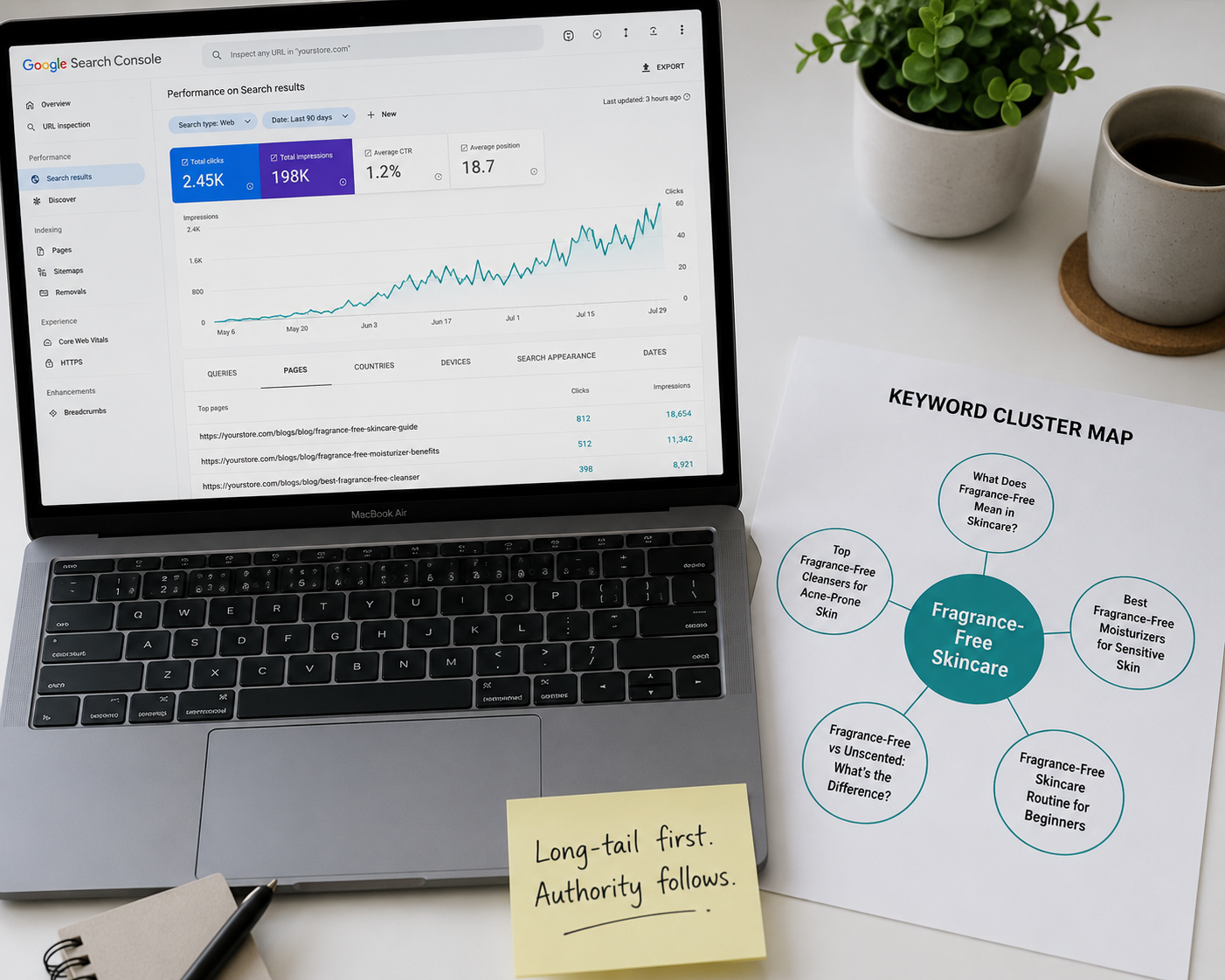
The content strategy that builds topical authority fastest is keyword clustering. Identify the central topic of your store — the subject you want Google to recognize you as an authority on — and build a cluster of blog posts around that topic that collectively cover every angle a potential buyer might search.
For a sensitive skincare brand, the cluster might include: "What Is Fragrance-Free Skincare and Why Does It Matter?" targeting informational intent, "Fragrance-Free Moisturizer vs Regular Moisturizer — What Is the Difference?" targeting comparison intent, "Best Fragrance-Free Skincare Routine for Sensitive Skin" targeting consideration intent, and "How to Read Skincare Labels to Identify Hidden Fragrances" targeting educational intent. Each post targets a different query while collectively signaling to Google that this domain has deep expertise in fragrance-free skincare.
Each blog post should be a minimum of 1,200 words, answer the target query thoroughly, include the target keyword in the H1 and naturally throughout the body, and link internally to related product and collection pages. The internal link from the blog post to the relevant collection page transfers topical relevance and authority from the post to the page you want to rank commercially.
Build Your First Backlinks
Backlinks — links from other websites pointing to your store — remain one of Google's strongest ranking signals. A page with ten high-quality relevant backlinks will consistently outrank an identical page with zero backlinks.
For a new Shopify store in days 60 to 90, the realistic backlink strategies are:
Supplier and manufacturer links: contact every brand whose products you carry or whose materials you use and ask to be listed on their "Where to Buy" or "Stockist" pages. These links are highly relevant to your niche and often available at zero cost.
Local and industry directories: submit your store to industry-specific directories relevant to your product category. A skincare brand should be listed in beauty and wellness directories. A fitness equipment store should be in fitness and health directories. These links are lower authority but build domain-level trust signals early.
Digital PR through data or stories: if your brand has an interesting founding story, a unique manufacturing process, or noteworthy sustainability practices, pitch it to journalists or bloggers covering your product category. A single link from a relevant editorial publication delivers more ranking impact than dozens of directory links.
Supplier and brand mentions: search Google for your supplier or brand names alongside terms like "where to buy" or "stockist" — any site that mentions the brand without linking to you is a potential link opportunity. Reach out and ask to be added.
The goal in the first 90 days is not hundreds of backlinks. It is 10 to 20 genuinely relevant links from real websites in your niche — which is enough to establish baseline domain authority and provide the competitive edge needed to rank on page one for long-tail targets.
Optimize for Google AI Overviews
In 2026, appearing in Google's AI Overview — the AI-generated summary that appears above traditional organic results for a growing percentage of queries — requires specific content formatting that standard SEO does not automatically produce.
AI Overviews pull from pages that directly and concisely answer the specific question behind a query. The formatting that gets cited most frequently is question-and-answer content where the question matches a specific search query and the answer is contained within the first 50 to 100 words following the question heading.
For your blog posts, structure key sections around the specific questions your target audience asks. H2 headings phrased as questions — "What Is the Difference Between Fragrance-Free and Unscented Skincare?" — followed by a concise, direct answer paragraph, are the content format most frequently pulled into AI Overviews. FAQ sections at the bottom of product pages and collection pages using the same question-answer format serve double duty: they satisfy voice search intent and increase AI Overview citation probability simultaneously.
Schema markup — specifically FAQ schema on pages with question-and-answer content and Product schema on every product page — further increases AI Overview eligibility by giving Google machine-readable structured data that confirms what each section of your page contains.
The Shopify-Specific SEO Problems That Kill Rankings
Understanding the platform-specific SEO challenges unique to Shopify prevents common mistakes that undermine months of optimization effort.
The duplicate URL problem — covered in the first 30 days — is the most well-documented Shopify SEO issue. The second most common is the /collections/all page that Shopify generates automatically as a collection containing every product in the store. This page is typically thin, poorly targeted, and indexed by default. Add a noindex tag to the /collections/all page to prevent it from competing with your properly optimized collection pages for category-level queries.
Pagination creates another set of issues. When a collection has more products than a single page displays, Shopify creates paginated URLs — yourstore.com/collections/skincare?page=2 — which Google may crawl and index as separate pages with thin content. Ensure your theme implements proper rel=prev and rel=next pagination tags, or add noindex to paginated collection pages to concentrate link equity on the main collection page.
Deleted products should be handled with 301 redirects — not 404 errors. When a product is discontinued, the product page previously ranking for its specific queries and accumulating backlinks over time has value that is entirely lost if the page returns a 404. A 301 redirect to the most relevant active product or collection page transfers that accumulated authority rather than discarding it.
Your 90-Day SEO Checklist by Week
Weeks 1 to 2 — Technical Foundation Set up Google Search Console and submit sitemap. Verify canonical tags on product pages. Check and fix Core Web Vitals on your top five pages. Add noindex to low-value pages. Fix any crawl errors showing in Search Console.
Weeks 3 to 4 — On-Page Setup Complete keyword research for your top ten product and collection pages. Rewrite page titles and meta descriptions for every page using keyword-first formula. Optimize collection page content with introductory paragraphs and FAQ sections. Write keyword-rich product descriptions using the two-layer structure. Add alt text to all product images.
Weeks 5 to 6 — Content Launch Publish first three blog posts in your topical cluster. Interlink each post to relevant collection and product pages. Submit each new post URL in Search Console for indexing. Begin first backlink outreach — supplier pages and industry directories.
Weeks 7 to 8 — Content and Links Publish next three blog posts completing your first content cluster. Add FAQ schema to blog posts and collection pages with question-answer content. Continue backlink outreach targeting five to ten additional relevant domains.
Weeks 9 to 10 — Monitor and Adjust Review Search Console Performance report for queries with impressions but low click-through rate — these pages are eligible to rank but need stronger titles or meta descriptions. Identify which blog posts are generating impressions and double down on similar topics. Check Core Web Vitals again and address any regressions from newly installed apps.
Weeks 11 to 12 — Optimize Winners and Expand Identify the pages showing page two rankings — these are your highest-leverage optimization targets for the final push to page one. Add more depth, internal links, and FAQ content to these specific pages. Request indexing for any updated pages in Search Console. Assess your backlink growth and plan the next wave of link building for months four through six.
What Happens After 90 Days
The 90-day mark is not a finish line — it is the beginning of sustainable organic growth. The pages you have optimized will continue accumulating authority as they age, as more internal pages link to them, and as additional backlinks arrive. Rankings that start at position eight or nine in month three typically move to position three or four by month six if you continue publishing content and building links consistently.
The compounding nature of SEO is what makes the investment worthwhile relative to paid advertising. A Meta Ads campaign stops generating traffic the moment you stop spending. A blog post that reaches page one in month three is still generating traffic in month eighteen — at zero additional cost per click.
Every piece of content you publish, every backlink you earn, and every technical fix you implement contributes to a growing SEO asset that delivers increasing returns over time. The Shopify stores with the most durable competitive advantages in 2026 are not the ones with the largest ad budgets — they are the ones that started building their organic presence consistently and systematically, and have been compounding that advantage for months or years while their competitors paid for every click.
Need help with Shopify SEO, or want an expert to audit your store's technical foundation and keyword strategy? Get in touch with EcomFixify — we specialize in Shopify development and SEO optimization for growing brands.