
How to Get Your First 1,000 Customers Without Spending on Ads
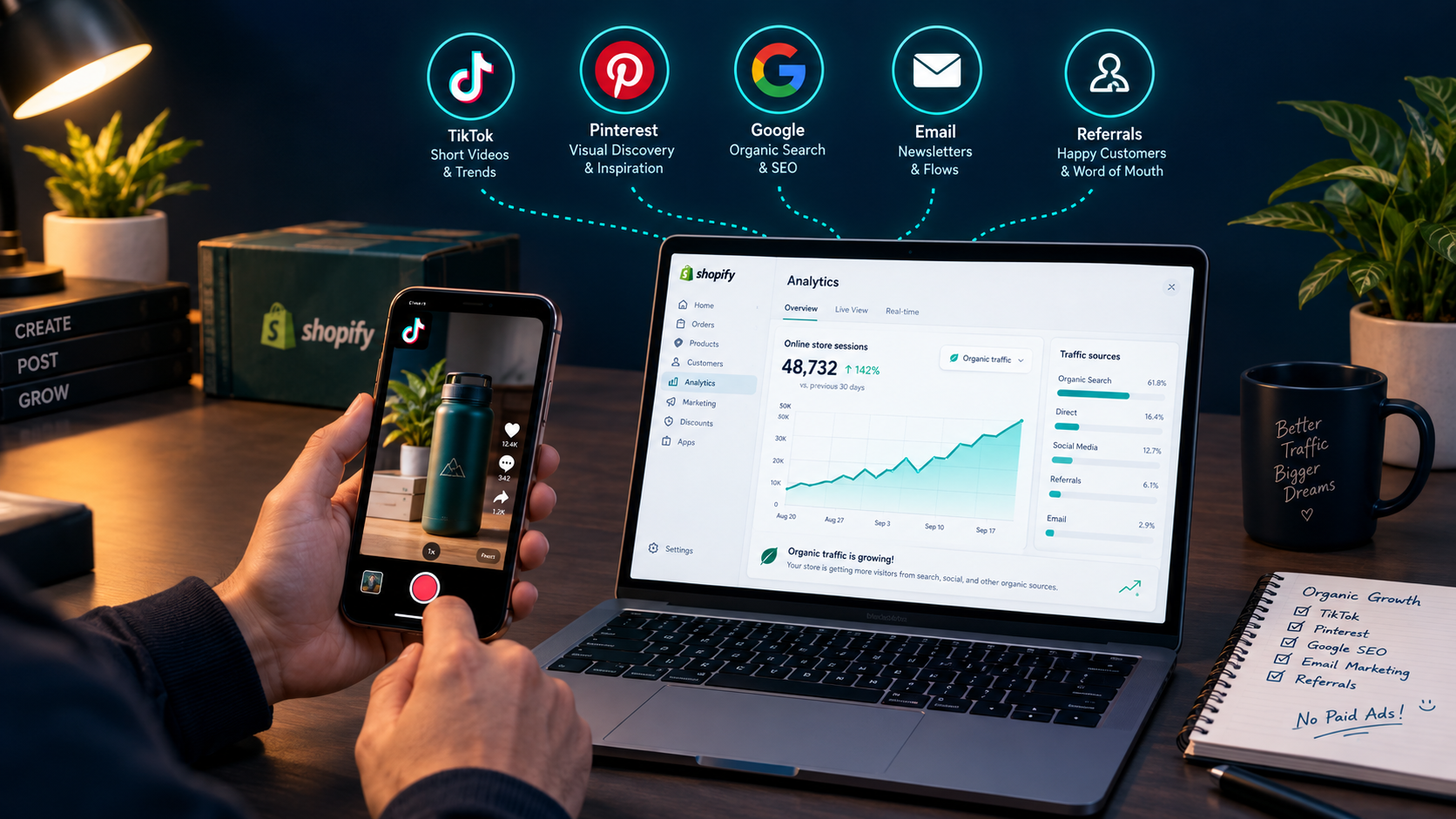
Paid advertising is the fastest path to traffic on Shopify. It is also the most expensive, the most unpredictable for new stores without conversion data, and the one that stops working the moment you stop spending. Get Your First 1,000 Customers Without Spending on Ads
For a brand-new Shopify store with no customer data, no email list, no review base, and no established brand identity, running Meta Ads or Google Shopping before any of those foundations are in place is one of the most common ways to lose $500 to $2,000 with nothing to show for it. The algorithm has no signal to optimize against. The ad lands on a store that has never converted a stranger. The campaign underperforms. The merchant concludes that ads do not work and gives up.
The smarter path — and the one taken by most Shopify stores that have actually grown sustainably — is building the first 1,000 customers through organic channels first. Not forever. Not as a religious opposition to paid advertising. As the foundation-building phase that makes paid advertising significantly more effective when you eventually run it.
Those first 1,000 customers give you review data, email subscribers, customer purchase behavior, testimonials, social proof, and a conversion-validated product page. Every ad dollar spent after that foundation exists is worth dramatically more than an ad dollar spent before it.
This guide covers the specific organic strategies that get Shopify stores from zero to 1,000 customers in 2026 — with realistic timelines, channel-by-channel guidance, and the sequence that produces the fastest results without spending on ads.
Why Organic Customer Acquisition Builds a Better Business Foundation
Before getting into tactics, the strategic case for organic-first growth is worth making clearly — because the temptation to run ads immediately is strong and the counterargument is not always obvious.
Customers acquired organically — through search, social content, referrals, and community — convert at higher rates, retain at higher rates, and generate more word-of-mouth than customers acquired through paid interruption advertising. They found you because something you created or someone they trusted pointed them your direction. That context — discovery with intent rather than interruption — creates a fundamentally different first interaction than a cold ad impression.
Organic strategies also generate compounding assets that paid advertising does not. A blog post that ranks on Google sends traffic for months or years after it is written. A TikTok video that resonates with your audience continues accumulating views and clicks long after it was posted. A referral program that converts happy customers into recruiters generates acquisition at an accelerating rate as the customer base grows. Paid ads stop delivering the moment the budget stops.
The goal is not to avoid paid advertising permanently. The goal is to arrive at paid advertising with a store that has proven it can convert, a product that has proven customers love it, and an email list that provides the retargeting audience that makes paid ads dramatically more efficient.
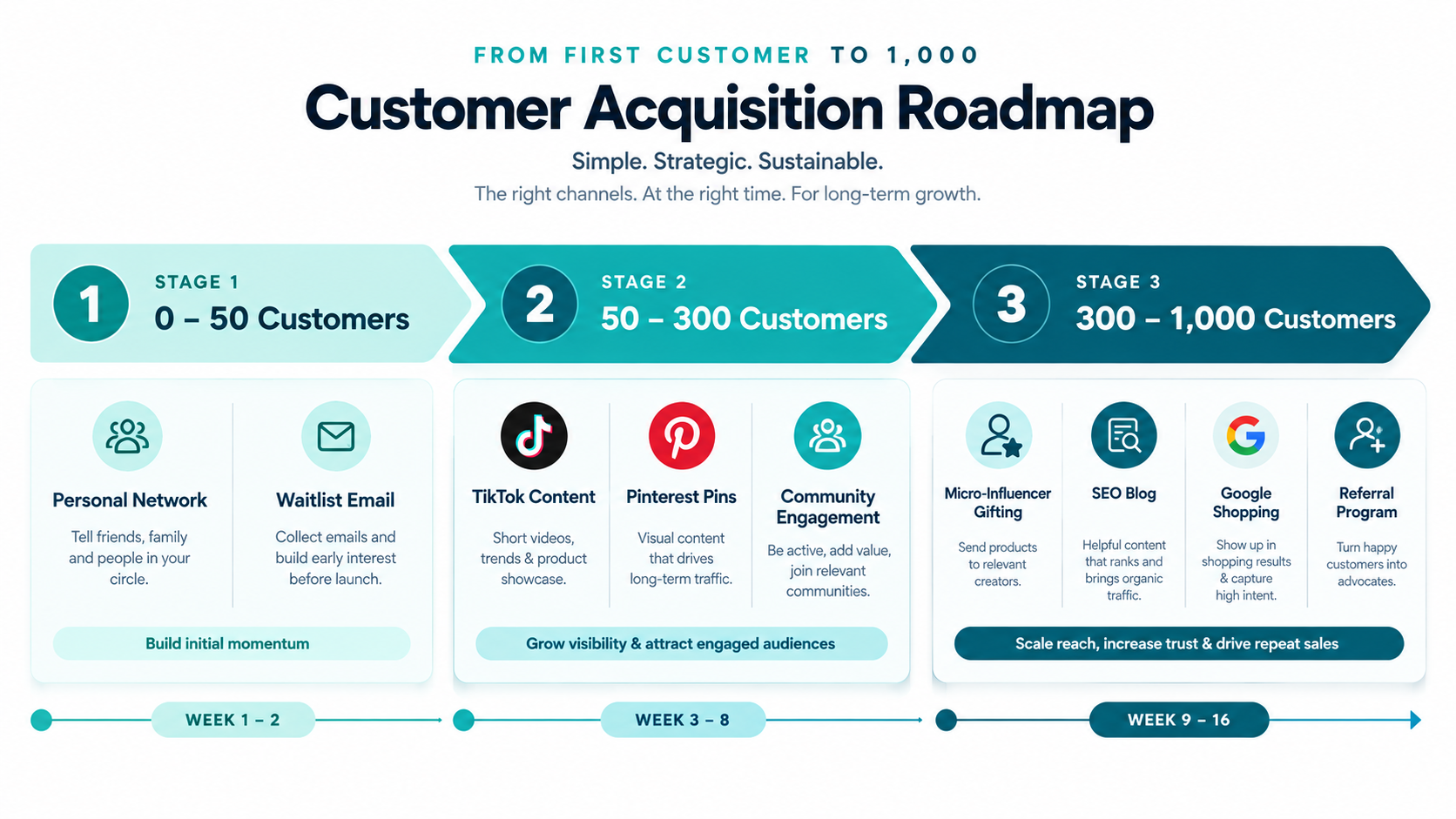
Stage 1: The Foundation — Getting Your First 50 Customers
The first 50 customers are the hardest because you have no social proof, no reviews, no word-of-mouth momentum, and no data. The strategies that work at this stage are close-range and high-touch — not scalable yet, but effective at generating the initial social proof that makes everything else possible.
Your Personal Network: The Most Underrated Launch Strategy
Every Shopify founder has a network of people who know them, trust them, and — if they genuinely believe in the product — will support their launch. Most founders are too embarrassed to activate this network directly, which is one of the most expensive mistakes in early-stage ecommerce.
Send personal messages — not mass emails, not social media announcements, but individual messages — to fifty to one hundred people in your personal network who match your target customer profile. Not everyone you know. The people who would genuinely benefit from your product. Tell them you have launched, share a direct link to the product you think is most relevant to them, and offer them a founder's discount of 15 to 20% as thanks for being an early supporter.
This approach generates your first ten to twenty orders from people who are predisposed to leave positive reviews, share the store on their own social channels, and provide genuine product feedback that helps you improve before you scale. It is not scalable past this stage — but it is the fastest and most reliable source of first revenue for a brand-new store.
Ask for reviews from every personal network customer who purchases. Offer a small thank-you — a discount on their next order, a bonus product, or simply a genuine request — and make the review process as simple as possible by sending them a direct link to your review platform. Ten genuine five-star reviews from real customers transforms your product page for every subsequent visitor.
Build a Waitlist Before or During Your Launch
Whether you are in pre-launch or have already launched without significant traction, a waitlist or email capture mechanism generates the initial email list that powers every subsequent organic channel.
A waitlist built on a simple landing page — "Be the first to know about our new collection / limited drop / launch offer" — with a compelling lead magnet (early access, founder pricing, exclusive content) converts cold visitors to email subscribers at rates between 15 and 35%. Those subscribers are warmer than any cold traffic source because they have actively opted in to hear from you.
Post your waitlist landing page in relevant online communities — niche subreddits, Facebook groups, Discord servers — where your target customer is already gathering. Share it in your personal network alongside your product launch message. Pin it in your social media bios. Every email address collected before or during launch is a customer acquisition asset that compounds in value over time.
Stage 2: Building Momentum — Customers 50 to 300
With initial social proof established, the second stage uses content and community to build awareness at scale without spending on distribution.
TikTok Organic: The Highest-Reach Free Channel in 2026
TikTok's algorithm is the most democratic distribution mechanism in the history of social media. A brand-new account with zero followers can post a product video today and wake up tomorrow to tens of thousands of views if the content resonates — because TikTok surfaces content to non-followers based on engagement signals rather than follower counts.
This characteristic makes TikTok uniquely valuable for new Shopify stores that have no existing audience. You are not starting from zero in the conventional sense — you are starting with access to TikTok's full user base and a fair shot at reaching your target customer through content quality rather than advertising spend.
The content formats that consistently drive Shopify product discovery on TikTok in 2026 are product demonstrations that show the product solving a specific problem in the first three seconds, before-and-after transformation content that makes the outcome immediately visible, unboxing and packaging reveals for visually interesting products, and founder-led content where the person behind the brand explains why they built the product. None of these require expensive production. A smartphone, good lighting, and a genuine presentation of a product that solves a real problem is sufficient.
Post three to five times per week consistently. Consistency matters more than individual video quality — the TikTok algorithm rewards accounts that post regularly because consistent posting provides more data for optimization. Add your Shopify store link to your bio from day one and include a call to action at the end of every video that directs viewers to the link in bio.
Use TikTok SEO deliberately. TikTok has become a search engine for product discovery — users search phrases like "best moisturizer for dry skin" or "home organization products" within TikTok itself. Include your primary product keywords in your video captions, on-screen text, and spoken audio to improve the probability that your content appears for relevant in-app searches.
Pinterest: The Longest-Lasting Free Traffic Channel
Pinterest content has an average lifespan of 3.5 months — compared to 24 hours for Instagram and minutes for TikTok. A well-optimized Pinterest pin continues sending traffic to your Shopify store months or years after you created it, making Pinterest the highest longevity free traffic source available to Shopify merchants.
The mechanics of Pinterest for Shopify traffic are straightforward. Create a business Pinterest account and connect your Shopify store to enable Product Pins — which automatically pull product images, prices, and availability from your Shopify catalog and create shoppable pins that link directly to your product pages. Product Pins appear in Pinterest's shopping feed and surface to users searching for products in your category.
Beyond automatic Product Pins, create educational content pins — step-by-step guides, product comparison graphics, and inspirational lifestyle content — that are optimized for the keywords your target customers search on Pinterest. Pinterest functions as a visual search engine, and pins optimized for relevant search terms continue ranking and driving traffic long after their initial distribution.
The investment to set up Pinterest properly is two to three hours. The compounding traffic it generates over twelve months represents one of the best time-to-traffic ratios of any free organic channel.
Reddit and Online Community Strategy
Reddit communities and niche online communities are among the most underutilized traffic sources for new Shopify stores — and when done correctly, they drive some of the highest-converting traffic available because visitors arrive with strong social context and peer validation.
The critical rule for Reddit and community traffic is that direct promotion fails and genuine contribution succeeds. Communities detect and reject self-promotional content immediately. They welcome genuine participation, expertise sharing, and problem-solving — and they respond positively to product mentions that arise naturally from genuine engagement.
Identify three to five subreddits or online communities where your target customer gathers. Spend two to three weeks participating genuinely — answering questions, sharing advice, and contributing value without mentioning your products. Build a reputation as a helpful, knowledgeable community member before any product mention.
When product mentions do arise — either because your product genuinely answers a community question or because you have built enough trust to share what you have built — the response from an established community member is dramatically different from the rejection a new account promoting a link on its first post receives. Community-sourced traffic converts at 2 to 4 times higher rates than cold traffic because it arrives with peer validation.
Stage 3: Scaling Organically — Customers 300 to 1,000
With initial momentum established through TikTok content, Pinterest, and community engagement, the third stage adds the highest-leverage compounding channels that accelerate growth toward 1,000 customers.
Micro-Influencer Gifting: The Highest-ROI Awareness Strategy
Micro-influencers — creators with 5,000 to 50,000 followers in a specific niche — consistently outperform mega-influencers for Shopify store customer acquisition because their audiences are more engaged, their recommendations carry more personal credibility, and the cost of working with them is the product itself rather than a significant cash fee.
Gifting campaigns work as follows: you send your product to ten to twenty carefully selected micro-influencers in your product's niche, ask them to share their genuine experience with their audience if they enjoy it, and make no contractual demands on the content they create. The absence of a paid content obligation is what makes gifted content feel authentic rather than sponsored — which is precisely why it converts better.
Identify micro-influencers by searching your product category hashtags on TikTok and Instagram, noting creators whose content style aligns with your brand and whose audience comments suggest genuine engagement rather than bot activity. Send a personal outreach message that is warm, specific about why you think their audience would enjoy the product, and clear that there is no obligation to post if they do not love it. This approach generates a high acceptance rate because the risk to the influencer is zero.
A gifting campaign sending product to twenty micro-influencers at a product cost of $15 per unit represents a $300 marketing investment. If ten of the twenty create content that each drives fifty visits to your store at a 3% conversion rate, the campaign generates fifteen new customers at a cost per customer of $20 — competitive with paid advertising without requiring any cash beyond product cost.
SEO Blog Content: Traffic That Compounds Forever
Shopify's built-in blog is one of the most underused organic traffic assets available to any merchant. A product page can rank for the product name. A blog post can rank for the questions, comparisons, and educational content that buyers search before reaching a purchase decision.
For a store selling reusable kitchen products, a product page can rank for "reusable beeswax wraps." A blog post can rank for "how to reduce plastic in your kitchen," "beeswax wrap vs plastic wrap comparison," or "zero waste kitchen essentials guide" — broad informational queries that attract buyers earlier in the research process and introduce them to your products through education rather than direct selling.
Write one to two blog posts per week for the first three months, each targeting a specific long-tail keyword with 500 to 2,000 monthly searches and limited competition from established publications. Long-tail keywords — four to six word phrases with specific intent — are significantly more achievable for a new domain than high-volume head terms and often indicate higher purchase intent from the searchers using them.
The timeline for blog SEO to generate meaningful traffic is three to six months — which is why starting it in Stage 1 alongside shorter-term channels is important. The blog posts written in month one are the ones generating consistent traffic in months four through twelve.
Google Free Shopping Listings
Most Shopify merchants do not know that Google Shopping has a free tier — organic product listings that appear in Google's Shopping tab without any advertising spend required. Connecting your Shopify store to Google Merchant Center through the Google and YouTube Shopify app syncs your product catalog to Google's free listings within one to two weeks of approval.
Free Google Shopping listings show your products to searchers who are actively looking to buy — arguably the highest purchase intent traffic available from any free channel. A product listing that appears in the Shopping tab for a relevant query generates clicks from buyers who have already decided they want the product type and are now comparing options. Your optimization task is ensuring your product title, description, and price are compelling enough to earn the click when you appear alongside competitors.
Optimize your product feed specifically for Google Shopping performance by including the primary purchase-intent keyword in the product title, writing descriptions that address the specific use case and benefit rather than generic product features, and ensuring your product images meet Google's quality standards — clean background, high resolution, and accurate representation of the product being sold.
Email List Monetization: Converting Subscribers Into Customers
Every organic channel you have built — TikTok, Pinterest, community, gifted influencer content — should be directing people toward your email list as the ultimate owned marketing asset. By the time you reach 500 customers, you should have an email list of 1,000 to 3,000 subscribers — people who have expressed interest in your brand but have not yet purchased.
The gap between email subscriber and customer is closed through a systematic approach to email engagement. A welcome series that delivers value before selling — sharing brand story, product education, and customer testimonials — builds the relationship that converts first-time buyers from your subscriber list. A browse abandonment flow that catches subscribers who visit your store without purchasing keeps your products top of mind through the consideration phase.
Promotional emails sent to your list should be infrequent enough to maintain value — two to four per month maximum — and personalized enough to feel relevant rather than generic. Segmenting your list by engagement level, what content brought them to the list, and what products they have viewed allows the same number of subscribers to generate significantly more revenue than an unsegmented list receiving identical messages.
The Referral Engine: Turning Customers Into Customer Generators
The channel that gets Shopify merchants from 500 to 1,000 customers fastest is not any of the above in isolation — it is the referral system that turns every customer acquired through the above channels into a potential recruiter for the next customer.
A referral program for a Shopify store offers both the referrer and the referred customer an incentive for a successful referral — typically a discount, store credit, or free product. The double-sided incentive structure is critical: a referral program that rewards only the referrer has significantly lower activation rates than one that creates value for both parties.
The mechanics are simple. When a customer completes a purchase, their order confirmation email and their post-purchase page include a unique referral link and an explanation of the reward they receive when someone they refer makes their first purchase. Every subsequent customer received the same invitation, creating a perpetual recruitment mechanism that grows in power as the customer base grows.
Apps including ReferralCandy, Smile.io, and UpPromote handle the technical implementation of Shopify referral programs, tracking referral links, automating reward issuance, and generating analytics that show which customers are your most effective brand advocates.
The compounding math of a well-configured referral program is significant. If 10% of your customers refer at least one additional customer, and those new customers refer at their own 10% rate, the referral channel generates between 5 and 15% of total customer acquisition at a cost — the referral incentive — that is typically lower than the customer acquisition cost of any paid channel.
Realistic Timelines: What to Expect Month by Month
The most important expectation to set for organic customer acquisition is timing. Organic channels compound over time but rarely produce the immediate results that a paid campaign can generate on day one.
Months one and two represent the foundation-building phase. Personal network activation generates the first 20 to 50 orders and the initial reviews. TikTok posting establishes an account with growing content inventory. Pinterest setup and initial pin creation begins the compounding process. Google Shopping listing gets approved and products begin appearing in free Shopping results. Blog content starts publishing. Email list begins growing.
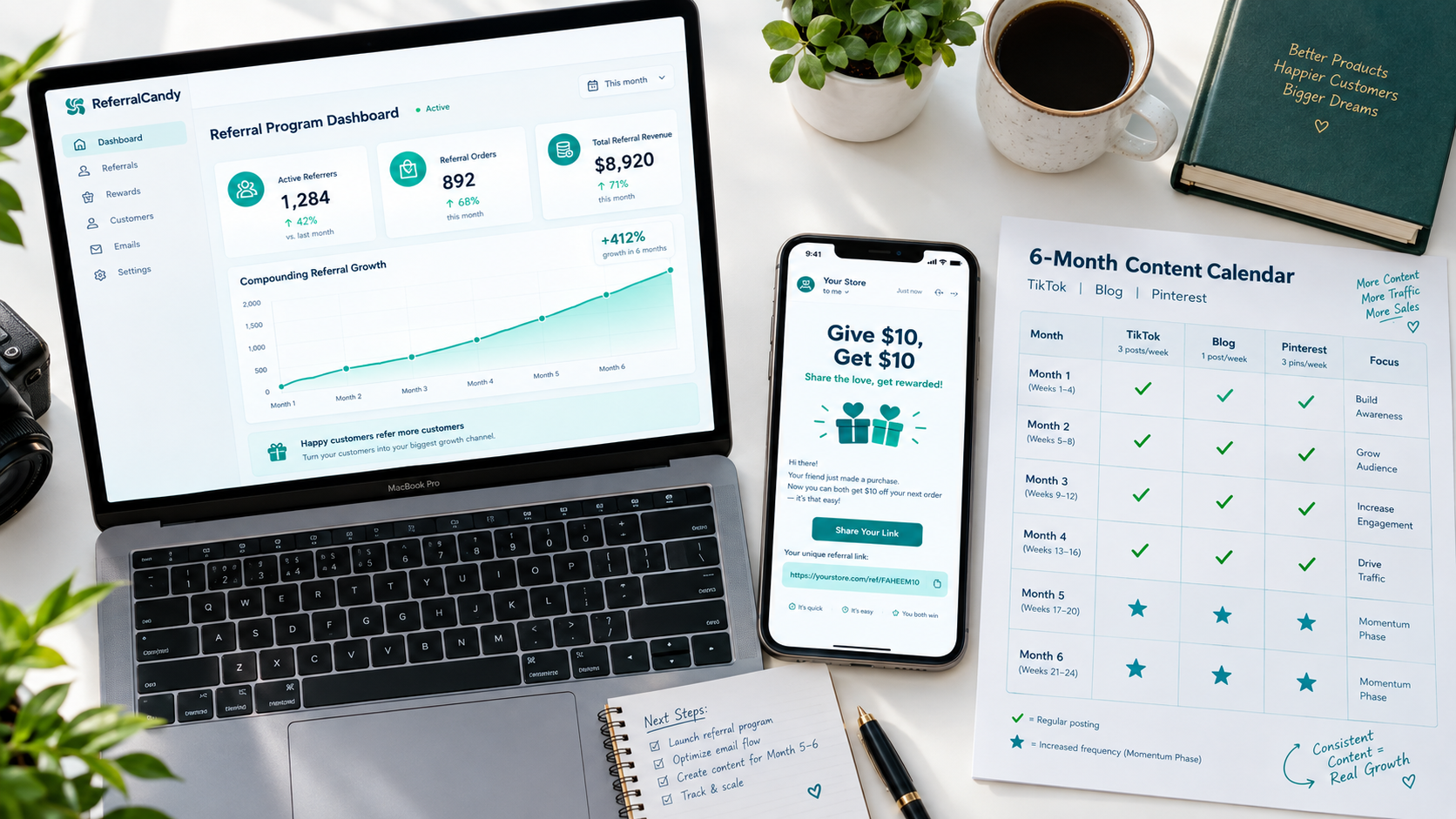
Months three and four represent the first signs of compounding momentum. TikTok content reaches a critical mass where consistent posting has trained the algorithm and identified the content formats that resonate with your specific audience. Pinterest pins from months one and two begin ranking for their target keywords and driving consistent traffic. Blog content begins appearing in Google search results for lower-competition long-tail queries. Gifted influencer content generates a wave of discovery traffic.
Months five and six represent acceleration. Blog SEO traffic begins delivering consistent daily visitors. Pinterest generates its most significant traffic volume as pins from early months continue accumulating impressions. The referral program begins delivering a growing percentage of new customers through word-of-mouth. The combination of these channels delivering simultaneously creates compounding momentum that approaches 1,000 total customers.
The merchant who reaches month six with consistent execution across these channels — TikTok three to five times per week, one to two blog posts per week, active community participation, an email list being monetized through systematic flows — will arrive at 1,000 customers with a store that is positioned to scale dramatically more efficiently through paid advertising because every foundation that makes ads work has been built.
The Mindset Shift That Makes Organic Growth Work
The reason most merchants fail with organic customer acquisition is not that the strategies do not work. It is that organic channels require a fundamentally different operating mindset than paid advertising.
Paid advertising delivers results proportional to spend on a relatively predictable timeline. Organic channels deliver results proportional to consistency on a timeline that requires patience. The blog post that generates significant traffic in month six required the discipline to write it in month one when it generated nothing. The TikTok account that drives meaningful store traffic in month four required posting consistently in months one through three when individual videos received limited views.
Most merchants abandon organic channels during the period when they are still building rather than delivering — which is exactly the phase that the merchants who succeed pushed through. The compounding nature of organic content means that the tenth blog post generates more traffic than the first, the twentieth TikTok video gets seen by a larger audience than the first, and the referral program in month six delivers more customers per month than it did in month three.
Commit to the channels, commit to the timeline, and measure progress weekly rather than daily. The 1,000-customer milestone through organic acquisition is achievable for any Shopify store with a genuine product, consistent execution, and the patience to let compounding channels do what they are designed to do.
Need help setting up your Shopify store for organic growth, or want an expert to audit your current traffic channels and identify the highest-impact opportunities? Get in touch with EcomFixify — we specialize in Shopify development and ecommerce growth strategy for brands building for the long term.