
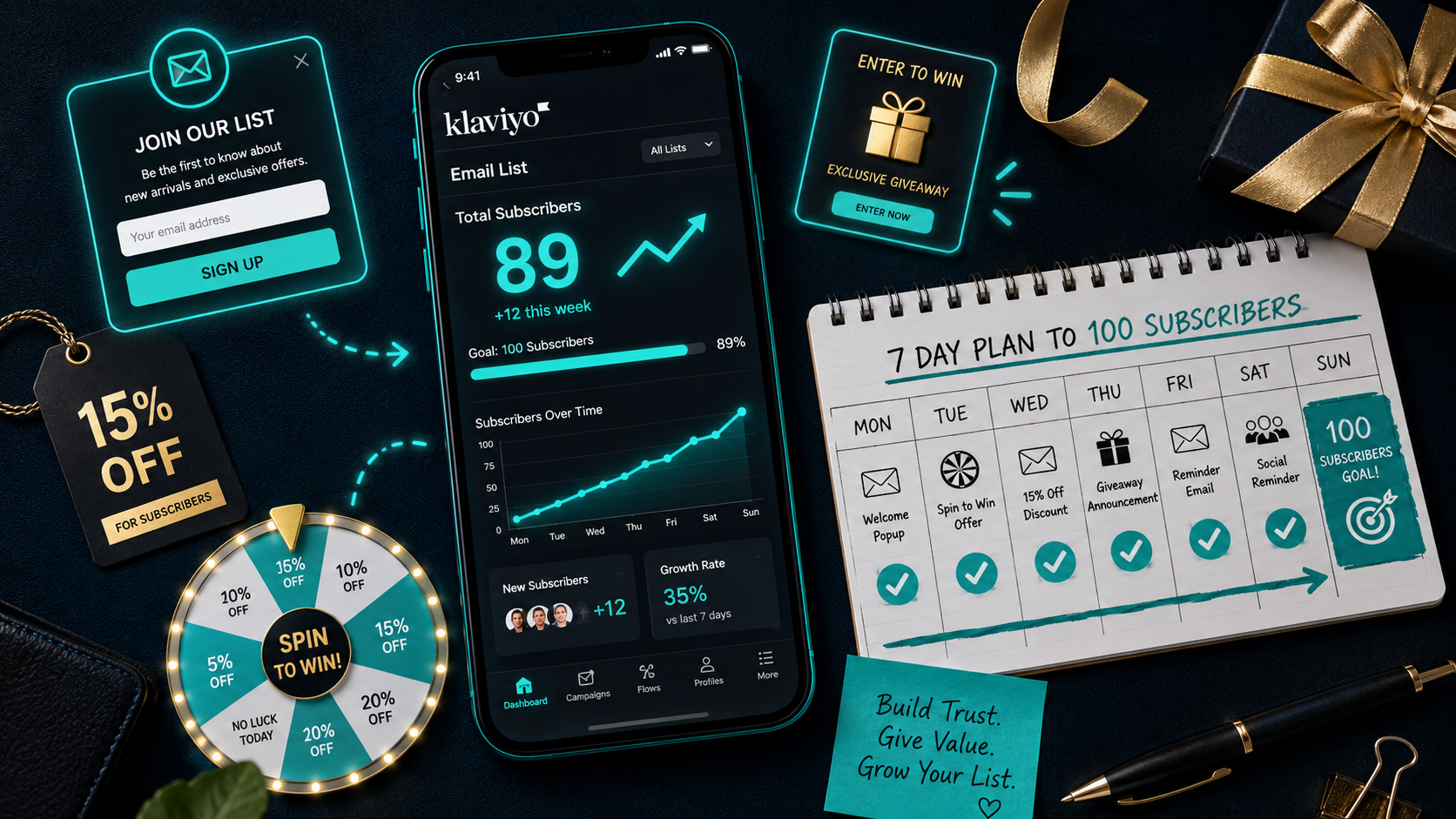
How to Get 100 Email Subscribers for Your Shopify Store This Week
Most Shopify store owners treat email list building the same way they treat flossing — they know they should be doing it consistently, they intend to start properly at some point, and they currently have a generic "Subscribe to our newsletter" form buried in their footer generating three signups per month. How to Get 100 Email Subscribers for Your Shopify Store
That approach produces a list that stays at a few hundred contacts indefinitely, a welcome flow that sends to almost nobody, and abandoned cart emails that recover nothing because there is nobody to send them to.
Here is the commercial reality of what you are leaving on the table. Email marketing generates between $36 and $42 for every $1 spent — the highest return on investment of any marketing channel in ecommerce. A 10,000 subscriber list can drive $5,000 to $15,000 per month for an active Shopify store with solid flows configured. Welcome automations averaged $6.30 per email sent in 2026 according to Omnisend benchmark data. And stores with properly configured email capture popups grow their lists three to five times faster than stores relying on footer forms alone.
The good news is that getting your first 100 subscribers — or your next 100 — does not require a large ad budget, a massive existing audience, or weeks of setup time. The tactics in this guide can be implemented within days, and the results compound from the moment the first subscriber joins.
This is the practical playbook for getting 100 real, high-intent email subscribers for your Shopify store this week.
Why 100 Subscribers Is the Number That Changes Everything
Before diving into tactics, it is worth understanding why 100 subscribers specifically is the threshold that matters for a new or early-stage Shopify store.
100 subscribers is the point at which your email automations start generating meaningful data. Your welcome flow has enough recipients to tell you which subject lines open, which product features generate clicks, and which offers convert. Your abandoned cart flow has enough triggers to recover real revenue rather than occasionally firing at a trickle. Your post-purchase flow has enough recipients to generate the review requests and cross-sell conversions that directly improve repeat purchase rate.
Below 100 subscribers, your automations are running but the data is too thin to optimize from. Above 100, you can see patterns, make decisions, and improve systematically. Every subscriber you add from 100 onward compounds the value of the infrastructure you have built.
100 is also achievable in a single week for any Shopify store with existing traffic — even modest traffic. A store receiving 500 unique visitors per week has a realistic path to 100 new subscribers if it converts 20% of those visitors into signups through the right combination of capture mechanisms and incentives. That 20% sounds ambitious but is entirely achievable with properly configured popups and a compelling lead magnet, as the tactics below demonstrate.
Before You Start: The Three Things You Need in Place
Before activating any subscriber collection tactic, three foundational elements need to be in place. Without them, you will collect email addresses into a system that cannot use them effectively — which wastes the signup momentum you are about to generate.
An email platform connected to Shopify. Klaviyo is the standard for Shopify stores in 2026 and the platform most of the tactics in this guide reference. Its native Shopify integration syncs purchase history, browse behavior, cart data, and customer information in real time, enabling the behavioral triggers that make email marketing so profitable. Klaviyo's free plan covers up to 250 contacts and 500 emails per month — sufficient for your first 100 subscribers and the automations that serve them. Install it from the Shopify App Store and connect it to your store before doing anything else.
A welcome flow configured and live. Every subscriber should receive a welcome email sequence the moment they sign up. At minimum, this is a single email that delivers whatever was promised — the discount code, the lead magnet download, or the exclusive content — and introduces your brand. Without a live welcome flow, new subscribers receive nothing after signing up, which immediately destroys the engagement and trust you just earned by getting their email address.
A functional popup or signup form. Shopify's native email capture tools are basic. Klaviyo's built-in forms, Privy, and Justuno all offer more capable popup functionality with targeting options, multi-step forms, and design flexibility that significantly outperform the native experience. Have one of these installed and at least partially configured before driving traffic to any list-building initiative.
With these three elements in place, every subscriber you collect this week enters a functioning marketing system rather than a static contact list.
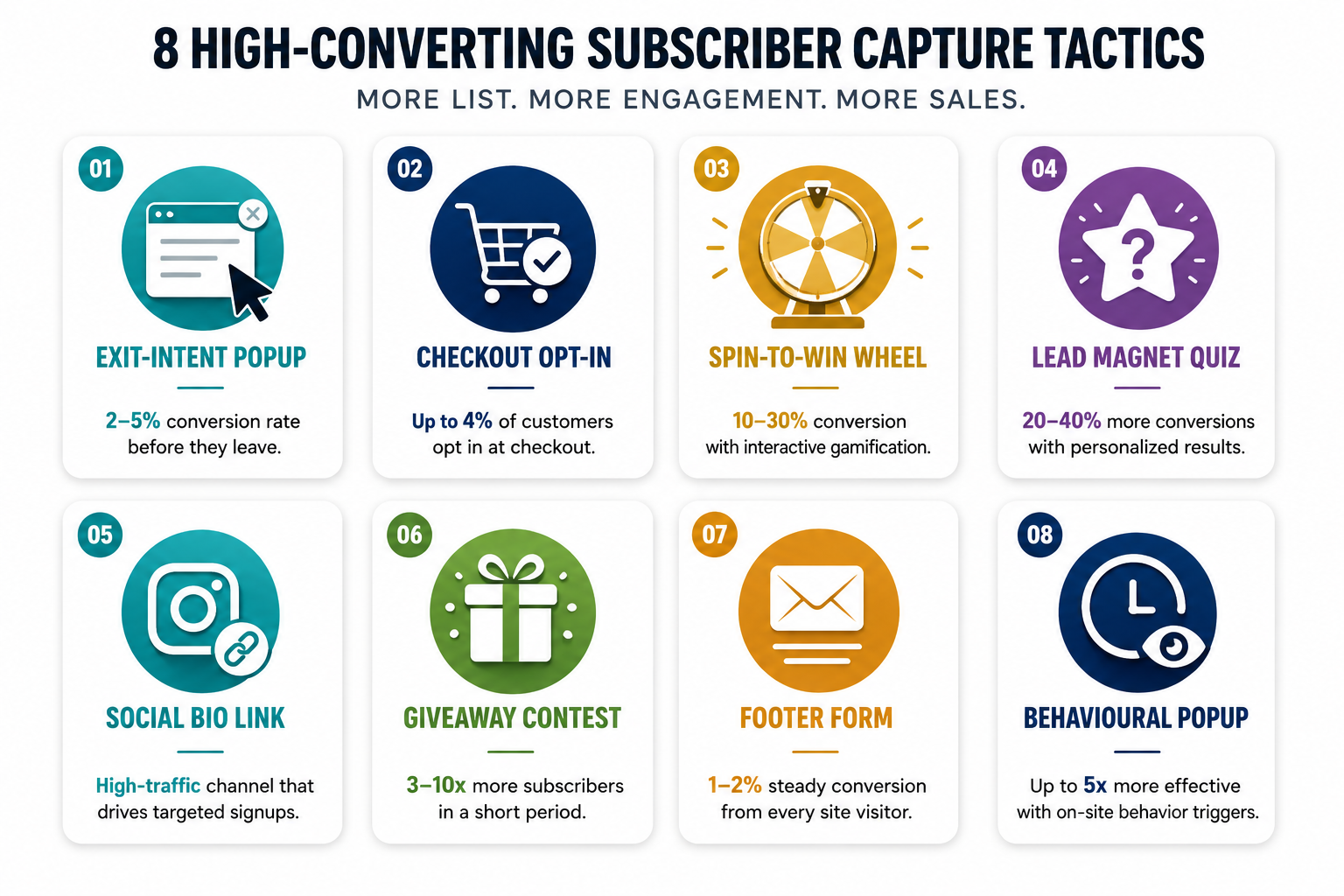
Tactic 1: The Exit-Intent Popup With a Real Incentive
The single highest-volume email capture mechanism available to most Shopify stores is an exit-intent popup — a form that appears when a visitor's cursor moves toward closing the browser tab or navigating away from the page.
Exit-intent popups work because they intercept visitors at the exact moment they are about to leave without taking any action. A visitor who was going to leave without buying or signing up has nothing to lose by engaging with an exit-intent offer — which is why conversion rates on exit-intent popups consistently run two to four times higher than popups that interrupt visitors mid-browse.
The incentive is everything. A popup that says "Subscribe to our newsletter" gets ignored. A popup that says "Wait — get 15% off your first order" gets filled in. Discounts of 10 to 15% off the first order are the most reliable lead magnet for product-focused ecommerce stores because they solve the most common objection — price hesitation — at the exact moment a visitor is demonstrating that hesitation by attempting to leave.
If you are concerned about training customers to always wait for a discount before buying, there are two alternative lead magnets that generate strong signup rates without discount dependency: free shipping on the first order (which solves the shipping cost hesitation that drives most cart abandonment), and exclusive early access to new products or sales (which creates aspiration rather than pure price incentive).
Configure your exit-intent popup in Klaviyo forms, Privy, or Justuno. Set the trigger to fire on exit intent — cursor moving toward the browser toolbar — rather than on a timer. Time-based popups that interrupt visitors 15 seconds into browsing convert significantly worse and generate more irritation than exit-intent popups that appear only at the moment of departure. Aim for a signup rate of 5 to 10% on your exit-intent popup traffic. On 500 weekly visitors, a 5% signup rate produces 25 new subscribers per week from this tactic alone.
Tactic 2: The Checkout Marketing Opt-In
This is the most underused high-volume email capture tactic available to Shopify merchants — and it requires zero additional app installation because it is built directly into Shopify's native checkout settings.
When a customer completes a purchase, Shopify can display an opt-in checkbox at the checkout page asking whether they would like to receive marketing emails. Because the customer is already entering their email address to complete the order, the marginal effort to tick the opt-in box is essentially zero. This frictionless opt-in mechanism captures subscribers who are actively buying — the highest-quality segment of your list.
To enable it, go to Settings, then Checkout in your Shopify admin. Look for the Marketing consent section and enable the pre-checked or optional opt-in box for email marketing. The copy that appears beside the checkbox matters significantly for opt-in rate. "Subscribe to our newsletter" converts poorly. "Get exclusive offers, early access to new products, and order updates" converts significantly better because it describes the value the subscriber will receive rather than the action they are taking.
For a store processing even 20 to 30 orders per week, this single setting generates 10 to 20 new subscribers weekly from buyers — subscribers who have already demonstrated the highest possible purchase intent by completing an actual transaction.
Tactic 3: A Spin-to-Win Gamified Popup
Gamified signup forms — where visitors spin a digital wheel for a chance to win one of several prizes — consistently outperform standard discount popups on both conversion rate and subscriber quality. Conversion rates on spin-to-win wheels typically run eight to fifteen percent of unique visitors, compared to three to five percent for standard discount popups, because the game mechanic creates anticipation and engagement that a static form cannot.
The prizes on the wheel do not all need to be discounts. A well-designed spin-to-win wheel for a Shopify store might include one slot for 20% off, two slots for 15% off, three slots for 10% off, one slot for free shipping, one slot for a free gift with first purchase, and two slots for 5% off. The range of potential outcomes creates genuine excitement about what the visitor might win — which increases both the likelihood of spinning and the positive association with the brand immediately after signup.
Privy's spin-to-win popup and Wheelio are the two leading spin-to-win apps for Shopify in 2026. Both integrate natively with Klaviyo, passing subscriber data and the specific prize won directly into the subscriber's profile so your welcome flow can deliver the exact discount code or offer the subscriber received — which is critical for conversion from the welcome email.
Set the spin-to-win popup to appear after the visitor has been on your site for 30 to 60 seconds rather than immediately on landing. Visitors who have spent at least 30 seconds browsing have demonstrated genuine interest and are far more likely to engage than visitors who are still orienting themselves on the page.
Tactic 4: A Valuable Lead Magnet for Your Specific Niche
Discounts capture price-sensitive buyers. Lead magnets capture interest-driven subscribers — people who are earlier in their purchase journey but highly engaged with your product category. For stores where product education is part of the value proposition, a well-designed lead magnet can generate higher-quality subscribers than any discount offer.
The lead magnet formats that work best for Shopify ecommerce stores in 2026 are not generic eBooks or lengthy PDFs that nobody reads. They are specific, immediately useful resources that solve a concrete problem for your target customer in under five minutes of engagement.
A skincare brand could offer a "Free 2-Minute Skin Type Quiz — Find Your Perfect Routine" that delivers a personalized skincare routine matched to the subscriber's skin type, with product recommendations from the brand's catalog embedded naturally within the result. A fitness equipment store could offer "The 15-Minute Home Workout Plan That Requires Zero Gym Equipment" — a one-page PDF that provides genuine value while naturally positioning the brand's products as enhancements to the routine. A coffee brand could offer "The Specialty Coffee Beginner's Guide — Everything You Need to Know Before Your First Bag" — content that educates and simultaneously justifies paying a premium for specialty coffee over supermarket alternatives.
Quizzes are the highest-converting lead magnet format in ecommerce in 2026 because they provide genuinely personalized output rather than one-size-fits-all content. Octane AI, which integrates natively with Klaviyo and Shopify, allows merchants to build product recommendation quizzes that capture subscriber data alongside preference information — simultaneously building the list and populating zero-party data that improves all downstream personalization.
Tactic 5: Social Media Bio Links and Story CTAs
If you have any social media following — even a few hundred followers on TikTok, Instagram, or Pinterest — your bio link and stories are free list-building real estate that most merchants never activate deliberately.
On Instagram, your bio link should point directly to a dedicated landing page on your Shopify store rather than your homepage. That landing page should have a single focus: the email signup offer. A page that says "Get 15% off your first order — enter your email below" with nothing else competing for the visitor's attention converts dramatically better than a homepage where the visitor has to find the signup form among everything else on the page.
On TikTok, creators with over 1,000 followers can add a link in bio directly to this signup page. For accounts below that threshold, the workaround is to mention the signup link verbally in content and direct followers to the bio. A 30-second TikTok that says "I'm giving away 15% off to the first 100 people who sign up to my brand's early access list — link in bio" is not sophisticated content, but it works — because it is specific, time-limited, and requires minimal action from the viewer to participate.
Instagram Stories with a link sticker pointing to your signup page and a swipe-up CTA generate consistent list-building traffic for accounts with engaged followings. A weekly Story showing a new product preview with a "Join our early access list to get first dibs — link in bio" CTA runs permanently once created and requires no ongoing effort.
Tactic 6: A Giveaway or Contest With Email Entry
A well-structured giveaway generates more email signups in 72 hours than most standard tactics achieve in a month — because the prospect of winning something for free activates participation behavior that no discount offer can replicate.
The mechanics of a high-conversion email giveaway for a Shopify store: select a prize that is genuinely desirable to your target customer — typically your bestselling product, a product bundle, or a store credit of meaningful value. Create a simple entry form on a dedicated landing page or using a giveaway app like Gleam or Viral Loops that requires an email address to enter. Promote the giveaway across every channel you have access to: email to your existing list, all social channels, your bio links, and if budget allows a small Meta ad specifically targeting your product category audience.
The critical design detail that determines whether a giveaway builds a quality list or an unengaged one is prize alignment. A giveaway with a generic prize — an iPad, an Amazon gift card, a cash prize — attracts entries from people who want the prize but have no interest in your brand or products. The resulting subscribers are immediately disengaged and will unsubscribe or never open after the giveaway ends.
A giveaway prize that is your actual product attracts only people who want your actual product — which means every entrant is a potential customer who has already demonstrated interest in what you sell. These subscribers open your welcome emails, engage with your content, and eventually convert into buyers at rates that generic-prize giveaway subscribers never achieve.
For achieving 100 subscribers in a week, a single giveaway promoted across two or three social channels with a product prize valued at $50 to $100 realistically generates 50 to 200 entries depending on your existing reach and the desirability of the prize.
Tactic 7: The Footer Form — Optimized, Not Generic
Your footer signup form is not a strategy by itself — it will never generate the volume of a popup or a lead magnet. But it should be optimized rather than ignored, because a percentage of your most engaged visitors scroll to the bottom of every page, and those visitors are signaling above-average interest in your brand.
The two changes that most improve footer form conversion rate are the headline and the incentive. A footer form that says "Sign up for our newsletter" collects almost nothing. The same form that says "Join 2,400 members getting exclusive deals and early access" collects significantly more — because it communicates social proof through the subscriber count and value through the promised benefit.
Add a specific incentive to the footer form — a different one from your popup if possible. If your popup offers 15% off, the footer form could offer free shipping on the first order, or early access to new collections, or a loyalty point bonus on signup. Having two distinct incentives on the same page increases the chance that at least one resonates with each visitor's specific motivation.
Tactic 8: Post-Purchase Page Email Capture for Non-Buyers
Not every visitor who spends time on your site buys on the first visit. The visitors who spent the most time on your product pages — reading descriptions, checking reviews, comparing variants — without purchasing are your highest-intent non-buyers. They want to buy. Something stopped them.
A targeted popup or embedded form that appears specifically to visitors who have spent more than 60 seconds on a product page without adding to cart — configured with a behavioral trigger in Klaviyo forms or Justuno — presents the email signup offer to exactly the people most likely to convert later through your welcome flow.
The copy for this specific segment should acknowledge their browsing behavior without being creepy. "Not ready to decide yet? Get 10% off when you are — we will send it to your inbox" is more effective than a generic signup offer because it directly addresses the visitor's situation: they are considering but undecided, and the offer gives them a low-pressure way to stay connected until they are ready.
The 7-Day Plan to 100 Subscribers
Here is exactly how to execute this week if you are starting from zero:
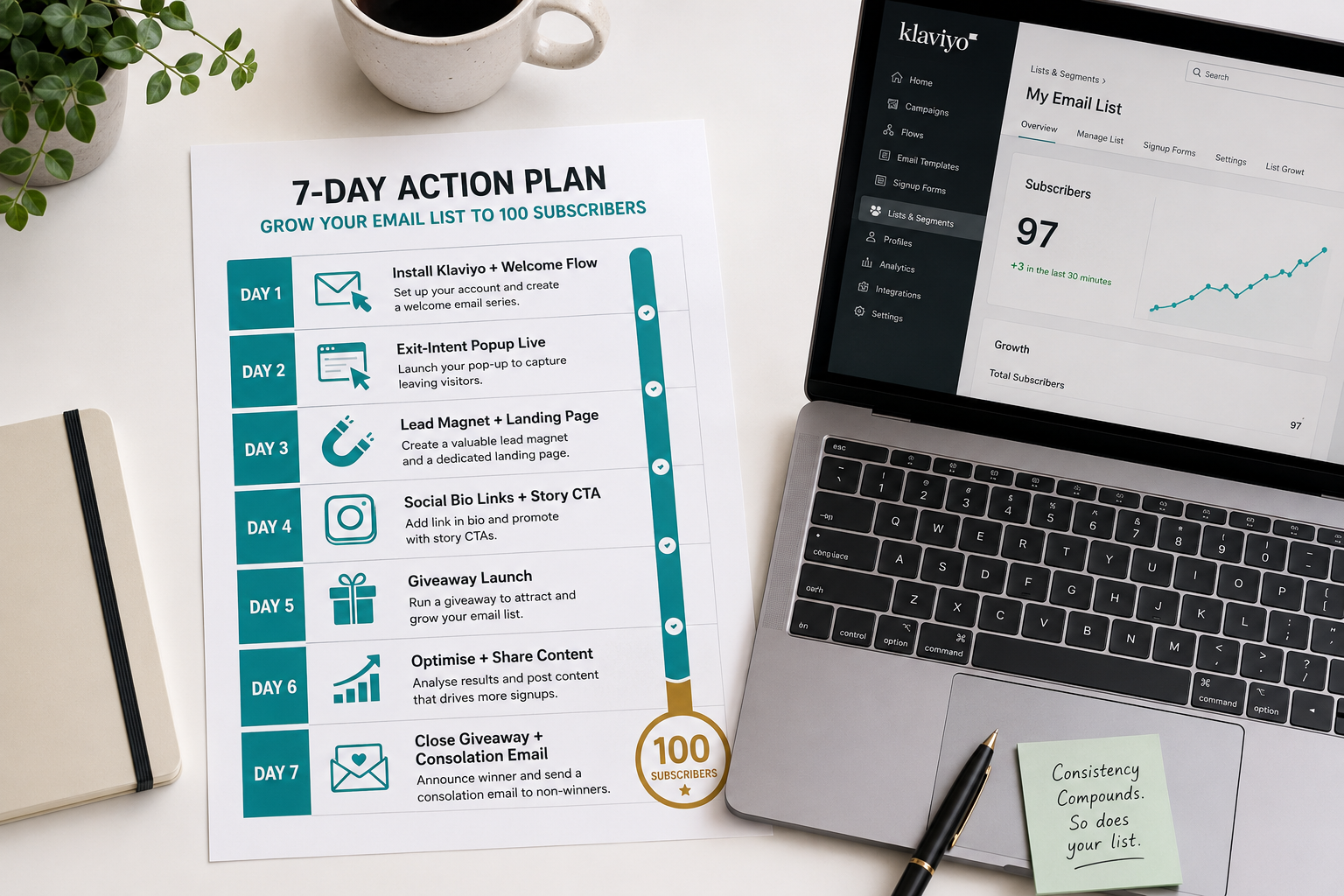
Day one — foundation: Install Klaviyo, configure your welcome flow with at minimum one email delivering your signup incentive, and enable the checkout marketing opt-in in Shopify Settings.
Day two — popup activation: Install your exit-intent popup with a 10 to 15% first order discount or free shipping offer. Set the trigger to exit intent rather than a timer. Make sure the popup connects to Klaviyo and the welcome flow triggers immediately on signup.
Day three — lead magnet creation: Create one specific lead magnet relevant to your niche — a quiz, a how-to guide, or an exclusive first look. Build a simple landing page for it and share the link in your social bios across all platforms.
Day four — social activation: Post a Story on Instagram and a TikTok video announcing your email list and the incentive for joining. Link directly to your signup landing page in both. Be direct about what subscribers get — not vague language about "joining the community" but specific language about what they receive.
Day five — giveaway launch: Set up a simple giveaway using Gleam or a Google Form with your bestselling product as the prize. Promote it across all channels with a 72-hour entry window. Share it in any relevant Facebook groups, subreddits, or community spaces where your target customer spends time — genuinely and helpfully, not spammily.
Day six — optimise and share: Review your popup conversion rate, check which social posts are driving the most link clicks, and double down on what is working. Share one piece of genuinely valuable content — a product tip, a behind-the-scenes video, a customer result — across social channels with a soft mention of your email list.
Day seven — giveaway close and welcome: Close the giveaway, announce the winner publicly, and send a consolation email to all non-winning entrants offering a smaller discount as a thank-you for participating. This consolation email typically converts 10 to 15% of entrants into first-time buyers — turning a list-building exercise into a direct revenue event.
What to Measure and What Comes Next
The metrics that tell you whether your list-building efforts are working this week:
Popup opt-in rate — email captures divided by popup impressions — should be running above 5% for an exit-intent popup with a compelling incentive. Below 5% suggests the incentive is insufficiently compelling or the popup design is creating friction.
List growth rate — net new subscribers per day — gives you a running total against your 100-subscriber goal. Tracking this daily keeps momentum visible and allows you to identify which specific day or tactic produced the most signups.
Welcome flow open rate — the percentage of new subscribers opening your first welcome email — should be running above 45% for a recently joined, high-intent subscriber list. Below 40% suggests the subject line, sender name, or email content is creating friction rather than delivering the value the subscriber was promised.
Once you reach 100 subscribers, the next milestone is 500. The tactics that got you to 100 will get you to 500 — with the additional leverage of your welcome flow converting subscribers into buyers, those buyers referring friends, and your growing review count attracting more organic traffic to convert.
The email list is not the destination. It is the infrastructure through which every other part of your Shopify marketing becomes more effective. Every subscriber you add this week makes your abandoned cart flow more productive, your flash sale announcements more impactful, and your loyalty program more valuable.
Start with the popup. Enable the checkout opt-in. Launch the giveaway. The first 100 subscribers are this week's work. The revenue they generate is the rest of the year's reward.
Need help setting up your Klaviyo email list building system on Shopify, or want an expert to configure your popup flows and welcome sequences for maximum subscriber conversion? Get in touch with EcomFixify — we specialize in Shopify development and ecommerce growth strategy for brands ready to build their owned marketing assets.