
How to Find Products That Will Sell Before You Buy a Single Unit
The most expensive mistake in ecommerce is not bad marketing, poor design, or rising ad costs. It is buying inventory that nobody wants. How to Find Products That Will Sell Before You Buy a Single Unit
A Harvard Business School study found that 95% of the 30,000 new products launched each year fail in the market. A survey of Shopify store owners who shut their businesses down revealed that 63% admitted they had not spent enough time validating demand before buying inventory. Inventory distortion — the combined cost of overstock and stockouts — cost global retailers $1.77 trillion in a single year. For a Shopify store generating $500,000 annually, that ratio translates to up to $36,000 in annual value destruction from buying the wrong products or buying them in the wrong volumes.
The problem is not that merchants are careless. It is that the traditional product research process — spot a trend, find a supplier, place an order, hope it sells — is built on intuition rather than evidence. And intuition, without supporting data, is an expensive way to make sourcing decisions.
The alternative costs between zero and $200 and takes two to four weeks. It replaces guesswork with actual demand signals — search behavior, competitor activity, social engagement, and most powerfully, real purchase intent from real people before you have committed a single dollar to inventory.
This guide covers the complete product validation playbook for Shopify merchants in 2026 — from free research tools through low-cost testing methods to the decision framework that tells you when you have enough evidence to move forward with confidence.
Why Product Validation Is Not Optional Anymore
There is a common assumption among new Shopify merchants that ecommerce is low-risk because you can start small. Order 100 units. See how it goes. If it does not sell, you are only out a few hundred dollars.
This reasoning underestimates the full cost of an unvalidated product launch. Direct inventory cost is the visible expense. The invisible costs include the time spent building product pages, writing descriptions, setting up ads, and managing a product that does not convert. The opportunity cost of capital tied up in slow-moving inventory rather than deployed toward a validated winner. The storage fees accumulating while you wait to see if the product gains traction. And the psychological tax of managing a product that does not move — which distracts attention and energy from finding the thing that actually does.
Proper validation does not eliminate risk. It narrows the gap between what you think will sell and what actually does. The goal is not certainty — markets are never certain. The goal is informed conviction before you commit capital. And in 2026, the tools available to build that conviction are more accessible, more powerful, and more accurate than at any previous point in ecommerce history.
Step 1: Google Trends — Read the Direction Before Anything Else
Before spending a dollar on research tools or a minute building a product page, open Google Trends and type your product category. The information it reveals in the first 30 seconds is irreplaceable.
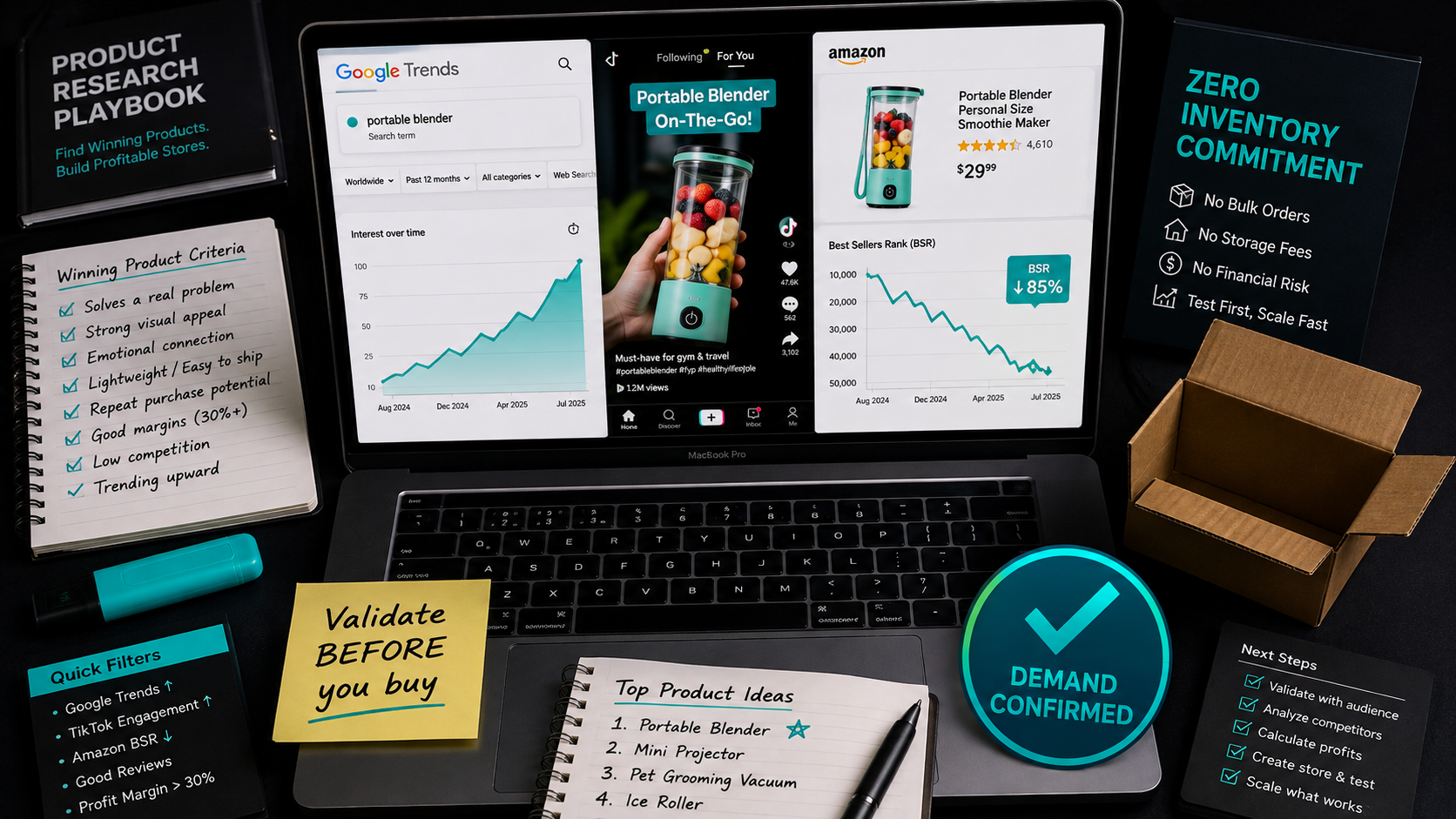
Google Trends shows relative search interest over time — not absolute volume, but direction. And direction is the variable that matters most in product research. A product category with rising search interest over 24 months tells you that more people are looking for this product now than a year ago. A declining trend tells you the opposite — regardless of how popular the product looks on TikTok today.
The four trend patterns covered in detail in EcomFixify's Google Trends guide apply directly here. A sustained upward trend over two or more years signals a growing market. A stable plateau indicates mature, reliable demand. A seasonal spike shows you exactly when to time inventory purchases and promotional pushes. And a spike-and-crash pattern — a sudden vertical climb followed by an equally sharp drop — signals viral noise that will have passed by the time your inventory arrives.
For product validation specifically, the Related Queries section under the Rising filter is where the highest-value research lives. These are the search terms that have grown most dramatically in relative popularity — often revealing specific product variations, sub-niches, or use-case framings that are gaining momentum before mainstream awareness catches up.
A rising query like "matcha for athletes" appearing in a trends analysis of the broader matcha category reveals a specific audience and positioning angle that competitors may not have identified yet. That sub-niche insight — product plus audience plus use case — is more actionable than a general trend confirmation.
Run your product idea through Google Trends before any other research step. If the direction is declining, no amount of supplier vetting or page optimization will overcome a contracting market.
Step 2: Amazon BSR and Review Mining — Where Real Purchase Data Lives
Google Trends shows search interest. Amazon Best Seller Rank shows actual purchase behavior — and the gap between those two signals is where product validation gets specific.
A product category showing rising search interest in Google Trends, combined with a falling BSR in Amazon's relevant category, provides double confirmation that demand is growing and converting into actual transactions. Both signals pointing in the same direction is the clearest validation available from public data sources.
BSR analysis works as follows: navigate to the relevant Amazon category, sort by Best Sellers, and look at the rank movement for products similar to what you are considering. A BSR that has moved from 8,000 to 2,500 in three months — indicating the product is selling faster relative to its category — is a bullish validation signal. A BSR holding flat or declining indicates the product is not growing its market share.
Review mining is equally important and more qualitative. Read the one-star and two-star reviews for the bestselling products in your category. These negative reviews are a gold mine of unmet customer needs — the specific complaints, failures, and disappointments that existing products generate but have not solved. A pattern of negative reviews around a specific issue — "the material is too thin," "the sizing runs two sizes small," "the fragrance fades within an hour" — tells you exactly what a differentiated product in that category needs to address.
The merchants who win in competitive categories are rarely the ones who copy what is already there. They are the ones who read the negative reviews carefully enough to know what the market is asking for that nobody has delivered yet.
Step 3: TikTok Product Research — Where Trends Surface Earliest
TikTok is the earliest signal in product trend identification in 2026. By the time a product is performing well on Google Trends and climbing Amazon BSR, it has often been trending on TikTok for weeks or months. Identifying a product on TikTok before it reaches those lagging indicators is where the timing advantage in product research lives.
The most effective TikTok product research method is the hashtag and search combination approach. Search your product category on TikTok and filter results by Latest rather than Top — this shows the most recent content rather than the most-viewed, which lets you spot products gaining momentum before they become mainstream. Look for videos about products in your category that were posted in the past 30 days and are accumulating views faster than their age would suggest.
The TikTok Shop data adds a purchase-intent layer to this social signal. Search your product category in TikTok Shop and sort by Best Sellers. Products appearing in both the organic TikTok search results and the TikTok Shop bestseller list have confirmed both social resonance and actual purchasing behavior — a dual-validation signal that is difficult to fake.
Comment sections on high-performing product videos are as valuable as the videos themselves. Comments like "where can I buy this?" "just ordered one," and "got mine last week and love it" confirm purchase intent and post-purchase satisfaction from real, identifiable users. A product video with 200,000 views and a comment section full of purchase signals is stronger validation than a polished market research report.
Step 4: Competitor Analysis — Confirming a Market Exists
A common assumption among new ecommerce merchants is that the presence of competitors is a bad sign. The opposite is true. Competitors confirm that the market exists and that customers are spending money in this category. The absence of competitors is a warning sign — either the product is too early for the market, or others have already tried and failed.
The competitor analysis framework that provides the most useful validation data covers four areas:
How long have competitors been in business? A competitor who has been selling in this category for two or more years with consistent product availability has validated the market through sustained commercial performance. A competitor who launched six months ago and shows signs of rapid growth suggests a market that is both viable and still early enough to enter.
What is the quality of their advertising? Navigate to the Meta Ad Library and search for competitors in your product category. If multiple brands are running active paid ads for this product, they have determined that the margin economics support advertising spend — which is one of the most reliable market validation signals available. Brands do not continue spending on ads for products that do not generate positive returns.
What does their review profile look like? A competitor with 500 reviews and a 3.8-star rating has a specific vulnerability — the 40 to 50 negative reviews are telling you exactly what a differentiated product needs to improve. A competitor with 50 reviews and a 4.8-star rating has validated demand but left the market underpenetrated — there is room for another quality player.
What price point are they selling at, and can you compete at margin? This is where product economics enter the validation process. The target margin structure for a viable Shopify inventory product is a minimum 55% gross margin before advertising costs, targeting 25 to 40% net margin after advertising. If the competitive price point in the category cannot support those margins at your sourcing cost, the product fails the economics test regardless of how strong the demand signal is.
Step 5: Social Validation — Reading Organic Engagement Signals
Beyond TikTok, social validation across Pinterest, Instagram, and Reddit provides additional demand signal from different audience demographics and intent profiles.
Pinterest is particularly valuable for categories with strong visual appeal — home décor, fashion, food, wellness, and crafts. A product category generating high Save rates on Pinterest has demonstrated that people find it aspirational and worth bookmarking — which is a middle-funnel intent signal that precedes purchase. Pinterest Trends, the platform's equivalent of Google Trends, shows which product searches are gaining velocity on the platform in real time.
Reddit is the most honest validation channel available for free because Reddit users are notoriously skeptical of anything that feels like marketing. Search your product category in relevant subreddits and read what real people are saying about the products they have tried, the problems they are trying to solve, and the specific attributes that matter to them. A subreddit discussion where users are actively recommending a type of product to each other — unprompted by any brand — is among the strongest organic demand validation available.
Instagram Explore and Reels searches surface content that the algorithm has identified as engaging to users interested in your category. A product category appearing consistently in Explore results for relevant searches has confirmed engagement signals from a broad audience. UGC-style product demonstrations that appear organically in Reels results — not paid promotions, but real customers sharing their purchases — confirm post-purchase satisfaction from real buyers.
Step 6: The Micro-Test — Real Money From Real Customers Before You Commit
All of the research methods above generate validation evidence from secondary data — search trends, competitor behavior, social engagement, and purchase signals from other brands' customers. The most definitive validation available is primary data: real customers putting real money toward your specific product.

There are three micro-test approaches available to Shopify merchants in 2026, in order of effort and cost.
Pre-Order Page
Build a simple Shopify product page for the product you are considering — with accurate product images, a complete description, and honest delivery expectations — and set it to accept pre-orders. Pre-orders are the highest-conviction validation signal available because a customer who provides payment details has moved past interest and intent to actual purchase behavior.
Transparency is essential in pre-order validation. Clearly communicate that this is a pre-order with an expected delivery timeline. Do not set a delivery date you cannot commit to. The goal is real demand data, not deceiving customers into an order you cannot fulfill. Pre-order campaigns that misrepresent timelines generate refund requests and negative reviews that damage your brand before it has launched.
If your margins and supplier relationships allow it, taking pre-orders also gives you the purchase order funding to go to suppliers — turning validation and sourcing into a single step rather than a sequence.
Waitlist Page
If pre-orders feel premature, a waitlist page provides the next strongest validation signal. Create a landing page with a clear product description, compelling imagery, and a prominent email capture field. Drive traffic through organic social content, a small paid test, or relevant community posts. The number and quality of waitlist signups — and the source of that traffic — tells you whether the product generates genuine interest before you have invested in inventory.
Waitlist data is less definitive than pre-order data because email signup has lower friction than payment — but the size of the waitlist, the speed at which it grows, and the engagement rate of the waitlist email sequence all contribute to a meaningful demand picture.
Small-Budget Meta Test
A $200 to $500 Meta Ads test on a product page — before you have inventory, with an "out of stock — notify me" or pre-order setup — provides purchase-intent data from your specific target audience at your specific price point. This is the most rigorous validation method available short of a full product launch because it tests whether real people in your target demographic will pay your price for your product.
The metrics that provide the clearest validation signal from a small Meta test are add-to-cart rate above 8%, landing page conversion rate above 2%, and cost per click within your target audience below $1.50 for broad interest targeting. A test that meets or exceeds these benchmarks has demonstrated that the product generates commercial interest at a testable cost — which provides the informed conviction needed to place a serious purchase order.
The Product Scoring Framework: Making the Go or No-Go Decision
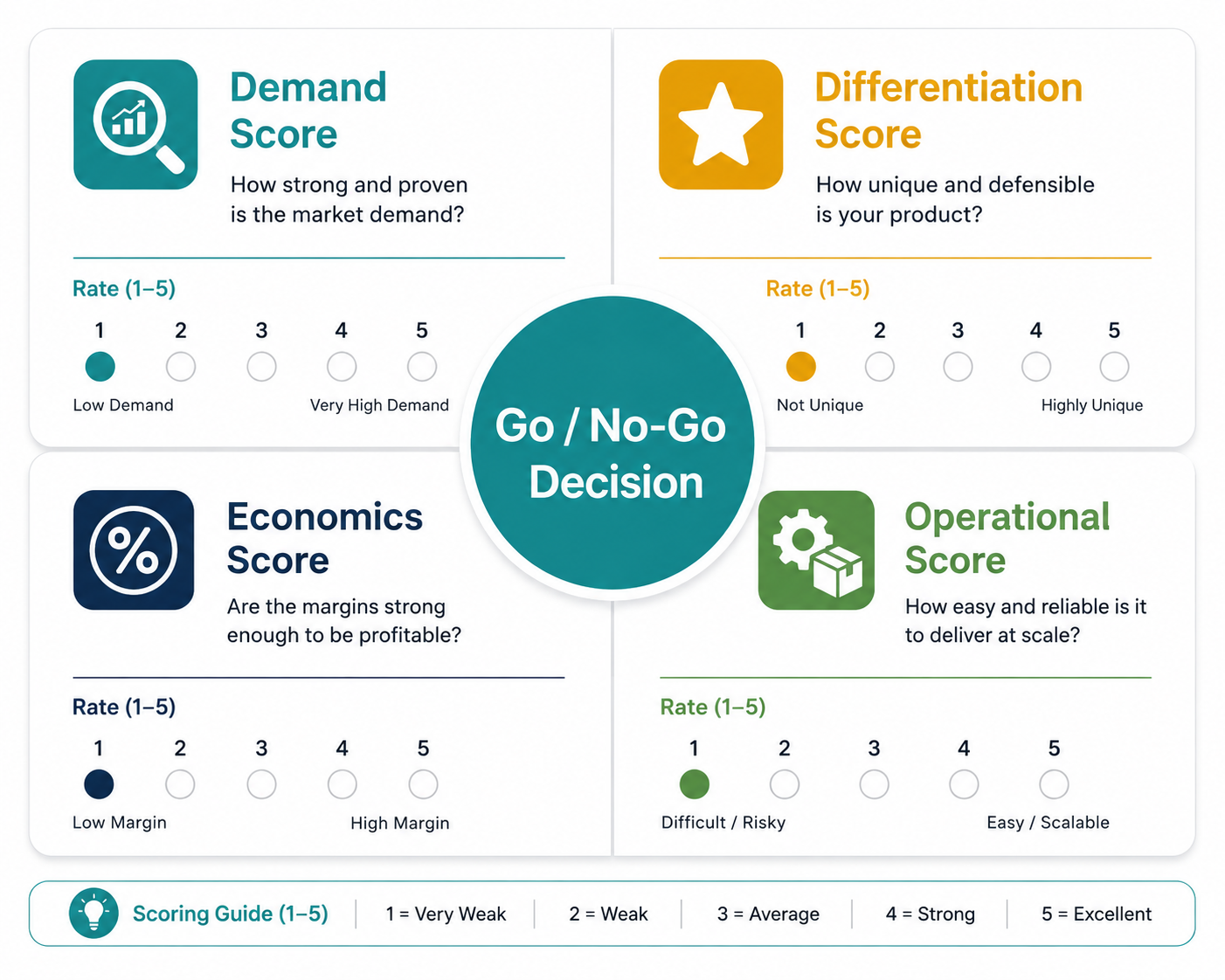
After running your product through the research and testing steps above, you need a consistent decision framework that converts the evidence you have gathered into a clear go or no-go recommendation. Scoring each product idea across four dimensions prevents the emotional attachment to a product idea overriding the signal the data is providing.
Demand score: is there growing, sustained search interest in Google Trends? Are TikTok and Pinterest showing organic engagement? Does Amazon BSR confirm rising purchase volume? Score 1 to 5 on each signal and total.
Differentiation score: does the competitive review analysis reveal a specific unmet need your product can address? Is there a sub-niche angle from the rising queries that competitors have not targeted? Is there a positioning angle — audience, use case, or formulation — that creates meaningful separation from existing options?
Economics score: can you source this product at a cost that supports a 55% gross margin before advertising at the competitive retail price? Does the average order value support the customer acquisition costs you would need to spend in the category?
Operational score: how long is the supplier lead time? Is the product fragile, oversized, or subject to regulatory complexity? How high are the likely return rates based on the product category? What are the storage requirements?
A product that scores strongly across all four dimensions — growing demand, clear differentiation, viable margins, and manageable operational complexity — has passed validation. A product with a strong demand score but weak economics fails the framework regardless of how much the trend data excites you. The framework overrides enthusiasm and prevents the most common and most expensive validation mistake: moving forward with a product you want to sell rather than one the evidence says you should sell.
The Five Traits of the Strongest Shopify Products in 2026
Across validated research from thousands of Shopify stores, the products that generate the highest conversion rates, the best retention metrics, and the most sustainable margins share five consistent characteristics.
Two to three times markup from cost to retail price, which enables adequate margins after advertising, shipping, and fulfillment costs while remaining competitive in the market.
Lightweight and compact for shipping, which reduces per-unit shipping costs and increases the proportion of the retail price that flows to margin rather than logistics.
Strong visual appeal for social content, which enables organic TikTok and Instagram content that reduces customer acquisition costs through earned rather than paid distribution.
Repeat purchase or consumable potential, which creates the subscription-like retention economics that build sustainable revenue rather than perpetual customer acquisition dependency.
Low return rate potential, which correlates with clear product functionality, accurate product imagery, and products where fit, taste, or personal preference variability is low.
Products that check all five of these boxes before validation begins are significantly more likely to pass the full validation process and generate sustainable commercial results after launch.
What Validated Conviction Actually Looks Like
The goal of the validation process is not absolute certainty — that is never available in a market that changes continuously. The goal is informed conviction: a position where the evidence strongly suggests demand exists, the economics work, and the competitive landscape has room for a differentiated entrant.
Informed conviction looks like: Google Trends showing sustained upward momentum over 18 to 24 months. Amazon BSR data confirming rising purchase volume in the category. TikTok showing organic social proof from real buyers. Competitor review analysis revealing a specific unmet need your product addresses. A micro-test generating add-to-cart rates and cost-per-click within target benchmarks.
When the majority of those signals align, the risk of placing a purchase order is not eliminated — but it is informed by evidence rather than driven by intuition. And that difference, consistently applied across every product decision, is what separates Shopify merchants who build sustainable businesses from the ones who spend years cycling through products that never quite work.
The validation is the product research. Do not skip it.
Need help validating product ideas for your Shopify store, or want an expert to audit your current product pages and positioning for conversion gaps? Get in touch with EcomFixify — we specialize in Shopify development and ecommerce growth strategy for brands building for the long term.