
How to Drive Free Traffic to Your Shopify Store in 2026
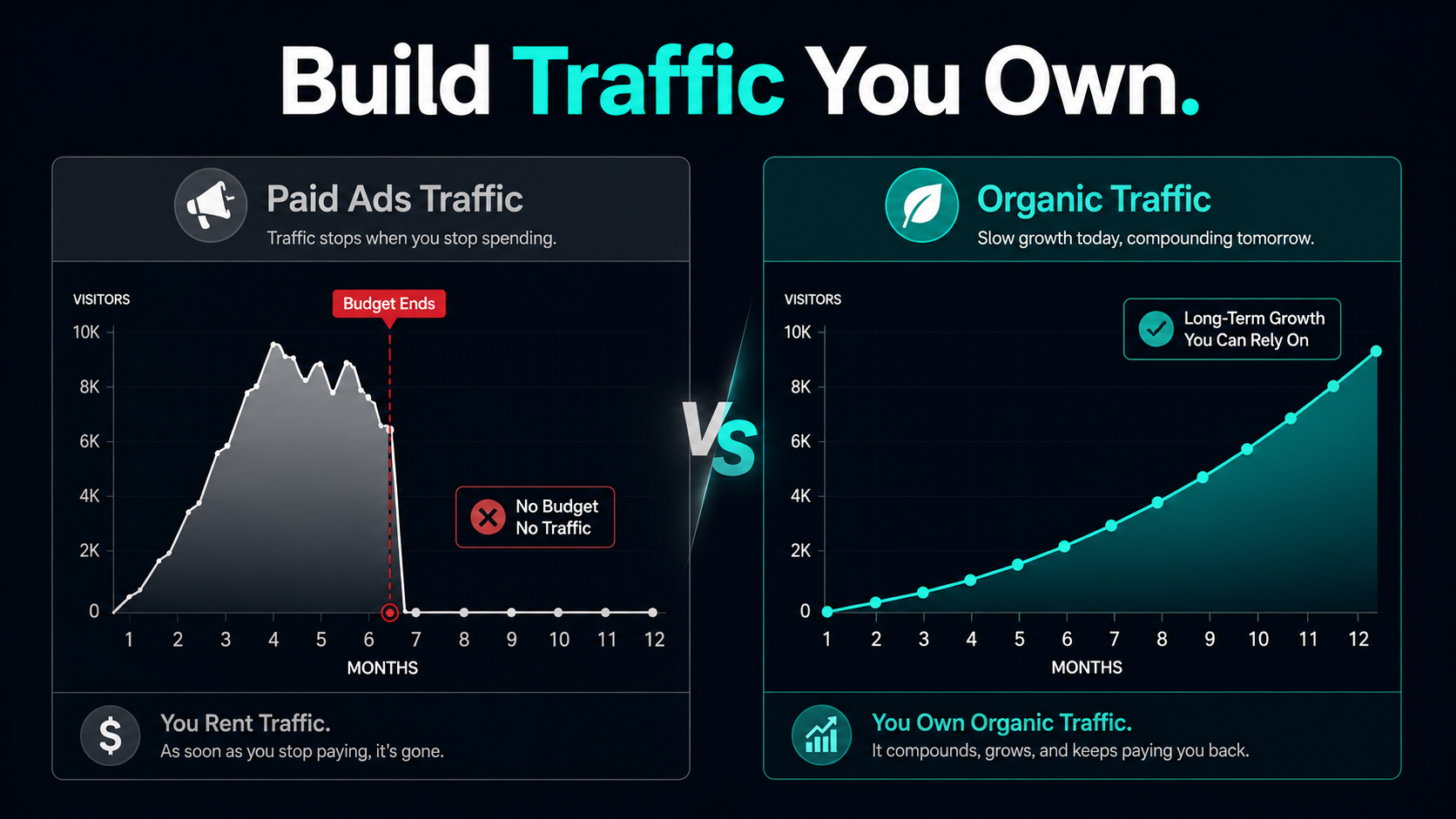
Here is the uncomfortable truth about paid advertising that most marketing guides skip over: the moment you stop spending, the traffic stops. Every customer acquisition cost you pay on Meta or Google is a rental payment — not an investment. The day your budget runs out or your account gets flagged, your store goes dark. Here is how to Drive Free Traffic to Your Shopify Store in 2026
Free traffic does not work that way. A product page ranking on page one of Google for a buyer-intent keyword drives sales every day without you touching it. A Pinterest pin that goes viral in your niche generates clicks for months. An email list built through organic lead generation is an asset you own permanently that no algorithm change can take away.
According to Shopify's own research, organic traffic and direct traffic are the two most effective sources of sales for Shopify stores — outperforming Facebook ads, Google ads, and Instagram ads in terms of conversion quality. A 2024 study of 60,000 Shopify stores found that organic was the top traffic source by both volume and sales conversion rate. Yet most store owners spend 80% of their marketing attention on paid channels while organic strategies that compound in value over time receive almost no investment.
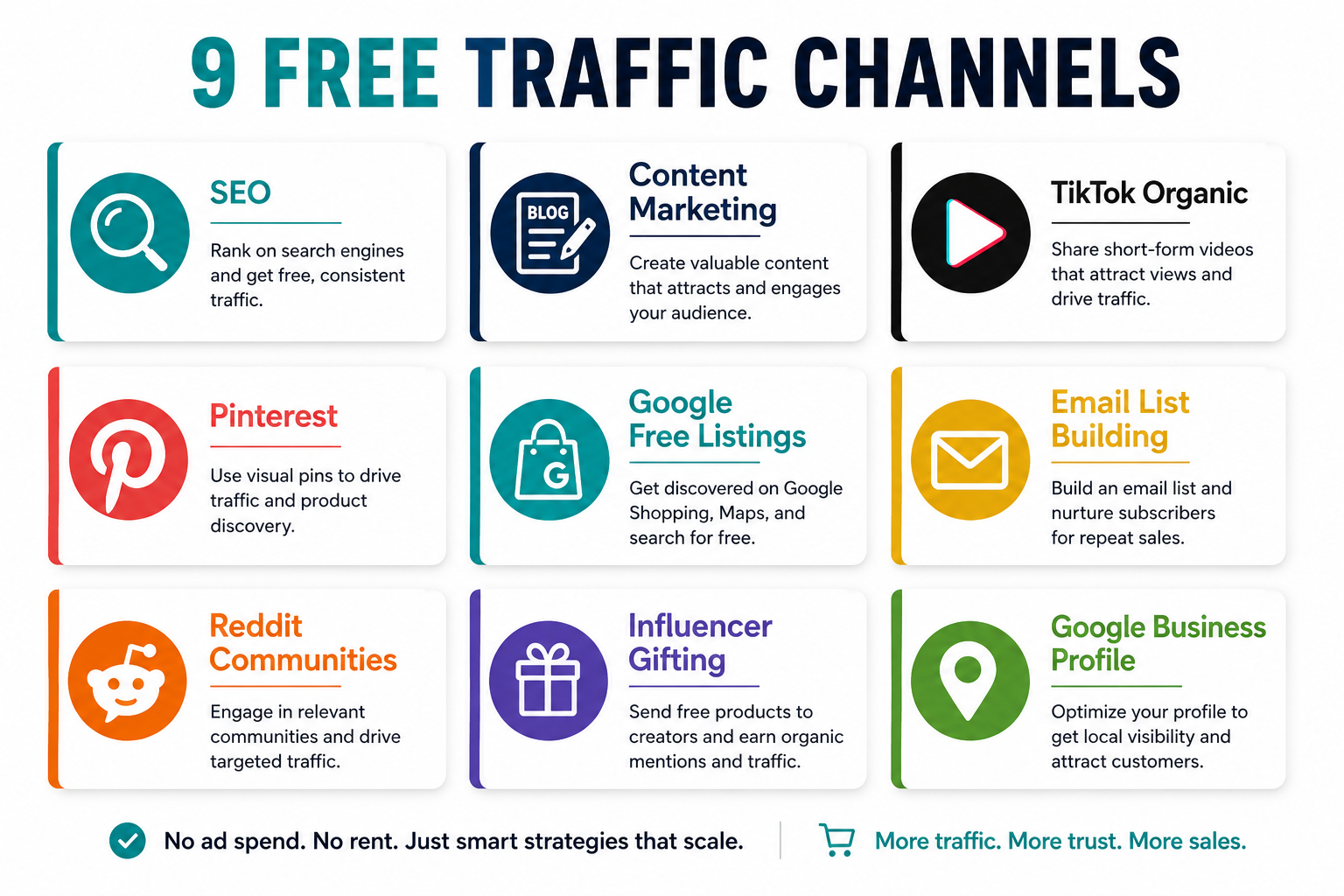
This guide covers every major free traffic channel available to Shopify stores in 2026 — what each one requires, how long it takes to generate results, and exactly how to implement it without a marketing team or a large budget.
Why Free Traffic Outperforms Paid in the Long Run
Before diving into channels, the strategic case for prioritizing organic traffic deserves a clear articulation — because the instinct to run ads is strong and the results are immediate, while organic results are slow and require patience that most store owners find difficult.
Paid advertising has three structural problems that compound over time. Customer acquisition costs through Meta and Google have risen more than 60% since 2020 and continue rising as more advertisers compete for the same audience pool. Attribution has become unreliable after iOS privacy changes, making it increasingly difficult to know which paid activity is actually driving revenue versus which is claiming credit for organic conversions. And the traffic itself generates no residual value — a $5,000 monthly ad budget produces traffic only for that month.
Organic traffic compounds. A well-written blog post targeting a specific buyer-intent keyword takes three to six months to rank but then generates traffic continuously for years. An email list built to 5,000 subscribers through organic channels is a permanent asset that generates revenue every time you send to it. A Pinterest presence built over 12 months continues driving referral traffic regardless of what you spend next month.
The stores that build durable, defensible revenue in 2026 are the ones treating organic traffic as infrastructure — built once, maintained with regular effort, and generating returns that compound rather than reset each month.
Channel 1: Search Engine Optimization — The Most Durable Free Traffic Source
SEO is the slowest organic channel to build and the most valuable once established. A Shopify store with strong SEO generates buyer-intent traffic from people actively searching for products like yours at the exact moment they are ready to purchase — without paying for each click.
The three SEO priorities that generate the fastest results for Shopify stores in 2026:
Product page SEO is where most merchants have the largest untapped opportunity. Rewrite every product description from scratch — manufacturer descriptions are duplicated across hundreds of competitor stores and generate no SEO value. Your rewritten descriptions should include the product name and primary keyword naturally in the first paragraph, address the most common customer questions about the product, include size, material, and compatibility information that buyers search for specifically, and be long enough — minimum 300 words — to give Google sufficient content to understand what the page covers.
Collection page SEO is frequently ignored entirely. Your collection pages — skincare, running shoes, home office furniture — are the highest-value pages for category-level buyer searches. Each collection page needs a unique description of at least 150 words that targets the category keyword naturally, explains the range of products available, and includes internal links to featured products. These pages rank for "best [category] for [use case]" queries that represent high-purchase-intent traffic.
Blog content for long-tail keyword targeting builds topical authority that lifts your entire store's search visibility. Every blog post you publish is a new potential entry point for organic traffic. Target question-based long-tail keywords — "how to choose the right yoga mat thickness," "what is the best skincare routine for sensitive skin in winter" — that represent real buyer research journeys. A store with 30 well-optimized blog posts covering its product category consistently sees higher domain authority and better rankings for product keywords than an identical store with no blog content.
Technical SEO fundamentals that Shopify handles automatically include sitemap generation and submission, canonical tags for variant URLs, and mobile-responsive themes. What Shopify does not handle automatically is page speed optimization — covered later in this guide — and the quality of your title tags and meta descriptions, which you must write intentionally for every page.
Channel 2: Content Marketing and Blogging
Content marketing is the engine that powers long-term SEO performance and gives you something to share across every other organic channel — social media, email, community platforms, and influencer outreach all work better when you have genuinely useful content to point people toward.
The content strategy that drives the most traffic for Shopify stores in 2026 is category authority building — the systematic creation of content that makes your store the most comprehensive and trusted resource for information in your product category.
Rather than writing random blog posts with no strategic connection, map your content plan around the questions your customers ask at every stage of their purchase journey. A buyer researching skincare products asks awareness-stage questions — "what causes dry skin in winter?" — then consideration-stage questions — "what ingredients are best for dry skin?" — then decision-stage questions — "best fragrance-free moisturizer for sensitive skin." A store that has published high-quality content answering all three stages owns the buyer's journey from initial research to purchase decision.
Each blog post should target one specific long-tail keyword, answer the question more completely than any competing result currently does, include internal links to relevant product pages and other posts, and be structured for featured snippet capture — direct question-and-answer format with concise, quotable answers in the opening paragraphs.
The compounding effect of consistent blogging is significant. A store publishing two well-researched blog posts per month reaches 24 posts per year. At an average of 500 monthly organic visitors per post after six months of ranking, that is 12,000 additional monthly organic visitors from content alone — visitors who found your store because they were searching for information, not because you interrupted them with an advertisement.
Channel 3: TikTok Organic — The Fastest Free Audience Builder in 2026
TikTok's algorithm is the only major social platform in 2026 where a brand-new account with zero followers can publish a video and reach tens of thousands of people organically. The platform's For You Page distributes content based on engagement signals rather than follower count — which means your content quality determines your reach, not your audience size.
For Shopify stores, TikTok organic content that consistently drives traffic and sales follows one of three proven formats:
Product demonstration videos showing the product working in a real context — solving a problem, producing a dramatic result, or demonstrating unexpected utility — generate the highest engagement and purchase intent. The hook must land in the first two seconds: show the most interesting or surprising aspect of the product before anything else appears on screen.
Behind-the-scenes content showing how products are made, packaged, or sourced builds the authenticity and brand trust that drives organic purchase decisions. A founder packing orders in their garage, a supplier visit showing product craftsmanship, or a time-lapse of a handmade product being created — these formats consistently outperform polished brand content because they feel real.
Educational content that teaches something genuinely useful within your product category — skincare ingredient education, home organization techniques, fitness form guidance — builds an audience that returns to your account because the content delivers value, not just product promotion. This audience converts at higher rates when you feature products because the trust relationship was established through education first.
Post consistently — minimum three times per week — and analyze what your specific audience responds to rather than copying what worked for a different brand in a different category. TikTok provides detailed analytics on every video showing exactly when viewers drop off, which moments drove shares, and what percentage of viewers visited your profile. Use this data to optimize your content progressively rather than guessing.
Channel 4: Pinterest — The Evergreen Visual Discovery Engine
Pinterest is the most underused free traffic source for Shopify ecommerce stores and one of the most commercially valuable. 97% of Pinterest searches are unbranded — meaning users are searching for products and ideas rather than specific brand names, creating discovery opportunities for smaller stores competing on equal algorithmic footing with major retailers.
Unlike TikTok or Instagram where content has a shelf life measured in hours or days, Pinterest content is evergreen. A well-optimized pin published today can drive traffic for 12 to 24 months. A research study tracking Pinterest referral traffic found that pins continue generating clicks an average of 2.5 months after initial publication — compared to less than 24 hours for Instagram posts and less than one week for most TikTok videos.
The Pinterest strategy that drives consistent Shopify traffic:
Create boards organized around your customer's interests rather than your product categories. A home décor brand creates boards for "Minimalist Living Room Ideas," "Small Apartment Storage Solutions," and "Scandinavian Interior Design" — not "Our Products" or "Shop Our Furniture." Buyers browsing those boards are in discovery mode and receptive to products that fit the aesthetic they are curating.
Optimize every pin description with the specific keywords buyers use when searching Pinterest. Pinterest's search function operates similarly to Google — keyword-rich descriptions rank better in search results. Include your primary keyword in the first sentence of the description and add three to five related keywords throughout.
Enable Rich Pins for your Shopify store — a free feature that pulls product name, price, and availability directly from your Shopify product pages and displays them on your pins. Rich Pins improve click-through rates because buyers can see the price before clicking, which pre-qualifies the traffic you receive as purchase-intent visitors rather than casual browsers.
Pin consistently — 5 to 15 pins per day including both original content and repins of relevant content from other creators — and use Pinterest Analytics to identify which boards and pin styles drive the most link clicks to your store.
Channel 5: Google Free Product Listings
This is the most overlooked free traffic source for Shopify stores in 2026 and requires the least ongoing effort of any channel in this guide.
Google's free product listings — also called Google Shopping free listings — allow your products to appear in Google Shopping results without paying for clicks. Your products can appear alongside paid Google Shopping ads in the Shopping tab, in Google Images search results, and increasingly in Google's AI Shopping recommendations — all at zero cost.
To enable free product listings: install the Google and YouTube app from the Shopify App Store, connect your Google Merchant Center account, sync your product catalog, and enable the free listings feature under Growth settings in Merchant Center. Shopify handles the technical product feed generation automatically.
The products that perform best in free listings have complete and accurate product data — including GTINs, correct product categories, high-quality images, and competitive pricing — and product titles that match how buyers search on Google. A product titled "Blue Cotton Tote Bag - Reusable Grocery Bag - Large 15x16 Inch" performs significantly better than one titled "Canvas Bag Model CB-04."
Optimize your product feed quarterly by reviewing which products are receiving impressions and clicks, improving titles and descriptions for underperforming listings, and fixing any policy violations or missing attribute warnings that Merchant Center flags.
Channel 6: Email List Building From Zero
An email list is the only marketing asset you own outright — no platform can take it from you, no algorithm change can reduce its reach, and no privacy regulation can sever your ability to reach the people on it. Building that list through organic channels rather than paid lead generation creates a permanent asset with zero ongoing cost per subscriber.
The organic email list building tactics that work best for Shopify stores in 2026:
An exit-intent popup on your Shopify store offering a genuine incentive — a discount, a free resource, or early access to new products — captures visitors who are about to leave without purchasing. A well-configured exit popup converts 3 to 8% of exiting visitors into email subscribers, meaning a store receiving 1,000 visitors per day can add 30 to 80 new subscribers daily without spending anything on list growth.
A lead magnet — a downloadable guide, a quiz result, a template, or any content genuinely useful to your target customer — attracts subscribers who are interested in your category even if they are not ready to purchase immediately. A skincare brand offering a free "Identify Your Skin Type" quiz captures email addresses from buyers at the awareness stage of their journey and nurtures them toward purchase through the welcome email sequence.
Referral incentives embedded in your post-purchase flow — offering existing customers a reward for referring friends who sign up to your email list — grow your list through word-of-mouth without advertising spend. Every referred subscriber arrives with a trust signal from the person who referred them, making them more likely to engage and eventually purchase.
The email list you build organically becomes the foundation for every other free traffic channel in this guide — blog content gets promoted to your list, new TikTok videos get shared to subscribers, Pinterest boards get featured in newsletters. The list amplifies everything else you do.
Channel 7: Reddit and Community Marketing
Reddit drives more Shopify referral traffic than most store owners realize — and it converts at higher rates than almost any other social platform because users who follow recommendations from communities they trust arrive with significantly higher purchase intent than users who saw an advertisement.
The strategy that works on Reddit is genuine community contribution rather than link dropping. Join subreddits relevant to your product category — r/skincareaddiction for beauty brands, r/homeimprovement for home products, r/running for fitness gear — and spend time answering questions, sharing expertise, and building a reputation as a knowledgeable community member before ever mentioning your store.
When a community member asks a question that your product genuinely solves and you have established credibility in the community, mentioning your store as one option among several feels helpful rather than promotional. That framing converts at significantly higher rates than overt advertising and builds a reputation that generates organic mentions from other community members who recommend your brand without any prompting.
The key rule on Reddit: solve problems first, mention your store only when directly relevant, and never post affiliate links or promotional codes without the community's explicit permission. Reddit's upvote system amplifies genuine helpfulness and suppresses promotional content, making authenticity not just an ethical choice but a strategic requirement.
Channel 8: Influencer Gifting and Earned Media
Organic influencer collaboration — gifting products to creators in exchange for honest reviews rather than paid sponsorships — generates a different category of content than paid partnerships. Audiences have learned to identify and discount paid sponsorships. Genuine reviews from creators who received a product, tried it, and chose to share their honest opinion carry the kind of trust signal that drives purchase decisions.
The influencer gifting strategy that works for Shopify brands with limited budgets in 2026 targets nano and micro-influencers — creators with 5,000 to 50,000 followers — rather than macro-influencers with millions of followers. Nano and micro-influencers deliver significantly higher engagement rates, more targeted audiences, and greater willingness to create authentic review content in exchange for product rather than payment.
Identify relevant creators by searching your product category hashtags on TikTok, Instagram, and YouTube. Look for creators whose content style, audience demographics, and brand values align with your store. Send a personalized outreach message that references their specific content — not a generic template — and offers your product with no obligation to post and no script to follow.
Creators who receive products they genuinely enjoy sharing will create content that introduces your brand to their audience in a context of authentic recommendation. That earned media compounds in value as the content remains discoverable on the creator's profile indefinitely.
Channel 9: Google Business Profile and Local SEO
For Shopify stores that have any local component — a physical location, local pickup, or a geographic service area — a complete and optimized Google Business Profile is one of the fastest sources of free, high-intent traffic available.
A fully completed Google Business Profile appears in Google Maps results, local search results for "[product] near me" queries, and the Knowledge Panel that appears when customers search your brand name directly. Businesses with complete profiles receive 70% more local search visits than those with incomplete information.
Even for online-only Shopify stores, a Google Business Profile establishes legitimacy signals that improve trust for customers who search your brand name before purchasing — seeing a verified business profile with reviews, photos, and accurate contact information reduces the skepticism that prevents first-time purchases from unfamiliar brands.
Putting It All Together: The Free Traffic Priority Stack
Not every channel delivers results at the same speed or requires the same effort. Prioritize in this order for the fastest path from zero to consistent organic traffic:
Month one to two: Set up Google free product listings and optimize your top product pages for SEO. These two changes require the least ongoing effort and begin generating results immediately.
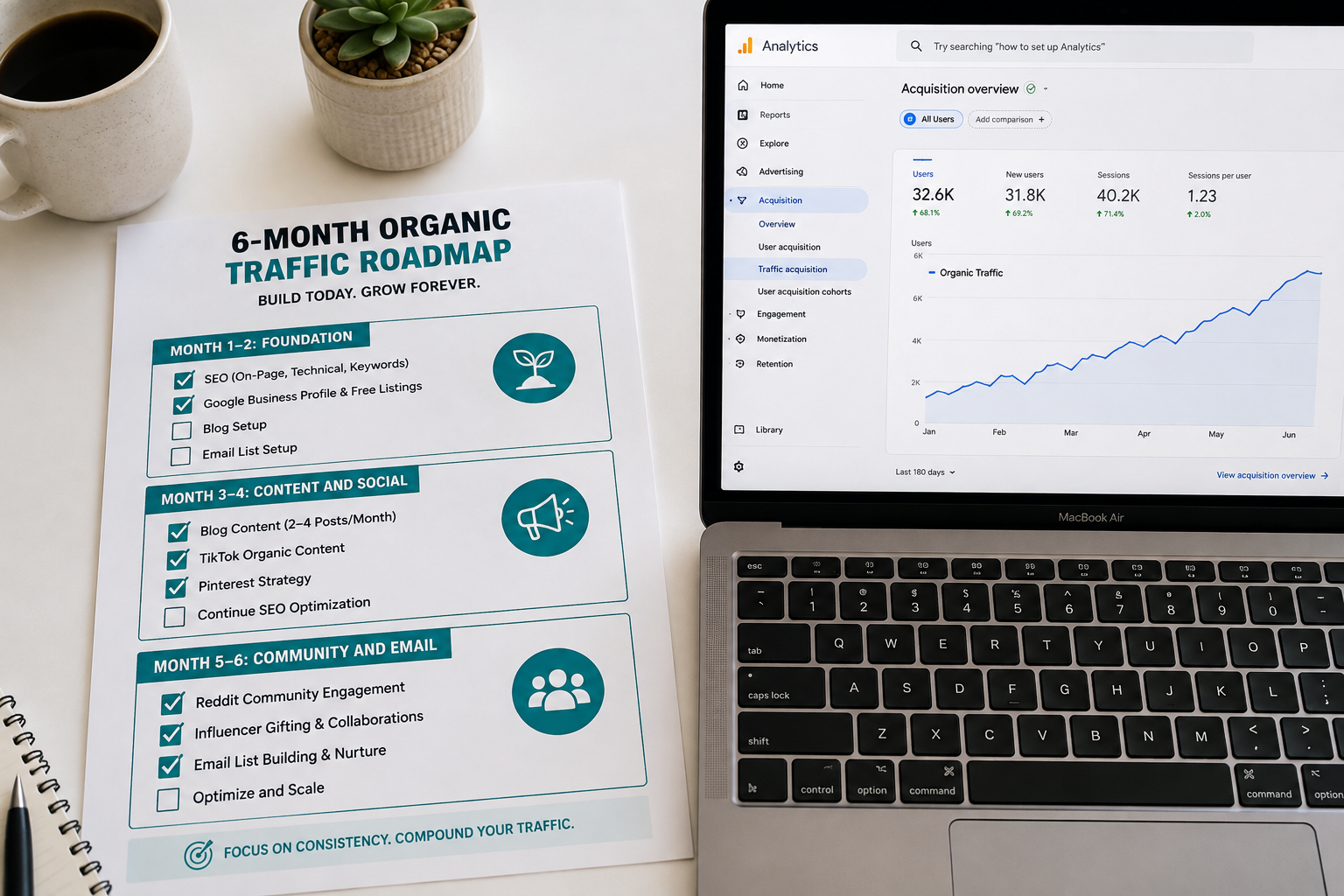
Month two to four: Launch your Shopify blog with two posts per month targeting specific long-tail keywords. Start your TikTok organic presence with three posts per week. Set up your email capture popup and welcome flow.
Month four to six: Build your Pinterest presence with consistent daily pinning. Begin Reddit community participation in two to three relevant subreddits. Send your first influencer gifting outreach to ten nano-influencers in your category.
Month six onward: All channels compound simultaneously. Blog posts begin ranking. Pinterest traffic grows as pin count increases. TikTok algorithm familiarity with your content improves reach. Email list grows from all organic touchpoints. The traffic infrastructure you have built generates returns every month without requiring proportional increases in effort or spend.
Final Thoughts
Free traffic is not actually free — it costs time, consistency, and creative effort rather than money. But the returns from that investment compound in ways that paid advertising never can. Every organic ranking earned, every email subscriber added, every community relationship built contributes to a traffic infrastructure that grows more valuable with each passing month.
The Shopify stores building genuine business durability in 2026 are the ones that treat organic channels as primary infrastructure rather than secondary supplements to their ad spend. They write the blog posts. They post the TikToks. They build the email list. And three to six months later, they have a traffic base that does not reset to zero at the end of the month.
The paid ads can come later — layered on top of an organic foundation that generates customers at zero marginal cost. Built in that order, marketing becomes compounding. Built the other way around, it remains a cost.
Need help setting up your Shopify store for organic traffic through SEO, blogging, and content strategy? Get in touch with EcomFixify — we specialize in Shopify development and ecommerce growth strategy for brands building sustainable revenue.