
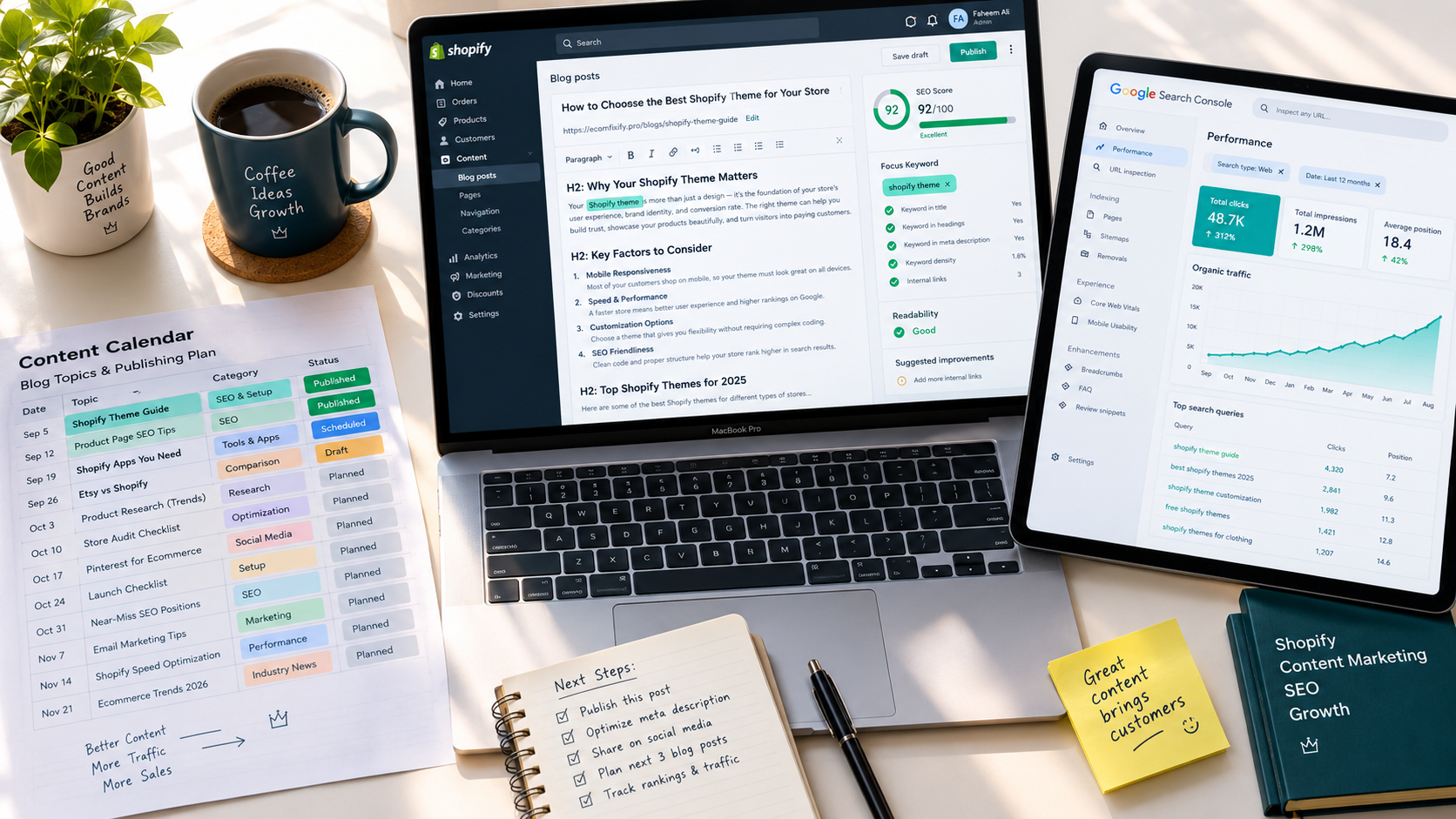
How to Create a Shopify Blog That Drives Organic Traffic
Most Shopify stores have a blog. Almost none of them are using it correctly.
The blog gets set up during the initial store launch, a few generic posts get published in the first month, traffic stays flat, and the blog quietly gets abandoned while the merchant focuses on paid ads instead. The blog tab stays in the navigation, a ghost town of three posts from two years ago serving as evidence that someone once had good intentions. How to Create a Shopify Blog That Drives Organic Traffic
That pattern represents one of the most expensive missed opportunities in Shopify marketing — because a well-executed blog is the only organic traffic asset that compounds in value over time, continues working while you sleep, and improves the SEO performance of your entire store including your product and collection pages.
Shopify stores with active, strategically managed blogs receive 55% more organic traffic than stores without blogs. Every blog post that ranks generates free, consistent traffic to your store without ongoing ad spend. And the topical authority built through a coherent, interlinked blog content strategy lifts the rankings of your commercial pages — product pages, collection pages, and your homepage — as a direct byproduct of the blog work you are doing.
This guide covers exactly how to build a Shopify blog that actually drives organic traffic — from keyword strategy and content structure through internal linking, publishing frequency, and the realistic timeline for when the results start appearing.
Why Most Shopify Blogs Fail to Drive Traffic
Before building the right approach, understanding the specific failure patterns that keep most Shopify blogs invisible in search results prevents the same mistakes from undermining new efforts.
The most common failure is targeting the wrong keywords. A skincare brand writing a blog post titled "Our Favourite Skincare Products" is publishing content that nobody is searching for. Organic traffic comes from matching your content to specific queries that real people type into Google — not from publishing content that feels natural to write. "Our Favourite" is not a search query. "Best moisturizer for oily skin in humid weather" is.
The second failure is publishing content that is too thin to rank. Google's 2024 and 2025 algorithm updates heavily penalized thin, generic content — blog posts that cover a topic at surface level without genuine depth, expertise, or information that the searcher cannot find more easily somewhere else. A 400-word blog post covering a broad topic is not a rankable asset. A 1,500 to 2,500 word post that comprehensively answers a specific question, with structured subheadings, practical examples, and links to related content, is.
The third failure is writing blog posts as standalone pages rather than as nodes in a content network. Every blog post that ranks for a keyword generates authority — but that authority only lifts your commercial pages if you have internal links connecting the blog post to the product pages, collection pages, and related posts that benefit from the transfer. A blog post with no internal links to your store's commercial pages is an island. An internally linked blog post is a pipeline.
Step 1: Keyword Research — Finding What Your Customers Actually Search
Shopify blog keyword strategy operates on a different logic than product page keyword strategy. Product pages target high-intent commercial keywords — searches from people ready to buy. Blog posts target informational keywords — searches from people learning, researching, or solving a problem — and convert a percentage of those readers into customers through the content itself and through internal links to commercial pages.
The keyword categories that generate the most organic traffic for Shopify blogs in 2026 are:
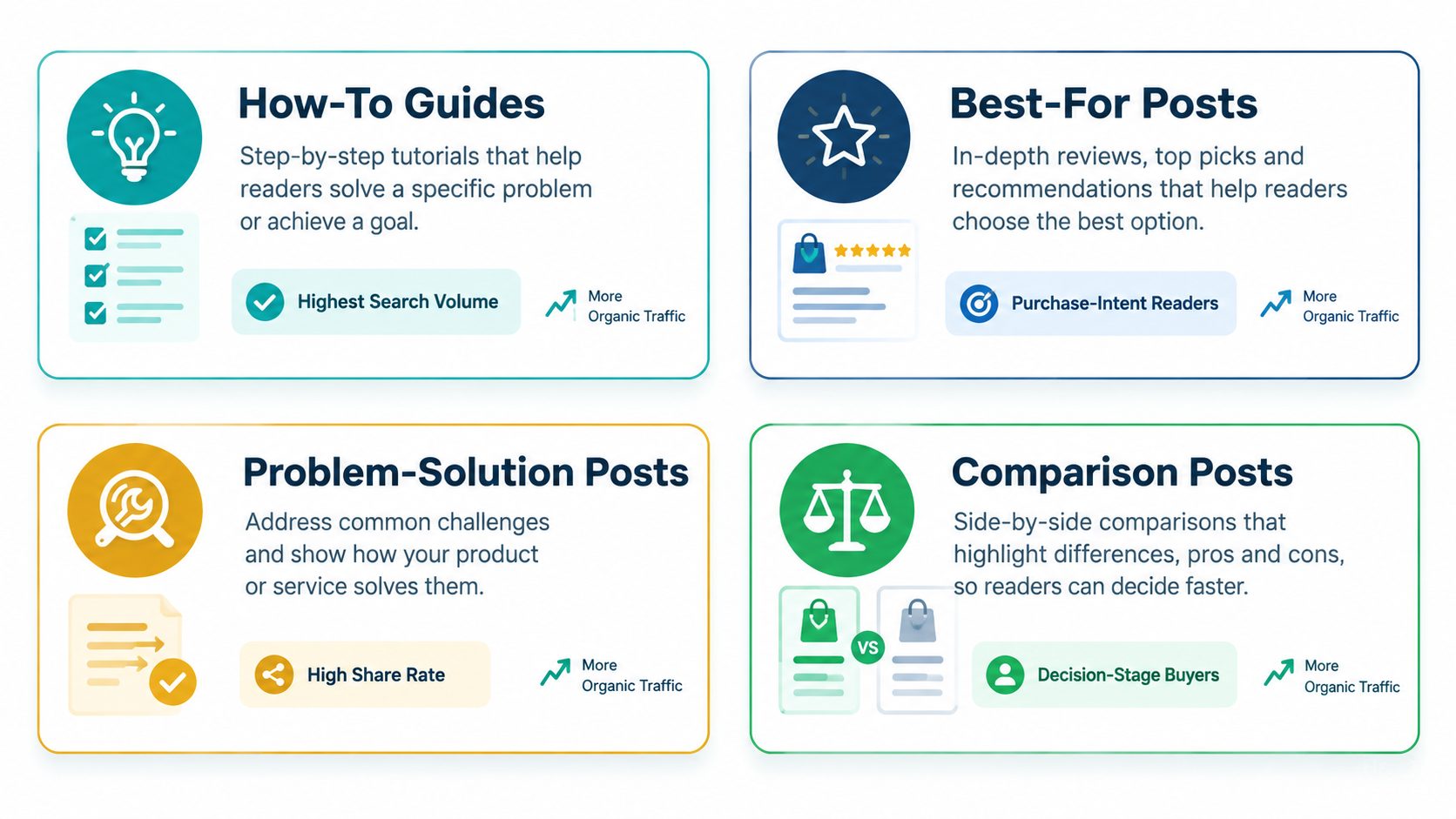
How-to queries — "how to remove gel nail polish at home" for a nail care brand, "how to clean a cast iron skillet" for a cookware brand, "how to style wide-leg trousers" for a fashion brand. How-to queries are the highest-volume informational keyword category in most product verticals, they attract readers with direct relevance to your product category, and they have a natural internal linking opportunity to the product that solves the problem described in the post.
Best-for queries — "best moisturizer for dry skin in winter," "best running shoes for flat feet," "best coffee grinder for French press." These queries come from people who are researching a purchase decision and have not yet decided what to buy. A well-written best-for post that genuinely evaluates options — including your own products — converts readers at higher rates than almost any other informational content type.
Problem-solution queries — "why does my coffee taste bitter," "why do my plants keep dying," "why is my skin breaking out after switching skincare." These posts attract readers who have identified a problem and are looking for solutions. Positioning your product as part of the solution, embedded naturally within genuinely helpful diagnostic and resolution content, converts readers who arrived with a problem and leave with a purchase.
Comparison queries — "brand A vs brand B," "type X vs type Y," "method one vs method two." Comparison content attracts readers at the decision stage of the purchase journey who are choosing between specific options. A comparison post that is genuinely helpful — not simply a thinly disguised promotion — builds trust and directs purchase-ready readers toward your store.
The practical keyword research process uses a combination of free and paid tools. Google's People Also Ask section shows the exact questions real people are asking about your product category. Answer the Public maps question-based search queries around any seed keyword. Ubersuggest and Semrush's free tiers provide search volume estimates for specific queries. And Google Search Console — available for free once your site is verified — shows you which queries your existing pages are already appearing for, revealing keyword opportunities adjacent to your current rankings.
For keyword selection, target queries with a minimum of 500 monthly searches and a keyword difficulty that your domain authority can realistically compete for. New Shopify stores with limited backlink profiles should initially target long-tail keywords of four or more words — "how to layer skincare products for beginners" rather than "skincare routine" — because long-tail keywords have lower competition ceilings that a new domain can clear within months rather than years.
Step 2: Content Structure That Ranks
Once you have identified a keyword worth targeting, the structure of the post determines whether it ranks in the top three results — where the majority of clicks go — or whether it ranks on page three, where effectively nobody goes.
The structural elements that most consistently produce top-ranking Shopify blog posts in 2026 are:
A keyword-rich H1 title that includes the primary keyword near the beginning and a clear promise of what the reader will get. "How to Remove Gel Nail Polish at Home (Without Damaging Your Nails)" is better than "How to Remove Gel Nail Polish" because it addresses the specific concern that drives the search and makes an additional promise that differentiates the post from simpler alternatives.
An introduction of three to four paragraphs that immediately validates the reader's search intent — demonstrating that this post answers exactly the question they asked — and briefly previews what the post will cover. The introduction is the highest-exit section of any blog post. A strong introduction that immediately resonates with the reader's specific situation dramatically reduces the bounce rate that signals to Google that a page did not satisfy the query.
H2 and H3 subheadings that map to the specific questions a reader would have about the topic — each one a mini-search query in itself. Google uses heading structure to understand what a post covers and to determine whether it belongs in featured snippets for specific sub-queries. A post that answers "what causes gel nail polish to damage nails" in a clearly labeled H2 has a chance to appear in the featured snippet for that specific query — which generates traffic independent of the main post's ranking.
Content length proportional to the complexity of the topic. A query like "how to layer skincare products" warrants 1,500 to 2,000 words covering the specific steps, the reasoning behind the sequence, common mistakes, and product recommendations. A query like "what is retinol" warrants 800 to 1,200 words that define the ingredient, explain how it works, describe who it is for, and address common concerns. Length should be driven by comprehensive coverage of the topic, not by a target word count.
A conclusion that summarizes the key points and includes a clear call to action — directing the reader to a related product, a collection page, or a related blog post — rather than ending abruptly after the last section.
Step 3: Internal Linking — The Traffic Pipeline Between Blog and Store
Internal links are the mechanism through which your blog's search traffic becomes product page traffic and eventually revenue. Without them, a ranking blog post drives readers to your site and then loses them — they read the content and leave without navigating to your products.
Every Shopify blog post should contain three to five internal links to commercial pages — specific product pages, collection pages, or landing pages that are directly relevant to the post's content. These links should be embedded naturally within the body content, using descriptive anchor text that tells both the reader and Google what the linked page contains.
A skincare blog post about "how to build a morning skincare routine" should link to your cleanser product with anchor text like "our gentle daily cleanser," to your moisturizer collection with anchor text like "lightweight moisturizers for daily wear," and to a related blog post about sunscreen with anchor text like "how to choose the right SPF for your skin type." Each link creates a navigational pathway from informational content to commercial intent — and each link passes a small amount of the blog post's search authority to the linked commercial page.
The reverse linking structure is equally important and almost universally neglected. Your collection pages and key product pages should include links back to relevant blog posts that provide deeper information on topics the product page covers briefly. A moisturizer product page that includes a link to "our complete guide to moisturizer for oily skin" serves readers who want more context and creates an internal link signal that connects the product page to a piece of content demonstrating topical depth.
When you publish a new blog post, also update two or three older posts that cover related topics to include a link to the new post. This internal linking between blog posts creates the content network architecture that signals topical authority to Google — demonstrating that your site has comprehensive, interlinked coverage of a subject area rather than isolated individual posts.
Step 4: On-Page SEO Optimization for Every Post
The technical on-page SEO elements of each blog post determine how effectively Google can crawl, understand, and rank the content. These elements take five to ten minutes to configure correctly for each post and make a measurable difference in how quickly and how highly each post ranks.
The title tag — the text that appears as the clickable headline in Google search results — should be under 60 characters, include the primary keyword near the beginning, and include a compelling element that differentiates the result from competitors on the same page. The Shopify blog editor allows you to set a custom page title in the SEO section of each post — always fill this in explicitly rather than leaving it to default to the post title.
The meta description — the two-line summary that appears beneath the title in search results — should be 120 to 155 characters, include the primary keyword naturally, and communicate a clear reason to click on this specific result rather than an adjacent one. Meta descriptions do not directly affect rankings but they significantly affect click-through rates, which indirectly affects rankings because Google monitors how frequently people click your result versus others on the same page.
The URL handle should be short, keyword-rich, and readable — five words or fewer, all lowercase, with hyphens separating words. Shopify generates URL handles automatically from the post title, which frequently produces unnecessarily long URLs. Edit the URL handle in the SEO section of the post editor to a clean, concise version that contains your primary keyword.
Image alt text for every image embedded in the post should describe the image accurately using natural language that includes relevant keywords where they fit organically. Alt text serves both an accessibility function — providing text descriptions for visually impaired readers using screen readers — and an SEO function, giving Google additional contextual signals about the post's topic.
Step 5: Content Types That Build Authority Fastest
Not all blog content formats are equal in their ability to build topical authority and generate backlinks — the two outcomes that most directly translate to domain authority growth and ranking improvement across your entire Shopify store.
The content types that build authority fastest are:
Comprehensive guides and pillar posts — 2,000 to 4,000 word posts that cover a topic with more depth and accuracy than any competing content currently ranking for that query. A pillar post on "the complete guide to choosing running shoes" that addresses foot type, terrain, cushioning, fit, and budget in genuine detail becomes the reference resource in its category — attracting backlinks, generating featured snippet placements, and compounding in traffic value over months and years.
Original data and research — any post that presents original data your brand has collected, surveyed, or analyzed. A skincare brand that surveys 500 customers about their most common skin concerns and publishes the findings in a post has created a resource that journalists, bloggers, and other content creators will reference and link to. Original research is the most reliable link-generating content format available to Shopify brands without large PR budgets.
Buying guides and comparison posts — comprehensive guides that help shoppers make purchase decisions in your category, covering the specific criteria they should evaluate, the questions they should ask, and the differences between the available options. Buying guides attract high-intent readers who are actively in the purchase decision process and generate links from other sites that reference them as authoritative resources on the buying decision.
Problem-diagnosis posts — in-depth posts that diagnose the specific reasons behind common problems in your category and walk through resolution options systematically. A plant care brand's post on "why your monstera leaves are turning yellow and how to fix each cause" covers every possible cause — overwatering, underwatering, insufficient light, root bound, pests — and the specific action for each. This format generates organic shares and links because it is genuinely useful in a way that generic "plant care tips" posts are not.
Step 6: Publishing Frequency and Content Calendar
Consistency in publishing frequency matters more than volume in Shopify blog SEO. Two to four posts per month published consistently over twelve months outperforms twelve posts published in month one followed by nothing for the next eleven months — because Google rewards sites with consistent content activity and because your audience cannot build the return-visit habit when publishing is erratic.
The practical content calendar for a Shopify store starting its blog strategy from scratch allocates the first month to foundational pillar content — one or two comprehensive guides on the highest-volume topics in your category. These pillar posts set the topical foundation that subsequent posts build on through internal linking.
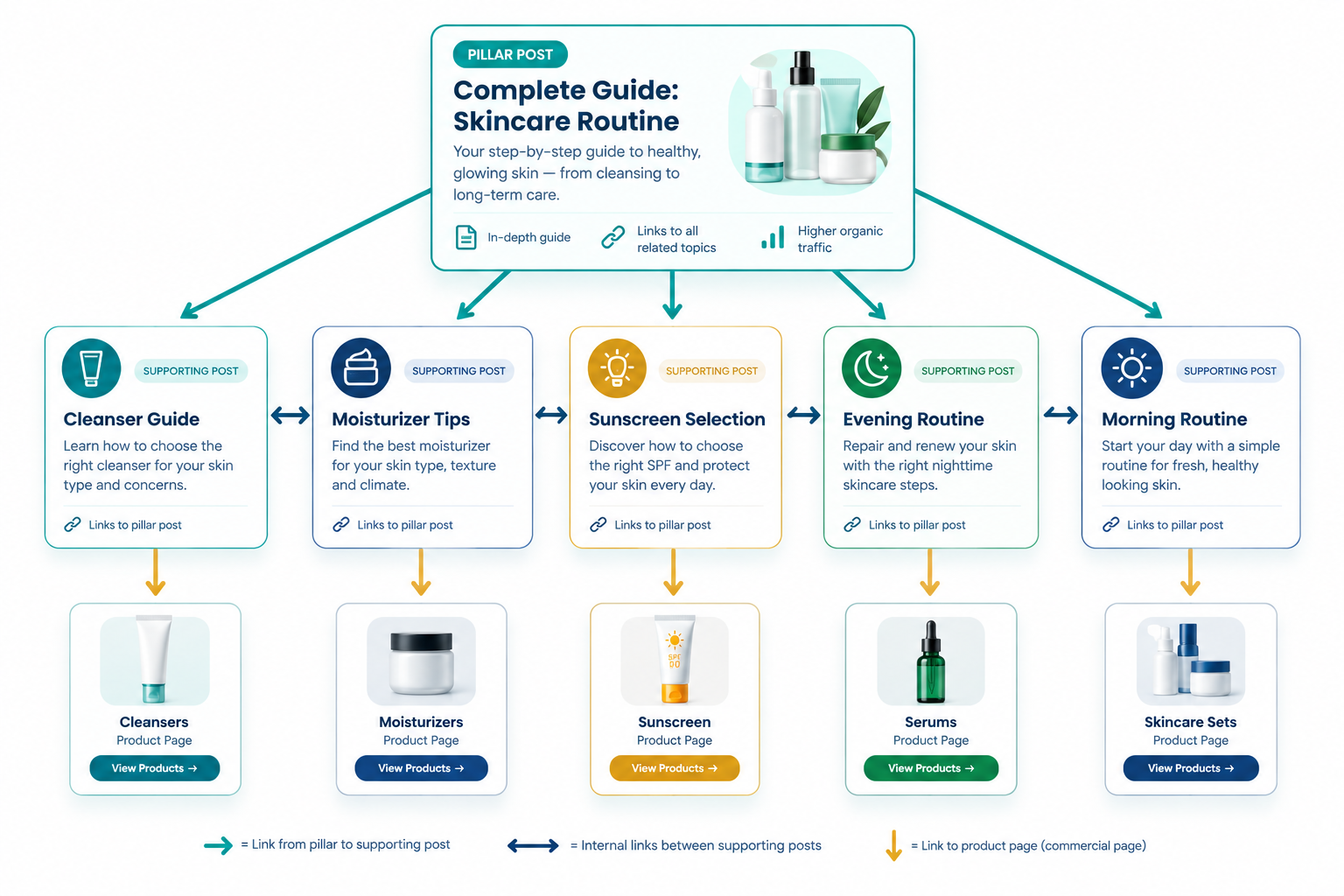
From month two onward, publish a mix of content types that creates a coherent topical network. For every pillar post, publish three to five supporting posts on related sub-topics that link back to the pillar and cross-link to each other. A pillar post on "complete skincare routine guide" supports five posts on cleanser selection, moisturizer selection, sunscreen selection, evening routine, and morning routine — each linking to the pillar, to each other where relevant, and to the specific product pages for each category.
Batch your content creation to reduce the time cost per post. Researching and outlining three posts in a single session, then writing them across the following week, is significantly more efficient than approaching each post as a separate research project. The keyword research, topic mapping, and competitor analysis done for one post in a cluster informs all the related posts in the same cluster.
Step 7: Promoting Your Blog Content Beyond SEO
Organic search traffic is the primary long-term value of a Shopify blog — but in the first three to six months before your posts have had time to rank, content promotion through owned and earned channels accelerates both traffic and the social signals that support faster indexing and ranking.
Email your blog posts to your subscriber list within 24 hours of publication. A blog post announced to an existing email list generates immediate traffic, engagement, and time-on-page signals that tell Google the content is relevant and valuable to the readers who find it. A new post with zero traffic in its first 30 days has fewer signals to learn from than a post that received 200 engaged visits from your email list in its first week.
Share blog content on Pinterest as standalone pins with keyword-rich descriptions. Pinterest is the only social platform where content continues driving traffic for months and years after publication — because Pinterest functions more like a search engine than a social feed, and pins that rank in Pinterest search generate ongoing referral traffic long after a Facebook or Instagram post has been forgotten.
Create short-form video content for TikTok and Instagram Reels that summarizes the key insight from each blog post and directs interested viewers to the full post through your link-in-bio. A 45-second video that summarizes "the three things that are making your plants turn yellow" and credits the full diagnostic guide in the bio converts TikTok viewers into blog readers and email subscribers at measurable rates.
Build backlinks to your best blog posts by submitting them to relevant industry directories, reaching out to bloggers who write roundup content in your category, and pursuing inclusion in "best resources" lists on related sites. Every quality backlink to a blog post increases the post's domain authority contribution and lifts the commercial pages it links to internally.
The Realistic Timeline: What to Expect Month by Month
Setting accurate expectations about Shopify blog SEO timelines prevents the premature abandonment that defeats most blog strategies before they have had time to produce results.
Months one and two are almost entirely invisible in search results. New blog posts from stores with limited existing domain authority take time to crawl, index, and rank — and will initially appear deep in search results for competitive queries. This is normal. Request indexing for each post in Google Search Console immediately after publishing to accelerate the crawl timeline.
Months three and four typically show the first signs of organic traction. Long-tail keyword posts begin appearing in positions 15 to 30 in search results. Impressions in Search Console begin accumulating even for posts not yet generating significant clicks. This data is valuable for identifying which posts are gaining traction faster than others and deserve additional internal linking and optimization attention.
Months five and six see initial meaningful traffic from the posts that have ranked most effectively. Posts targeting long-tail keywords with clear search intent and comprehensive coverage begin reaching positions 5 to 15 — the range where click-through rates start generating consistent traffic. Total organic blog traffic from a consistently published, well-structured blog strategy typically reaches 500 to 2,000 monthly visits by month six.
Months nine to twelve represent the compounding phase where early posts continue improving in ranking, new posts begin their own ranking trajectory, and the internal linking network between posts starts lifting commercial page rankings visibly. Most Shopify stores running a consistent, properly structured blog strategy see 2 to 3 times their organic traffic within twelve months of committed execution.
The merchants who see the strongest results are the ones who commit to the strategy for twelve months without redirecting attention based on the absence of visible results in the first eight weeks. Organic search is a compounding channel — slow to start and disproportionately rewarding over time.
Shopify-Specific Blog Setup Optimizations
The Shopify blog editor handles the basics of publishing, but several platform-specific configurations improve SEO performance beyond the defaults.
The /blogs/news URL path that Shopify generates for blog posts by default can be customized. Changing the blog handle from "news" to something more topically relevant — "guides," "journal," or your brand's specific content category — creates cleaner URLs and gives search engines an additional signal about the content type before they even read the page.
Installing a dedicated SEO app — Plug in SEO, Smart SEO, or JSON-LD for SEO — adds structured data markup to your blog posts that is not generated by Shopify's native theme. FAQ schema on posts with question-and-answer sections, Article schema on all blog posts, and BreadcrumbList schema on post pages all improve the way Google reads and categorizes your content and increase the probability of featured snippet placement for relevant queries.
Enabling blog comments — which Shopify supports natively — adds fresh content signals to posts over time as readers engage, and creates community around your content that generates return visits and social sharing. Moderated comments also surface customer questions that reveal additional keyword opportunities and content gaps worth addressing in future posts.
Connecting your Shopify blog to Google Search Console as a separate property — in addition to your main domain property — allows you to track blog-specific performance metrics including impressions, clicks, average position, and click-through rate for every indexed post. This data is the most important feedback loop in your entire blog strategy, showing you which posts are gaining traction, which keywords you are ranking for that you did not specifically target, and which posts need optimization attention to move from position 15 to position 5.
Final Thoughts
A Shopify blog that drives organic traffic is not built in a weekend. It is built through a consistent, systematic application of keyword strategy, content quality, internal linking discipline, and publishing regularity — sustained over the six to twelve months it takes for Google to recognize and reward the authority you are building.
The merchants who have built Shopify blogs that generate thousands of organic visits per month — driving revenue from customers who have never seen a paid ad from the brand — did not achieve that through a single viral post or a moment of inspiration. They chose a niche, built a keyword map, published consistently, linked methodically, and waited with the patience that organic search requires.
The compounding value of a well-built Shopify blog is unlike any other marketing asset. A paid ad stops working the moment the budget stops. A blog post that ranks for a valuable keyword continues generating traffic and revenue for years — improving over time as authority accumulates, as internal links multiply, and as the topical depth of your content network grows.
Start with one keyword cluster. Publish one pillar post and two supporting posts. Link them to your product pages and to each other. Request indexing. Repeat every two weeks.
The results will come. They just require the time that organic growth demands.
Need help building a Shopify blog content strategy, or want an expert to audit your existing blog for SEO gaps and internal linking opportunities? Get in touch with EcomFixify — we specialize in Shopify development and ecommerce growth strategy for brands building long-term organic traffic assets.