
How to Copy What Winning Shopify Stores Do
There is a form of competitive research that most Shopify merchants either do not know about or feel vaguely uncomfortable doing — yet the most successful ecommerce operators treat it as a core weekly discipline.
It is not copying products. It is not stealing creative. It is studying exactly how successful Shopify stores operate — their pricing strategy, their ad angles, their product page structure, their email timing, their traffic sources, their conversion architecture — and applying those learnings to your own store in your own category with your own products.
The distinction matters because copying products is a race to the bottom. The merchant with the lowest price wins, margins collapse, and the whole operation depends on supplier advantage rather than business skill. Copying strategy is entirely different. Strategy is transferable across categories, sustainable over time, and compounds in value as you get better at applying what you observe.
Businesses that run structured competitive analysis programs consistently outperform those that rely on gut instinct. In 2026, the barrier to entry for ecommerce has lowered dramatically while the barrier to sustained profitability has risen. Marketplaces are saturated with similar products, and the merchants winning are not the ones with unique products — they are the ones with superior understanding of what works and the discipline to apply it systematically.
This guide covers the complete competitive intelligence workflow for Shopify stores — what to look for, which tools to use, and exactly how to translate what you find into improvements in your own store.
What "Winning" Actually Means in a Shopify Context
Before studying competitors, defining what you are looking for prevents the most common competitive research mistake — getting distracted by surface-level aesthetics rather than the operational indicators that actually drive results.
A winning Shopify store in 2026 is not necessarily the one with the most beautiful design or the most viral TikTok content. It is the one with consistently strong fundamentals: healthy conversion rates across device types, sustainable customer acquisition costs, meaningful repeat purchase rates, growing organic traffic, and ad creative that has been running profitably for months rather than days.
The signals that indicate a store is genuinely winning — rather than just appearing to — are ones that require sustained performance to maintain. An ad that has been running for 90 or more days on Meta is profitable. A store driving consistent organic search traffic has built genuine SEO authority. A brand generating thousands of reviews across multiple product lines has real customer volume. These durable signals are what you are looking for — not the one-week viral moment that looks impressive but generates no lasting business value.
The mental model shift that makes competitive intelligence valuable is this: you are not looking at what your competitors are doing. You are looking at what the market has already validated. Every ad that has been running for months, every product page layout that is being tested at scale, every email subject line formula that is generating clicks — these are market-validated signals about what works with real customers spending real money. Your job is to understand why they work and apply that understanding to your own store.
Step 1: Identify the Right Stores to Study
The first and most important step in competitive intelligence is choosing which stores to study. Most merchants make the mistake of researching their direct category competitors only — which gives them a narrow view of what is possible and ignores the strategy innovations happening across the broader Shopify ecosystem.
Build a research list with three types of stores:
Direct competitors — stores selling the same or very similar products to the same audience. These are your most obvious research subjects and the most directly applicable for pricing intelligence, product positioning analysis, and traffic source research.
Category-adjacent stores — brands in a related but different product category selling to a similar customer demographic. A skincare brand studying a supplement brand targeting the same health-conscious 30 to 45 female demographic will find creative angles, email strategies, and retention mechanics that their direct competitors have not yet discovered.
Aspirational leaders — top-performing DTC brands known for excellent ecommerce execution regardless of product category. Gymshark, Allbirds, SKIMS, Brooklinen, and similar brands have invested heavily in conversion optimization, email strategy, and paid advertising — and their stores are publicly accessible laboratories of what works at scale.
Your research list should contain five to ten direct competitors, three to five adjacent category stores, and two to three aspirational leaders. This breadth ensures that your intelligence gathering surfaces innovations from outside your immediate competitive bubble — which is where the most commercially valuable insights typically originate.
Step 2: Analyze Their Store Architecture and Design
The first layer of competitor research requires nothing more than a browser, a device, and the willingness to look systematically at what you typically scroll past.
Visit your competitor's store as a first-time customer would — enter their homepage, navigate to a product page, add something to cart, and begin checkout. At each step, notice the decisions they have made and ask why.
On the homepage: what does the hero section lead with — a product, a lifestyle, a value proposition, or a promotion? What social proof is visible above the fold — review counts, press logos, customer numbers? What is the primary call to action and where is it positioned?
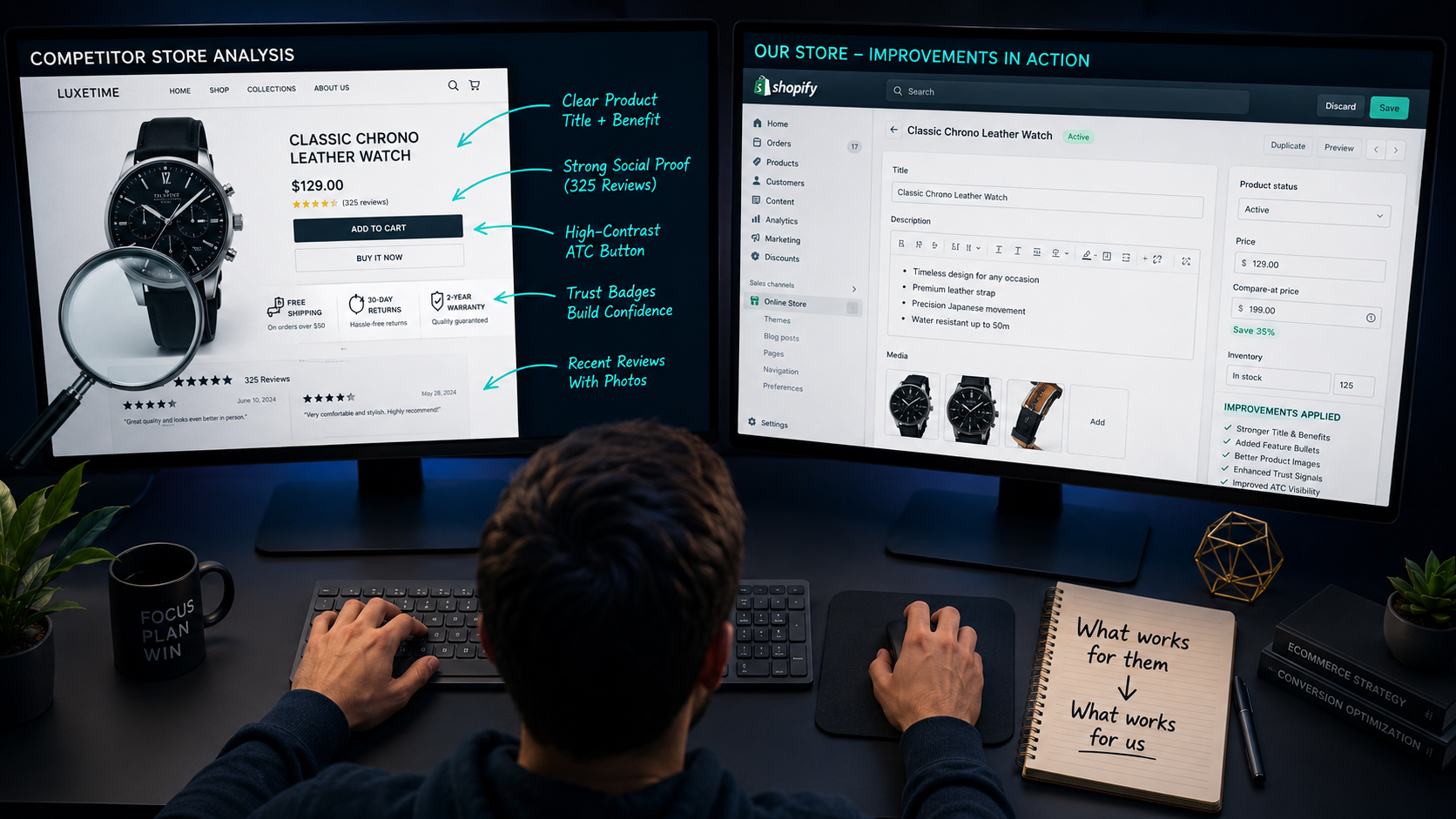
On the product page: how is the image gallery structured? How many images are there and in what sequence? Where does the Add to Cart button appear relative to the product description? What trust signals appear near the ATC button? How is social proof architected — aggregate rating, review count, featured reviews, or photo reviews from customers?
In the cart: what upsell or cross-sell appears at the cart stage? Is there a shipping threshold progress bar? What payment options are visible? Is there an urgency element?
At checkout: is guest checkout the default? Which express payment options appear above the form? How many form fields are required?
The answers to these questions constitute a competitive UX audit that tells you which conversion optimization decisions your competitors have made — and because they are running traffic at scale, these decisions are not random. They reflect what converts for their audience. Apply the relevant elements to your own store with your own brand expression.
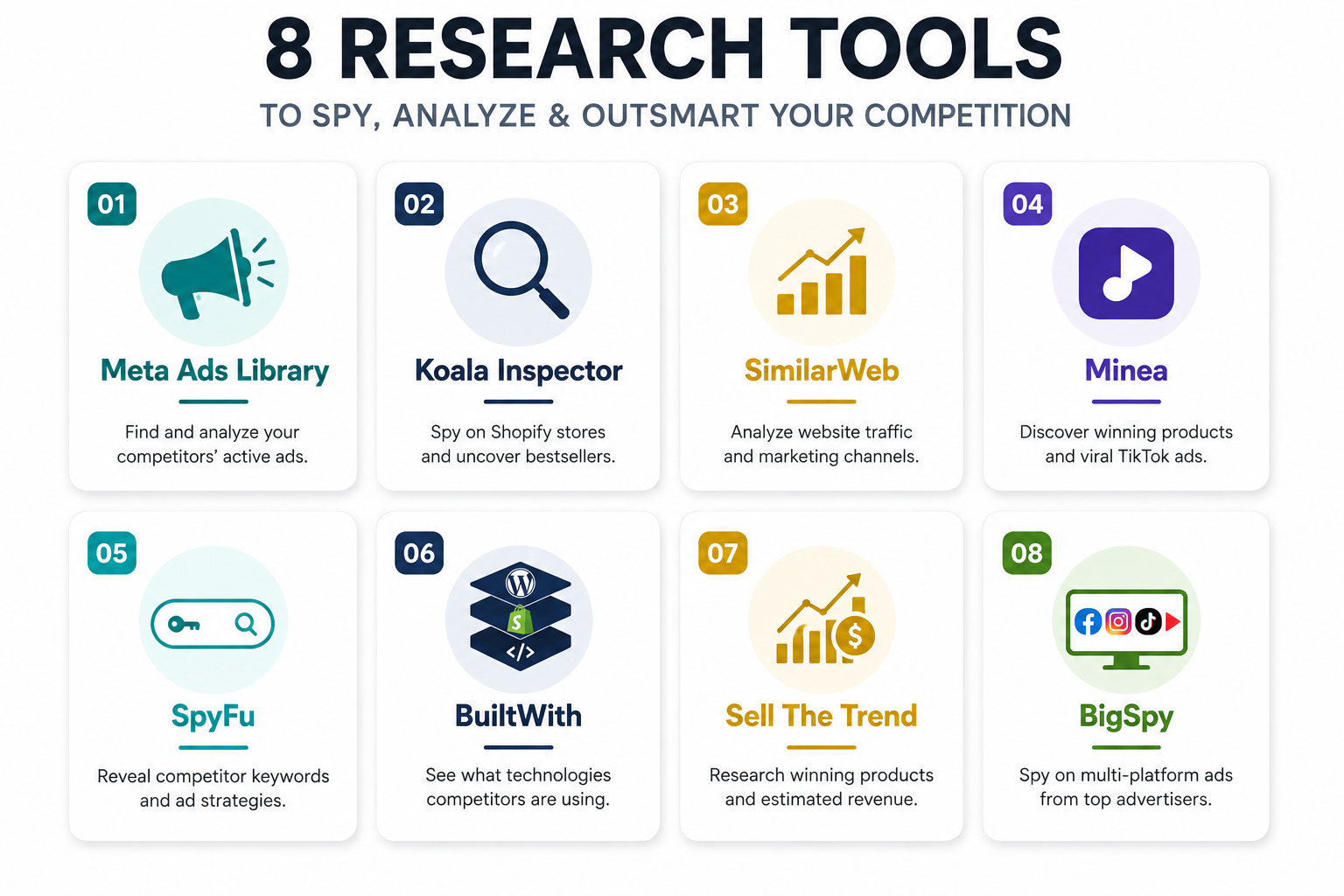
A free tool called Koala Inspector — a Chrome extension used by over 200,000 store owners — reveals which Shopify theme a competitor is using, which apps they have installed, their estimated traffic sources, and in some cases their best-selling products. Installing Koala Inspector and running it on your target competitor stores in five minutes delivers more structural intelligence than an hour of manual browsing.
Step 3: Reverse-Engineer Their Ad Strategy
Paid advertising is the most expensive and most carefully tested marketing decision most Shopify stores make. An ad that has been running profitably for 60 or more days on Meta represents weeks of creative testing, audience validation, and budget optimization — compressed into a single piece of content you can study for free.
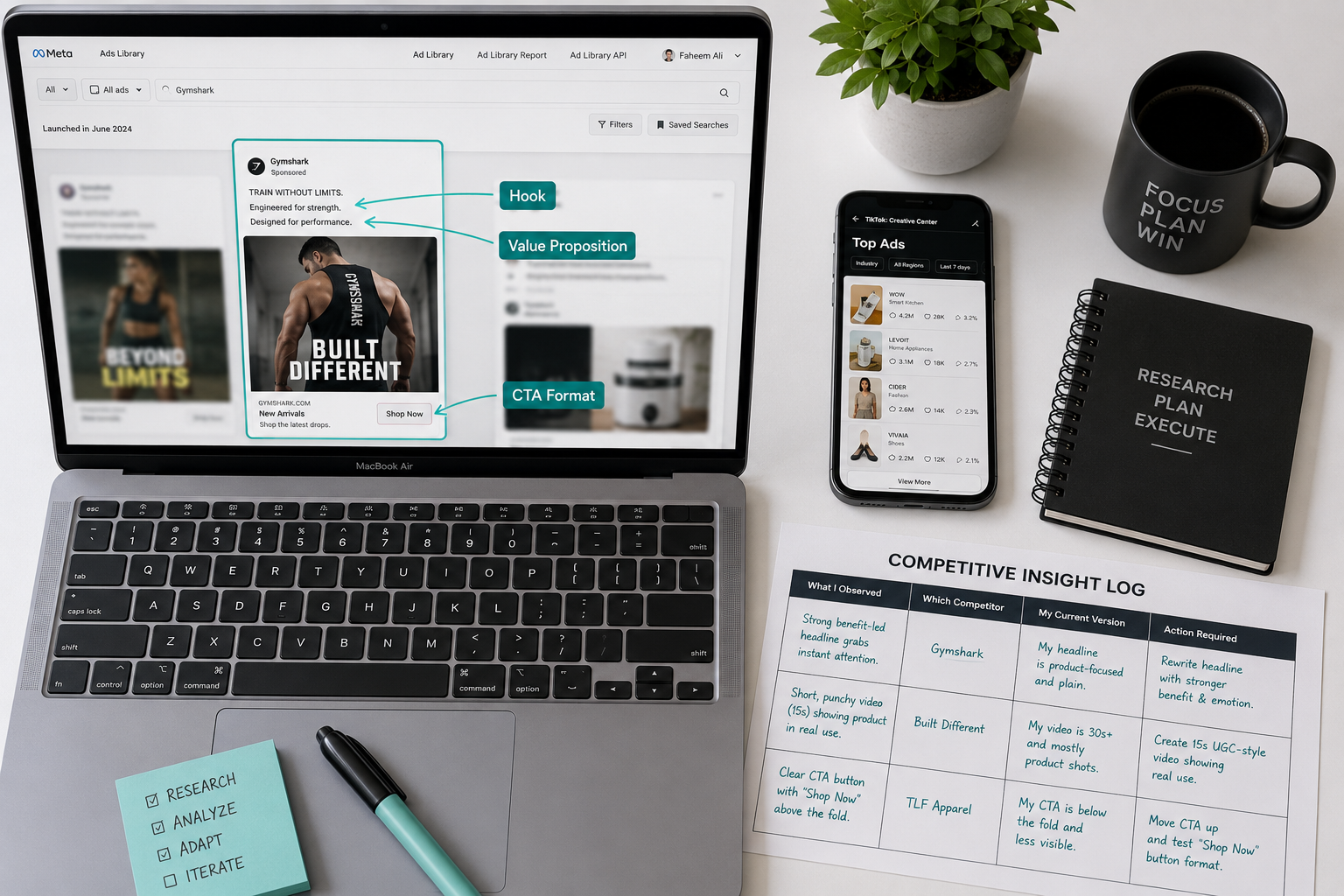
Meta Ads Library is the starting point. It is completely free, requires no account, and shows every active ad any brand is currently running on Facebook and Instagram — including the creative, the copy, the format, and how long the ad has been active.
Go to Meta Ads Library, search your competitor's brand name, and filter to see only their active ads. The ads that have been running the longest are the ones generating the best results — Meta's algorithm stops spending on underperforming ads automatically. An ad that has been active for 90 or more days is a proven performer.
Study each long-running ad for the following:
The hook — the first frame, the first sentence, or the first three words that stop the scroll. What question does it ask, what claim does it make, or what visual does it show to earn attention?
The value proposition — what specific benefit does the ad promise, and how is that benefit framed? Is the angle problem-solution, social proof, transformation, authority, or curiosity?
The format — static image, video, carousel, or UGC-style footage? How long is the video if it is a video? Is it polished or raw?
The call to action — what does the ad ask the viewer to do next, and what specific landing page does it point to?
None of this is copying. You are studying the angle, the hook structure, and the value proposition framing — then applying those learnings to your own product with your own creative. The goal is to understand why a specific approach resonates with the market, not to replicate the ad itself.
For TikTok ad intelligence, the TikTok Creative Center and BigSpy both provide access to competitor TikTok ad libraries. The TikTok Creative Center's Top Ads section shows the highest-performing TikTok ads across categories, filterable by industry, region, and time period — giving you a view of what creative formats are generating results on the platform right now.
Step 4: Analyse Their Traffic Sources and SEO
Understanding where a competitor's traffic comes from tells you which channels they have invested in and validated — which is useful information whether you want to compete on the same channels or find channels they have neglected.
SimilarWeb is the standard tool for traffic source analysis. Its free tier shows the top traffic sources for any website — direct, organic search, referral, social, paid search, and display — along with estimated monthly visit volumes and geographic distribution. The paid tier adds keyword-level data showing exactly which search terms are sending organic traffic to a competitor's store.
If a competitor is receiving 40% of their traffic from organic search, they have built meaningful SEO authority — which tells you that SEO is a viable channel in this category and gives you a target keyword set to investigate. If they are receiving 60% from paid social, they are heavily dependent on advertising spend — which may represent a vulnerability if you can build organic channels they have not invested in.
For keyword-level competitor SEO analysis, Ahrefs and Semrush both show which organic search terms a competitor ranks for, how much traffic each term generates, and how difficult each term would be to compete for. The most actionable output from this analysis is identifying keywords your competitors rank for that you currently do not — particularly commercial-intent terms like "best [product type]" or "buy [product] online" that indicate buyer-ready search intent.
SpyFu is a more affordable alternative for competitor keyword research that shows both organic rankings and paid search keyword history — the keywords a competitor has historically bid on in Google Ads, which reveals their highest-value commercial search terms even if they are no longer running those campaigns.
Step 5: Study Their Email and Content Marketing Strategy
Email is the owned channel that generates the highest return on investment for most Shopify stores — and studying how successful competitors use it reveals sequences, timing, and content approaches that you can adapt for your own list.
The simplest competitor email research method requires only a new email address and ten minutes. Sign up for a competitor's email list using a dedicated research email address. Go through their signup flow and note: what popup triggers the signup, what offer is made to incentivize the signup, and what happens in the first seven days after subscribing.
Count the emails, note the timing between each, observe what each email sells versus what it educates, and pay attention to subject line formulas — question versus statement, curiosity versus specificity, personalised versus broadcast. You are building a map of their welcome sequence that tells you exactly how they convert cold subscribers into first-time buyers.
After subscribing, abandon a cart with that email address and observe the abandoned cart recovery sequence. How many emails arrive, at what intervals, and with what offer escalation? This tells you the standard their customers expect — and whether there is an opportunity to recover carts more aggressively or more subtly than they are doing.
For content marketing research, examine their Shopify blog section. What topics do they cover? How long are the posts? Which posts are ranking in Google — visible through Semrush or Ahrefs? The intersection of topics they are covering and terms that are ranking gives you a validated content roadmap for your own blog strategy.
Step 6: Investigate Their App Stack
The apps a successful Shopify store has installed reveal the conversion tools they have invested in — and because every app carries a cost, the apps they keep installed are the ones generating a positive return.
BuiltWith is a free tool that identifies the technology stack of any website — including Shopify apps, analytics tools, advertising pixels, and third-party integrations. Entering a competitor's URL into BuiltWith reveals their installed apps without any reverse engineering required.
Koala Inspector also surfaces installed Shopify apps for any store you visit, typically with greater accuracy for Shopify-specific tools than BuiltWith. Between the two tools, you can identify whether a competitor is using Klaviyo or Omnisend for email, Gorgias or Tidio for support, Rebuy or LimeSpot for product recommendations, and Okendo or Judge.me for reviews.
The commercial logic behind app stack research is straightforward. If a competitor with similar traffic and product type is running Rebuy for product recommendations and you are not, they are likely extracting higher average order values from the same traffic through AI-powered upsells and cross-sells. The gap between your AOV and theirs is partially explained by the tools in their stack.
Step 7: Decode Their Pricing and Promotion Strategy
Pricing is one of the most operationally significant and least discussed elements of competitive research. Most merchants set prices by adding a margin to their cost of goods — which is a useful starting point but ignores the positioning signal that price sends to customers and the psychological pricing patterns that consistently outperform rational pricing models.
Study your competitors' pricing across their full product range. Are they positioning as the premium option, the value option, or the mid-market standard? What is their entry price point — the cheapest product in their catalog — and how does it compare to their average order value? Do they use charm pricing — prices ending in 9 or 7 — or round numbers that signal premium quality?
Observe their promotion calendar. Sign up for their email list and their SMS list and record every promotional communication over a 60-day period. How often do they run sales? What discount depths do they use? Do they use flash sale urgency, seasonal promotions, or loyalty-based offers? What is the cadence and the average frequency of promotional messaging?
This 60-day observation window maps their promotional strategy comprehensively — and reveals whether they are training their customers to wait for discounts, how heavily they are discounting relative to their regular pricing, and what promotional angles they have tested and repeated versus ones they ran once and abandoned.
Step 8: Monitor Competitors Continuously With Automated Tools
Manual competitor research is valuable but time-intensive. Automated monitoring tools track competitor changes continuously and alert you when something significant shifts — so you do not miss a pricing change, a new product launch, or a creative test that starts generating results.
Sell The Trend's Store Intelligence feature allows you to enter a competitor's Shopify URL and receive ongoing intelligence including revenue estimates, traffic trends, product launch velocity, and ad activity. For merchants who want passive competitor monitoring without daily manual checks, this automation makes it practical to keep tabs on multiple competitors simultaneously.
AI-powered competitive intelligence tools in 2026 can monitor pricing changes, new product launches, and website redesigns within hours of them happening — flagging changes that warrant your attention rather than requiring you to check manually. The merchants who respond fastest to competitive movements — a competitor's stockout that creates a window for your brand, a price increase that makes your pricing more competitive, a new product launch that validates a category you have been considering — consistently outperform those who discover these changes weeks later.
Minea is the most comprehensive ad intelligence platform for Shopify merchants who run paid social campaigns, monitoring both Meta and TikTok ad libraries across hundreds of thousands of brands and surfacing high-performing creative patterns before they become widely known. Its filtering by engagement, ad spend estimate, and duration allows you to isolate the specific ads that are working hardest in your category right now.
Translating Competitive Intelligence Into Store Improvements
The final and most commercially important step is closing the gap between what you have observed and what you have implemented. Competitive research that generates saved browser tabs and unread notes produces no revenue. Intelligence that becomes action does.
Build a simple competitive insight log — a shared document or spreadsheet — with four columns: what you observed, which competitor you observed it on, what your current equivalent looks like, and the specific action required to close the gap.
Prioritise your action list by potential revenue impact. A gap in your checkout conversion — a missing express payment option, a hidden shipping cost, a forced account creation — typically generates a larger revenue lift than a missing blog post. A gap in your email recovery sequence generates more immediate revenue than a gap in your social media strategy. Work through the list in impact order.
Set a monthly competitive research cadence — two hours per month minimum — and treat it as a non-negotiable operational task rather than something you do when you feel curious. The market shifts faster than annual reviews can capture. Monthly monitoring ensures you see new product launches, creative pivots, and pricing changes while there is still time to respond.
The Ethical Boundaries Worth Being Clear On
Competitive intelligence has clear ethical limits that distinguish legitimate research from practices that cross into harmful territory.
Studying publicly available information — ads in Meta's Ad Library, organic website content, publicly listed product pages, email campaigns you have legitimately subscribed to — is standard business practice with a long history across every industry.
Copying product designs with intellectual property protection, reproducing ad creative without original production, or misrepresenting competitor information to confuse customers crosses ethical and in some cases legal lines. None of the research methods in this guide approach those limits.
The guiding principle is applying insights rather than replicating artifacts. Understanding why a hook works and applying that understanding to your own creative is legitimate. Downloading a competitor's ad and reposting it is not. Understanding why a product page layout converts and adapting that structure with your own content is legitimate. Copying a competitor's product description and republishing it with minor changes is not.
The merchants who build durable businesses through competitive intelligence are the ones who use what they learn to get better at their own craft — not the ones who use it to avoid developing craft in the first place.
Final Thoughts
The Shopify stores generating consistent revenue growth in 2026 are not operating in isolation, making decisions based on instinct, and hoping the market responds. They are watching the market systematically, identifying what is working across the competitive landscape, and applying those learnings to their own store with deliberate speed.
Every successful ad in Meta's library is a market test someone else paid for. Every high-converting product page your competitor has optimized is a conversion experiment you can study for free. Every email sequence generating revenue in your category is a timing and content blueprint that took someone months to build through trial and error — and took you twenty minutes to map through their unsubscribe list.
The intelligence is available. The tools are accessible. The competitive window is open right now because most Shopify merchants are still making decisions from gut instinct rather than systematic market observation.
Start with one competitor. Study their ad library. Subscribe to their email list. Run Koala Inspector on their store. Spend two hours this week on competitive research that would have taken a market research firm weeks and thousands of dollars to compile a few years ago.
Then apply what you find.
Need help building a competitive research process for your Shopify store, or want an expert to audit your store's conversion gaps against category best practices? Get in touch with EcomFixify — we specialize in Shopify development and ecommerce growth strategy.