
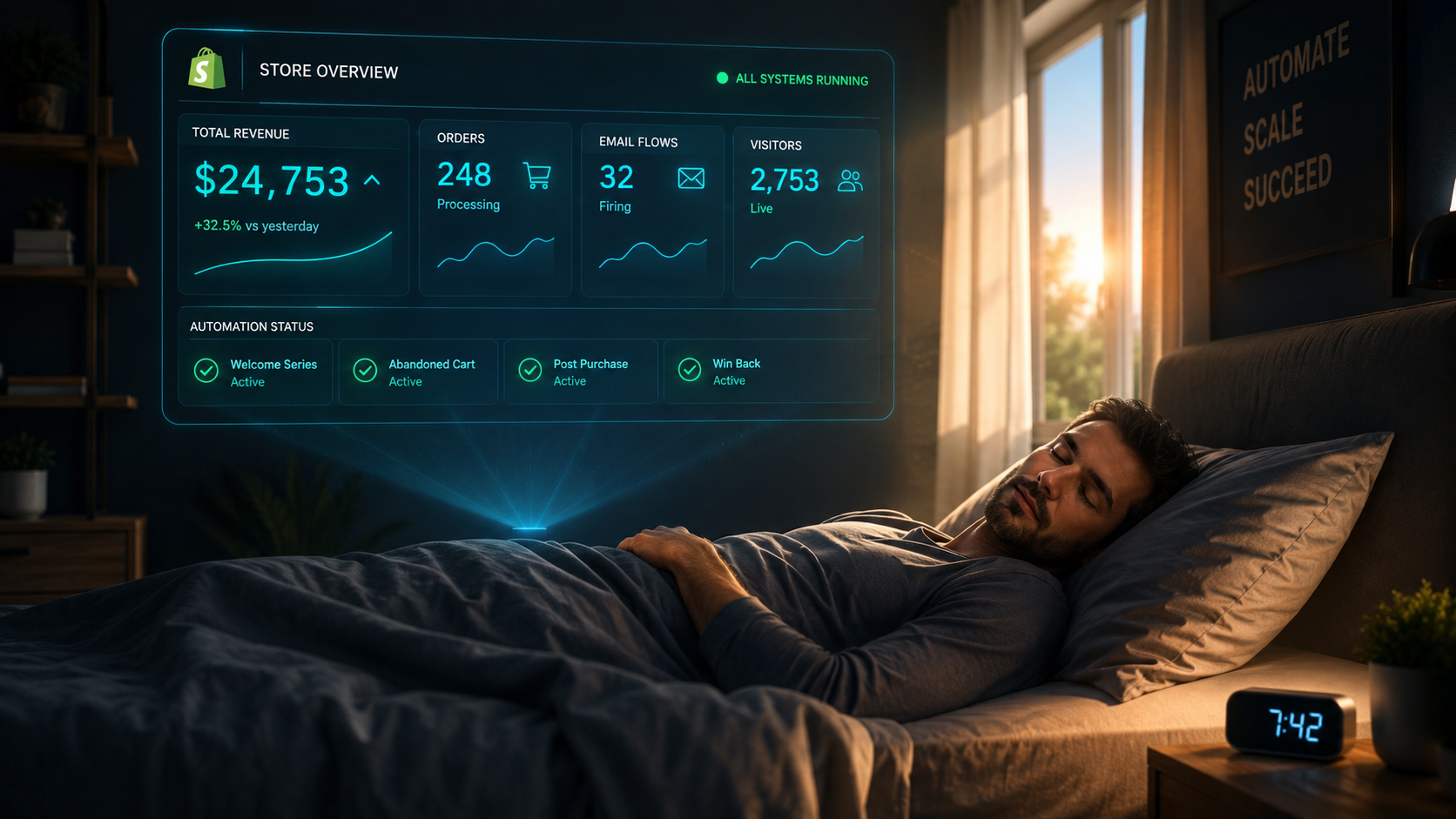
How to Build a Shopify Store That Sells While You Sleep 2026
The phrase "make money while you sleep" gets thrown around so carelessly in ecommerce circles that most serious merchants have stopped taking it seriously. And they are right to be skeptical — because the passive income fantasy peddled by gurus bears no resemblance to how successful automated Shopify stores actually work.
No Shopify store runs itself completely. What the best-operated stores do is something more interesting and more achievable: they front-load the work into systems, automations, and infrastructure that then run continuously without requiring daily manual intervention. The founder who built those systems still makes product decisions, strategic calls, and periodic improvements — but they are not manually fulfilling orders, writing individual abandoned cart emails, answering repetitive support tickets, or posting social content one by one.
The difference between a Shopify store that demands 50 hours a week and one that generates comparable revenue in 10 to 15 hours comes down entirely to systems. The merchants generating ten thousand to fifty thousand dollars per month with minimal daily involvement are not running different kinds of businesses — they are running the same kinds of businesses with better automation infrastructure underneath them.
This guide covers every automation layer a Shopify store needs to operate close to that 10-hour-a-week standard — organized by business function, with specific tools, and honest about what still requires human attention regardless of how well the automation is built.
What Shopify Store Automation Actually Means
Before building your automation stack, establishing a clear mental model of what automation does and does not accomplish prevents both overestimation and underinvestment.
Automation handles repetitive, rule-based tasks — actions that follow the same logic every time based on defined triggers. A customer abandons a cart: automation sends the recovery email sequence. An order is placed: automation routes it to the fulfillment partner, sends the confirmation, and updates the inventory count. A customer's 90-day win-back window triggers: automation sends the re-engagement sequence. A product goes below the safety stock threshold: automation alerts the purchasing team and creates a draft purchase order.
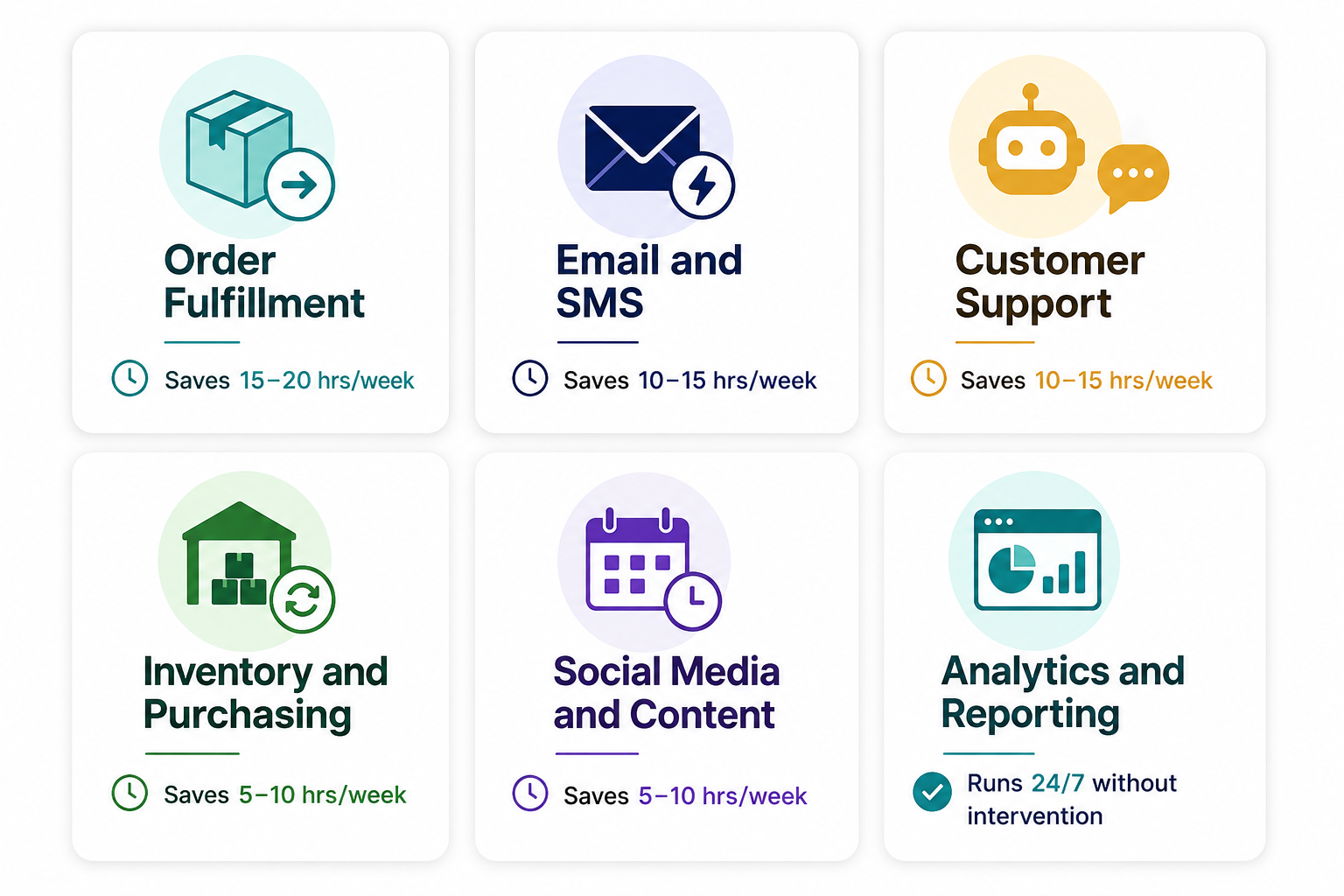
What automation cannot replace is judgment. Which new products to source, how to respond to a complex customer complaint, when to adjust your pricing strategy, what creative direction to take with your next campaign — these decisions require human context, experience, and strategic thinking that no rule-based system can replicate. The goal is not to eliminate human involvement but to eliminate the human involvement that does not require actual human judgment.
Shopify's own automation infrastructure has expanded dramatically in 2026. Shopify Flow — a no-code workflow builder included on every current Shopify plan — handles hundreds of automation scenarios natively without requiring developer involvement. Shopify Magic handles content generation. Shopify Sidekick answers data questions and builds automations from plain language descriptions. And the ecosystem of third-party apps covering email, fulfillment, support, and analytics has matured to the point where a well-configured automation stack genuinely does run the majority of your store's operational tasks without manual intervention.
Automation Layer 1: Order Fulfillment
Fulfillment is the most time-consuming operational task for physical product Shopify stores — and it is also one of the most automatable. The degree to which you can remove yourself from the fulfillment process depends on your business model.
For dropshipping stores, fulfillment automation is near-total. When a customer places an order, apps including AutoDS, Zendrop, and DSers automatically forward the order to your supplier, process the payment, retrieve the tracking number, and update the customer with shipping notifications — all without manual intervention. The merchant's operational involvement in fulfillment becomes zero once the system is configured correctly.
For stores using third-party logistics partners — where your inventory is held and shipped by a warehouse partner — fulfillment automation operates through your 3PL's API integration with Shopify. When an order is placed, Shopify automatically pushes the order to your 3PL's system, which picks, packs, and ships it, then pushes tracking information back to Shopify, which automatically emails the customer their tracking details. Your involvement in the fulfillment of a specific order is zero.
For merchants who self-fulfil, tools including ShipStation, Pirateship, and Shippo automate the rate shopping, label printing, and carrier booking process. What previously required visiting each carrier's website and manually comparing rates becomes a single-click label generation workflow.
Shopify Flow handles the order management automation that sits around fulfillment: automatically tagging high-risk orders for manual review before fulfillment, sending internal Slack or email alerts when orders above a certain value are placed, automatically sending a personalized note to repeat customers with their tenth or more order, and pausing fulfillment on orders flagged as potentially fraudulent by Shopify's risk assessment engine.
Automation Layer 2: Email and SMS Marketing
Email and SMS are the highest-ROI owned marketing channels in ecommerce — and the majority of their revenue potential is unlocked through automated flows rather than manual campaigns.
Klaviyo, properly configured, delivers 25 to 35% of total store revenue through automated flows that run continuously without manual involvement. The welcome series fires when someone joins your list. The abandoned cart sequence fires when someone leaves without buying. The post-purchase flow fires when someone buys. The win-back sequence fires when someone goes 90 days without purchasing. The VIP flow fires when someone crosses your lifetime value threshold. None of these require you to write an email, schedule a send, or monitor a campaign. They run in the background, every hour of every day, reaching each customer at the exact moment their behavioral signal indicates they are most likely to engage.
The setup investment is real — building a complete seven-flow Klaviyo stack takes meaningful time and requires careful copy, segmentation logic, and conditional branching to perform at its best. But it is a one-time investment with permanent ongoing returns. A welcome series built in January continues generating revenue in December without a single additional hour of effort.
Klaviyo's AI capabilities in 2026 extend this further. Predictive send-time optimization automatically schedules each email to arrive at the moment each individual subscriber is most likely to open — meaning you do not need to think about send timing for individual contacts. Predictive analytics surfaces which customers are at risk of churning before they disengage, allowing your win-back flow to trigger at the optimal moment rather than a generic time window.
For SMS automation, Klaviyo handles SMS flows alongside email in the same platform. SMSBump and TxtCart are strong dedicated SMS alternatives for merchants who want more granular SMS-specific features. Both integrate natively with Shopify and support the same behavioral trigger logic that makes email flows effective.
Automation Layer 3: Customer Support
Customer support is the automation layer most merchants approach last — and the one that recovers the most founder time when implemented correctly.
The automation principle in support is tiered resolution: AI handles Tier 1 inquiries automatically, human agents handle Tier 2 and above. Tier 1 encompasses the rule-based, data-driven questions that have definitive answers: where is my order, what is your return policy, how do I change my shipping address, when will this item be back in stock. These questions represent 50 to 80% of total support ticket volume in most Shopify stores.
Gorgias AI Agent handles Tier 1 ticket resolution autonomously — pulling order data from Shopify, generating accurate responses based on your policies, and closing tickets without agent involvement. Tidio's Lyro AI performs the same function at a lower price point suitable for stores in earlier stages of growth. Both integrate natively with Shopify and can be configured to match your brand voice in automated responses.
The result of implementing AI Tier 1 support is that your human support team spends time exclusively on the interactions that require genuine human judgment: complex complaints, pre-purchase consultations that require product knowledge, situations where empathy and discretion are required, and the high-value interactions where human involvement generates revenue through recommendation and upsell.
Shopify Flow handles the support-adjacent automations that sit around the ticket system: automatically flagging orders with specific characteristics for proactive support outreach, tagging customers who have contacted support multiple times about the same issue for escalation, and triggering a post-resolution follow-up email automatically after a ticket is closed.
Automation Layer 4: Inventory and Purchasing
Inventory management automation prevents stockouts and overstock by monitoring levels continuously and triggering action before problems occur.
Shopify Flow's native inventory automation covers the essential low-stock alert workflow: when inventory for any tracked SKU falls below a defined threshold, Flow triggers an alert to the relevant team member and optionally creates a draft purchase order in your inventory management app. This workflow alone prevents the most common cause of stockouts — a merchant who did not notice a product running low because they were focused elsewhere.
For stores with significant SKU depth or complexity, dedicated inventory forecasting apps add demand prediction to the monitoring function. Prediko and Inventory Planner analyze your sales velocity, seasonality, and supplier lead times to generate reorder recommendations with specific quantities — removing the judgment call from the reorder decision and replacing it with data-driven recommendations that improve as the apps accumulate more store-specific history.
The purchasing side of inventory automation integrates with supplier communication. AutoDS monitors supplier pricing and stock availability continuously for dropshipping stores — automatically updating your Shopify prices when supplier costs change to protect margin, and pausing or removing products when a supplier runs out of stock.
Automation Layer 5: Social Media and Content
Social media content is one of the most time-consuming ongoing tasks for Shopify merchants — and one of the most automatable without sacrificing meaningful quality.
Scheduling tools including Buffer, Later, and Planoly allow you to batch-create social content in a single session and schedule it for publication across the following two to four weeks. A two-hour content creation and scheduling session on Monday morning can handle your entire social media calendar for the next month — eliminating the daily decision of what to post and the distraction of switching between store management and content creation throughout the week.
Shopify Magic generates product descriptions, email copy, and social media captions directly in your admin. For merchants who need to create content for multiple new products simultaneously, the copy generation capability compresses hours of writing into minutes of review and editing.
User-generated content and customer review programs — run through apps including Okendo, Yotpo, and Judge.me — create an ongoing stream of authentic content that supplements your own creation without additional effort. Automated post-purchase review request flows collect photo and video reviews that can be repurposed as social content, product page social proof, and email marketing assets — all generated by your customers rather than your team.
Automation Layer 6: Analytics and Reporting
The final automation layer that most merchants overlook is reporting — building a dashboard that gives you the business intelligence you need without requiring manual data compilation.
TrueProfit integrates with Shopify and your ad platforms to generate real-time profit reports that account for COGS, shipping costs, transaction fees, refunds, and ad spend — presenting your actual profitability rather than the gross revenue figure that Shopify's native reports display. This eliminates the end-of-month calculation that most merchants dread and provides a continuous, accurate picture of where the business actually stands financially.
Triple Whale performs similar profit tracking with stronger attribution capabilities for stores running significant Meta and Google ad spend — automatically attributing revenue across channels and surfacing the Marketing Efficiency Ratio data that allows budget allocation decisions to be made from real revenue data rather than platform-reported attribution.
Shopify Sidekick answers data questions in plain language without requiring you to navigate multiple reports. "Which products had the highest return rate last month?" "What was my average order value from Instagram compared to Google?" "Which customer segment generated the most repeat purchases in the last 90 days?" These questions, which previously required navigating multiple reports and potentially exporting to a spreadsheet, are now answered in seconds through a natural language query.
Setting up automated weekly and monthly report emails from your analytics tools means the performance data you need to make strategic decisions arrives in your inbox without you needing to pull it.
The Automation Stack by Business Stage
The right automation stack varies significantly by business stage. Building enterprise-level automation infrastructure before a store has the revenue to justify it adds cost and complexity without proportional benefit.
For stores under $5,000 per month in revenue, the essential automation stack is Shopify Flow for operational workflows and low-stock alerts, Klaviyo on the free plan for welcome and abandoned cart flows, a free or low-cost support chat tool like Tidio for AI-assisted Tier 1 support, and a dropshipping fulfillment app or 3PL integration to remove manual fulfillment. Total monthly cost at this stage should be under $50 and saves 15 to 20 hours per week compared to fully manual operation.
For stores between $5,000 and $30,000 per month, expand to Klaviyo's paid plan with the full seven-flow email stack, Gorgias for professional support with AI automation, ShipStation or a 3PL integration for fulfillment, a scheduling tool for social content, and a basic profit tracking app. Total monthly cost at this stage runs $200 to $400 and frees 25 to 35 hours per week compared to manual operation.
For stores above $30,000 per month, add dedicated inventory forecasting through Prediko or Inventory Planner, Triple Whale or TrueProfit for profit analytics and attribution, Rebuy for AI-powered product recommendations and post-purchase upsell, and evaluate whether dedicated marketing automation tools beyond Klaviyo are justified by the incremental return.
What Still Requires Human Attention
Honest automation guidance acknowledges what cannot be automated — because building a realistic picture of time investment prevents the disappointment of expecting zero involvement and discovering that some things genuinely still need you.
Product strategy requires human judgment. Which products to add, discontinue, or invest more heavily in based on market signals, supplier conversations, and customer feedback is a decision that data can inform but cannot make for you. Expect to spend two to four hours per month reviewing product performance and making catalog decisions.
Supplier relationships require human management. Negotiating pricing, resolving quality issues, building the relationships that give you preferential access to new products or better terms — these are conversations that automation cannot have.
Creative direction requires human taste. The strategic decisions about what your brand looks like, how it sounds, and what story it tells are judgment calls that Shopify Magic can assist but cannot make. Reviewing and editing AI-generated content to align it with your brand voice remains a human responsibility.
Customer escalations require human empathy. The complex complaints, the emotionally charged return situations, the customers who are genuinely upset and need to feel heard — these are the interactions where AI deflection is the wrong answer and human presence is the only one that works. Allocating two to four hours per week for high-quality human support on escalated tickets is not an automation failure. It is good business practice.
The 90-Day Automation Build Plan
Building the full automation stack in one day is not realistic — and attempting it creates overwhelming complexity. A staged 90-day approach delivers automation benefits progressively while allowing each layer to be configured correctly before the next is added.
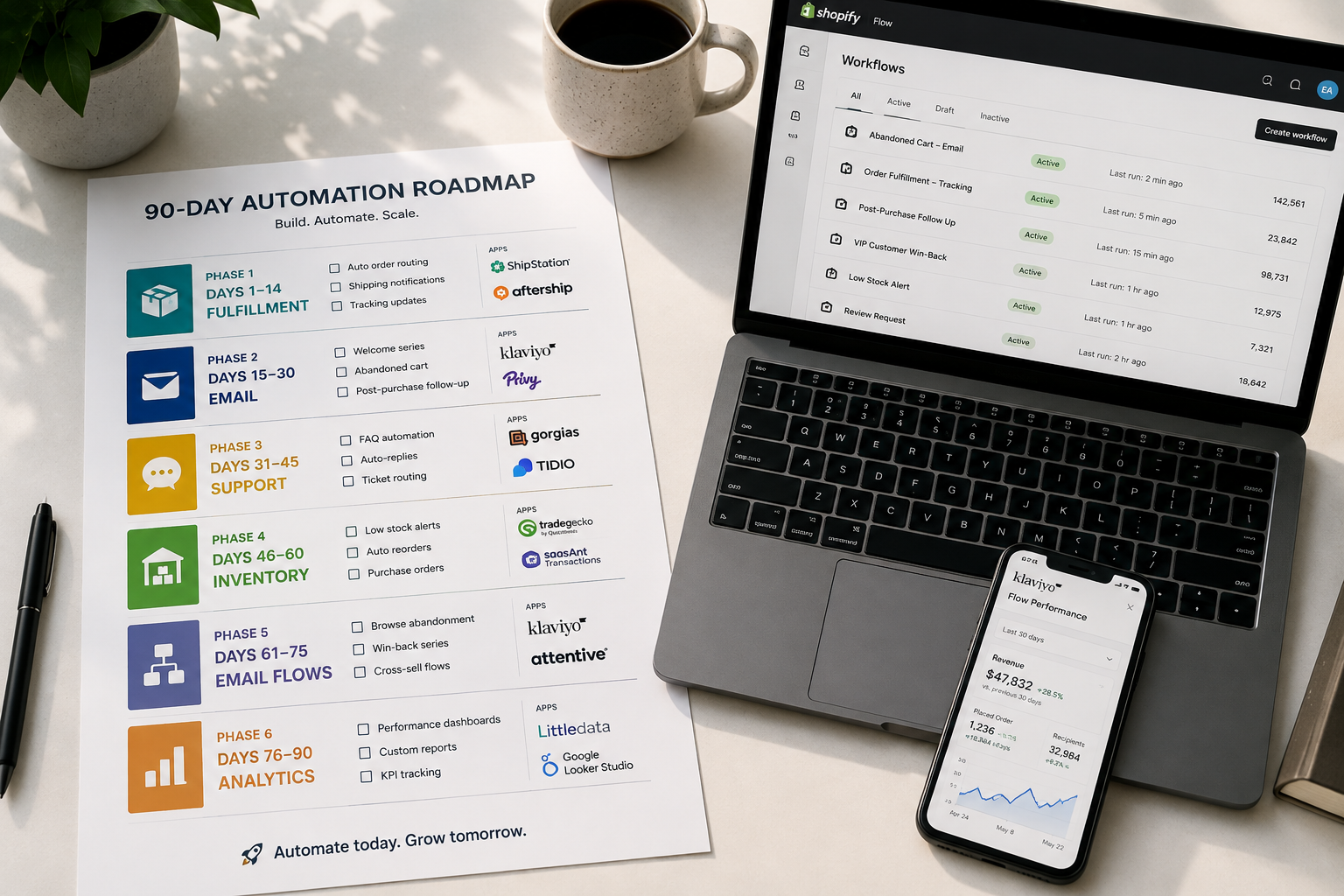
Days 1 to 14: fulfillment automation first. Connect your 3PL or dropshipping app, configure Shopify Flow for order tagging and high-risk order flagging, and test the full order-to-delivery automation by placing test orders through each channel.
Days 15 to 30: email automation. Build your Klaviyo welcome series and abandoned cart flow — the two highest-ROI flows that generate immediate revenue impact. These two flows alone justify the entire Klaviyo subscription cost for the majority of Shopify stores.
Days 31 to 45: customer support automation. Install Gorgias or Tidio, configure AI responses for your top 10 most common inquiry types, build your FAQ knowledge base, and set up routing rules that escalate complex tickets to human agents.
Days 46 to 60: inventory automation. Configure Shopify Flow low-stock alerts, set up safety stock thresholds per SKU, and evaluate whether a dedicated forecasting app is justified at your current SKU depth.
Days 61 to 75: remaining email flows. Build post-purchase, win-back, VIP, and review request flows to complete your seven-flow email stack.
Days 76 to 90: analytics and content scheduling. Set up TrueProfit or Triple Whale, configure automated weekly reporting emails, establish your social content scheduling rhythm, and build the reporting dashboard that gives you a complete business picture without manual data compilation.
By day 90, the majority of your store's repetitive operational tasks are automated. You are reviewing dashboards, making strategic decisions, managing suppliers, and handling customer escalations — not manually fulfilling orders, writing individual emails, or answering repetitive support questions.
Final Thoughts
The Shopify store that sells while you sleep is not a fantasy. It is a systems engineering problem — and the solution is available to any merchant willing to invest the upfront time in building the automation infrastructure that removes them from the daily operational loop.
The front-loading is real. Building the systems described in this guide takes weeks, not hours. But the compounding return on that investment — in time recovered, in revenue generated automatically, and in the operational resilience of a store that does not collapse when you take a vacation — makes it the highest-return investment available to a growing Shopify merchant.
Start with fulfillment. Add email. Automate support. Build the inventory systems. Schedule the content. Configure the reporting. Each layer you complete is a permanent reduction in the operational overhead that stands between you and the business you are trying to build.
The store that runs without you is built one automation at a time.
Need help building automation workflows for your Shopify store, or want an expert to audit your current setup and identify which manual tasks are costing you the most time? Get in touch with EcomFixify — we specialize in Shopify development and operational automation for brands ready to scale without burning out.