
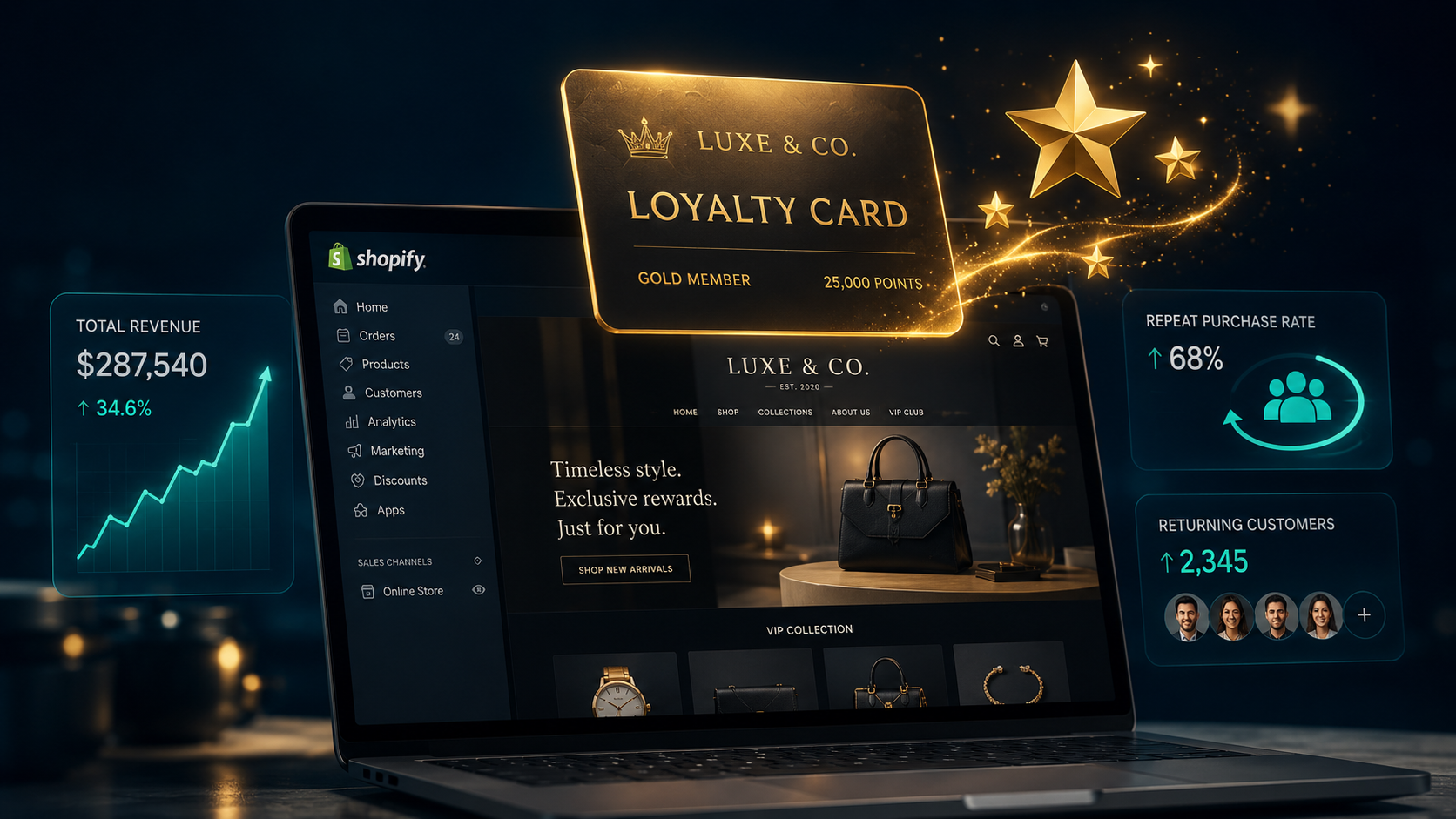
How to Build a Shopify Loyalty Program That Actually Works in 2026
How to Build a Shopify Loyalty Program That Actually Works
Running paid ads to keep acquiring new customers is getting more expensive every single year. Meta costs are up. Google costs are up. TikTok costs are climbing. And yet most Shopify store owners keep pouring budget into acquisition while ignoring the most profitable customer they already have — the one who's bought from them before.
The math is simple and brutal. Acquiring a new customer costs 5–25x more than retaining an existing one. You have a 60–70% chance of selling to a current customer, compared to just 5–20% for a brand-new prospect. And the top 5% of your customers generate 35% of your total revenue.
A well-built loyalty program is how you tap into that math — systematically, at scale, without spending an extra dollar on ads.
But most Shopify loyalty programs don't actually work. They're set up once, forgotten about, and silently ignored by customers who see no real reason to engage. This guide covers what separates programs that drive measurable retention from ones that just look good on the setup page.
Why Loyalty Programs Matter More Than Ever in 2026
True customer loyalty dropped from 34% in 2024 to 29% in 2025. Shoppers have more choices, more distractions, and shorter attention spans than ever before. Getting someone to buy once is hard enough — getting them to come back takes intentional effort.
But the rewards for doing it right are significant. Loyalty program members generate 12–18% more incremental revenue per year than non-members. Customers who actively redeem loyalty rewards generate 115% higher revenue per customer and maintain a 50% repeat purchase rate, compared to just 10.7% for non-redeemers.
The program-level numbers are just as compelling. 83% of brands with loyalty programs report a positive return on investment, with many citing more than five times the revenue from running them compared to costs. Loyalty programs deliver an average 4.8x ROI, with members spending 12–18% more per transaction than non-members.
Top-performing loyalty programs lift annual revenue from enrolled customers by 15–25%. And a 5% increase in customer retention can boost profits by 25–95%.
Those aren't theoretical outcomes. They're documented results from brands that built their programs with intention rather than as an afterthought.
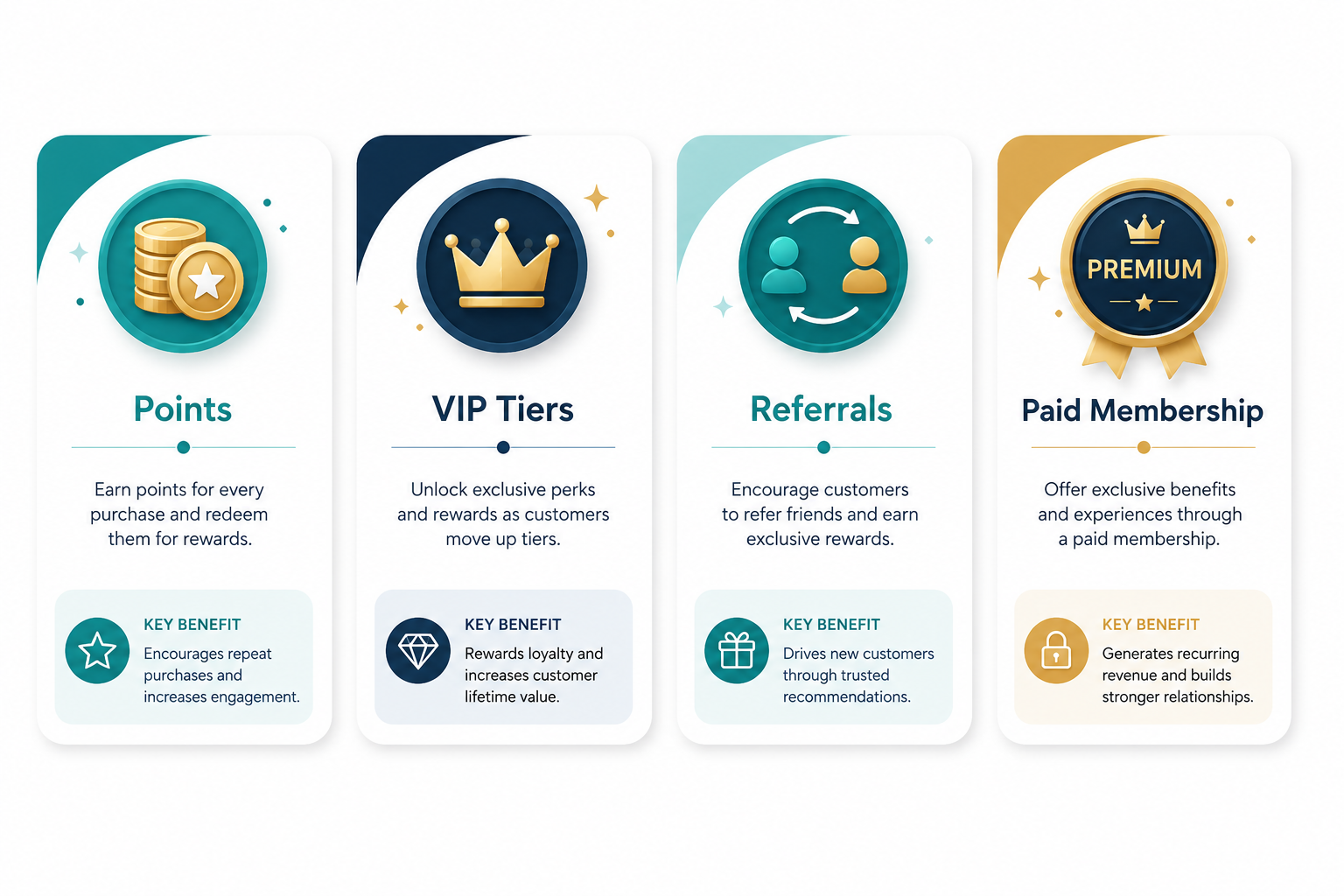
The 4 Types of Shopify Loyalty Programs (And When to Use Each)
Not every loyalty model fits every store. Choosing the wrong structure is one of the primary reasons programs fail to generate engagement.
Points-Based Programs
The most common model. Customers earn points for purchases and specific actions, then redeem them for discounts, free products, or free shipping. Simple to understand, easy to launch, and effective for stores with repeat-purchase products.
The key is making the first reward achievable quickly. A customer who earns 500 points and needs 5,000 to redeem anything will disengage almost immediately. A good rule of thumb: each point should be worth $0.01, and customers should reach their first reward within 2–3 purchases.
Best for: Stores with regular purchase frequency — skincare, supplements, apparel, consumables.
Tiered (VIP) Programs
Customers progress through tiers — Silver, Gold, Platinum — based on cumulative spend or points earned. Each tier unlocks better perks: higher point multipliers, early access to sales, free shipping, exclusive products.
Tiered programs deliver 1.8x higher ROI than flat, non-tiered structures because they create aspirational spending behavior. A customer who's one purchase away from Gold tier will often spend more just to get there. Brands using VIP tiers frequently see 2–4x higher lifetime value from top-tier members.
Best for: Mid-to-high AOV stores where customers have a reason to accumulate and progress over time.
Referral Programs
Rewards customers for bringing new buyers — typically with a double-sided incentive where both the referrer and the referee receive a discount or credit. Referral programs are the most cost-effective customer acquisition strategy available in 2026, particularly as paid ad costs continue rising.
Referred customers make 2x more purchases than average customers, providing acquisition advantages that compound over customer lifetime while reducing dependency on paid channels.
Best for: Stores with strong word-of-mouth products and an existing base of satisfied customers to activate.
Paid Membership Programs
Customers pay a monthly or annual fee in exchange for premium perks — free shipping on every order, exclusive pricing, early access to drops. Borrowed from Amazon Prime's playbook and increasingly common in DTC ecommerce.
This model generates predictable recurring revenue and signals extremely high intent from customers who join. Not suitable for all stores, but exceptionally effective for brands with a strong enough value proposition to justify the subscription.
Best for: High-frequency purchase stores with strong brand affinity and clear ongoing value to offer.
What a Loyalty Program That Actually Works Looks Like
Most underperforming loyalty programs make the same mistakes. Here's what the ones that work do differently.
They Make Earning Easy and Rewarding Fast
A loyalty program nobody engages with is worse than no program at all — it creates the impression that the effort isn't worth it. High-performing programs reward customers for actions beyond just purchases:
- Creating an account
- Writing a product review
- Following on social media
- Referring a friend
- Celebrating a birthday
- Reaching a spend milestone
This keeps customers engaged between purchases and builds habitual interaction with the brand. Members who engage through non-purchase actions are significantly more likely to return for their next order.
They Use VIP Tiers Strategically
Generic "earn 10 points per dollar" programs are the floor, not the ceiling. In 2026, leading programs layer VIP tiers on top of a base points structure to create progression and aspiration.
The tier structure should feel achievable at the bottom and aspirational at the top. If every customer hits Gold within a month, the tier loses its meaning. If nobody ever reaches Platinum, the program loses its motivational pull. Map your tier thresholds to the natural spending behavior of your actual customer segments, not arbitrary numbers.
They Integrate Directly With Checkout
Apps that support Shopify Checkout Extensions allow loyalty programs to appear directly in the checkout flow — showing points earned, enabling reward redemption, and displaying VIP status at the highest-intent moment in the customer journey.
This matters enormously for redemption rates. A loyalty program where customers have to navigate to a separate page to use their rewards will see dramatically lower engagement than one where points can be applied in a single click at checkout.
They Communicate Regularly
A loyalty program that customers forget about is a loyalty program that doesn't work. Consistent communication about point balances, expiring rewards, and tier progress is what keeps the program top-of-mind and drives return visits.
The most effective loyalty communication formats in 2026 are personalized email flows triggered by behavioral milestones — "You're 200 points away from your next reward," "Your Gold status expires in 30 days," "It's your birthday — here's a bonus 100 points." These aren't mass emails; they're triggered by the customer's specific program status, which is why they drive action.
They Layer In Personalization
AI-driven personalization in loyalty programs produces a 200% improvement in customer retention rates compared to generic program structures. This means suggesting rewards based on individual purchase history, sending tier upgrade prompts at moments of high engagement, and calibrating offers to each customer's price sensitivity and preferences.
56% of customers will repurchase from a company if they receive personalized loyalty discounts and rewards. Simply personalizing the reward type — percentage discounts for price-sensitive customers, VIP events and early access for premium buyers — meaningfully lifts redemption rates.
The Best Shopify Loyalty Apps in 2026
Shopify doesn't have a built-in loyalty engine. Every merchant runs their program through a third-party app. These are the ones worth considering:
Smile.io — The most widely used loyalty app on Shopify. Excellent balance of points, referrals, and VIP tiers. Works with almost every other app in the Shopify ecosystem. Best for stores that want a proven, easy-to-launch foundation without heavy configuration.
Rivo — Built exclusively for Shopify and Shopify Plus merchants. Full API access, native Liquid metafields, and developer-friendly architecture for custom integrations. HexClad generated $450,000 in referral revenue in the first 90 days using Rivo, achieving 92x ROI with 17% higher AOV from referred customers. Best for scaling brands that need deep customization.
BON Loyalty — Standout choice for international merchants. Supports 250+ languages and offers a generous free tier (up to 250 orders per month). 4.9 out of 5 rating across 1,400+ reviews. Best for stores selling across multiple countries.
LoyaltyLion — Data-driven platform with strong analytics capabilities. Deep integrations with Klaviyo allow loyalty data to feed directly into email segmentation and personalization flows. Best for stores that want their loyalty data to power their broader marketing stack.
Rise.ai — Specializes in store credit rather than points. Store credit programs tend to generate higher redemption rates than points because the value feels more concrete and immediate. Best for high-AOV stores where store credit is a meaningful incentive.
How to Set Up Your Shopify Loyalty Program: Step-by-Step
Step 1: Define your goals before you build. Do you want to increase average order value, improve repeat purchase rate, reduce churn, or drive referrals? Your goal determines your program structure. Establish specific targets — for example, increase repeat purchase rate by 15% in six months — so you have something concrete to measure against.
Step 2: Choose your program model. Most effective programs combine two or three mechanics. A typical starting setup: points-for-purchases as the base, with VIP tiers layered on top and a referral component added once the core program is running.
Step 3: Set your earn rules. Map earning actions to the behaviors you want to drive. If you want more reviews, reward them generously. If referrals are the priority, make the referral incentive compelling for both sides. Start simple — one clear earn rate for purchases — then add complexity over time as you see what drives engagement.
Step 4: Design your rewards. Match rewards to your customer segments. Price-sensitive customers respond to percentage discounts. Premium buyers value exclusive access, free shipping, and early product drops. Don't offer the same reward to everyone.
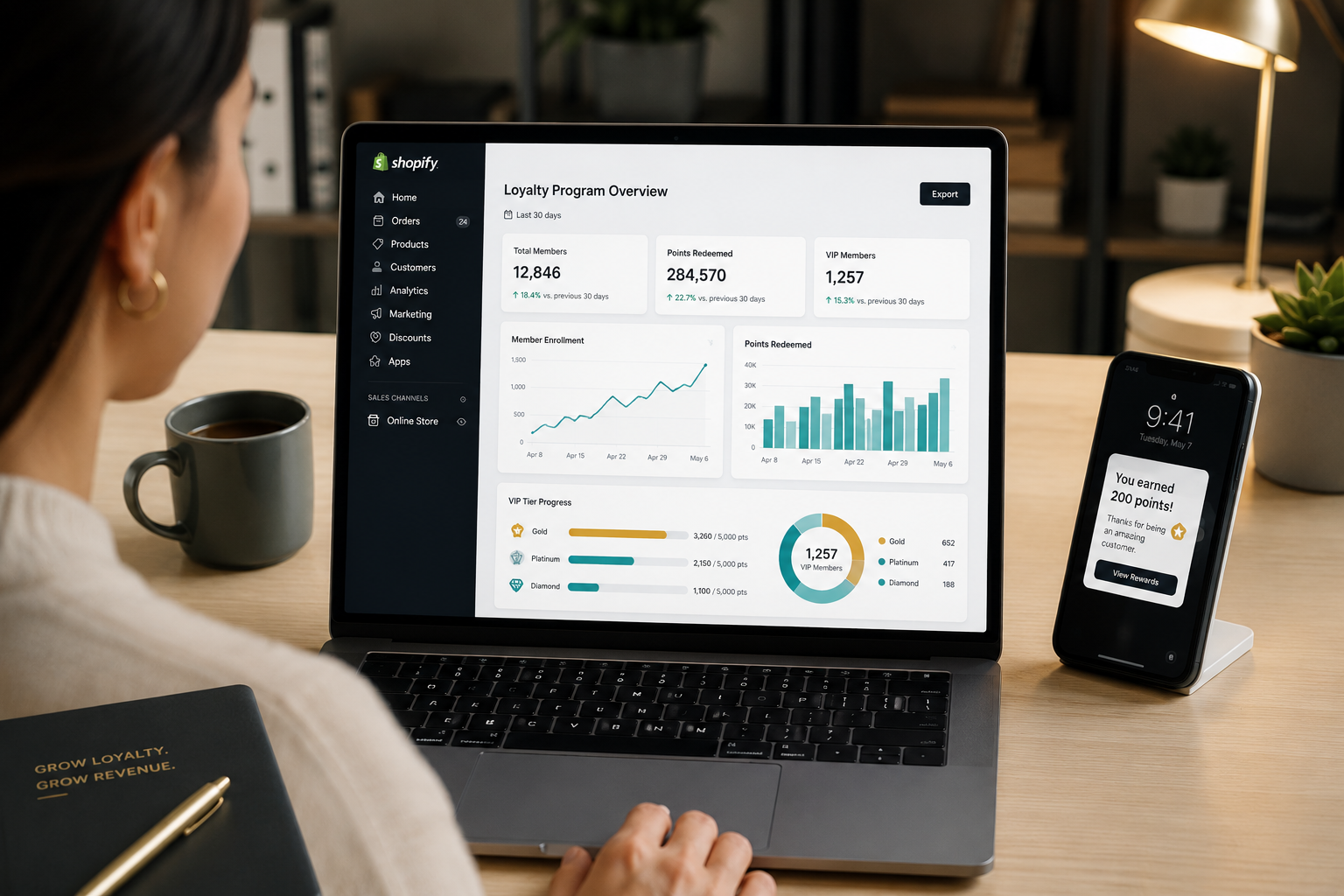
Step 5: Install your chosen app and configure checkout integration. Ensure your app supports Shopify Checkout Extensions so customers can redeem rewards directly at checkout. Set up the widget to match your brand colors and typography — a loyalty widget that looks like an afterthought undermines trust.
Step 6: Launch with a member-only incentive. Announce your program via email and social media. Offer bonus points for joining in the first week to drive initial enrollment. The launch push determines your starting membership base, which affects how quickly you gather enough data to optimize.
Step 7: Connect to Klaviyo for automated communication. Set up triggered email flows for key milestones: welcome to the program, points balance update, tier upgrade, approaching next reward, expiring points. These automations run in the background and consistently bring customers back.
The Metrics That Tell You If It's Working
Once your program is live, these are the numbers to track:
Enrollment rate — What percentage of customers join the program? Under 20% means your signup incentive isn't compelling enough or you're not promoting the program effectively.
Active member rate — Of enrolled members, how many earn or redeem points in a given month? Only 49% of loyalty members actively use the programs they're enrolled in across the industry. Your goal is to beat that benchmark substantially.
Redemption rate — Members who redeem rewards have 50% higher repeat purchase rates than those who don't. Low redemption means rewards aren't desirable enough or the process to redeem them is too complicated.
Member vs. non-member AOV and LTV — The clearest measure of program impact. If members aren't spending more than non-members over time, the program isn't generating incremental revenue.
Referral conversion rate — How many referred visitors actually convert into customers?
Review these monthly for the first six months. The most common intervention needed early on is either simplifying the path to the first reward or improving awareness through loyalty-specific email flows.
Final Thoughts
A Shopify loyalty program that works isn't complicated — but it does require deliberate design. The stores that see 15–25% revenue lifts from their programs aren't running anything exotic. They have clear earn rules, achievable rewards, VIP tiers that motivate progression, checkout-native redemption, and consistent communication keeping the program visible.
The stores whose programs quietly fail treated loyalty as a feature to install rather than a system to maintain.
With customer acquisition costs continuing to rise and consumer loyalty becoming harder to earn, the brands that invest in retention today are building a structural advantage that compounds over every quarter that follows. Your most valuable customer is already in your store. A loyalty program is how you make sure they keep coming back.
Need help choosing the right loyalty app for your Shopify store or setting up the email flows that drive program engagement? Get in touch with EcomFixify — we help Shopify merchants build retention systems that generate measurable revenue.