
How to Build a Shopify Brand That Customers Actually Remember in 2026
There are over 5.8 million Shopify stores operating globally in 2026. How The overwhelming majority of them sell similar products at similar prices through similar-looking storefronts. They compete on discounts, chase the same trending products, and wonder why customer loyalty is impossible to build and paid acquisition costs keep rising.
The stores that break out of that cycle share one thing. They are not just selling products — they are building brands.
A brand is not a logo or a color palette. It is the complete set of associations, feelings, and expectations a customer carries in their mind when they think of your store. It is the reason someone chooses your moisturizer over the equally reviewed one sitting two positions above you in search results. It is the reason a customer tags you in their Instagram story rather than simply using the product and moving on. It is the reason your email open rates are 40% when the industry average is 20%.
Brand is the compounding asset that makes every other investment in your store work harder over time. Strong brands spend less to acquire customers because word of mouth substitutes for paid acquisition. Strong brands retain customers longer because identity and values create switching costs that price can never create. Strong brands weather competition better because price is not their primary reason for existing.
This guide covers exactly how to build one in 2026 — from the strategic foundation that most guides skip to the specific touchpoints where brand is won or lost in the customer experience.
Why Most Shopify Stores Fail at Branding
Most Shopify merchants approach branding as an aesthetic exercise. They choose a color palette, commission a logo, pick a font, and consider the branding done. Then they wonder why their store feels generic, why customers do not remember them, and why their repeat purchase rate never climbs.
The problem is sequencing. Visual identity is the last step of brand building, not the first. Building a logo before you know exactly who you are building it for, what you stand for, and how you are genuinely different from alternatives is like designing packaging before knowing what is inside the box.
The brands customers actually remember in 2026 — Allbirds, SKIMS, Athletic Greens, Glossier, Liquid Death — built their visual identity on top of a strategic foundation that was already clear. The logo communicated something specific because the something specific already existed. The color palette expressed a personality that had already been defined. The tone of voice had a point of view because the brand had a point of view first.
This guide follows the same sequence. Strategy before execution. Foundation before surface. Meaning before aesthetics.
Step 1: Define Your Brand Foundation Before Touching Design
The brand foundation is the strategic layer that everything else sits on. It answers four questions that most Shopify merchants have never written down explicitly:
Who exactly are you building this for? Not a demographic — a psychographic. Not "women aged 25 to 40" but "women who have spent years trying products that promise natural ingredients and deliver synthetic fillers, who are done being marketed to and want a brand that shows its work." The more specifically you can describe the person who needs what only you can offer, the more powerfully your brand will speak to them — and the more irrelevant it will be to everyone else, which is exactly the point.
What do you specifically stand for? Every durable brand is built on a belief that goes beyond the product category. Patagonia believes wilderness should exist unchanged for future generations. Liquid Death believes sustainability should not be self-serious and boring. Allbirds believes environmental responsibility should not require compromising on design or performance. Your brand's core belief is the north star that makes every content, design, and business decision obvious or obviously wrong.
What is the transformation you deliver? Customers do not buy products — they buy better versions of themselves. They buy the person they will become after using your product. A skincare brand is not selling moisturizer — it is selling confidence in bare skin. A fitness supplement brand is not selling protein powder — it is selling the version of the customer who shows up consistently and sees results. Define the transformation your customer experiences and make it the center of your brand narrative.
How are you genuinely different? Not just different in marketing language but different in something specific and verifiable. Different in ingredients, process, sourcing, packaging, service model, community, or founder expertise. The difference does not need to be radical — it needs to be real, articulatable, and relevant to the specific customer you are building for.
Write the answers to these four questions down. Every subsequent branding decision flows from them.
Step 2: Build Your Brand Story and Own It
In 2026, the brands winning at customer memory are almost universally built around a story that is specific, honest, and human rather than corporate, polished, and generic.
A brand story is not a mission statement. A mission statement says "we are committed to delivering high-quality sustainable skincare." A brand story says "I spent three years with eczema trying everything the dermatologist recommended while reading the ingredient labels and not understanding half of what was in them. I started making my own formulas in my kitchen in 2021 and eventually something worked. That is why every formula we make has an ingredient list I can read to my mother and explain every line."
The first is forgettable. The second is shareable. The difference is specificity and humanity — the presence of a real person with a real problem and a real reason for building what they built.
Shopify's own research published in 2026 shows that 35% of store owners named building a social media presence as a core Year 1 growth strategy — and the most successful social media strategies were founder-led, with real people showing real behind-the-scenes content rather than brand accounts posting product photography.
Mike Alfaro of Millennial Loteria built the brand entirely on his personal story and community identity — showing his life, his creative process, and his cultural perspective on social media. The brand now generates loyal customers who feel a personal connection not just to the products but to the person and the mission behind them.
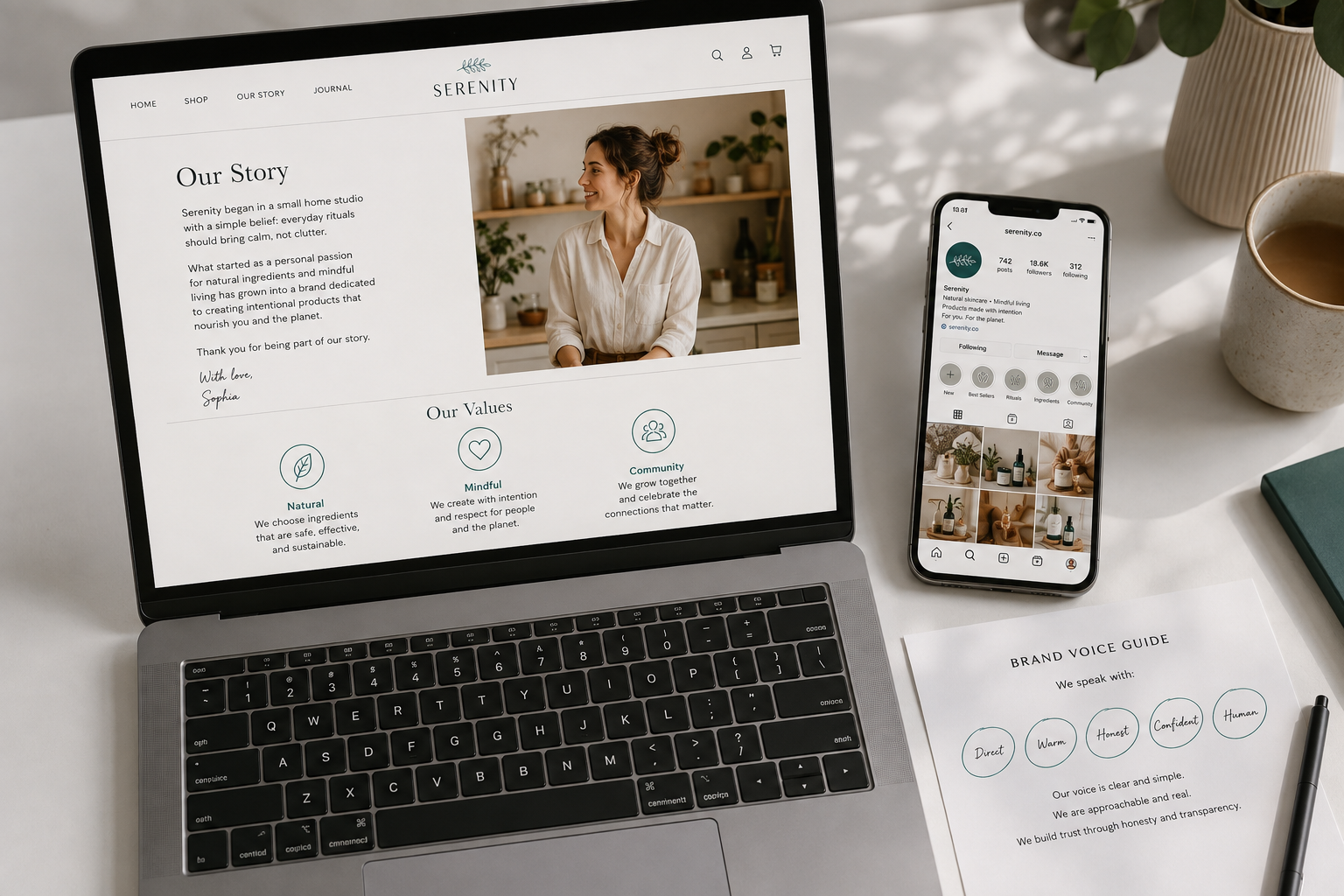
Your brand story lives on your About page, in your email welcome series, in your packaging inserts, in your founder's social media presence, and in the way your customer support team responds to every inquiry. It is not a piece of content — it is the narrative thread running through every customer touchpoint.
Step 3: Develop a Visual Identity That Communicates Something Specific
Once your strategic foundation is clear, visual identity becomes significantly easier to build because you are not designing in a vacuum. You are translating a specific personality, belief, and audience into visual language.
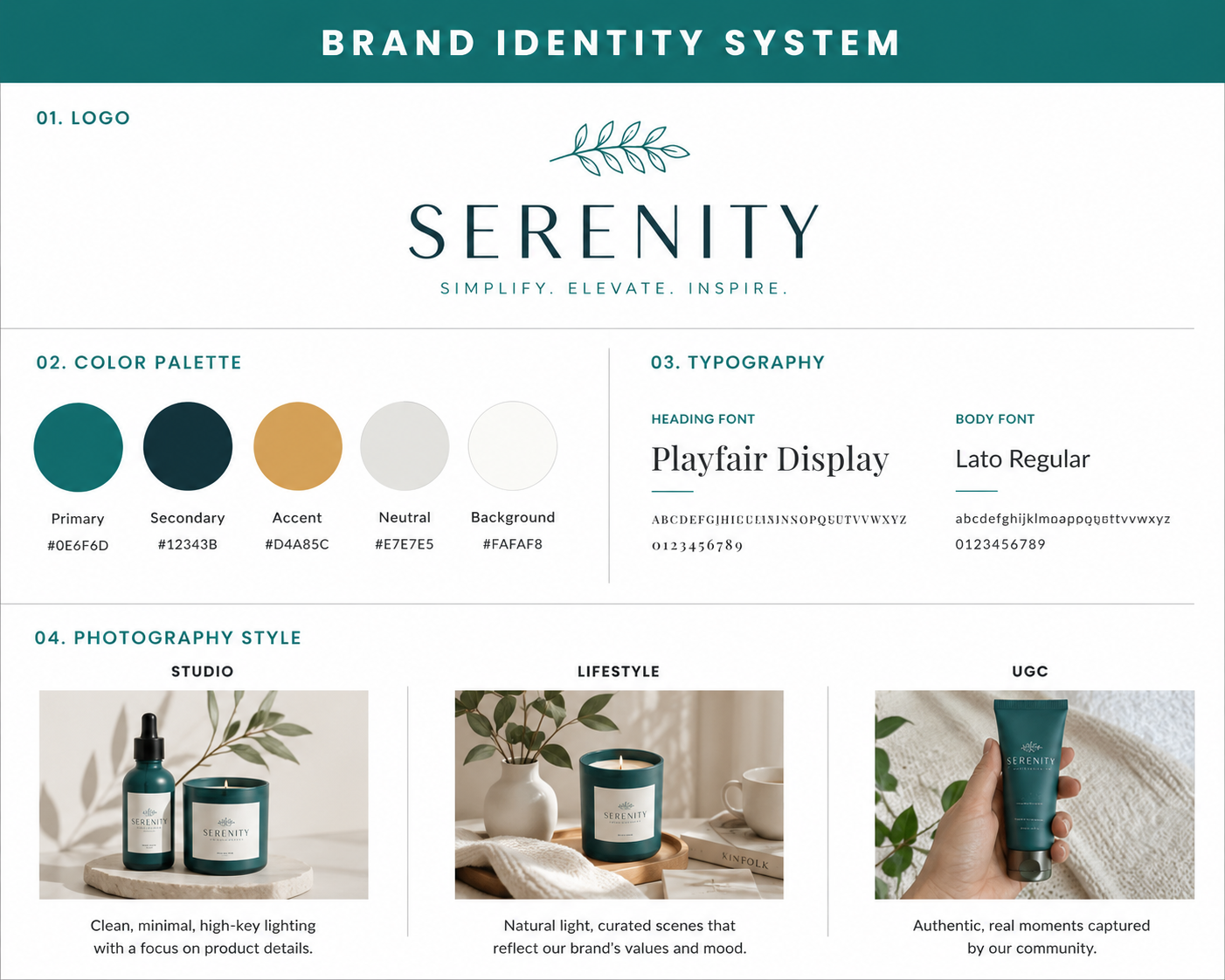
The four components of a brand visual identity — logo, color palette, typography, and photography style — should work as a system where each element reinforces the same personality.
Your logo should be the simplest possible expression of your brand's character. Complex logos with multiple elements, gradients, and detailed illustrations look weak at small sizes, do not reproduce cleanly on packaging, and date quickly. The most memorable brand logos in ecommerce — Allbirds' bird silhouette, SKIMS' wordmark, Glossier's circled G — are distinctive through simplicity, not through complexity.
Your color palette communicates personality before a single word is read. Dark navy and gold signals premium and established. Bright primary colors signal playful and accessible. Muted earth tones signal natural and considered. Stark black and white signals editorial and sophisticated. Your palette should have one primary color, one secondary color, and one accent — and it should feel immediately coherent with the personality you defined in your brand foundation.
Typography choices communicate equally. A serif typeface signals heritage, craft, and authority. A geometric sans-serif signals modern, clean, and direct. A hand-drawn or script typeface signals personal, artisanal, and warm. Choose a primary typeface that matches your brand personality and a secondary typeface that complements it for body copy — and use them consistently everywhere.
Photography style is where many Shopify brands fail at visual consistency. Your website might use clean white-background product photography while your Instagram uses heavily filtered lifestyle shots while your TikTok shows raw, unedited footage. Each format communicates a different brand personality, and the cumulative impression is incoherence.
Define your photography style in writing: the lighting (natural or studio), the settings (clean and minimal, lifestyle and contextual, or street and candid), the editing approach (warm and saturated, cool and desaturated, or bright and airy), and the model representation (who appears in your imagery and how they are shown). Apply this standard consistently across every platform and every format.
Step 4: Develop a Brand Voice That Sounds Like a Real Person
Your brand voice is how your brand speaks — the personality that comes through in every email subject line, product description, social caption, customer service message, and packaging insert.
Most Shopify brand voices fail at one of two extremes. Either they sound corporate and interchangeable — formal, safe, and forgettable — or they try so hard to sound casual and relatable that every message reads like a forced attempt to be the fun brand, which is equally off-putting.
The brand voices that resonate in 2026 sound like a specific real person rather than a marketing committee. They have a distinct point of view. They use language that their specific customer uses. They make occasional jokes that are actually funny rather than jokes that were approved by twelve people. They are not afraid to have an opinion.
Define your brand voice with three to five adjectives and one or two that it is not. For example: "Our brand voice is direct, warm, and quietly confident — it is never corporate, never self-deprecating, and never tries to be cool." Then write ten example sentences in that voice and ten example sentences that violate it. Share this document with everyone who writes anything for your brand.
Apply your voice consistently across the highest-impact text touchpoints: your homepage headline and subheadline, your email welcome sequence, your product descriptions, your social media captions, your order confirmation email, and your packaging insert. A customer who receives a warm, witty order confirmation email from you after buying from a formal, generic product page experiences a brand inconsistency that subtly erodes trust. Consistency across every text touchpoint is what makes the voice feel real rather than performed.
Step 5: Make Packaging Part of the Brand Experience
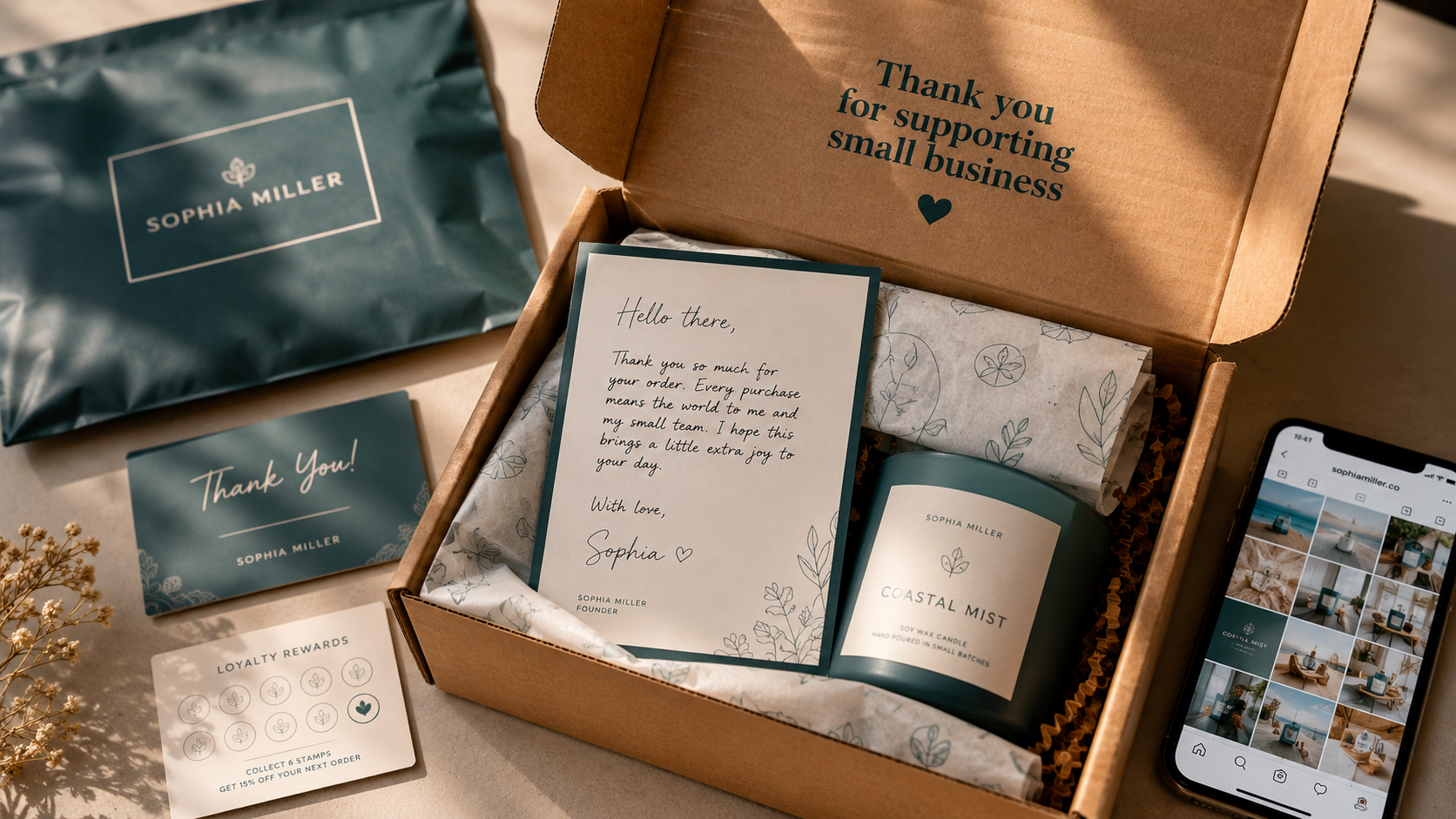
For Shopify brands selling physical products, packaging is the most powerful offline brand touchpoint available. It is the only moment when your brand appears physically in the customer's home — and the experience of opening your package communicates as much about your brand as any digital touchpoint.
The brands whose packaging customers photograph and share — Glossier's pink bubble wrap pouches, Allbirds' recycled box with the cheerful illustrated interior, Graza's olive oil squeeze bottle with the friendly green branding — have understood that the unboxing experience is not a logistics function. It is a marketing function that generates organic word-of-mouth at the exact moment of peak customer satisfaction.
The specific packaging elements that generate the most brand impact are the exterior packaging — mailer or box design that is distinctive enough to be recognizable on a doorstep, the interior presentation — tissue paper, crinkle fill, or a deliberate arrangement that shows care, the branded insert card — a personal note that reinforces your brand story and gives the customer a next action, and the product packaging itself — labels, bottles, bags, or boxes that feel premium relative to the price point.
Each of these elements has a cost implication that scales with your volume. The most cost-effective starting point for most Shopify brands is a custom-printed branded insert card — printable for a few cents per order at scale — and a branded exterior mailer that makes your package recognizable. These two changes deliver the majority of unboxing brand impact at a fraction of the cost of fully custom packaging.
Step 6: Build Community Around the Brand Identity
The most durable Shopify brands in 2026 are not just companies — they are communities. They have audiences of customers who identify with the brand's values and world view, who connect with each other around shared interests that the brand facilitates, and who advocate for the brand to their networks because doing so says something about who they are.
Liquid Death built a community of people who think environmental responsibility should be loud, irreverent, and fun rather than self-serious and guilt-inducing. Gymshark built a community of people who take fitness seriously but want to be celebrated for consistency rather than aesthetic perfection. Glossier built a community of people who believe beauty should be personal and low-pressure rather than aspirational and exclusionary.
None of these communities were accidents. They were built deliberately by brands that had a clear point of view and were willing to take sides — to stand for something specific enough to attract true believers and repel people who do not share the values.
For Shopify brands building community in 2026, the most effective formats are Instagram broadcast channels for direct founder-to-customer communication, Discord servers for highly engaged customer subcultures, user-generated content programs that turn customers into contributors rather than passive recipients, and loyalty programs structured around shared values and identity rather than purely transactional points.
Edelman's 2025 research cited by Shopify shows that consumers want brands to give them optimism, help them do good, and make them feel good. Community is the delivery mechanism for all three — and the brands building communities are building the retention engine that makes paid acquisition investment far more efficient.
Step 7: Be Consistent Across Every Touchpoint for Longer Than Feels Necessary
Consistency is the most underestimated variable in brand building. It is also the one that separates brands customers remember from brands they forget.
A brand that is consistent across its website, emails, packaging, social media, and customer service for twelve consecutive months creates a cumulative impression that is dramatically stronger than a brand that redesigns its website every six months, changes its tone of voice quarterly, and uses different visual styles across different platforms.
Customers build brand recognition through repeated exposure to consistent signals. The color that always appears on your packaging, the tone that is always present in your emails, the photography style that is always consistent on your Instagram — these repetitions are what move a brand from something a customer has encountered to something they recognize, trust, and seek out.
The brands that customers genuinely remember in 2026 are almost universally brands that have maintained a consistent identity across years, not months. Allbirds has looked and sounded like Allbirds since 2016. Glossier has maintained its pink-and-white editorial aesthetic since 2014. Gymshark has stayed in its lane of community-focused, authenticity-over-perfection fitness content since 2017.
Build your brand foundation carefully, execute it consistently across every touchpoint, and resist the temptation to refresh, rebrand, or pivot every time a new aesthetic trend appears on your For You page. The brands that customers remember are the ones that have been themselves, clearly and consistently, for long enough that the identity has accumulated into something recognizable.
Brand Building for AI Discovery: The 2026-Specific Consideration
There is a dimension of brand building in 2026 that did not exist even two years ago and that most brand guides are not yet covering: AI discovery.
Shoppers are increasingly asking AI assistants — ChatGPT, Perplexity, Google AI Mode — to recommend products and brands. These AI systems draw their recommendations from the content available about a brand across the internet — blog posts, reviews, social media mentions, press coverage, and the structured data on your Shopify store.
Brands with strong content footprints — detailed About pages, published sustainability reports, active blog content, press coverage, and consistent social media presence — are more likely to be surfaced by AI recommendation systems than brands with thin or inconsistent online presences.
This makes every piece of brand content — your About page, your brand story, your values documentation — a functional AI discoverability asset. Write your About page for the AI assistant that will read it and summarize it for a customer who just asked "what is the best natural skincare brand for sensitive skin" — because in 2026, that is exactly what is happening millions of times per day.
The Brand Audit: Where Your Brand Currently Stands
Use these questions to assess your current brand against the 2026 standard:
Can you describe your ideal customer in specific psychographic terms rather than demographic ones? Can a new team member read your brand foundation document and immediately understand what your brand stands for? Do your logo, color palette, typography, and photography style communicate the same personality consistently? Does your brand voice sound like a specific real person across emails, social media, and customer service? Does your packaging create a moment worth photographing? Do your customers tag you on social media and share their purchases organically? Can you identify a community of customers who identify with your brand's values rather than just using your products? Have you maintained visual and verbal consistency for at least six consecutive months?
Every "no" on this list is a specific gap between where your brand is and where it needs to be to generate the loyalty, advocacy, and recall that strong brands produce.
Final Thoughts
Building a Shopify brand that customers actually remember is not a creative project — it is a strategic one. The brands that stay in customers' minds are the ones that know exactly who they are, speak consistently from that identity across every touchpoint, and maintain that consistency for long enough that it accumulates into recognition.
The good news is that the brands most consumers remember today are not the ones with the biggest budgets. They are the ones with the clearest point of view, the most consistent execution, and the willingness to stand for something specific rather than trying to appeal to everyone.
In a market with 5.8 million Shopify stores, generic is the most competitive position you can occupy. Specific is where the opportunity lives.
Build the foundation. Express it consistently. Repeat it longer than feels necessary. That is how brands get remembered.
Need help developing your Shopify brand identity, designing a store that expresses your brand accurately, or building the content strategy that puts your brand in front of the right audience? Get in touch with EcomFixify — we specialize in Shopify development and ecommerce growth strategy for brands building for the long term.