
How to Build a Shopify Affiliate Program That Drives Consistent Sales
Affiliate marketing drives 16% of all ecommerce sales in North America — yet most Shopify store owners have never launched a program. The setup feels complicated. Commission structures feel like guesswork. Recruiting affiliates feels like a full-time job on top of everything else already demanding attention. Shopify Affiliate Program That Drives Consistent Sales
The result is one of the most significant missed revenue opportunities in independent ecommerce. A well-structured Shopify affiliate program is essentially a performance-based sales force that costs you nothing until it generates revenue. Affiliates promote your products to their audiences, drive traffic and sales to your store, and receive a commission only when a purchase actually completes. You pay for results — not for reach, not for impressions, not for clicks that never convert.
The brands that build affiliate programs correctly treat them as a systematic revenue channel rather than a passive experiment. They choose the right commission model, recruit the right partners, equip those partners with what they need to succeed, and optimize the program over time based on performance data. The result is a channel that generates compounding revenue as the affiliate network grows — without proportionally increasing the marketing spend required to sustain it.
This guide covers every element of building a Shopify affiliate program that drives consistent sales — from deciding whether the model fits your margins through setup, recruitment, management, and optimization.
Is Your Shopify Store Ready for an Affiliate Program?
The first question is not which app to use or what commission rate to offer. It is whether an affiliate program makes financial sense for your specific store right now.
The single most important prerequisite is margin. Affiliate programs work by sharing a percentage of your revenue with the partner who drove the sale. If your gross margin is 35% and you offer a 20% affiliate commission, you are left with 15% of revenue to cover all other costs — shipping, payment processing, returns, customer acquisition overhead, and profit. That is an extremely thin number and leaves no room for error.
The practical margin threshold for a sustainable Shopify affiliate program is 40% gross margin or above. Below that level, every affiliate sale risks being margin-negative once all variable costs are accounted for. Above 40%, there is room to offer a competitive commission, cover all costs, and still generate meaningful contribution margin on every affiliate-driven sale.
Beyond margin, the products that perform best in affiliate programs share specific characteristics. They solve a clear, articulable problem that an affiliate can explain in content — a product with a compelling story generates more affiliate engagement than a commodity item with no narrative. They have a price point high enough that a percentage commission represents a meaningful earning for the affiliate — a 15% commission on a $200 product generates $30 per sale, which motivates sustained promotion in ways that $30 products at the same commission rate cannot. And they have a repeat purchase angle — subscription products, consumables, or complementary product lines — that allows affiliates to earn recurring commissions rather than one-time payouts, which dramatically improves long-term affiliate retention.
If your store meets the margin threshold and your products have the characteristics above, an affiliate program is worth building. If your margins are thin, focus on improving them before launching a program that generates sales at near-zero profitability.
Choosing Your Commission Structure
Commission structure is the most consequential decision in affiliate program design. It determines what affiliates earn, what behavior it incentivizes, and whether the program economics work for your store over time.
The four main commission models available to Shopify merchants in 2026 each suit different business situations:
Flat CPA (Cost Per Acquisition) pays affiliates a fixed dollar amount for each sale they generate — for example, $15 for every order they refer regardless of order value. This model is predictable, easy for affiliates to understand, and works well for stores with relatively consistent order values. It protects your margins when average order value is high because you pay the same commission regardless of order size.
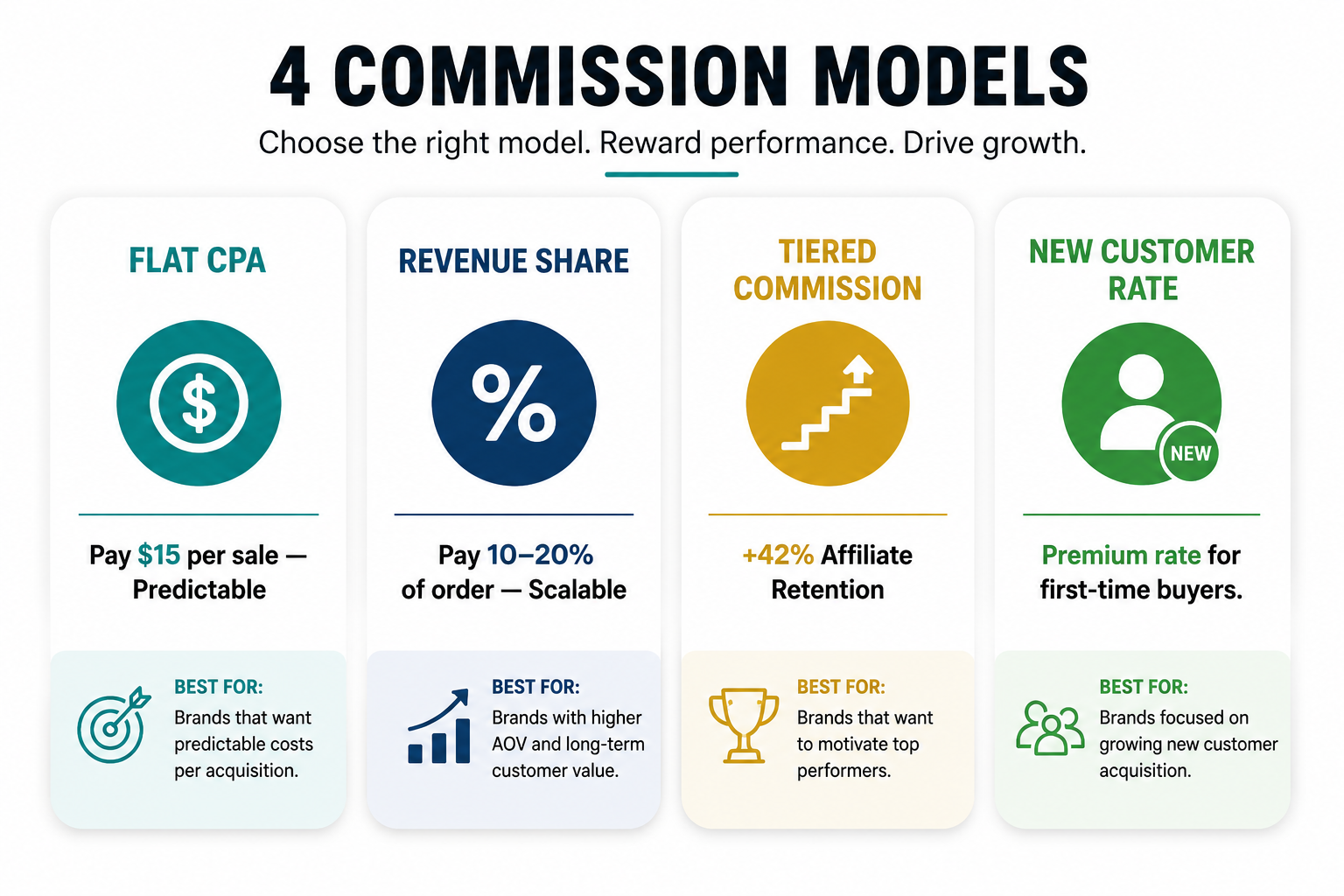
Revenue Share pays affiliates a percentage of the order value they generate — typically 10 to 20% for physical products and 20 to 40% for digital products. This model naturally aligns affiliate incentives with your revenue — affiliates who drive larger orders earn more, which encourages them to promote higher-value products and bundles. Revenue share is the most common model in ecommerce affiliate programs and the most familiar structure for experienced affiliates.
Tiered Commission structures pay different rates based on performance thresholds — for example, 10% for the first 10 sales per month, 15% for 11 to 30 sales, and 20% for 31 or more. Stores using tiered commission structures see 42% higher affiliate retention after six months compared to flat-rate programs because the escalating rate creates a clear motivation for affiliates to keep promoting rather than treating your program as a one-off content placement. Tiered structures reward your most productive affiliates with the highest rates, which keeps top performers engaged rather than migrating to competing programs with better earning potential.
New Customer Commission pays a premium rate specifically for affiliates who drive first-time buyers — customers who have never purchased from your store before. This model aligns affiliate incentives with new customer acquisition, which is typically the highest strategic priority for Shopify stores building their customer base. Affiliates who bring genuine new customers earn more; affiliates who generate return-customer sales earn a lower rate. This structure prevents affiliates from gaming the program by promoting exclusively to your existing email list.
Industry commission benchmarks by category in 2026: fashion and accessories typically offer 8 to 15%; beauty and skincare offer 10 to 20%; health and supplements offer 15 to 25%; digital products and courses offer 20 to 40%; home décor and furniture offer 5 to 12%; electronics offer 3 to 8% due to large absolute dollar amounts per sale.
The Best Shopify Affiliate Apps in 2026
Shopify does not have native affiliate program functionality beyond its basic referral features — every merchant runs their program through a third-party app. The right choice depends on your budget, program complexity, and growth ambitions.
Shopify Collabs is Shopify's own free creator partnership tool, available to all merchants. It connects Shopify stores with creators across Instagram, TikTok, YouTube, and Twitch who can apply to promote your products in exchange for commissions or gifted product. Because it is built directly into Shopify, setup is minimal and tracking is accurate without configuration overhead. The limitation is functionality — Shopify Collabs is suitable for influencer gifting and basic commission tracking but lacks the advanced tiered commission, multi-level structures, and detailed analytics that growing programs need.
UpPromote is the most widely used affiliate marketing app on Shopify in 2026, with comprehensive features covering multi-level commission structures, affiliate portal customization, automated email sequences for affiliates, performance analytics, and integration with Klaviyo for synchronized affiliate and email marketing data. Its free plan covers basic affiliate tracking for up to 200 affiliates, with paid plans from $29 per month adding advanced features including multi-level marketing support and priority commission rules. UpPromote suits stores at every stage from launch through significant scale.
Refersion is the enterprise-leaning option, particularly well suited for brands running influencer marketing at scale alongside traditional affiliate partnerships. Its reporting depth, attribution controls, and affiliate performance visibility appeal to stores managing large volumes of referral sales and multiple affiliate relationship types simultaneously. Refersion's pricing starts at $99 per month — higher than alternatives — but its tracking accuracy and analytics sophistication justify the cost for stores with meaningful affiliate revenue that need reliable attribution data to make program investment decisions.
GoAffPro offers a generous free tier covering unlimited affiliates with basic commission tracking, making it the most accessible entry point for stores testing an affiliate program for the first time without committing to a monthly fee. Its paid Pro plan at $24 per month adds multi-level commission structures and advanced customization. GoAffPro is the right choice for budget-conscious stores that want to validate the affiliate channel before investing in a more capable platform.
Impact is the platform for Shopify stores that want access to an established network of professional publishers alongside their direct affiliate relationships. Impact's marketplace includes hundreds of thousands of active affiliates across categories, which provides immediate recruitment reach that direct-only programs take months to build. The enterprise pricing and custom setup make it suitable only for stores with significant existing revenue and a dedicated marketing team to manage publisher relationships.
Step-by-Step: How to Launch Your Shopify Affiliate Program
Step 1: Define Your Program Economics Before Building Anything
Run the numbers before choosing an app or writing a single recruitment email. Calculate your gross margin per product, subtract the commission rate you plan to offer, subtract payment processing fees (typically 2.5 to 3%), and subtract the per-transaction platform fee your affiliate app charges. What remains is your contribution margin per affiliate sale. If that number is positive and meaningful, the program economics work. If it is near zero or negative, adjust your commission rate or address your margin before launching.
Step 2: Choose and Install Your Affiliate App
Install your chosen app from the Shopify App Store and connect it to your Shopify store. Most apps handle the technical integration automatically — creating unique tracking links for each affiliate, firing conversion events when sales are attributed to affiliate referrals, and updating commission balances in real time. Test the tracking before recruiting affiliates by creating a test affiliate account, clicking your own affiliate link, and completing a test purchase to confirm the attribution is working correctly.
Step 3: Set Up Your Affiliate Portal and Program Materials
Your affiliate portal is the dashboard where affiliates track their performance, access their unique links, view their commission balance, and download creative assets. The quality of this portal directly affects how seriously affiliates engage with your program — a professional, informative portal signals that you are a serious partner worth promoting.
Stock your portal with every resource affiliates need to promote your products effectively: product images in multiple formats, lifestyle photography, product descriptions they can adapt for their content, any discount codes exclusive to their audience, and your brand guidelines. The more complete your resource library, the more consistent and effective affiliate content will be across your partner network.
Write a clear affiliate program agreement that covers commission rates, attribution window — typically 30 to 90 days — payment schedule and minimum payout threshold, prohibited promotion methods, and commission reversal policy for returns and cancelled orders. A clear agreement prevents disputes and protects your program from affiliates who use paid search to bid on your brand keywords or employ other prohibited tactics.
Step 4: Set Your Attribution Window
The attribution window defines how long after an affiliate's referral click you will credit them with a resulting sale. A 30-day window credits the affiliate if the referred visitor purchases within 30 days of clicking their link. A 90-day window extends that credit period to three months.
Longer attribution windows incentivize affiliates to drive genuine discovery-stage traffic — bringing new audiences to your brand who need time to consider and research before buying. Shorter windows work better for products with short purchase cycles and high purchase intent traffic. The standard for physical product Shopify stores in 2026 is 30 to 60 days, which balances affiliate incentive with realistic purchase cycle lengths.
Step 5: Recruit Your First Affiliates
The most common mistake in affiliate recruitment is trying to recruit everyone simultaneously rather than starting with a small number of high-quality partners who can generate initial performance data. The first ten to twenty affiliates you recruit should be treated as a pilot program — the data they generate on conversion rates, average order values, and traffic quality informs how you scale recruitment.
The four recruitment channels that consistently produce the highest-quality Shopify affiliates in 2026:
Your existing customer base is your highest-quality affiliate pool because these people have already experienced your products and can speak about them authentically. An email to your customer list announcing your affiliate program with a simple sign-up link consistently generates the first cohort of affiliates at zero recruitment cost. Customers who love your products and already talk about them informally are natural affiliates who simply need a formal structure and a commission incentive.
Micro-influencers with audiences of 5,000 to 50,000 followers in your product category deliver higher engagement rates and more authentic promotion than macro-influencers — and they are significantly more accessible for outreach from a brand they have not heard of. Identify relevant micro-influencers on Instagram, TikTok, and YouTube by searching hashtags related to your product category and filtering for accounts with consistent engagement. A direct message that acknowledges their content specifically — not a generic template — and clearly outlines the commission structure generates response rates that mass outreach cannot match.
Content creators who publish category-relevant blog posts and YouTube videos are the most valuable affiliate partners for long-term consistent traffic because their content has evergreen search visibility. A product review embedded in a YouTube video or a "best of" blog post drives affiliate traffic for months or years after publication — unlike social media content that disappears from feeds within 48 hours. Identify these creators by searching your product category keywords in YouTube and Google, and reach out to ones whose existing content demonstrates genuine relevance to your audience.
Affiliate networks including ShareASale and Impact provide access to established affiliate publishers who are actively seeking new programs to join. The setup cost and ongoing network fees are higher than direct recruitment, but the immediate access to thousands of active affiliates who already understand affiliate marketing mechanics accelerates early program growth in ways that direct-only recruitment cannot match.
Managing Your Affiliate Program for Consistent Performance
The brands that generate consistent affiliate revenue are not the ones who launched a program and forgot about it. They are the ones who treat affiliate management as an ongoing marketing relationship.
Monthly communication keeps affiliates engaged and informed. A monthly affiliate newsletter — sent through your affiliate platform or through Klaviyo — covering new product launches, upcoming promotions, top-performing content formats, and updated creative assets keeps your program top-of-mind for affiliates who are simultaneously managing relationships with multiple programs. The affiliates who receive consistent communication from a brand prioritize promoting it over programs they never hear from.
Tiered recognition and rewards for top performers go beyond commission rates. Affiliates who consistently generate high volumes of sales are candidates for exclusive commission tiers, early access to new products for review content, dedicated account management attention, and public recognition in your affiliate newsletter. These gestures cost little but significantly reduce churn among the 15 to 25% of affiliates who typically generate 80% of a program's revenue.
Commission payment reliability is the most important trust factor in affiliate retention. Late payments, payment threshold barriers that prevent affiliates from accessing earned commissions, and opaque payout calculations destroy affiliate confidence and drive migration to competing programs. The shift toward instant commission releases — made available by platforms like Affiliate Aura — reduces affiliate churn by approximately 35% compared to traditional net-30 payment terms because affiliates can see and access their earnings in real time rather than waiting weeks for verification and processing.
Performance data review on a monthly basis identifies which affiliates are generating real sales, which are generating traffic without conversion, and which have gone dormant. Affiliates generating traffic without conversion often need better creative assets or landing page guidance — they are sending interested visitors to a page that is failing to convert. Dormant affiliates are candidates for a re-engagement email campaign or removal from the program to keep your active affiliate metrics meaningful.
Fraud Prevention: Protecting Your Program From the Start
Affiliate fraud — affiliates generating fake or self-referred sales to claim commissions — is a real and growing problem in ecommerce affiliate programs, particularly as programs scale and attract affiliates with less ethical practices.
The most common affiliate fraud patterns are self-referral — affiliates using their own links to purchase products and claim commissions on their own orders — cookie stuffing, where fraudulent affiliates inject affiliate cookies into user browsers without genuine referral behavior, and brand keyword bidding, where affiliates run paid search ads on your brand name to intercept high-intent traffic that would have converted organically.
Prevention mechanisms to configure before your first affiliate generates a sale: exclude existing customers from commission attribution by requiring affiliate-referred purchasers to be new-to-file email addresses. Set a minimum time between affiliate link click and purchase — typically one to two minutes — to prevent instant self-referral. Review high-commission affiliates whose traffic shows anomalous patterns — high click volume with near-100% conversion rates, purchases from the same IP addresses as the affiliate's account, or suspiciously round order values. Most affiliate apps include fraud detection flags that surface these patterns automatically.
Commission reversal for returned orders is a policy decision to make explicit in your program agreement before launching. If a customer returns a product, the commission on that sale should be reversed. Configure your affiliate app to automatically deduct reversed commissions from the affiliate's balance when returns are processed in Shopify, and communicate this policy clearly during affiliate onboarding so it does not feel punitive when it occurs.
The Metrics That Tell You Whether Your Program Is Working
Tracking the right metrics prevents the common mistake of evaluating affiliate program performance on vanity metrics — total affiliate count, total clicks — rather than the revenue and profitability metrics that reflect actual program health.
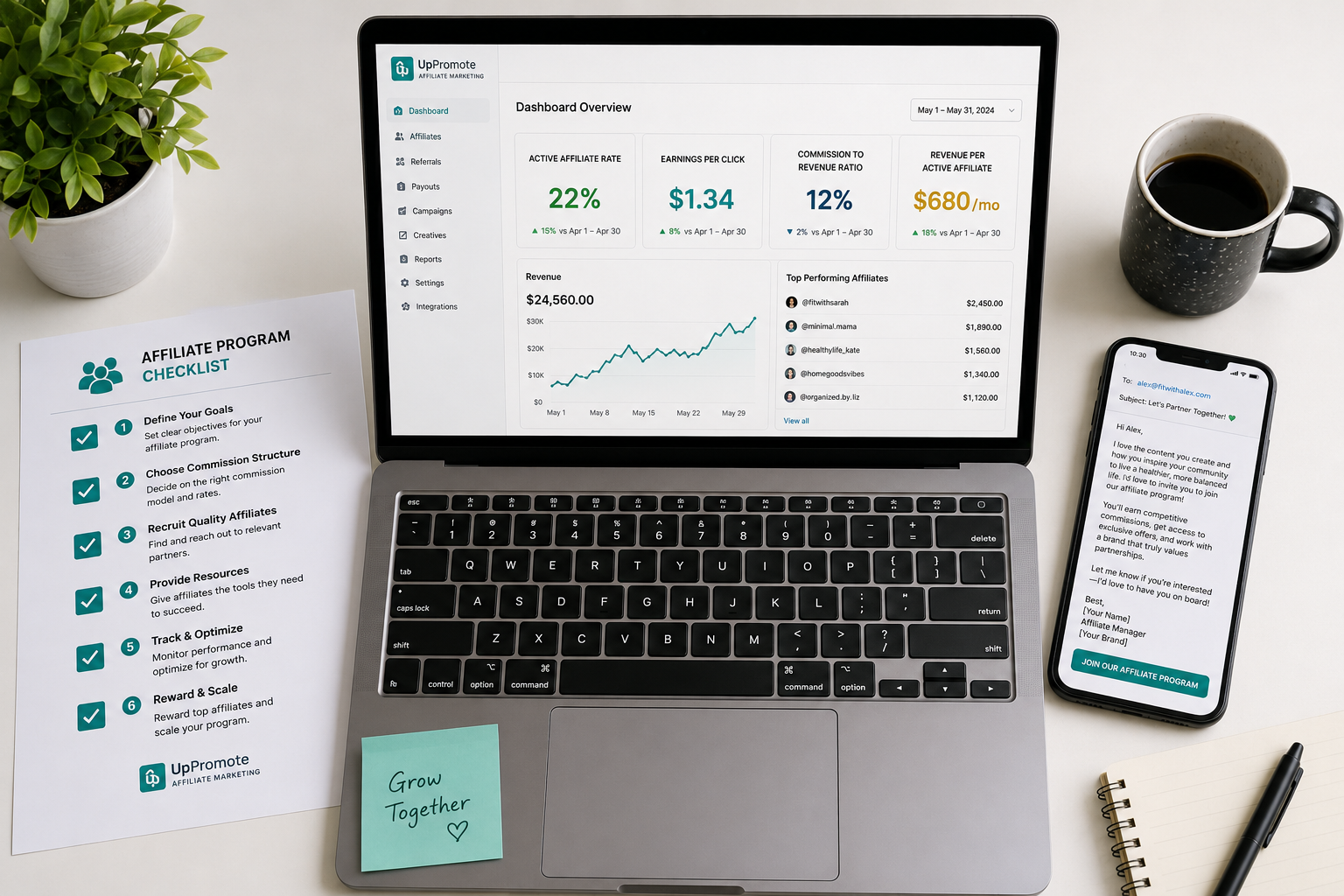
Active affiliate rate measures the percentage of enrolled affiliates who have generated at least one sale in the past 30 days. The benchmark for a healthy program is 15 to 25% active rate. Below 15% indicates a recruitment quality problem — you have enrolled many affiliates who are not genuinely motivated or positioned to promote your products. Above 25% indicates exceptional program engagement that is worth studying and replicating.
Earnings per click measures the revenue generated per click sent by affiliates — total affiliate revenue divided by total affiliate clicks. The benchmark range is $0.50 to $2.00. EPC below $0.50 indicates that affiliate traffic is not converting well on your product pages — a landing page or offer problem rather than an affiliate quality problem. EPC above $2.00 indicates high-quality affiliate traffic and strong product-page conversion that justifies aggressive affiliate recruitment investment.
Commission-to-revenue ratio tracks total affiliate commissions paid as a percentage of total affiliate-driven revenue. A ratio between 8 and 15% is typical for physical product Shopify stores — meaning for every $100 in affiliate-driven revenue, $8 to $15 goes to commission. Above 15% indicates your commissions are too high relative to your margins. Below 8% may indicate commissions are too low to attract and retain quality affiliates in competitive categories.
Revenue per active affiliate — total affiliate revenue divided by number of active affiliates in the period — reveals the average commercial output of your affiliate relationships and is the most useful metric for setting realistic recruitment targets. If your average active affiliate generates $400 per month and your revenue target from affiliates is $20,000 per month, you need approximately 50 consistently active affiliates — which means recruiting two to three times that number knowing that 15 to 25% will be active at any given time.
Scaling Your Affiliate Program Beyond the First Cohort
Once your first cohort of affiliates has generated enough data to confirm the program economics — typically 60 to 90 days of operation — scaling the program follows a systematic process rather than an intuitive one.
Double down on what is working before adding new affiliate types. If micro-influencers in a specific content format — unboxing videos, tutorial content, comparison posts — are generating your highest EPC affiliates, recruit more creators in the same format before diversifying. The content formats and affiliate profiles that perform best for your specific products in your specific category are not universal truths — they are insights specific to your store that data reveals over time.
Introduce program tiers based on performance data from your initial cohort. A standard tier for new affiliates with your baseline commission rate and a VIP tier for affiliates who have generated above a defined volume threshold — with higher commission rates, exclusive creative assets, and direct brand contact — creates a clear progression path that motivates sustained performance from your most productive partners.
Consider adding a referral layer for existing customers alongside your affiliate layer for content creators. A customer referral program — where existing buyers share a unique link with friends and earn store credit when their referrals make a first purchase — is structurally similar to an affiliate program but recruits from your highest-trust audience at zero recruitment cost. Most affiliate apps support both affiliate and referral program management in the same platform, making the addition operationally simple once your affiliate infrastructure is in place.
Final Thoughts
An affiliate program is not a marketing experiment. It is a sales infrastructure investment that compounds in value as your affiliate network grows and your top performers develop genuine expertise in promoting your products to their audiences.
The merchants generating consistent affiliate revenue are not the ones who installed an app and hoped affiliates would show up. They recruited deliberately, equipped affiliates thoroughly, paid reliably, and communicated consistently. They treated their affiliate partners the way they want their own suppliers and partners to treat them — with clarity, professionalism, and a genuine interest in mutual success.
Build the infrastructure correctly from the start. Choose a commission model your margins can sustain. Recruit affiliates who have authentic relevance to your product category. Give them everything they need to promote effectively. Pay them on time. Optimize based on data rather than intuition.
The 16% of ecommerce revenue that flows through affiliate channels in North America is not distributed randomly. It concentrates in stores that built their programs with the same intentionality they bring to every other revenue channel in their business.
Need help setting up an affiliate program for your Shopify store, or want an expert to review your commission structure and recruitment strategy? Get in touch with EcomFixify — we specialize in Shopify development and ecommerce growth strategy for brands ready to build scalable revenue systems.