
Headless Commerce on Shopify: Is It Worth It for Your Store in 2026?
Headless Commerce on Shopify: Is It Worth It for Your Store in 2026?
Every few years, a term starts circulating in ecommerce circles that sounds technical, expensive, and vaguely necessary. Right now, that term is headless commerce.
If you've spent any time reading about Shopify development in 2026, you've encountered it. Agency websites tout it as the future of ecommerce. Conference talks describe it as a competitive necessity. And yet most Shopify store owners have no clear idea whether it applies to them, what it actually costs, or whether it would genuinely improve their results.
This guide cuts through the noise. We'll explain exactly what headless commerce is, what it can and can't do for your store, who it's actually built for, and — most importantly — whether your business is at a stage where it makes strategic sense to pursue it.
The honest answer is that headless commerce is transformative for the right brands and an expensive distraction for the wrong ones. Knowing which camp you're in is worth more than any technical deep-dive.
What Is Headless Commerce, Actually?
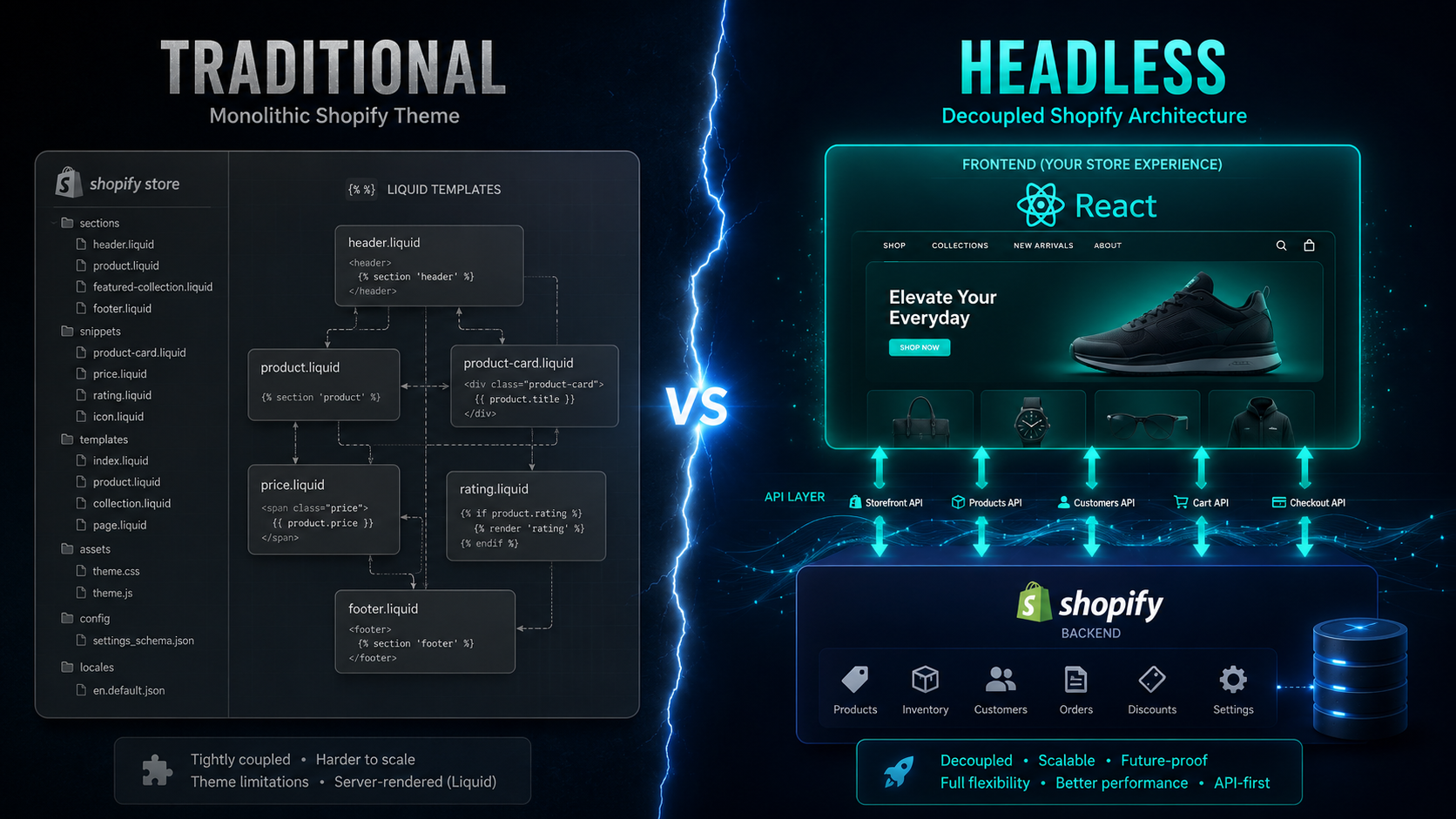
In a traditional Shopify store, the front end — everything customers see and interact with — and the back end — products, inventory, checkout, and order management — are tightly coupled inside a Shopify theme. When you customize your store, you work within the boundaries of what your theme allows. Changing the design means working in Liquid, Shopify's templating language, and the depth of customization has a ceiling.
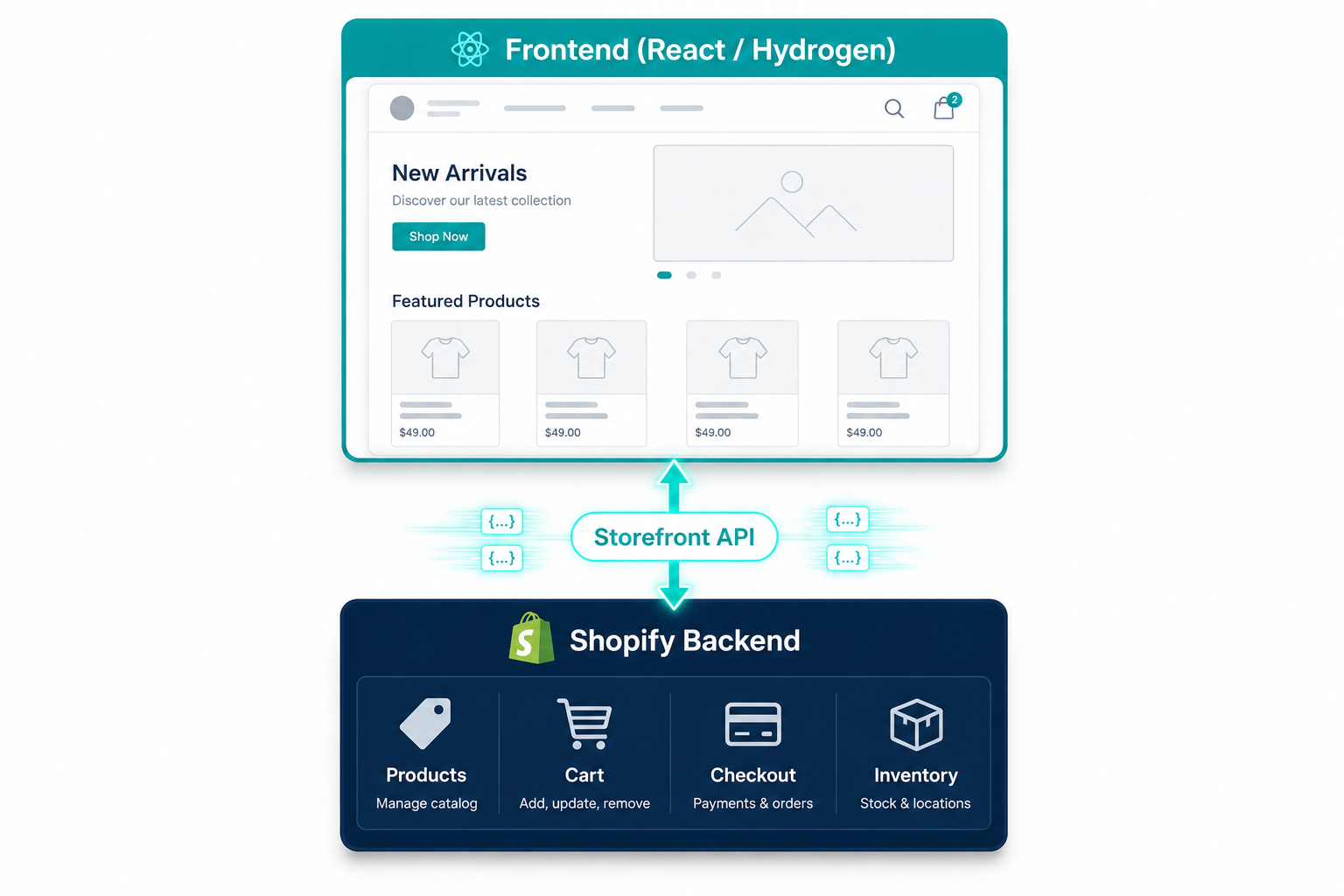
Headless commerce removes that ceiling entirely.
<cite index="21-1">Headless commerce separates the front-end experience layer from the back-end commerce engine. The back end manages the operational components of commerce, including product catalog, inventory, checkout, customer records, and order data. The two layers connect through application programming interfaces (APIs), allowing each to be managed independently.</cite>
In practical terms: <cite index="27-1">you can build any custom frontend experience you want while Shopify continues to handle all the commerce logic behind the scenes.</cite> Your design team works in React, Next.js, or Shopify's own Hydrogen framework. Shopify keeps running payments, fulfillment, and inventory. The two sides talk to each other through APIs.
What this unlocks is complete creative and technical freedom on the customer-facing side — immersive product pages, complex configurators, interactive lookbooks, AR try-on tools, and experiences that are simply impossible to build inside a standard Shopify theme.
How Big Is the Headless Movement in 2026?
This isn't a fringe architectural experiment. <cite index="21-1">In 2024, 73% of surveyed IT and marketing leaders said their organizations were already using headless architecture, while nearly 98% of those not using headless solutions were planning to evaluate them within the next 12 months.</cite>
<cite index="12-1">The headless commerce market is expected to reach $11.8 billion by 2028, growing at a 17.5% compound annual growth rate, making it one of the fastest-growing ecommerce technologies.</cite>
And there's a new dimension to headless that makes it particularly relevant in 2026 specifically. <cite index="22-1">In March 2026, Shopify activated agentic storefront integration with ChatGPT. Shoppers can now discover products and initiate purchases inside AI chat interfaces. When they click through to complete a purchase, they land on your store. The stores that convert this traffic are the ones that load instantly, have clean structured data, and deliver a frictionless experience.</cite>
<cite index="22-1">API-first architecture means AI agents can read your product data, pricing, and availability in real time. Clean structured data and schema markup make your catalogue parseable by AI systems. Sub-second load times meet the performance threshold that AI-referred buyers expect when they land on your store.</cite>
Headless storefronts are structurally better positioned for AI-driven commerce discovery than Liquid-based stores — and that's a 2026-specific advantage that most headless articles aren't yet covering.
The Real Benefits of Going Headless on Shopify
1. Unlimited Design and Experience Freedom
This is the most cited benefit, and it's genuine. <cite index="9-1">With D2C, you can effectively target your audience as you are able to offer a unique and authentic brand experience.</cite> With headless specifically, your design team isn't constrained by theme limitations. <cite index="27-1">You can build immersive product pages, 3D visualizers, interactive lookbooks, or completely custom checkout experiences — all without touching Shopify's core backend.</cite>
Real brands are doing exactly this. Victoria Beckham Beauty runs a headless Shopify store that feels editorial and high-fashion, <cite index="29-1">keeping the site feeling "editorial" and on-brand, while still benefiting from Shopify's secure transaction layer.</cite> Veloretti built a headless storefront that runs a configurator with over 100 bicycle combinations across four languages while maintaining an 80+ Lighthouse score.
2. Dramatically Faster Page Speeds
<cite index="12-1">Headless storefronts load faster, feel smoother on mobile, and are built with performance in mind — something shoppers now expect by default. In a world where a one-second delay in loading times can cost you a sale, improving website speed matters.</cite>
<cite index="23-1">Denham migrated from Salesforce Commerce Cloud to headless Shopify, and their site became 3x faster.</cite> Typical headless builds see 0.4–1.2 second improvements in Largest Contentful Paint (LCP) over tuned Liquid themes. That's not a revolutionary gap on its own — but in competitive categories, those fractions of a second translate directly into measurable conversion rate improvement, and Google's Core Web Vitals algorithm rewards them with better search rankings.
3. True Omnichannel Selling From a Single Backend
<cite index="30-1">By decoupling the frontend from the commerce backend, brands can deliver consistent content, pricing and product data across multiple touchpoints, including websites, mobile apps, in-store displays, social commerce and marketplaces.</cite>
<cite index="25-1">Customers see the exact same product, pricing, and inventory data wherever they shop because every touchpoint pulls from the same API. This means you can deploy new shopping experiences without rebuilding core business logic like tax calculations, automations, loyalty programs, or shipping tiers.</cite>
For brands selling across web, mobile app, physical kiosk, and social commerce simultaneously, headless is the only architecture that makes that manageable without maintaining separate backends for each.
4. Best-in-Class Tool Integration
<cite index="28-1">Use the best tool for each job: Shopify for commerce, Sanity for editorial content, Algolia for search, Klaviyo for email — all connected via APIs. Traditional themes force you to use Shopify's built-in version of each.</cite>
For brands that have outgrown Shopify's native search, need a serious CMS for content marketing, or want a best-in-class personalization engine that connects directly to their storefront data, headless architecture makes those integrations cleaner and more performant.
5. Independent Frontend and Backend Scaling
<cite index="29-1">Headless Shopify makes it easier to scale because the storefront and backend can evolve independently. Your team can redesign the frontend, add new features, or expand into new markets without needing to rebuild the entire commerce foundation.</cite>
This matters most when your product catalog grows significantly, traffic spikes seasonally at massive scale, or your business adds new selling models like B2B or subscription without wanting to rebuild from scratch.
The Real Costs and Trade-Offs (Nobody Talks About These Enough)
Here is where headless discussions typically fall short. The benefits are real, but so are the costs — and the agencies selling headless builds have a financial incentive not to dwell on them.
It costs 3–5x more to build than a standard Shopify theme. <cite index="23-1">Cost, timeline, React developer dependency, loss of Shopify's plug-and-play app ecosystem, higher ongoing maintenance, and the risk of a poorly executed build performing worse than a good Liquid theme</cite> are all factors every brand should weigh honestly against the benefits.
The Shopify App Store largely doesn't work headlessly. <cite index="28-1">The Shopify App Store has 8,000+ apps — most inject code into Liquid themes and do NOT work headlessly. Review apps, loyalty apps, and live chat widgets often need custom headless integration.</cite> Every app you rely on today needs to be evaluated for headless compatibility — and many will need to be rebuilt or replaced, adding weeks to your development timeline and ongoing maintenance to your cost structure.
Build timelines are long. <cite index="28-1">A headless build takes 3–6 months; a theme-based Shopify store can launch in 2–4 weeks.</cite> For brands that need to move fast, test new concepts, or launch seasonal campaigns quickly, that timeline gap is a serious operational disadvantage.
You now own the frontend code. <cite index="24-1">Moving to headless gives you more freedom. It also comes with more responsibility. You step out of the comfort of a predefined theme system and start managing a custom frontend layer. That shift requires careful planning, clear ownership, and the right technical ownership.</cite> Every Shopify API update, schema change, or new feature requires your dev team to update the frontend. The ongoing maintenance cost is real and permanent.
The checkout is still Shopify's. This surprises many brands considering headless. <cite index="26-1">Shopify's checkout is still Shopify-hosted — and that's actually a feature, not a limitation.</cite> Even in fully headless setups, the checkout page remains Shopify's hosted UI unless you're on Shopify Plus with Checkout Extensibility. You're not "fully headless" at the point of purchase.
Shopify's Headless Tools: Hydrogen and Oxygen
Shopify has invested heavily in making headless more accessible through its own tooling.
<cite index="22-1">Hydrogen is Shopify's official React-based framework for headless storefronts. In 2026, it runs on React Router and includes pre-built commerce components for cart, product display, collection pages, search, and filters. It has direct integration with Shopify's Storefront API and Admin API via built-in data loaders, optimistic UI updates for instant cart interactions without page reloads, server-side rendering and static generation out of the box, and built-in support for Shopify Markets for multi-region international storefronts. Hydrogen is free to use.</cite>
Oxygen is Shopify's global edge hosting platform, deploying Hydrogen storefronts to 285+ edge locations worldwide — also free when paired with Hydrogen.
<cite index="26-1">Hydrogen on Oxygen is the path of least resistance if you're committed to staying on Shopify long-term, with the best caching for Shopify data, fewest edge cases, and lowest hosting cost surprises.</cite>
If your team already works heavily in React or you need deep integration with a complex CMS like Sanity or Contentful, Next.js paired with Shopify's Storefront API is a strong alternative — particularly for content-heavy brands where editorial flexibility matters as much as commerce performance.
Who Should Actually Go Headless in 2026?
This is the question most guides avoid giving a straight answer to. Here's a clear framework:
Headless is worth evaluating seriously if:
- Your Shopify Lighthouse score is consistently below 60 on a well-optimized theme, and speed is measurably costing you conversions
- You need a product configurator, AR experience, or custom interactive feature that simply cannot be built in Liquid
- You're selling across multiple channels — web, mobile app, kiosks, and physical retail — and need a unified backend serving all of them
- You're an enterprise brand with a dedicated development team and a product catalog or traffic volume that has genuinely outgrown standard theme architecture
- You need deep content marketing integration where editorial pages and commerce pages need to work together seamlessly under a headless CMS
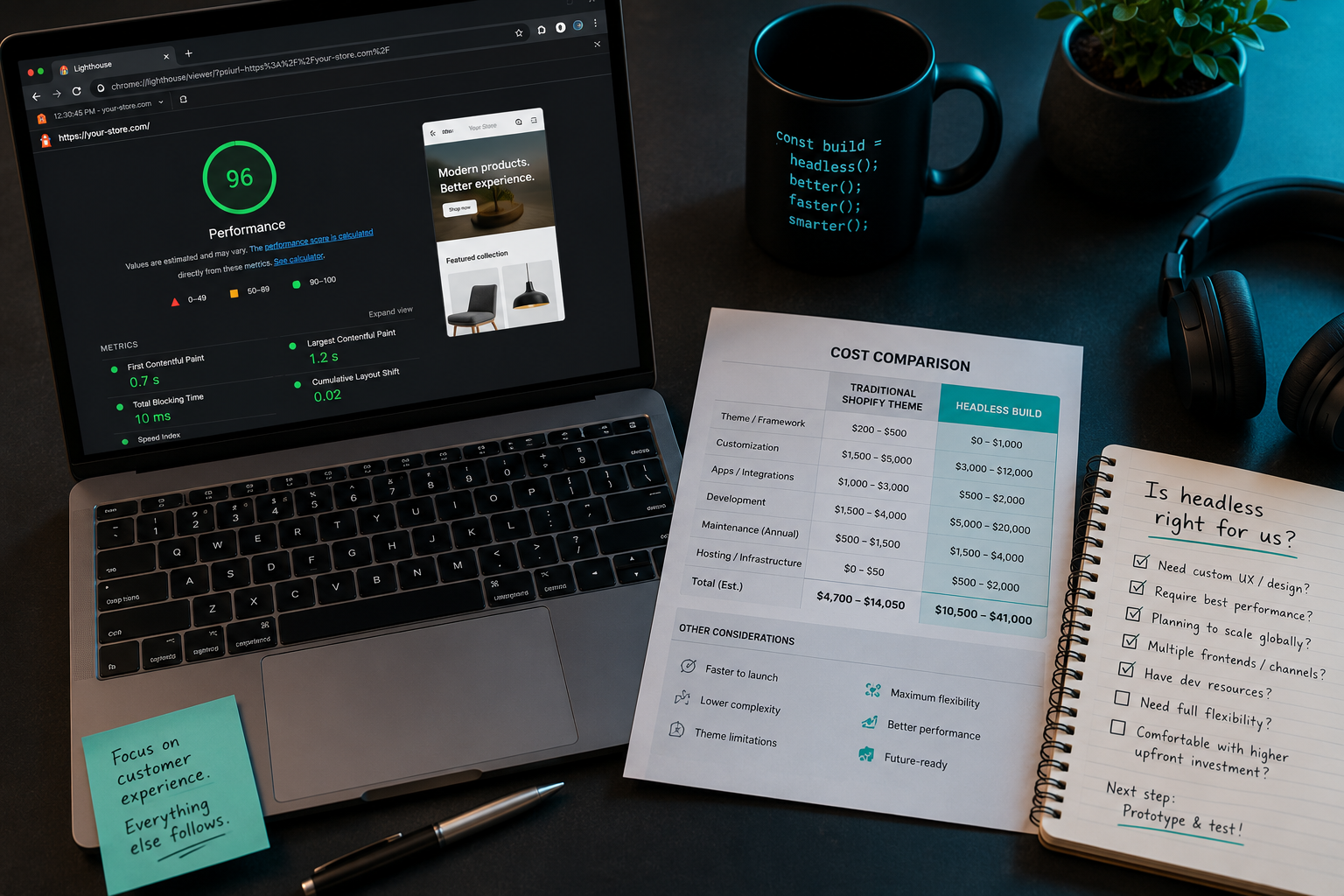
Stick with standard Shopify if:
- You're doing under $1–2 million in annual revenue and don't have a dedicated technical team
- Your customization needs can be met with Shopify's current theme editor, Online Store 2.0, and Checkout Extensibility
- You rely heavily on Shopify App Store plugins for reviews, loyalty, upsells, and chat — replacing all of these in a headless environment adds significant cost
- You need to move fast and iterate on campaigns frequently — headless timelines don't support rapid deployment
<cite index="25-1">According to Shopify's site speed report, Shopify's infrastructure renders 1.8x faster on average than stores on other platforms, with 93% of Shopify brands achieving fast storefront performance — demonstrating that speed and scalability are achievable with both traditional and headless architectures.</cite>
That stat matters because it directly challenges the assumption that going headless is the only way to achieve strong performance. For most Shopify stores, a well-optimized Liquid theme with lean apps, proper image compression, and clean code delivers performance that's difficult to distinguish from a headless build in real-world conditions.
<cite index="23-1">One leading Shopify agency talked roughly 75% of the brands who came to them wanting headless into choosing native Shopify Plus instead — because headless is not an upgrade, it is a different architecture, with different trade-offs, and the wrong choice costs six figures and months of runway for no meaningful return.</cite>
Real-World Examples of Headless Done Right
The brands that get the most out of headless on Shopify tend to have one thing in common: a specific, concrete problem that their existing Shopify theme genuinely couldn't solve.
Kotn — The fashion retailer needed to unify multiple storefronts and back-end systems. <cite index="21-1">Their team implemented a custom front end that consolidated two independent storefronts into one experience filled with the unique brand experiences they wanted to provide, then connected their front end via APIs to Shopify's unified back end.</cite>
Inkbox — <cite index="29-1">Known for its semi-permanent tattoos and highly visual, experience-driven product discovery, where shoppers often need rich previews and interactive browsing before they purchase, Inkbox combined Shopify's commerce backend with a custom frontend experience built for high engagement.</cite>
TASCHEN — <cite index="29-1">The publishing house leveraged Shopify Plus's headless architecture to integrate a robust Product Information Management system, streamlining their extensive catalog management</cite> across a global storefront.
In each case, the headless investment solved a real architectural problem — not a theoretical one.
The SEO Reality of Headless Shopify
A common concern about headless is whether it harms SEO. Handled correctly, it doesn't — and can actively improve search performance. But there are non-negotiable technical requirements.
Server-side rendering is mandatory. <cite index="23-1">Both Hydrogen and Next.js support SSR. Search engines receive fully rendered HTML, identical to a traditional server-rendered page. Client-side-only rendering — where the browser assembles the page from JavaScript — is an SEO risk that no competent agency should ship in 2026.</cite>
Redirect mapping is critical during migration. <cite index="23-1">Every URL from your old site needs a 301 redirect to its new equivalent. This is the most common SEO failure point — build and test redirect maps before launch, not during.</cite>
Structured data must be explicitly implemented. Native Shopify themes generate JSON-LD for products and collections automatically. In a headless build, you build this yourself — it's straightforward, but it cannot be overlooked without paying an SEO penalty.
Done correctly, headless builds consistently achieve strong Core Web Vitals scores, and Google's algorithms continue to reward fast, well-structured pages with better rankings.
Final Verdict: Is Headless Commerce Worth It for Your Shopify Store?
For the right brand, in the right situation, with the right technical team — yes, headless commerce on Shopify is worth it. The performance gains are real, the design freedom is transformative, and the positioning for AI-driven discovery in 2026 and beyond is a genuine strategic advantage.
But for the majority of Shopify stores — particularly those under $2 million in annual revenue, without dedicated development resources, and without a specific customization need that standard themes can't address — headless is a solution to a problem you don't yet have. A well-optimized Shopify theme with Checkout Extensibility, modern performance practices, and a lean app stack will serve you better at a fraction of the cost and complexity.
The most useful question isn't "should I go headless?" It's "what specific problem am I trying to solve, and is headless the most cost-effective way to solve it?"
If you have a concrete answer to that question — a configurator that needs building, an omnichannel experience that needs unifying, a performance ceiling you've genuinely hit — then the conversation about headless becomes very different. And that's exactly the kind of conversation worth having with a Shopify development partner who will give you a straight answer rather than a sales pitch.
Wondering whether headless commerce makes sense for your Shopify store, or need a performance audit to find out where your current setup is holding you back? Get in touch with EcomFixify — we specialize in Shopify development and can give you an honest assessment of what your store actually needs.