
Email Marketing for Shopify: The 7 Automated Flows Every Store Needs
Email marketing generates between $36 and $42 for every $1 spent — the highest return on investment of any digital marketing channel available to Shopify stores in 2026. That number is not disputed. What is consistently misunderstood is how that return is actually generated.
Most Shopify merchants spend 80% of their email effort on campaigns — the scheduled newsletters, promotional blasts, and sale announcements that go to their entire list on a calendar-driven basis. Those campaigns represent 94.7% of total email send volume. They also generate only 59% of total email revenue.
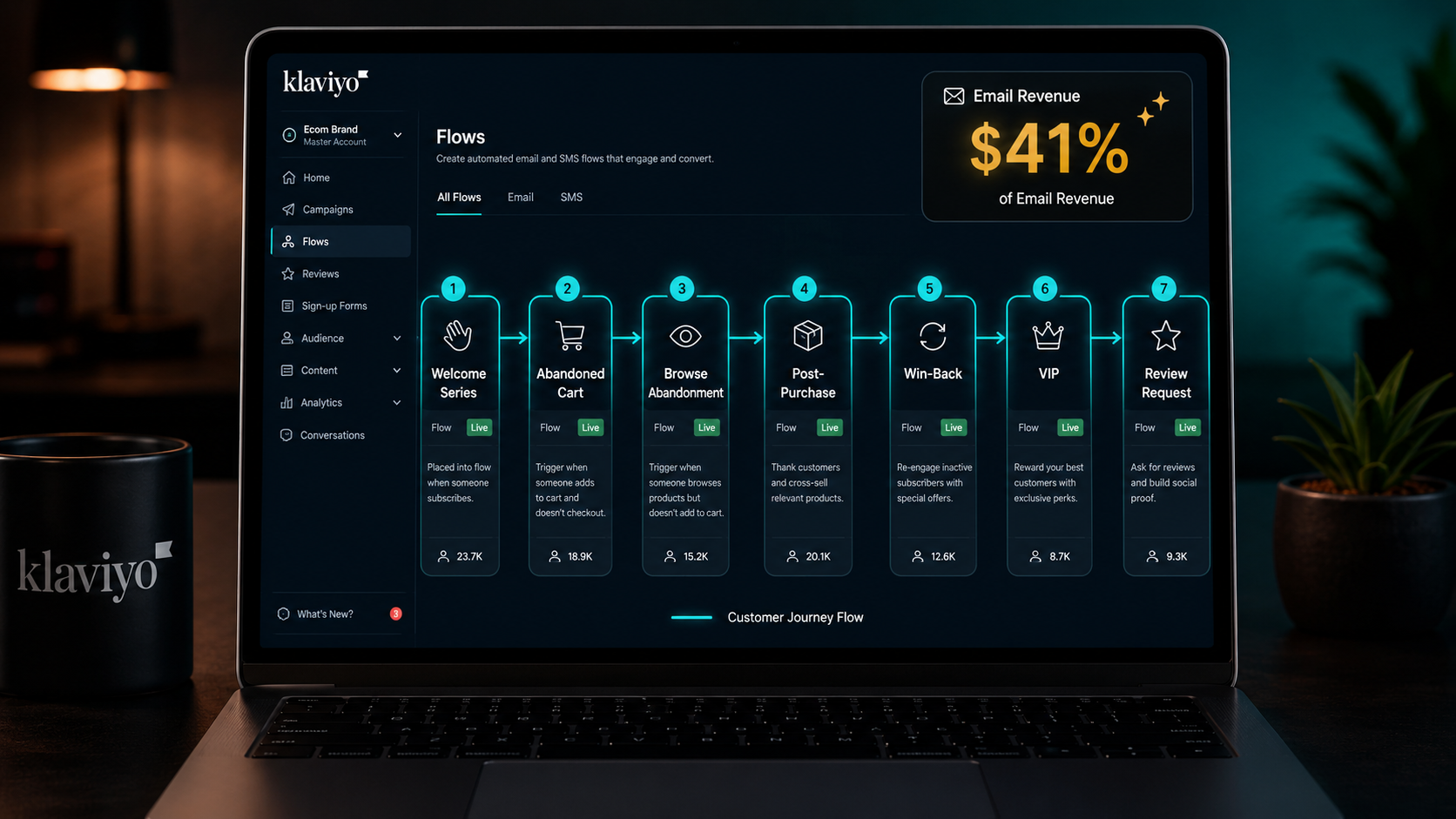
The other 41% of email revenue comes from automated flows — sequences that trigger automatically based on customer behavior, run 24 hours a day without manual intervention, and reach each customer at the exact moment their intent is highest. Flows account for just 5.3% of total email send volume but generate 41% of total email revenue, with average revenue per recipient nearly 18 times higher than campaign emails.
That ratio — 41% of revenue from 5.3% of sends — is the most important number in Shopify email marketing. It means automated flows are the primary revenue engine of any high-performing email program, yet only a fraction of Shopify stores have all of them configured correctly. Stores with all five core flows active generate 3.2 times more email revenue than stores running only a welcome email.
This guide covers the 7 automated flows every Shopify store needs in 2026, with exact structure, timing, and copy guidance for each — so you can build the email infrastructure that runs in the background and generates revenue whether you are working, traveling, or asleep.
Why Flows Outperform Campaigns: The Behavioral Trigger Advantage
Before building the flows, understanding why they outperform campaigns prevents the common mistake of treating them as secondary to your broadcast strategy.
Campaigns reach everyone on the same day with the same message. A promotional email sent on Tuesday at 10am lands in the inbox of customers who bought yesterday, customers who have not bought in 18 months, customers who are actively shopping right now, and customers who signed up once and never engaged again. The same message to all of them is relevant to almost none of them.
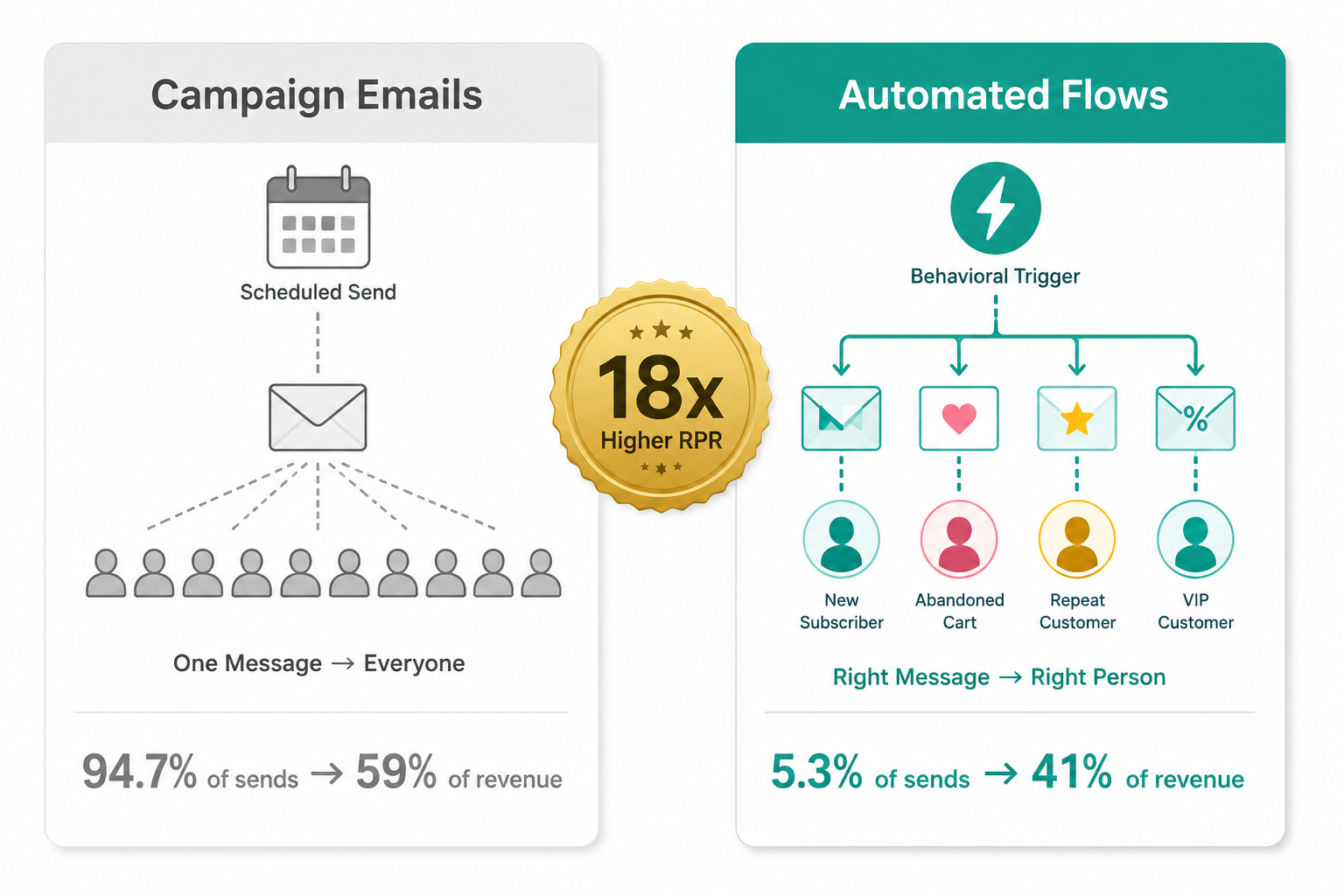
Flows operate on an entirely different logic. They react to behavior rather than a calendar. An abandoned cart flow triggers because a specific customer added a product to their cart and left. A win-back flow triggers because a specific customer has not purchased in 90 days. A browse abandonment flow triggers because a specific customer viewed a product page twice without buying. In every case, the trigger is a real behavioral signal that indicates where the customer is in their purchase journey — and the flow responds to that signal with a message timed and targeted to that exact moment.
Flow-based emails deliver 3 times higher click rates and 13 times higher placed order rates than campaigns, according to Klaviyo's 2026 benchmark data. The mechanism is simple: relevance and timing produce engagement, engagement produces revenue.
The tool that handles this for Shopify stores is Klaviyo. As of 2026, Klaviyo is the officially recommended email platform for Shopify Plus merchants, and Shopify holds an equity stake in the company. That relationship means the integration is deeper than any competitor — Shopify's commerce data flows into Klaviyo in under 200 milliseconds in real time, across every customer action including purchases, product page views, cart additions, and checkout starts. Every flow in this guide is built on that real-time behavioral data.
Flow 1: Welcome Series — Your First and Most Important Flow
The welcome series is the highest-engagement email sequence your store will ever send. Welcome email open rates average 52.4% — more than double the industry average for campaign emails. A three-email welcome series generates 90% more revenue than a single welcome email. And welcome series revenue accounts for 8 to 12% of total email revenue for well-configured Shopify stores.
The reason welcome emails perform so strongly is timing. A new subscriber has just taken an active step to engage with your brand — they have given you their email address, typically in exchange for a discount or in response to something that caught their interest. Their attention and intent are at their peak. The welcome series capitalizes on that moment while it is fresh.
A four-email welcome series structured over seven days consistently outperforms shorter sequences:
Email 1, sent immediately: deliver the promised discount or lead magnet if one was offered, introduce your brand story in a single paragraph, and feature three to five of your bestselling products. This email should feel warm and personal, not transactional. Open rate benchmark: 50 to 60%.
Email 2, sent 24 hours later: share your brand's values and what makes your products different from alternatives. If you have a strong sustainability story, sourcing transparency, or founder narrative, this is where it lives. No heavy selling — this email builds the trust that converts Email 3 and 4.
Email 3, sent 48 hours after Email 2: feature social proof. Customer reviews, user-generated content, before-and-after results, or press coverage. Address the most common objections new customers have about your product category. Include a call to action to shop the specific collection most relevant to what attracted them to sign up.
Email 4, sent 72 hours after Email 3: create urgency for subscribers who have not yet purchased. If a discount was offered in Email 1, remind them it is expiring. Feature a specific product recommendation based on what they browsed, if browse data is available. Add a guarantee or risk-reduction statement — "Free returns within 30 days, no questions asked" — to remove the final hesitation.
If a subscriber purchases at any point in the sequence, exit them from the welcome flow immediately and enroll them in your post-purchase flow instead. Continuing to send welcome discount emails to someone who has already bought damages trust and erodes your margin.
Flow 2: Abandoned Cart — Your Highest Revenue Per Recipient Flow
Abandoned cart flows consistently generate the highest revenue per recipient of any automated flow in Klaviyo. They recover 5 to 15% of abandoned carts that would otherwise be permanently lost. And they target the warmest possible audience — customers who have demonstrated explicit purchase intent within the past hours.
The average cart abandonment rate on Shopify sits at 70.2% in 2026. For a store generating 500 cart additions per month, that means roughly 350 potential customers leaving without completing their purchase. A well-configured three-email abandoned cart flow recovers 20 to 50 of those per month at minimal marginal cost.
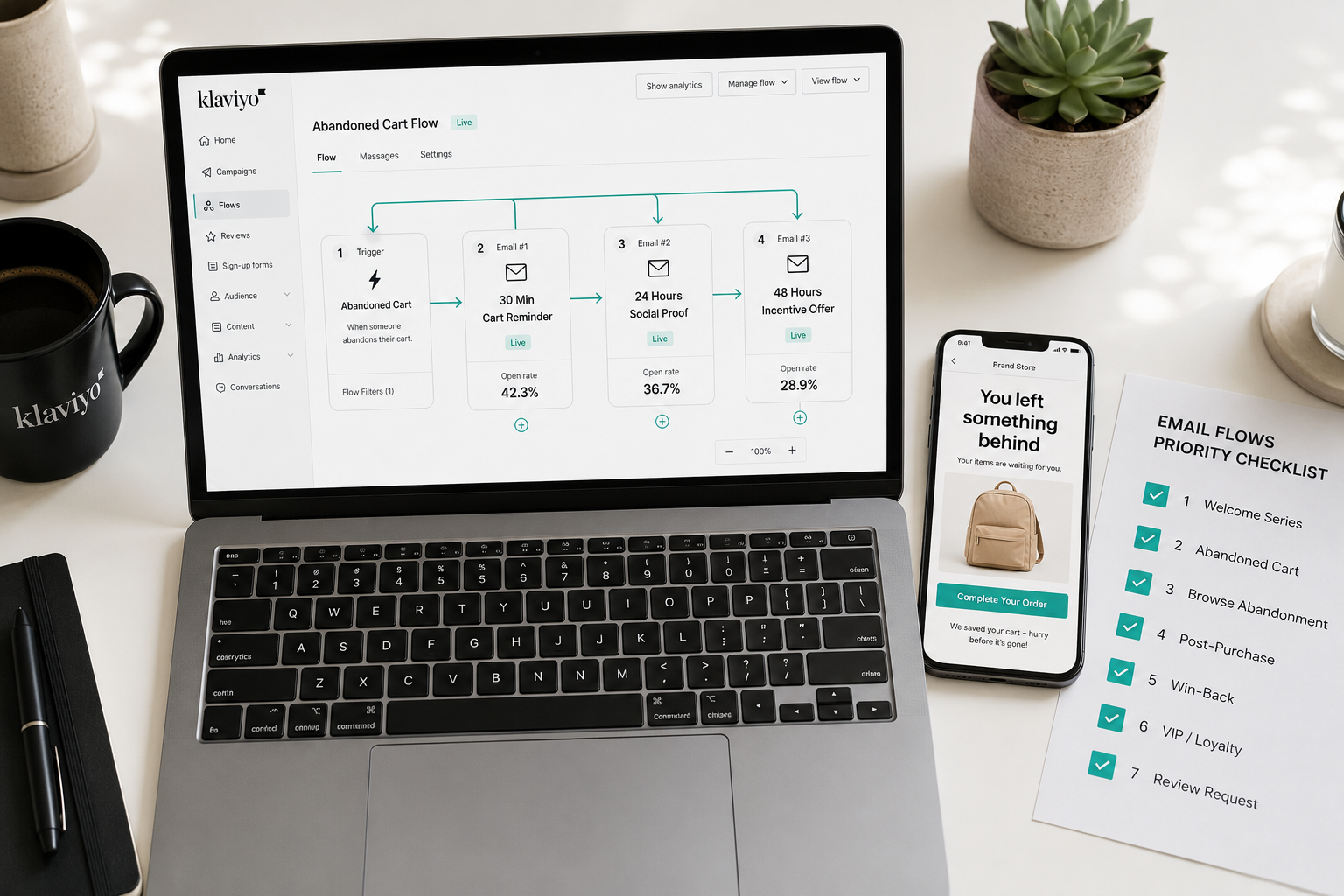
The three-email structure that consistently performs best:
Email 1, sent 30 to 60 minutes after abandonment: show the exact product left in the cart with a large product image, the product name, and the price. Keep copy minimal — the email should feel like a helpful reminder, not a desperate sales pitch. A subject line that works: "You left something behind" or "Still thinking it over?" Direct link to the cart — not the homepage, not the product page. The cart, with their items saved.
Email 2, sent 12 to 24 hours later: add social proof specific to the abandoned product. Pull two or three recent reviews of that specific item and display them prominently. If customers frequently ask about a specific concern — does this run true to size, how long does this take to work — address that concern directly in the email body. A conditional split at this email is high-value: subscribers who opened Email 1 without purchasing get a different version than those who did not open at all. The non-openers get a more direct re-engagement hook.
Email 3, sent 24 to 48 hours after Email 2: introduce a time-limited incentive for subscribers who have not returned. Free shipping, a 10% discount, or a small gift with purchase are all effective at this stage. Use this incentive sparingly — sending discounts in Email 1 trains customers to abandon carts on purpose. Reserve the incentive for Email 3, and set it to expire within 24 to 48 hours to maintain urgency.
One configuration detail that most guides miss: set a smart sending filter that prevents the abandoned cart flow from triggering for customers who have already received it in the past 30 to 60 days. Sending cart abandonment emails to repeat abandoners at high frequency trains them to tune the emails out and erodes their performance over time.
Flow 3: Browse Abandonment — The Most Underused High-ROI Flow
Browse abandonment flows target customers who viewed a product page one or more times without adding to cart. They represent the second-highest intent signal available in email marketing after cart abandonment — and only 21% of Shopify stores use them despite their documented revenue performance.
The browse abandonment flow is simpler than the cart flow. A one to two email sequence is typically sufficient:
Email 1, sent four to six hours after the browse session: show the product that was viewed, ideally with a short description that addresses the most common question about that product category. Subject lines that work: "Still thinking about [product name]?" or "Is this what you were looking for?"
Email 2, sent 24 hours later only for high-value products or subscribers who opened Email 1 without purchasing: add a social proof element — the product's star rating, a featured review, or a brief "customers who bought this also loved" recommendation. Keep the path to purchase short — single product focus, clear button, direct link to the product page.
Browse abandonment flows average $0.73 revenue per recipient — lower than abandoned cart flows but significant given that these are customers who never even added to cart. Because browse abandonment emails are lower urgency than cart abandonment, slightly longer delays between send and trigger are appropriate. Emailing someone two minutes after they viewed a product page feels intrusive. Four to six hours feels helpful.
Flow 4: Post-Purchase Flow — Where Loyalty Is Built
The post-purchase flow is the most commercially undervalued flow in the majority of Shopify stores. Only 34% of Shopify stores have an active post-purchase upsell flow, yet this sequence is the primary driver of repeat purchase rate — the metric most directly correlated with long-term store profitability.
A customer who just purchased is at peak satisfaction and engagement with your brand. They have made a decision, they are anticipating their order, and their guard is down. The post-purchase flow capitalizes on this window to deepen the relationship, drive a second purchase, and set the foundation for long-term retention.
A three-email post-purchase sequence structured over 14 days:
Email 1, sent one hour after purchase: a confirmation email that goes beyond the standard transactional receipt. Thank the customer warmly, reinforce the value of what they bought ("You are going to love how this works"), share a useful tip or how-to that helps them get the most out of their purchase, and set expectations for delivery timing. This email has nothing to sell — it builds the trust that makes Emails 2 and 3 convert.
Email 2, sent five to seven days after purchase: introduce a complementary product recommendation based on what was purchased. If the customer bought a face moisturizer, recommend your sunscreen or serum. If they bought a yoga mat, recommend a yoga block or strap. This is cross-sell at the ideal moment — the customer is using or anticipating using the product they just bought, their satisfaction is high, and a genuinely relevant recommendation feels helpful rather than pushy.
Email 3, sent 12 to 14 days after purchase: request a review. Timing this between 12 and 14 days gives the customer enough time to have used the product and form an opinion. Subject lines that work: "How are you getting on with [product name]?" or "Your honest opinion means everything to us." Include a direct link to the review platform and make the process as frictionless as possible. Post-purchase review request emails generate three to five times higher review submission rates than generic post-purchase broadcasts.
Flow 5: Win-Back Flow — Recovering Customers Before They Are Gone
Win-back flows target customers who have not purchased within a defined time window — typically 60 to 90 days for stores with monthly purchase frequency, or 120 to 180 days for stores with less frequent purchase cycles. The goal is to re-engage them before they have mentally moved on to a competitor.
Win-back flows reactivate 3 to 8% of churned customers. That sounds modest, but for a store with 5,000 lapsed customers, a 5% reactivation rate means 250 purchases from customers who were already acquired — at near-zero incremental acquisition cost.
A two-email win-back sequence:
Email 1, at the 60 to 90 day mark: acknowledge the gap directly without making it awkward. "We have not seen you in a while" is honest and relatable. Feature your bestselling products from the past 60 days — the customer may not know about new products or recent additions to your catalog. Include a modest incentive: free shipping or a small discount that expires in seven days.
Email 2, sent seven days after Email 1 for non-purchasers: create final urgency. "Your [discount/offer] expires tomorrow" combined with a last-look product recommendation. If the subscriber does not engage with either email, move them to a suppression list or a significantly reduced-frequency segment. Continuing to email truly disengaged subscribers damages your sender reputation and deliverability for your entire list.
Flow 6: VIP and Loyalty Flow — Rewarding Your Best Customers
Most Shopify stores have a rough sense of who their best customers are. Few have a systematic flow that identifies them automatically, rewards them specifically, and keeps them engaged as an explicit VIP segment.
A VIP flow triggers when a customer crosses a spend or purchase count threshold — typically three or more orders, or cumulative spend above a defined amount. The trigger signals that this customer is a high-value repeat buyer who deserves a different communication experience than a first-time purchaser.
The VIP flow serves three purposes: it makes the customer feel recognized and valued, which increases loyalty and word-of-mouth; it delivers exclusive benefits that give the customer a reason to choose your store over alternatives; and it creates a natural communication channel for early access to new products, member-only sales, and loyalty rewards.
In Klaviyo, VIP identification uses Predictive Analytics to tag customers when their predicted lifetime value crosses your defined threshold, or uses order count and cumulative spend conditions in a flow filter. The flow itself is typically two to three emails: a VIP welcome acknowledging their status, an exclusive benefit delivery (early access code, member discount, free shipping tier), and a periodic check-in email that maintains engagement between purchases.
Flow 7: Review Request and UGC Flow — Building Social Proof at Scale
Reviews are the most trusted form of social proof in ecommerce — 93% of consumers say online reviews influence their purchasing decisions — yet most Shopify stores collect reviews passively and inconsistently. A dedicated review request flow creates a systematic process that generates a steady stream of social proof without manual effort.
The review request flow triggers three to seven days after confirmed delivery, depending on the product's typical usage cycle. Products that take time to evaluate — skincare, supplements, fitness equipment — should have longer delays than products that provide immediate value.
Email structure: a single, focused request with a large, easy-to-tap review button and a two-line explanation of why reviews matter to your brand. Personalization that includes the customer's name and the specific product they purchased generates significantly higher response rates than generic review requests.
For stores using Judge.me, Okendo, or Yotpo, the review request flow integrates directly with the review platform to handle the submission flow natively. Okendo and Yotpo both support multimedia reviews — photo and video submissions — which are significantly more persuasive than text-only reviews on product pages.
A second email in the review request flow, sent five to seven days after the first for non-responders, adds a small incentive for completing a review — loyalty points or a small discount code on their next purchase. This follow-up consistently increases review submission rates by 30 to 50% compared to single-email review request sequences.
Building Your Flow Stack: Where to Start
The sequence in which you build your flows determines how quickly you see revenue impact. Build in this order:
- Priority one — week one and two: Welcome series and abandoned cart flow. These two flows together address the highest-intent moments in the customer journey and generate the most immediate revenue lift. Without them, you are leaving money on the table from every new subscriber and every cart abandonment event.
- Priority two — week three and four: Post-purchase flow and browse abandonment flow. The post-purchase flow begins building repeat purchase behavior from your first wave of customers. Browse abandonment captures the intent signals your welcome and cart flows cannot reach.
- Priority three — week five and six: Win-back flow and VIP flow. These flows work on your existing customer base rather than new subscribers, and their impact compounds as your list grows and your purchase history data deepens.
- Priority four — ongoing: Review request flow. This can be built at any stage but generates compounding value as your review count grows and the social proof compounds across your product catalog.
The Metric That Tells You Whether Your Flows Are Working
Revenue per recipient is the single most important metric for evaluating individual flow performance. It measures how much revenue each email in a flow generates per send, giving you a normalized comparison across flows of different sizes and cadences.
Klaviyo's 2026 benchmark data shows that top 10% performing flows achieve revenue per recipient as high as $7.79 with click rates above 10%. Average performing flows see RPR of $0.50 to $2.00 depending on flow type. If your abandoned cart flow RPR is below $1.00, you almost certainly have a single-email flow or a flow with untested default copy. Moving to a three-email structure with a conditional split at Email 2 alone — without changing a word of copy — typically increases abandoned cart RPR by three to five times.
Track RPR per flow, per email, and per audience segment. The differences between segments often reveal that a flow performing averagely overall contains one exceptional segment whose performance is masked by others. Those segment-level insights are where the next wave of optimization lives.
Final Thoughts
Automated flows are not a feature of email marketing — they are the foundation of it. The 41% of email revenue that flows generate from 5.3% of sends is not theoretical potential. It is the documented reality of what happens when customer behavior triggers relevantly timed, personalized messages rather than calendar-driven broadcasts reaching everyone with the same message on the same day.
The seven flows in this guide — welcome series, abandoned cart, browse abandonment, post-purchase, win-back, VIP, and review request — cover the full customer lifecycle from first contact through long-term retention. Each one runs automatically once built. Each one improves with the behavioral data that accumulates in Klaviyo as your store grows.
The merchants who have built all seven are generating email revenue on autopilot while their competitors are manually writing campaigns. The infrastructure advantage compounds with every new subscriber, every new purchase, and every new behavioral signal that feeds the flows running in the background.
Build the flows first. Everything else in your email program is an optimization of what they establish.
Need help setting up your Klaviyo email flows for your Shopify store, or want an expert to audit your existing automations for revenue gaps? Get in touch with EcomFixify — we specialize in Shopify development and ecommerce growth strategy for brands ready to build a real retention system.