
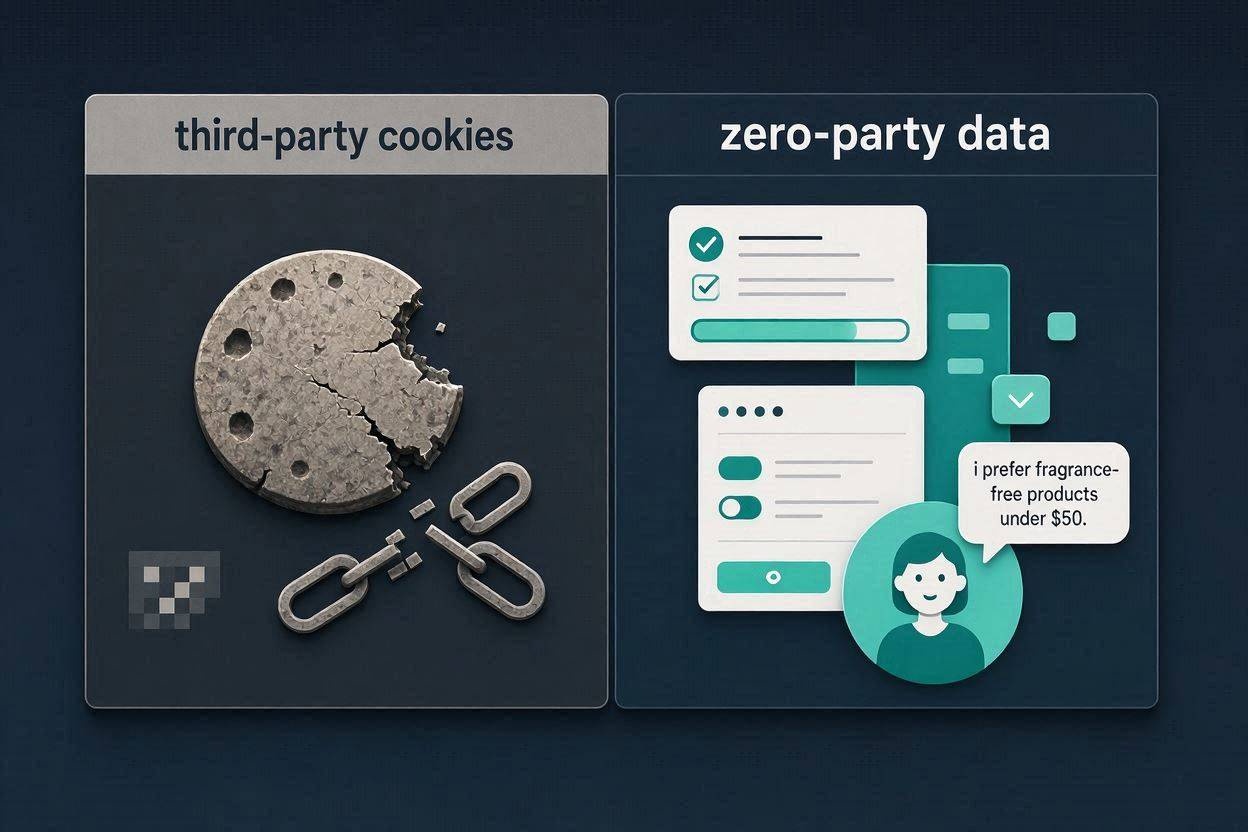
Data Strategy to Collect Customer Data Without Third-Party Cookies
Data Strategy to Collect Customer Data Without Third-Party Cookies
Here is the marketing problem most Shopify store owners are quietly ignoring: the data infrastructure your paid advertising has depended on for the past decade is breaking down in real time.
Safari has blocked third-party cookies since 2020. Firefox followed. Apple's App Tracking Transparency changed how Meta and Google report conversions from iOS devices. The EU's enforcement of GDPR and the UK's PECR are tightening with every passing quarter. And Google's Privacy Sandbox — the long-promised replacement for third-party cookie tracking in Chrome — has been delayed enough times that the majority of forward-looking brands stopped waiting for it two years ago.
The symptoms are visible in your analytics right now. Meta reports one ROAS figure. Google reports another. Klaviyo claims credit for the same orders both platforms counted. Shopify's native reporting shows a fourth number that matches none of them. Your customer acquisition costs have risen more than 60% since 2020. And the behavioral data that was supposed to tell you exactly who your customers are and what they want has become increasingly unreliable as tracking restrictions compound.
The brands thriving in this environment are not building workarounds for broken tracking. They are building something better: a direct relationship with their customers where data is volunteered rather than inferred, shared rather than surveilled, and owned rather than rented from platforms that change the rules without warning.
That shift has a name. It is called zero-party data — and in 2026, it is the most strategically important marketing investment a Shopify store can make.
What Is Zero-Party Data, and How Is It Different From First-Party Data?
The terminology in data privacy marketing can feel deliberately confusing, so a clear distinction is worth establishing before diving into strategy.
Third-party data is information purchased or licensed from external sources — data brokers, ad networks, and platform audiences built from tracking users across websites they do not own. This is what cookie deprecation and privacy legislation are eliminating.
First-party data is behavioral information you collect directly from your own owned properties — browsing history on your Shopify store, purchase history, email open and click behavior, session duration, and pages visited. You observe this data by watching what customers do. It belongs to you, it is privacy-compliant, and it is significantly more accurate than third-party data for the customers it covers.
Zero-party data is something fundamentally different and more valuable than either. It is information that a customer intentionally and proactively shares with your brand — their stated preferences, declared motivations, explicit answers to your questions, and voluntary feedback. The customer tells you directly rather than you inferring it from their behavior.
A cookie tells you someone visited your moisturizer product page three times. Zero-party data tells you they have dry, sensitive skin, prefer fragrance-free products, are shopping for themselves rather than as a gift, and have a monthly budget of $40 to $60. Which data helps you sell more effectively?
The difference between observation and dialogue is the entire premise of zero-party data. And the business case for prioritizing it in 2026 is not primarily about privacy compliance — it is about building a more accurate, durable, and actionable understanding of your customers than any tracking workaround can deliver.
83% of consumers are willing to share personal data in exchange for a more personalized experience. They do not hate data collection. They hate being tracked without consent. Zero-party data collection respects customer autonomy while giving you better signal than cookies ever provided — because it comes directly from the person, not from inferences about their behavior.
The Commercial Case for Zero-Party Data in Shopify Marketing
The privacy argument for zero-party data is compelling on its own. The commercial argument is even stronger.
When you know exactly what a customer wants — their specific skin type, their size, their preferred product category, their budget, who they are shopping for — you can personalize every subsequent communication with the kind of relevance that behavioral data can only approximate. Personalized email campaigns built on declared preferences generate significantly higher transaction rates than campaigns built on inferred segments. Product recommendations matched to stated preferences convert at 10 to 30% higher rates than generic recommendations.
Customer acquisition costs continue rising because the digital advertising ecosystem is increasingly bidding for the same diminishing pool of trackable audiences. The brands that have built robust zero-party data collection are less dependent on expensive platform audiences because they can re-target and retain customers through owned channels using data those customers have explicitly shared. Every piece of zero-party data you collect reduces your dependence on rented platform audiences and strengthens your ability to market effectively through email, SMS, push notifications, and on-site personalization.
The compounding advantage is what makes zero-party data strategically unique. A customer who completes a product quiz in January gives you preference data that improves every communication you send that customer for the next 12 months. A customer who fills in a preference center in February is flagged for the exact types of promotions and content they want to receive. Each data point collected does not expire the way a behavioral cookie does — it represents a durable customer preference that you can activate across every channel you own.
71% of brands, agencies, and publishers are already growing first-party and zero-party datasets, according to the IAB's 2024 State of Data report, at a projected 35% growth rate over 12 months. The brands waiting for a competitive reason to start are running behind a field that has already moved.
The 6 Zero-Party Data Collection Methods That Work on Shopify
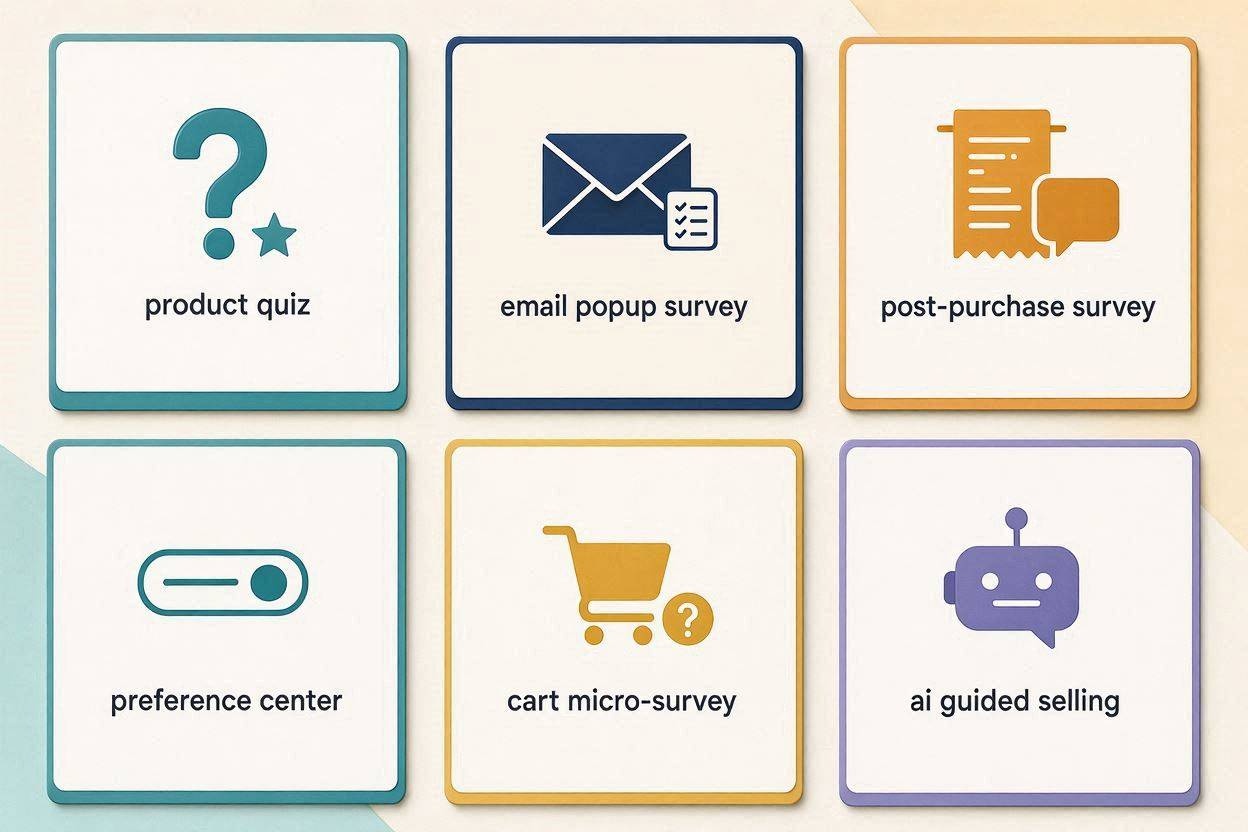
1. Product Recommendation Quizzes
The product quiz is the single most effective zero-party data collection mechanism available to Shopify merchants in 2026 — and the reason it works so well is that it disguises data collection as a service. The customer answers questions to receive a personalized recommendation. You receive rich preference data as a direct byproduct. Both parties get what they came for.
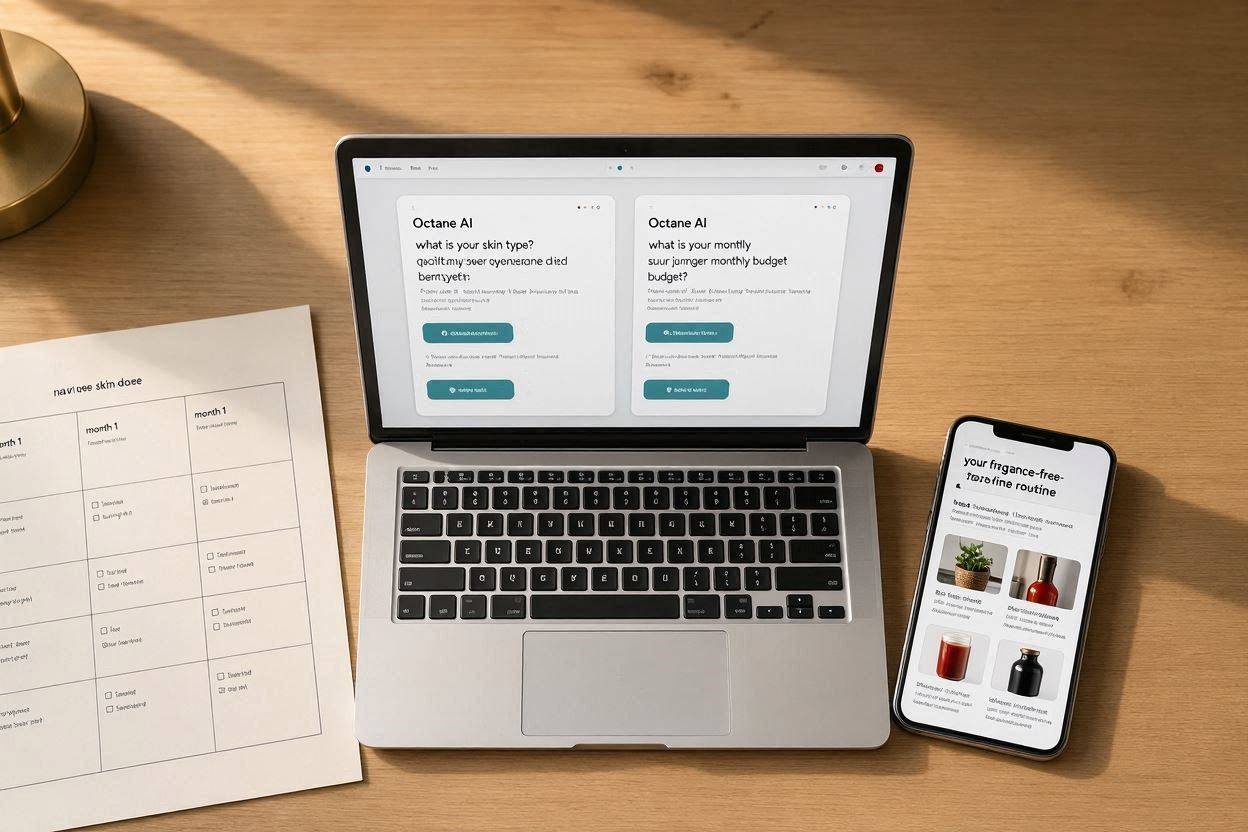
A skincare brand asking "What is your primary skin concern?" "Do you prefer fragrance-free formulas?" "What is your monthly skincare budget?" is not conducting a survey — it is guiding a customer toward the right product while simultaneously building the most valuable customer profile segment in its database.
The performance data on quizzes is consistently strong. Brands using Octane AI — the leading quiz platform for Shopify, used by more than 5,000 stores — report quiz conversion rates of 7 to 25%, dramatically higher than the 2 to 4% average ecommerce conversion rate. Product quizzes increase conversion rates by 10 to 30% compared to generic product pages, and quiz participants show significantly higher engagement across all downstream marketing channels.
The quiz data syncs directly from Octane AI into Klaviyo as subscriber profile properties, immediately enabling segmented email flows triggered by the specific answers provided. A customer who identified as having sensitive skin gets a welcome flow featuring fragrance-free products. A customer who indicated they are shopping for a gift gets a gift guide sequence. The personalization happens automatically once the data is mapped correctly.
Alternative quiz platforms worth considering for Shopify include Typeform, which integrates with over 300 tools and offers conversational conditional logic, and Digioh, which combines quiz functionality with preference center management and native Klaviyo mapping.
2. Multi-Step Email Signup Popups
The email signup popup is one of the highest-intent moments in a customer's first visit to your store. A visitor who is willing to exchange their email address for a discount has already signaled significant purchase intent — and that moment of peak willingness is the ideal time to collect zero-party preference data alongside the email.
A multi-step popup that asks three to five intent questions after the initial email submission collects zero-party data at near-100% response rates, because the customer has already committed to the exchange. The questions that reveal the most useful data are not demographic but motivational: "Who are you shopping for?" "What are you most interested in?" "What matters most to you when choosing this type of product?" "When are you planning to purchase?"
The timing question in particular is exceptionally valuable for segmenting your welcome flow by urgency. A customer who answers "I am ready to buy now" gets a different email sequence than one who answers "I am just researching." The former gets a shorter, more direct flow with a single clear call to action. The latter gets a longer educational sequence that builds toward purchase over several touches.
This setup requires no CDP and no data science team. The popup form is the collection layer. The data lands in Klaviyo as subscriber properties. Start using it to personalize your welcome flow within two weeks of launch.
3. Post-Purchase Surveys
The moment immediately after a completed purchase is one of the most underused zero-party data collection opportunities in Shopify ecommerce. A customer who just bought from you is at peak satisfaction and engagement — and they are typically willing to share information that helps you understand why they bought, how they found you, and what they are planning to buy next.
A single post-purchase survey question embedded in your order confirmation email or thank-you page delivers significant insight at minimal friction. The most valuable single question for most Shopify stores is attribution: "How did you hear about us?" The answers consistently reveal that customers came from channels your analytics platform is not crediting — word of mouth, podcast recommendations, offline channels, or organic social that bypassed your tracking entirely.
Expand this to three or four questions over time: what made you decide to buy today, what are you planning to use the product for, would you like to hear about related products in a specific category? Each answer refines your understanding of a customer's purchase motivation in ways behavioral data simply cannot reveal.
Post-purchase surveys are also one of the safest zero-party data collection contexts from a trust perspective. The customer has already purchased and is satisfied — they are predisposed to engage positively with your brand rather than suspicious of your motives.
4. Preference Centers
A preference center is a dedicated page — typically linked from your email footer and your account profile — where customers can explicitly tell you how they want to be communicated with and what they are interested in hearing about.
At minimum, a preference center should allow customers to choose their email frequency, select the product categories they are interested in, specify whether they want to hear about sales and promotions, and update their size or other category-relevant preferences. More sophisticated implementations add shopping context — "I shop for myself / for my family / for gifts" — and content preferences — "I want product recommendations / educational content / behind-the-scenes brand updates."
Preference center data is the cleanest form of zero-party data because the customer is updating it with full knowledge of how it will be used. The data is explicitly consented, easily verifiable, and directly actionable in your email and SMS flows. Brands that implement preference centers see measurable reductions in unsubscribe rates because customers who manage their preferences stay opted in rather than unsubscribing from a frequency they find overwhelming.
5. Cart and Checkout Micro-Surveys
A single question at the cart or checkout stage — placed non-intrusively above or below the checkout button — captures zero-party data at the moment of highest purchase intent without disrupting the conversion flow.
The most commercially useful cart-stage question is intent clarification: "Are you shopping for yourself or as a gift?" This single data point enables meaningful segmentation downstream — gift buyers receive different post-purchase follow-up, different product recommendations, and different timing for their next communication than self-purchasers.
For fashion and apparel stores, checkout micro-surveys that capture size information — "What size did you order today?" — build a size profile that eliminates the sizing uncertainty driving return rates. For subscription products, a cart-stage question about usage frequency — "How often do you use this type of product?" — informs replenishment recommendation timing.
Keep cart-stage surveys to one question maximum. Multiple questions at checkout create friction and risk abandonment. One well-chosen question adds valuable data without impeding the purchase.
6. Conversational AI Chat and Guided Selling
The evolution beyond static quizzes is conversational AI — chatbots that conduct natural-language dialogues to understand customer needs in real time. Unlike a quiz with predetermined questions, an AI chat assistant adapts its questions based on previous answers, follows up on nuances, handles objections, and guides customers toward purchase decisions while simultaneously collecting zero-party data at each exchange.
For Shopify merchants, Gorgias AI and Tidio both offer conversational AI capabilities that collect customer preference data during support and shopping assistance interactions. The data generated through these conversations is rich, contextual, and directly tied to purchase motivation — making it more actionable than most structured survey formats.
The commercial ROI on guided selling chat is measurable. Brands that pair conversational data collection with their Shopify storefront see 12 to 23% conversion lifts from visitors who engage with the guided selling experience, because the personalized recommendation delivered at the end of the conversation is matched to the specific preferences the customer expressed during it.
How to Activate Zero-Party Data Across Your Shopify Marketing Stack
Collecting zero-party data is only the first step. The commercial value is realized when that data actively improves every communication you send. The activation map for most Shopify merchants looks like this:
Klaviyo is where zero-party data becomes email and SMS personalization. Quiz answers, preference center selections, and post-purchase survey responses should all sync to Klaviyo as custom profile properties. Once mapped, these properties enable conditional content blocks — email sections that show different products, offers, or messaging based on each subscriber's specific profile — and flow branching that sends subscribers down different email sequences based on their stated preferences.
Shopify customer metafields store zero-party data at the customer profile level, making it accessible to every app in your Shopify ecosystem — including support tools like Gorgias, loyalty programs like Smile.io, and product recommendation engines like Rebuy. When a customer contacts support, the agent can see their skin type, size, and product preferences before reading a single message. When a loyalty reward is triggered, it can suggest a product matched to their stated category interest rather than a generic bestseller.
Meta and Google ad platforms can use zero-party audience segments built from declared preferences to run targeting that does not depend on third-party behavioral data. A segment of customers who identified as gift shoppers can receive gift-focused creative during the holiday season. A segment who indicated they prefer premium products can be excluded from value-based messaging that would underperform with that audience. This preference-based audience segmentation is what zero-party data enables in paid media once the data is collected and structured correctly.
The Zero-Party Data Stack Worth Building in 2026
For most Shopify merchants, the zero-party data tech stack does not need to be complex. The following combination covers the vast majority of collection and activation use cases:
Octane AI handles quiz-based collection — the highest-intent, highest-response-rate collection surface — with native Klaviyo and Shopify integration. If your store sells products that lend themselves to "find your perfect match" recommendation logic, this is your foundational zero-party data tool.
Digioh or Formtoro handles popup forms with multi-step intent questions — collecting preference data alongside email addresses at the highest-intent moment of a first visit. Both integrate directly with Klaviyo and push data to subscriber profiles without additional configuration.
Klaviyo is the activation layer — where zero-party data is stored as profile properties and used to personalize email flows, SMS campaigns, and conditional content blocks. If you are not already on Klaviyo, the integration with Shopify is native and the setup time is minimal.
A post-purchase survey tool — KnoCommerce or Grapevine Post Purchase Survey — captures attribution data and purchase motivation immediately after conversion. This data feeds your understanding of which channels are actually driving customers versus which ones are claiming credit in your analytics.
Shopify customer metafields ensure zero-party data is stored at the customer profile level and shared across your entire Shopify app ecosystem. Most of the apps above support direct metafield syncing, meaning the data becomes accessible to support tools, loyalty programs, and product recommendation engines automatically.
Data Governance: Collecting With Trust
Zero-party data strategy is not just about collection mechanics — it is about maintaining the trust that makes customers willing to share in the first place.
Be explicit about how data will be used at the moment of collection. "We are asking about your skin type so we can send you products that actually work for you" is a value exchange statement that converts and builds trust simultaneously. Vague data collection prompts that do not explain the benefit to the customer generate lower response rates and higher distrust over time.
Store only what you will actively use. Collecting 20 data fields to use three of them creates unnecessary compliance risk and data management overhead. Identify the five to eight fields that most directly improve your personalization and marketing, collect those specifically, and review your schema quarterly to remove fields you are not activating.
Give customers easy control over their data. A preference center with a clear update and deletion option is both a trust signal and a compliance requirement under GDPR and PECR for merchants selling to EU and UK customers. Customers who can manage their own preferences are more likely to stay engaged with your brand than those who feel locked into a communication cadence they did not choose.
Write and publish a clear privacy policy that explains your zero-party data collection practices in plain language. Under the EU's Green Claims Directive and increasingly under US state-level privacy laws, transparency in data collection is not optional — it is a baseline requirement for selling to consumers in regulated markets.
What Your Zero-Party Data Strategy Should Look Like in 90 Days
The practical reality is that most Shopify merchants can build a functional zero-party data collection and activation system within 90 days without a dedicated data team.
Month one is collection setup. Install your quiz platform, configure the multi-step email popup with three to five intent questions, and set up a post-purchase survey on your order confirmation page. Map all collected data to Klaviyo profile properties. Do not try to activate it yet — let data accumulate.
Month two is activation. Build your first personalized email flow branch based on quiz or popup data. If quiz data reveals a segment of customers who prefer a specific product category, create a branched welcome flow that features that category. Measure the open rate, click rate, and conversion rate of the personalized branch against your standard welcome flow. The lift will give you the data you need to justify expanding personalization.
Month three is optimization and expansion. Review which zero-party data points are generating the highest engagement lifts. Add preference center functionality to your account page. Integrate your zero-party data with your paid media audiences. Begin building the case for expanding quiz functionality to additional product lines or customer segments.
By the end of month three, you will have a functioning zero-party data asset that improves every month as more customers contribute to it. Unlike third-party data that erodes as cookies disappear, zero-party data compounds in value as your collection grows and your activation becomes more sophisticated.
Final Thoughts
The brands that will win in 2026 and beyond are not the ones with the biggest ad budgets or the most sophisticated tracking infrastructure. They are the ones that have built direct, consented, data-rich relationships with their customers — relationships that no platform change, cookie deprecation, or privacy regulation can disrupt.
Zero-party data is the foundation of that relationship. It is the only data asset in ecommerce that gets better as privacy restrictions tighten — because while every other data source becomes less reliable in a cookieless world, data that customers gave you directly only becomes more valuable as alternatives disappear.
Every day spent chasing diminishing third-party signals is a day that could have been spent building an owned data asset that compounds in value over time. The collection infrastructure is accessible, the tools are affordable, and the competitive window is still open.
Start with one quiz. Ask three questions. Map the answers to Klaviyo. Send one personalized email. Measure the lift.
That is the entire entry point. Everything else is an optimization built on top of it.
Need help building a zero-party data collection strategy for your Shopify store, or want an expert to set up your quiz funnels and Klaviyo personalization flows? Get in touch with EcomFixify — we specialize in Shopify development and ecommerce growth strategy for brands building for the long term.