
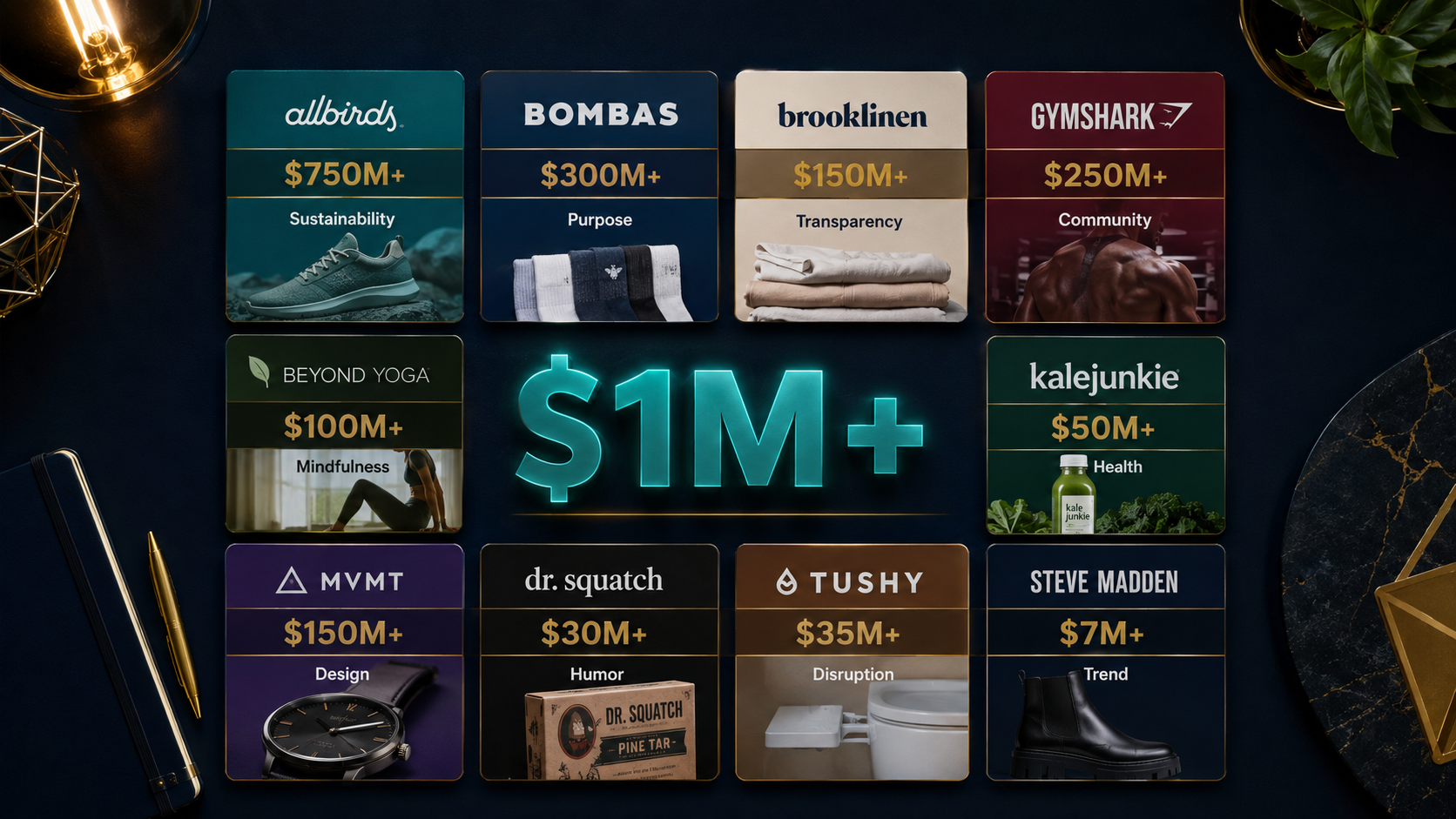
10 Shopify Stores Making Over $1 Million Per Year case study
Of the roughly 2.7 million Shopify stores active in 2026, approximately 45,000 have reached Shopify Plus status — the platform's enterprise tier, widely used as a proxy for stores generating $1 million or more in annual revenue. That is roughly 2% of all stores breaking seven figures. 10 Shopify Stores Making Over $1 Million Per Year case study
The question worth asking is not why so few reach that milestone. It is what specifically the ones who do reach it are doing differently from the 98% who do not.
The answer is not a single strategy or a single product category. The million-dollar Shopify stores in 2026 operate across wildly different niches — footwear, supplements, activewear, food, beauty, and home goods. What they share is not a category or a channel. It is a set of principles that show up consistently across every brand that reaches and sustains that revenue level: strong brand identity, investment in customer lifetime value over single-transaction optimization, multi-channel presence with owned data at the center, and an obsessive focus on product quality and customer experience.
This guide breaks down ten of the most instructive Shopify success stories — their revenue, their key strategies, and the specific lessons that apply to stores at every stage of growth.
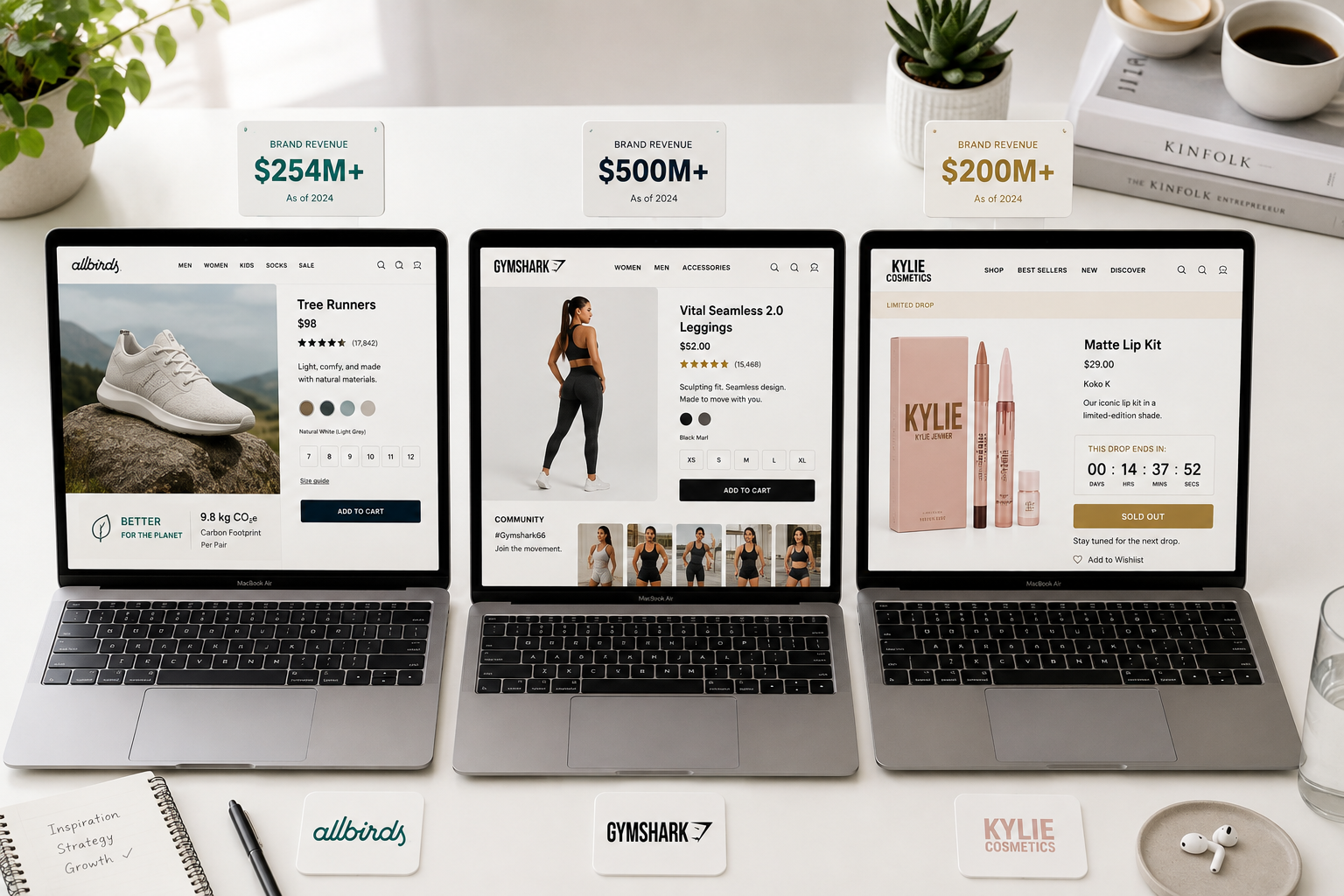
1. Gymshark — $500M+ Revenue | Community Before Advertising
Gymshark is the most studied Shopify success story in the activewear category, and for good reason. The brand was founded in 2012 by Ben Francis in a garage in Birmingham, UK, and by 2026 generates over $500 million in annual revenue with a brand valuation exceeding $1.3 billion.
What makes Gymshark instructive is not what it spent on advertising. It is what it did before it had a budget for advertising. The brand grew through influencer marketing before it was a mainstream strategy — partnering with fitness YouTubers and Instagram creators who genuinely used and believed in the products. The critical distinction was authenticity: Gymshark sent products to creators who fit the brand's values rather than buying reach from the largest accounts available. The creators' audiences trusted their recommendations because those recommendations were genuine.
The community-first model that early influencer strategy created has become the defining structural advantage of the Gymshark brand. By 2026, the Gymshark community — athletes, gym-goers, and fitness enthusiasts who identify with the brand rather than simply buying from it — functions as an organic acquisition and retention engine that no paid media budget can fully replicate. Limited product drops that create genuine scarcity and urgency, athlete ambassador partnerships at every tier from micro to elite, and a product quality standard in the affordable activewear space that has never been compromised despite enormous scale are the pillars that sustain the revenue.
The lesson for early-stage Shopify merchants: community is not a later-stage strategy. It is the strategy. Building genuine relationships with a specific audience before you have a marketing budget is more durable than buying reach once you do.
2. Allbirds — $254M+ Revenue | Transparency as Competitive Advantage
Allbirds launched on Shopify in 2016 with a single product — a wool running shoe — and a brand thesis that radical material transparency and environmental commitment could differentiate in the saturated footwear market. By 2026, the brand generates over $254 million in annual revenue across direct-to-consumer and retail channels.
The specific practice that most distinguishes Allbirds from other sustainable footwear brands is carbon footprint disclosure. Every Allbirds product page displays its CO2 footprint in grams per pair — not a vague sustainability claim or a marketing statement about environmental commitment, but a specific, audited number that represents the brand's actual manufacturing and logistics impact. The 2024 footprint for their most popular runner was 7.08 kg CO2e.
That level of specificity is what converts sustainability from a marketing claim into a trust-building differentiator. Consumers in 2026 have become sophisticated at identifying greenwashing. A specific number is credible in a way that aspirational language never can be.
The lesson: in a market where consumers are increasingly skeptical of brand claims, specificity builds trust more effectively than positioning. Whatever makes your brand different — your sourcing, your craftsmanship, your impact — quantify it and publish the number prominently.
3. Bombas — $300M+ Revenue | Mission-Driven Business Model
Bombas built an entire business model around a single social mission: for every pair of socks purchased, the brand donates a pair to homeless shelters. By early 2026, the brand had donated over 160 million items across socks, underwear, and t-shirts — a figure that appears on the Bombas homepage in real time as a running counter.
The mission is not a marketing afterthought. It is the structural reason the brand exists and the primary driver of customer loyalty that generates Bombas' industry-leading repeat purchase rate. Customers who buy Bombas are not just buying socks. They are participating in a giving model they believe in — and that participation creates emotional attachment to the brand that price competition from commoditized alternatives cannot disrupt.
Bombas generates over $300 million annually on Shopify, despite selling products — socks, underwear, t-shirts — in one of the most commoditized categories in consumer goods. The premium pricing the brand commands — Bombas socks cost two to four times more than comparable commodity alternatives — is entirely attributable to the brand's mission and the product quality that gives customers a reason to pay it.
The lesson: a genuine mission that is operationally embedded in the business model — not attached to it as a marketing layer — creates customer loyalty that price-based competition cannot erode.
4. Kettle and Fire — $100M+ Revenue | Content-First Category Creation
Kettle and Fire did not enter an existing product category. They created one. When founder Justin Mares launched the brand in 2015, premium bone broth was not an established consumer product. It was a wellness concept discussed in nutrition blogs and paleo community forums.
The strategy that took Kettle and Fire to over $100 million in annual revenue was content-first category creation — publishing educational content that taught consumers what bone broth is, why it matters for health, and how to incorporate it into daily routines before attempting to sell it to them. By the time a consumer reached the Kettle and Fire product page, they had already been educated by the brand's content, already associated Kettle and Fire with category authority, and were arriving with pre-existing purchase intent.
By 2026, Kettle and Fire ranks for hundreds of health and nutrition-related search keywords that generate organic traffic with zero paid acquisition cost. Their podcast sponsorship strategy in the early years — running ads on health, fitness, and nutrition podcasts before podcast advertising became competitive — built brand awareness at a cost per acquisition dramatically below what the same reach would cost on Meta or Google today.
The lesson: being the brand that educates the market on a category you are creating is a structural advantage that competitors entering the same category later cannot easily replicate. First-mover content authority compounds in value every year.
5. SKIMS — $750M+ Revenue | Product Innovation Meets Cultural Relevance
SKIMS launched on Shopify in 2019 and reached $750 million in annual revenue by 2023, with continued growth through 2026 driven by category expansion from shapewear into loungewear, swimwear, and now performance activewear. The brand's founding by Kim Kardashian gave it immediate cultural visibility — but the $750 million revenue figure is not explained by celebrity founding. It is explained by product innovation and size inclusivity that addressed genuine gaps in the shapewear market.
SKIMS launched with 10 shades across all products — a direct response to the industry's historical failure to serve women with deeper skin tones. The inclusive shade range was not a diversity marketing initiative. It was a product development decision that opened market segments that competitors had ignored and generated genuine word-of-mouth from customers who had never previously found shapewear that worked for them.
The brand's product page execution is among the most studied in DTC ecommerce. Emotional benefit language that describes how the customer will feel wearing the product precedes technical specifications. Model imagery represents a genuine range of body types rather than a single standard size. The checkout experience is optimized for the mobile shopper — the brand's primary audience — with express payment options prominent above the fold.
The lesson: product inclusivity is not just an ethical choice. It is a market expansion strategy that opens revenue opportunities your competitors have left unaddressed. Designing for the customer who has historically been underserved generates loyalty from an audience with nowhere else to go.
6. Chubbies — $40M+ Revenue | Brand Voice as the Product
Chubbies sells short shorts for men. On paper, that is a product category with limited differentiation potential. In execution, Chubbies has turned brand voice, community, and content into a differentiation moat that conventional competitors in the shorts category cannot replicate.
The brand's product descriptions are entertainment. The email marketing generates genuine laughter. The social content builds community around the idea of the weekend as a lifestyle rather than around shorts as a product. Chubbies generates approximately $40 million annually from a product that any manufacturer can produce — the margin premium comes entirely from the brand that surrounds it.
What Chubbies demonstrates is that brand voice — the specific personality and perspective through which a brand communicates — is a competitive asset that is genuinely difficult to copy. Any brand can produce similar shorts. No brand can authentically replicate the 12 years of consistent voice and community that makes Chubbies customers loyal to the brand rather than the product.
The lesson: your brand's voice is a product feature. If your Shopify store communicates in generic, interchangeable language, you are competing on price and product spec. A genuine, consistent, specific brand voice is a moat.
7. Firebelly Tea — Growing Rapidly | Subscription-First From Day One
Firebelly Tea, co-founded by Harley Finkelstein — Shopify's own President — is a case study in building a DTC brand with subscription-first economics from launch rather than adding subscriptions as an afterthought once one-time sales are established.
The brand positions every product with a subscribe-and-save offer as the default purchase option rather than the alternative. The content strategy is educational — teaching customers about tea sourcing, brewing methods, and flavor profiles in ways that deepen their relationship with the category and the brand simultaneously. The result is a customer base that returns not just for the product but for the expertise the brand provides.
Firebelly's rapid revenue growth in 2026 is built on the compounding math of subscription commerce: every subscriber acquired reduces dependency on continuous new customer acquisition, and the education-forward content strategy drives discovery through organic search and social content that does not require paid media to sustain.
The lesson: making subscription the default rather than the add-on changes the entire economics of customer acquisition. When the first purchase is a subscription rather than a one-time transaction, the CAC-to-LTV ratio improves from day one.
8. Princess Polly — $300M+ Revenue | Returns as Retention
Princess Polly is an Australian fast-fashion brand that expanded to the US market through Shopify and by 2026 generates over $300 million in annual revenue. The brand is studied most frequently in operations circles — not for its product strategy, which is comparable to other fast-fashion DTC brands — but for its returns management innovation.
Princess Polly integrated Loop Returns to allow customers to shop during the return flow with their return credit — selecting a replacement product from the store before the original return was even received. The implementation added $1.23 in average upsell per return and reduced out-of-stock rates by 55% year over year because the exchange flow helped balance demand across the catalog.
The operational insight behind this strategy is profound: a customer who is returning is still a customer with intent to own something from your store. Designing the return experience to redirect that intent toward an exchange rather than a refund retains both the revenue and the customer relationship — turning what would have been a net-negative interaction into a net-positive one.
The lesson: operations are a competitive advantage. A brand that processes returns faster, more generously, and more intelligently than its competitors builds loyalty from the interaction most brands treat as a cost center.
9. Beardbrand — $7M+ Revenue | Niche Authority at Premium Price
Beardbrand is one of the most instructive Shopify success stories for independent merchants because it demonstrates what is achievable in a niche that sounds narrow — beard care products for men — without venture funding, celebrity founders, or mass-market positioning.
The brand was founded by Eric Bandholz in 2012, grew to $7 million in annual revenue on Shopify, and has sustained that revenue with a team of fewer than 20 people by maintaining category authority rather than chasing growth at the expense of brand integrity. Beardbrand content — blog posts, YouTube videos, and email newsletters covering beard care, grooming, and men's style — ranks for the specific search terms that its target customer uses, driving organic acquisition at effectively zero marginal cost.
The premium pricing — Beardbrand products cost significantly more than drugstore alternatives — is justified by the brand's authority positioning, the quality of its formulations, and the customer experience that surrounds the product. A Beardbrand customer is not buying beard oil. They are buying expertise, community, and a brand that understands their specific grooming identity.
The lesson: niche authority at premium pricing is a more sustainable business model than broad market share at commodity pricing. A smaller audience that is genuinely loyal, pays premium prices, and refers their peers is more valuable than a large audience with thin margins and high churn.
10. Kylie Cosmetics — $200M+ Revenue | Scarcity and Community at Scale
Kylie Cosmetics launched in 2015 with 15,000 lip kits that sold out in under a minute. By 2026, the brand generates over $200 million in annual revenue on Shopify, having demonstrated that limited-drop product launches — when executed with genuine scarcity rather than manufactured urgency — create demand that conventional always-available retail cannot replicate.
The limited-drop model works on three psychological levers simultaneously: scarcity makes each product feel more valuable than its price suggests, urgency forces a purchase decision that browsing shoppers would otherwise defer indefinitely, and the community of buyers who secured a limited drop feel a sense of achievement that deepens their attachment to the brand.
Kylie Cosmetics executes the technical side of limited drops with precision. The Shopify infrastructure handles the traffic spikes that drops generate without performance degradation. The email and SMS pre-launch sequences build anticipation in the hours and days before each drop. The sold-out status of past drops is prominently displayed as proof of demand.
The lesson: artificial scarcity erodes trust. Real scarcity — genuinely limited inventory released on a predictable schedule to a community that anticipates each drop — creates demand and loyalty that always-available retail cannot generate.
The 7 Patterns Every Million-Dollar Shopify Store Shares
Across these ten stores — spanning categories, price points, and founding stories — seven strategic patterns appear consistently enough to represent the operating principles of million-dollar Shopify commerce in 2026.
Brand identity that is specific and defensible. Every store on this list has a clear, specific brand positioning that cannot be easily replicated. Gymshark owns athletic community. Allbirds owns carbon transparency. Chubbies owns weekend culture. Vague positioning is the most common failure mode of stores that plateau below seven figures.
Customer lifetime value over transaction value. Every store on this list measures and optimizes for how much a customer spends across their entire relationship with the brand — not just the first order. Subscription models, loyalty programs, post-purchase sequences, and community building all serve the same goal: maximizing the total revenue generated per acquired customer.
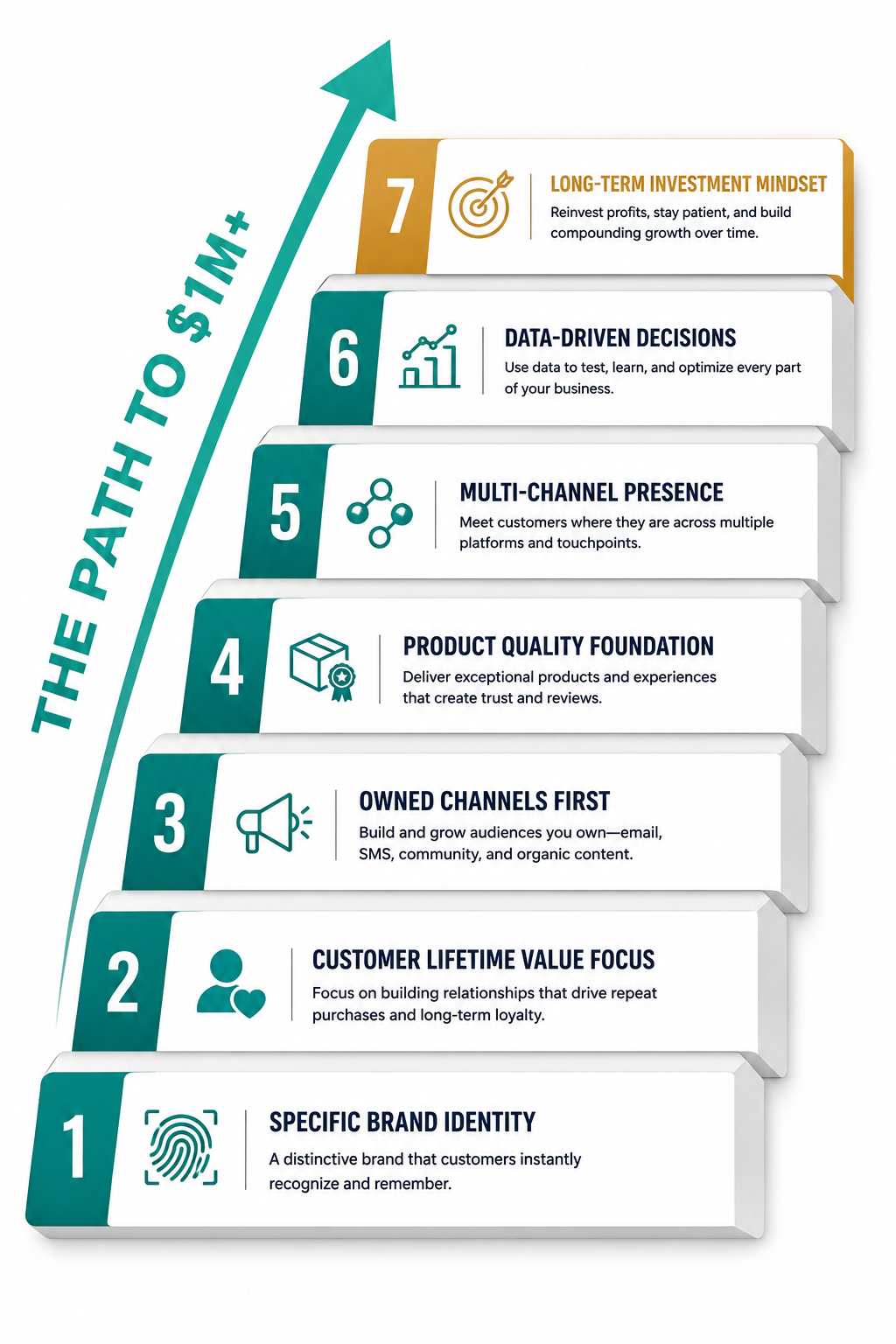
Owned channels at the center of growth. Email lists, SMS subscribers, community members, and loyalty program participants are the assets that every store on this list invested in earliest and most consistently. Rented audiences on platforms change with algorithm updates. Owned audiences compound in value regardless of platform changes.
Product quality that justifies the brand story. Every store on this list sells a genuinely good product. Brand strategy amplifies product quality — it does not substitute for it. The brands that tried to use community and content to sell mediocre products at premium prices did not make this list because they did not sustain $1 million in annual revenue.
Multi-channel presence with Shopify as the hub. Every store on this list sells across multiple channels — owned DTC store, retail partnerships, marketplaces, and social commerce — but uses Shopify as the operational and data hub that connects them. Channel diversification reduces dependency on any single traffic source while the owned channel generates the margin and data that fuel growth.
Data-driven decision making at every stage. The stores generating $1 million or more in annual revenue are not running their businesses on intuition. They are tracking conversion rate by device, revenue per email subscriber, repeat purchase rate by cohort, and customer acquisition cost by channel — and making investment decisions based on what the numbers show.
Willingness to invest in the long term. Every store on this list made investments — in content, community, product quality, and operational infrastructure — that did not pay off in the first month or the first quarter. The compounding returns on those investments are exactly why the stores that made them are generating seven figures and the ones that did not are still stuck below $10,000 per month.
What This Means for Your Shopify Store Right Now
The gap between where most Shopify stores operate and where the stores on this list operate is not primarily a gap in budget, technology, or product category. It is a gap in strategic clarity and operational discipline.
You do not need $500 million in revenue to implement community-first marketing. Gymshark started it with no budget. You do not need celebrity backing to build a mission-driven brand. Bombas built theirs with product design and operational commitment. You do not need venture funding to build content authority in a niche. Kettle and Fire built theirs with consistent publishing over several years.
What you need is a clear answer to the same question every store on this list answered before reaching seven figures: why should a customer buy from us instead of anyone else? Not a generic answer about quality and service. A specific, defensible, true answer that reflects a genuine advantage your brand has built and a genuine connection your brand has formed with a specific audience.
The stores that cannot answer that question clearly are the 98% that never reach $1 million. The ones that can — and build operations, marketing, and product strategy in service of that answer — are the 2% that do.
Want to build the operational and marketing foundation that gives your Shopify store a genuine path to seven figures? Get in touch with EcomFixify — we specialize in Shopify development and ecommerce growth strategy for brands ready to scale.